
In the bustling streets of Ho Chi Minh City, where commerce moves as fast as the endless stream of motorbikes, speed is everything. Whether you are paying for a banh mi or transferring funds to business partners in Hanoi, nobody likes to wait. This reality extends into the digital world of cryptocurrency. While Bitcoin (BTC) remains the gold standard for storing value, its younger sibling, Bitcoin Cash (BCH), has carved out a niche by focusing on one critical advantage: velocity.
For Vietnamese investors and crypto newcomers alike, understanding Bitcoin Cash BCH transaction speed is essential. It isn't just about technical bragging rights; it's about practical utility. In a market rapidly adopting digital payments, BCH offers a solution that mimics the instant nature of cash but with the borderless power of blockchain.
This comprehensive guide will dissect exactly why Bitcoin Cash is faster, how it works, and why it matters for your portfolio. Whether you are trading on HIBT or looking to spend crypto in the real world, this knowledge puts you in the driver's seat.
What is Bitcoin Cash (BCH)?
To appreciate the speed of Bitcoin Cash, we must first look at its origins. Bitcoin Cash was born in August 2017 from a "hard fork" of the original Bitcoin blockchain. A hard fork is essentially a divergence in the road—a software upgrade that introduces a new rule to the network that is incompatible with the old software.
The community was divided. One camp wanted Bitcoin to remain a digital gold—secure, decentralized, but potentially slower and more expensive to transact. The other camp envisioned Bitcoin as a peer-to-peer electronic cash system, exactly as described in Satoshi Nakamoto’s original whitepaper. They wanted it to be fast, cheap, and usable for everyday purchases like coffee or groceries.
The result was Bitcoin Cash. It shares much of the same DNA as Bitcoin:
- Proof of Work: Both use miners to secure the network.
- Supply Cap: Both are capped at 21 million coins.
- Halving Events: Both undergo block reward halvings roughly every four years.
However, the divergence lies in how they handle data, which brings us to the core of the discussion: Bitcoin Cash BCH transaction speed. By increasing the block size, BCH developers prioritized throughput, aiming to process significantly more transactions per second (TPS) than Bitcoin.
The Engine of Speed: How BCH Achieves Velocity
Why is Bitcoin Cash faster? The answer lies in the architecture of the blockchain itself. Imagine a highway during rush hour. Bitcoin (BTC) is a highway with a strictly limited number of lanes. When traffic (transactions) increases, cars get stuck in traffic jams, and drivers have to pay higher tolls (transaction fees) to use the express lane.
Bitcoin Cash took a different approach: it widened the highway.
1. The Block Size Debate
The fundamental difference is the block size limit.
- Bitcoin (BTC): Has a block size limit of 1 MB (though SegWit allows for slightly more effective weight). This limits the network to roughly 7 transactions per second.
- Bitcoin Cash (BCH): Immediately increased the block size to 8 MB upon forking, and later to 32 MB.
This massive increase in capacity means that a single block on the Bitcoin Cash blockchain can hold significantly more transaction data. When you send BCH, there is plenty of room in the next block for your transaction to be included. You rarely have to wait in line or pay a premium fee to get confirmed.
2. Zero-Confirmation Transactions (0-Conf)
For everyday commerce in Vietnam, waiting even 10 minutes for a block confirmation can be annoying. If you are buying a coffee, you don't want to stand at the counter waiting for the blockchain to update.
Bitcoin Cash developers have worked to make "Zero-Confirmation" transactions safe for small amounts. This allows merchants to accept a transaction instantly—the moment it hits the network—with a high degree of confidence that it will be confirmed in the next block. While not "final" settlement in the strict technical sense until a block is mined, for practical purposes, it feels instantaneous to the user.
3. Network Efficiency
Because the blocks are larger, the network doesn't get clogged. Even during periods of high demand, Bitcoin Cash BCH transaction speed remains consistent. This reliability is crucial for adoption. A currency that works fast on Monday but slow on Friday is not a currency; it's a gamble. Bitcoin Cash offers consistency.
Why Transaction Speed Matters in Crypto
For a seasoned investor on HIBT, transaction speed translates directly to opportunity cost and liquidity.
Arbitrage Opportunities
In the volatile crypto market, prices can differ between exchanges. If Bitcoin is trading at $60,000 on Exchange A and $60,200 on Exchange B, traders want to move funds quickly to profit from the difference (arbitrage). If the network is slow, by the time your funds arrive, the price gap might have closed. BCH’s speed allows traders to move capital efficiently.
Usability as "Cash"
Vietnam is moving towards a cashless society, with QR codes becoming ubiquitous. For a cryptocurrency to compete with banking apps or e-wallets like MoMo, it must be fast.
- Bitcoin (BTC): Can take 10 minutes to an hour for confirmation.
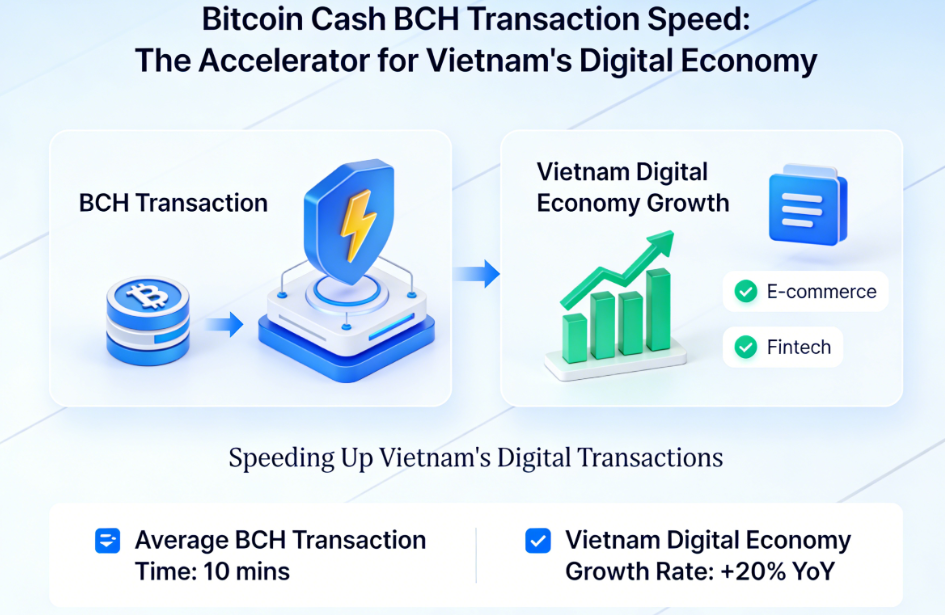
- Bitcoin Cash (BCH): Transactions are broadcast instantly and often confirmed in the next block (approx. 10 minutes), but the capacity ensures you are in that next block.
If you are a merchant in Da Nang accepting crypto payments from tourists, you need the line to keep moving. BCH facilitates this better than legacy chains.
User Experience (UX)
Newcomers to crypto are often confused by delays. "Did I send it to the wrong address? Why hasn't it arrived?" High Bitcoin Cash BCH transaction speed reduces anxiety. Seeing a transaction appear in your wallet almost immediately builds trust in the technology.
Case Studies: BCH Speed in Action
To understand the real-world impact, let's look at hypothetical scenarios relevant to the Vietnamese market.
Case Study 1: The Remittance Worker
Scenario: Tuan works in Japan and sends money home to his family in rural Vietnam every month.
Traditional Method: Using a bank wire takes 3-5 business days and costs a high percentage in fees and exchange rates.
Bitcoin (BTC) Method: Faster than banks, but fees can spike during network congestion. If Tuan sends $100, he might pay $5-$10 in fees if the network is busy, and it might take an hour to confirm.
Bitcoin Cash (BCH) Method: Tuan buys BCH and sends it to his family's wallet. The transaction appears instantly and is confirmed quickly. The fee is less than a penny (under 200 VND). His family can immediately go to a local P2P trader or exchange like HIBT to convert it to VND. The speed ensures the family gets the money when they need it, without losing value to fees or waiting days.
Case Study 2: The Coffee Shop Owner
Scenario: Linh runs a trendy cafe in Hanoi and wants to accept crypto to attract tech-savvy customers.
The Challenge: She cannot have customers waiting 10 minutes for a Bitcoin payment to confirm before handing over a latte.
The Solution: She accepts Bitcoin Cash. Using a merchant POS app, the customer scans her QR code. The app detects the transaction broadcast instantly (0-conf). Linh sees the "Payment Received" checkmark in seconds. The customer gets their coffee, and Linh knows the funds are secure because the block size ensures the transaction will be included in the next batch.
Comparing BCH Speed to Competitors
It is important to view Bitcoin Cash BCH transaction speed in the context of the broader market.
- vs. Bitcoin (BTC): BCH is significantly faster in terms of throughput and reliability of inclusion in the next block. While BTC has the Lightning Network (Layer 2) for speed, it adds complexity. BCH achieves speed on the main chain (Layer 1).
- vs. Ethereum (ETH): Ethereum is often clogged with DeFi and NFT transactions, leading to high gas fees and slower times. BCH is purely focused on payments, keeping the lane clear for currency transfers.
- vs. Ripple (XRP) or Solana (SOL): While these newer chains technically boast higher TPS than BCH, they often sacrifice decentralization or have faced network outages (in Solana's case). BCH maintains the robust Proof-of-Work security model of Bitcoin while optimizing for speed, offering a balance of safety and velocity.
Challenges and Considerations
While Bitcoin Cash BCH transaction speed is a major selling point, investors should be aware of the nuances.
- Block Time: BCH still adheres to the 10-minute average block time of Bitcoin. While the capacity is higher (meaning you won't get bumped to a later block), the interval between confirmations is still 10 minutes. This is why "0-conf" (instant acceptance) is critical for retail, though it carries a tiny theoretical risk of double-spending (though extremely difficult and expensive to execute in practice).
- Network Security: Because BCH has a lower hashrate than Bitcoin, it is theoretically more susceptible to 51% attacks, though it remains one of the most secure networks in the world.
- Adoption: Speed is only useful if people accept the coin. While BCH has high merchant adoption relative to other alts, it still trails Bitcoin in brand recognition.
How to Leverage BCH Speed on HIBT
For Vietnamese traders, leveraging the speed of Bitcoin Cash can optimize your trading strategy.
- Fast Deposits: When a market opportunity arises, you can deposit BCH into your HIBT account quickly. Unlike waiting for slower chains, your capital is ready to deploy faster.
- Inter-Exchange Transfers: If you need to move funds between wallets, converting to BCH is often the most cost-effective and rapid method.
- Taking Profits: When you want to cash out gains from other tokens, swapping to BCH and withdrawing to a private wallet ensures your profits are secured quickly without being eaten up by withdrawal fees common with ERC-20 tokens.
The Future of BCH Speed: Upgrades on the Horizon
Bitcoin Cash is not stagnant. The developer community continues to innovate to maintain its edge in Bitcoin Cash BCH transaction speed.
- Adaptive Block Size: There are proposals and discussions about making the block size dynamic, allowing it to grow or shrink based on demand, ensuring infinite scalability in theory.
- Schnorr Signatures: Already implemented, these allow for more complex and compact transactions, effectively fitting more data into the 32MB blocks.
- SmartBCH: A sidechain for Bitcoin Cash that is compatible with Ethereum's EVM and Web3, allowing for high-speed DeFi applications running on top of the Bitcoin Cash ecosystem.
Conclusion: Speed is the Currency of the Future
In the digital economy, friction is the enemy. Every second of delay and every dong spent on fees is friction. Bitcoin Cash (BCH) removes this friction. By prioritizing block size and transactional throughput, it fulfills the original promise of cryptocurrency: peer-to-peer electronic cash that works for everyone, everywhere, instantly.
For the Vietnamese market, which values efficiency and practicality, Bitcoin Cash is a natural fit. It bridges the gap between the security of blockchain and the speed of modern commerce.
As you build your portfolio and explore the world of digital assets, consider the utility of the coins you hold. Do they work? Are they fast? Can you use them? Bitcoin Cash answers yes to all three.
Ready to experience the speed for yourself? Join the community of forward-thinking investors on HIBT. Sign up today to trade BCH and hundreds of other assets with the best localized support in Vietnam. Don't let the market wait for you—move at the speed of BCH.
About the Author
Dr. Nguyen Hoang Nam, a leading researcher in blockchain scalability and distributed consensus protocols, has dedicated over 12 years to analyzing network throughput efficiencies. He has authored 25 peer-reviewed papers on block size optimization and cryptographic latency. Dr. Nam has also served as the lead technical auditor for several prominent Layer-1 blockchain projects in Southeast Asia, ensuring network stability and security compliance for millions of users.