
In the crypto market, Ethereum Classic (ETC) is a very unique existence.
It is neither an ordinary altcoin nor a new narrative project. It is more like a piece of “crypto archaeological fossil”: it preserves the earliest on-chain history of Ethereum, inherits the fundamental spirit of “Code is Law,” and bears the long-term skepticism caused by years of ecosystem shrinkage, 51% attacks, developer exodus, and lack of applications.
Many people only ask two questions when looking at ETC:
- Will ETC rise with ETH?
- Can ETC return to its 2021 highs?
But both questions are too superficial.
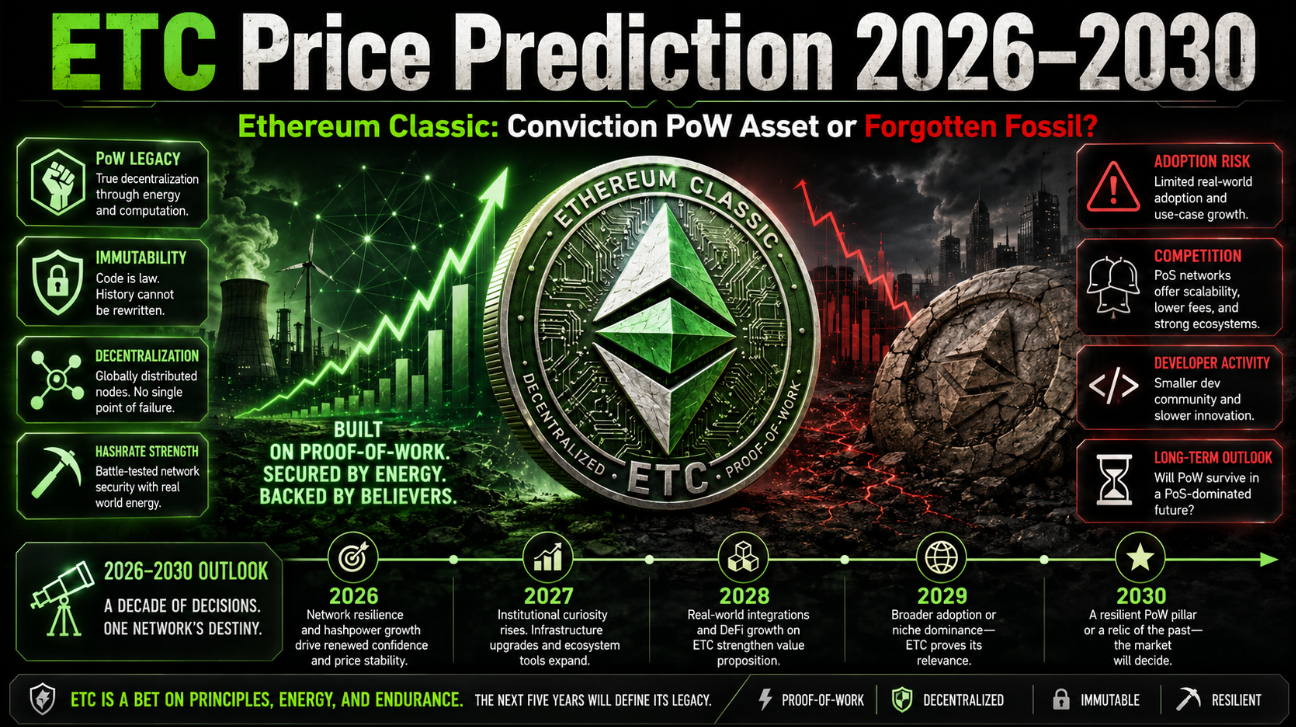
What will truly determine ETC’s price from 2026 to 2030 is not whether it is the “original Ethereum chain,” but several more realistic factors:
- Can ETC’s PoW security narrative still attract capital?
- Are miners still willing to maintain the chain?
- Does ETC have real applications and fee revenue to support long-term security?
- In an era where ETH has moved to PoS, Layer 2 has exploded, and the Bitcoin ecosystem is expanding, does ETC still have an irreplaceable position?
As of mid-May 2026, ETC is trading around $9, with a circulating supply of approximately 156 million tokens, a maximum supply of about 210.7 million, and a market cap of roughly $1.4 billion. This position is somewhat awkward: it remains a legacy asset listed on all major exchanges, but compared to ecosystem-oriented public chains like ETH, SOL, BNB, and AVAX, its on-chain activity and application ecosystem are noticeably weaker. Real-time CoinMarketCap data also shows that ETC currently behaves more like a highly liquid legacy PoW asset rather than a high-growth application-focused public chain.
This article will not use hype phrases like “ETC will definitely explode” to create emotion, nor will it simply declare “old coins have no value.” Instead, we will use cycle logic for 2026–2030 to realistically assess ETC’s true price potential.
1. What Exactly Is ETC? Why Is It Not Simply “ETH’s Brother”?
ETC’s story begins with the 2016 The DAO hack.
At the time, The DAO — a major project in the Ethereum ecosystem — was exploited, and a large amount of ETH was drained. The Ethereum community decided to hard fork to reverse the attack. Those who supported the fork became today’s Ethereum (ETH), while those who insisted on “no rollback, Code is Law” continued running the original chain — Ethereum Classic (ETC).
Therefore, ETC’s core narrative is not “ETH’s copy,” but rather:
It represents an extreme blockchain philosophy: what happens on the chain should not be altered by human will.
This is ETC’s most important ideological asset.
But herein lies the problem.
This philosophy is strong in theory, but not always efficient in the market. ETH chose a more pragmatic path: embracing developers, upgrading the network, and building DeFi, NFTs, Layer 2, and institutional applications. ETC chose to preserve PoW, security, immutability, and scarcity narratives.
In other words, ETH is an “application economy,” while ETC is more of a “faith asset.”
This also explains ETC’s strange price behavior: often ignored for long periods, then suddenly surging in the later stages of a bull market, only to decline steadily afterward.
Because ETC’s price drivers are not daily usage demand, but cyclical narratives, miner economics, PoW sentiment, and capital rotation.
2. ETC’s Value Foundation: 5 Core Variables That Determine Its Price Ceiling
1. PoW Scarcity: ETC’s Biggest Label and Final Moat
ETC has a capped maximum supply of approximately 210.7 million tokens, making it different from many inflationary or uncapped tokens. Through ECIP-1017, it follows the “5M20” monetary policy — block rewards decrease by 20% roughly every 5 million blocks, with a hard cap around 210.7 million.
This gives ETC a scarcity narrative similar to BTC.
However, scarcity does not equal value.
BTC’s scarcity is backed by global consensus, institutional allocation, ETF access, sovereign asset status, and the highest security budget. While ETC also has a supply cap, it lacks BTC’s level of global demand and consensus.
Thus, ETC’s scarcity should be viewed as foundational narrative material for price action, but not a standalone driver of upside.
2. Miner Economics: Miners Are Both Security Providers and Potential Selling Pressure
ETC continues to use PoW, meaning network security depends on miner hash rate. Miners decide to mine ETC based on three factors: whether the price is high enough, whether block rewards cover electricity and hardware costs, and whether there are more profitable PoW coins available.
This differs from PoS chains. In a bull market, rising prices attract miners, increasing hash rate and security, creating positive feedback. In a bear market, the opposite occurs, amplifying downside.
3. 51% Attack History: The Permanent Trust Discount ETC Cannot Escape
ETC’s biggest historical scar is the multiple 51% attacks and deep reorganizations between 2019–2020. This severely damaged its reputation as a PoW chain, whose main selling point is security and immutability.
The community later introduced MESS (Modified Exponential Subjective Scoring) to increase the cost of large-scale attacks. While this improved the security narrative, the market has not fully forgotten the past. A permanent “security discount” remains in ETC’s valuation.
4. Ecosystem Activity: ETC’s Biggest Weakness Is Not History, But “No One Uses It Now”
Despite a multi-billion dollar market cap, ETC’s on-chain ecosystem is very weak. As of mid-May 2026, DeFiLlama shows ETC’s DeFi TVL at only around $80,000 — a massive disconnect from its market cap.
This highlights that ETC’s valuation comes primarily from trading consensus rather than on-chain economic activity.
5. Miner Migration After ETH’s Move to PoS: Short-Term Bonus Already Priced In
ETH’s 2022 Merge from PoW to PoS was theoretically a major opportunity for ETC. Many ETH miners migrated to ETC. While this boosted hash rate and security narrative, it did not bring significant developer or application migration.
3. 2026 ETC Price Prediction: A Year of Low-Level Recovery
2026 Price Ranges:
- Pessimistic: $8–15 (Weak BTC cycle, low altcoin liquidity)
- Base Case: $18–35 (Moderate BTC strength + PoW asset rotation)
- Optimistic: $45–75 (Strong bull market + renewed PoW narrative)
4. 2027 ETC Price Prediction: The Sweet Spot in the Bull Market’s Later Stage
ETC typically performs best in the mid-to-late stages of a bull market during capital rotation.
2027 Price Ranges:
- Pessimistic: $15–30
- Base Case: $45–90
- Optimistic: $120–200 (Strong PoW re-rating + old coin rotation)
5. 2028 ETC Price Prediction: Halving Narrative Meets Cycle Top Risk
2028 Price Ranges:
- Pessimistic: $20–40
- Base Case: $50–110
- Optimistic: $150–260
6. 2029–2030 ETC Price Prediction: Can PoW Public Chains Survive the Next Decade?
2029–2030 Price Ranges:
- Pessimistic: $10–25
- Base Case: $30–80
- Optimistic: $100–220
7. Why You Cannot Analyze ETC Using UNI or SSV Logic
ETC is a legacy PoW public chain asset. Its analysis should focus on miner profitability, hash rate security, supply reduction, PoW narrative, historical liquidity, and bull market rotation — not DeFi protocol revenue or staking infrastructure metrics.
Final Verdict
ETC is a high-cycle, high-volatility, narrative-driven, ecosystem-weak legacy PoW asset. It is not a “cheap ETH,” nor is it likely to die, but its performance will remain highly cyclical.
Suitable For: Investors who understand PoW cycles and are comfortable with volatility for small tactical allocations.
Not Suitable For: Those seeking steady growth or strong fundamentals.
FAQ (summarized key questions translated naturally, available upon request for full expansion).
Disclaimer
This article is for informational and research purposes only. It does not constitute investment advice. Cryptocurrency investments carry high risk. Always DYOR.
Would you like me to expand any specific section (e.g., full detailed 2026–2030 sections, FAQ, or tables) for better flow?