
Introduction: Why Predicting ATOM Is More Difficult Than Most Altcoins
In the crypto market, many tokens simply follow BTC cycles and narrative hype. However, ATOM (the native token of Cosmos Hub) has a much more complex logic. It is not just another Layer-1 coin, but the “security leasing layer” and cross-chain Hub for the entire Cosmos ecosystem. Its price is deeply tied to whether Cosmos Hub can genuinely capture value from ecosystem growth, rather than relying solely on the widespread adoption of Cosmos SDK.
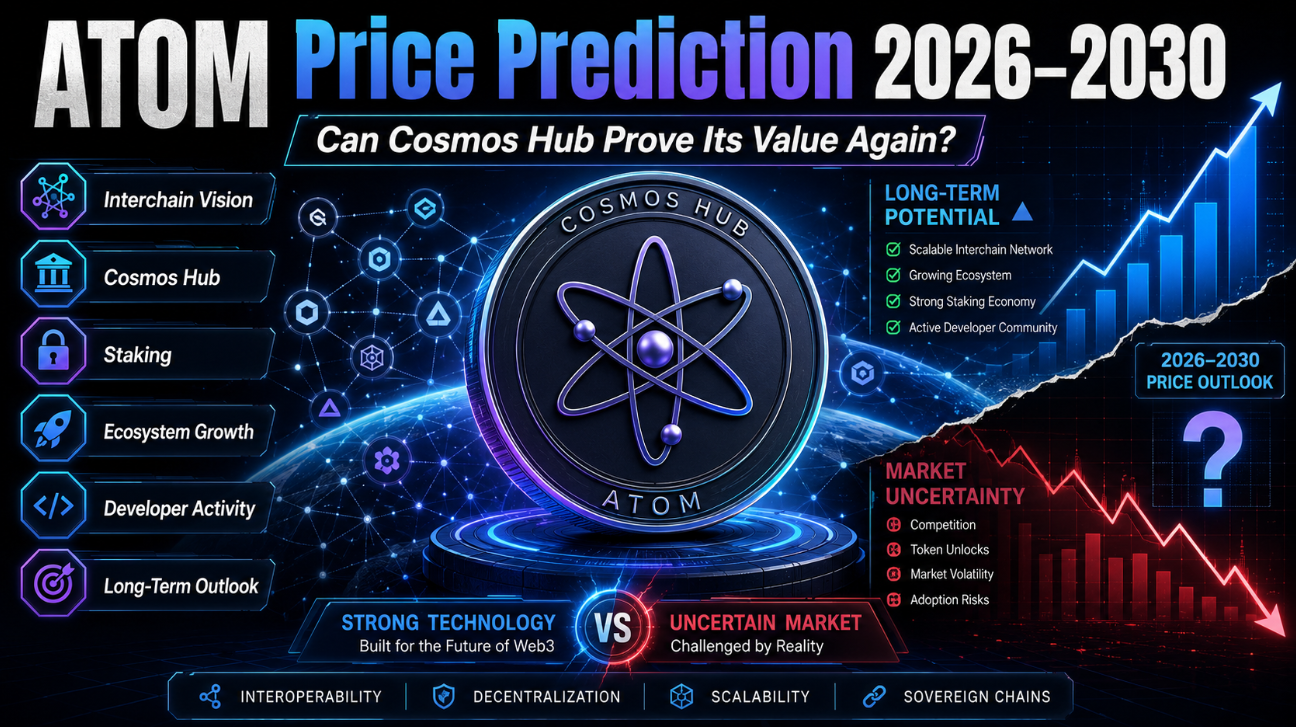
What Exactly Is ATOM?
ATOM is the native token of Cosmos Hub. Cosmos’ vision is to build the “Internet of Blockchains,” enabling seamless communication between sovereign chains through the IBC (Inter-Blockchain Communication) protocol. Investors must distinguish three concepts: the Cosmos ecosystem (many application chains), Cosmos Hub (the central hub), and the ATOM token. Ecosystem growth does not automatically translate into higher ATOM prices — the key is whether value actually flows back to ATOM stakers and the Hub.
Why Has ATOM Often Shown “Strong Ecosystem, Weak Price”?
Cosmos SDK has been widely adopted by projects like dYdX, Celestia, and Injective. IBC is also a major cross-chain infrastructure. However, many application chains have their own tokens and economic models, making it difficult for growth to directly convert into ATOM demand. This has created a classic “value capture dilemma” for ATOM.
ATOM and HIBT can be discussed within the same “value capture challenge” framework. Although they are different project types, both face similar issues — whether ecosystem activity and user growth can translate into sustained token demand. For platform tokens like HIBT, slowing platform traffic directly impacts price. For ATOM, if growth in Cosmos application chains fails to flow back effectively to the Hub, it results in the same situation: “strong ecosystem narrative, weak price performance.”
For reference: LINK Price Prediction 2026–2030 and TRB Price Prediction 2026–2030.
This article analyzes ATOM from six key dimensions — Cosmos Hub value capture, ATOM inflation and staking, IBC activity, Interchain Security (ICS) controversies, cross-chain competition, and BTC cycle correlation — to help readers rationally assess whether ATOM still has the opportunity to be re-priced by the market between 2026 and 2030.
1. ATOM’s Value Foundation — 5 Core Variables That Determine Its Price Ceiling
1.1 Variable 1: Can Cosmos Hub Remain the Center of the Ecosystem?
Early market expectations positioned Cosmos Hub as the main entry point for the ecosystem — the more chains connected, the higher ATOM’s value. In reality, many application chains are highly sovereign, and users often interact primarily with Osmosis, dYdX, etc., without directly relying on ATOM. The Hub must evolve from a “symbolic center” into an “economic center” that provides security, liquidity, routing, and fee capture to truly support ATOM’s valuation.
1.2 Variable 2: Interchain Security — From Narrative Upside to Controversial Variable
ICS was originally a major value capture pathway for ATOM: Hub validators provide security to consumer chains, which pay fees to ATOM stakers. It has since evolved into Partial Set Security (PSS), with some adoption. However, community discussions about weakening or halting new consumer chains persist. While ICS was once a key narrative, uncertainty remains heading into 2026 and it cannot be viewed as a guaranteed growth engine. Three possible scenarios: weakening (loss of narrative), partial retention (limited revenue), or upgrade (regaining premium).
1.3 Variable 3: ATOM Inflation and Staking Rewards — Real Yield or Internal Transfer?
Prop 848 reduced maximum inflation from 20% to 10%. Current staking APR is around 13%. Staking offsets some dilution, but rewards still include a large portion of newly issued tokens and are not entirely external real yield. Non-stakers are directly diluted. The 21-day unbonding period suits long-term holders but restricts liquidity during sharp drops, potentially creating delayed selling pressure. True valuation uplift comes from external revenue (consumer chain fees, MEV, etc.), not just lower inflation.
1.4 Variable 4: IBC Activity vs. DEX Volume — Which Better Represents ATOM’s Value?
IBC transfer count and volume reflect ecosystem activity (Osmosis DEX TVL and volume are important indicators). However, ATOM value capture depends on demand for ATOM trading pairs, staking ratio, and use as collateral. Ecosystem activity does not automatically equal ATOM demand growth.
1.5 Variable 5: Cross-Chain Competition Is Reshaping ATOM’s Valuation
ATOM faces strong competition from Ethereum L2s, LayerZero, Wormhole, Celestia, EigenLayer, and others. Cosmos’ advantages lie in sovereign chains and mature SDK; its disadvantages are fragmented value capture and complex narratives. The core market question is: if every application chain has its own economy, why hold ATOM?
2. 2026 ATOM Price Prediction — Recovery Year or Continued Undervaluation?
2026 is more likely to be a “value re-rating observation year.” Inflation pressure is easing, but ICS uncertainty and value capture issues remain. Capital will prioritize BTC/ETH and strong narrative sectors.
Potential Catalysts: Hub economic reforms, real yield mechanisms, IBC data recovery, strong ecosystem projects, and renewed attention on cross-chain narratives.
Main Risks: ICS weakening, reforms falling short, intensifying competition, and insufficient altcoin liquidity.
2026 Price Range Predictions:
- Pessimistic: $1.5–3.5 (Reforms underperform, narrative weakens)
- Base Case: $3.5–8 (Mild market recovery, ecosystem remains active)
- Optimistic: $8–15 (Value capture solutions implemented, clear IBC improvement)
3. 2027 ATOM Price Prediction — Can ATOM Outperform in the Bull Market’s Main Wave?
In the previous bull market, ATOM underperformed SOL and AVAX mainly due to complex narratives, indirect value capture, and fragmented application chains. In 2027, if altcoin rotation occurs, ATOM will need a powerful new narrative (e.g., cross-chain security asset, real revenue distribution, or explosive RWA/AI applications) to outperform the market.
Market cap ceiling estimation follows three layers: base recovery + ecosystem premium + value capture re-rating.
2027 Price Range Predictions:
- Pessimistic: $3–8 (Underperforms hot narratives)
- Base Case: $8–20 (Rotation + recovery)
- Optimistic: $20–40 (New mechanisms + breakout applications)
4. 2028 ATOM Price Prediction — Bull-to-Bear Transition: How to Avoid Being Trapped at the Top?
2028 may bring high-level consolidation and differentiation. Top risks must be monitored closely.
Top Signals: Large holders sending to exchanges, declining staking ratio, IBC activity diverging from price, extreme social optimism, governance disputes, etc.
External Risks: Macro tightening, regulation, consumer chain security incidents, and intensified competition.
2028 Price Range Predictions:
- Pessimistic: $2–6 (Bull market ends early)
- Base Case: $6–15 (High-level consolidation)
- Optimistic: $15–35 (Bull market extends + reforms recognized)
5. 2029–2030 ATOM Price Prediction — The Real Questions for Long-Term Holders
Whether ATOM can survive two full cycles depends on whether the Hub maintains its position as an economic center and whether value flows back to the token.
By 2030, three possible outcomes: Cosmos becomes important infrastructure (bullish for ATOM), ecosystem exists but value capture remains average (cyclical volatility), or it is suppressed by L2/modular stacks (valuation compression).
2029 Predictions:
- Pessimistic: $1.5–4
- Base Case: $4–10
- Optimistic: $10–25
2030 Predictions:
- Zero Risk: Below $0.5 (low probability — Hub becomes completely marginalized)
- Pessimistic: $1–5
- Base Case: $5–15
- Optimistic: $15–35 (Re-establishes itself as a core asset)
6. ATOM vs. HIBT Comparison: What Is the Biggest Challenge for Ecosystem Tokens?
Although ATOM (cross-chain infrastructure) and HIBT (platform ecosystem) are different types, both face the core “value capture dilemma”: whether ecosystem growth can translate into real token demand.
Upside for both requires user growth, increased activity, reduced supply pressure, and new narratives. Downside comes from fading hype and liquidity contraction. For ATOM, Hub value capture, real yields, and IBC usage are critical. For HIBT, platform traffic and user retention are more direct. Investors should focus on: “Is the token actually being used?” and “Does revenue flow back to holders?”
7. Practical ATOM Strategies for Different Types of Investors
7.1 Should You Stake ATOM?
Long-term holders are advised to stake (to offset inflation and participate in governance) but must accept the 21-day unbonding risk. Not suitable for short-term traders.
7.2–7.4 Capital Strategies
- Small capital (< $1,000): DCA at bottoms and observe.
- Medium capital: Limit to 10-15% of portfolio, long-term staking + some liquidity.
- Large capital: Portfolio approach (majority staked + swing trading + ecosystem opportunities).
7.5 Stop-Loss & Take-Profit
Stop-loss based on price support + fundamental deterioration. Take profits in stages (2x to recover capital, reduce at resistance levels, leave a small runner).
7.6 Red Flag List
Governance deadlock, declining staking ratio, large inflows to exchanges, sustained IBC drop, application chains decoupling, delayed reforms — reassess immediately if these appear.
8. ATOM 2026–2030 Comprehensive Price Prediction Table

The above price ranges are scenario-based projections, not investment advice. ATOM is a high-volatility asset and should be adjusted dynamically according to market conditions.
9. Is ATOM Worth Holding Long-Term? Overall Risk Rating
ATOM Overall Score (out of 10):
- Technical Foundation: 8/10 (SDK and IBC still have advantages)
- Ecosystem Activity: 7/10 (Rich projects but value is fragmented)
- Token Value Capture: 4/10 (Biggest weakness)
- Staking Economics: 6/10 (Inflation improved but real yield needs observation)
- Narrative Clarity: 5/10 (Complex but strong vision)
- Liquidity: 7/10 (Solid legacy foundation)
- Long-Term Risk: 7/10 (Risk of continued “strong ecosystem, weak price”)
Final Verdict:
ATOM has a solid technical foundation and vibrant ecosystem, but its core issue is whether Cosmos’ prosperity can translate into value capture for ATOM. If the Hub establishes clear paths for security, fees, and collateral between 2026–2030, ATOM has a chance to regain proper pricing. Otherwise, it may continue to underperform more direct assets.
It is suitable for investors who believe in Cosmos’ long-term vision, can accept staking lockups and volatility, and prefer mid-to-long-term holding. It is not suitable for those seeking short-term explosive gains or unable to handle significant drawdowns. The most rational approach is small-position allocation based on ecosystem data and BTC cycle timing.
FAQ: Common ATOM Price Prediction Questions
**Q1: Can ATOM reach $100 by 2030?** Extremely difficult. More realistic ranges are $5–15 (base case) and $15–35 (optimistic). This would require strong value capture reforms and large-scale adoption.
Q2: Why does ATOM have a strong ecosystem but weak price performance?
Ecosystem growth does not always translate directly into ATOM demand, as many application chains operate with independent economies.
Q3: Is staking ATOM risk-free yield?
No. A significant portion comes from inflation, and there is a 21-day unbonding period. It is best suited for long-term holders.
Q4: Is lower inflation a major positive?
It is an important improvement, but real external revenue is still needed to fundamentally boost valuation.
Q5: Will a weakened Cosmos Hub cause ATOM to go to zero?
Not necessarily immediately, but valuation would face severe pressure, potentially turning it into a low-elasticity legacy asset.
Q6: Is 2026 a good time to buy ATOM?
It is suitable for observing reform progress and potential bottoms, but not for blind heavy positioning. Focus on staking ratio, IBC data, governance, and BTC trends.
Author Bio
Author: Luke|Web3 SEO & Crypto Growth Researcher
Luke has long focused on Layer-1 infrastructure, cross-chain technology, and crypto asset narrative cycles. Research areas include the Cosmos ecosystem, DeFi, on-chain data, and token economic models. This article is based on public data and cycle analysis for reference only.
Disclaimer
This article is for informational and market research purposes only. It does not constitute investment advice, financial advice, or trading recommendations. Cryptocurrency prices are extremely volatile. ATOM is a high-risk token that may experience significant fluctuations, prolonged declines, or substantial loss of value. All investment decisions should be based on your personal risk tolerance, independent research (DYOR), and professional consultation if needed. Never invest money you cannot afford to lose. Past performance is not indicative of future results.
References & Data Sources
- Cosmos Hub official website, Mintscan (IBC & governance data)
- Token Terminal, DefiLlama (TVL & activity)
- CoinMarketCap / CoinGecko (price & historical data)
- Messari, Delphi Digital, and other institutional reports
- HIBT platform-related analysis articles
Investing involves risks. Please exercise caution.
Welcome to follow the HIBT platform for more in-depth cycle analysis on infrastructure and high-volatility assets.