
If you are searching for "RAIL price prediction" or "Railgun RAIL 2030 forecast," the first thing you must clarify is that RAIL is the governance token for the Railgun protocol. It is not a traditional railway stock, nor is it associated with other similarly named "RAILS" tokens on the market.
Railgun is a privacy protocol built directly on public blockchains like Ethereum. Its primary goal is to enable users to execute private transfers, interact with DeFi, and manage assets securely without sacrificing the underlying security of the native chain. RAIL serves as the governance token for the Railgun DAO, allowing holders to stake their tokens and participate in protocol decisions.
This article provides a systematic analysis of RAIL’s true identity, Railgun's underlying tech stack, the Kohaku catalyst, Vitalik Buterin’s privacy narrative, regulatory hurdles, and year-by-year price predictions from 2026 to 2030. Ultimately, it will help you understand whether RAIL is merely a short-term narrative play or a foundational piece of Ethereum's privacy infrastructure.
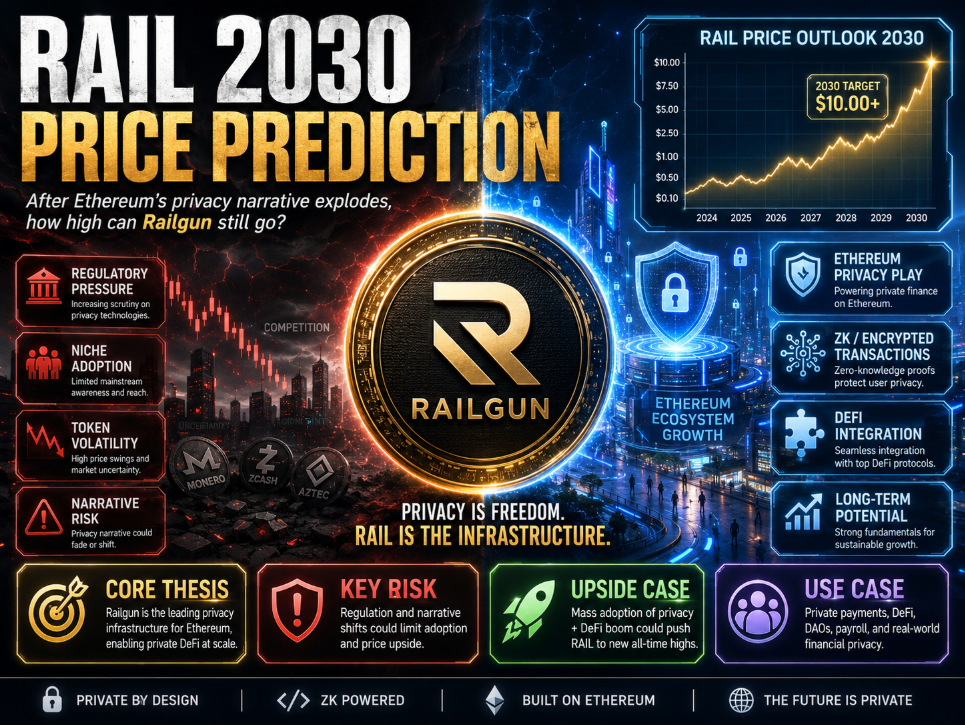
1. What Is the "RAIL" You Are Searching For? Clearing the Confusion Before Investing
Due to its ticker, RAIL is highly prone to mix-ups across different asset classes. In the context of the crypto market, this token must be distinguished from three specific categories:
- Not a Railway Stock: Searching for "rail" on traditional brokerages will yield railroad equities, transportation conglomerates, or industrial ETFs. These have zero connection to Railgun.
- Not Similary Named Tickers: The crypto space frequently sees copycat names or overlapping tickers (like "Rails"). Always verify the smart contract address, official website, and trading platform before deploying capital.
- Not an Independent L1 Privacy Coin: Unlike Monero (XMR) or Zcash (ZEC), Railgun does not run on its own isolated blockchain. It acts as an on-chain privacy layer or smart-contract privacy tool natively embedded within the Ethereum ecosystem.
Is Railgun a Legitimate Project?
Railgun is far from a paper-only project built on empty whitepapers and speculative marketing. It features an actively deployed protocol, extensive developer documentation, a growing ecosystem, and native wallet integrations.
Its primary purpose is to leverage Zero-Knowledge (ZK) cryptography to give users a "shielded balance" on a public ledger, hiding transaction details and account histories from public view.
This addresses a critical pain point. While Ethereum is decentralized, it is entirely transparent by default. Once a public address is linked to a real-world identity, anyone can audit its balances, historical trades, DeFi interactions, NFT holdings, and funding sources. For retail users, this is an invasive exposure of financial data; for institutional funds, it exposes proprietary trading strategies and capital allocation paths to competitors and on-chain analytics tools. Railgun is designed to solve this exact vulnerability.
2. RAIL Tokenomics: What Does a 100 Million Max Supply Imply?
Under Railgun’s tokenomic framework, the maximum supply of RAIL on Ethereum is strictly capped at 100,000,000 tokens. While individual deployments on other networks (like Polygon or BNB Chain) may have specific regional governance variants, this analysis focuses exclusively on the core Ethereum-native RAIL token.
The Value Capture Model
RAIL does not capture value through direct "fee dividends" or passive protocol revenue distribution. Instead, its value is strictly driven by governance utility.
RAIL holders can stake their assets to vote on critical Railgun DAO proposals, protocol parameters, fee structures, upgrade paths, and ecosystem grant allocations. The long-term valuation of this governance right depends entirely on Railgun's adoption rate as core Ethereum infrastructure.
If Railgun remains a niche tool for privacy purists, the governance premium for RAIL will remain low. However, if the protocol is widely adopted via SDKs by mainstream wallets, institutional tools, and dApps, the scarcity and demand for governance power will climb. This structural adoption—rather than generic "privacy hype"—is the anchor for all long-term price forecasts.
3. What Problem Does Railgun Solve? Technical Architecture Sets the Ceiling
1. The Transparency Flaw of Public Ledgers
Because Ethereum relies on a public ledger, every single transaction and smart contract execution is permanently viewable via block explorers. This creates severe real-world complications:
- High-net-worth wallets are systematically tracked and targeted.
- Institutional fund rebalancing is exposed prematurely, risking front-running.
- Proprietary DeFi yield strategies can be instantly copied.
- Airdrop hunters, market makers, and project treasuries face constant tracking.
- Everyday consumer identities are publicly linked to their net worth.
In traditional finance, bank balances and transaction histories are private by default. In the Web3 world, absolute transparency is the default state, meaning privacy requires deliberate architectural design.
2. How zk-SNARKs Power Shielded Transactions
Railgun resolves this flaw by employing Zero-Knowledge cryptography, specifically zk-SNARKs. Put simply, a Zero-Knowledge proof allows a user to mathematically prove that they possess the legitimate authority to execute a transaction without revealing who they are, what their exact balance is, where the capital originated, or where it is going.
Within the Railgun ecosystem, users deposit assets into a "shielded pool." Once inside, tokens can be transferred or deployed across DeFi protocols privately, breaking the visible link on the public ledger.
[ Public Ethereum Address ] ───> ( Shield Asset ) ───> [ Railgun Shielded Pool ]
                                                                │
[ Private Portfolio View ] <─── ( DeFi / Transfers ) <─── ( zk-SNARKs Proofs )
The Difference From Traditional Tumblers
This architecture represents a clean break from old-school crypto "mixers." Traditional mixers pool various users' tokens together and distribute them from a chaotic address to obscure the transaction trail.
However, this crude shuffling mechanism offers no compliance filtering, transforming mixers into a haven for illicit capital and subjecting them to severe regulatory crackdowns. Railgun, by contrast, focuses on building a dynamic, programmable privacy environment capable of interacting directly with smart contracts while maintaining verifiable cryptographic proofs.
4. Railgun vs. Tornado Cash: Structural Differences
You cannot evaluate RAIL without addressing Tornado Cash—the textbook example of regulatory risk in the privacy sector.
Tornado Cash faced heavy sanctions from the US Treasury’s OFAC due to its extensive use by malicious actors and state-sponsored hackers. While subsequent legal updates and market developments shifted the enforcement landscape into 2025 and 2026, the incident permanently rewrote the industry's risk profile. It proved that while privacy tech is valid, protocols that provide anonymous, unvetted asset pooling will face massive friction from global compliance bodies and tier-1 centralized exchanges.
The Compliance Integration: Proof of Innocence
Railgun's primary differentiator is its proactive stance on compliance, specifically through its native Proof of Innocence (PoI) cryptographic toolset.
PoI allows users to mathematically prove that their shielded tokens did not originate from known illicit wallets, flagged hacks, or sanctioned addresses—all without revealing their actual transaction history or identifying data.
While this mechanism doesn't completely eliminate regulatory risks, and while global compliance bodies are still evaluating automated cryptographic proofs, it changes RAIL's fundamental valuation model. If regulators view Railgun as another standard mixer, its upside will be permanently capped by compliance barriers. If it successfully establishes itself as a compliant, integrable privacy utility for the broader Ethereum ecosystem, its market potential opens up drastically.
5. The Core Catalyst: Vitalik Buterin, Kohaku, and Wallet-Level Privacy
The most significant price drivers for RAIL stem from its deep integration into Ethereum's unfolding infrastructure narrative.
The Kohaku Connection
Kohaku represents the modular developer toolset being implemented across the Ethereum ecosystem to equip decentralized wallets with native privacy, robust security, and advanced Account Abstraction capabilities. The market's enthusiasm for Railgun intensified significantly once its zero-knowledge developer modules were highlighted within the Kohaku framework, signaling that the protocol was evolving from an isolated dApp into a structural developer utility.
- The October 2025 Milestone: When initial developer documentation surfaced showing the integration of Railgun's privacy logic into foundational wallet toolkits, RAIL experienced a massive 300% rally. This momentum intensified as Ethereum co-founder Vitalik Buterin continuously emphasized that full-stack privacy and ironclad user security must remain a top priority for the network.
- The May 2026 Developer Update: Speculators identified active Railgun development tools inside updated Kohaku code repositories, sparking another major single-day rally.
Can This Momentum Be Sustained?
In the near term, RAIL carries a visible narrative premium. Traders are aggressively front-running a theoretical future:
- Broad developer adoption of the Kohaku SDK featuring Railgun modules.
- Native, single-click privacy features becoming standard across mainstream wallets.
- Increased demand from DAOs and corporate treasuries for private multi-sig structures.
However, a substantial portion of RAIL's current valuation remains a speculative bet on future adoption rather than immediate protocol cash flows. Consequently, sharp pullbacks following these narrative-driven expansions are entirely normal and expected.
6. Primary Market Variables: The Bulls vs. The Bears
The wild divergence in RAIL price forecasts comes down to a fundamental disagreement between two core market perspectives:
The Bull Case
- Structural Privacy Demand: As institutional capital, Real-World Assets (RWAs), corporate cash reserves, and global retail users flock to Ethereum, the absolute necessity for transactional privacy will grow exponentially.
- Frictionless SDK Distribution: In the past, using privacy dApps required manual steps (shielding, unshielding, managing proof generations, independent gas tracking). Integrating Railgun natively via the Kohaku SDK allows wallets to abstract this complexity away, providing users with zero-knowledge privacy through a single user-friendly button.
- Corporate Treasury Demands: Standard public multi-sig wallets expose a company's exact runway, vendor payrolls, and strategic capital plays to the public. Shielded multi-sigs change this dynamic, offering a massive entry point for enterprise Web3 adoption.
The Bear Case
- The Regulatory Sword of Damocles: Global regulators remain highly skeptical of zero-knowledge technologies. If major agencies target the front-ends, open-source developers, or relayers of privacy-focused SDKs, the entire sector will face immediate de-risking events.
- Low Market Cap Volatility: RAIL maintains a relatively compact market capitalization. While this provides excellent upward elasticity when capital flows in, it also means the token lacks deep liquidity. Large-scale profit-taking by early whales can cause severe pullbacks.
- An Expanding Competitive Landscape: Railgun faces strong alternative approaches. Stealth addresses, Privacy Pools, off-chain zero-knowledge compliance networks, and baseline L1 protocols all compete for the exact same market share.
7. 2026 RAIL Price Prediction: Post-Rally Consolidation and Integration Milestones
The year 2026 serves as a structural validation year for RAIL. Following intense momentum driven by Vitalik Buterin's comments and early Kohaku code integrations, the token has corrected into a mature price-discovery range. By mid-2026, RAIL has moved well past its historical lows, establishing a regular trading channel between $3 and $4.
2026 Price Scenarios:
- Bearish Scenario ($1.00–$2.50): Sharp regulatory pushback targets modular privacy SDKs, or developer delays slow down the rollout of the Kohaku framework, forcing a retest of historical accumulation zones.
- Base Case ($3.00–$5.00): Continuous, incremental developer adoptions occur without an immediate retail explosion. RAIL builds a strong valuation floor as the market digests its newfound narrative position.
- Bullish Scenario ($5.00–$8.00): Multiple mainstream production-grade Web3 wallets formally roll out native privacy updates powered by Railgun's ZK toolkits, sparking a run toward new local highs.
8. 2027 RAIL Price Prediction: Post-Halving Capital Expansion
By 2027, the digital asset ecosystem will likely be operating within the mature, post-halving expansion phase of the market cycle. Historically, this window triggers broad capital rotation from foundational layers into specialized application tiers and infrastructure narratives.
2027 Price Scenarios ($3.00–$12.00):
- Bearish Scenario ($3.00–$5.00): The macro growth trend benefits broad layer-1 plays while niche infrastructure tokens experience capital stagnation.
- Base Case ($5.00–$8.00): Steady protocol usage across DeFi aggregators lifts the structural staking demand for RAIL governance.
- Bullish Scenario ($8.00–$12.00): Shielded transactional volume on Ethereum scales dramatically, positioning RAIL as a high-performing Beta asset within the infrastructure sector.
9. 2028 RAIL Price Prediction: The Halving Era Macro Shift
The year 2028 introduces another standard Bitcoin halving window. From a fundamental standpoint, however, RAIL's performance will be governed by the maturity of Ethereum's long-term roadmap—specifically whether Account Abstraction and compliant zero-knowledge privacy have achieved mainstream status.
2028 Price Scenarios ($4.00–$15.00):
- Bearish Scenario ($4.00–$6.00): Structural narrative fatigue sets in, or competing layer-2 privacy architectures dilute Railgun's active developer mindshare.
- Base Case ($6.00–$10.00): Railgun cements its position as a default privacy standard for institutional dApp integrations, generating sustained governance demand.
- Bullish Scenario ($10.00–$15.00): Enterprise Web3 adoptions scale up, and the demand for shielded multi-sig corporate tooling triggers aggressive buy-side pressure on limited circulating RAIL supplies.
10. 2029 RAIL Price Prediction: The Regulatory Invalidation or Acceptance Peak
By 2029, the long-term viability of the privacy sector will be determined by regulatory clarity. A globally adopted public financial network cannot scale to enterprise-grade heights without a reliable, secure privacy layer.
If global enforcement agencies implement sophisticated risk-mitigation structures that accept cryptographic proofs (like Proof of Innocence) rather than pursuing outright bans on anonymity, Railgun's institutional onboarding potential will expand significantly.
2029 Price Range Forecast ($5.00–$22.00):
- Bearish Scenario ($5.00–$8.00): Global compliance standards enforce stringent, unworkable blacklists on all zero-knowledge pooling systems, driving privacy dApps into niche, alternative venues.
- Base Case ($8.00–$15.00): Railgun maintains an established, functional market share across specific self-custodial jurisdictions, keeping prices resilient.
- Bullish Scenario ($15.00–$22.00): Regulatory bodies officially validate compliant zero-knowledge frameworks, triggering massive institutional capital inflows into audited privacy networks.
11. 2030 RAIL Price Prediction: Financial Infrastructure or Speculative Narrative?
By 2030, the market will categorize RAIL into one of two definitive brackets: an unadopted narrative token that moves purely on localized cycles, or a core, institutional infrastructure asset that secures the governance layer of decentralized privacy.
2030 Price Range Forecast ($7.00–$25.00):
- Bearish Scenario ($7.00–$10.00): The protocol remains functional but scales slowly, tracking broad market cycles without achieving major structural breakouts.
- Base Case ($10.00–$16.00): Railgun maintains consistent, documented integration across the EVM space, with steady staking metrics supporting the mid-double-digit range.
- Bullish Scenario ($16.00–$25.00): Railgun secures a dominant market share as a compliant privacy infrastructure layer for Ethereum, pushing governance value toward its absolute mathematical targets.
Thinking About Long-Term CAGR (Compound Annual Growth Rate)
Taking a baseline price of $3.50 as a contemporary reference point:
- A target of $7.00 by 2030 represents a ~2x return.
- A target of $14.00 by 2030 represents a ~4x return.
- A target of $21.00 by 2030 represents a ~6x return.
- A target of $25.00+ by 2030 represents a 7x+ return profile.
Comparative Market Context: When cross-referencing alternative high-narrative asset profiles on platforms like HIBT—such as long-term SNDKON price forecasts or Citrea (CTR) predictive** models**—always remember that layer-2 scalability tokens, BTC-fi protocols, and privacy infrastructure governance assets rely on entirely different valuation mechanics. Never rely on nominal target numbers alone; always evaluate the underlying tech stack and market liquidity structure.
12. 2026–2030 RAIL Price Prediction Scenario Matrix

13. Deep-Dive Risk Analysis: The Regulatory Landscape
The ultimate risk factor for the privacy sector will always be compliance enforcement. While Web3 networks require privacy to function as legitimate economic systems, global enforcement bodies remain deeply concerned about capital opacity, money laundering, and illicit fund routing. This friction will not disappear anytime soon.
The Proof of Innocence (PoI) Imperative
Railgun’s implementation of Proof of Innocence is a vital step toward survival. By giving users the tools to cryptographically exclude sanctioned or tainted funds from their transactions without breaking personal privacy, the protocol offers a compelling alternative to older mixing models.
From a cryptoraphic standpoint, this is a highly optimized path forward. From a legal standpoint, however, acceptance is not guaranteed. Global jurisdictions interpret developer liability and financial monitoring mandates differently. Consequently, investors should view PoI as a tool that significantly reduces systemic regulatory risk, rather than one that eliminates it entirely.
Critical Regulatory Warning Signs to Monitor:
Investors should watch for specific indicators that signal an escalation in risk:
- Direct mentions of the Railgun protocol by major regulatory bodies (such as the SEC or FinCEN).
- Mainstream self-custodial wallets pulling or pausing privacy SDK integrations.
- Major global exchanges restricting deposits or spot trading pairs for RAIL.
- Coordinated enforcement pressure on open-source front-end developers or relayers.
14. Competitive Architecture: RAIL vs. XMR vs. ZEC vs. Privacy Pools

15. Investor Profiles and Portfolio Management Frameworks
RAIL is built for high-risk-tolerance tactical allocators, not conservative investors looking for steady compounding.
[ FOUNDATIONAL ASSETS: 70–80% ] ──> Bitcoin (BTC) / Ethereum (ETH)
               │
[ LIQUID MAJOR UTILITY: 15–20% ] ──> Tier-1 Layer-1s, Major Exchange Assets
               │
[ HIGH-VOLATILITY SATELLITE: 1–3% ] ─> RAIL (Thematic Privacy Allocation)
For a typical digital asset portfolio, a 1% to 3% allocation provides plenty of exposure to the upside of the privacy narrative without exposing your core capital to sector-specific drawdowns. Even for aggressive, high-conviction traders, capping exposures below 5% to 8% is standard practice to mitigate potential regulatory shocks.
16. Technical Entry Triggers: When to Allocate Capital
Avoid chasing vertical green candles immediately following major media announcements. Instead, look for disciplined entry signals:
- Structural Consolidation: Entering positions when RAIL establishes clear, horizontal support lines during market corrections rather than buying into high-slippage market moves.
- Documented Developer Velocity: Tracking open-source code repositories to ensure the Kohaku SDK and Railgun modular builds are hitting milestones.
- On-Chain Volume Concurrence: Verifying that price appreciations are supported by a corresponding increase in actual shielded protocol usage and active stakers, rather than simple retail hype.
17. Exit Execution: Fundamental and Macro Red Flags
Establish explicit invalidation triggers to protect your capital:
- The Price-to-Utility Disconnect: If the token price spikes significantly while active network utilization numbers (shielded pool TVL, contract interactions) remain flat or trend downward, scale out into stablecoins or core majors.
- Structural Invalidation: If major crypto wallet providers officially deprioritize or drop Railgun developer modules from their upcoming roadmaps.
- The Legal Trigger: If regulatory bodies file enforcement actions against core protocol contributors or open-source infrastructure networks.
18. Is RAIL Eligible for Automated Dollar-Cost Averaging (DCA)?
Standard, mechanical monthly DCA is not recommended for RAIL.
Automated accumulation strategies are best reserved for highly liquid, broad-market protocols with predictable, decades-long growth paths (like BTC or ETH). Because RAIL operates as a highly volatile, event-driven infrastructure asset with unique regulatory hurdles, buying into a prolonged downtrend without evaluating live macro events can be a costly mistake.
A more effective approach is a Tactical, Milestone-Driven Scaling Strategy:
- Scale in only when the token trades within documented historical support zones.
- Increase positions when audited quarterly data reveals structural growth in active users or wallet integrations.
- Pause all accumulation parameters instantly if regulatory friction escalates.
19. Summary Conclusions: The Long-Term Outlook for RAIL
The investment thesis for RAIL is straightforward: If Railgun successfully secures its position as a compliant privacy infrastructure layer for Ethereum, its long-term potential is substantial; if its adoption stalls and it remains a narrative-driven speculative vehicle, it carries significant downside risk.
The project's strengths are clear: its position within Ethereum's evolving privacy framework, its technical alignment with the Kohaku developer ecosystem, and the implementation of Proof of Innocence compliance filtering. However, these factors must be weighed against intense regulatory oversight, low thin-market liquidity profiles, and a highly competitive privacy landscape.
For disciplined investors, RAIL functions as a high-volatility satellite play. Over the 2026 to 2030 window, the most important indicators to watch are structural integration milestones rather than short-term price targets: Look at real-world wallet deployments, verify whether privacy tools become an intuitive user default, and monitor how global regulators treat cryptographically compliant zero-knowledge systems.
Methodology and General Disclaimer
This long-term forecasting review leverages a top-down structural framework tracking technical developer velocity, regulatory trends, global macro liquidity cycles, and scenario-based value matrices. Source metrics include official Railgun protocol releases, open-source repository documentation, public market order books, historical compliance case studies, and automated predictive analytics. This content is prepared strictly for educational, informational, and historical context. It does not constitute investment advice, legal counsel, or financial planning, nor does it recommend the purchase, sale, or holding of any digital asset or governance token. Digital assets—particularly micro-cap infrastructure tokens and privacy protocols—carry immense price volatility and structural hazards, including total capital loss. Readers must conduct independent due diligence and evaluate their personal risk tolerance before entering any trades.