
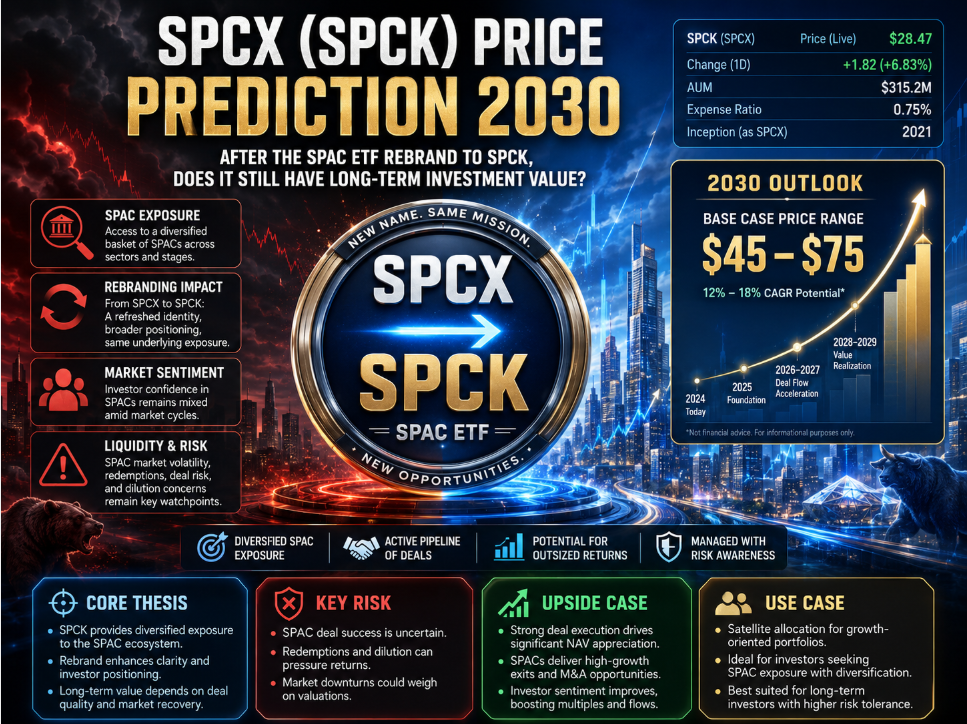
If you are searching for "SPCX price prediction" or "SPCX 2030 forecast," the first thing you need to clarify is that SPCX officially changed its ticker to SPCK on April 7, 2026. This means the asset you previously tracked as SPCX is now trading under the symbol SPCK. Its full name remains The SPAC and New Issue ETF.
More importantly, SPCX/SPCK is not a cryptocurrency or an on-chain token; it is a SPAC and new-issue-themed ETF traded on the US stock market. Many crypto investors spot the "SPCX" ticker and mistake it for a new coin, a Real-World Asset (RWA) token, or a SpaceX-related asset. In reality, it is an actively managed ETF overseen by Tuttle Capital Management.
This article breaks down the long-term prospects of SPCX/SPCK through a systematic analysis of its fund identity, historical performance, SPAC market cycles, macro and regulatory factors, year-by-year price predictions from 2026 to 2030, common risk misconceptions, and portfolio allocation frameworks.
1. Know What You Are Investing In: Are SPCX and SPCK the Same Thing?
Essentially, SPCX and SPCK are the exact same fund—only the ticker symbol has changed.
On April 7, 2026, The SPAC and New Issue ETF switched its ticker from SPCX to SPCK. According to the fund provider, this rebranding does not alter the fund's investment objectives, strategies, or fee structure, and requires no action from current shareholders.
This implies:
- The historical price data you previously viewed for SPCX remains valid and serves as the track record for SPCK.
- You should execute your trades using SPCK going forward, as the old SPCX ticker is retired.
- The ticker change is not a structural pivot; it does not mean the fund has suddenly invested in SpaceX, crypto assets, or other speculative themes.
What is a SPAC?
SPAC stands for Special Purpose Acquisition Company, often referred to as a "blank check company."
Put simply, a SPAC is a shell company that goes public first with the sole intention of acquiring or merging with a private company later. When it goes public, it has no commercial operations of its own. It places the capital raised from its IPO into a trust account and is given a strict deadline to find a target company. Once a merger is finalized, the target company goes public through a process known as a de-SPAC transaction.
This sets it apart from traditional stocks and crypto:
- Vs. Traditional Stocks: Regular equities represent companies with existing operations, revenue, and audited financial statements. Prior to a merger, a SPAC is essentially a financial vehicle bet on future M&A opportunities.
- Vs. Cryptocurrencies: Crypto prices are heavily driven by on-chain ecosystems, tokenomics, exchange liquidity, narratives, and retail hype. Conversely, a SPAC ETF's price is dictated by its underlying equity holdings, SPAC market liquidity, the IPO window, interest rates, and regulatory shifts.
What is a SPAC ETF?
Rather than betting on a single SPAC, a SPAC ETF bundles multiple SPACs, newly listed companies, or post-de-SPAC equities into a single diversified portfolio.
The defining characteristic of SPCK is that it is an actively managed ETF, not a passive index tracker. The fund manager has the discretion to adjust holdings based on market conditions—which represents both an opportunity and a risk.
- The Opportunity: Active management can theoretically weed out low-quality SPACs and cherry-pick new issues or M&A targets with higher upside potential.
- The Risk: Active managers can make wrong calls. Additionally, high turnover rates, management costs, and liquidity constraints can eat into long-term returns.
2. SPCX/SPCK Fund Structure: What Does It Actually Hold?
SPCK’s investment objective is to seek total return. According to its mandate, the fund primarily invests in:
- Units and common stock of SPACs.
- SPACs that meet a specified minimum market capitalization.
- Newly listed companies that have completed their IPO within the last two years.
- Opportunistic assets related to the SPAC or new issue ecosystem.
This indicates that SPCK is not just "trading SPAC hype"—it packages the broader SPAC and IPO market into a managed portfolio.
Who is the Fund Manager?
SPCK is managed by Tuttle Capital Management. Tuttle Capital is well-known in the industry for launching thematic, event-driven, and tactical ETFs. These funds typically target niche, high-conviction thematic trends rather than chasing broad market Beta like an S&P 500 fund.
Is the 0.95% Expense Ratio Too Expensive?
From the perspective of traditional ETFs, a 0.95% net expense ratio is quite steep. For comparison, broad-market S&P 500 ETFs often charge rock-bottom fees ranging from 0.03% to 0.10%.
However, when viewed through the lens of an actively managed, niche thematic fund that handles complex SPAC and new-issue filtering, a 0.95% fee is not entirely out of line. The real question is not whether the fee is high, but whether the active management can generate enough alpha (excess returns) to justify it.
If the SPAC market remains stagnant long-term, that 0.95% drag will sting. If SPAC and IPO activity accelerates, the active management could prove its worth.
3. Historical Performance Review: How Has SPCX Handled Past Years?
SPCX launched in late 2020, perfectly catching the tail end of the massive 2020–2021 SPAC boom. That particular bull run was textbook: ultra-low interest rates, overflowing market liquidity, bloated growth stock valuations, and investors who were highly willing to pay a premium for future promises.
However, the macroeconomic landscape shifted violently post-2022.
The Federal Reserve embarked on a rapid rate-hike cycle, compressing growth valuations and freezing the IPO market. Many companies that went public via SPACs failed to meet earnings expectations, causing investors to lose patience with assets that offered "all narrative and no numbers." SPACs quickly transformed from Wall Street’s darling into an unloved, heavily discounted sector.
SPCX Historical Trading Range (Approximate):
High: ~$27.58 (Around May 2022)
Low:  ~$21.60 (Around February 2024)
While this range does not mirror the extreme multi-X volatility seen in crypto, it represents significant, localized thematic volatility for an equity ETF.
Annual Return Context
Looking at its annual trajectory, the fund experienced the following phases:
- 2021: Maintained relatively positive performance, riding the residual waves of the SPAC mania.
- 2022: Caught in the crosshairs of rate hikes and a severe multiple-compression cycle in growth stocks.
- 2023: Faced muted recovery as the broader IPO window remained largely shut.
- 2024: Saw periodic sentiment bounces, though it remained far below its historic peak.
- 2025: Rebounded modestly alongside a broader recovery in risk assets and new listings.
- 2026: Post-ticker change to SPCK, the market is intensely focused on whether the fund can claw back valuation points via a fresh wave of IPOs and a healthier SPAC market.
This timeline illustrates that SPCK is not a day-trading vehicle for explosive daily moves; it is entirely tethered to the lifecycle of the primary and secondary equity markets. Compared to Bitcoin or altcoins, its volatility might seem tame; compared to a broad-market index fund, its thematic risk is heavily concentrated.
4. Why Do SPAC Markets Move in "Boom-Bust-Recovery" Cycles?
To forecast SPCK’s future price, one must first grasp the mechanics of the SPAC market cycle.
1. Low Interest Rates Are the Fuel
In a low-rate environment, the cost of capital is cheap. Investors are incentivized to move further up the risk curve, boosting the valuations of early-stage growth companies. SPACs thrive here because they provide retail investors a vehicle to get in early on the "next big thing" before its formal public debut.
2. High Interest Rates Crush Valuations
When interest rates climb, the present value of future cash flows drops significantly. Growth and narrative-heavy companies are hit hardest. Because many SPAC targets are early-stage firms with unproven or volatile earnings, they are the first to be dumped during a macro tightening cycle. This explains the post-2022 freeze.
3. Tightening Regulations Squeeze Out "Narrative Arbitrage"
The SEC has dramatically raised the bar for disclosures regarding SPAC and de-SPAC transactions, placing greater liability on sponsors and target firms. While this is an excellent development for long-term market health, it slows down the pipeline of low-quality, speculative deals in the short term. The market is shifting from quantity-driven expansion to quality-driven selection.
4. The Opening of the IPO Window Controls SPCK’s Elasticity
Because SPCK also allocates up to two years post-IPO to newly listed firms, it is not a pure-play SPAC fund. It relies heavily on the overall health of the IPO market. If the US IPO window opens up wide and high-quality growth companies seek listings, SPCK's asset quality and upside potential will benefit. If the window remains shut, the manager's sandbox shrinks.
5. 2026 SPCX/SPCK Price Prediction: Rebranding Year Focuses on Recovery, Not Fireworks
As of late May 2026, SPCK hovers around $22, with a 52-week high near $26.61 and a low near $21.32. It continues to consolidate near its historical basement, showing that it has yet to fully decouple from its post-boom hangover.
Key Variables for 2026:
- The Fed Policy: Whether the Federal Reserve solidifies a path toward monetary easing. Rate relief is the single biggest catalyst for growth and new-issue equity.
- IPO Pipeline: If the latter half of 2026 brings an influx of high-profile, fundamentally sound private companies to the public markets.
- The Ticker Transition: While changing the ticker doesn't alter the Net Asset Value (NAV), it may spark a localized liquidity shift as investors re-discover the fund under its new SPCK moniker.
2026 Price Range Forecast:
- Bearish Scenario ($19–$21): Risk-off market sentiment dominates, the SPAC landscape remains frozen, and continuous capital outflows force the fund to retest or break below its 2024 lows.
- Base Case ($21–$24): The market grinds sideways. IPO activity picks up modestly, but without a major sector catalyst, keeping SPCK range-bound.
- Bullish Scenario ($24–$27): Aggressive rate cuts fuel a growth rally, the IPO window swings wide open, and SPCK retests its 52-week highs.
Summary: view 2026 as a stabilization and accumulation observation year, rather than the launchpad for a guaranteed bull market.
6. 2027 SPCX/SPCK Price Prediction: Can a Rate-Cut Cycle Reactivate M&A?
The central theme for 2027 is execution: If monetary easing deepens, will SPAC deal-making actually return?
Lower interest rates reduce corporate borrowing costs and make investors more forgiving of long-duration growth assets. If 2027 presents a distinctly accommodative macro environment, both the SPAC and IPO pipelines should see meaningful traffic.
However, a recovery does not mean a return to the wild speculative excess of 2021. Enhanced regulations and investor scar tissue mean the market will look very different.
2027 Price Range Forecast ($20–$28):
- Bearish Scenario ($20–$22): The macro economy experiences a harder landing or recession, forcing capital into defensive mega-caps and suppressing new issues.
- Base Case ($22–$25): A steady, measured recovery. SPCK climbs slowly out of its valuation trough, but gains are capped by a highly selective M&A market.
- Bullish Scenario ($25–$28): High-quality target companies execute clean de-SPAC transactions, risk appetite floods back, and the ETF approaches its historical highs.
7. 2028 SPCX/SPCK Price Prediction: Post-Election Policies Meet the New Issue Market
The year 2028 brings a critical, often underestimated catalyst: the aftermath of the US Presidential Election.
Markets will spend 2028 pricing in new fiscal, regulatory, and corporate tax policies. If the incoming administration adopts a pro-capital market posture that encourages corporate listings and tech innovation, the IPO and SPAC structures will receive a tailwind.
2028 Price Range Forecast ($21–$30):
- Bearish Scenario ($21–$23): Defensive macro positioning keeps small-cap and thematic growth assets sidelined, leaving SPCK marginalized.
- Base Case ($23–$27): Capital markets normalize completely, and SPCK trends upward in lockstep with a healthy, steady flow of new public listings.
- Bullish Scenario ($27–$30): A fresh technological cycle (e.g., advanced AI scaling, commercial aerospace expansion, or localized fintech infrastructure) leverages the SPAC path to go public, pushing SPCK past its historic resistance levels.
8. 2029 SPCX/SPCK Price Prediction: Will the Historic High of $27.58 Be Broken?
By 2029, market analysts will likely draw comparisons between two distinct market eras: the speculative bubble of 2020–2021 and the mature, compliance-driven recovery cycle of 2026–2029.
For SPCK to convincingly break past its all-time high of $27.58, three conditions must be met:
- The SPAC market must be driven by sustainable fundamentals, not cheap hype.
- The fund’s underlying selections must actively outperform broad market indices.
- The fund must reverse its long-term fund flow trend from structural outflows to net positive inflows.
2029 Price Range Forecast ($22–$32):
- Bearish Scenario ($22–$24): If the fund fails to scale, low Assets Under Management (AUM) and deteriorating liquidity could cause it to trade at a persistent discount.
- Base Case ($24–$28): Standard cyclical recovery brings the fund back to its historical baseline, hovering right around its old all-time high.
- Bullish Scenario ($28–$32): A healthy, secondary SPAC boom launches the fund into uncharted valuation territory, transforming it from a "turnaround play" into a verified thematic winner.
9. 2030 SPCX/SPCK Price Prediction: Why Is There Such a Vast Divergence in Models?
Long-term forecasting models for 2030 show an incredibly wide spread. Some purely algorithmic platforms project a terminal collapse down to ~$4, while fundamental models suggest it will comfortably hold above $22 or target $30+.
This is an issue of model logic, not a simple right-or-wrong answer.
Why Do Some Algorithmic Models Predict a $4 Collapse?
Extremely bearish projections typically stem from purely technical or trend-extrapolation algorithms. These models look at the past few years of shrinking AUM, capital outflows, and depressed prices, and blindly project that downward trajectory in a straight line for the next several years.
The flaw here is that they fail to understand the structural reality of an ETF. An ETF is a basket of liquid assets; it does not go to zero like a single bankrupt corporate stock unless its underlying holdings completely fail simultaneously. However, if AUM shrinks too low for too long, a fund does face liquidation risk (closure by the provider).
Why Do Fundamental Models Suggest $22+?
Fundamental models look at the underlying assets. As long as Tuttle Capital continues to operate the ETF and the portfolio managers actively rotate into liquid SPACs and fresh IPOs, the fund's floor is supported by the actual cash and equity values of those listings.
Rather than banking on a single arbitrary number, a scenario-based range is far more analytical for 2030.
2030 Price Range Forecast ($18–$35):
- Bearish Scenario ($18–$21): The SPAC vehicle becomes permanently obsolete, fee drags erode the NAV, and low liquidity forces the fund into a tight, depressed trading band or outright closure.
- Base Case ($22–$28): The new-issue equity ecosystem functions normally. SPCK acts as a low-growth thematic fund, tracking the modest ebb and flow of the broader markets.
- Bullish Scenario ($28–$35): The 2028–2030 macro cycle produces high-conviction tech and industrial listings, validating active management and pushing the ETF to new heights.
Thinking About Long-Term CAGR (Compound Annual Growth Rate)
If you enter a position around the $22 mark today:
- A drop to $18 by 2030 yields a negative capital return.
- A rise to $25 yields a mediocre annualized return that likely underperforms the S&P 500.
- A target of $30 to $35 delivers a highly compelling CAGR, but relies on a robust primary market recovery.
Note on Comparative Assets: If you monitor long-term forecasts for other emerging assets on platforms like HIBT—such as the 2030 SNDKON price prediction—keep in mind that tokenized asset narratives or crypto tokens operate on entirely separate valuation frameworks. You cannot use the same analytical model for a US equity ETF like SPCK as you would for an on-chain digital asset.
10. Core Risks of SPCK: 5 Misconceptions New Investors Overlook
- Misconception 1: "SPAC" automatically means high risk/high reward.
- While individual SPAC equities can exhibit wild, binary outcomes, SPCK is an ETF. It mitigates single-stock risk via diversification. The flip side is that it also dilutes the explosive gains of a single breakout company. Its real threat is systemic, sector-wide stagnation.
- Misconception 2: Trusting algorithm-driven price prediction websites as expert consensus.
- Many automated tracking sites use basic linear trends or moving averages. They do not analyze underlying fund structures, SEC regulatory shifts, interest rate regimes, or institutional fund flows. For a niche ETF with tight liquidity, these automated models are highly unreliable.
- Misconception 3: Ignoring capital outflow signals.
- One of SPCK's greatest vulnerabilities is its small asset footprint. It has experienced prolonged net outflows over the past few years. For small ETFs, chronic outflows don't just kill market buzz; they can degrade trading liquidity and increase the risk that the issuer decides to liquidate the fund entirely.
- Misconception 4: Treating the ETF like a single stock.
- Buying SPCK is not a direct bet on one specific company's success. It represents the collective health of the micro-to-small cap new listing ecosystem.
- Misconception 5: Assuming a ticker change implies a strategy shift.
- The move from SPCX to SPCK is purely administrative. Do not read it as a hidden signal that the fund is pivoting to cryptocurrency, AI tokens, or an exclusive SpaceX tracking fund.
11. Who is SPCK Actually For?
SPCK is a highly specific tool that does not fit into a standard "set-it-and-forget-it" portfolio.
Investor Profile
Suitability
Rationale
Conservative / Core Growth
❌ Unsuitable
If you want steady compounding, low fees, and reliable long-term growth, a broad-market index ETF (e.g., S&P 500 or Total Stock Market) is a far superior core holding.
Crypto-Only Day Trader
❌ Unsuitable
If you approach this asset expecting the 10x intraday swings of an unbacked altcoin, you will find its equity-bound price movements incredibly boring.
Tactical Growth / Satellite Investor
Highly Suitable
If you want direct, actively managed exposure to the cyclical recovery of the primary US IPO and venture-adjacent public markets using a small portion of your capital.
12. Portfolio Construction: What Percentage Should SPCK Occupy?
For the vast majority of retail investors, SPCK should reside strictly within a satellite allocation framework.
[ Core Allocation: 70–80% ] ---> Broad Index Funds, Large-Cap Blue Chips, Fixed Income
          │
[ Growth Allocation: 15–20% ] -> Sector ETFs (Tech, Biotech), Large Growth Stocks
          │
[ Satellite Position: 1–5% ] --> SPCK (Thematic SPAC/New Issue Exposure)
          │
[ Speculative Pool: Variable ] -> Crypto, Single-Stock Options, Early-Stage Startups
- Conservative Profile: A 1% to 3% allocation is more than enough to capture thematic upside without threatening your core capital.
- Aggressive/Tactical Profile: If you have high conviction in a massive 2026–2030 IPO renaissance, you might extend this to 3% to 5%.
Allocating more than 10% of a standard portfolio to a niche, high-fee thematic ETF like SPCK is generally discouraged unless you are an institutional market participant actively tracking its daily underlying holdings.
13. Trigger Signals: When to Buy or Sell SPCK
Potential Accumulation (Buy) Signals:
- The Federal Reserve initiates a prolonged, transparent interest rate cutting cycle.
- US IPO volume and capital aggregate raises show consecutive quarter-over-quarter growth.
- High-profile, fundamentally stable private firms successfully execute clean de-SPAC transactions.
- SPCK's institutional fund flow stabilizes, reversing from net outflows to steady net inflows.
- The ETF’s price clears and holds above its near-term trading channel on expanding volume.
Potential Risk Reduction (Sell) Signals:
- The fund's AUM continues to shrink, raising structural liquidation concerns.
- Average daily trading volume falls to levels that trigger wide bid-ask spreads.
- The quality of de-SPAC transactions deteriorates back into pure narrative hype with poor balance sheets.
- Broad equity markets shift to a secular risk-off posture.
- The price spikes temporarily on retail confusion, while underlying institutional fund flows remain negative.
14. Where Does SPCK Sit in the Investment Hierarchy?
To properly evaluate SPCK, contrast it against alternative routes:
- Direct IPO Investing: Offers maximum capital elasticity and explosive returns if you pick the right winner, but exposes you to severe single-stock downside and high volatility.
- Trading Single SPAC Equities: This requires deep, professional-level due diligence—analyzing sponsor track records, redemption rights, trust configurations, warrant dilution structures, and target company audits. It is highly labor-intensive.
- Broad Growth ETFs: Offers superior liquidity, larger asset footprints, and lower expense ratios. The trade-off is that they are too large to give you pure-play exposure to the early-stage new issue lifecycle.
- SPCK ETF: Strips away individual stock-picking pressure, placing the diversification and structural rebalancing into the hands of an active manager. The drawbacks are its high 0.95% cost, smaller asset base, and complete reliance on macro cycles.
Further Reading: For those tracking alternative asset classes under long-term forecasting models, you may encounter resources like the 2030 CTR (Citrea) price prediction across various market feeds. CTR deals with Bitcoin ZK-Rollups and decentralized BTC finance narratives. While completely detached from traditional equities, analyzing these assets teaches the same lesson: rely on disciplined scenario-based ranges rather than chasing single-point price targets.
15. Is SPCK Eligible for Dollar-Cost Averaging (DCA)?
SPCK is generally not a good candidate for blind, long-term mechanical DCA.
Dollar-cost averaging works best with low-fee, highly liquid, broad-market index instruments that are structurally designed to rise alongside global economic expansion over multiple decades. Because SPCK is a highly cyclical, niche thematic asset with an elevated expense ratio and clear fund-survival risks, blind monthly accumulation can trap your capital in a declining or stagnant asset.
If you choose to use a DCA framework here, modify it into a Conditional DCA Strategy:
- Only accumulate in tranches when the price trades at or near documented historical support floors.
- Halt monthly purchases immediately if the underlying fund AUM breaks below critical thresholds.
- Accelerate accumulations only when macroeconomic data confirms the IPO window has reopened.
- Scale out and take partial profits mechanically if the price spikes toward historical highs without a corresponding improvement in the fund's underlying cash flows.
16. 2026–2030 Price Prediction Scenario Matrix

Disclaimer:* This matrix represents an analytical scenario model based on current macro structures, interest rate cycles, historical pricing bounds, and ETF mechanics. It does not constitute a guarantee of future returns or a binding investment commitment.*
17. Final Verdict: Is SPCX/SPCK Worth Buying?
The core appeal of SPCX/SPCK is its status as one of the few pure financial instruments providing targeted, diversified exposure to the SPAC and new-listing lifecycle. If you anticipate that the US primary markets are on the cusp of a multi-year cyclical turnaround, SPCK presents a viable entry point at a historical discount.
However, its structural vulnerabilities cannot be swept under the rug:
- Small total asset size (AUM).
- Elevated 0.95% expense ratio.
- Historic institutional capital flight.
- Persistent structural risks regarding fund longevity and liquidation.
Conclusion: SPCK does not belong in your portfolio's core foundation. It is a tactical, cycle-dependent satellite asset. If you understand the mechanics of primary equity markets and can track institutional flows, it belongs on your watchlist for layered entry as conditions improve. If you stumbled across the ticker thinking it was a crypto play or a direct proxy for Elon Musk’s SpaceX, it is best to step aside—this is a traditional, specialized Wall Street equity product that moves strictly by the rules of corporate finance.
Methodology and General Disclaimer
This analysis utilizes a fundamental, top-down macro approach combined with scenario-based modeling. Data points are aggregated from public fund disclosures, historical price channels, SEC regulatory documentation, and institutional capital flow trackers. This content is intended purely for informational and educational purposes. It does not constitute financial advice, investment recommendations, or an endorsement to buy, sell, or hold SPCK/SPCX. All long-term projections carry inherent uncertainty. Past performance is never indicative of future results. Always consult with a licensed professional advisor before deploying capital into speculative thematic assets.