
Risk Warning
The contents of this article are for educational reference only and do not constitute any investment advice, trading advice, financial advice, tax advice, or legal advice. The cryptocurrency market is highly volatile, and the price of the 1INCH token can rise or fall drastically in the short term. DeFi protocols carry smart contract vulnerabilities, allowance risks, MEV risks, liquidity risks, and the risk of irreversible on-chain operations. Please make independent judgments after fully understanding the project mechanisms and your personal risk tolerance.
In the world of DeFi, one of the most common actions users perform is swapping tokens.
You might want to swap ETH for USDC, USDT for WBTC, or convert a certain on-chain asset into another ecosystem token. The most direct way is to open Uniswap, SushiSwap, PancakeSwap, or another DEX, enter the amount, and confirm the swap.
But here is the question: is swapping tokens directly on a single DEX guaranteed to give you the best price?
The answer is usually no.
DeFi liquidity is fragmented across different chains, different DEXs, different liquidity pools, and different automated market-making models. One pool might offer a cheaper quote, another might have lower slippage, and a third might optimize Gas costs. For everyday users, manually comparing these paths is practically impossible.
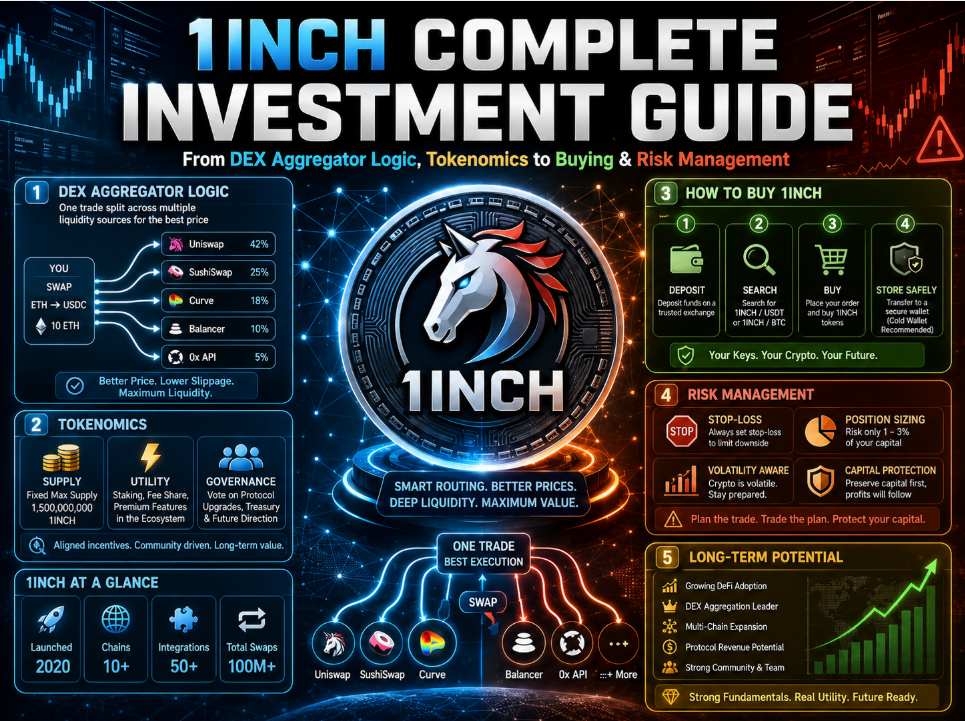
This is exactly why 1inch emerged.
1inch is not a single DEX in the traditional sense, but rather a DEX aggregator and DeFi trading infrastructure. Its core value is to help users discover better swap paths across multiple decentralized exchanges and liquidity sources, thereby minimizing slippage, optimizing execution prices, and, under certain modes, mitigating MEV attacks and Gas costs.
If Uniswap is a specific trading venue, then 1inch is more like an intelligent trade routing system. It does not necessarily provide all the liquidity itself; instead, it helps you find where to swap, how to split orders, and which path to take to get the best value.
This article will systematically explain 1INCH from both an investor's and a practical user's perspective, including:
- What 1inch actually is;
- What pain points of DeFi a DEX aggregator solves;
- How technological mechanisms like 1inch's Pathfinder, Fusion, and limit orders operate;
- What utility the 1INCH token holds;
- Whether the project team, funding, and historical development are reliable;
- Where it stands in the DEX aggregator competitive landscape;
- How to purchase 1INCH via the HIBT exchange;
- How to actually use the 1inch dApp;
- How to evaluate the investment value of 1INCH;
- How to handle taxes, compliance, and newcomer risks.
If you are researching the long-term value of 1INCH, you can also explore HIBT's two extended analysis articles:
- Will 1INCH Reach $10:
https://hibt.com/zh-cn/news/47-4959 - 2030 1INCH Price Prediction:
https://hibt.com/zh-cn/news/47-4969
Chapter 1: What Exactly Is 1INCH? What Core DeFi Pain Point Does It Solve?
1.1 What Is a DEX Aggregator? Why Is Buying Directly on Uniswap Not Always the Best Choice?
A DEX aggregator is a tool that helps users find the optimal trading path across multiple decentralized exchanges.
The logic of a regular DEX is simple: you complete a swap within that single exchange. For example, if you open Uniswap and swap ETH for USDC, this transaction will typically be fulfilled solely within Uniswap's relevant liquidity pools.
However, the DeFi market does not consist of just Uniswap. Across different chains, there are numerous liquidity sources:
- Uniswap
- SushiSwap
- Curve
- Balancer
- PancakeSwap
- QuickSwap
- DODO
- KyberSwap
- Maverick
- Trader Joe
- And a vast array of other liquidity venues.
Even for a straightforward ETH-to-USDC swap, the price, depth, slippage, and Gas costs can vary significantly from one DEX to another. If you swap on only one DEX, you might miss out on a much better quote.
The value of 1inch lies precisely here: It compares multiple liquidity sources simultaneously and relies on smart routing to discover a better trading solution.
This is particularly crucial for large transactions. In small trades, the price discrepancies might be negligible; however, when your swap volume scales up, slippage, liquidity depth, and order-splitting paths directly impact the final amount of tokens you receive.
1.2 Price Slippage and Liquidity Fragmentation: What Were Users Losing Before 1inch?
When DeFi users swap tokens, the most easily overlooked cost is not the protocol fee, but slippage.
Slippage refers to the difference between your expected execution price and the actual execution price. For instance, if you intend to swap 10 ETH for USDC and the page estimates you will receive 35,000 USDC, but due to thin pool depth, rapid price shifts, or poor trade execution paths, you ultimately only receive 34,700 USDC—the 300 USDC difference represents a direct transaction loss.
One of the core catalysts for slippage is liquidity fragmentation. The liquidity for the exact same trading pair can be scattered across:
- Uniswap on Ethereum;
- Stablecoin pools on Curve;
- Multi-asset pools on Balancer;
- PancakeSwap on BNB Chain;
- QuickSwap on Polygon;
- Camelot on Arbitrum;
- Other DEXs or RFQ (Request for Quote) market makers.
If users were to manually seek out the absolute best path, it would be incredibly time-consuming and highly prone to error. 1inch's aggregator was engineered specifically to solve this problem. It does not simply tell you "which DEX has the lowest price"; instead, it may split a single transaction into multiple parts:
- 30% routed through Uniswap;
- 40% routed through Curve;
- 20% routed through Balancer;
- 10% routed through other liquidity sources.
The goal of this order splitting is to bring the final execution outcome as close to the theoretical optimum as possible.
1.3 The Core Feature of 1inch: How Does the Routing Algorithm Find a Better Price?
The absolute core competency of 1inch is its routing algorithm. Put simply, once a user initiates a Swap request, 1inch compares a multitude of pathways:
- Direct swaps;
- Swaps routed through intermediary tokens;
- Splitting orders across multiple DEXs;
- Utilising different types of liquidity pools;
- Comparing real-time Gas costs;
- Calculating expected slippage;
- Evaluating the exact final net token payout.
For example, say you want to swap ETH for an asset with a smaller market cap, Token A. A direct ETH $\rightarrow$ Token A pool might suffer from thin liquidity and high slippage. However, if the route first converts ETH $\rightarrow$ USDC, and then swaps USDC $\rightarrow$ Token A, the final yield of Token A could be higher. Alternatively, if 1inch identifies that running a portion through Uniswap, a portion through SushiSwap, and a portion through Balancer yields the best outcome, it will split and execute the order accordingly.
This is the core value of a DEX aggregator: It does not just look at the surface-level price; it calculates the final net execution result. While users interact with a straightforward, clean swap interface, 1inch is executing complex path computations and trade optimizations beneath the surface.
1.4 Are 1inch and DEXs Like Uniswap or SushiSwap Competitors or Partners?
1inch shares a relationship with DEXs like Uniswap and SushiSwap that features both competition and cooperation.
From the user gateway perspective, they compete. Users can swap tokens directly on Uniswap's interface or route them through 1inch. If users develop a habit of using 1inch, a portion of front-end traffic will bypass Uniswap's native page.
However, from the liquidity perspective, they cooperate. 1inch actively channels transaction volume into the liquidity pools of Uniswap, SushiSwap, Curve, and others. It does not replace these DEXs; rather, it absorbs them into its routing grid to secure better execution for users across diverse liquidity backends.
Therefore, a more precise description is: Uniswap is a vital liquidity source, while 1inch is a liquidity aggregation gateway. If DeFi liquidity remains highly fragmented in the future, the value of aggregators will become even more pronounced. Conversely, if a single DEX establishes an absolute monopoly over all liquidity, the necessity of an aggregator might decline. However, the higher probability is that a multi-chain, multi-DEX, and multi-liquidity model ecosystem will coexist long-term, preserving a permanent role for aggregators.
1.5 Real-World Scenario: Where Does 1inch Save Money for Users?
Suppose you intend to swap 20 ETH for USDC. If you trade directly on a single DEX, you risk facing:
- Inadequate depth in that specific pool;
- Expanded slippage;
- An execution price inferior to alternative venues;
- Elevated Gas costs;
- Large trades being targeted by MEV (Maximal Extractable Value) front-running bots;
- A final net receipt of USDC that falls short of expectations.
By routing through 1inch, the system might discover an optimized split:
- 50% via Uniswap V3;
- 25% via Curve;
- 15% via Balancer;
- 10% via other liquidity sources.
As a result, the user may walk away with a higher net amount of USDC, or achieve a better net return after factoring in Gas fees. Of course, 1inch does not guarantee that every single transaction will outshine a manual operation, especially for tiny swaps where network Gas overhead might eclipse the structural price optimization. However, for larger volumes, fragmented assets, or pairs with apparent slippage, utilizing a DEX aggregator is highly beneficial.
Chapter 2: 1inch's Technical Architecture—How It Achieves "Optimal Routing" On-Chain
2.1 What Is the Pathfinder Algorithm?
Pathfinder is the core routing algorithm underpinning the 1inch Network. Its primary objective is to calculate the most efficient swap solution across a vast matrix of multiple DEXs, liquidity pools, intermediary tokens, and trading paths simultaneously.
While everyday users focus entirely on "how many tokens will I receive," Pathfinder evaluates multiple engineering data points in real time:
- Which pools hold deep enough liquidity;
- Which pathway minimizes slippage;
- Whether splitting the order yields an optimized outcome;
- Whether routing through intermediary asset pairs is superior;
- Whether the aggregate Gas cost of a path outweighs its price benefit;
- Whether cross-path combinations yield a synergistic optimization;
- Whether the final net yield beats a direct, single-route swap.
This algorithm forms a major part of 1inch's technical moat. In DeFi trading, the optimal route is never static; because every fresh block, every parallel transaction, and every sudden shift in liquidity can alter quotes instantly. Consequently, competition among aggregators is fundamentally a race of routing speed, liquidity coverage, execution efficiency, and user experience.
2.2 Which Blockchain Networks Does 1inch Support?
1inch initially built its reputation serving the Ethereum ecosystem, but as DeFi evolved into a multi-chain landscape, it aggressively scaled across multiple environments. Supported networks include:
- Ethereum
- BNB Chain
- Polygon
- Arbitrum
- Optimism
- Base
- Avalanche
- Gnosis Chain
- zkSync Era
- Linea
- Scroll
- Sonic
- Solana
- And an array of other continuously integrated ecosystems.
The actual roster of supported chains evolves with 1inch's official product updates. Users should always check the live 1inch dApp interface for current availability. Multi-chain deployment is crucial for 1inch because DeFi volume is no longer confined to the Ethereum mainnet; ecosystems like BNB Chain, Arbitrum, Base, and Solana capture massive trading demand. The aggregator that provides a seamless, optimized aggregation experience across these diverse environments stands the best chance of becoming the user's default transaction gateway.
2.3 What Is Fusion Mode? How Does It Differ from a Standard Swap?
Fusion Mode represents one of the most critical structural upgrades to the 1inch Network.
In a standard Swap, users manually submit an on-chain transaction, fund the Gas costs out of pocket, and absorb the native MEV risks of the public mempool. Fusion Mode, by contrast, shifts toward intent-based execution: users specify their desired transaction outcome, and verified third-party professional entities (known as resolvers) compete to fill the order.
The core flow functions as follows:
- The user broadcasts a transaction intent;
- The order price adjusts smoothly over time, mimicking a Dutch auction structure;
- Resolvers compete aggressively to execute the order;
- The user receives a highly optimized execution experience;
- In specific setups, users do not need to hold or pay native Gas directly out of pocket;
- The cryptographic design naturally mitigates the risk of front-running or sandwich attacks.
The strategic importance of Fusion is that it moves beyond simply "locating a pool to swap tokens." Instead, it introduces an execution framework where professional actors compete against one another, directly enhancing the final execution price for retail users. This marks a pivotal evolutionary step for 1inch as it expands from a pure DEX aggregator into a broader, generalized DeFi trading infrastructure.
2.4 The On-Chain Execution Logic of 1inch Limit Orders
Many users assume that DEX environments are restricted to market-rate swaps and cannot execute limit orders like centralized exchanges. 1inch addresses this through its dedicated Limit Order Protocol, allowing users to configure explicit, conditional target prices on-chain.
For example, if you want to automatically buy ETH with USDC only if the price drops to a specific target, you can construct an on-chain limit order. Its baseline logic operates as follows:
- The user cryptographically signs an order;
- The order is not broadcasted to the blockchain instantly and sits off-chain;
- Once market prices shift to satisfy the pre-set conditions, professional executors match and fill the order;
- Users do not need to remain online or manually monitor the screen;
- Real on-chain settlement and asset transfers occur only upon successful execution.
This feature is highly valuable for DeFi participants because it mirrors a centralized trading experience on-chain. However, users must remember that whether a limit order successfully fills depends entirely on real market price action, deep liquidity availability, executor willingness, order configuration parameters, and real-time gas environments.
2.5 Smart Contract Security: Is 1inch Entirely Risk-Free?
1inch is an established blue-chip DeFi protocol whose codebase and core smart contracts have undergone extensive, multi-year market validation, rigorous third-party audits, and iterative improvements. However, no DeFi protocol can ever claim to be "absolutely safe."
Users must always stay alert to generalized on-chain security vectors:
- Hidden smart contract vulnerabilities;
- Front-end phishing clones and lookalike domains;
- Granting excessive token allowance thresholds;
- Interacting with malicious, corrupted token contracts;
- Cross-chain bridge exploits;
- Cryptographic signature deception;
- Imposter customer service agents;
- Browser extension compromises;
- DNS hijacking attacks.
When utilizing 1inch, the most vital safety habits include: confirming you are interacting with the verified official domain name, using a hardware wallet or an isolated small-balance hot wallet, avoiding the temptation to grant infinite token allowances, revoking unnecessary permissions regularly, conducting small test trades before handling large capital, and never connecting your wallet via unverified external links. DeFi's freedom is inextricably tied to personal responsibility. 1inch can optimize your transaction routing, but it cannot absorb your operational on-chain risks.
Chapter 3: The 1INCH Tokenomics—What Utility Does Holding the Token Have?
Understanding the utility of the 1inch protocol is completely different from understanding the investment dynamics of the 1INCH token. This is where many investors get confused. A highly useful protocol does not automatically mean its native token will experience a perpetual uptrend, nor does a surging token price automatically imply a continuous improvement in protocol fundamentals. Therefore, analyzing 1INCH requires an independent look at its token utility, distribution architecture, staking mechanics, governance weights, and value capture mechanisms.
3.1 Core Utilities of the 1INCH Token
The 1INCH token’s functional design primarily revolves around the following pillars:
- Governance: 1INCH holders can participate directly in protocol governance, voting on key system parameters, protocol upgrades, and DAO treasury deployments.
- Staking: Users can lock up their 1INCH tokens to generate Unicorn Power, which can be deployed to exercise governance votes or delegated directly to resolvers.
- Ecosystem Incentives: 1INCH has historically been distributed as community rewards, liquidity mining incentives, and ecosystem development grants.
- Fusion Delegation: Inside the Fusion execution framework, stakers can delegate their Unicorn Power to competing resolvers to participate in native incentive dynamics.
It is critical to recognize that 1INCH is not a simple "fee-dividend token." Investors should not assume that just because the protocol processes massive trading volumes, the token automatically captures 100% of that aggregate network value. A rigorous valuation must inspect whether a closed-loop system exists between protocol revenues, governance structures, staking incentives, organic token demand, and value backflow.
3.2 Total Supply and Distribution Architecture
The total maximum supply of 1INCH is fixed at 1.5 billion tokens. The initial allocations generally span:
- Community incentives and rewards;
- Protocol growth and ecosystem funds;
- Core team members and future contributors;
- Early-stage venture capital investors;
- Strategic advisors;
- Foundation reserves.
Different tracking platforms (like CoinGecko, DefiLlama, or Token Terminal) might use slightly varying parameters to define unlock progress. Investors must consult the latest live dashboards when conducting an analysis. Generally, token unlock schedules directly influence market sell pressure. A concentrated, massive unlock event can depress price action, whereas a highly circulating token supply implies diminished future unlock shocks—though the asset movements of foundations, insiders, and whales still require close monitoring.
When evaluating token distribution, look beyond the total cap and track:
- Real circulating supply vs. non-circulating supply;
- Remaining unvested allocations;
- Precision unlock timelines;
- Concentration metrics among top whale wallets;
- Net exchange exchange balances;
- Treasury wallet activity under DAO or Foundation control;
- Presence of genuine, organic token sink scenarios.
3.3 What Is st1INCH?
st1INCH is the cryptographic representation of a user’s staked 1INCH position. By staking native 1INCH tokens, users lock their capital and receive Unicorn Power in return. This Unicorn Power dictates the user's total weight and influence within protocol governance votes and Fusion ecosystem parameters.
Generally, the longer the user commits to locking their tokens, the higher the volume of Unicorn Power they generate per token. This design incentivizes long-term ecosystem alignment over short-term speculative trading. However, staking comes with explicit tradeoffs that investors must weigh:
- Severe liquidity lockdown during the staking window;
- Exposure to underlying token spot price depreciation;
- Fluctuations in staking APY yields;
- Early-exit penalties or absolute withdrawal restrictions;
- Smart contract security exposure;
- Opportunity costs of capital.
If your style is short-term trading, locking up tokens long-term for staking is likely counterproductive. Staking is far more rational for those who hold a firm long-term conviction in the 1inch ecosystem and wish to actively wield governance influence or engage in resolver delegation mechanics.
3.4 The Unicorn Power Mechanism: Why Does Duration Scale Governance Weight?
Unicorn Power is a foundational design layer within 1inch Governance and the Fusion framework. When a user stakes 1INCH, the system evaluates the chosen time commitment. A longer locking duration yields a structurally higher governance weight per token.
The intent of this design is to give long-term stakeholders a stronger voice in steering the protocol's direction, preventing short-term speculators from buying up massive spot allocations to manipulate governance outcomes before immediately dumping their positions. Unicorn Power can be deployed to vote directly on proposals, delegated to alternative community actors, assigned to resolvers to influence Fusion dynamics, or used to tap into ecosystem rewards. This transforms 1INCH staking from a basic yield lock into an active functional component of the protocol's engine.
3.5 Protocol Revenue Streams: Is 1inch's Value Capture Robust?
When investing in 1INCH, a critical question arises: The 1inch protocol is incredibly useful, but does the 1INCH token effectively capture that utility value?
The monetization model of a DEX aggregator differs from a standard automated market maker. 1inch's long-term value infrastructure can generate value from:
- The gateway value of controlling dominant order routing flows;
- Commercial B2B API integrations and professional enterprise data feeds;
- Performance layers within the Fusion order execution ecosystem;
- Resolver incentive mechanisms;
- Premium execution features like advanced limit orders;
- Subsidiary consumer products like the 1inch Wallet and portfolio trackers;
- Strategic DAO-driven buybacks or fee accumulation architectures.
However, disciplined investors must carefully decouple these separate metrics:
$\text{Protocol Volume} \neq \text{Protocol Fees} \neq \text{Protocol Revenue} \neq \text{DAO Treasury Value} \neq \text{Token Holder Value}$
These concepts are not identical. A protocol can process hundreds of billions in transaction volume without a single dollar automatically converting into direct buy pressure for the token. Therefore, an investment thesis for 1INCH shouldn't rely solely on the headline that "1inch has millions of users"; it must prove that the tokenomics loop successfully funnels that organic usage into structural token demand.
3.6 Inflation, Unlocks, and Long-Term Dilution Risks
The long-term price action of 1INCH is determined by supply dynamics just as much as demand. Investors must keep a close eye on:
- Whether the total supply cap remains genuinely unalterable;
- The real-time circulating ratio;
- The volume of remaining unvested developer or investor allocations;
- Whale or insider wallet transfers moving into centralized exchanges;
- DAO treasury liquidations deployed to fund ongoing operational costs;
- Whether staking lockups are growing fast enough to offset circulating supply expansion.
If the token has already achieved a high circulation status, future structural unlock shock waves are naturally mitigated. However, if organic market demand is lackluster, the spot price can drift lower even in the absence of massive supply cliffs. A balanced 1INCH investment thesis must evaluate both sides:
- The Demand Side: Organic protocol usage, governance utility needs, staking lockup adoption, and ecosystem macro expansion.
- The Supply Side: Unlock schedules, structural sell pressure, exchange balance flows, and circulating distribution metrics.
Chapter 4: Historical Development and Team Background—Is This Project Trustworthy?
4.1 The Genesis of 1inch: From a Hackathon Prototype to DeFi Infrastructure
1inch was conceived during the 2019 ETHGlobal Hackathon. Originally engineered as a lightweight script to help users scan a handful of DEXs for optimized trade paths, the project holds a distinct historical advantage: it did not launch with a speculative token sale looking for a narrative; it built a functional product that solved a real user frustration first.
During the early stages of DeFi, users were running into severe friction:
- An exploding number of isolated DEX venues;
- Fractured, shallow liquidity pools;
- Severe transaction slippage;
- Opaque, volatile Gas costs;
- Excessive multi-step execution costs for large trades.
1inch systematically targeted these pain points, mapping out an efficient path forward that fueled its rapid growth.
4.2 The Founders: Sergej Kunz and Anton Bukov
The technical development of 1inch is steered by its co-founders, Sergej Kunz and Anton Bukov, both of whom possess deep experience in software engineering, smart contract development, and DeFi architecture.
- Sergej Kunz primarily guides product strategy, ecosystem growth, and business development operations.
- Anton Bukov directs core technical implementations, smart contract engineering, and protocol infrastructure design.
For DeFi protocols, having a technical team that deeply understands chain dynamics is crucial. A DEX aggregator is far more than a clean web dashboard; it demands mastery over smart contract architecture, AMM bonding curves, mathematical routing algorithms, Gas token optimization, MEV landscape dynamics, off-chain order matching, multi-chain cross-compilation, strict security audits, and execution experiences. 1inch's multi-year resilience underpins the team's engineering execution within the Web3 native layer.
4.3 Funding History: Why Did Top Institutions Invest in 1inch?
The 1inch Network has secured backing and capital investments from prominent venture firms, including Pantera Capital, ParaFi Capital, Binance Labs, Galaxy Digital, Amber Group, Jane Street, and VanEck.
Institutional capital flowed into 1inch not because it was seen as a simple "token swapper," but because it successfully captured the strategic entry gateway layer of DeFi trading. In Web3, controlling the user interface and entry gateway carries immense value. Wallets are gateways, and trading aggregators are gateways. If a massive volume of users default to launching their on-chain swaps from 1inch, the protocol effectively commands order flow routing, user behavior analytics, and the power to distribute liquidity across alternative base layers. This structural leverage keeps the aggregator vertical highly attractive to venture capital.
4.4 Key Milestones: 2019–2026
The evolutionary trajectory of 1inch can be mapped across several key phases:
- 2019: The project launches as a raw prototype at an ETHGlobal hackathon event.
- 2020: The "DeFi Summer" explodes; on-chain transaction volumes spike, driving massive, widespread demand for DEX aggregation.
- Late 2020: The native 1INCH token is formally launched.
- 2021: Multi-chain expansion accelerates rapidly, deploying across BNB Chain, Polygon, and alternative networks.
- 2022: The macro crypto bear market takes hold; the protocol pivots focus toward maximizing capital efficiency and security architecture.
- 2022–2023: Fusion Mode is officially unveiled, pioneering intent-based swaps, gasless parameters, and native MEV protection layers.
- 2024–2026: Continuous expansion across Layer-2 networks, advanced native wallet suites, institutional enterprise APIs, cross-chain swaps, and specialized Web3 structural tooling.
As an investor, look past basic PR press releases and track the engineering upgrades that shift the protocol's core competitive edge:
- Pathfinder iterations that structurally boost routing speeds and reduce calculation latency;
- Fusion parameters that optimize final net settlement execution;
- Multi-chain scaling that expands the protocol's Total Addressable Market (TAM);
- Enterprise API suites that cement 1inch as foundational backend infrastructure for external wallets and institutional dApps.
4.5 The Reality of DAO Governance: Who Guides the Ship?
1inch operates under a decentralized DAO governance architecture, allowing 1INCH token holders to draft and vote on proposals. However, like many major DeFi DAOs, it faces practical ecosystem dynamics:
- Voter turnout and participation rates among retail holders are historically modest;
- High-net-worth whales, venture funds, and delegate entities wield outsized voting power;
- The core development team still largely pilots the primary product roadmap and engineering direction;
- Strategic allocations or treasury spend proposals can spark community friction.
Thus, do not naively assume a project is seamlessly decentralized simply because it features a "DAO" label. Evaluate the system objectively: observe whether proposal discussions are genuinely active, check if voting concentration is healthily distributed or heavily centralized in a few institutional multisigs, and monitor whether community feedback genuinely shifts the engineering roadmap.
Chapter 5: The Competitive Landscape—Where Does 1inch Stand in the Aggregator Vertical?
5.1 Primary Competitors in the DEX Aggregator Field
1inch operates within a highly competitive sector, facing rival protocols including:
- ParaSwap: Heavily focused on institutional integrations, professional trader toolsets, and robust developer API frameworks.
- CoW Protocol: Employs batch auctions and coincidence of wants matching models, placing heavy structural emphasis on MEV protection.
- Odos: Known for its multi-input, multi-output routing paths, allowing users to swap multiple tokens into a basket of assets in a single transaction.
- Matcha / 0x: Backed by an enterprise-grade API suite and an extensive network of institutional RFQ market makers.
- Jupiter: Holds a dominant, highly consolidated position as the primary gateway aggregator for the Solana ecosystem.
- LI.FI / Socket: Focused on cross-chain bridging aggregation and unified cross-chain swap routing infrastructures.
Each protocol sharpens a unique competitive edge. 1inch's core advantages rely on its deep brand equity, early mover status, extensive multi-chain footprint, comprehensive feature set, and continuous iterations across its Pathfinder engine, Fusion architecture, and institutional API suites.
Ultimately, user loyalty in the aggregator space is highly fluid and is driven by direct execution realities: Who offers the best net payout quote? Who executes the transaction fastest? Whose chain coverage is most complete? Whose wallet SDK is smoothest to integrate? Who shields users best from toxic MEV? Who offers the most resilient cross-chain experience?
5.2 Evaluating 1inch's Real Market Share
To evaluate 1inch’s market share with precision, analyze data trends across public analytical engines like Dune Analytics, DefiLlama, or Token Terminal. Focus on indicators such as:
- Aggregate aggregated transaction volume;
- Total number of individual swap events;
- Daily/Monthly active unique wallet addresses;
- Total volume processed via external commercial API calls;
- Protocol generated fee revenue;
- User retention and repeat usage rates.
While 1inch maintains its position as a pillar of the aggregator vertical, its market share fluctuates across different chains and timeframes. For example, on the Ethereum mainnet, it fights a close war with 0x, CoW Protocol, and Odos; on Solana, Jupiter commands a powerful structural monopoly; and in cross-chain bridge environments, dedicated cross-chain aggregators like LI.FI siphon off a portion of transaction volume. Therefore, avoid looking just at global total metrics; slice the data into specific components:
- Multi-chain L2 performance metrics (Base, Arbitrum, Optimism);
- Percentage of volume driven by high-net-worth large trades vs. retail swaps;
- Retention and order flow volumes generated by third-party B2B API integrations.
5.3 Will the Swap Features of Centralized Exchanges Encroach on 1inch's User Base?
Centralized Exchanges (CEXs) actively market simplified one-click "Convert" tools and instant flash-swap options. These products hold explicit advantages for certain cohorts:
- Users bypass the hurdle of installing and configuring web3 wallets;
- Operational flows are exceptionally straightforward;
- Bypasses immediate on-chain Gas cost complexities;
- Eliminates the need to configure slippage parameters manually;
- Highly friendly to absolute beginners;
- Backed by traditional account recovery systems and customer support desks.
However, CEX convert tools target a different user profile than 1inch. Centralized swap portals cater to beginners, small-balance users, and individuals uncomfortable handling the raw responsibility of self-custody wallets. 1inch caters directly to DeFi native users, self-custody wallet participants, large-volume on-chain whale swappers, multi-chain power users, and developers who require advanced execution parameters like limit orders, Fusion intent matching, and complex enterprise API routings. While CEXs capture low-barrier conversion volume, they do not replace the necessity of 1inch. The more direct threat to 1inch stems from peer on-chain aggregators and the native swap modules built directly into popular web3 wallets.
5.4 The Cross-Chain Aggregation Wave: The Threat of LI.FI and Socket
As user behavior shifts from trading assets on a single blockchain to navigating a fragmented multi-chain universe, the aggregator war has escalated from "which DEX has the best price on Ethereum" to "which chain, which bridge, and which path offers the absolute best efficiency." Swapping USDC on Ethereum for native ETH on Arbitrum involves coordinating a complex sequence:
- Source chain asset availability;
- Cross-chain bridge routing and safety profiles;
- Target chain DEX liquidity depth;
- Multi-step transaction fees and execution delays;
- Handling potential execution slippage, toxic MEV, or bridge failure recovery logic.
Cross-chain infrastructure protocols like LI.FI and Socket are engineered to aggregate these bridge networks directly. If cross-chain volume becomes the dominant trading modality, 1inch must continuously refine its Fusion+ architectures and cross-chain cross-swap experiences to ensure users are not permanently captured by dedicated cross-chain protocols.
5.5 Tracking Organic User Retention: What Do Active Address Metrics Prove?
To judge whether 1inch commands genuine, long-term organic user demand, look past short-term token spot price charts and evaluate:
- Monthly Active Wallet (MAW) counts: Is the user base growing organically over a multi-month view?
- Repeat Usage Frequency: Are users returning to the protocol, or are they one-time interactions?
- Average Transaction Size: Is the platform trusted to execute deep institutional volume, or is it mostly low-fee retail traffic?
- Volume Stability in Bear Markets: Does transaction volume remain healthy when market speculation cools, confirming a utilities-driven infrastructure demand? Or does it evaporate entirely, indicating a speculative use case?
Chapter 6: How to Purchase 1INCH? Taking HIBT Exchange as a Case Study
This chapter details the standard execution flow for a user to acquire 1INCH tokens using the HIBT exchange. Because exchange pair configurations, trading fee structures, KYC requirements, fiat onboarding options, and product parameters shift over time, verify current conditions directly on HIBT's live application pages before executing a trade.
6.1 Why Centralized Exchanges Are More Practical for Beginners Buying 1INCH
Although 1inch is a native DeFi protocol, absolute beginners are often better off utilizing a Centralized Exchange (CEX) to make their initial purchase. Operating completely on-chain demands immediate mastery over complex steps: wallet setup, seed phrase management, mainnet switching, out-of-pocket Gas calculations, contract token allowances, slippage configuration, dodging phishing domain lookalikes, verifying smart contract tokens, and absorbing the absolute irreversibility of on-chain operations.
By contrast, purchasing 1INCH via a centralized exchange simplifies the operational workflow:
- Register an account securely;
- Complete identity verification (KYC);
- Fund your account with USDT;
- Locate the 1INCH/USDT trading module;
- Execute a spot buy order;
- View your token balance directly in your secure account dashboard.
Using a CEX serves as a reliable first step. Once you become fully comfortable handling web3 wallets, Gas fee management, contract allowances, and blockchain transfers, you can transition to interacting with the native 1inch dApp safely.
6.2 Checking 1INCH/USDT Availability on HIBT
Before publishing or acting on an investment strategy, navigate directly to HIBT's spot trading interface and search for 1INCH to verify live status details:
- Confirm the presence of the active 1INCH/USDT spot trading pair;
- Review supported deposit and withdrawal networks (e.g., Ethereum ERC-20, BNB Chain BEP-20);
- Check minimum trade size limitations and minimum withdrawal thresholds;
- Evaluate order book liquidity depth and transaction volumes;
- Check if HIBT features integrated Earn, Savings, or Staking support for 1INCH tokens.
If HIBT actively hosts the pair, you can integrate interface step screenshots into your text: "Cari 1INCH -> Masuk ke Portal Spot 1INCH/USDT-> Analisis Kedalaman Buku Pesanan -> Penuhi Pesanan Beli.." If the asset is temporarily unlisted, adjust your workflow: "Users can acquire USDT on HIBT first, then transfer their stablecoins to a personal wallet or a supported venue to swap for 1INCH." Always verify live platform statistics rather than relying on hardcoded assertions.
6.3 Registration and Identity Verification (KYC)
Prior to purchasing 1INCH, complete the foundational security onboarding: register your account, bind a secure email and mobile number, configure an alphanumeric login password, enable Google Authenticator (2FA), set up a funding password, and fulfill the required identity verification steps (KYC). Clearing KYC parameters expands your daily funding caps, unlocks comprehensive withdrawal privileges, and enhances account security enforcement.
6.4 Fiat Onboarding: Converting Local Currency to USDT
The standard trajectory to acquire 1INCH across most platforms runs:
Local Fiat Currency->USDT->1INCH
Ecosystem onboarding varies by jurisdiction:
- Users in regions with strict local cryptocurrency restrictions must meticulously adhere to domestic regulatory boundaries and avoid non-compliant transactions;
- Users in Hong Kong can leverage compliant local OTC desks or regulated channels to secure stablecoins;
- Users in Singapore can deploy supported native electronic payment networks;
- Users in alternative regions can inspect HIBT's integration with international credit/debit cards, verified P2P escrow desks, or third-party payment infrastructure partners.
Prior to funding your account, verify all transaction fees, processing windows, regional legal compliances, and automated risk restrictions.
6.5 Spot Purchasing 1INCH: Market Orders vs. Limit Orders
When executing your 1INCH buy order on HIBT, select the order archetype that matches your execution strategy:
- Market Order: Automatically executes instantly against the best available quotes in the live order book. Pros: Immediate execution. Cons: Exposure to execution slippage if order sizes are massive relative to pool depth. Ideal for quick, smaller purchases.
- Limit Order: You configure a precise maximum price threshold; the order will execute if, and only if, the market spot price drops to match your target. Pros: absolute price control. Cons: Execution is not guaranteed if prices move away.
For example, if 1INCH is trading at 0.08 USDT but your technical analysis suggests a brief retrace to 0.075 USDT is likely, you can place a limit buy order at 0.075 USDT. If you prioritize immediate ownership, deploy a market order.
Beginner Tip: Use market orders for minor learning sizes; use scaled limit orders (buying in tranches) for larger capital amounts. Avoid chasing vertical green candles with massive market orders during spikes.
6.6 Post-Purchase Strategy: Keeping Assets on Exchange vs. Moving to Personal Wallets
Once your 1INCH purchase settles, you face two structural paths:
- Leave the tokens on HIBT: Highly appropriate for short-term swing traders, individuals intending to sell within a near-term window, and beginners who are still building confidence with self-custody wallet security.
- Withdraw to a personal self-custody wallet: The rational path for long-term investors who intend to lock their assets in 1inch DAO staking, participate in on-chain governance, or manage their own private cryptographic keys independently.
If you choose to withdraw, confirm: HIBT’s active outgoing networks, your wallet’s chain compatibility, the address character strings via a small test transfer, and your offline seed phrase backups.
6.7 Participating in 1INCH Staking via Centralized Exchange Portals
Does HIBT feature native 1INCH savings, flexible vaults, or exchange-managed staking options? If you leverage a centralized platform's yield product, evaluate the terms carefully:
- Is the exchange routing your tokens directly into the real on-chain 1inch DAO staking architecture, or is it an internal centralized promotional savings pool?
- How is the APY yield calculated and paid out?
- Are the funds locked in a rigid term, or is there a flexible redemption framework?
- What are the early redemption penalty terms?
- Are you comfortable absorbing the platform custody risk during the holding period?
Centralized exchange staking prioritizes absolute convenience and bypasses Gas complexities, but it requires you to trust the platform's custody framework. On-chain staking gives you direct control over your keys and interaction with the protocol smart contract layers directly.
6.8 DCA (Dollar-Cost Averaging) Strategies for 1INCH
Given the high volatility characteristic of DeFi utility tokens, a Dollar-Cost Averaging (DCA) strategy is often far more rational for everyday investors than attempting to time a single lump-sum entry perfectly. If you intend to allocate 1,000 USDT to 1INCH, consider breaking the entry down:
- Purchasing 50 USDT worth of tokens every single week;
- Deploying 200 USDT on a fixed day every month;
- Executing specific buy tranches every time the token spot price retraces by a set percentage.
DCA structurally mitigates the psychological stress of market timing, prevents you from accidentally deploying all your capital at a localized market peak, and helps smooth out your average cost basis across an extended market cycle. However, DCA does not guarantee profits; if an asset's underlying network fundamentals decay permanently, continuously averaging down will simply compound your losses. Review the underlying protocol metrics periodically to ensure your long-term investment thesis remains intact.
Chapter 7: On-Chain Native Use of 1INCH—Experiencing the Protocol Value
Purchasing 1INCH tokens on an exchange is simply a speculative financial play. To truly evaluate the asset, you should interact directly with the 1inch Network on-chain.
7.1 Connecting Your Web3 Wallet to the 1inch dApp
Taking the popular software browser extension MetaMask as our reference example, the foundational workflow runs:
- Install the verified MetaMask browser extension or mobile application;
- Set up a fresh wallet seed phrase and back it up securely on paper completely offline;
- Deposit a small fraction of native gas tokens (such as ETH for Ethereum, BNB for BSC, or POL for Polygon) into your wallet address to fund future transaction fees;
- Navigate to the official, verified 1inch dApp domain name;
- Click the "Connect Wallet" button in the upper interface;
- Select MetaMask from the list, choose your active account address, and approve the connection request;
- Once connected, your public address and wallet token balances will populate on the Swap dashboard.
Crucial Security Warning: Always manually bookmark the official 1inch domain. Never click on sponsored search engine results or follow unverified hyperlinks from public chat rooms. If you handle a high-value wallet containing core savings, avoid connecting it frequently to experimental dApps; maintain an isolated, low-balance "burner" wallet for exploratory web3 interactions.
7.2 Executing a Token Swap: Converting ETH to USDC via 1inch
Suppose you want to execute an on-chain swap, converting a portion of ETH into USDC via the 1inch interface. The execution sequence is:
- Select your active blockchain network layer (e.g., Ethereum mainnet) inside your wallet and on the 1inch dashboard;
- In the "Pay" token asset module, select ETH;
- In the "Receive" token asset module, select USDC;
- Input the precise quantity of ETH you wish to convert;
- The Pathfinder engine will automatically calculate the optimal route, mapping out an interactive visual breakdown of how your order is being split across various DEX pools and market makers;
- Review the estimated net USDC payout, check the transaction Gas cost projections, and adjust your Slippage Tolerance parameters (e.g., setting it to 0.5%);
- Click the "Swap" button;
- Your wallet extension will trigger a pop-up window detailing the raw transaction, gas parameters, and contract call details;
- Review the details and click "Confirm" inside your wallet interface;
- Wait for network miners to validate the block. Once confirmed, your wallet's ETH balance will decrease, and your USDC balance will update accordingly.
To truly evaluate 1inch's utility, perform a test trade and compare its estimated final net payout against a direct quote generated on a single DEX interface like Uniswap. This exercise will show you exactly how the routing algorithm optimizes execution and minimizes slippage.
7.3 Executing a Fusion Mode Trade: Initiating a Gasless Swap Order
To take advantage of 1inch's specialized intent-based architecture, execute a transaction using Fusion Mode:
- Navigate to the 1inch Swap interface and connect your wallet;
- Pick a supported mainnet layer and select highly liquid token asset pairs (such as ETH to USDT);
- Enter your swap size;
- In the execution parameters options, toggle the transaction mode from legacy "Legacy Swap" to "Fusion";
- Analyze the parameters displayed: the interface will show your estimated payout, the linear Dutch auction price decay timeline, and the guaranteed minimum token fill threshold;
- Click the swap button. Instead of prompting a standard contract call that demands out-of-pocket Gas funding, your wallet will ask you to cryptographically sign a secure off-chain order intent;
- Approve the signature. The signed order enters 1inch’s off-chain order book marketplace;
- Professional resolvers analyze the order, calculate optimal backend execution splits, and compete to fulfill it;
- Once matched, the resolver executes the transaction on-chain, funding the public blockchain Gas fees from their own balances and delivering the net token payout directly to your wallet address.
Observe how the execution behaves. Fusion Mode offers significant advantages for certain trades, but remember: if your minimum token fill requirements are set too tight during highly volatile or illiquid market environments, resolvers may pass on the order, causing your intent to expire unfulfilled.
7.4 Utilizing the Limit Order Feature on 1inch
If you want to establish an automated on-chain target buy order without keeping your browser active, deploy the 1inch Limit Order Protocol:
- Navigate to the dedicated "Limit" tab on the 1inch dashboard;
- Select your payment asset (e.g., USDC) and your target receiving asset (e.g., ETH);
- Manually type in your exact target conversion price;
- Configure an explicit order expiration timeframe parameter (e.g., 7 days, 30 days, or a custom window);
- Click the order submission button and provide a secure cryptographic signature via your wallet interface.
Your limit order sits off-chain without consuming Gas or moving assets out of your wallet initially. If market spot rates shift to hit your target configuration within the chosen timeframe, automated network keepers match your signature against available liquidity pools to execute settlement. If the order expires or you choose to manually cancel it via an on-chain transaction, the order invalidates.
7.5 Staking 1INCH to Generate st1INCH and Wielding Unicorn Power
If you choose to move your 1INCH tokens off centralized exchanges to participate directly in protocol governance, execute the native staking flow:
- Transfer your 1INCH tokens into your personal self-custody Web3 wallet;
- Open the official 1inch DAO Staking web portal and connect your wallet;
- Input the exact number of 1INCH tokens you wish to stake;
- Set your explicit lockup duration parameters using the modular interface slider. The interface will automatically calculate your projected st1INCH equity balance and real-time Unicorn Power allocation based on your time commitment;
- Click the approval transaction to grant the 1inch staking smart contract permission to handle your tokens, and confirm the step inside your wallet;
- Once the approval transaction settles, execute the final "Stake" contract call and approve the network Gas fee in your wallet;
- Once the transaction is confirmed on the blockchain, your raw 1INCH tokens are locked inside the staking contract layer, and your dashboard will display your active st1INCH equity and Unicorn Power. You can now use this power to vote on active improvement proposals (1IPs) or delegate it to ecosystem resolvers.
7.6 Providing Liquidity on 1inch: Understanding the Risks of Doing LP
The 1inch Network previously integrated a native automated market maker layer known as the 1inch Liquidity Protocol. If you allocate capital to act as a Liquidity Provider (LP) inside DeFi automated market maker pools, you must understand the mechanics of Impermanent Loss (IL).
Your revenue as an LP stems from:
- Earning a pro-rata share of trading fees generated by users swapping through your chosen pool;
- Capturing designated liquidity mining incentive rewards paid out by the DAO or project teams;
- Overall spot price appreciation of the underlying tokens.
However, the structural risks are severe: if the price ratio between the two paired assets diverges significantly from the moment you deposited them, your pool composition will shift automatically toward the depreciating asset, leaving you with less net total value than if you had simply held the raw tokens loosely in your wallet. If the underlying asset spot prices crater or the protocol rewards drop off, your yield can easily turn negative. For beginners, studying the aggregator routing logic is far safer than jumping into complex automated market maker liquidity provisioning.
Chapter 8: Fundamental Analysis—How to Value the 1INCH Token?
8.1 Evaluating Fundamentals via Real Protocol Metrics
To build a rational valuation framework for 1INCH, look past social media sentiment and dissect real-time data from protocol analytics dashboards:
- Aggregate Trading Volume: Is the core engine processing steady or expanding transaction volumes over a quarterly view?
- Unique User Growth & Retention: Is the protocol attracting a diverse user base, or is it heavily dependent on a few institutional addresses?
- Fusion Order Penetration Rates: Are users actively adopting Fusion Mode, confirming the utility value of 1inch's intent-based architecture?
- Third-Party API Call Volume: How much transaction flow is driven by external web3 wallets using 1inch's developer backend? This metric reflects the protocol's strength as core B2B infrastructure.
If you observe an expanding protocol transaction volume alongside stagnant token spot prices, it may indicate that the market has not yet efficiently repriced the asset, or it could reveal that the tokenomics model lacks a sufficiently tight loop to funnel protocol utility into token value capture. A disciplined investor must track whether protocol expansion successfully translates into token demand.
8.2 Using the P/S (Price-to-Sales) Ratio as a Valuation Reference
The Price-to-Sales (P/S) ratio serves as a basic valuation baseline across traditional finance and web3 protocols:
P/S Ratio = Fully Diluted Valuation (FDV) or Market Cap / Annualized Protocol Revenue
If a protocol generates steady, traceable fee revenue, the P/S ratio helps benchmark its relative value against sector peers. When analyzing 1INCH, compare its P/S multiple against alternative protocols inside the trading and routing sectors: Uniswap, Curve, Aave, CoW Protocol, 0x, ParaSwap, and Jupiter.
However, avoid applying traditional equity formulas rigidly. DeFi token valuation is significantly more complex because protocol revenues are handled differently across systems: some revenues accumulate directly inside a DAO treasury, some are deployed to fund developer grants, and others are captured by stakers. You must look closely at the exact percentage of revenue that flows back into the token's ecosystem loop.
8.3 Core On-Chain Metrics to Monitor for 1INCH
- Total Unique Holding Addresses: A steady long-term uptrend indicates a broadening holder base. Filter out noise from airdrop dust accounts, centralized exchange multi-sigs, and automated arbitrage bots.
- Large Whale Wallet Flows: Large transfers moving from private wallets into centralized exchange deposit addresses typically signal potential near-term sell pressure. Conversely, large outflows moving from exchanges into cold storage indicate long-term accumulation.
- Net Exchange Balances: A sustained net inflow of 1INCH tokens into centralized exchange order books points to an expanding liquid circulating supply, which can put a cap on price rallies. Net outflows toward self-custody hint at a supply tightening.
- Percentage of Supply Staked: Tracking the volume of 1INCH converted into st1INCH reveals the percentage of the circulating supply that is locked up and taken off the liquid spot market, reflecting long-term investor commitment to governance participation.
8.4 Tracking Valuations Across Crypto Market Cycles
1INCH is an infrastructure utility token within the DeFi sector, meaning its price action is closely tied to the broader crypto market cycle.
- During a Crypto Bull Market: On-chain trading activity surges, DEX volumes expand rapidly, retail and institutional risk appetites swell, and users trade a wider variety of long-tail assets. This activity naturally drives heavy traffic into DEX aggregators, expanding 1inch's revenue metrics and expanding token valuation multiples across the entire DeFi sector.
- During a Crypto Bear Market: On-chain transaction volumes contract sharply, risk aversion takes hold, liquidity thins across automated market maker pools, and investors consolidate capital back into blue-chips like BTC, ETH, and stablecoins. Under these conditions, mid-to-small cap DeFi utility tokens frequently face persistent valuation pressure, regardless of ongoing developer commits or system upgrades.
Therefore, avoid evaluating 1INCH in a silo. If the macro DeFi sector is facing a structural down-cycle, even an outperforming aggregator protocol can see its token price drift lower.
8.5 Three Primary Catalysts for 1INCH Price Action
- A Sustained Resurgence in DeFi Transaction Volumes: An overall expansion of on-chain trading naturally increases the demand for efficient routing engines, driving up 1inch’s core performance metrics.
- Widespread Adoption of Fusion and Cross-Chain Architectures: If advanced iterations like Fusion, Fusion+, and cross-chain swaps become the standard for Web3 execution, 1inch's position as critical ecosystem infrastructure is cemented, lifting its institutional value.
- Structural Enhancements to Token Value Capture: If the DAO introduces updates to governance, staking weights, execution fees, or resolver incentives that tie protocol revenue directly to token utility, the market may reprice the asset's structural value.
When assessing long-term token potential, refer to HIBT's detailed projection articles: Will 1INCH Reach $10 (https://hibt.com/zh-cn/news/47-4959) and 2030 1INCH Price Prediction (https://hibt.com/zh-cn/news/47-4969). Use these model projections as educational reference points rather than a sole foundation for investment decisions.
8.6 Primary Investment Risk Matrix for 1INCH
- Smart Contract Vulnerability Risk: 1inch is entirely built on smart contracts. Any technical exploit or code vulnerability inside its core routing layers, limit order protocols, or staking frameworks could result in sudden asset loss.
- Intense Vertical Competition: The aggregator vertical features zero user lock-in. Competitors like CoW Protocol, Jupiter, Odos, and Matcha are constantly optimizing their pricing models and can steal user order flow overnight if their quotes outshine 1inch's Pathfinder engine.
- Deficient Token Value Capture: A protocol can experience explosive growth while its native token remains stagnant. If the 1INCH tokenomics model fails to translate protocol transaction volume into sustainable asset demand, the spot price may underperform over the long term.
- Regulatory Compliance Headwinds: Global regulatory bodies are paying closer attention to DeFi systems, front-end dApps, aggregation software, and cross-chain bridging tools. Sudden policy shifts could restrict front-end access or impose strict KYC/AML mandates on public interfaces.
- Macro Market Drawdowns: As a volatile altcoin, 1INCH carries a beta that can lead to severe drawdowns if Bitcoin or the broader macroeconomic environment experiences a sharp sell-off.
Chapter 9: Taxation Realities and Compliance Parameters
9.1 Does Simply Buying and Storing 1INCH Trigger an Immediate Tax Liability?
Tax codes vary significantly across international jurisdictions. Generally speaking, the simple act of purchasing 1INCH tokens with fiat or stablecoins and holding them loosely inside a wallet is a non-realization event, meaning it does not trigger an immediate capital gains tax liability.
However, you will likely trigger a tax reporting or compliance obligation the moment you execute a disposal event: selling tokens back for fiat, swapping them for alternative crypto assets, earning staking yields, receiving airdrop distributions, or executing on-chain swaps via 1inch.
Ensure you maintain structured logs of every transaction:
- Precise timestamps of purchases;
- Executed fiat cost basis or stablecoin values;
- Exact token volumes handled;
- Out-of-pocket transaction and Gas fees paid;
- Timestamps and spot values at the exact moment of any token swap or sale;
- All accrued distributions derived from staking rewards or delegator programs;
- Public wallet addresses and associated TxID strings.
9.2 Does Executing an On-Chain Swap via 1inch Trigger a Tax Event?
In prominent tax jurisdictions (such as the United States under IRS frameworks, and various European states), a crypto-to-crypto swap is legally classified as a taxable disposal. For example, utilizing 1inch to swap ETH for USDC is legally treated as two simultaneous actions: selling your ETH at fair market value (realizing any capital gains or losses accumulated since you acquired that ETH), and immediately using those proceeds to purchase USDC.
If you engage in high-frequency trading or run complex multi-hop swaps via 1inch, do not attempt to compile these data logs manually at the end of the year. Leverage dedicated cryptographic tax software that integrates with blockchain explorers to automate your cost-basis tracking.
9.3 How Staking and Delegation Yields Are Treated by Tax Frameworks
The tax treatment of staking rewards differs depending on your local regulatory body:
- Some tax jurisdictions classify staking rewards as income at the exact fair market value of the token on the day it was claimed or credited to your address.
- Other frameworks defer taxation until you execute a final sale of those reward tokens, evaluating the entire transaction under capital gains rules with a starting cost basis of zero.
- Certain regions distinguish between passive individual investing and active commercial digital asset operations.
If you lock up capital in st1INCH to earn resolver incentives or participate in governance rewards, maintain a detailed record of every reward distribution event, noting the native token volume, the spot price at the time of receipt, and subsequent disposal prices.
9.4 Recommended Tools to Automate 1INCH Crypto Tax Reporting
To clean up your on-chain data and compile compliant tax documentation, consider utilizing established crypto tax platforms:
- Koinly
- TokenTax
- CoinTracker
- CoinLedger
- Accointing
For portfolio visualization and tracking raw on-chain swaps across multiple wallets, tools like DeBank, Zerion, or open-source software like Rotki are highly useful.
Operational Tip: On-chain DeFi interactions can be incredibly complex. Automated tax tracking tools can occasionally misclassify multi-chain bridge transfers, liquidity provider actions, or staking lockups as simple taxable sales. Always perform a manual review of your data or consult a certified crypto tax specialist to ensure your cost basis is mapped correctly.
9.5 International Regulatory Quick-Reference
- Singapore: Maintains a clear regulatory framework for Digital Payment Token (DPT) services under the Monetary Authority of Singapore (MAS). The Inland Revenue Authority of Singapore (IRAS) provides detailed, progressive guidelines detailing the taxation of tokens, airdrops, and DeFi staking actions.
- Hong Kong: Actively implementing a structured licensing regime for Virtual Asset Trading Platforms (VATPs). Retail investors should monitor which assets and platforms clear official regulatory thresholds for compliant access.
- United States: Enforces a strict property tax model via the IRS. Every single token-to-token swap, staking reward, validation yield, or commercial transaction triggers a reporting requirement, necessitating comprehensive cost-basis maintenance.
- European Union: The comprehensive Markets in Crypto-Assets (MiCA) regulation shapes operations for centralized service providers and stablecoin issuers across the bloc, while regulatory frameworks surrounding pure, decentralized DeFi protocols continue to shift.
Chapter 10: Newcomer Pitfalls and the Ultimate Risk Prevention Checklist
10.1 FOMO-Driven Impulse Buying
It is common to see explosive price charts, exaggerated predictions, or aggressive call signals splashed across social media platforms. As an investor, you must learn to screen out high-noise marketing and separate:
- Rigorous, data-driven fundamental research;
- High-emotion marketing campaigns;
- Paid influencer promotions and sponsored shilling;
- Deceptive, cherry-picked profit screenshots;
- Retail trap alerts designed to manufacture exit liquidity for whales.
Before executing a buy order, ask yourself: Do I understand why the 1inch network functions? Do I know what parameters dictate 1INCH token value capture? Have I audited the competitive landscape? Am I buying simply because I saw a tweet claiming the price is about to double?
10.2 Conflating Protocol Utility with Token Spot Price Appreciation
This is one of the most common mistakes made by DeFi investors. The 1inch protocol being highly efficient does not guarantee that the 1INCH token will experience a perpetual price rally. Similarly, a sudden short-term rally in the token price does not automatically imply that the protocol's on-chain metrics have fundamentally improved.
Always evaluate these dynamics as separate layers:
$\text{Protocol Utility Value} \neq \text{Token Economic Value}$
The token's long-term spot price will only sustain a healthy uptrend if the protocol's structural growth successfully translates into programmatic market demand for the token itself.
10.3 Careless On-Chain Smart Contract Approvals
When interacting with 1inch or alternative decentralized exchanges, you must grant smart contracts permission to interact with your tokens. The security risks surrounding allowances include:
- Granting unconditional "Infinite Allowances" to unverified smart contracts;
- Inadvertently approving a malicious, fake clone contract;
- Landing on a phishing domain lookalike and approving a drainer script;
- Approving blind wallet signatures without checking the contract source details.
Safety Protocols: Always double-check domain names, limit your allowance caps to the exact size of your immediate trade, deploy separate low-balance wallets for daily dApp interactions, and preserve your core long-term capital inside air-gapped hardware wallets that never connect to smart contracts.
10.4 Allocating an Irresponsible Percentage of Capital to a Single DeFi Asset
1INCH is an altcoin within the highly volatile DeFi sector. Allocating an excessive percentage of your net worth to a single high-beta utility token is an incredibly high-risk approach. A far more rational portfolio architecture structures assets into distinct tiers:
- The Core Layer: Blue-chip assets like BTC and ETH forming the foundation;
- The Liquidity Layer: High-quality stablecoins acting as dry powder and cash reserves;
- The Satellite Layer: Selective allocations to specific DeFi utility tokens, Layer-1 alternatives, or Web3 infrastructure assets.
- Maintain strict position caps, avoid overallocation to a single mid-cap asset, enter positions in tranches, and establish clear exit or stop-loss criteria. Trading is about managing risk, not gambling on a story.
10.5 Staking Capital Without Evaluating Liquidity Lockdowns
Before committing your tokens to a long-term st1INCH staking lockup, you must model your near-term capital needs: What if I run into an immediate real-world emergency demanding cash? What if the token price drops 50% during the lockup window—will I be comfortable watching my capital sit unreachable? Does the projected staking yield genuinely cover the opportunity cost of having my tokens locked? Never let an appealing headline APY blind you to severe liquidity risks.
10.6 Falling Victim to Malicious Clone Sites
Phishing sites copy official front-end interfaces flawlessly to trick users into connecting their wallets and signing malicious approval scripts.
- Defensive Actions: Manually type verified domain URLs and bookmark them; never click search engine advertisement links; ignore links shared in public chat groups; and treat any prompt demanding you input your mnemonic seed phrase into a web page as an absolute scam confirmation.
10.7 Pre-Investment Comprehensive Self-Audit Checklist
Before deploying capital into 1INCH, ensure you can check off every single parameter:
- [ ] Do I clearly understand that 1inch operates as a DEX aggregator and transaction router?
- [ ] Can I list the primary functional utilities of the 1INCH token?
- [ ] Have I analyzed the token's current spot price relative to its historical macro charts?
- [ ] Am I aware of the token's current circulating supply vs. its fully diluted valuation?
- [ ] Can I name 1inch's primary market competitors and describe their features?
- [ ] Have I audited real-time protocol data trends (transaction volumes, active address retention)?
- [ ] Am I completely comfortable with the native smart contract risks of DeFi?
- [ ] Is my operational style geared toward long-term accumulation or short-term swing trading?
- [ ] Have I configured an explicit exposure cap for this asset inside my portfolio?
- [ ] Am I entering the position in tranches (DCA) rather than executing a single lump-sum market order?
- [ ] Do I possess a predefined exit plan or stop-loss threshold?
- [ ] Am I fully confident in my ability to manage a self-custody wallet or CEX security keys?
- [ ] Am I executing this investment using strict discretionary idle capital, completely avoiding rent or living funds?
- [ ] Can I look at a sudden 50% market retrace without panic?
If you struggle to answer these check-points cleanly, you are not yet ready to deploy significant capital into 1INCH.
FAQ: Frequently Asked Questions
1. What is 1INCH?
1INCH is the native utility and governance token of the 1inch Network. The 1inch Network is a decentralized financial infrastructure ecosystem whose core suite includes a dominant DEX aggregator engine, the specialized Fusion intent trading architecture, a decentralized Limit Order Protocol, multi-chain cross-swaps, and commercial developer API frameworks.
2. How does 1inch differ from Uniswap?
Uniswap is a native decentralized exchange (DEX) that hosts physical liquidity pools and utilizes automated market maker (AMM) bonding curves to settle trades directly. 1inch is a DEX aggregator; it does not focus on hosting base liquidity pools directly, but rather scans a vast array of separate DEX venues (including Uniswap) to map out, split, and route orders through the most price-efficient path available globally. Simply put: Uniswap is an individual trading venue; 1inch is the intelligent routing engine that scans all available venues to secure you the best deal.
3. What is the real purpose of holding the 1INCH token?
The 1INCH token is designed to drive protocol governance, empower staking lockups, generate Unicorn Power, and facilitate delegation rights inside the Fusion order execution network. It does not act as a passive fee-dividend asset; its price action relies heavily on how effectively the DAO structures token demand sinks relative to circulating supply unlocks.
4. Can the 1INCH token hit a price target of $10?
In cryptocurrency markets, massive price swings are technically possible. However, whether 1INCH can achieve a target like $10 depends on macro market cycles, sustained expansion of on-chain trading volumes, structural tokenomics upgrades that enhance value capture per trade, the competitive pressure from rival aggregators, global regulatory developments, and overall institutional capital flows. Rely on data analytics over short-term price hype.
5. Is 1INCH an appropriate asset for long-term holding?
This relies entirely on your personal investment framework and thesis. If your data analysis indicates that multi-chain liquidity fragmentation will persist, that intent-based architectures like Fusion will command the future of Web3 trading, and that 1inch will maintain its dominant market share as a core B2B/BC gateway infrastructure, then keeping 1INCH on your watchlist is rational. If you are buying simply because the nominal token price looks low, that does not represent a disciplined investment approach.
6. What is the easiest way for a beginner to purchase 1INCH safely?
For absolute beginners, the most straightforward path is to utilize a centralized exchange like HIBT. You can register, pass secure identity checks, deposit stablecoins, and trade via the liquid 1INCH/USDT spot trading module. Once you build a comprehensive understanding of web3 wallet security, transaction Gas costs, and contract allowances, you can transition to executing native swaps directly on-chain via the 1inch dApp interface.
Disclaimer
This article is intended strictly for educational popularization and operational flow explanations concerning cryptocurrency, DeFi networks, and the 1INCH token project. It does not constitute investment advice, trading advice, financial planning, tax guidance, legal counsel, or a formal recommendation to purchase assets.
1INCH is a highly volatile digital asset whose market price can experience severe fluctuations driven by shifts in market sentiment, DeFi sector cycles, aggregate liquidity depth, regulatory compliance policies, token unlock schedules, technical commits, and global macroeconomic indicators. Past performance metrics, valuation models, historical charts, and case comparisons do not serve as an indicator or guarantee of future returns.
All references to specific platforms, protocols, or software applications—including HIBT, 1inch, 1INCH, Uniswap, SushiSwap, Curve, CoW Protocol, ParaSwap, Odos, TokenTax, and Koinly—serve solely as illustrative examples to clarify technical concepts and operational mechanics. Their inclusion does not represent an endorsement, sponsorship, or structural guarantee of any project or network. Users must verify official documentation independently and assume absolute personal responsibility before interacting with any digital asset or protocol layer.
DeFi transactions are completely irreversible. Any loss of capital resulting from connecting wallets to fraudulent phishing domains, granting allowances to malicious contracts, exposing private keys or seed phrases, choosing an incorrect network chain, experiencing heavy execution slippage, discovering smart contract exploits, running into cross-chain bridge failures, or miscalculating tax liabilities must be borne entirely by the user.
Digital asset regulations, staking rules, token swaps, capital gains, and crypto tax compliance frameworks vary widely across international jurisdictions. Users are fully responsible for maintaining awareness of and adhering to the prevailing legal mandates of their local place of residence. If necessary, seek counsel from certified legal, tax, or financial professionals. HIBT and the authors of this text assume zero liability for any investment, trade, withdrawal, wallet setup, or downstream financial action performed by users based on this content. Never deploy capital into volatile digital assets using living expenses, loans, or funds you cannot afford to lose completely. Perform diligent, independent research before arriving at any financial decision.