
For many beginners who have just entered the cryptocurrency market, buying coins is not difficult; what truly makes people nervous is "withdrawal."
You might have already bought BTC, ETH, or USDT on an exchange, and even started to learn about mainstream assets like LTC, DOT, SOL, and BNB. After purchasing, the system displays your balance, and everything looks perfectly safe. But here is the question: are these coins truly under your complete control? If the exchange suddenly restricts withdrawals, your account triggers risk control, the platform suffers a hacker attack, or you accidentally select the wrong network, can you still get these assets back smoothly?
This is why every cryptocurrency user should learn how to "withdraw coins."
Withdrawal is not a skill reserved only for advanced users, but rather a foundational capability of crypto asset management. It determines whether you truly understand wallets, private keys, on-chain addresses, transaction fees, secure backups, and self-custody risks.
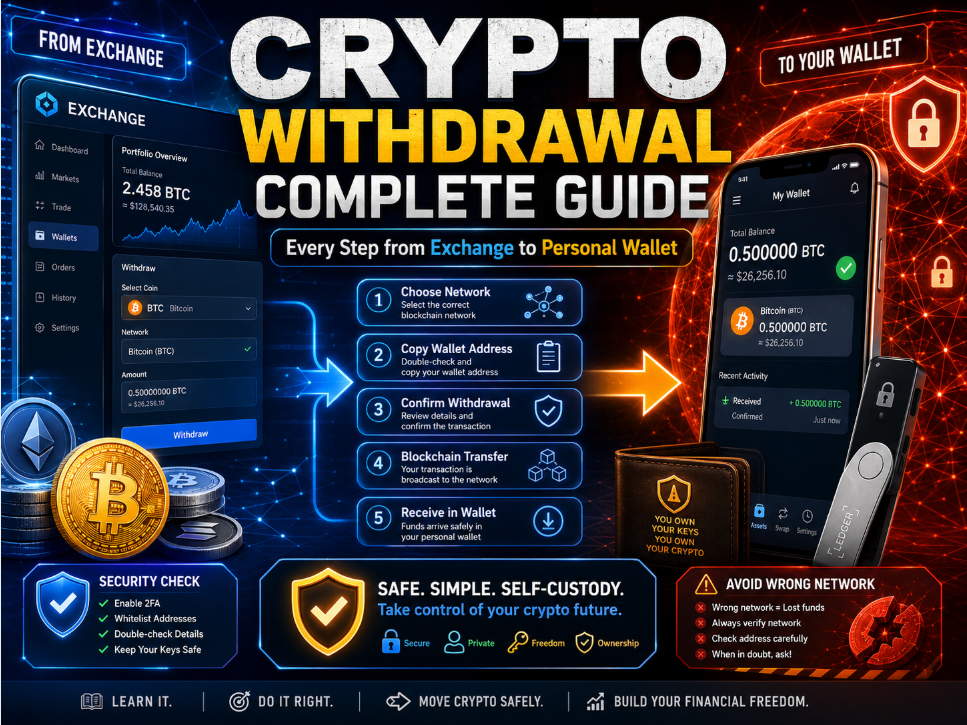
In a way that beginners can easily grasp, this article will comprehensively explain the entire withdrawal process from an exchange to a personal wallet, including: why you should not leave your coins on an exchange for the long term, what concepts you must grasp before withdrawing, how to choose a personal wallet, how to complete a withdrawal using HIBT exchange as a case study, how to safely manage your assets after arrival, and the 10 most common errors newcomers make.
Risk Warning: This article is for cryptocurrency foundational knowledge popularization only and does not constitute investment advice, tax advice, or legal advice. Regulatory policies for digital assets vary across countries and regions. Specific operations should be guided by local laws, official exchange rules, and your personal risk tolerance.
Part 1: Why You Cannot Keep Your Coins on an Exchange Forever
When many newcomers buy coins for the first time, they naturally think: Since I bought them on the exchange, I might as well leave them there. It makes it convenient to check prices and trade, and saves me the trouble of managing a wallet.
This thought is not entirely wrong. For short-term traders, users with small capital, or those who buy and sell frequently, keeping a portion of funds on a compliant exchange is indeed more convenient. But if you plan to hold for the long term, or if your asset size grows over time, you must understand a core issue:
Coins left on an exchange are, in essence, kept by the exchange on your behalf—they are not completely managed by you independently.
1.1 Exchanges Are Not Banks—Are Your Coins Truly Yours?
In the traditional banking system, you deposit money into a bank, which is bound by financial regulations and backed by relatively mature deposit insurance, clearing, and compensation mechanisms. However, cryptocurrency exchanges are not equivalent to banks.
When your coins sit on an exchange, what you see is an account balance. You can trade, transfer, place orders, deposit, and withdraw, but you typically do not hold the private key to the on-chain address corresponding to those assets.
In the crypto world, there is a legendary saying:
Not your keys, not your coins.
This means: if you do not own the private keys, you cannot claim that you truly and completely control those coins.
The private key is the absolute core of control over on-chain assets. Whoever holds the private key can sign and transfer transactions. The balance in an exchange account is merely a record of your asset rights in the platform's database, not proof of your direct ownership of the on-chain assets.
This does not mean exchanges are inherently unsafe; rather, you must recognize that exchange custody and personal wallet self-custody represent two completely different risk models.
1.2 Real Cases of Exchange Collapses: What Did FTX and Mt.Gox Users Lose?
In the history of the crypto industry, exchange risks are not theoretical—they have manifested as harsh realities multiple times.
FTX was once a premier global cryptocurrency exchange, but it suddenly collapsed in 2022 and subsequently entered bankruptcy proceedings. A massive number of users found themselves unable to withdraw their funds normally, leaving their assets frozen within the platform. Even though later bankruptcy liquidation brought some compensation progress, users had to endure a prolonged period of deep uncertainty.
Mt.Gox is a classic example from an even earlier era. It was once one of the largest Bitcoin trading platforms globally, but it went under in 2014 due to the loss of a massive amount of BTC and severe management failures. Many users had to wait for years before any reimbursement arrangements were gradually rolled out.
These cases teach us a brutal truth:
When your assets are completely custodied on a platform, you face not only price volatility, but also platform operational risks, hacker risks, liquidity crunches, compliance risks, and bankruptcy liquidation risks.
1.3 Under What Conditions Can You Keep Capital on an Exchange? When Must You Withdraw?
Not all assets need to be pulled into a personal wallet immediately. A more rational approach is to manage your funds in tiers based on their intended use.
You can keep a portion of your assets on an exchange if you fit the following scenarios:
- Your capital is relatively small, and you are just starting out to learn the ropes;
- You need to trade frequently and prioritize buying and selling efficiency;
- You regularly utilize trading features like contracts, spot trading, or grid bots;
- You have not yet mastered the proper way to back up mnemonic seed phrases;
- You are utilizing a mainstream, compliant platform with robust risk management.
However, you should seriously consider withdrawing your coins if you fit these scenarios:
- You plan to hold assets like BTC, ETH, LTC, or DOT for the long term;
- The asset amount on a single platform has exceeded a threshold of loss you can reasonably bear;
- You have no intention of trading frequently;
- You worry about your exchange account being compromised, frozen, or restricted from withdrawals;
- You want to participate in the on-chain ecosystem, such as DeFi, staking, cross-chain protocols, or NFTs;
- You desire true, absolute ownership and control over your assets.
For instance, if you are researching long-term hold assets, you can look into the core fundamentals of different coins first. Readers interested in Litecoin can read HIBT’s guide "What is LTC?" ; if your focus is on cross-chain ecosystems and Polkadot, you can check out "What is DOT?" .
1.4 What Risks Does "Not Your Keys, Not Your Coins" Actually Imply?
This phrase is not meant to scare everyone into withdrawing every single coin immediately, but rather to remind you of the boundaries of asset control.
- If your coins are on an exchange, your primary risks are:
- Platform halting withdrawals;
- Account theft or phishing attacks;
- Account restrictions triggered by exchange risk controls;
- Platform technical failures;
- Platform bankruptcy or suffering a hacker exploit;
- Regulatory shifts impacting service availability.
- If your coins are in a personal wallet, your primary risks are:
- Losing your mnemonic seed phrase;
- Private key exposure or leakage;
- Transferring to the wrong address or selecting the wrong network;
- Granting permissions to a malicious contract;
- Downloading a fake wallet application;
- Malware or viruses infecting your phone or computer.
Therefore, withdrawing coins does not mean you become "absolutely safer"—it simply means you shift the risk from "platform risk" to "personal management risk."
The mature approach is to keep short-term trading funds on an exchange, move long-term holdings to a personal wallet, use small-balance hot wallets for daily activities, and secure large capital in cold storage for the long haul.
Part 2: Foundational Concepts You Must Grasp Before Withdrawing
Many withdrawal accidents happen not because hackers possess sophisticated techniques, but because users misinterpret foundational concepts. Misunderstanding words like address, network, private key, seed phrase, and gas fees can directly result in permanent asset loss.
2.1 What Is the Relationship Between Public Keys, Private Keys, and Seed Phrases?
You can think of a wallet as a "tool to control assets," but what truly matters is not the wallet app itself, but the private keys and seed phrases running behind it.
To put it simply:
- Public Key: Think of it as the foundational information used to generate your address;
- Wallet Address: The receiving address you share with others when they want to send you funds;
- Private Key: The core cryptographic credential used to authorize and control outgoing asset transfers;
- Mnemonic Seed Phrase: Usually a sequence of 12 or 24 English words that can restore your entire wallet and all corresponding private keys.
Many newcomers believe "the wallet app is the wallet." It is not. The true wallet is not the app living on your phone, but the seed phrase and private key you hold. MetaMask, Trust Wallet, OKX Wallet, and Ledger Live are merely management interfaces. As long as you possess the correct seed phrase, even if your phone vanishes, you can instantly restore your wallet on a fresh device. Conversely, if your seed phrase is lost, even if your wallet app is still open on your screen, you may lose the ability to recover your assets.
Therefore, the very first step before initiating a withdrawal is not copying an address, but confirming: Have you securely backed up your mnemonic seed phrase offline?
2.2 On-Chain Addresses vs. Exchange Addresses: Why Can't You Mix Them Up?
An exchange address and a personal wallet address look like similar strings of characters on the surface, but their management logic is entirely different.
For a personal wallet address, you generally control the private key. Once the coins hit this address, as long as you have the seed phrase, you can manage them as you please.
An exchange deposit address, on the other hand, is an address allocated to you by the platform. When you deposit coins into it, the platform's system detects the transaction and credits your internal account balance. The private key behind this address is held by the exchange.
Thus, never loosely treat a "previously used address" as a universal address. Addresses can differ significantly across different exchanges, tokens, and networks. This is especially true for USDT, which can exist across multiple networks including ERC-20, TRC-20, BEP-20, Polygon, and Arbitrum. The address formats can look nearly identical sometimes, but if the networks do not match, the asset could disappear.
2.3 What Is a Mainnet? Why Does Choosing the Wrong Network Make Coins Vanish?
A mainnet can be understood as an independently operating blockchain network. For example:
- Bitcoin mainnet is dedicated to BTC;
- Ethereum mainnet handles ETH and ERC-20 tokens;
- Tron mainnet is commonly used for TRC-20 USDT;
- BNB Smart Chain is widely used for BEP-20 tokens;
- Polkadot mainnet is for DOT;
- Litecoin mainnet is for LTC.
When withdrawing, the exchange will almost always require you to select a network. This step is absolutely critical.
For instance, say you want to withdraw USDT to a wallet. If your receiving wallet address supports TRC-20 USDT but you select the ERC-20 network on the exchange, the assets will fail to arrive normally. In rare instances, assets might be recovered through complex technical interventions, but the process is highly convoluted, costly, and success is never guaranteed.
The ultimate safety principle is: The withdrawal network must perfectly match the network supported by the receiving wallet. Do not just look at the token name. USDT is simply the name of the asset; ERC-20, TRC-20, and BEP-20 are the real underlying on-chain networks.
2.4 Gas Fees / Transaction Fees: What Is the Fee Logic of Each Chain?
Withdrawals typically involve two categories of fees:
- The first category is the exchange withdrawal fee: This is the execution cost charged by the exchange to process your withdrawal, which is usually clearly displayed right on the withdrawal page.
- The second category is the on-chain Gas fee: This is the cost required by the blockchain network to process transactions. The fee logic varies significantly across chains.
- The BTC network fee is dictated by the number of UTXOs and network congestion;
- The ETH network Gas fee is heavily tied to on-chain traffic, and can become quite expensive during peak times;
- TRC-20 USDT usually incurs a lower transaction fee, though it also depends on platform rules;
- Networks like BSC, Polygon, and Arbitrum are typically much cheaper than the Ethereum mainnet;
- Mainnets like DOT and LTC have their own specific transaction fee mechanics.
For beginners, you do not need to master all the underlying architecture right away, but you must remember two things:
- Double-check the fee displayed on the page before hitting confirm;
- Never blindly choose an unfamiliar network just to save a few pennies on transaction fees. Network compatibility always trumps a low fee.
2.5 UTXO Model vs. Account Model: Why Are BTC and ETH Withdrawals Different?
BTC and ETH employ different models on-chain.
- BTC uses the UTXO model: You can think of it as a collection of "unspent receipts." Every time a transfer occurs, the system aggregates these receipts and outputs a fresh balance.
- ETH uses the Account model: It mirrors a standard bank account system where each address holds a balance ledger. When a transfer happens, funds are directly deducted from one account and added to another.
This explains why BTC transfers and ETH transfers deviate in terms of fee calculations, confirmation styles, and address management. As an everyday user, you don’t need to be a blockchain developer, but you must realize that different tokens do not run on the same system, and withdrawal rules across chains cannot be mixed up.
Part 3: How to Choose a Personal Wallet? A Realistic Comparison of Hot vs. Cold Wallets
Before withdrawing your coins, you must possess a receiving wallet. Your choice of wallet shouldn't be based on blind trend-following; it should match your asset size, usage frequency, and technical familiarity.
3.1 Software Wallets: Who Are They Suitable For?
Software wallets are also known as hot wallets, with common examples being MetaMask, Trust Wallet, and OKX Wallet.
- Pros: Highly convenient, free to install, ideal for routine transfers, supports multi-chain and DeFi interactions, and excellent for managing smaller amounts of assets.
- Cons: Vulnerable if your phone or computer gets infected by malware; seed phrases can easily be captured via screenshots, copy-pasting, or leakage; clicking a phishing link can easily authorize a malicious contract; and entirely unsuited for storing large amounts of capital long-term.
If you are just starting to learn how to withdraw or are managing minor sums ranging from a few hundred to a few thousand dollars, a software wallet is a highly appropriate starting point.
3.2 Hardware Wallets: Are They Worth Buying?
Hardware wallets are also known as cold wallets, with leading brands including Ledger and Trezor.
- Core Advantage: The private keys are sealed inside a physical hardware component, completely isolated from any internet-connected environment. Even if your computer gets compromised by malware, attackers face a massive barrier trying to extract the private key directly.
- Suitable For: Users holding large amounts of BTC, ETH, LTC, or DOT long-term; infrequent trading; individuals demanding maximum security; those comfortable with a slight learning curve; and users willing to invest in the upfront cost of purchasing hardware.
However, buying a hardware wallet does not mean you enter a state of absolute safety automatically. You must still back up your seed phrase properly, avoid buying second-hand devices, never use a pre-generated seed phrase that came out of the box, and never type your seed phrase into any website.
3.3 Multi-Sig Wallets: At What Asset Threshold Should You Consider One?
A multi-signature (multi-sig) wallet means a transaction requires authorizations from multiple independent private keys before it can be executed on-chain. For example, a 2/3 multi-sig wallet means there are 3 total keys, and any 2 must sign to successfully execute a transfer.
- Suitable For: Team treasury management, company funds, DAO asset pools, high-net-worth individuals, and anyone who wants to prevent a single point of failure (like losing one private key) from causing absolute asset loss.
If your asset size is still modest, a standard seed phrase wallet or a hardware wallet is perfectly sufficient. If your portfolio hits a value equivalent to several years of your income, or involves funds managed collectively by a team, you should start exploring multi-sig setups.
3.4 What Is the Difference Between Exchange Self-Custody Wallets and Third-Party Wallets?
Some exchanges roll out self-custody wallets as standalone apps. These are entirely distinct from your exchange account.
- Exchange Account: Your assets are managed by the platform under custody; you log in to see a credit balance.
- Self-Custody Wallet: You hold absolute ownership of the seed phrase; neither the platform nor the wallet provider can recover your assets if you lose them.
Third-party wallets like MetaMask or Trust Wallet are also self-custody wallets. The defining difference does not lie in the brand name, but in whether you hold exclusive possession of the seed phrase. As long as the seed phrase is in your hands, you assume absolute responsibility. If it isn't, it is not true self-custody.
3.5 Wallet Selection Matrix
- Beginner Learning
- Asset Scale: Small
- Frequency: Occasional transfers
- Recommended Solution: Software (Hot) Wallet
- Regular Investor
- Asset Scale: Medium
- Frequency: Occasional trading + Long-term holding
- Recommended Solution: Software Wallet + Exchange Tiers
- Long-Term Hodler
- Asset Scale: Large
- Frequency: Seldom trades
- Recommended Solution: Hardware (Cold) Wallet
- DeFi Power User
- Asset Scale: Medium
- Frequency: High-frequency interactions
- Recommended Solution: Hot Wallet + Separate small-balance web3 wallets
- High-Net-Worth Individual
- Asset Scale: Massive
- Frequency: Low-frequency management
- Recommended Solution: Hardware Wallet + Multi-Sig
- Team / Project Team
- Asset Scale: Massive
- Frequency: Multi-person management
- Recommended Solution: Multi-Sig Wallet
The most practical strategy is: one exchange account for active trading, one hot wallet for daily on-chain operations, and one cold wallet for long-term secure storage.
Part 4: Case Study on HIBT Exchange—The Complete Step-by-Step Withdrawal Process
Below is a generic withdrawal workflow utilizing HIBT exchange as a case study. Button labels and interface layouts can vary across platforms, but the fundamental logic remains identical. When executing a real trade, please follow the real-time display on HIBT’s official interface, focusing especially on supported assets, network selections, withdrawal fees, KYC limits, processing times, and risk parameters.
4.1 What Kind of Platform Is HIBT? Who Is It For?
HIBT is a comprehensive trading platform designed for cryptocurrency users, making it highly suitable for individuals who need to perform spot trading, deposits, buying, withdrawing, and asset management. For beginners, the core value of an exchange lies in:
- Easily purchasing mainstream crypto assets;
- Viewing market trends and order book depth;
- Conducting seamless deposit, withdrawal, and exchange operations;
- Converting smoothly between different crypto pairs;
- Understanding foundational token data via the platform's info pages.
If you are unfamiliar with the core logic of specific tokens, it is wise to start your learning journey with mainstream assets. For example, to understand the positioning, history, and traits of Litecoin, you can check out "What is LTC?" at [https://hibt.com/zh-cn/news/48-5614](https://hibt.com/zh-cn/news/48-5614); if your interest lies in cross-chain systems, you can explore "What is DOT?" at [https://hibt.com/zh-cn/news/48-5609](https://hibt.com/zh-cn/news/48-5609).
4.2 Registration and KYC Verification: Steps You Must Clear Before Withdrawing
Most exchanges require users to pass a certain tier of identity verification, known as KYC (Know Your Customer), before granting withdrawal capabilities. The standard flow includes: registering an account, binding an email or phone number, configuring a secure login password, fulfilling identity verification by uploading required identity documents as prompted by the platform, awaiting approval, and enabling multi-factor security verifications before you can unlock seamless deposits, trades, and withdrawals.
The primary intent of KYC is compliance with Anti-Money Laundering (AML), anti-fraud, and account security frameworks. For users, clearing KYC typically unlocks higher withdrawal ceilings and access to more comprehensive account features.
4.3 Purchasing Cryptocurrency on HIBT: Taking USDT / BTC as an Example
Before you can withdraw, you must hold withdrawable assets in your balance. The standard path is:
- Log into your HIBT account;
- Complete a deposit or a fiat-to-crypto purchase;
- Exchange your funds into assets like USDT, BTC, or ETH;
- Confirm that the assets reside in your spot or funding account;
- Verify whether the asset supports external withdrawals;
- Enter the withdrawal page to execute the operation.
Beginners are highly encouraged to start their learning with highly liquid assets like USDT or BTC. Avoid experimenting with niche chains, exotic tokens, or complex cross-chain assets right out of the gate, as they present far more network compatibility pitfalls.
4.4 Pre-Withdrawal Security Configuration: Why You Must Bind Google Authenticator
Prior to initiating any withdrawal, it is strongly advised to configure the following security parameters:
- Bind a secure email;
- Bind a verified mobile number;
- Enable Google Authenticator (2FA);
- Configure a unique funding password;
- Turn on an anti-phishing code;
- Activate a withdrawal address whitelist;
- Check active login devices periodically;
- Never log into your exchange account on public computers.
While SMS codes are convenient, they are exposed to risks like SIM-swapping, SMS interception, and carrier vulnerabilities. Google Authenticator or other time-based one-time password (TOTP) tools offer significantly superior protection. For high-risk operations like withdrawals, relying purely on SMS verification is highly discouraged.
4.5 Withdrawal Address Whitelist: Why You Should Run a Small Test First
A withdrawal address whitelist is an exceptionally practical security feature. Once turned on, the platform restricts withdrawals exclusively to addresses that have been pre-verified and added to the whitelist. This helps prevent assets from being drained to a stranger's address if your account is compromised, reduces the hazard of copying an incorrect string, forces you to double-verify addresses before large transfers, and upgrades your long-term asset management safety.
When transferring to an address for the first time, no matter how confident you feel, always run a small test transfer first. For example, if you intend to withdraw 1,000 USDT, send 10 USDT (or the platform’s minimum allowed amount) first. Once you confirm it has safely landed in your receiving wallet, proceed to transfer the remaining balance. This minor step can save you from a catastrophic loss of your entire capital.
4.6 Step-by-Step Execution: From the "Withdraw" Button to On-Chain Confirmation
- Step 1: Enter the Assets Page
- Log into HIBT, navigate to the "Assets" or "Wallet" page, locate the asset you wish to extract (e.g., BTC, ETH, USDT, LTC, DOT), and click "Withdraw".
- Step 2: Select the Specific Asset
- Verify that you have selected the exact asset you intend to move. Never misread token names; USDT, USDC, USD, and TUSD are entirely separate assets, LTC and BTC utilize completely distinct networks, and DOT cannot be randomly sent to addresses on other chains.
- Step 3: Choose the Network
- This is the most critical juncture. Taking USDT as an example, common networks include:
- ERC-20: The Ethereum network, boasting elite security and an expansive ecosystem, but Gas fees can scale quite high;
- TRC-20: The Tron network, widely supported across exchanges and known for generally low transaction fees;
- BSC / BEP-20: BNB Smart Chain, offering low fees, but you must ensure your receiving wallet explicitly supports it;
- Polygon, Arbitrum, Optimism: Ideal options for users fully accustomed to those respective Layer-2 environments.
- When picking a network, you must verify that HIBT's withdrawal page supports it AND your receiving wallet supports the exact same network. If there is any mismatch, abort the operation.
- Step 4: Copy and Paste the Receiving Address
- Copy the receiving address directly from your personal wallet and paste it into HIBT’s withdrawal address field. Crucial precautions:
- Never manually type out the address string;
- Once pasted, carefully verify the first 6 and last 6 characters;
- Watch out for clipboard hijacking malware;
- Never copy addresses shared via chat apps or social media;
- Avoid entering addresses through links embedded in emails;
- Never scan an unfamiliar QR code.
- Clipboard hijacking is a highly prevalent attack method. You copy your genuine address, but upon pasting, malware stealthily swaps it with a hacker's address. Always review the pasted text.
- Step 5: Input the Withdrawal Amount
- Enter the amount you wish to extract. The page will typically display your available balance, the withdrawal fee, the net amount that will arrive, the minimum withdrawal limit per transaction, your daily remaining quota, and the estimated processing window. Do not just look at the input amount; pay close attention to the final net amount to ensure smaller transfers are not rendered inefficient by fixed network fees.
- Step 6: Confirm the Fee Tier (If Available)
- Some platforms offer options to select different fee tiers (e.g., Fast, Standard, Slow). If you are in a rush, pick a higher tier; if not, standard is fine. Beginners should avoid obsessing over pushing fees to the absolute absolute floor, as underpaying network fees during heavy congestion can leave your transaction stuck in limbo. If the platform uses a flat default fee, proceed with the default.
- Step 7: Fulfill Multi-Factor Authentication
- Upon submitting the request, the platform will prompt you to clear security verifications, which may include an email verification code, an SMS code, a Google Authenticator token, your funding password, or explicit email confirmations. Never click links inside strange emails; if a withdrawal verification is required, always navigate to the verification page via HIBT’s official app or site interface.
- Step 8: Monitor On-Chain Confirmation
- Once cleared, the exchange will process and broadcast your transaction to the blockchain. Once broadcasted, you will be provided with a transaction hash, known as a TxID. This TxID serves as your unalterable proof and receipt to track the live status of your transfer on the public ledger.
4.7 How Long Does It Take to Arrive? How to Track Status via Blockchain Explorers?
Arrival times are dictated by three variables: the exchange’s internal review speed, the real-time congestion of the blockchain network, and the block confirmation count required by the receiving wallet or platform.
- BTC typically demands multiple block confirmations;
- ETH and ERC-20 speeds are bound to Gas dynamics;
- TRC-20 USDT is generally quite swift;
- Niche chains can occasionally run into node synchronization delays.
You can copy your TxID and paste it into the appropriate public blockchain explorer to inspect its exact live status:
- For BTC, use a BTC Block Explorer;
- For ETH / ERC-20, use Etherscan;
- For TRC-20, use Tronscan;
- For BSC, use BscScan;
- For Polygon, use Polygonscan;
- For DOT, use Polkadot Explorer;
- For LTC, use Litecoin Block Explorer.
If the explorer marks the transaction as "Success" but your wallet balance remains unchanged, verify if you need to manually add that specific token contract to your wallet's display list, or check if the wallet app's node is experiencing a synchronization lag. If the explorer returns no records at all, the exchange has likely not broadcasted the transaction yet, or the TxID copy was flawed.
4.8 Common Error Codes: 5 Reasons Why Withdrawals Fail
- Network Selection Error: Abort immediately, contact platform customer support, and meticulously verify if your receiving wallet supports that exact chain.
- Address Format Error: Re-copy the destination string and ensure the token asset matches the chosen network archetype.
- Insufficient Withdrawal Quota/Balance: Check the minimum limits and the transaction fee deductions to make sure your net balance covers the operational requirements.
- Account Security Lockout: Check if you have recently reset your account password, deactivated an authenticator, updated a phone number, or triggered an automated risk flag (which often imposes a temporary 24-hour withdrawal freeze).
- Network Congestion or Mainnet Maintenance: Patiently wait for the platform to conclude its system maintenance or for network traffic to recede, or shift to another mutually compatible network option if available.
Part 5: How to Safely Manage Assets in Your Personal Wallet After Arrival
Clearing the withdrawal is merely the opening phase. The true test of your capability is whether you can preserve this capital over the long term. A massive volume of asset losses occurs not during the withdrawal event itself, but afterward due to compromised seed phrases, interaction with malicious contracts, or installing corrupted wallet clones.
5.1 The Ironclad Rules for Backing Up Seed Phrases
Your mnemonic seed phrase is the ultimate master key to your entire crypto footprint.
- The Right Way: Write it down by hand using a pen and paper completely offline. Double-check every single character and spelling order immediately. Store the physical paper in separate, secure, waterproof locations. Never take a digital photo of it. Never screenshot it. Never share it via message apps. Never save it on Google Drive, iCloud, emails, or cloud storage. Never type it into an unfamiliar website, and never give it to anyone claiming to be "customer support."
- The Wrong Way: Saving a screenshot in your phone's photo library, sending it to your own chat app history, typing it into a
.txtfile on your computer desktop, syncing it to cloud services, keeping it in your clipboard, providing it to a "helpful agent" for verification, or entering it into an unverified wallet recovery site.
Remember one absolute rule: anyone who obtains your mnemonic seed phrase can instantly drain every single asset out of your wallet.
5.2 The Tiered Wallet Management Strategy
Divide your crypto footprint into three distinct tiers to minimize exposure:
- Tier 1: Exchange Accounts: Utilized for short-term trading, instant spot conversions, executing orders, and immediate liquidity needs.
- Tier 2: Daily Hot Wallets: Utilized for smaller transactions, interacting with web3/DeFi dApps, minting NFTs, and testing out fresh ecosystems.
- Tier 3: Long-Term Cold Storage: Dedicated exclusively to storing major stakes of BTC, ETH, LTC, or DOT long-term. This wallet should never connect to any dApp websites, and should never grant contract authorizations.
This tiered structure ensures that even if your daily hot wallet falls prey to a malicious contract exploit, your core long-term cold holdings remain completely insulated.
5.3 How to Verify If an On-Chain Transaction Has Truly Arrived?
Certain sophisticated scams deploy modified wallet apps that display fraudulent balances, or send fabricated deposit screenshots to deceive users. The only source of truth is the public blockchain explorer. To verify a transaction, inspect the ledger to confirm:
- The destination address matches yours perfectly;
- The transaction hash (TxID) exists validly on the public chain;
- The transaction status is marked as an absolute success;
- The block confirmation count has cleared safety thresholds;
- The token's smart contract address matches the official token perfectly;
- The exact asset volume and chosen network align flawlessly.
If the public chain explorer displays no record of the transfer, do not trust any screenshot or application interface claiming the funds have "already been sent."
5.4 What to Do If Your Wallet App Is Deleted or Your Phone Breaks?
If your mobile device breaks, breaks down, or vanishes, as long as you retain secure possession of your paper seed phrase, your capital is perfectly safe. The restoration sequence is:
- Secure a clean, uncompromised new hardware device;
- Download the official wallet application from verified sources;
- Select "Import Wallet" or "Recover using Seed Phrase";
- Input your words carefully in the precise original sequence;
- Configure a fresh local access password;
- Verify that the generated address matches your original address;
- If your custom tokens do not populate automatically, manually import the correct smart contract address to restore their visibility.
Warning: When restoring wallets, remain hyper-vigilant about downloading authentic apps. Never click on search engine advertisement listings, as malicious phishing operations frequently buy ad placements to masquerade as official wallet providers.
5.5 Wallet Security Best Practices in DeFi Interactions
If you interact with DeFi platforms, automated market makers, NFT marketplaces, or cross-chain bridges, you must master the concept of "Token Approvals." Many smart contracts require you to grant them an allowance to spend your tokens. If you inadvertently sign an approval for a compromised or malicious contract, it can drain your wallet balance at a later date.
- Never connect your tier-3 long-term storage wallet to unfamiliar dApp sites;
- Read exactly what you are signing; never blindly sign transactions;
- Avoid granting "Infinite Allowances"; set spending caps manually;
- Review and revoke active smart contract approvals regularly using tools like Revoke.cash;
- Use isolated, low-balance hot wallets to test out experimental dApps.
Part 6: Taxation and Compliance Nuances in Asset Withdrawals
Moving assets from an exchange to a personal self-custody wallet may look like a simple balance transfer, but tax authorities and regulatory bodies across different jurisdictions can interpret these movements differently. This chapter serves as a high-level educational overview and does not constitute formal tax or legal counsel.
6.1 Does the Act of Withdrawing Wealth Trigger a Tax Event?
In most tax jurisdictions, simply moving cryptocurrency from an exchange account owned by you to a personal self-custody wallet owned by the exact same individual is viewed as a self-transfer, meaning it is generally a non-taxable event because no disposal or sale occurred.
However, you must remain mindful of actions that do trigger tax events:
- Selling crypto for fiat currency;
- Swapping one cryptocurrency directly for another (e.g., trading BTC for ETH);
- Utilizing crypto to purchase real-world goods or services;
- Earning yields through staking, lending, or on-chain mining protocols;
- Receiving airdrops or protocol rewards;
- Moving funds across multiple un-linked platforms, which can make it exceptionally difficult to prove your original cost basis later on.
While the pure act of extraction is usually not a taxable trade, the downstream transactions, swaps, and rewards generated by those assets often entail rigorous tax reporting mandates.
6.2 High-Level Overview of Regional Regulatory Climates
- Mainland China: Maintains a strict prohibition against cryptocurrency trading and associated derivatives financial activities. Individuals must closely observe local policy boundaries and avoid any engagement in illicit trading, unauthorized public financing, money laundering, or high-risk peer-to-peer fiat handling actions.
- Hong Kong: Actively establishing a clear regulatory architecture for virtual asset trading platforms, with heavy policy emphasis centered on mandatory licensing frameworks and robust retail investor protection.
- Singapore: Implements clear licensing mandates for digital payment token services under the Monetary Authority of Singapore (MAS) and provides formal guidelines regarding crypto taxation. Both individuals and entities must cleanly categorize actions into capital investments, active trading, or business operations.
- United States: The IRS treats digital assets strictly as property and imposes comprehensive reporting obligations. Every sale, token swap, income reward, or commercial use must be tracked with its exact cost basis and declared on annual tax filings.
6.3 How to Maintain Pristine On-Chain Records for Future Tax Reporting?
Regardless of your current local tax reporting obligations, developing meticulous logging habits is highly recommended. Ensure you preserve:
- Comprehensive exchange order history logs;
- Historical deposit and withdrawal timestamps;
- Accurate TxIDs for every on-chain movement;
- Public wallet addresses involved;
- Exact asset volumes and native asset values at the precise time of the transaction;
- Transaction and network fees paid;
- The explicit purpose of each transfer.
Should you eventually be required to verify the source of your funds, compute capital gains, or satisfy an official tax audit, these organized records will prove invaluable.
6.4 Legal Risks of Using Crypto Mixers or Privacy Tokens
Crypto mixers, coin joiners, and anonymous privacy tokens are designed to obscure transactional traces. However, because they are heavily utilized by illicit actors for money laundering, global regulators and compliance frameworks look upon their usage with extreme suspicion.
Average retail users are strongly discouraged from interacting with complex mixing tools simply to "hide their footprints." If you trigger compliance flags and find yourself unable to clearly explain the origin and destination of your capital to financial institutions or exchanges, you run a severe risk of having your accounts blacklisted, assets frozen, or facing legal scrutiny.
The safest path is always to utilize reputable exchanges, preserve transparent transaction logs, reject funds from unverified or unknown origins, and steer clear of "high-yield arbitrage" or "asset cleaning" schemes.
Part 8: Ten Common Withdrawal Mistakes Newcomers Make and How to Avoid Them
- 7.1 Withdrawing ERC-20 USDT to a TRC-20 Address: One of the most prevalent errors. USDT can live across multiple chains, but these chains are not automatically cross-compatible. You must confirm that the network you select on the exchange matches the network configuration of your receiving wallet perfectly.
- 7.2 Skipping the Small Test Transfer on First-Time Withdrawals: Moving a massive lump sum to a new address without verifying the pipeline is an incredibly reckless habit. Always send a small test amount, confirm its arrival in your wallet tracker, and only then proceed with the remaining balance in controlled batches.
- 7.3 Executing Withdrawals Over Public Wi-Fi Networks: Public Wi-Fi spots leave you exposed to man-in-the-middle packet sniffer attacks, router traffic redirections, and malicious DNS spoofing. Always conduct sensitive financial transactions over a private, encrypted home network or via your mobile cellular data.
- 7.4 Clicking "Withdrawal Confirmation Links" via Emails or Chat Apps: Phishing operations frequently construct brilliant imitations of exchange notices to harvest your credentials. Never follow links inside suspicious emails, Telegram chats, or Discord channels to authorize actions. Manually enter the official exchange domain name in your browser or operate directly inside the official mobile app.
- 7.5 Storing Photos of Seed Phrases on Cloud Services: Uploading a snapshot of your seed words to an iCloud account, Google Photos library, or a mobile note-taking app exposes your entire portfolio to automated scrapers if your cloud credentials are ever compromised. Keep your backup strictly analog—written on paper or stamped in metal, kept entirely offline.
- 7.6 Downloading Wallets from Unverified Search Engine Results: Fake wallet variants buy sponsored advertisement slots at the top of Google or Bing search queries to trick users into downloading lookalike apps that automatically steal deposited capital. Always verify the domain name, utilize official app store links from the native project site, and never install standalone
.apkfiles sent by individuals. - 7.7 Routeing Withdrawals Directly Into a DeFi Smart Contract Address: Certain smart contracts are designed to receive interactions, not standard deposits. If you withdraw tokens directly from an exchange into a dApp contract address that isn't configured to attribute incoming funds to an account ledger, your coins can become permanently locked in the contract code. Always withdraw to a wallet address you own and control first.
- 7.8 Falling for "Customer Support Wallet Verification" Scams: Anyone reaching out to you online claiming they need you to "verify your wallet," "sync your nodes," or input your seed phrase into an external interface to unlock a pending transfer is a scammer. Real customer support personnel will never, under any circumstances, ask for your private key or seed phrase.
- 7.9 Neglecting Hardware Wallet Firmware Updates Over Long Periods: Hardware wallet architectures require maintenance to defend against freshly uncovered security vulnerabilities and maintain network compatibility. Only update firmware via the official desktop suite software (e.g., Ledger Live), and always verify that your paper seed backup is physically in your hands before hitting the update button.
- 7.10 The Pre-Withdrawal Ultimate Checklist: Run through this list before clicking confirm every single time:
- Is the token type correct?
- Is the selected chain network correct?
- Am I 100% certain the destination address is under my direct control?
- Have I manually verified the first 6 and last 6 characters of the pasted address?
- Have I checked the transaction fee impact?
- Does the size clear the platform's minimum withdrawal floor?
- Is my Google Authenticator active and functioning?
- Am I utilizing a whitelisted address?
- Did I perform a small test transaction first?
- Have I documented the TxID?
- Did I check the public blockchain explorer to confirm the state of the transfer?
- Is my mnemonic seed phrase securely backed up offline?
- Am I operating on a secure, private internet connection?
- Have I verified that my wallet application is an authentic, official version?
- Have I kept my seed phrase completely secret from everyone?
Conclusion: Withdrawal Is a Foundational Asset Security Capability
One of the greatest virtues of cryptocurrency is that it grants individuals the power to hold absolute, unmediated control over their wealth. However, this absolute freedom carries absolute responsibility.
Keeping your coins on an exchange offers great convenience, but you assume platform operational and custody risks. Shifting your coins to a personal self-custody wallet grants you raw ownership of your private keys, but shifts the absolute burden of security onto your own shoulders.
Thus, a mature crypto user should avoid binary thinking. Do not look at the landscape as "keep everything on exchanges" or "move everything to wallets." Instead, adopt a smart, tiered approach:
- Utilize exchanges to process fast trades and maintain short-term liquidity;
- Utilize hot wallets to test out daily web3 and on-chain dApp movements;
- Utilize cold storage devices to lock away core long-term capital assets;
- Run small test transfers to minimize the cost of human error;
- Keep your seed phrase backed up offline to preserve the ultimate master control.
If you are just step-stepping into the crypto arena, give yourself room to master mainstream assets and basic transfers first. Beyond studying BTC, ETH, and USDT, continue expanding your horizon by learning the unique network mechanics of alternative assets like LTC and DOT.
A truly sophisticated cryptocurrency participant doesn't just watch chart trends, buy tokens, or chase speculative hype; they possess the core discipline required to safeguard their wealth securely. Learning how to withdraw coins properly is your very first step away from being a mere exchange user and moving toward becoming a sovereign, self-custody participant.
FAQ: Frequently Asked Questions About Cryptocurrency Withdrawals
1. What exactly does "withdrawing cryptocurrency" mean?
Withdrawing cryptocurrency means transferring your digital token assets out of an exchange platform's custody account and sending them to an external location, such as a personal self-custody wallet, a hardware wallet, or a deposit address hosted on another exchange. To put it simply: you are moving your funds off the exchange's internal database ledger and settling them onto a specific destination address directly on the live blockchain network.
2. What is the difference between a withdrawal and a standard transfer?
From a technical standpoint, a withdrawal is fundamentally an on-chain transfer. The distinction lies in the context: a withdrawal specifically defines the act of moving assets out of a centralized exchange's custody system to an external address. A transfer is a broader term that applies to any moving of assets—wallet-to-wallet, exchange-to-wallet, or internal accounting shifts. For example, moving funds internally from your HIBT Spot Account to your HIBT Funding Account is an internal transfer; it does not touch the public blockchain ledger and generates no on-chain TxID.
3. Do I absolutely have to use a personal wallet when withdrawing?
No, you can route a withdrawal to any external address that is fully compatible with the specific token and network you are using. This can be your personal hot wallet, a cold storage hardware address, a multi-sig vault, or the designated deposit address of a completely different exchange platform. However, if your long-term objective is autonomous asset preservation and independent control, you should always favor sending funds to a self-custody wallet where you hold exclusive ownership of the seed phrase.
4. What are the absolute most vital parameters to double-check during a withdrawal?
You must verify three elements flawlessly:
- The Token Asset: Ensure you are moving the exact token you intend to select (e.g., do not confuse USDT with USDC, or BTC with LTC).
- The Network Chain: Ensure the network pipeline selected on the exchange matches the exact chain standard supported by the receiving wallet (e.g., ERC-20 vs. TRC-20 vs. BEP-20).
- The Destination Address: Never type this string out manually; copy it directly and rigorously verify the initial and final characters to rule out clipboard modification malware.
- Any mistake across these three steps will likely result in a permanent, irrecoverable loss of your assets.
5. Why is a small test transfer so heavily recommended for beginners?
Blockchain transactions are structurally irreversible. Once a transaction is validated and broadcasted onto the network by nodes, an exchange possesses zero technical capacity to recall or undo the transfer. If you sent the capital to an incorrect string or an incompatible network, the funds are gone. Running a tiny test transfer first allows you to verify that the path is clear, the network is correct, and the wallet interface displays the arriving balance accurately before risking your entire capital stack.
6. Is there a simple rule of thumb or memory phrase for withdrawals?
You can commit this simple mantra to memory: Test small before sending big; check the token asset, then verify the chain; match the network, audit the string; seed phrases live strictly offline, and real customer service never asks for your private key. Adhering to these core principles will keep you insulated from the vast majority of common beginner withdrawal mistakes.
Disclaimer
The contents of this article are intended strictly for cryptocurrency foundational knowledge popularization and operational workflow explanations and do not constitute investment advice, trading advice, financial advice, tax advice, legal counsel, or asset custody recommendations.
Cryptocurrencies are high-risk financial assets subject to intense price volatility. Before buying, holding, trading, withdrawing, transferring, or utilizing on-chain wallets, users must thoroughly evaluate associated risks and make entirely independent judgments aligned with their financial standing, risk threshold, and local legal frameworks.
Exchanges, wallets, blockchain networks, token symbols, and digital tools mentioned in this text serve exclusively as illustrative examples and do not represent a formal recommendation, endorsement, or structural guarantee of any platform or project. Deposit parameters, withdrawal policies, KYC thresholds, transaction fees, block confirmation speeds, and safety guidelines vary across platforms and are subject to immediate adjustment; users must refer to the live official pages and announcements of the respective systems before operating.
On-chain transfers are mathematically irreversible. If a user experiences asset loss due to copying an incorrect destination address, picking an incompatible network, failing to input a required Memo/Tag, exposing private keys or seed phrases, downloading counterfeit wallet software, or authorizing a malicious smart contract, such losses are typically impossible to recover. Users must bear all operational risks independently.
Regulatory frameworks, tax declaration mandates, trading prohibitions, and capital transfer boundaries concerning digital assets vary drastically across global jurisdictions. Users are fully responsible for proactively educating themselves on and complying with the prevailing laws of their home country or region. If needed, please consult with qualified legal, tax, or financial advisory professionals. HIBT and the authors of this guide assume no liability for any investment, trade, withdrawal, wallet management action, or downstream consequence performed by users based on this content. Proceed with caution and never risk capital beyond your means.