
Data Verification Date: July 13, 2026 (UTC+8)
This article is for informational research and risk education only and does not constitute investment advice. SUSHI is a highly volatile DeFi asset; its price is influenced by crypto market cycles, DEX trading volume, SushiSwap ecosystem development, token unlocks, protocol revenue, competitive landscape, and on-chain liquidity, among other factors. Please conduct independent judgment based on your own risk tolerance before investing.
I. Opening: Why Are Investors Still Watching SUSHI?
Many newcomers to crypto search for SUSHI and usually have one question: Is SUSHI already an outdated DeFi token? Why does anyone still care?
That question is very real.
SUSHI was indeed one of the star projects of the last DeFi Summer. It first gained market attention for liquidity mining, decentralized trading, community governance, and its adaptation of the Uniswap model. Although it later experienced team controversies, governance adjustments, intensified competition, and significant price drawdowns, SUSHI remains an unavoidable asset in DeFi history.
According to Sushi’s official documentation, Sushi, also commonly known as SushiSwap, is a decentralized finance platform whose best-known product is the automated market maker (AMM); it emerged in 2020 as a community-driven fork of Uniswap and introduced additional staking features and governance options through the SUSHI token. As it evolved, Sushi has expanded into a DeFi ecosystem encompassing an aggregator, AMM, staking mechanisms, and more.
So, discussing SUSHI today is not simply asking whether an “old coin will bounce back,” but rather: Is DeFi still poised for a recovery? Are DEXs still on-chain financial infrastructure? Can SushiSwap find its footing again amid fierce competition?
1.1 What Is SUSHI? One Sentence to Understand Its Position
In one sentence: SUSHI is the native token of the SushiSwap ecosystem, primarily used for governance, ecosystem incentives, and protocol value capture.
SushiSwap is a decentralized trading protocol where users do not need to hand assets over to a centralized exchange for custody; instead, they can connect their wallet to a smart contract and complete token swaps, provide liquidity, earn fees, or participate in governance on-chain.
This is fundamentally different from centralized exchanges.
The centralized exchange flow is:
User registers an account
↓
Deposits assets into the exchange
↓
Exchange matches orders internally
↓
User withdraws from the exchange account
The DEX flow is closer to:
User connects wallet
↓
Smart contract reads asset approval
↓
Trade executes through a liquidity pool
↓
Assets return directly to the user’s wallet
Therefore, SUSHI is not exchange stock, nor is it equity in SushiSwap the company. It is a crypto asset within a DeFi protocol, and its value depends more on protocol usage, trading volume, governance mechanisms, incentive models, and the market’s overall risk appetite for DeFi.
1.2 Why Did SushiSwap Once Become a DeFi Summer Icon?
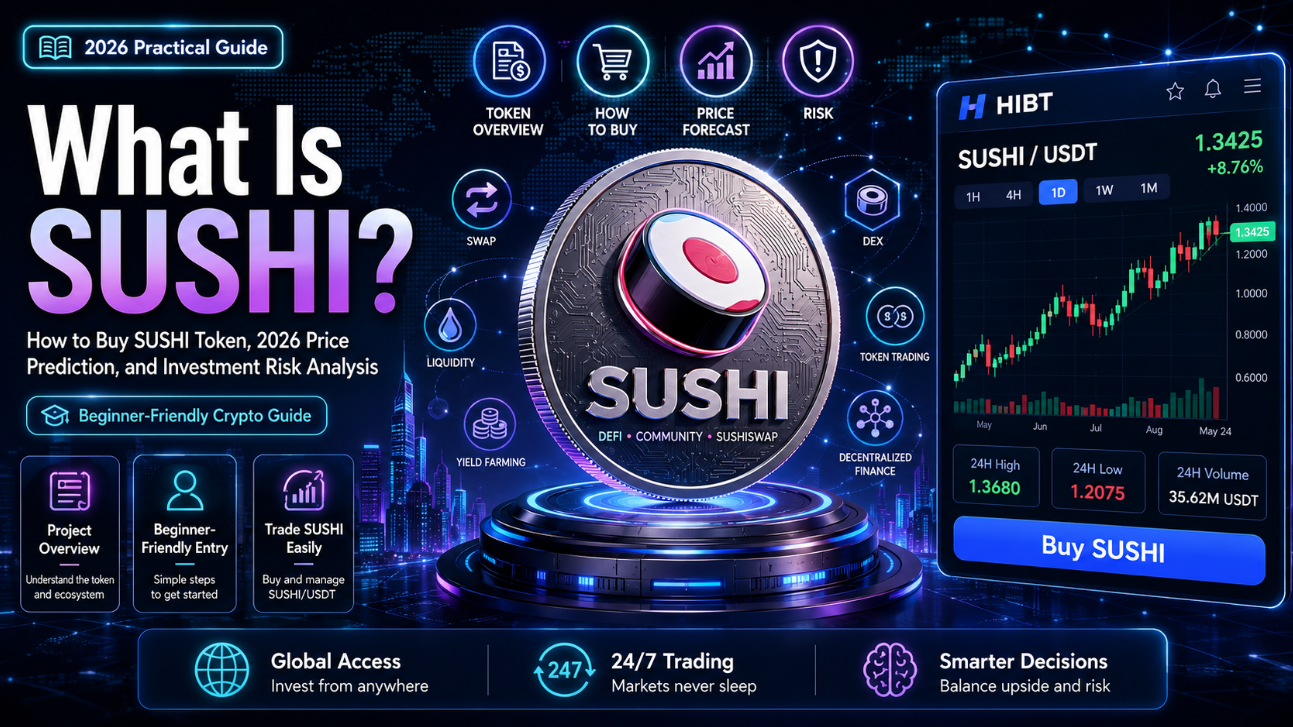
When DeFi Summer erupted in 2020, three major shifts occurred in the market:
First, users began using decentralized exchanges in large numbers.
Second, liquidity mining allowed ordinary users to earn token rewards by providing pool liquidity.
Third, community governance meant users were no longer just traders but could participate in protocol direction decisions.
SushiSwap rose rapidly in this context. Sushi’s official documentation states that SushiSwap launched in August 2020, forked from Uniswap by the anonymous developer Chef Nomi, and quickly gained attention through an incentive system that rewarded liquidity providers with SUSHI governance tokens. Early on, Chef Nomi withdrew development funds, sparking community backlash before returning them; despite the controversy, SushiSwap became one of the most well-known DeFi platforms.
This history is important for newcomers. It shows that SUSHI had strong narratives and a strong community, but also governance and trust crises. Investing in SUSHI cannot be based solely on its past glory; one must also evaluate whether it can regain users, trading volume, and ecosystem growth today.
1.3 What Are the Current Market Focus Points for SUSHI?
Looking at SUSHI again in 2026, the market is mainly focused on four things:
First, whether DeFi is regrowing.
If on-chain trading, lending, derivatives, RWA, stablecoins, and cross-chain trading continue to develop, DEXs remain part of the infrastructure.
Second, whether DEX trading volume is recovering.
SUSHI’s value logic is tied to SushiSwap’s protocol usage. If trading volume remains depressed for a long time, the token’s value-capture capability will be affected.
Third, whether Sushi’s multi-chain and aggregator strategies are effective.
The official documentation notes that Sushi’s aggregator searches multiple decentralized exchanges to find better swap prices for users, aiming to reduce slippage and optimize trade execution.
Fourth, whether SUSHI tokenomics can reduce inflationary pressure and strengthen value capture.
Sushi’s official tokenomics documentation states that SUSHI has no hard total supply cap, but the issuance rate is influenced by community governance; the tokenomics combine liquidity incentives, fee revenue sharing, and on-chain governance, with the goal of forming a sustainable, community-aligned ecosystem.
If you want to check SUSHI’s real-time price, 24-hour change, trading volume, and market data, you can visit Hibt’s SUSHI Real-Time Price page.
II. What Is SushiSwap? Understanding the DeFi Ecosystem Behind SUSHI
Before buying SUSHI, newcomers should not just ask, “Is the price low?” but first ask: What am I actually investing in when I buy SUSHI?
The answer is: you are buying a governance and incentive token within a DeFi protocol ecosystem, not a traditional company stock.
2.1 What Exactly Is SushiSwap?
SushiSwap is a decentralized exchange, or more accurately, a suite of DeFi protocols. Its core function is to allow users to swap tokens through smart contracts, rather than having a centralized exchange match orders.
Traditional centralized exchanges function more like intermediary platforms: you deposit assets into a platform account, and the exchange matches buyers and sellers for you.
DEXs like SushiSwap function more like a set of on-chain contracts: the user’s wallet interacts directly with the contracts, and trades are executed through liquidity pools. The protocol itself does not need to wait for a specific buyer or seller to match one-to-one as in a traditional order book.
This is also one of DeFi’s core attractions:
Permissionless;
Globally open;
Users self-custody assets in their wallets;
Transaction records are verifiable on-chain;
Liquidity is provided jointly by users and the protocol.
But this also brings the other side: users must bear wallet security, approval risks, slippage risks, contract risks, and on-chain transaction failure risks themselves.
2.2 How Does the AMM (Automated Market Maker) Mechanism Work?
To understand SushiSwap, you must understand AMMs.
Traditional exchanges rely on order books. For example, if you want to buy SUSHI, someone needs to place a sell order; if you want to sell SUSHI, someone needs to place a buy order.
An AMM does not rely on a traditional order book but on liquidity pools.
Take the ETH/SUSHI pool as an example:
Liquidity providers deposit ETH and SUSHI in a certain ratio into the pool;
Traders use ETH to buy SUSHI, or swap SUSHI for ETH;
The trade price is determined by the asset ratio in the pool and the algorithm;
Each trade generates a fee;
Liquidity providers earn fee income proportional to their share.
Sushi’s official documentation also explains that the AMM is Sushi’s core: it supports token swaps through liquidity pools rather than traditional order books; liquidity providers can deposit a pair of tokens into a pool and earn a portion of trading fees when users trade.
The advantages of this mechanism are openness, automation, and the absence of centralized market makers; the disadvantages include impermanent loss, slippage, contract vulnerabilities, and price deviations during extreme market volatility.
2.3 What Problems Does SushiSwap Solve for Traditional Trading?
SushiSwap does not solve “all trading problems,” but rather some pain points in traditional trading and centralized platforms.
Traditional finance or centralized trading platforms typically have:
Account-opening barriers;
Regional restrictions;
Asset custody risks;
Insufficient trading transparency;
Centralized listing review;
Users unable to participate in platform governance.
The advantages of a DEX are:
Users can participate with just a wallet;
Assets do not need to be custodied long-term on an exchange;
Trades are executed via smart contracts;
Anyone can inspect on-chain data;
Liquidity providers can share fee revenue;
Token holders can participate in certain governance processes.
But do not think of a DEX as “absolutely safe.” A DEX merely shifts some risks from platform credit risk to contract security, wallet security, liquidity risk, and user operation risk.
III. What Is the SUSHI Token? Why Would Anyone Hold It?
Many newcomers ask: What value does SUSHI actually have? Why would anyone buy it?
SUSHI’s value mainly comes from three aspects: governance, incentives, and expected protocol value capture.
3.1 What Are the Uses of the SUSHI Token?
SUSHI’s core uses can be divided into three categories.
First, community governance.
Sushi’s official governance documentation states that SushiSwap is governed by the community, where members discuss proposals on forums and vote on Snapshot; major DAO structural changes, tokenomics, and devfund wallet usage all involve community voting processes.
This means SUSHI is not just a trading asset; it is also tied to protocol governance.
Second, ecosystem incentives.
SUSHI once attracted large numbers of users through liquidity mining, where liquidity providers could earn SUSHI rewards. Although incentive models adjust over time, “rewarding users with tokens for providing liquidity” has always been a common mechanism in the DeFi ecosystem.
Third, value capture.
Sushi’s official tokenomics documentation summarizes that SUSHI sits at the core of SushiSwap’s community-driven DEX model, offering governance rights and forming a value-accumulation mechanism through staking rewards and protocol fee buybacks.
Note here: value capture does not equal guaranteed price appreciation. Token prices can only benefit when protocol trading volume, fee revenue, buyback mechanisms, token demand, and market confidence form a virtuous cycle.
3.2 What Is the Difference Between SUSHI and Ordinary Exchange Platform Tokens?
Many newcomers conflate SUSHI with centralized exchange platform tokens such as BNB, OKB, HT, etc. These two asset classes have different logics.
Comparison Item
SUSHI
Exchange Platform Tokens
Type
DeFi protocol token
Centralized trading platform asset
Core Value
Protocol usage, governance, fee mechanisms
Platform business, fee discounts, ecosystem benefits
Control Method
Joint influence of DAO/community governance and core team
Dominated by company or centralized platform
Risk Sources
Contract risk, liquidity risk, DeFi competition
Platform operations, regulation, centralized custody
User Assets
Users typically self-custody in wallets
User assets typically custodied in platform accounts
SUSHI’s advantage is openness and on-chain verifiability; its disadvantage is that protocol revenue, governance execution, ecosystem competition, and security risks are all more complex.
Exchange platform tokens have the advantage of relatively straightforward business models; their disadvantage is higher platform centralization risk.
Therefore, SUSHI is not “another platform token,” but a DeFi protocol asset.
3.3 How Does the SUSHI Token Economic Model Work?
Token economics determine long-term supply and demand.
CoinMarketCap data shows SUSHI’s current price is approximately $0.161, with 24-hour trading volume around $5.94 million, circulating supply approximately 286,835,036 tokens, and the page indicates no maximum supply is available.
CoinGecko data shows SUSHI’s current market cap is approximately $43.97 million, circulating supply around 270 million tokens, and 24-hour trading volume around $6.56 million; it also shows SUSHI’s all-time high price was $23.38, and the all-time low was $0.1410.
Etherscan’s SUSHI ERC-20 contract page shows the SUSHI contract address is 0x6b3595068778dd592e39a122f4f5a5cf09c90fe2, with a maximum total supply displayed at approximately 291,514,753.9009 tokens, and the number of holders exceeds 126,000.
These figures indicate several things:
First, SUSHI is not a newly launched micro-cap token; it has a long market history and a large holder base.
Second, it has experienced extreme bull-bear volatility, with a significant drawdown from its all-time high to the current price.
Third, token supply, protocol revenue, holder structure, trading volume, and governance adjustments remain key variables investors must monitor continuously.
Fourth, low unit price does not mean low risk; judgment must be based on market cap, liquidity, historical drawdown, and protocol fundamentals.
IV. SUSHI Technology & Ecosystem Analysis: Where Is the DeFi Competitive Edge?
To judge whether SUSHI still has long-term competitiveness, one cannot rely solely on historical reputation but must look at what value SushiSwap can still provide users today.
4.1 What Are SushiSwap’s Core Products?
Sushi’s official documentation mentions that the Sushi ecosystem has expanded from a single AMM to multiple DeFi products, including an aggregator, AMM, and staking mechanisms.
Sushi’s core products can be understood in four categories:
First, Swap Trading.
Users can swap tokens on-chain through SushiSwap.
Second, Liquidity Pools.
Users can provide two assets to a pool to help traders complete swaps and earn fee revenue.
Third, Aggregated Trading.
Sushi’s aggregator searches multiple DEXs and liquidity sources for better prices, aiming to reduce slippage and improve trading efficiency.
Fourth, Governance & Incentives.
SUSHI holders can participate in governance discussions and certain voting processes, and the protocol attracts users, liquidity, and ecosystem participants through incentive mechanisms.
All of these products essentially serve the same goal: making on-chain asset exchange more efficient and creating an ecosystem loop between liquidity providers and users.
4.2 Why Did SushiSwap Choose a Multi-Chain Strategy?
Early DeFi was almost entirely concentrated on the Ethereum mainnet, but as users grew, mainnet gas fees once became very high. Later, Layer 2, BNB Chain, Polygon, Arbitrum, Avalanche, and other ecosystems emerged, and DeFi entered a multi-chain competition phase.
Sushi’s choice to pursue multi-chain development has several reasons:
First, reduce user transaction costs.
In high gas environments, small users cannot trade frequently. Multi-chain deployment can cover networks with lower fees.
Second, acquire more liquidity.
Different chains have different users and assets; cross-chain deployment helps attract more pools.
Third, expand trading scenarios.
DeFi users are no longer staying only on Ethereum mainnet; multi-chain asset swaps and cross-chain trading demand are increasing.
Fourth, respond to competition.
Uniswap, Curve, PancakeSwap, Balancer, and other protocols are all competing for liquidity; if Sushi only defended a single market, it would be hard to sustain growth.
But multi-chain also brings challenges: fragmented liquidity, cross-chain bridge risks, increased development and maintenance costs, and a more complex user experience. Investors need to focus on whether multi-chain is actually bringing trading volume and revenue, not just “deployment count.”
4.3 What Competition Does SushiSwap Face?
The DEX market where SushiSwap operates is extremely competitive.
Uniswap is one of the largest competitors, with advantages in brand, trading volume, liquidity, and developer ecosystem.
Curve has an edge in stablecoin and like-asset trading, suitable for low-slippage trades.
PancakeSwap has a strong user base and low-fee advantages in the BNB Chain and other ecosystems.
1inch, Matcha, and other aggregators help users find better prices through route optimization.
Newer CLMM protocols improve capital efficiency through concentrated liquidity, also diverting trading volume from traditional AMMs.
Sushi’s differentiation direction lies mainly in multi-chain presence, aggregator features, community governance, and ecosystem integration. But from an investment perspective, differentiation must ultimately be reflected in trading volume, fees, TVL, user growth, and token value capture.
If Sushi has products but users don’t use them; has pools but liquidity is thin; has governance but execution efficiency is low, then the investment thesis for SUSHI weakens.
V. SUSHI Price Trend Analysis: Is It Worth Watching Now?
Many people search for SUSHI ultimately wanting to judge: the price is low now, is it worth buying?
This question cannot be answered by price alone. SUSHI has historically been highly volatile, and analysis must combine market cycles, DeFi fundamentals, and protocol data.
5.1 How Has SUSHI Performed Historically?
CoinGecko data shows SUSHI’s all-time high was $23.38, and the all-time low was $0.1410; as of the data verification date, SUSHI’s current price is approximately $0.161, having already retraced sharply from its all-time high.
This illustrates two things:
First, SUSHI once achieved extremely high valuations during the DeFi bull market.
Second, it has also experienced very deep bear-market drawdowns.
Newcomers should not simply interpret this as “it has fallen so much, it must be cheap.” Because price declines may represent excessive market pessimism, or they may reflect declining protocol competitiveness, insufficient token value capture, shrinking trading volume, or eroding investor confidence.
The correct questions to ask are:
Has SushiSwap’s trading volume recovered?
Has protocol revenue grown?
Has SUSHI’s tokenomics improved?
Are multi-chain and aggregator products bringing user growth?
Is the DeFi market re-entering a strong cycle?
Has the current price already fully priced in the risks?
5.2 What Factors Affect SUSHI’s Price?
SUSHI’s price is mainly influenced by four categories of factors.
First, DeFi market factors.
DEX trading volume, TVL, on-chain activity, stablecoin liquidity, and ETH ecosystem sentiment all affect SUSHI.
Second, project-specific factors.
SushiSwap product updates, aggregator performance, multi-chain expansion, governance reforms, fee mechanisms, and incentive models all affect market expectations.
Third, token economic factors.
If SUSHI incentive releases increase while protocol value capture is insufficient, price may come under pressure; if protocol fees, buybacks, staking rewards, or governance mechanisms improve, the market may re-evaluate its value.
Fourth, macro market factors.
BTC and ETH trends and overall risk appetite affect DeFi tokens. In a bull market, capital is more willing to buy high-beta assets; in a bear market, highly volatile assets typically face greater pressure.
5.3 How to Check SUSHI’s Real-Time Market Data?
You can view the real-time SUSHI/USDT market data on Hibt’s SUSHI Real-Time Price page.
It is recommended to focus on:
Real-time price;
24-hour price change;
24-hour trading volume;
Candlestick trends;
Order book depth;
Market trends;
Short-term support and resistance levels.
If you are preparing to buy, do not look only at the “current price.” Also check whether volume is expanding, whether the order book has depth, whether the price has just pumped rapidly, and whether the market is in a highly volatile phase.
VI. SUSHI Price Forecast: 2026, 2030 & Future Trend Analysis
“How high can SUSHI go in the future?” is a high-search-demand question, but price forecasts are the easiest way to mislead newcomers.
Hibt’s SUSHI Price Prediction page shows SUSHI’s current price at approximately ¥1.09, and presents forecast data of roughly ¥1.15 for 2027, ¥1.22 for 2028, ¥1.29 for 2029, and ¥1.36 for 2030; the page also clearly states that all price predictions are generated based on user feedback.
This shows: price predictions can be used as an analytical tool, but must not be regarded as investment advice, and even less as a guarantee of returns.
6.1 What Conditions Would SUSHI Need to Rise Again in the Future?
For SUSHI to regain higher valuations in the future, it would need to satisfy at least several conditions.
First, DeFi regrowth.
If on-chain trading, lending, stablecoins, RWA, and derivatives become active again, DEXs as infrastructure will benefit.
Second, DEX trading volume increases.
SushiSwap’s core value still depends on trading volume. If users do not trade, it is difficult to improve protocol fees and token value capture.
Third, Sushi ecosystem expansion.
Aggregators, multi-chain trading, staking, liquidity pools, and new products need to continuously bring users, not just rest on historical brand value.
Fourth, enhanced token value capture.
If protocol fees, buybacks, staking yield, governance mechanisms, and token demand form a virtuous cycle, SUSHI may achieve a valuation recovery.
Fifth, market capital flows back into DeFi.
DeFi tokens usually require rising market risk appetite to generate sector-wide momentum.
6.2 How Should SUSHI Price Predictions Be Analyzed?
A more mature approach is not to shout target prices, but to use three market scenarios.
Bear Market Scenario:
If DeFi enthusiasm declines, DEX trading volume decreases, SushiSwap’s market share is continually squeezed by protocols like Uniswap, Curve, and PancakeSwap, and SUSHI lacks effective value capture, the price may continue to oscillate at low levels or even retest historical lows.
Neutral Scenario:
If Sushi products develop steadily, trading volume holds but does not explode, tokenomics adjusts moderately, and market capital does not flow back into DeFi in a significant way, SUSHI may fluctuate around its current valuation range, acting more as a cyclical trading opportunity.
Bull Market Scenario:
If DeFi becomes a market hotspot again, on-chain trading explodes, Sushi’s aggregator and multi-chain products bring real user growth, and SUSHI’s value-capture mechanism improves, the market may reprice SUSHI. But even in a bull market scenario, sharp drawdowns and high volatility will still occur.
The correct way to use price predictions is not to ask “how high can it go,” but to ask:
What conditions are needed for a rise?
Are those conditions actually happening?
If the forecast fails, what is my maximum loss?
If the target price is reached, will I take profits in tranches?
6.3 Check Hibt’s SUSHI Price Prediction Tool
If you wish to view future price model analysis for SUSHI, you can refer to Hibt’s SUSHI Price Prediction page.
This page is suitable for:
Short-term price observation;
Long-term price scenario analysis;
Capital input and expected return estimation;
Risk-reward ratio reference;
Comparison with mainstream assets like ETH.
But remember: predictions are only analytical tools and do not represent future returns. Especially for a DeFi token like SUSHI with extreme historical volatility, any long-term forecast should be dynamically adjusted based on DeFi market cycles, protocol revenue, tokenomics, and broader market conditions.
VII. How to Buy SUSHI? A Complete Beginner’s Investment Guide
If you already understand SushiSwap’s basic logic, SUSHI’s uses, and the investment risks, and still want to buy SUSHI/USDT on Hibt, you can follow the process below.
7.1 What Do You Need to Prepare Before Buying SUSHI?
Before buying SUSHI, you need to prepare:
Hibt account;
Account security settings;
Necessary identity verification;
USDT funds;
Basic trading knowledge;
A clear buy plan and stop-loss plan.
It is recommended to complete security settings first:
Set a strong password;
Bind email and phone number;
Enable two-factor authentication (2FA);
Set a fund password;
Do not click unfamiliar links in community groups;
Do not share verification codes, private keys, or seed phrases with anyone.
SUSHI is an established DeFi token, but when buying on a centralized platform, you should still pay attention to account security, trading depth, fees, and withdrawal networks.
7.2 How to Buy SUSHI?
The complete process is as follows:
Register on Hibt
↓
Complete account security settings and identity verification
↓
Deposit USDT
↓
Enter the spot trading zone
↓
Search for SUSHI/USDT
↓
Check price, candlesticks, and order book
↓
Enter the purchase quantity
↓
Choose market order or limit order
↓
Confirm the order
↓
Check assets after execution
You can also first open the SUSHI Real-Time Price page to observe market conditions before entering the trading interface.
It is not recommended to go all-in on your first purchase. You can start with a small amount, such as 10–20 USDT, to test the process, confirm execution, fees, and asset arrival, and then decide whether to scale in gradually.
7.3 The Difference Between Market Buy and Limit Buy
Market orders have the advantage of fast execution, suitable for scenarios with sufficient liquidity and low volatility. The disadvantage is potential slippage, especially when prices fluctuate sharply in a short time; the actual execution price may be worse than expected.
Limit orders have the advantage of price control; you can set the price you are willing to buy at. The disadvantage is that if the market price does not reach your set price, the order may not be filled.
For newcomers, it is more advisable to use limit orders when buying SUSHI, especially when the price has just pumped rapidly. Do not FOMO into a market order because you are afraid of missing the move.
7.4 Common Mistakes Newcomers Make When Buying SUSHI
Beginners buying SUSHI most easily make five mistakes.
First, buying just because the price looks low.
SUSHI’s current price is far below its all-time high, but that does not mean it is necessarily cheap. You must look at whether the protocol is recovering growth.
Second, ignoring project fundamentals.
Buying SUSHI is not buying a lottery ticket; you need to pay attention to SushiSwap’s trading volume, TVL, fee revenue, product updates, and tokenomics.
Third, going all-in.
DeFi tokens are highly volatile and not suitable for newcomers to go all-in. Even if you are bullish, you should scale in gradually.
Fourth, not paying attention to market cycles.
If BTC and ETH are weak, DeFi tokens are unlikely to sustain independent long-term rallies.
Fifth, confusing the DEX experience with CEX purchases.
Buying SUSHI on Hibt is centralized platform trading; trading on SushiSwap is on-chain wallet interaction. The two methods have different risks and different operational flows.
VIII. SUSHI Investment Risk Analysis: What You Must Know Before Buying
SUSHI is a DeFi token with history, an ecosystem, and on-chain data, but it is not a low-risk asset.
8.1 What Are SUSHI’s Biggest Risks?
First, DeFi competition risk.
The DEX market is extremely competitive; Uniswap, Curve, PancakeSwap, Balancer, 1inch, and other protocols are all competing for users and liquidity. If Sushi cannot improve trading volume and user experience, its market share may continue to be squeezed.
Second, user growth risk.
SUSHI’s value logic is inseparable from protocol usage. If trading volume is insufficient, fee revenue is low, and TVL declines, token value capture will also weaken. CoinGecko’s page shows that Sushi’s recent 24-hour fees and project revenue data remain at a relatively small scale; such indicators require long-term tracking.
Third, technical and smart contract risk.
DEXs rely on smart contracts to operate. Even mature protocols cannot rule out contract vulnerabilities, integration risks, cross-chain risks, front-end phishing, and approval risks.
Fourth, token economic risk.
Sushi’s official tokenomics documentation explicitly states that SUSHI lacks a hard cap, and the issuance rate is balanced by community governance between liquidity incentives and inflation. If future incentive releases are excessive while protocol growth is insufficient, price may come under pressure.
Fifth, governance risk.
SushiSwap is a community-governed project, but governance does not mean there is no centralized influence. The official governance documentation also mentions that certain binding proposals need to be posted to Snapshot by the CORE team, and devfund wallet usage requires multi-signature members to sign. This indicates that investors still need to pay attention to governance structure, execution efficiency, and transparency.
8.2 What Type of Investor Is SUSHI Suitable For?
SUSHI is more suitable for:
Investors who are bullish on DeFi’s long-term development;
People who understand DEX, AMM, and liquidity pool mechanisms;
People who can tolerate high volatility;
People willing to track protocol data;
People willing to allocate SUSHI to a small thematic position.
SUSHI is not suitable for:
People seeking stable returns;
People who cannot accept large drawdowns;
People who buy just because the price is low;
Newcomers who completely do not understand DeFi risks;
People without a stop-loss and position plan.
8.3 How to Manage SUSHI Investment Risk?
I recommend newcomers follow five principles:
First, scale in gradually; do not buy all at once.
Second, do not chase pumps, especially do not buy after a short-term parabolic move.
Third, set a risk ratio; do not let SUSHI exceed the loss range you can bear.
Fourth, observe ecosystem indicators long-term, including trading volume, TVL, fees, revenue, and governance proposals.
Fifth, regularly review your buy thesis; if the DeFi logic or project data deteriorates, adjust your position promptly.
For most newcomers, SUSHI is more suitable as a DeFi thematic observation position, not a core position. Core positions are better built from established assets like BTC and ETH.
IX. SUSHI vs. ETH and RWA Assets: How to Understand Different Crypto Investment Logics?
Newcomers fear investing without a frame of reference. Comparing SUSHI with ETH and RWA assets can help you understand its risk position more clearly.
9.1 What Is the Difference Between SUSHI and ETH?
SUSHI and ETH are assets at different layers.
Comparison Item
SUSHI
ETH
Positioning
DeFi application protocol token
Base-layer public chain asset
Value Source
SushiSwap protocol usage, governance, incentives, fee mechanisms
Ethereum network ecosystem, gas demand, Layer 2, DeFi, stablecoins
Maturity
Medium, dependent on protocol competitiveness
More mature, broader ecosystem
Risk
Higher
Relatively mature
Growth Logic
DEX trading volume and DeFi recovery
Blockchain infrastructure and application expansion
Suitable Position
Small DeFi thematic position
Core asset candidate
If you want to first establish a mainstream asset benchmark, you can refer to Hibt’s ETH Future Price Trends. The Hibt ETH forecast page shows the current price, short-term forecasts, and long-term forecasts, and also notes that price predictions are generated based on user feedback.
Simply put, ETH is more like infrastructure in the crypto world, while SUSHI is more like a DeFi application asset built on top of that infrastructure. Infrastructure assets are usually more mature; application tokens have higher elasticity but also greater risk.
9.2 What Is the Difference Between DeFi Tokens and RWA Tokens?
In 2026, crypto investing is no longer just about BTC, ETH, and DeFi; RWA, AI asset tokenization, and stock tokenization have also become important directions.
SUSHI belongs to the DeFi token category, with its core value depending on protocol usage, liquidity, trading volume, TVL, and fee revenue.
Assets like CBRSB and WDCB lean more toward RWA or tokenized stock directions. Hibt’s What Is CBRSB article explains that CBRSB is Cerebras Tokenized bStocks, an on-chain tokenized security referenced to Cerebras’ underlying stock, and is not equivalent to directly holding NASDAQ CBRS shares. Hibt’s What Is WDCB article also states that WDCB is Western Digital Tokenized bStocks, providing economic exposure to WDC’s underlying stock price rather than registering the user as a Western Digital shareholder.
The three types of assets can be understood as follows:
SUSHI: depends on DeFi protocol usage;
ETH: depends on public-chain infrastructure and ecosystem expansion;
CBRSB/WDCB: depends on the underlying US stock assets, tokenized securities mechanisms, and platform liquidity.
Therefore, investors are not simply asking “which one will go up,” but rather: which risk do I want to take?
If you are bullish on a DeFi recovery, you can research SUSHI;
If you are bullish on base-layer public chains, you can research ETH;
If you are interested in AI, tech stocks, and the on-chainization of RWA assets, you can research CBRSB and WDCB horizontally.
X. SUSHI Frequently Asked Questions (FAQ)
Q1: What Is SUSHI?
SUSHI is the native token of the SushiSwap ecosystem, mainly related to governance, ecosystem incentives, staking rewards, and protocol value capture. SushiSwap is a decentralized finance platform whose core products include AMM, an aggregator, and staking mechanisms.
Q2: Is SushiSwap Safe?
SushiSwap is a mature DeFi protocol, but that does not mean it is risk-free. It still carries smart contract risk, liquidity risk, governance risk, cross-chain risk, front-end phishing risk, and market price volatility risk.
Q3: Is SUSHI Worth Investing In?
It cannot be judged simply. Whether to invest in SUSHI requires comprehensive judgment based on the development of the DeFi industry, SushiSwap trading volume, TVL, protocol fees, tokenomics, governance changes, and personal risk tolerance.
Q4: Where Can I Buy SUSHI?
You can purchase through platforms that support SUSHI/USDT trading. Users can check market data and trading access on Hibt’s SUSHI Real-Time Price page.
Q5: How Much Can SUSHI Rise in the Future?
SUSHI’s future price depends on market cycles, DeFi demand, SushiSwap ecosystem growth, DEX trading volume, token value capture, and market capital inflows. You can refer to Hibt’s SUSHI Price Prediction, but predictions are not investment advice.
Q6: Are SUSHI and SushiSwap the Same Thing?
Not exactly the same concept. SushiSwap is a decentralized trading protocol and DeFi ecosystem; SUSHI is the native token within that ecosystem.
Q7: Is SUSHI an Exchange Platform Token?
Not in the traditional sense of a centralized exchange platform token. SUSHI is a DeFi protocol token, and its value logic derives more from protocol usage, governance, and tokenomics rather than centralized trading platform business.
Q8: Is SUSHI Suitable for Newcomers to Go Heavy?
No. SUSHI is a highly volatile DeFi asset; newcomers are better suited to small observation positions, scaling in gradually, and placing it within a risk position they can afford to lose.
XI. Conclusion: What Should You Watch Before Investing in SUSHI?
SUSHI is the native token of the SushiSwap ecosystem, and SushiSwap is one of the important decentralized trading protocols in DeFi history. It serves the on-chain trading market through AMM, liquidity pools, an aggregator, governance, and incentive mechanisms.
But investing in SUSHI cannot be based solely on “it was once very popular,” nor can it be based solely on “the price is far below its all-time high.”
What really needs attention is:
First, whether SushiSwap still has real trading volume;
Second, whether the DeFi market is re-entering a growth cycle;
Third, whether SUSHI tokenomics can improve value capture;
Fourth, whether protocol revenue, fees, TVL, and users are growing continuously;
Fifth, whether SUSHI still has differentiation compared to Uniswap, Curve, and PancakeSwap;
Sixth, whether you can tolerate high volatility and long-term sideways risk.
If you are watching SUSHI, you can continuously track market changes through Hibt’s SUSHI Real-Time Price and SUSHI Price Prediction tools; if you want to build a more complete asset comparison framework, you can also refer to ETH Future Price Trends, What Is CBRSB, and What Is WDCB.
Finally, remember one thing: SUSHI’s core opportunity does not lie in “cheap price,” but in whether SushiSwap can regain users, trading volume, protocol revenue, and DeFi market attention.