
In the crypto market, new tokens appear constantly. For many beginners, the first time they come across SESTRI, the most immediate questions are: What is SESTRI? Is SESTRI a cryptocurrency? What is SESTRI used for? How do you buy SESTRI? Is SESTRI worth investing in?
At its core, SESTRI can be understood as a digital asset issued on a blockchain—essentially, a token in the crypto market. It may represent ecosystem rights, application value, a medium of exchange, or incentive tools for a Web3 project. But for new tokens, the most important thing for investors isn't just the name or short-term price action—it's determining whether there's real utility behind it, a clear tokenomic model, sufficient market liquidity, and long-term growth potential.
This article systematically breaks down the investment case for SESTRI crypto, covering what SESTRI is, the problems it might solve, the sources of its token value, the trends in its sector, price predictions, how to buy it, and the risks involved.
1. What Is SESTRI? Why Is This Token Gaining Attention?
This chapter answers the question: When users first search for SESTRI, they want to know "What exactly is SESTRI, and why are people paying attention to it?"
At a basic level, SESTRI is a crypto token—a digital asset issued on a blockchain. It could be a Web3 ecosystem asset, an on-chain application utility token, or the native token of a platform-type project.
But beginners should note: just because an asset appears in the crypto market doesn't automatically mean it has long-term value. A token's real value depends on three core factors: whether the project has a genuine application, whether users actually want to use it, and whether the market accepts its tokenomics.
Therefore, SESTRI shouldn't be dismissed as a mere speculative coin, nor should it be automatically categorized as a meme token without sufficient information. A more reasonable approach is to recognize that SESTRI's value must come from ecosystem adoption, user demand, market liquidity, and sustained project development.
If you want to check SESTRI's current market data, you can view the SESTRI real-time price and trading data for the SESTRI/USDT price, changes, volume, and market trends.
2. Why Do New Tokens Attract Attention in the Crypto Market?
New tokens keep appearing in crypto, and the reason isn't just "the market likes to chase the new." The deeper driver is that the blockchain industry is still evolving rapidly, and each cycle brings new technological directions, new application demands, and new asset narratives.
The first category of opportunity comes from new technological directions.
For example, AI Crypto, DePIN, RWA, Layer 2, modular blockchains, on-chain privacy, intent-based trading, decentralized compute networks—all of these continuously generate new projects and tokens. Investors关注 these new tokens essentially to find the next potential growth sector.
The second category comes from new application demands.
In the past, crypto mainly revolved around trading, lending, staking, NFTs, and gaming. Now the market is shifting toward more complex use cases, such as on-chain financial infrastructure, decentralized data networks, AI agent payment systems, RWA asset trading, on-chain yield management, and decentralized service marketplaces.
The third category comes from early-stage investment expectations.
New tokens generally have greater price elasticity. If a project truly gains user adoption, ecosystem expansion, and exchange support, early investors can potentially realize significant returns. But that also means higher risk. Many new tokens have incomplete information, limited liquidity, and extreme price volatility in the early stages—beginners who blindly chase rallies can easily end up buying at the top.
3. What Problem Does SESTRI Solve? What Market Demand Exists?
This chapter addresses: Why do we need SESTRI?
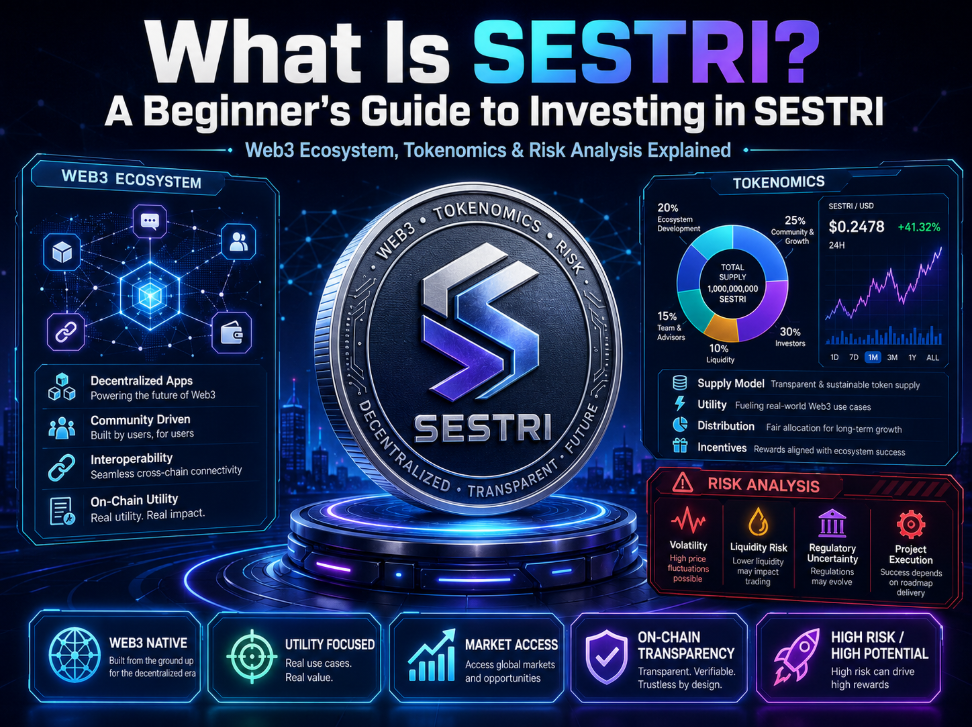
To determine whether a token is worth researching, you first need to see what problem it solves. Many crypto projects fail not because the concept isn't novel, but because there's no real demand. Without users, transaction volume, or ecosystem participants, token prices are unlikely to sustain long-term.
From a user perspective, traditional crypto projects have several pain points.
First, projects are too complex. Many beginners see whitepapers, smart contracts, on-chain data, TVL, FDV, circulating supply, and other jargon, making it hard to assess whether a project is genuinely reliable.
Second, the barrier to entry is high. Wallets, private keys, cross-chain bridges, gas fees, contract addresses, slippage, and authorization risks are all unfriendly to newcomers.
Third, token value is hard to assess. Many tokens appear to have ecosystems, roadmaps, and communities, but whether real demand exists needs to be validated with data.
From an investment perspective, the biggest pain point is the lack of real demand. Many tokens rise not because of project revenue growth, but because of short-term sentiment, KOL promotions, exchange listings, or market rotations. Once the hype fades, prices can drop quickly.
Therefore, when researching SESTRI, investors need to ask: Which sector does SESTRI belong to? Who does it serve? Why do users need it? Does the token have real utility within the ecosystem? Does the project have sustainable growth prospects?
4. Which Sector Might SESTRI Belong To?
This chapter addresses: Is SESTRI in DeFi, AI Crypto, RWA, Gaming, or Infrastructure?
For a new token like SESTRI, if public information is still incomplete, the safest approach is not to force a conclusion but to build a framework for sector assessment.
If SESTRI is in the DeFi sector, investors should look at whether it involves trading, lending, yield, liquidity management, derivatives, or stablecoin applications. Key DeFi metrics typically include TVL, trading volume, protocol revenue, unique addresses, security, and smart contract audits.
If SESTRI is in the AI Crypto sector, investors should check if it relates to AI models, data, compute power, AI agents, inference services, or automation. The critical question for AI Crypto projects is: does the token genuinely participate in AI service payments or network incentives, or is it just riding the AI hype?
If SESTRI is in the RWA sector, investors should examine connections to real-world assets—stocks, ETFs, bonds, commodities, credit assets, or yield-bearing assets. The most important factors for RWA projects are the authenticity of underlying assets, custody structure, regulatory compliance, and redemption mechanisms.
If SESTRI is in Gaming or SocialFi, focus on real user retention, game economy design, user spending power, and token burn mechanisms.
If SESTRI is in the Infrastructure sector, check whether it serves on-chain data, cross-chain communication, privacy computing, identity systems, wallet infrastructure, node networks, or developer tools.
Different sectors imply different market sizes and different investment logics. Identifying the sector is the first step in analyzing SESTRI.
5. Core Mechanism of SESTRI: How Does the Token Generate Value?
This chapter addresses: What is SESTRI token actually used for?
A token's long-term value isn't about price alone—it's about its real utility within the ecosystem. Common token value models include several types.
First, ecosystem payments.
If SESTRI can be used to pay for platform service fees, on-chain operation fees, data call fees, trading fees, or subscription fees, then it has a foundational demand. More users and more service calls make the token's use case clearer.
Second, medium of exchange.
If SESTRI facilitates asset swaps, service settlements, in-app spending, or cross-platform transfers within an ecosystem, it could act as an internal exchange medium. But this model requires a sufficiently large user base; otherwise, token circulation will be limited.
Third, platform rights.
Many projects design tokens as platform rights credentials—for example, holding SESTRI could grant VIP access, fee discounts, boosted yields, whitelist eligibility, early product access, or community status.
Fourth, governance.
If SESTRI is used for community governance, holders can participate in parameter adjustments, ecosystem fund allocation, product roadmap voting, or protocol upgrade decisions. But governance value is real only if the project genuinely empowers the community, not just performs symbolic votes.
Fifth, network incentives.
If SESTRI belongs to an infrastructure project, the token may be used to incentivize nodes, data providers, compute suppliers, validators, developers, or ecosystem contributors. For such tokenomics, the key is supply-demand balance: too many rewards cause inflation; insufficient demand growth puts pressure on price.
6. Three Core Metrics to Evaluate SESTRI's Value
This chapter addresses: What data should investors use to judge whether SESTRI has value?
First metric: real user count.
User numbers shouldn't be measured by social media followers alone—look at on-chain active addresses, product usage, transaction frequency, retention, and genuine interactions. A project with a lively community but no product usage has weak long-term fundamentals.
Second metric: ecosystem growth rate.
Investors should track whether SESTRI has partnerships, ecosystem dApps, developer activity, exchange support, community growth, and product iterations. If a project shows no new progress over time and relies only on short-term marketing, risk increases.
Third metric: tokenomics.
Tokenomics determines long-term supply and demand. Investors need to monitor total supply, circulating supply, unlock schedules, team holdings, investor allocations, ecosystem incentive ratios, and inflation mechanisms. If supply release outpaces demand growth, prices may face persistent pressure.
7. Future Trends in SESTRI's Sector
This chapter addresses: Does SESTRI have industry-level opportunities?
Even if SESTRI itself requires more public data for validation, the broader environment for new crypto assets is still worth analyzing. In the coming years, the Web3 market is likely to evolve around RWA, AI Crypto, DeFi infrastructure, and the Ethereum ecosystem.
1. RWA Tokenization Trend
RWA is one of the most important long-term trends in crypto today. In the future, traditional assets—stocks, ETFs, commodities, bonds, funds, and credit assets—could all enter the blockchain market through tokenization.
Traditional financial institutions are also pushing in this direction. In 2026, NYSE's parent company ICE announced the development of a Tokenized Securities platform, aiming for 24/7 trading, instant settlement, dollar-denominated orders, and stablecoin funding. Crypto.com Research also noted that the tokenized stock market saw clear growth in the first half of 2026, though investors should still watch for custodian risks, lack of direct legal ownership, and voting rights issues.
This shows that RWA is not just a crypto-native narrative—it's entering mainstream financial infrastructure discussions. You can continue reading about what SOXSB is and what PYPLB is to understand how traditional financial assets are being tokenized for the crypto market.
2. AI + Crypto Trend
The convergence of AI and crypto mainly plays out in three directions.
First, decentralized data. AI models require vast amounts of data, and blockchain can enable data rights verification, data trading, and contribution incentives.
Second, decentralized compute. AI training and inference demand massive computing resources, and DePIN and decentralized compute networks could become part of the AI infrastructure stack.
Third, the AI agent economy. In the future, AI agents may autonomously handle payments, trading, task execution, and resource calls, while blockchain provides programmable money, smart contracts, and open settlement networks.
If SESTRI eventually links to AI, data, compute, or automation services, the AI + Crypto trend could serve as a potential growth backdrop.
3. Ethereum Ecosystem Development and Its Impact on New Tokens
Many crypto projects depend on the Ethereum ecosystem. Ethereum's official materials describe DeFi as an open financial system built on smart contracts, and the institutional Ethereum documentation lists RWA, stablecoins, DeFi yields, and on-chain asset management as key application areas.
This means Ethereum's ecosystem development affects DeFi activity, on-chain capital flows, new token liquidity, and RWA expansion. You can reference ETH price prediction to monitor ETH trends, Layer 2 growth, DeFi capital flows, and overall market risk appetite.
8. SESTRI Tokenomics Analysis
This chapter addresses: Does SESTRI have long-term value?
Tokenomics is the core of whether SESTRI is worth long-term attention. Beginners' most common mistake is focusing only on the token's price while ignoring supply and release schedules.
1. How Does Token Supply Affect Price?
Supply determines long-term dilution pressure.
If SESTRI has a high maximum supply but a low current circulating supply, that means a large amount of tokens may enter the market in the future. Once unlocks begin and demand doesn't grow correspondingly, price may face significant pressure.
If SESTRI has a low supply but is overly concentrated among a few holders, that's not necessarily safe either. When a small number of whales, team members, or early investors hold most of the tokens, price can be heavily influenced by concentrated selling.
Therefore, beginners should look at three figures simultaneously: maximum supply, current circulating supply, and future unlock schedule.
2. Does SESTRI Have Inflationary Pressure?
If SESTRI has continuous issuance mechanisms—node rewards, ecosystem incentives, liquidity mining, user rewards, or team unlocks—then it faces inflationary pressure.
Inflation itself isn't necessarily bad. Many Web3 infrastructure projects need token rewards to attract nodes, developers, users, and ecosystem partners. The key is whether the rate of new token issuance is lower than the growth rate of real demand.
If tokens keep being released while user numbers, transaction volume, ecosystem revenue, and usage don't grow, price may remain under long-term pressure.
3. What Token Data Should Investors Track?
When investing in SESTRI, at least five data points deserve attention.
First, market cap. Market cap helps gauge the project's current scale. If market cap is high but the ecosystem is still early, valuation may already be ahead of itself.
Second, FDV (fully diluted valuation). FDV represents the valuation after full dilution. Many new tokens have a seemingly low circulating market cap but a very high FDV, indicating greater future unlock risk.
Third, circulating ratio. The lower the circulating ratio, the more attention should be paid to future release pressure.
Fourth, holder addresses. If the number of holders is small, or if the top few addresses hold a large percentage, price is more susceptible to manipulation.
Fifth, trading volume. Volume determines ease of entry and exit. If volume is too low, users may face significant slippage when buying or selling.
9. SESTRI Price Prediction: Where Could Future Upside Come From?
This chapter addresses: How much could SESTRI rise in the future?
Rather than giving a fixed price target for SESTRI, it's more prudent to avoid such predictions. New token prices are influenced by market sentiment, exchange support, liquidity, project progress, and token unlocks—making a single numeric forecast unreliable.
You can view the SESTRI price prediction for relevant market trends, but a more rational approach is scenario analysis.
1. Potential Factors for SESTRI's Upside
First, improving market cycle.
If BTC and ETH enter a strong bull phase, risk appetite rises, and capital typically flows from majors to new tokens, AI, RWA, DeFi, and small-cap assets. As an emerging crypto asset, SESTRI could attract capital inflows.
Second, ecosystem application growth.
If the project behind SESTRI launches real products, attracts users, generates transaction demand, or establishes ecosystem partnerships, the token's value will have a stronger foundation.
Third, rising trading volume.
Volume is a key indicator of market recognition. If SESTRI/USDT volume continues to grow, it signals increasing buyer and seller activity and heightened market interest.
Fourth, additional exchange listings.
If SESTRI gets listed on more exchanges, that can improve liquidity and accessibility. But beginners should note that exchange listings often bring short-term volatility—they don't guarantee long-term price appreciation.
2. Risks That Could Pressure SESTRI's Price
First, market risk.
Crypto asset prices are heavily dependent on BTC cycles, macro liquidity, USD interest rates, and market sentiment. If the overall market declines, SESTRI may suffer even if project fundamentals are sound.
Second, project risk.
If development slows, products fail to launch, user growth stalls, or roadmaps are delayed, token prices may lose support.
Third, token-specific risk.
If SESTRI has large unlocks, insufficient liquidity, overly concentrated holdings, or early investor selling pressure, price may experience sharp volatility.
10. How to Buy SESTRI? A Beginner's Step-by-Step Guide
This chapter addresses: How do you buy SESTRI?
Step 1: Check the SESTRI market page.
Start by visiting the SESTRI real-time price and trading data to confirm whether SESTRI/USDT is tradable, and observe price, changes, volume, and market depth.
Step 2: Register on a supported exchange.
If SESTRI is listed, you'll need to create an account and complete security settings per the platform's requirements. Enable two-factor authentication, avoid weak passwords, and never share your verification codes.
Step 3: Prepare USDT.
Most crypto trading uses USDT as the quote currency. USDT's advantages are relative price stability, cross-platform convenience, and suitability as a settlement tool. Beginners can start with a small deposit or purchase of USDT, confirm receipt, then proceed.
Step 4: Search for the SESTRI trading pair.
On the trading page, search for SESTRI or SESTRI/USDT and verify the pair name is correct. Do not buy via unknown links, private group messages, or unverified contract addresses to avoid scams or phishing.
Step 5: Choose your order type.
Limit orders are preferable for beginners over market orders. Limit orders give you control over entry price and reduce slippage risk in low-liquidity environments.
Step 6: Practice position management.
SESTRI is an emerging crypto asset with potentially high volatility. Beginners should not go all-in; it's wiser to start with a small position, participate in batches, and predetermine an acceptable loss range.
11. Why Do Many Crypto Trades Use USDT?
USDT is one of the most widely used stablecoins in crypto, primarily for trade settlement, cross-platform transfers, and risk management.
For beginners, USDT functions like the "quote currency" in the crypto market. Many trading pairs are quoted in USDT—e.g., BTC/USDT, ETH/USDT, SESTRI/USDT—so users don't need to convert to and from fiat repeatedly; they can quickly switch between different crypto assets.
However, USDT is not entirely risk-free. Stablecoins require attention to issuer reserves, regulatory environment, on-chain liquidity, and exchange support. During extreme market stress, stablecoins can experience temporary price deviations.
12. How Does SESTRI Differ from Other Popular Crypto Assets?
This chapter addresses: What sets SESTRI apart from other projects?
1. SESTRI vs. Traditional Crypto Projects
Traditional crypto projects generally fall into several categories: Layer-1 tokens, DeFi tokens, meme tokens, GameFi tokens, AI tokens, and infrastructure tokens.
- Layer-1 tokens typically pay for gas, staking, and network security.
- DeFi tokens are linked to trading, lending, yield, or liquidity.
- Meme tokens rely primarily on community hype and viral spread.
- AI tokens may relate to data, compute, models, or AI agents.
- Infrastructure tokens often serve node incentives, data validation, cross-chain communication, or developer services.
What distinguishes SESTRI from these depends on its actual use case. If SESTRI has a clear product, user demand, and token utility, it's more than just a ticker symbol. If it lacks applications and depends only on short-term hype, the risk is higher.
2. SESTRI vs. RWA Asset Projects
RWA assets emphasize tokenizing real-world assets—stocks, ETFs, bonds, commodities, or traditional financial instruments. You can further understand the differences among various crypto assets by reading what MARSCOIN is and what SMHB is.
Some assets are more native crypto tokens, others are tokenized stocks, others are pure RWA assets, and some are narrative-driven projects. Which category SESTRI falls into must be judged based on official project materials, exchange descriptions, underlying asset structures, and token utility.
Investors shouldn't judge by name alone—look at the real logic behind the asset.
13. What Are the Risks of Investing in SESTRI?
This chapter addresses the need to inform users of risks (meeting Google EEAT requirements).
1. Market Risk
Crypto prices are influenced by BTC cycles, macroeconomic conditions, market liquidity, regulatory policies, and investor sentiment. New tokens tend to be more volatile—they can surge in bull markets and plummet just as quickly when sentiment turns.
2. Project Development Risk
If the project behind SESTRI fails to sustain product development, attract users, form ecosystem partnerships, or prove real demand, the token price may lack long-term support. The most common issue with new projects is that roadmaps are ambitious but execution falls short.
3. Information Transparency Risk
For new tokens, transparency is crucial. Investors need to confirm whether the project discloses team, whitepaper, contract address, token allocation, unlock schedule, audit reports, and roadmap. If key information is missing, investment risk rises significantly.
4. Liquidity Risk
If SESTRI's trading volume is low, users may face difficulty selling even if buying is easy. Low-liquidity assets also suffer from wide slippage, where even small orders can cause large price swings.
5. Price Manipulation Risk
Small-cap new tokens are more susceptible to short-term capital, community sentiment, or KOL influence. If price increases are driven mainly by hype and shilling rather than user growth and ecosystem development, the correction risk is high.
6. Contract and Platform Risk
If SESTRI is traded via on-chain contracts, ensure the contract address is correct to avoid fake tokens. If buying through an exchange, pay attention to platform security, deposit/withdrawal rules, trading pair liquidity, and regional restrictions.
14. Future Development Prospects for SESTRI
This chapter addresses: Does SESTRI have room to grow?
SESTRI's future growth depends mainly on three directions.
First, increased ecosystem applications.
If the project behind SESTRI can launch real applications and continuously attract users, token demand may increase. Genuine user growth is one of the most important supports for a new token's long-term value.
Second, maturation of crypto infrastructure.
The crypto industry is gradually moving from pure speculation toward trading infrastructure, on-chain finance, RWA assets, AI networks, and real-world applications. If SESTRI can enter one of these established sectors with a clear position, it could gain a larger market.
Third, Web3 integration with traditional finance.
In the future, the crypto market may no longer trade only native tokens, but connect with RWA, AI, DeFi, tokenized stocks, on-chain yields, and real-world assets. If SESTRI can find a genuine use case within this trend, its long-term growth potential becomes clearer.
However, if SESTRI lacks applications, users, and liquidity, and relies only on short-term hype, it's more likely to be a highly volatile speculative asset rather than a long-term growth asset.
15. Summary: Is SESTRI Worth Investing In?
SESTRI is worth paying attention to, but it should not be simplified to "buy the new coin."
Its potential advantages include:
- SESTRI is an emerging crypto asset that may have early-stage growth potential.
- If the project can enter high-growth sectors like DeFi, AI, RWA, Gaming, or Infrastructure, it could benefit from industry tailwinds.
- If SESTRI has real applications, clear token utility, and sustained user growth, its value will be better supported.
But the risks are equally clear:
- As a new token, SESTRI may suffer from insufficient information transparency.
- The crypto market is highly competitive; new projects can easily be displaced by more established ones.
- Token prices are highly volatile—short-term gains don't imply long-term value.
Before investing in SESTRI, beginners should focus on three things.
First, track the project's actual development, not just community hype.
Second, understand the tokenomics—supply, circulating supply, FDV, unlock schedule, and holder distribution.
Third, monitor market liquidity—SESTRI/USDT trading volume, bid-ask spreads, and exchange support.
A more rational approach is: first check the SESTRI real-time price and trading data to gauge market performance, then combine it with the SESTRI price prediction, ETH price prediction, what SOXSB is, what PYPLB is, what MARSCOIN is, and what SMHB is to build a comprehensive crypto asset knowledge base.
SESTRI may be a new token worth researching, but whether it's worth investing in ultimately depends on whether the project can prove real demand, ecosystem growth, and token value capture. For beginners, don't ignore risks just because it's an "early opportunity." True investment judgment comes from information verification, data tracking, and position control—not short-term emotion.