
If you’ve recently seen MEOW on Base chain’s new-coin leaderboards, DEX hot pools, or crypto social channels, the first thing you need to do is not decide whether it will pump.
It’s to confirm:
Which MEOW are you actually looking at?
This is the most overlooked – and most critical – step when researching KittehCoin.
Because MEOW is not a unique crypto ticker. There are tokens named MEOW – or with the ticker MEOW – on Base, Solana, and other chains. This article covers KittehCoin (MEOW) on Base chain. As of now, CoinGecko lists this version under the Base ecosystem and Meme category, with total and circulating supply both around 1 billion tokens.
As of August 18, 2026, this version of MEOW is still a very typical micro-cap meme asset:
- Market cap ~$800K
- 24h volume ~$1.1M
- Main pool liquidity only ~$80K
That set of numbers is actually more worth studying than “how much has MEOW pumped lately.”
Because it forms a classic new-meme structure:
Small market cap + high turnover + low liquidity.
That means MEOW can surge quickly with just a small amount of fresh capital – but it can also crash violently if liquidity suddenly dries up or a large holder sells.
So when analyzing MEOW, the real question isn’t:
“Is this the next 100x cat coin?”
It’s:
How long can that $1M+ daily trading activity be sustained, and can a few tens of thousands in liquidity support a higher market cap?
What Is MEOW? First, Confirm Which MEOW You’re Looking At
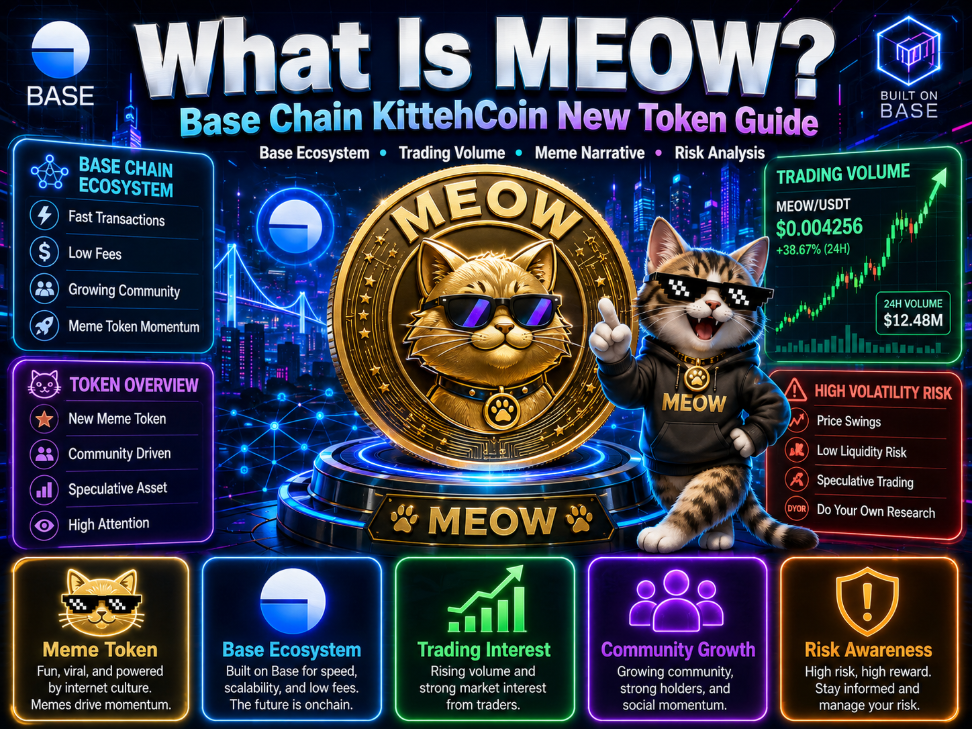
MEOW is a ticker that’s extremely prone to name collisions.
If you just type:
MEOW
into a DEX or wallet, you may see multiple completely different tokens.
They could be on:
- Base
- Solana
- Ethereum
- Or other networks
Some may even have:
- The same name
- A similar logo
- The same ticker “MEOW”
but entirely different contract addresses.
So this article focuses on:
KittehCoin (MEOW)
Network: Base
Token type: Meme Coin
Total supply: approx. 1,000,000,000 MEOW
That’s why the #1 rule before buying MEOW is:
Never buy a token just by its name.
At minimum, cross-check:
- Token name
- Network
- Contract address
- Official website
- Main trading pools
For a new meme coin, this step matters even more than studying the chart.
Because:
If you buy the wrong contract,
all subsequent price analysis becomes meaningless.
Why Is Base MEOW Different from Solana MEOW?
A crypto asset’s true identity isn’t decided by its name – it’s decided by:
Blockchain network + Contract address
For example:
Two tokens both called MEOW.
One runs on Base, the other on Solana.
Even if the name is identical, they are:
Two independent assets.
So if you see on social media:
“MEOW is up 200% today!”
Step one is not to immediately open your wallet and buy.
Instead ask:
Which MEOW?
Which chain?
What’s the contract address?
The KittehCoin discussed here is the Base version, currently classified as a Base meme asset by major data aggregators.
What Is KittehCoin? Why the Constant Emphasis on “the First Cat Coin from 2013”?
One of KittehCoin’s key marketing narratives revolves around:
2013.
The project description on DEX Screener claims that KittehCoin traces back to the early crypto days of 2013, and is now being rebuilt and relaunched on the Base network while retaining the original brand, domain, and social media assets.
This narrative matters a lot for a meme coin.
Because meme projects – unlike traditional tech companies – don’t have:
- Revenue
- Net profit
- Order books
- Cash flow
as their primary valuation anchors.
They rely heavily on:
- Culture
- History
- Community identity
- A story that spreads
KittehCoin’s story can be summed up as:
2013 Crypto Culture → Cat Meme → Old Coin Revival → 2026 Base Relaunch.
That “Old Coin Revival” angle may indeed attract some early-crypto enthusiasts.
But investors must separate:
historical brand
from
the current token.
Does the 2013 History Make the 2026 MEOW Safer?
No – you cannot make that leap.
Even if the brand really does date back to 2013, the MEOW token on Base in 2026 still needs a fresh analysis of:
- Contract
- Liquidity
- Token supply
- Holder addresses
- Whale structure
- Community
- Trading volume
So keep this in mind:
Historical brand ≠ inherent safety of the current token.
A brand that has existed for over a decade does not guarantee that today’s new contract is free from market risk, that liquidity won’t drop, that whales won’t sell, or that the community won’t lose interest.
For MEOW, 2013 is the:
Narrative.
The current token data is the:
Risk.
These two cannot be conflated.
Why Did KittehCoin Choose Base Chain for Its Relaunch?
Base is an Ethereum Layer‑2 ecosystem.
For meme projects, one of Base’s biggest advantages is:
Lower transaction costs.
That matters a lot. Because meme coin traders tend to have:
- Smaller trade sizes
- High frequency
- High turnover
- Short holding periods
If a user only wants to put in:
- $50
- $100
- $200
into a new meme coin, but each on‑chain transaction costs a lot in gas – their willingness to participate drops sharply.
Base’s low‑cost environment is better suited for this type of:
high‑frequency, small‑ticket trading.
Beyond that, Base also offers:
- Ethereum compatibility
- A thriving DEX ecosystem
- Uniswap liquidity
- Coinbase ecosystem access
- Active meme and social token scenes
So for a micro‑cap project like MEOW, Base is a reasonably logical environment for issuance and trading.
What Is MEOW’s Market Cap Right Now?
As of August 18, 2026, real‑time prices vary across platforms.
At that time, CoinGecko showed:
- Circulating supply ~1B MEOW
- Total supply ~1B MEOW
- Market cap ~$828K
- 24h volume ~$1.089M
Meanwhile, Phantom data showed:
- Market cap ~$800K
- Holders ~2,795
- 24h volume ~$1.1M
- 24h trades over 13,000
These numbers tell us:
MEOW is still a:
Micro‑cap meme coin.
Does Micro‑Cap Mean Big Opportunity?
From a mathematical standpoint, micro‑cap tokens do have greater price elasticity.
For example:
$800K market cap
rising to
$8M market cap
means a 10x expansion.
Bitcoin, with its massive market cap, would need a completely different scale of capital to achieve the same multiple.
That’s why traders like hunting for micro‑cap memes.
But the reverse is equally true.
$800K market cap
falling to
$80K
means ‑90%.
So small market cap is not evidence of being “undervalued.”
It only means:
Price is more sensitive to capital flows.
Why Does MEOW Have an $800K Market Cap but Over $1M in 24h Volume?
This is one of the most interesting aspects of MEOW right now.
Many newcomers see:
Market Cap: $800K
24H Volume: $1.1M
and think:
“Does that mean $1.1M of new money came in today?”
No.
24‑hour volume is the cumulative total of all trades over that period.
The same tokens can be traded over and over.
Example:
Trader A sells to Trader B
Trader B sells to Trader C
Trader C sells to Trader D
All three trades count toward volume.
So if a meme coin has very high turnover, it’s entirely possible to see:
24H Volume > Market Cap.
That’s not rare.
But it does tell us that MEOW is seeing intense short‑term speculative activity.
Does High Volume Mean MEOW Is Strong?
You can’t just look at volume in isolation.
A more complete analysis requires checking:
- Volume
- Unique traders
- Transactions
- Buy volume
- Sell volume
- Liquidity
Because a token could show $1M in volume – but if:
- Most trades come from a few dozen addresses
- Many trades are bot‑driven and repetitive
- Buy/sell patterns are highly mechanical
- Liquidity is only a few tens of thousands
then the quality of that $1M volume is completely different from natural trading by thousands of real users.
So:
Volume is a starting point, not a conclusion.
Why Is MEOW’s Volume Over 1M While Liquidity Is Only ~80K?
This is the most critical set of data for analyzing MEOW.
At the time, DEX Screener showed:
- Main MEOW/ETH pool liquidity ~$78K
- 24h volume ~$950K
Phantom simultaneously showed total liquidity around $86K.
That creates a very typical structure:
High Volume + Low Liquidity.
In plain terms: trading is frenetic, but the pool that actually absorbs buys and sells is not deep at all.
What Does High Volume + Low Liquidity Mean?
First:
MEOW currently has clear speculative heat.
Many users are:
- Buying
- Selling
- Flipping
Second:
The actual AMM pool is small.
If a large sell order suddenly appears, the price can drop sharply.
Third:
The effective cost of execution can vary wildly depending on position size.
Example:
Buying MEOW with $100 USDT
vs.
Buying MEOW with $10,000 USDT
Even if the displayed price is the same, the average filled price may be completely different.
Why?
Slippage.
So for micro‑cap memes, volume is not the most important safety metric.
In many cases:
Liquidity matters more than volume.
Why Does Low Liquidity Cause Crashes?
In an AMM pool, the price is determined by the ratio of the two assets in the pool.
If MEOW trades mainly in a MEOW/ETH pool:
When users sell a lot of MEOW,
the pool gets more MEOW and less ETH.
So the price of MEOW relative to ETH drops.
With only ~$80K in liquidity,
a trade of just a few thousand dollars – or even $10,000 –
can significantly alter that ratio.
That’s why small‑cap memes often see:
- +20% in one minute
- ‑30% a few minutes later
- +100% in an hour
- then a 50% retrace
It’s not always “manipulation.”
Often, the market structure itself is fragile enough.
How Can You Tell If MEOW’s Volume Is Healthy?
High volume alone doesn’t mean healthy.
You can check four dimensions.
1. Unique Traders
Phantom data at the time showed MEOW had roughly 1,248 traders in 24 hours.
Compared to only a few dozen addresses trading repeatedly, more unique traders generally means more distributed activity.
But you still need to assess whether those addresses are real users or bots.
2. Buy vs. Sell Imbalance
If 24h volume spikes but the vast majority are sells, that suggests distribution.
Conversely, if it’s all buys, watch for:
- FOMO
- Bot sniping
- Short‑term pumping
MEOW’s main pool had active buying and selling at the time.
More important is whether that balance can be sustained.
3. Order Size Patterns
If you see many orders that are:
- Exactly the same size
- Spaced at regular intervals
- Coming from the same set of addresses swapping back and forth
that could indicate:
- Bot trading
- Arbitrage
- Even wash trading
You can’t immediately say “volume is fake,”
but it’s a reason to be cautious.
4. Volume Consistency
Day 1: $1M volume
Day 2: $800K
Day 3: $700K
That’s different from:
Day 1: $1M
Day 2: $50K
They represent completely different market vitality.
So:
Look at volume persistence, not just a single‑day spike.
Why Can MEOW Pump 100% in a Day and Then Drop 50% in Half a Day?
Core reason:
Market cap and liquidity are both tiny.
CoinGecko shows MEOW’s main activity is on Uniswap pools on Base.
With only a few hundred thousand in market cap and a few tens of thousands in liquidity, a few thousand dollars of fresh buy pressure can move the price noticeably.
Conversely, an early whale selling a few thousand dollars can push the price down just as hard.
So don’t look at MEOW’s price of $0.000x and think:
“That’s cheap.”
Price alone means nothing.
Example:
Token A: $0.0001
Token B: $10
Token A could have a $10B market cap; Token B could have a $100K market cap.
What really matters for valuation is:
Market Cap + Supply + Liquidity.
What Does a 1B MEOW Supply Mean?
At the time, CoinGecko showed:
- Circulating Supply: ~1B MEOW
- Total Supply: ~1B MEOW
- Max Supply: ~1B MEOW
So based on the current data, Market Cap and FDV are relatively close.
That’s different from many new projects that have only 10% circulating and 90% unlocking later.
If most tokens are already in circulation, the risk of dilution from massive future unlocks is easier to understand.
But that doesn’t mean MEOW has no supply risk.
Because the bigger question becomes:
Who holds those circulating tokens?
Who Holds the Most MEOW? Why Top Holders Matter More Than MACD
For a sub‑$1M market cap token, holder concentration can be more important than traditional technical indicators.
Investors should check:
- Top 10 holders
- Top 20 holders
- LP addresses
- Contract address
- Burn address
- Regular wallets
- Suspected team addresses
But one crucial caveat:
Don’t see “Top 1 holds 20%” and immediately cry “team manipulation.”
That top holder could be:
- The liquidity pool
- The contract itself
- A burn address
- An exchange wallet
You must identify address types first.
For a micro‑cap meme like MEOW, the real danger is:
A large number of sellable tokens concentrated in a few ordinary wallets.
If a few early wallets have very low cost basis, and even one of them starts to trim, it can significantly impact the market.
Is MEOW Safe? Why Does a Clean Security Scan Not Mean Investment Safety?
At the time, DEX Screener showed that Go+ Security and Quick Intel didn’t flag obvious contract risks.
But automated security scans are not 100% foolproof.
You must distinguish between:
Contract Safe
and
Investment Safe.
What Is Smart Contract Risk?
Smart contract risks include:
- Honeypot
- Unlimited mint
- Blacklist
- Abnormally high tax
- Pause trading
- Malicious permissions
If any of these exist, you might not even be able to sell after buying.
So security scans matter.
What Is Market Risk?
Even if the contract code is perfectly normal, the token can still:
- Drop 90%
- Have its LP pulled
- See whales selling
- Lose community interest
- See volume go to zero
So:
Contract Safe ≠ Investment Safe.
That’s a mantra to remember when investing in new meme coins.
Why Is MEOW Particularly Easy to Buy the Wrong One?
Because there are multiple “MEOW” tokens out there.
Some even have similar names like “KittehCoin.”
This article covers the Base chain KittehCoin version.
Before buying, complete at least five verification steps.
Step 1: Confirm the Network
Target should be:
Base.
If your wallet shows Solana, it’s not the same asset discussed here.
Step 2: Confirm the Contract Address
Do not copy the contract from:
- Telegram DMs
- Unfamiliar groups
- Private KOL messages
Safer sources are:
- Official channels
- CoinGecko
- BaseScan
- DEX Screener
Cross‑verify across multiple sources.
Step 3: Confirm the Main Trading Pool
Check that you’re in the main MEOW/ETH pool.
Don’t buy a copycat pool with little to no volume just because the token name looks the same.
Step 4: Confirm Liquidity
If a similarly named MEOW has only:
- A few hundred dollars
- A few thousand dollars
in liquidity, the risk is significantly higher.
Step 5: Test with a Small Amount
Especially when buying a new token on DEX, don’t use a large amount on the first try.
First verify:
- You can buy
- You can sell
- The asset displays correctly
How to Buy MEOW? A Beginner’s Guide Using HIBT as an Example
If HIBT has already listed MEOW for spot trading, you can search for:
MEOW
or:
MEOW/USDT on the platform.
Actual listing and trading pairs should be confirmed on HIBT’s live trading page.
Don’t assume that just because a platform supports some other MEOW, it’s automatically the Base KittehCoin discussed here.
Step 1: Register on HIBT and Complete Security Setup
Recommended:
- Account registration
- Identity verification (KYC)
- 2FA
- Google Authenticator
- Basic account security checks
New coins move fast – but don’t skip security because of FOMO.
Step 2: Prepare USDT
For example, prepare 100 USDT.
When depositing, first confirm the deposit network.
Don’t assume that because both networks support USDT, you can arbitrarily transfer assets across chains.
Step 3: Search for MEOW
Go to the trading area and search for MEOW.
Key points to check:
- Is the project name KittehCoin?
- Does it match the target asset?
For coins with the same ticker:
Ticker alone is not a unique identifier.
Step 4: Choose Spot Trading
If the platform offers:
MEOW/USDT
you can enter the spot market.
For meme newbies, it’s recommended to understand spot trading first, rather than jumping straight into:
- Leverage
- Perpetual contracts
Step 5: Prefer Limit Orders
Meme coin prices can change very quickly.
Using a Market Order may result in significant slippage.
A Limit Order lets you set the price you’re willing to pay in advance.
That doesn’t eliminate investment risk, but it helps you control your execution cost.
Step 6: Don’t Make Your First Position Too Large
For micro‑cap memes, position sizing is critical.
Not because it will drop – but because price swings can be vastly larger than for BTC, ETH, or other mature assets.
Before investing, ask yourself:
If this position drops:
- 50%
- 80%
- or even nearly 100%
would it materially affect your financial situation?
If the answer is “yes,” your position is probably too large.
If HIBT Doesn’t Have MEOW, How to Buy on DEX?
If a centralized exchange doesn’t list the MEOW spot pair, users may trade via a Base‑ecosystem DEX.
The general flow is:
USDT / ETH
↓
Bridge to Base
↓
Base Wallet
↓
Uniswap
↓
MEOW
But on DEX, the most important thing isn’t speed – it’s risk checks.
You’ll Need Base ETH for Gas
Even if you’re using USDT, you’ll still need a small amount of ETH to pay for Base network gas.
If your wallet has no gas token, you won’t be able to complete the swap.
Always Double‑Check the Contract Address
One of the biggest risks on DEX is:
Fake tokens.
Don’t just search “MEOW” and click the first result.
Because name‑alike tokens are extremely common.
Watch Out for Slippage
With only tens of thousands in MEOW liquidity, large trades can cause significant slippage.
Therefore:
The larger your buy, the more you should pay attention to Price Impact.
Be Aware of MEV
DEX trades can be affected by:
- Arbitrage
- Sandwich attacks
- Transaction ordering
These can also increase your effective execution cost.
Why Does MEOW Go Up? Five Real Potential Drivers
When analyzing a meme’s upside, don’t just write “strong community.”
Break it down into observable variables.
1. Base Meme Market Momentum
If the Base ecosystem is in a general risk‑on mode, capital starts looking for:
- Small caps
- High beta
- Fresh memes
MEOW becomes more likely to catch a rotation.
Conversely, if Base meme sentiment cools, MEOW may lose support.
2. The “Old Coin Revival” Narrative
KittehCoin’s most unique selling point is its 2013 history.
Crypto has a classic cultural pattern – Old Coin Revival.
If more users buy into the “early cat coin making a comeback” story, that can bring fresh attention.
3. Cat Meme Virality
Dog, cat, frog – these animal symbols have repeatedly proven they spread fast in crypto.
Reason: users don’t need to understand complex tech.
A cat picture spreads easily.
Memes, at their core, compete for attention.
4. DEX Trending
If MEOW suddenly appears on:
- DEX leaderboards
- Trending lists
- Hot token rankings
that further increases visibility.
More visibility → more traders enter.
Price rises → rankings improve further.
That creates an attention feedback loop.
5. Low Market Cap
The current $80M market cap (wait, $800K) – actually $800K – gives MEOW a lot of price elasticity.
From $800K to $8M is mathematically a 10x.
But never remember only that side.
Because $800K to $80K is also ‑90%.
Micro‑cap meme’s biggest opportunity and biggest risk come from the same variable.
What’s the Biggest Difference Between MEOW and DOGE/SHIB?
MEOW is also a meme coin – but you cannot put it in the same risk tier as DOGE or SHIB.
DOGE and SHIB already have:
- Large market caps
- Deep liquidity
- Broad CEX coverage
- Years of community history
- Global brand recognition
MEOW, by contrast, is a micro‑cap meme.
So:
DOGE’s historical 100x+ run does not imply MEOW will replicate it.
One of the biggest differences between established memes and new micro‑cap memes is:
Probability of failure.
The market only remembers the winners – DOGE, SHIB, PEPE, BONK.
But the number of memes that failed in the same period is vastly larger.
That’s classic survivorship bias.
What’s the Relationship Between MEOW and BTC?
MEOW is a Base meme coin.
Its price is primarily driven by:
- Community
- Base ecosystem
- DEX flows
- Liquidity
- Meme hype
But the broader crypto environment still matters.
If Bitcoin enters a clear risk‑off phase, investors usually reduce exposure to high‑risk assets.
You can monitor overall risk appetite via BTC Price Prediction & Bitcoin Market Trends.
However:
BTC up ≠ MEOW up.
For micro‑cap memes, their own liquidity and capital flows are often more important.
What’s the Relationship Between MEOW and ETH?
Base is part of the Ethereum Layer‑2 ecosystem, so the overall capital environment on Ethereum is also worth watching.
You can gauge ETH sentiment via ETH Price Prediction & Ethereum Market Trends.
But again:
ETH rising does not guarantee MEOW rises.
Even if Ethereum has abundant liquidity, that capital could flow into:
- DeFi
- Layer‑2s
- Stablecoins
- Other memes
MEOW ultimately needs its own community, traders, and liquidity.
MEOW vs. WDCON – What’s the Difference?
If you want to understand the gap between meme assets and traditional finance (TradFi) assets, see:
What Is WDCON USDT? Western Digital Storage Industry & TradFi Logic Explained
WDCON’s analysis is more rooted in:
- Corporate revenue
- Storage cycles
- AI data center demand
- Company valuation
MEOW has none of that – no profits, no free cash flow, no orders.
It relies almost entirely on token supply/demand and attention.
MEOW vs. LITEON – No Corporate Earnings as a Valuation Floor
Another comparison:
What Is LITEON USDT? AI Optical Communications & Data Center Asset Analysis
LITEON‑type TradFi assets at least allow you to research:
- Revenue
- Orders
- Industry demand
- Company earnings
MEOW has no traditional valuation metrics like P/E, P/B, or EV/Revenue.
So the valuation range for meme coins is much fuzzier.
MEOW vs. MSTRON – One Is a Meme, the Other Still Has a Public Company Asset Logic
You can also read:
What Is MSTRON? Bitcoin Treasury & TradFi Asset Logic Explained
MSTRON, even though it’s influenced by Bitcoin, can still be analyzed through:
- Corporate financials
- BTC holdings
- Financing activities
MEOW is a purer crypto meme asset.
MEOW vs. EWYON – ETFs Have Portfolios; MEOW Only Has Token Supply/Demand
ETF‑type products typically hold a basket of stocks.
For example:
What Is EWYON USDT? Korea ETF & Asian Market Asset Analysis
Such products have underlying traditional securities value.
MEOW’s price depends mainly on:
- How many buyers
- How many sellers
- Whether liquidity is sufficient
- Whether the community grows
That’s the biggest structural difference between these two asset classes.
What Are MEOW’s Biggest Risks? At Least These 12
What attracts traders most to MEOW is high elasticity.
But its biggest risk comes from that same high elasticity.
Risk 1 – Micro‑Cap Size
Sub‑$1M market cap means the market is easily influenced by single trades.
Risk 2 – Insufficient Liquidity
Main pool liquidity is only in the tens of thousands.
In a panic, selling may become difficult quickly.
Risk 3 – Extreme Price Swings
A micro‑cap meme can go up 50% or 100% in a day – and drop 50% just as easily.
Risk 4 – Name‑Alike Tokens
Searching “MEOW” might lead you to a completely different token.
This is a very real newbie trap.
Risk 5 – Whale Dumps
If a few wallets hold large amounts, one sale can move the price materially.
Risk 6 – LP Risk
Declining liquidity increases slippage, reduces sell capacity, and amplifies volatility.
Risk 7 – Wash Trading
Abnormally high volume may not come purely from organic users.
Monitor trader addresses, order patterns, and trade sizes.
Risk 8 – Bot Trading
New meme assets often attract:
- Sniper bots
- Arbitrage bots
- High‑frequency programs
Retail traders competing against bots are often at an informational and speed disadvantage.
Risk 9 – MEV
DEX trades can be affected by:
- Sandwich attacks
- Front‑running
- Arbitrage
Risk 10 – Community Fade
Memes have no stable cash flow as a valuation floor.
If attention leaves, the price may struggle to find a “fair value.”
Risk 11 – The 2013 Narrative May Fail
The historical story has marketing value – but 2013 does not directly improve liquidity, revenue, or token safety.
So the Old Coin narrative cannot replace risk research.
Risk 12 – Extreme Drawdowns
Micro‑cap memes can see ‑50%, ‑80%, or even ‑90%.
If you cannot tolerate a very large loss on your principal, micro‑cap memes are simply not a suitable asset class.
Is MEOW Worth Investing In? Answer These 6 Questions First
Instead of asking:
“Can MEOW 100x?”
ask six more practical questions.
1. Have you confirmed the contract?
If not, don’t trade.
2. How much liquidity is there?
With only tens of thousands in liquidity, large entries/exits require extra caution.
3. What is the market cap?
~$800K means extremely high elasticity – and extremely high risk.
4. How long can volume sustain?
$1M daily volume looks impressive – but if it drops to a few tens of thousands tomorrow, sentiment may have shifted.
5. How concentrated are the top holders?
Whale distribution can directly determine sell pressure.
6. What’s the maximum loss you can afford?
This is the most important question.
If, after buying MEOW:
- you have to watch the chart every minute
- a 30% drop is unacceptable
- the capital is needed for living expenses
then micro‑cap memes are probably not for you.
How to Read MEOW Price Predictions – Don’t Just Call Out $0.01
The best way to predict price for a token like MEOW is not to throw out a single number.
It’s Market Cap Scenarios.
With current supply around 1B MEOW, if supply structure doesn’t change significantly, price and market cap have a straightforward relationship.
For example:
- Market cap at $1M
- $5M
- $10M
each implies a different price level.
That’s far more meaningful than saying “MEOW will hit $0.01.”
Bull Case – When Could MEOW Continue Rising?
An optimistic scenario requires several conditions to align:
- Base meme market stays active
- MEOW volume holds up
- Holders keep growing
- Liquidity increases
- Community expands
- The 2013 narrative gains more traction
If both market cap and liquidity grow together, the quality of the uptrend tends to be healthier.
Base Case – Heat Fades, but Community Remains
A neutral scenario could be:
- The initial burst ends
- Volume declines
- Community stays active
- Price enters a high‑volatility range
This is very common for memes.
The market waits for a new catalyst.
Bear Case – Volume Vanishes + LP Shrinks
The most dangerous situation:
- Volume drops quickly
- Liquidity decreases
- Whales start selling
- Base meme cycle ends
At that point, MEOW could see a massive repricing.
For micro‑cap assets, liquidity can evaporate faster than investors expect.
Which Data Changes Signal That MEOW Is Getting Dangerous?
Compared to MACD and RSI, these data points may be more valuable.
Red Flag 1
Price rises, but Holders decrease.
That suggests concentration.
Red Flag 2
Volume rises, but Unique Traders don’t increase.
Investigate whether the same addresses are trading repeatedly.
Red Flag 3
Market cap keeps rising, but Liquidity doesn’t grow alongside it.
Paper valuation expands, but real exit depth doesn’t improve.
Red Flag 4
Top holder concentration keeps increasing.
Retail keeps selling to a few large wallets, or there’s overt concentration.
Red Flag 5
Sell volume consistently exceeds buy volume.
That could indicate early capital exiting.
Red Flag 6
LP shrinks significantly in a short period.
This is one of the most dangerous signals for a meme project – because without liquidity, price itself loses meaning.
For a meme like MEOW:
Liquidity, Holders, and Unique Traders often matter more than MACD.
What Coin Is MEOW?
MEOW is the Base‑chain KittehCoin meme token discussed in this article.
Major data platforms currently classify it under:
- Base Ecosystem
- Meme
What Is KittehCoin?
KittehCoin claims its brand history dates back to an early cat‑themed crypto project in 2013.
It is now relaunching on the Base network.
Which Chain Is MEOW On?
The KittehCoin MEOW analyzed here runs on Base.
There are other MEOW tokens on other networks, so you must verify network and contract before buying.
What Is MEOW’s Total Supply?
Current data shows:
Total supply ~1 billion MEOW.
What Is MEOW’s Market Cap?
As of August 18, 2026, roughly $800K level.
But for a micro‑cap new token, market cap can change significantly within a day.
What Is MEOW’s Trading Volume?
At the same time, 24‑hour volume was roughly $1.1M level.
Why Is MEOW’s Volume Higher Than Its Market Cap?
Because volume is the cumulative total of all trades over a period.
The same MEOW can be bought and sold multiple times in a day.
So Volume > Market Cap is not contradictory.
Is MEOW a Solana Coin?
The KittehCoin MEOW discussed here is not the Solana version.
It runs on Base.
There are similarly named assets on Solana and other networks – distinguish them by Network and Contract.
Will MEOW 100x?
There is no reliable evidence that MEOW will definitely 100x.
Micro‑cap memes do have huge upside elasticity – but they also carry the risk of:
- ‑80%
- ‑90%
- or even near‑zero
Investors cannot simply reason from “the price is low now” to “it will 100x in the future.”
Is MEOW Worth Buying?
MEOW is best defined as a high‑risk, micro‑cap, high‑turnover, low‑liquidity Base meme asset.
If you’re interested in:
- Base memes
- Old Coin Revival
- Cat memes
- Early‑stage token trading
it’s worth studying.
But “worth studying” does not mean “worth a heavy position.”
The real variables that will determine MEOW’s performance include:
- Market Cap
- Liquidity
- 24H Volume
- Unique Traders
- Holder Growth
- Top Holder Concentration
- LP changes
Conclusion: For MEOW, the Real Question Isn’t the “2013 Cat Coin Story” – It’s Whether the Capital Stays
KittehCoin’s current marketing appeal boils down to four words:
2013 crypto history
Cat meme
Base ecosystem
Micro‑cap
Plus a sudden spike in volume.
Those factors can certainly generate meme‑market attention.
But when analyzing a new token, Narrative and Data must be separated.
KittehCoin can tell a 2013 story.
The market, however, decides price based on:
- How many buyers there are today
- How much liquidity there is today
- How many traders will be here tomorrow
As of August 18, 2026, the most noteworthy structure MEOW presents is:
- Market cap ~$800K
- 24h volume ~$1.1M
- Liquidity ~80K–90K
When you put those three numbers together, the real question about MEOW is not “Is it trending right now?”
It’s:
How long can this high volume be sustained?
And:
Can a few tens of thousands in liquidity support an increasingly higher market valuation?
For a micro‑cap meme coin like MEOW, the biggest opportunity is:
Small market cap meets rapidly growing attention.
And the biggest risk is exactly the same:
Small market cap meets suddenly vanishing liquidity.
So the question worth asking is never:
“Is MEOW the next 100x cat coin?”
But rather:
Are holders still growing? Is liquidity increasing alongside? Is volume being driven by more and more real traders? Are early whales starting to exit?
The answers to those questions matter far more than any target price pulled from thin air.
Data as of August 18, 2026. Micro‑cap meme coin market cap, liquidity, and trading volume can change dramatically within a single day. Please re‑check real‑time data before investing. This article is for educational and research purposes only and does not constitute any buy, sell, or investment advice.