
If you first encounter MOONSHOTUSDT on a crypto trading platform, your immediate reaction might be:
What coin is MOONSHOT? Did Moonshot AI issue a new token? Is Kimi already public? Does buying MOONSHOTUSDT mean I'm buying Moonshot AI stock early?
In reality, none of these interpretations are accurate.
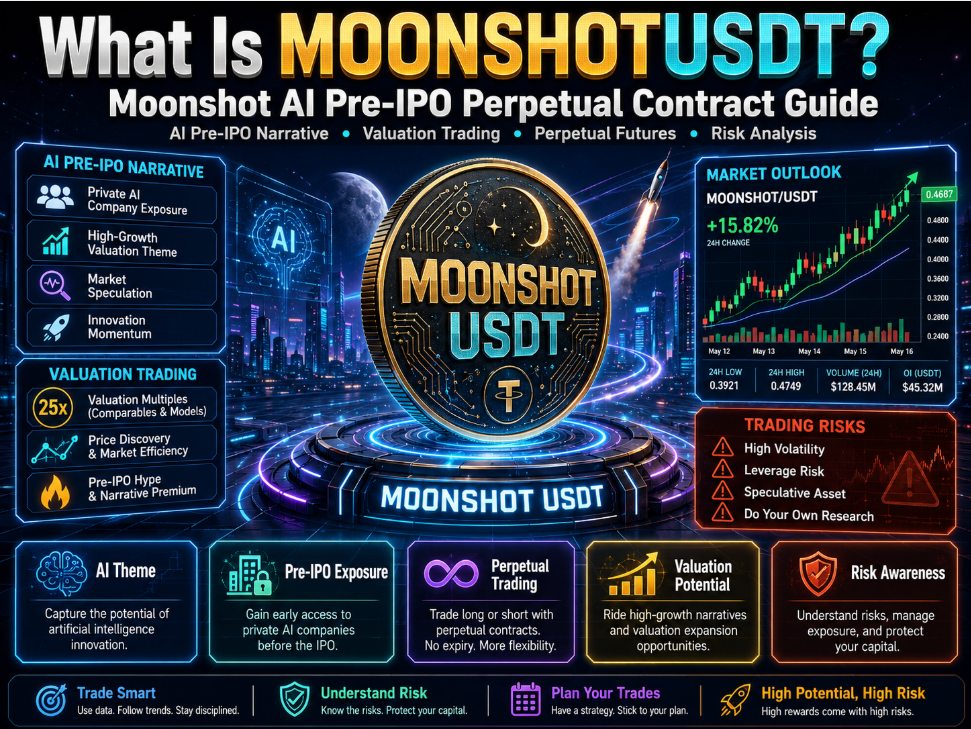
As of August 18, 2026, MOONSHOTUSDT is available as a Moonshot AI Pre-IPO Perpetual Contract on exchanges like MEXC and Bitget. Reports show that MEXC listed the product on August 6, followed by Bitget on August 7, allowing traders to go long or short on the company's future valuation and IPO expectations before Moonshot AI officially goes public.
What's most notable:
Moonshot AI remains a private company.
That means there is no continuously publicly traded Moonshot AI stock price like Tesla or NVIDIA.
So MOONSHOTUSDT is not simply porting a listed stock into crypto. Instead, it trades:
What the market believes Moonshot AI could be worth when it eventually goes public.
That's the fundamental difference between a Pre-IPO perpetual contract and ordinary BTCUSDT or stock-based perpetuals.
For investors, the real questions aren't "Is MOONSHOT the next 100x coin?" but far harder ones:
What is Moonshot AI actually worth today?
Is the $50 billion valuation already set?
Can Kimi user growth translate into revenue?
Will the Hong Kong IPO ultimately close?
How much optimism is already priced into MOONSHOTUSDT?
The gaps between these questions create the real opportunity—and the real risk.
Moonshot AI hasn't IPO'd—so why can MOONSHOTUSDT already trade?
In traditional investing, a company typically completes an IPO before retail investors can buy its shares on a securities exchange. The process:
File for listing;
Pass hearings or reviews;
Conduct a public offering;
Set the offering price;
Begin trading.
After that, a public stock price exists.
Moonshot AI hasn't completed that process. Public reports indicate that Moonshot AI is preparing for a potential Hong Kong IPO, including corporate restructuring and hiring advisors, but the timing remains highly uncertain.
So why does a price already exist in crypto?
Because:
Derivatives can trade "expectations."
Traders don't need to own actual Moonshot AI shares. Exchanges can build a Pre-IPO perpetual market based on:
Private financing valuations;
IPO expectations;
Order flow;
Index rules;
Exchange pricing mechanisms.
Thus, MOONSHOTUSDT is closer to:
A financial bet on Moonshot AI's future valuation.
It is not a new cryptocurrency issued by Moonshot AI.
What exactly is MOONSHOTUSDT? Distinguishing token, stock, and Pre-IPO contract
The easiest way to understand MOONSHOTUSDT is to break it into three parts.
What does MOONSHOT represent?
MOONSHOT refers to:
Moonshot AI—known in Chinese markets as "Yue Zhi An Mian."
Moonshot AI was founded in 2023, with its core product and brand being the Kimi series of AI models and applications.
Important: MOONSHOT does not mean Moonshot AI has issued an official crypto token called MOONSHOT. It's simply the ticker used by exchanges to represent this Pre-IPO asset.
What does USDT represent?
USDT functions as:
Margin;
Profit/loss settlement;
Settlement currency.
For example, if you deposit 100 USDT to open a long position in MOONSHOTUSDT, that 100 USDT is not "buying $100 worth of Moonshot AI shares." It's using 100 USDT as derivatives margin. With leverage, the notional position can be far larger than 100 USDT.
What does Perpetual mean?
Perpetual Futures have no fixed expiration date, unlike traditional futures. They are maintained through:
Mark Price;
Funding Rate;
Index mechanisms;
Margin rules.
So the most important takeaway:
MOONSHOTUSDT ≠ Moonshot AI stock.
Does buying MOONSHOTUSDT give you Moonshot AI shares?
Generally, no.
Trading MOONSHOTUSDT typically does not mean:
You become a shareholder of Moonshot AI;
You own actual equity;
You have voting rights;
You have liquidation rights;
You automatically get IPO shares;
Moonshot AI issued securities directly to you.
MEXC positions MOONSHOTUSDT as a Pre-IPO Futures product for trading market expectations around Moonshot AI's pre-listing valuation.
This distinction is critical because:
Getting price exposure
and
Owning actual equity
are entirely different things.
If you want to invest in real Moonshot AI equity, you'd need to explore:
Private secondary transactions;
Fund holdings;
IPO allocations;
Future listed securities.
MOONSHOTUSDT solves a different problem: how to trade changes in Moonshot AI's future valuation.
What's the relationship between Kimi and Moonshot AI?
Many retail users first encounter Kimi, not Moonshot AI. That leads to common searches like:
"How to buy Kimi stock?"
"Has Kimi gone public?"
"What's Kimi's ticker?"
Strictly speaking:
Kimi is not the name of a public company.
Kimi is the flagship AI product and model brand under Moonshot AI, while Moonshot AI is the corporate entity.
So when users search "Kimi stock," they're really looking for:
Moonshot AI investment opportunities.
MOONSHOTUSDT gained attention precisely because it offers a way for crypto users to gain exposure to Moonshot AI's valuation—something previously very difficult for retail investors.
Why does Kimi directly affect Moonshot AI's valuation?
For a high-growth AI company, traditional valuation methods are often difficult because the market prices not just current profits but also:
Future users;
Model competitiveness;
Monetization revenue;
Brand;
Future market share.
Kimi is one of the most important components of those variables.
Model capability: the core product competitiveness of an AI company
Investors should first ask:
Can Kimi maintain its competitive edge?
Key aspects include:
Reasoning ability;
Coding;
Agent capabilities;
Long context;
Multimodality;
Inference cost.
For an AI company:
A decline in model capability could mean user attrition.
Conversely, if Kimi consistently releases industry-leading products, the market may raise its revenue expectations for Moonshot AI.
User growth: benchmarks are not the final business model
AI companies often get the most attention from:
Benchmark rankings.
But investors should really study:
DAU;
MAU;
Paying users;
Retention;
Usage frequency.
Because:
Benchmarks tell you how strong the model could be.
User data tells you:
How many people are actually using it.
If user scale continues to grow, Moonshot AI will have a larger foundation for:
Subscription revenue;
Advertising or value-added revenue;
API revenue;
Enterprise services.
API and enterprise business: Kimi must eventually convert user growth into revenue growth
For Moonshot AI to support a multi-tens-of-billion-dollar valuation, it must ultimately answer:
How does it make money?
The ideal path:
Model capability improves
↓
Users increase
↓
Developers adopt the API
↓
Enterprise clients grow
↓
Revenue expands
↓
ARR grows
↓
Valuation is supported.
So future analysis of Moonshot AI can't just discuss:
"Is Kimi's latest model impressive?"
It must also track:
Monetization efficiency.
Kimi's brand is also a critical asset for Moonshot AI
For consumer AI products, brand recognition matters enormously. Many users may not know "Moonshot AI" but they know "Kimi." That brand strength means the company isn't just a large model—it may also have a consumer front door, which can further generate:
User network effects;
Subscription revenue;
Ecosystems;
Developer adoption.
This is a key part of the future IPO narrative.
How much is Moonshot AI actually worth?
This is the most important—and most misreported—question in the entire article.
Currently, you can see multiple valuation figures:
$30 billion;
$31.5 billion;
$35 billion;
$50 billion.
Why do all these numbers exist simultaneously?
Because:
Financing valuations are not permanently fixed.
Different times;
Different rounds;
Different investors;
Different share rights;
Even different media reports—
All produce different valuation metrics.
In June 2026, reports showed Moonshot AI seeking new financing at up to ~30 billion; then ~31.5 billion and ~35 billion rounds appeared. More recent reports state the company is seeking a **~50 billion Pre-Money Valuation** in a pre-IPO round.
Critical distinction:
"Seeking a $50 billion valuation" ≠ "Moonshot AI is currently worth $50 billion."
Those are two completely different statements.
When analyzing Moonshot AI's valuation, at least distinguish three types of numbers
Type 1: Completed financing valuations
This has the highest credibility because investors and the company have already closed transactions at that valuation. Even though different rounds may have different share rights, it at least represents an actual executed reference.
Type 2: Negotiated financing valuations
Example: the company hopes to raise at a $50 billion Pre-Money valuation. That represents the company's ask or negotiation target—not necessarily what investors will accept. The actual close could be:
Higher;
Lower;
Or the round may not complete at all.
Type 3: Media-reported potential IPO valuations
For instance, the market estimates the company could list at some future level. This is even closer to "expectation" and should not be taken as a confirmed market cap.
What does MOONSHOTUSDT really trade?
In one sentence:
MOONSHOTUSDT trades the market's expectation of Moonshot AI's future capital-market value.
It may simultaneously price in:
Next-round financing valuation;
IPO valuation;
Kimi user growth;
Model capability;
AI sector multiples;
Probability of a Hong Kong IPO;
IPO timing;
Monetization revenue.
So users are not simply betting on "whether Kimi is good." The real bet is:
What will Moonshot AI be worth when it eventually hits the public markets?
That's why MOONSHOTUSDT prices can swing sharply on a single financing news item, IPO update, or major model release.
How is a Pre-IPO perpetual contract priced?
This is the biggest difference between MOONSHOTUSDT and BTCUSDT.
Bitcoin has:
Binance;
Coinbase;
OKX;
Kraken;
and many global spot markets, so BTC perpetuals have a very strong public spot price anchor.
Moonshot AI does not—because it's not yet:
Listed on NYSE;
Listed on Nasdaq;
Listed on HKEX.
So there's no continuous public stock price. Pre-IPO products require more input data, such as:
Private financing valuations;
OTC share trades;
Exchange indices;
Oracles;
Order book;
Mark Price;
Funding Rate;
IPO-related information.
The result:
Price discovery for MOONSHOTUSDT is significantly more complex than for ordinary BTC perpetuals.
Why do Pre-IPO contracts tend to have larger price deviations?
Suppose news breaks that Moonshot AI may raise at a $50 billion valuation. Many investors believe the IPO valuation could reach $70 billion. They buy MOONSHOTUSDT heavily. Without a public stock market for arbitrage and calibration, the contract may rally rapidly.
But if days later:
Financing terms change;
IPO timing is delayed;
Media reports are clarified;
The market reassesses valuation—
The contract may drop just as fast.
Thus, Pre-IPO products inherently carry greater valuation expectation risk.
Why doesn't a Moonshot AI valuation jump from $30B to $50B mean MOONSHOTUSDT should rise 66.7%?
This is a common mistake.
Assume:
Financing valuation: $30B → $50B.
That's a ~66.7% increase. A novice might think MOONSHOTUSDT should also rise 66.7%.
But that's not how it works. You also need to consider:
What valuation the exchange used to launch the contract;
What economic meaning each contract unit represents;
Total share count;
Whether the new round issues new shares;
Option pools and dilution;
Liquidation preferences for existing investors;
Whether the market had already priced in the $50B expectation.
Therefore:
Company valuation does not translate linearly into perpetual contract price.
Unless the exchange's contract specifications clearly define a fixed conversion, you cannot assume a 1:1 ratio.
Why is Moonshot AI preparing for an IPO?
For a high-growth AI company, training models is extremely capital-intensive. Costs come from:
GPUs;
Data centers;
Talent;
Model training;
Inference;
Product rollout.
An IPO offers several potential advantages:
Access to larger public capital markets;
Enhanced brand and transparency;
Liquidity for early investors and employees;
A public market valuation;
Easier M&A and equity incentives.
Reuters reports indicate Moonshot AI is preparing for a potential Hong Kong IPO, including corporate restructuring, but there is no confirmed timeline.
So you must distinguish:
IPO preparation;
IPO filing;
Hearing;
Offering;
Official listing.
Preparing for an IPO ≠ a confirmed listing date.
Will Moonshot AI definitely list in Hong Kong?
Current public information primarily points to:
Hong Kong.
But we should still use phrasing like:
"planning,"
"preparing,"
"potentially."
Avoid saying: "Moonshot AI will officially list on [date]."
Because until the process is complete, the IPO could:
Be delayed;
Have adjusted valuations;
Change offering size;
Or even be canceled.
This is the Listing Risk that MOONSHOTUSDT must bear.
After Moonshot AI's IPO, will MOONSHOTUSDT automatically convert to stock?
Not necessarily.
Once the underlying company completes its IPO, the exchange may choose among several actions:
Continue trading;
Switch the reference index to the official stock;
Adjust contract specifications;
Settle early;
Change the ticker;
Migrate to a stock-based perpetual.
The exact choice depends entirely on:
The exchange's official rules.
Never tell users that "MOONSHOTUSDT will automatically 1:1 convert to Moonshot AI stock after IPO" without explicit exchange guidance—that's highly misleading.
Why can Moonshot AI be worth tens of billions?
To judge whether $50 billion is expensive, you can't just say "AI is the future." Any valuation should have fundamental support. Focus on six factors.
1: Revenue
Core sources may include:
Kimi subscriptions;
API;
Enterprise business;
Other AI value-added services.
If valuation keeps rising, revenue growth must eventually keep pace—otherwise multiples become stretched.
2: ARR
For high-growth SaaS or AI companies, ARR (Annual Recurring Revenue) is a key metric. Current profits may be suppressed by R&D, compute, and marketing spend, but ARR helps gauge future revenue scale.
3: User scale
Don't just look at downloads. Ask:
How many continue using after download?
Track:
MAU;
DAU;
Pay rate;
Retention;
ARPU.
4: Model competitiveness
Kimi must compete against:
Global AI models;
AI products from Chinese tech giants;
Other AI startups.
AI model iteration is extremely fast—a lead today doesn't guarantee a lead in two years.
5: Inference cost
A crucial but often overlooked question:
As revenue grows, does compute cost grow even faster?
If every additional $1 in revenue requires $1.50 in GPU and inference costs, the business model has issues. Moonshot AI's ability to reduce cost per token, inference cost, and training cost directly impacts margins.
6: Capital-market valuation multiples
For high-growth AI companies, traditional P/E is often not the best metric because they may still be in high-investment, low-profit or loss-making stages. The market may focus more on:
P/S;
EV/Revenue;
ARR multiple;
Future growth rate.
So "Is Moonshot AI worth $50 billion?" must be discussed in the context of revenue and growth.
Who are Moonshot AI's real competitors?
Kimi doesn't grow in a vacuum. It faces at least three layers of competition.
Global closed-source AI companies
e.g., OpenAI, Anthropic, Google. They have strong advantages in model capability, developer ecosystems, enterprise clients, and global brand.
Chinese tech giants' AI products
e.g., Alibaba, Tencent, ByteDance. These large companies have traffic, cloud computing, capital, enterprise clients, and product matrices.
Chinese AI startups
Competition here is closer to iteration speed, funding, talent, product innovation, and user growth.
So avoid absolute statements like "Kimi has surpassed OpenAI." AI benchmarks change rapidly, and different tests produce different results.
The five core investment theses for Moonshot AI
Stripping away all AI narratives, Moonshot AI boils down to five key logics.
Kimi user growth continues
More users = greater potential commercial value. But users must convert to active and paying.
China's AI application market expands
If AI becomes a major portal for search, office, coding, education, and enterprise services, the addressable market could be enormous.
Model capability stays in the top tier
AI product competition still hinges on model strength. If the model falls behind, user growth suffers.
Monetization works
Markets reward technological breakthroughs early, but eventually they ask: What's the revenue? The company that closes the loop from model → users → revenue → profits will command a more sustainable valuation.
IPO scarcity
If China's leading AI startups enter public markets sequentially, they may form a "Chinese AI public-company valuation sector." Moonshot AI, as a major representative, could command a scarcity premium.
How to buy MOONSHOTUSDT? Using HIBT as an example for Pre-IPO trading
If HIBT offers MOONSHOTUSDT or similar Pre-IPO / TradFi perpetuals, follow this general process. Actual availability, tradable regions, leverage, and funding rates should be based on HIBT's live trading page.
Step 1: Register on HIBT and secure your account
Complete:
Registration;
Identity verification;
Google Authenticator;
2FA;
Account security.
Don't skip basic security steps just to trade a new asset quickly—especially for perpetual contracts.
Step 2: Prepare USDT margin
USDT in MOONSHOTUSDT serves as:
Margin;
Profit/loss settlement.
Example: depositing 100 USDT does not mean you bought $100 of Moonshot AI stock—you have 100 USDT available to open a contract position.
Step 3: Search for MOONSHOT or MOONSHOTUSDT
Go to HIBT's contract or TradFi trading area and search:
MOONSHOT
or
MOONSHOTUSDT.
Check:
Contract name;
Product type;
Mark Price;
Funding Rate;
Maximum leverage;
Index price;
Exchange contract rules.
Don't just see "MOONSHOT" and place an order.
Step 4: Choose Long or Short
If you believe:
Moonshot AI's future financing valuation will rise;
Kimi growth is strong;
IPO progress is smooth—
Go Long.
If you think:
Current AI valuations are too high;
$50B already prices in too much future growth;
IPO may be delayed—
Go Short.
Perpetuals allow both upside and downside trading, but that also means leverage and liquidation risks are more complex.
Step 5: Beginners—don't use max leverage initially
Start with:
1x;
2x;
3x
to understand the contract, rather than jumping to 10x, 20x, or higher. Pre-IPO assets already have high valuation uncertainty—adding high leverage amplifies risk.
Step 6: Set take-profit and stop-loss
Pay special attention to:
Mark Price;
Liquidation Price;
Maintenance Margin;
Funding Rate.
Don't just watch the last traded price. Perpetual liquidations are closely tied to mark price and margin systems.
Example: What happens with 100 USDT trading MOONSHOTUSDT?
Assume you have:
100 USDT.
Use:
3x leverage.
Notional position ≈ 300 USDT.
If MOONSHOTUSDT rises 10%, ignoring fees, theoretical change ≈ +30 USDT. If it drops 10%, ≈ -30 USDT.
But real trading must also consider fees, funding, slippage, mark price, and liquidation mechanics.
So:
100 USDT margin ≠ buying $100 of Moonshot AI stock.
These are completely different financial structures.
What's the relationship between MOONSHOTUSDT and BTC?
MOONSHOTUSDT's primary price drivers are not Bitcoin—they are Moonshot AI's valuation and IPO expectations. However, because trading occurs in crypto derivatives markets, overall risk appetite can affect leveraged capital, liquidity, and investor risk tolerance.
For example, during a crypto Risk-Off event, high-leverage assets tend to deleverage. You can check BTC price prediction and Bitcoin market cycle analysis to gauge crypto risk sentiment.
But be clear:
BTC rising does not mean Moonshot AI's valuation rises. Bitcoin and Moonshot AI have entirely different fundamentals.
What about ETH?
ETH represents infrastructure value for smart contracts, DeFi, and on-chain applications. You can monitor overall crypto liquidity via ETH future price trends and Ethereum market analysis. If both BTC and ETH enter major deleveraging, MOONSHOTUSDT's short-term funding environment may be affected. But long-term, Moonshot AI valuation should revert to Kimi, revenue, financing, and IPO.
MOONSHOTUSDT vs. WDCON—the biggest difference
To understand the difference between Pre-IPO products and listed-stock TradFi assets, compare WDCON USDT: Western Digital storage sector and TradFi asset analysis.
WDC corresponds to a publicly traded company with an established stock price. Moonshot AI is still a private company. So WDC products have a public stock price anchor, while MOONSHOTUSDT requires an additional layer of private-market valuation modeling—making price discovery harder.
MOONSHOTUSDT and LITEON: AI supply chain upstream vs. application layer
Another comparable asset: LITEON USDT: AI optical communications and data center infrastructure. LITEON is more about optical communications and data centers—AI infrastructure. Moonshot AI is in the model and AI application layer.
Think of the AI value chain:
GPU
↓
Data centers
↓
High-speed networking
↓
Models
↓
AI applications.
Each layer has different revenue and valuation logics.
MOONSHOTUSDT and MSTRON: AI valuation vs. Bitcoin Treasury
MSTRON: MicroStrategy Bitcoin Treasury and TradFi asset analysis represents a completely different logic—driven by Bitcoin price, BTC Treasury, and financing structure. MOONSHOTUSDT revolves around Kimi, Moonshot AI revenue, private financing, and IPO. While both are part of the expanding TradFi asset ecosystem on crypto platforms, their fundamentals are entirely different.
MOONSHOTUSDT and EWYON: single private company vs. ETF
You can also refer to EWYON USDT: Korea ETF tokenized asset and Asian market investment logic. An ETF typically holds multiple companies, offering diversification. MOONSHOTUSDT is centered on a single company—Moonshot AI—so company-specific risks are more concentrated (e.g., sudden drop in Kimi user growth, failed major model release, IPO delay).
What are the biggest risks of MOONSHOTUSDT?
Pre-IPO perpetuals are not spot tokens. At minimum, understand these 12 risk categories.
Risk 1: Moonshot AI hasn't gone public
This is the starting point of all risks. No public listing means no continuous public stock price, so pricing transparency is inherently lower.
Risk 2: IPO may be delayed
"Planning to list" ≠ listing on schedule. Regulatory environment, market conditions, and company circumstances can all affect timing.
Risk 3: IPO may be canceled
Pre-IPO investing must account for Listing Risk. If Moonshot AI ultimately decides not to list, delays for years, or uses other capital arrangements, MOONSHOTUSDT's original IPO expectations may need repricing.
Risk 4: Private-market valuation opacity
Different rounds may have different share classes, liquidation preferences, anti-dilution clauses, preferred stock. So a given round's valuation doesn't fully equate to the common stock's eventual IPO value.
Risk 5: $50B may just be a funding target
The recent " $50B " figure largely refers to the valuation sought in a new pre-IPO financing round—it should not be written as a confirmed final company valuation. If the round closes below $50B, the market may reassess previous optimism.
Risk 6: Index and price-benchmark risk
Without a public stock market, MOONSHOTUSDT has an additional layer of index-model risk. You need to understand what valuation benchmark, mark price, and index mechanism the exchange uses.
Risk 7: High leverage
Pre-IPO assets themselves can be volatile. With high leverage, even a small adverse move can cause significant account losses.
Risk 8: Liquidation risk
Even if you're right that Moonshot AI will eventually reach $70B, if MOONSHOTUSDT first retraces 30%, high-leverage users may already be liquidated. Being right long-term doesn't guarantee short-term contract profitability.
Risk 9: Funding Rate
If the market is heavily long, funding rates may rise. Long-term holders pay ongoing fees, so net return ≠ pure price appreciation.
Risk 10: AI valuation bubble
AI is one of the fastest-growing tech sectors, but valuations can outrun revenue. If the entire AI capital-market multiple contracts, even if Moonshot AI's business grows, its valuation could fall.
Risk 11: Rapidly changing competition
OpenAI, Anthropic, Google, Chinese tech giants, other startups—all will continue releasing new models. There's no permanent technological lead in AI. Today's leader may be completely different six months later.
Risk 12: Compute and regulation
External risks include GPU supply, compute resources, model regulation, data security, AI policy, and capital-market policy. A major change in any of these could affect Moonshot AI's financing and IPO.
Why are Pre-IPO contracts riskier than listed-stock perpetuals?
A listed-stock perpetual has a simple structure:
Public stock price → Perpetual contract.
For example, the stock market generates real-time trades every second, and arbitrageurs constantly calibrate spot vs. perpetual prices.
Moonshot AI is different. Its pricing chain is more like:
Private financing info
↓
Moonshot AI valuation
↓
IPO success probability
↓
Future offering valuation
↓
Exchange index
↓
MOONSHOTUSDT price.
There are significantly more intermediate variables. Each added variable adds a layer of uncertainty.
So:
MOONSHOTUSDT's risk comes not only from price volatility but also from the possibility that the valuation model itself is wrong.
Is MOONSHOTUSDT worth buying?
Break this into three layers.
Layer 1: Do you believe in the AI industry?
If yes, you think the long-term AI market will grow. But that alone doesn't justify investing in Moonshot AI.
Layer 2: Do you believe in Moonshot AI as a company?
You need to judge Kimi users, model capability, revenue, ARR, financing, competitive advantage, and IPO. Even if the AI industry is great, one specific AI company may underperform.
Layer 3: Is the current MOONSHOTUSDT price worth going long?
At this level, you must also factor in current price, funding rate, open interest, leverage, market sentiment, and whether IPO expectations are already priced in.
Thus:
Bullish on AI ≠ Bullish on Moonshot AI.
Bullish on Moonshot AI ≠ current price is a buy.
Reasonable price ≠ suitable for high leverage.
These are the three most important distinctions when analyzing MOONSHOTUSDT.
MOONSHOTUSDT price prediction: don't just call "where it'll be by year-end"
Pre-IPO assets are better analyzed using three scenarios:
Bull Case;
Base Case;
Bear Case.
Bull Case: Kimi growth + financing + IPO all materialize
If we see:
Kimi maintains strong competitiveness;
Rapid user growth;
Increasing revenue;
Successful ~$50B financing round;
Hong Kong IPO progresses;
Final listing valuation exceeds current market expectations—
Then MOONSHOTUSDT could see further valuation expansion. The key isn't "$50B" but the final realized valuation exceeding what the current contract has already priced in.
Base Case: company performs well, but good news is already priced in
A common situation: Moonshot AI continues to grow, Kimi does well, IPO proceeds—but MOONSHOTUSDT has already priced in those optimistic expectations. So even if future news is positive, prices may not rise—high-volatility consolidation is possible. Classic "Buy the Rumor, Sell the News."
Bear Case: IPO, financing, or AI valuation changes negatively
If we see:
IPO delay;
Financing valuation below expectations;
Kimi user growth slows;
Competitors release stronger models;
Inference costs stay high;
AI sector multiples contract—
MOONSHOTUSDT could reprice rapidly. Especially with heavy long leverage, a drop could trigger liquidations, leading to further selling and more liquidations—a classic deleveraging cycle.
FAQ: What is MOONSHOTUSDT?
MOONSHOTUSDT is a Pre-IPO perpetual contract designed around Moonshot AI's pre-listing valuation expectations. It is not a regular crypto token issued by Moonshot AI.
What coin is MOONSHOT?
Strictly, you shouldn't interpret MOONSHOT in MOONSHOTUSDT as an ordinary cryptocurrency. It represents the trading identifier for the Moonshot AI Pre-IPO asset.
Does Kimi have a stock?
As of August 18, 2026, Moonshot AI remains a private company in the IPO preparation stage. There is currently no publicly listed "Kimi stock" available to retail investors.
Has Moonshot AI gone public?
Not yet. Market discussions primarily center on a potential Hong Kong IPO.
Where is Moonshot AI planning to list?
Current public reports primarily point to Hong Kong, but timing remains uncertain.
What is Moonshot AI's valuation?
There's no single number. Distinguish:
Completed financing valuations;
Negotiated new-round valuations;
Potential IPO valuations.
The recent $50B figure largely refers to the Pre-Money valuation sought in a new pre-IPO round—not a confirmed final company value.
Does buying MOONSHOTUSDT give me Moonshot AI shares?
No—it's a Pre-IPO perpetual derivative, not actual equity.
Can I short MOONSHOTUSDT?
Pre-IPO perpetuals typically allow both Long and Short positions per exchange rules, so you can trade both valuation upside and downside.
What happens to MOONSHOTUSDT after Moonshot AI's IPO?
You must wait for the exchange's official announcements regarding migration, settlement, index adjustments, or ticker changes. Never assume automatic conversion to real stock.
Is MOONSHOTUSDT suitable for long-term holding?
MOONSHOTUSDT is a high-risk derivative. Long-term holding requires monitoring funding, contract pricing anchors, leverage, IPO timing, financing valuation, and exchange rules. It is not equivalent to holding private equity in Moonshot AI.
Conclusion: MOONSHOTUSDT trades "what Moonshot AI will ultimately be worth"
What makes MOONSHOTUSDT special is not that it's tied to Kimi—it's that it turns the valuation expectations of a still-private Chinese AI company into a real-time long/short derivative on crypto markets.
So its core variables aren't the usual altcoin metrics—token supply, gas, on-chain TVL—but:
Kimi model capability;
User growth;
Monetization revenue;
Financing valuation;
IPO progress;
AI capital-market multiples;
The Pre-IPO contract's own market structure.
This means analyzing MOONSHOTUSDT requires two mindsets simultaneously.
First:
VC / tech company valuation thinking. Study: Is Moonshot AI truly an AI company that can generate tens of billions in long-term value?
Second:
Crypto derivatives trading thinking. Study: current price, funding, leverage, OI, liquidation, market expectations.
Ultimately, the investment opportunity isn't determined by "Is Kimi a good product?" but by:
What will Moonshot AI ultimately be worth, and how much of that future has already been priced into MOONSHOTUSDT today?
If Moonshot AI does successfully go public, today's Pre-IPO market could become a valuable price-discovery experiment.
But if the IPO is delayed, financing valuation falls short, or the entire AI sector revalues lower, MOONSHOTUSDT could become a classic high-volatility Pre-IPO cautionary tale.
Therefore, this product is better suited for:
High-risk, high-uncertainty, event-driven TradFi derivative research—not as "the next new coin."
Risk Disclosure: This article is for educational and product research purposes only. It does not constitute a buy, sell, long, or short recommendation for MOONSHOTUSDT, Moonshot AI, or any crypto derivative. Pre-IPO perpetual contracts involve multiple risks including private-company valuation uncertainty, IPO uncertainty, leverage, funding rates, and forced liquidation. Before trading, always refer to the exchange's latest contract rules and Moonshot AI's official disclosures.