
If you’re new to crypto and see GOOGLON USDT on a trading platform for the first time, a natural misconception often arises:
Is GOOGLON a new coin issued by Google? Is it Alphabet’s official token for entering Web3? Or something like a “Google Coin”?
The answer to all of the above is no.
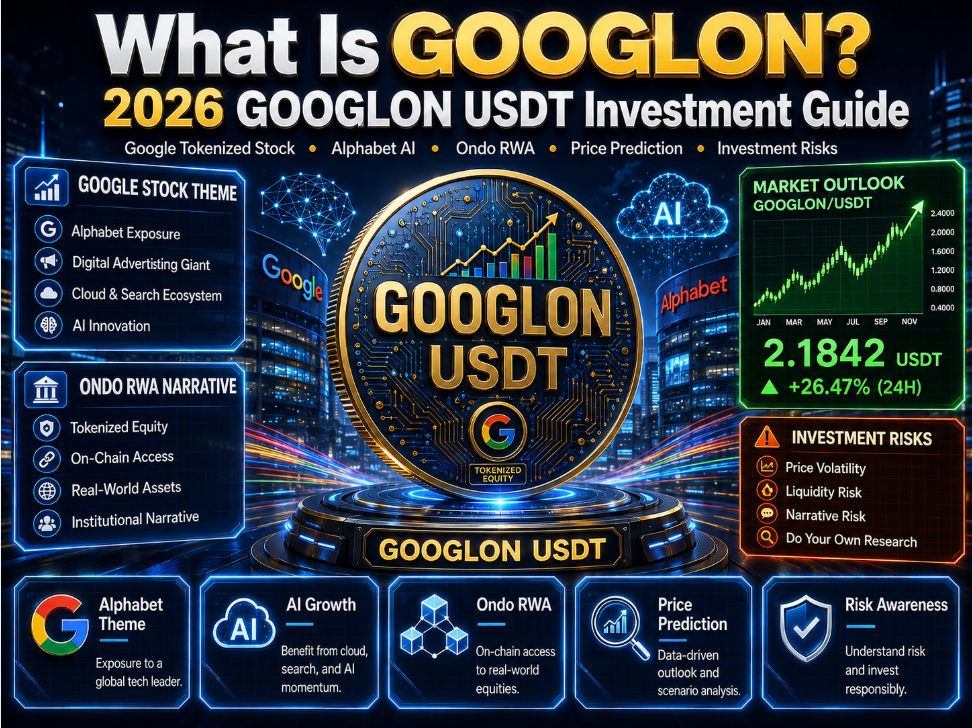
GOOGLON is an Ondo tokenized stock product built around Alphabet Class A stock (GOOGL). Its value derives from the NASDAQ-listed Alphabet shares, not from some standalone crypto project. This is the foundational point to establish from the start.
Ondo and its partner exchanges have listed GOOGLON under their Tokenized Stocks offerings. For example, in 2026, Ondo’s initial batch of tokenized securities launched with Bitget included GOOGLON for Alphabet.
So when researching GOOGLON, it’s critical to separate these four layers:
Alphabet Inc.
↓
GOOGL: Alphabet Class A Stock
↓
Ondo Stocks / Ondo Global Markets
↓
GOOGLON: Alphabet Tokenized Stock
↓
GOOGLON/USDT: GOOGLON traded against USDT
If you want to check the token’s market price first, you can view the GOOGLON real-time price and quotes.
But what really drives GOOGLON’s long-term value isn’t “whether crypto influencers are pumping it” – it’s a much more complex question:
Can Alphabet successfully migrate the advantage it built in the search era to a new AI era defined by Gemini, AI Search, and Google Cloud?
That is the most worthwhile thread to follow when researching GOOGLON in 2026.
What Is GOOGLON? Why Is It Not an Ordinary Crypto?
GOOGLON is more accurately classified as a:
Tokenized Stock / RWA Token.
It is not a native digital asset like BTC or ETH that has its own independent crypto economic model.
Typical crypto projects may derive value from:
Token supply;
Network gas fees;
Staking;
DeFi;
Community;
On-chain applications.
GOOGLON is different.
Its value transmission is much closer to:
Alphabet’s operating performance
↓
Alphabet’s market valuation
↓
GOOGL stock price
↓
Ondo Tokenized Stock structure
↓
GOOGLON price
Ondo currently positions its Tokenized Stocks as products that bring traditional public securities on-chain, backed by U.S. stocks, ETFs, and cash, and connected to traditional finance through conventional securities infrastructure, validation mechanisms, and redemption arrangements.
Therefore:
When you see GOOGLON price rise, the first question shouldn’t be:
“Is the GOOGLON community strong?”
But rather:
What’s happening with Alphabet?
Is GOOGLON Issued by Google?
No.
This must be emphasized clearly.
Google has not issued a new official crypto token because of GOOGLON.
GOOGLON belongs to Ondo’s Tokenized Stock product line.
The underlying asset corresponds to:
Alphabet Inc. Class A stock GOOGL.
So:
Google / Alphabet is the underlying enterprise.
Ondo is responsible for the tokenization product.
These are two completely different entities.
Therefore, calling GOOGLON:
“Google official coin”
“Google Coin”
“Alphabet platform token”
are all misleading expressions that can confuse newcomers.
What Does GOOGLON USDT Mean?
GOOGLON/USDT is simply a trading pair.
Where:
GOOGLON is the tokenized stock asset being traded;
USDT serves as the quote currency.
For example, if an exchange shows:
GOOGLON/USDT = 350
That can be read as:
The market is currently willing to trade 1 GOOGLON for about 350 USDT.
But for a tokenized stock, knowing only:
“Now 350 USDT”
is not enough.
Investors also need to compare:
The current price of Alphabet Class A stock GOOGL;
GOOGLON’s Shares Per Token;
The token’s reference value;
The actual trading price;
Whether there is a premium or discount.
This is a crucial difference between tokenized stocks and typical crypto spot trading.
What Exactly Is the Relationship Between Alphabet and Google?
Many people know Google but aren’t familiar with Alphabet.
In fact:
Alphabet Inc. is Google’s parent company.
Google is Alphabet’s core operating business.
Alphabet officially describes itself as a collection of companies, the largest of which is Google; core products like Search, Ads, Chrome, Cloud, YouTube, and Android all sit within Google’s ecosystem.
So when you buy GOOGL stock or research GOOGLON:
What you’re really investing in is:
Alphabet’s entire technology ecosystem.
Not just the Google.com search box.
How Does Alphabet Make Money?
Alphabet can be understood across three main layers.
Google Services
Alphabet defines Google Services as including:
Google Search;
YouTube;
Android;
Chrome;
Google Maps;
Google Play;
Pixel devices,
among others.
The primary revenue source here remains advertising, but also includes subscriptions like YouTube Premium and Google One, as well as sales of apps, digital content, and hardware.
So Google Search remains extremely important.
But it’s no longer the only business worth studying at Alphabet.
Google Cloud
Google Cloud includes:
Google Cloud Platform;
AI infrastructure;
TPUs and GPUs;
Vertex AI;
Cybersecurity;
Data & Analytics;
Gemini Enterprise;
Google Workspace,
and other enterprise services.
This is one of Alphabet’s most important second growth engines in recent years.
Other Bets
Other Bets include:
Waymo;
Wing;
Verily;
GFiber;
and other innovative ventures.
These are currently smaller relative to Google Services and Cloud, but some may generate long-term option value.
So:
Buying GOOGLON is not just betting on Google Search.
You get exposure to the enterprise value of Alphabet’s entire ecosystem:
Search + YouTube + Android + Cloud + Gemini + Waymo, etc.
Why Must You Focus on Gemini and AI When Researching GOOGLON in 2026?
AI is one of Alphabet’s biggest opportunities today – and also one of its biggest long-term debates.
The traditional Google business model has been extraordinarily powerful:
Users generate search queries
↓
Google displays search results
↓
Advertisers bid for traffic
↓
Users click on ads or commercial results
↓
Google earns ad revenue.
This model helped Google build one of the world’s strongest cash-generating internet machines.
But after generative AI emerged, a new question arose:
Users used to search for:
“3-day Tokyo travel itinerary”
Now they may directly ask ChatGPT or Gemini:
“Plan a 3-day Tokyo trip for me.”
If AI generates the answer directly:
Do users still need to click through ten web pages?
If clicks decrease:
Could Google’s traditional search ad model be affected?
This is one of the most important long-term questions in Alphabet’s valuation.
Will ChatGPT Disrupt Google Search?
This question cannot be answered with a simple:
“Yes.”
Nor with:
“Absolutely not.”
A more reasonable view is:
Generative AI is changing how people access information, and Alphabet’s biggest challenge is to migrate its search advantage into AI Search.
Google has already integrated Gemini heavily into:
AI Overviews;
AI Mode;
Search;
Chrome;
Android,
among other products.
In its Q4 2025 earnings call, Alphabet reported Search revenue grew 17% year-over-year, while also noting that AI Mode user engagement is increasing, AI search queries are more complex, and overall Search usage is still growing.
This at least suggests that, so far, AI hasn’t simply played out as:
“Gemini appears → Search revenue drops immediately.”
Instead, there’s another possibility:
AI lets users ask questions that were previously difficult to search for, thereby:
Expanding the use cases for Search.
Why Could AI Still Threaten Google Search?
The risk remains.
Because:
AI changes not just the search page design.
It changes:
The user entry point.
In the past, when users went online to find answers:
Google was often their first stop.
In the future:
They may open ChatGPT directly;
Gemini;
Perplexity;
Other AI agents.
If AI assistants can further:
Search;
Shop;
Book hotels;
Buy flights;
Complete transactions,
then the traditional “search keywords → click web pages” commercial flow could undergo structural change.
Therefore, GOOGL investors shouldn’t just watch:
“Google’s search market share today.”
But rather:
In the future AI agent era, can Alphabet still control the user intent entry point?
Gemini Isn’t Just Defensive – It Can Also Create Entirely New Revenue Streams
This is the other side that’s often overlooked when analyzing Alphabet’s AI strategy.
Many investors only see:
AI could hurt Google Search.
But Gemini could also help Alphabet build new revenue.
For example:
Gemini paid subscriptions;
Gemini Enterprise;
APIs;
Vertex AI;
Enterprise AI agents;
Google Cloud AI infrastructure;
Workspace AI;
AI-powered ad optimization.
Alphabet disclosed in Q4 2025:
Gemini App monthly active users exceeded 750 million;
Gemini Enterprise sold over 8 million paid seats within four months of launch;
Revenue from products built on its generative AI models grew nearly 400% year-over-year.
This shows Gemini is moving from:
“a cash-burning R&D project”
toward:
a real commercial product.
So researching GOOGLON shouldn’t just say:
“AI is good for Google.”
A more accurate statement is:
AI could both restructure Google’s legacy Search cash flow and create new Cloud, Subscription, and Enterprise AI revenue.
Is Gemini Burning Cash, or Already Making Money?
The answer is:
Both are happening simultaneously.
On one hand:
Alphabet is making massive capital investments for AI.
The company guided in Q4 2025 that 2026 capital expenditures would be approximately $175–185 billion, primarily for servers, data centers, AI compute infrastructure, etc.
Such capex brings:
GPUs;
TPUs;
Data centers;
Networking;
Electricity;
Depreciation,
and other huge costs.
So in the short term:
AI is indeed very expensive.
But on the other hand:
AI products are already contributing revenue.
Alphabet disclosed that revenue from generative AI model-related products is growing rapidly, and Cloud AI Infrastructure and Enterprise AI Solutions have already generated multi-billion-dollar quarterly revenue.
So the real question for investors isn’t:
“Is Google spending a lot on AI?”
It’s:
For every additional dollar of AI capex, how much sustainable revenue and profit can it create in the future?
That is the core of GOOGL’s valuation.
Is Google Search Still Alphabet’s Biggest Moat?
At least for now:
Search remains one of Alphabet’s most important cash flow sources.
Google has several advantages that other AI companies cannot easily replicate in the short term.
User Scale
Hundreds of millions of users worldwide have already formed the habit:
“Just Google it” when they have a question.
This is an extremely strong behavioral network effect.
Search Intent
What makes search advertising so valuable is that users actively express their needs.
For example, searching:
“best laptop 2026”
already implies:
the user is likely in a purchasing phase.
This commercial intent is highly suitable for ad monetization.
Advertiser Ecosystem
Google has a mature ad bidding system, advertiser data, and conversion infrastructure.
Even if AI competitors gain large user bases:
that doesn’t mean they immediately have an equally mature ad business system.
Chrome and Android
Google doesn’t just own a search engine.
It also controls or deeply participates in:
Chrome;
Android;
Maps;
YouTube;
Gmail,
and other global user entry points.
These products create very strong distribution capabilities.
What Is the Real Long-Term Risk to Google Search?
The risk is not:
“Nobody uses Google tomorrow.”
The more realistic risk is:
The commercial value per search may change.
For example:
Traditional Search:
User sees 10 results;
Clicks on several pages;
Ads have multiple display opportunities.
AI Search:
The model generates a direct answer.
So where should ads go?
Will users still click?
How much will advertisers pay?
Can Google successfully commercialize AI conversations?
All of these are still evolving.
Therefore, a key metric for researching Alphabet in 2026 is:
As AI Search usage grows, can Search revenue grow simultaneously?
If the answer is yes over the long term:
Google has successfully defended or even expanded its market.
If we see:
AI queries increase,
but Search ad revenue continues to decline,
that could signal the business model is being eroded.
Why Is Google Cloud Becoming More Important?
If Google Search has been Alphabet’s cash flow engine for the past two decades:
Google Cloud could become another major growth engine for the next decade.
Cloud’s value isn’t just from renting servers.
It now also offers:
TPUs;
GPUs;
Vertex AI;
Gemini;
Enterprise AI agents;
Data analytics;
Cybersecurity;
Workspace,
and more.
One of Google Cloud’s biggest advantages is that Alphabet can provide a full AI stack:
Chips
↓
Data centers
↓
Models
↓
Development platforms
↓
Enterprise applications.
This is quite different from just renting GPUs.
Why Does AI Drive Google Cloud Revenue?
When enterprises want to deploy AI:
They need compute power.
They need:
GPUs;
TPUs;
Storage;
Networking;
Models;
Databases;
Security;
Development tools.
Google Cloud can provide all of these together.
So the growth chain can be understood as:
Enterprises adopt AI
↓
Need more Cloud compute
↓
Use TPUs / GPUs
↓
Call Gemini
↓
Deploy Vertex AI
↓
Enterprise AI agents go live
↓
Google Cloud revenue increases
↓
Profit improves
↓
Alphabet valuation changes
↓
GOOGL price
↓
GOOGLON.
Alphabet disclosed in Q4 2025 that Google Cloud revenue grew 48% year-over-year to $17.7 billion, with Cloud Operating Income reaching $5.3 billion and operating margin rising to 30.1%. Cloud backlog reached $240 billion, primarily driven by AI demand.
This means Cloud is no longer just:
“a business that might be profitable in the future.”
It is becoming:
an increasingly large and high-margin business.
Can Google Cloud Become Alphabet’s Second Growth Engine?
Based on current trends:
It has that potential.
Especially because enterprise AI is rapidly boosting Cloud demand.
But investors should still note:
Google Cloud faces very strong competitors.
Including:
Amazon AWS;
Microsoft Azure;
Oracle Cloud;
and other AI infrastructure providers.
So Cloud growth shouldn’t be viewed simplistically as:
“AI grows, so Google automatically wins.”
What should be consistently monitored:
Revenue Growth;
Operating Margin;
Backlog;
Number of large customers;
Gemini adoption;
AI infrastructure utilization.
Why Is YouTube Another Asset That GOOGLON Investors Can’t Ignore?
Alphabet isn’t just Search and Cloud.
YouTube itself has become one of the world’s largest digital media platforms.
In Q4 2025, Alphabet reported that YouTube’s combined annual advertising and subscription revenue exceeded $60 billion.
Its business model includes:
YouTube Ads;
YouTube Premium;
YouTube Music;
YouTube TV;
Shorts.
This means:
even if Search undergoes structural change,
Alphabet still has:
YouTube;
Cloud;
Subscriptions
to help diversify revenue sources.
So GOOGLON is not a:
“single-business Search token.”
How Does GOOGLON Turn Alphabet Stock Into an On-Chain Token?
Now let’s dive into the RWA structure.
In the traditional world:
Investors buy through a securities account:
Alphabet Class A stock GOOGL.
Ondo attempts to bring that public securities value on-chain.
The simple logic is:
GOOGL stock
↓
Traditional securities market
↓
Broker / Custody system
↓
Ondo Tokenization
↓
GOOGLON
↓
On-chain wallets, trading venues, and DeFi.
Ondo currently states that its Tokenized Stocks are backed by U.S. stocks, ETFs, and cash assets through U.S. broker-dealer infrastructure, with daily asset verification and corresponding investor protection mechanisms.
So GOOGLON’s price foundation is not:
the GOOGLON community “creating value” on its own.
But rather:
the underlying Alphabet stock.
What Can You Do With GOOGLON On-Chain?
One of the biggest features of tokenized stocks compared to traditional brokerage shares is:
easier access to crypto infrastructure.
For example, GOOGLON can already be bridged via Ondo Bridge to Hyperliquid’s HyperEVM, allowing on-chain trading and strategy management alongside other tokenized assets.
This means stock tokenization could enable:
On-chain transfers;
Collateral;
DeFi;
24/7 markets;
Automated portfolio combinations;
Unified management with crypto assets,
and other new use cases.
This is what makes RWA truly attractive to crypto investors:
not simply “renaming a stock,”
but:
giving traditional assets blockchain composability.
Does Buying GOOGLON Mean You Actually Own Google Stock?
Not exactly.
This is one of the most important EEAT sections of this article.
GOOGLON’s goal is to give token holders exposure to economic performance similar to Alphabet Class A stock.
But:
economic exposure
and
direct equity ownership in a traditional securities account
are not the same concept.
So you shouldn’t simply say:
“1 GOOGLON equals 1 share of Google stock.”
The actual relationship depends on:
Shares Per Token;
Product issuance structure;
Corporate actions;
Dividend handling;
Mint / Redemption rules,
and other specific terms.
Ondo emphasizes that its Tokenized Stocks have clear asset backing, redemption rights, and traditional market liquidity connections, but the on-chain token remains an asset wrapped through a tokenization structure.
Does GOOGLON Have Voting Rights?
Here we can’t use the simple answer from early tokenized stock articles:
“Absolutely none.”
In 2026, Ondo partnered with Broadridge to enable holders of over 250 tokenized stocks and ETFs to submit voting preferences for the underlying stocks, and to access prospectuses, regulatory disclosures, and other information.
But it needs to be understood precisely:
This is:
expressing a Voting Preference.
It is not the same as directly holding GOOGL stock in a traditional shareholder register.
So the governance experience for tokenized stocks is gradually approaching traditional securities,
but the product structure still has differences.
What’s the Difference Between GOOGL and GOOG?
This is a common question when searching for Google stock.
Alphabet has multiple share classes.
GOOGL corresponds to Class A Common Stock.
Alphabet’s corporate charter states that Class A common stock has 1 vote per share.
Class C stock typically has no voting rights.
In the market:
GOOGL usually represents Class A;
GOOG represents Class C.
GOOGLON corresponds to:
Alphabet Class A / GOOGL
that asset, not GOOG.
For most investors, the economic value of the two classes may be similar over the long term, but the voting structure differs.
Why Does GOOGLON Belong to RWA?
RWA stands for:
Real World Assets.
The core idea is:
connecting real-world assets with blockchain.
Including:
Treasuries;
Gold;
Real estate;
Stocks;
ETFs;
Private credit.
GOOGLON’s underlying comes from NASDAQ-listed Alphabet stock, so it falls under:
Tokenized Equity RWA.
As of 2026, Ondo Stocks has expanded to over 440 assets and covers multiple on-chain ecosystems.
This shows that tokenized stocks are no longer just a small-scale experiment with a few stocks.
They are gradually becoming a full-fledged asset class.
What’s the Difference Between GOOGLON and BTC?
BTC is a Crypto Native Asset.
Its primary value sources include:
Scarcity;
Bitcoin network;
Global liquidity;
Market consensus;
Store-of-value demand.
You can observe the broader crypto macro cycle via BTC price prediction and Bitcoin market trends.
GOOGLON is completely different.
Its long-term value comes from:
Alphabet’s enterprise value.
So:
Researching BTC,
you focus more on crypto and macro liquidity.
Researching GOOGLON,
you focus on:
Earnings;
Search;
Cloud;
Gemini;
YouTube;
AI investment.
What’s the Difference Between GOOGLON and ETH?
ETH’s core value comes from:
Ethereum;
Gas;
DeFi;
Stablecoins;
Staking;
Layer 2.
You can check ETH price prediction and Ethereum’s future outlook to gauge the crypto infrastructure cycle.
GOOGLON has none of:
Gas demand;
Staking yield;
DeFi revenue,
such token-native economics.
Its logic is simpler:
Alphabet → GOOGL → GOOGLON.
Why Does GOOGLON Price Rise? The 8 Variables You Should Really Watch
Predicting GOOGLON price isn’t about how many KOLs are talking about it.
At minimum, you need to watch eight directions.
First: GOOGL Stock Price
This is the No. 1 core variable.
Under normal circumstances:
GOOGL rises → GOOGLON’s reference economic value rises.
If GOOGL itself falls:
GOOGLON cannot rise independently in the long term.
So any GOOGLON price forecast should start with analyzing GOOGL.
Second: Google Search Ad Revenue
Google Search remains Alphabet’s cash flow core.
Investors should consistently watch:
Search Revenue Growth;
Search queries;
Advertiser spending;
Commercial queries;
AI Search monetization.
If AI Search both brings:
more Queries
and successfully displays and converts ads,
Google could further strengthen its Search moat.
If AI significantly increases compute costs while lowering ad monetization:
the profit structure could come under pressure.
Third: Google Cloud
Cloud is increasingly becoming Alphabet’s second growth curve.
Key metrics to watch:
GCP growth;
AI infrastructure;
TPUs;
GPUs;
Gemini;
Cloud Backlog;
Operating Margin.
The faster Cloud grows:
the less Alphabet depends on a single advertising business.
Fourth: Gemini Commercialization
Investors shouldn’t just look at:
benchmarks.
Look at:
Gemini MAU;
Paid subscriptions;
Enterprise seats;
APIs;
Enterprise AI revenue.
As of Q4 2025, Alphabet disclosed Gemini App MAU exceeded 750 million, Gemini Enterprise paid seats surpassed 8 million, and generative AI model product revenue grew nearly 400% year-over-year.
These numbers matter more for investment than:
“Where does Gemini rank on the leaderboard?”
Fifth: AI Capital Expenditure
AI is an opportunity,
but also a cost.
In 2026, Alphabet plans massive increases in capital spending for:
Servers;
TPUs;
GPUs;
Data centers;
Networking;
Energy.
If these investments generate high returns in the future:
GOOGL valuation could benefit.
If CAPEX grows faster than revenue for too long:
free cash flow and valuation could face pressure.
Sixth: YouTube
YouTube has:
Advertising;
Subscriptions;
Shorts;
YouTube TV,
and multiple business models.
It’s Alphabet’s important second consumer platform.
If YouTube ad and subscription revenue continue to grow:
that adds revenue diversification for Alphabet.
Seventh: Regulation
Alphabet also faces:
Search antitrust;
Ad tech;
App Store;
AI regulation;
Privacy,
and other policy risks.
Regulation could affect:
Distribution;
Default search agreements;
Ad tech;
Business structure.
This is another unavoidable variable for big tech valuations.
Eighth: GOOGLON’s Own Liquidity
Even if GOOGL doesn’t move at all:
a given secondary market for GOOGLON could still see short-term price changes due to:
Liquidity;
Spread;
Token supply;
Trading hours;
Market demand.
So investors need to study both:
the Underlying Market
and
the Token Market.
Why Might GOOGLON Price Differ From GOOGL Stock?
Many newcomers assume that since GOOGLON tracks GOOGL,
the price should be exactly the same every second.
That’s not how it works.
There are at least three price levels.
First:
GOOGL stock price.
Second:
GOOGLON’s theoretical reference economic value.
Third:
The actual traded price of GOOGLON on a given platform.
The third price is affected by:
Bid;
Ask;
Liquidity;
Token supply/demand.
So short-term premiums or discounts can occur.
What Is a GOOGLON Premium?
Here’s a simplified example.
Assume after calculating based on the token ratio:
GOOGLON’s theoretical value is about:
$350.
But the crypto market currently trades at:
$364.
That means roughly:
a 4% premium.
At that point, investors need to ask two questions:
Is Alphabet a company worth investing in for the long term?
and:
Am I now paying an extra 4% Token Premium for GOOGLON?
These are completely different questions.
Even if you’re very bullish on Google:
if the token itself is clearly overvalued,
you could still suffer additional losses.
What Is a GOOGLON Discount?
Conversely:
Theoretical reference value $350.
Token traded at:
$336.
That would mean about a 4% discount.
A discount could come from:
Sell pressure;
Liquidity;
Arbitrage channel frictions;
Market closure;
Redemption restrictions.
If Mint / Redemption mechanisms work smoothly:
arbitrageurs may help prices converge.
But:
arbitrage isn’t always instantly executable.
So short-term discounts are entirely possible.
Why Should You Pay Extra Attention to GOOGLON Prices on Weekends?
NASDAQ-listed GOOGL stock doesn’t trade 24/7.
But tokenized stocks can trade on:
Crypto secondary markets;
Wallets;
Some on-chain venues.
So if over the weekend there’s suddenly:
a major Gemini product announcement;
regulatory change;
Alphabet M&A;
significant AI news,
GOOGLON may start trading on that news first.
While the real NASDAQ GOOGL will only do full price discovery when traditional markets reopen.
This can create:
Token prices first → U.S. markets open → convergence.
Therefore, buying tokenized stocks during off-hours:
especially requires watching the premium/discount.
How to Invest in GOOGLON in 2026?
For tokenized stocks, newcomers shouldn’t start with:
“Where do I click buy?”
The right sequence is:
Research the underlying first.
Step 1: Research Alphabet First
At minimum, understand:
Search;
Gemini;
Cloud;
YouTube;
Latest earnings;
AI CAPEX.
If you don’t even know how Alphabet makes money:
and buy only because you see a “Google concept token”,
the risk is very high.
Step 2: Check GOOGLON Quotes
Open the GOOGLON real-time price and USDT quotes to see:
Latest price;
24h change;
Volume;
Historical candles;
Order book.
But don’t look only at the token itself.
Step 3: Prepare USDT
GOOGLON/USDT means:
trading GOOGLON against USDT.
So some crypto users can get tokenized equity exposure via USDT.
That’s one reason RWA products attract crypto natives:
they don’t have to leave their familiar crypto funding systems.
Step 4: Always Compare GOOGL Price
Buying tokenized stocks requires one extra important step compared to regular altcoins:
Compare the Underlying.
Check:
GOOGL current price;
GOOGLON reference value;
GOOGLON traded price.
If the token is at a significant premium,
reconsider entry.
Step 5: Limit Order or Market Order?
Market Order:
Advantage – fast execution.
Disadvantage – slippage if order book is thin.
Limit Order:
You specify the price you’re willing to pay.
For tokenized stock markets with relatively limited liquidity,
limit orders usually give better cost control.
Step 6: Position Sizing
Don’t fall into the trap of thinking:
“Alphabet is so big, it can’t drop much.”
GOOGL itself is a risk asset.
GOOGLON adds additional risks from:
Tokenization;
Liquidity;
Platform;
Regulation,
among others.
So position sizing still matters.
How Should You Read GOOGLON Price Predictions?
You can refer to GOOGLON price prediction and historical trends, but for tokenized stocks, it’s not advisable to use simple models like:
“$500 in 2027”
“$1,000 in 2030.”
A more reasonable approach is:
Bull Case;
Base Case;
Bear Case.
GOOGLON Bull Case: Alphabet Wins the AI Era
An optimistic scenario might include:
Gemini maintains model competitiveness;
AI Search commercializes successfully;
Google Search ad revenue is not materially eroded;
Google Cloud sustains high growth;
Gemini Enterprise revenue increases;
YouTube continues expanding;
AI CAPEX generates high returns;
Alphabet’s valuation improves further.
If these conditions gradually materialize,
GOOGL could enjoy a new AI growth premium over time.
GOOGLON would benefit accordingly.
GOOGLON Base Case: Search Stable, AI Progresses Gradually
A neutral scenario might be:
Traditional Search maintains growth;
Cloud continues expanding;
Gemini user base grows;
but AI monetization proceeds at a moderate pace.
Meanwhile:
High CAPEX;
Depreciation;
Energy costs,
offset some profit improvements.
In this case,
Alphabet may deliver steady growth,
but valuation won’t expand dramatically.
GOOGLON would largely track GOOGL’s fundamental normal fluctuations.
GOOGLON Bear Case: AI as a Disruptor Rather Than a Growth Engine
A pessimistic scenario might include:
ChatGPT and other AI entry points increasingly capture search demand;
AI Search reduces ad clicks and commercial conversion;
Gemini monetization falls short of expectations;
Google Cloud competition intensifies;
AI infrastructure investment returns are insufficient;
Antitrust pressures increase;
U.S. tech valuations contract broadly.
This would create the most dangerous combination:
the legacy business is eroded by AI
while:
the new AI business hasn’t yet earned enough money.
If that happens,
Alphabet’s valuation could be significantly compressed.
GOOGLON Price Prediction Is Essentially a GOOGL Value Prediction
A simplified long-term price logic could be:
GOOGLON value ≈ Alphabet profitability × GOOGL valuation × AI competitiveness × token tracking efficiency × Premium/Discount.
This isn’t a strict mathematical formula.
But it helps newcomers understand:
GOOGLON is not a token that can be predicted independently of Alphabet.
Will a BTC Bull Market Push GOOGLON Higher?
There’s no one-to-one correspondence.
Bitcoin up 20%:
doesn’t mean GOOGLON is also up 20%.
GOOGLON’s core remains:
Alphabet fundamentals + GOOGL stock price.
Bitcoin may affect tokenized stocks indirectly through:
Crypto risk appetite;
RWA capital flows;
USDT market activity.
So:
A BTC bull market may attract more crypto capital to GOOGLON,
but it won’t change the fact that Alphabet ultimately has to prove its value through:
Revenue;
Profit;
Cash flow.
What’s the Difference Between GOOGLON and METAON?
If you want to research different AI-related tokenized stocks, you can read What Is METAON USDT? Meta Stock Tokenization and AI Investment Logic.
METAON primarily gives exposure to:
Facebook;
Instagram;
WhatsApp;
AI advertising;
AI agents;
Meta AI.
GOOGLON is more concentrated on:
Search;
YouTube;
Cloud;
Gemini;
AI infrastructure.
Both are AI platform companies,
but with different business models.
What’s the Difference Between GOOGLON and PLTRON?
You can further read What Is PLTRON USDT? Palantir Stock Tokenization and AI Data Analytics Investment Logic.
PLTRON’s investment thesis is more focused on:
Enterprise AI software;
Data analytics;
Government contracts;
AIP platform.
Alphabet is a large, diversified tech ecosystem.
So:
PLTRON is more like:
Pure Enterprise AI Software Exposure.
GOOGLON is more like:
Search + Ads + Cloud + Consumer AI Platform.
What’s the Difference Between GOOGLON and INTCON?
What Is INTCON? Semiconductor Tokenized Asset and Chip Investment Logic represents a more upstream hardware asset.
Semiconductor companies focus on:
Chips;
Capacity;
Process technology;
AI compute demand.
Alphabet is about:
Cloud;
AI models;
Search;
Consumer Platform.
Simply put:
INTCON is more:
AI Hardware.
GOOGLON is more:
AI Platform + Cloud + Applications.
What’s the Difference Between GOOGLON and QQQON?
If an investor believes:
AI is great long-term,
but isn’t sure which of Google, Meta, or NVIDIA will ultimately be the biggest winner,
they might prefer an index-type asset.
You can check What Is QQQON USDT? NASDAQ Tech ETF Tokenized Asset Analysis.
QQQON is essentially:
a portfolio of tech assets.
GOOGLON is a:
single company.
Therefore:
GOOGLON’s potential return is more concentrated;
and:
Company-Specific Risk is also higher.
Is GOOGLON Suitable for Long-Term Investment?
This question should be split into two parts.
First:
Is Alphabet suitable for long-term investment?
Second:
Is gaining exposure through GOOGLON rather than direct GOOGL right for you?
These are not the same question.
Who Might Pay More Attention to GOOGLON?
Potentially:
Those bullish on Alphabet’s long-term AI capabilities;
Those bullish on Google Cloud;
Those who believe Search can successfully transition to AI;
Those who want to invest in U.S. stocks using crypto-native systems;
Those familiar with RWA and tokenized securities.
Who Might Prefer to Buy GOOGL Directly?
If you already have:
a traditional U.S. securities account,
and you value:
direct stock ownership;
more mature liquidity;
traditional brokerage protections;
standard securities infrastructure,
then buying GOOGL directly may be simpler.
Because each layer of tokenization adds another layer of risk to understand.
Who Should Not Buy GOOGLON?
If your investment thesis is only:
“Google is big, so it will definitely go up.”
or:
“GOOGLON is a new Google concept coin,”
that shows you haven’t really understood the product.
GOOGLON is not:
a Google Meme Coin.
It is a:
Tokenized Equity product.
10 Key Risks You Must Know Before Investing in GOOGLON
Risk 1: GOOGL Share Price Risk
GOOGLON first inherits:
Alphabet stock’s own market volatility.
Alphabet is a large tech company,
but large tech companies can also experience:
20%;
30%;
or even larger drawdowns.
Risk 2: Search Disruption by AI
This is GOOGL’s most critical long-term risk.
If AI changes user search behavior,
the traditional ad model may need to be rebuilt.
Alphabet needs to prove that AI Search can increase both usage and revenue.
Risk 3: Gemini Competition Risk
The AI model race is extremely fast-paced.
Gemini must continuously face competition from:
OpenAI;
Anthropic;
Meta;
other models.
Being ahead today doesn’t guarantee being ahead two years from now.
Risk 4: Google Cloud Competition
The cloud market is fiercely competitive.
AWS;
Azure;
Oracle,
all will compete for AI workloads.
Google Cloud needs to maintain competitiveness in:
Products;
Pricing;
Models;
Chips.
Risk 5: AI CAPEX Return Risk
In 2026, Alphabet plans massive AI infrastructure capex.
If future revenue growth can’t cover:
Depreciation;
Energy;
Servers;
Data centers,
free cash flow could be pressured.
Risk 6: Regulation
Alphabet has long faced:
Antitrust;
Search default agreements;
Ad tech;
Privacy;
AI regulation,
and other policy risks.
Regulatory events can directly impact valuation.
Risk 7: Ondo Product Structure Risk
GOOGLON is not GOOGL stock in a traditional brokerage account.
Users also bear risks related to:
Issuer;
Tokenization;
Redemption.
Risk 8: Underlying Infrastructure Risk
Tokenized stocks rely on connections among:
Broker;
Custody;
Blockchain;
Smart contracts.
Any serious issue in any component could affect asset trading or redemption.
Risk 9: Liquidity and Slippage
Even though NASDAQ GOOGL is highly liquid,
a given GOOGLON secondary market may have limited liquidity.
So:
Underlying Liquid
doesn’t necessarily mean:
Token Market is equally Liquid.
Risk 10: Geographic and Regulatory Restrictions
Tokenized securities are subject to securities regulations across different jurisdictions.
Ondo has expanded compliance coverage in certain markets, but different products may still have geographic and eligibility requirements.
So before investing,
reconfirm the current platform’s rules and your local regulations.
Is GOOGLON Expensive Right Now? Use a 5-Layer Framework
Better than simply asking:
“Can I buy?”
is to analyze across five layers.
Layer 1: Search Fundamentals
Is Search advertising still growing?
As AI Overviews and AI Mode usage grow,
are commercial queries continuing to grow?
This is the cash flow moat.
Layer 2: Cloud
Can Google Cloud revenue and margins continue to expand?
If Cloud becomes a second massive cash flow engine,
Alphabet’s business quality will improve markedly.
Layer 3: Gemini
Is Gemini merely increasing capex,
or is it already generating real subscription, Cloud, and enterprise AI revenue?
This is key to whether AI valuation can materialize.
Layer 4: GOOGL Valuation
Even if Alphabet’s fundamentals are strong,
you still need to ask:
how much AI growth is already priced into the current stock price?
A great company doesn’t mean it’s a buy at any valuation.
Layer 5: GOOGLON Premium
Finally, look at the token.
Even if GOOGL’s price is reasonable,
if GOOGLON carries an additional:
5%;
8%
Premium,
investors could still overpay.
So remember two conclusions:
Great company ≠ any price is a buy.
and:
Good stock price ≠ Good token price.
What Is GOOGLON?
GOOGLON is an on-chain asset product in Ondo’s Tokenized Stock system built around Alphabet Class A stock GOOGL. GOOGLON already appears on Ondo partner exchanges and on-chain infrastructure.
What Coin Is GOOGLON?
Strictly speaking:
It shouldn’t be called an ordinary crypto coin.
The more accurate category is:
Tokenized Stock / RWA.
Is GOOGLON Issued by Google?
No.
The underlying company is Alphabet.
GOOGLON is part of Ondo’s Tokenized Stock system.
What’s the Difference Between GOOGLON and GOOGL?
GOOGL:
is the NASDAQ-listed Alphabet Class A stock.
GOOGLON:
is the on-chain tokenized stock product.
They are economically linked,
but product structures differ.
What’s the Difference Between GOOGLON and GOOG?
GOOGL corresponds to:
Alphabet Class A.
GOOG corresponds to:
Alphabet Class C.
Alphabet’s corporate governance documents state that Class A typically has 1 vote per share, while Class C typically has no voting rights.
GOOGLON corresponds to:
GOOGL Class A assets.
Does Buying GOOGLON Equal Buying Google Stock?
You cannot draw a simple equal sign.
GOOGLON provides:
economic exposure to Alphabet stock.
But tokenized stocks and direct stock ownership in a traditional brokerage account are different structures.
What Does GOOGLON USDT Mean?
It means:
trading GOOGLON against USDT as the quote currency.
You can view GOOGLON USDT real-time quotes to see the price.
How Do You Buy GOOGLON?
Before buying, check in order:
Alphabet fundamentals;
GOOGL stock price;
GOOGLON reference value;
Token premium / discount;
Liquidity;
Platform’s current product status;
Local regulatory requirements.
Then decide whether to trade.
Why Is GOOGLON Considered an AI-Themed Asset?
Because Alphabet’s AI strategy now deeply integrates:
Google Search;
Gemini;
Google Cloud;
TPUs;
YouTube;
Workspace;
Enterprise AI.
Alphabet has disclosed that its Gemini users, Cloud AI, and generative AI product revenue are growing rapidly.
So AI is no longer just a future story for Alphabet,
but is progressively affecting:
Revenue;
Capex;
Product structure;
Valuation.
Is GOOGLON Worth Investing In?
You should evaluate at least six variables simultaneously:
Alphabet Fundamentals
- Google Search Moat
- Gemini Commercialization
- Google Cloud Growth
- GOOGL Valuation
- GOOGLON Premium/Discount and Token Structure.
Studying only one won’t give a complete conclusion.
Conclusion: Investing in GOOGLON Is Essentially Judging Whether Alphabet Can Extend Its Search-Era Dominance Into the AI Era
GOOGLON looks like a crypto ticker.
But if you trace the value source downward:
GOOGLON
↓
GOOGL
↓
Alphabet
↓
you eventually come back to three core business lines:
Google Search / Advertising
Google Cloud
Gemini / AI.
For more than two decades,
Google’s greatest competitive advantage came from:
the search entry point.
Users have a need:
open Google.
Advertisers have a need:
buy Google Ads.
That created an extraordinarily powerful business flywheel.
But the AI era is changing internet entry points.
In the future, users may increasingly:
talk directly to AI;
let agents search for them;
have AI complete shopping and tasks.
So what Alphabet really needs to prove is:
After AI changes search, can Google still own the user entry point?
Going further:
It not only needs to defend Search.
It also needs to turn Gemini into:
new consumer products;
new enterprise AI;
new Cloud revenue;
new subscription revenue.
From the data disclosed so far:
AI is helping Search add new usage modes, Gemini user scale is growing rapidly, generative AI product revenue is rising fast, and Google Cloud is seeing strong AI-driven demand.
At the same time:
Alphabet is making historically large capital expenditures.
So:
The biggest investment question isn’t:
“Does Google have AI?”
It’s:
Can the long-term profits created by AI exceed the cost of AI capital, and the potential erosion of AI on the traditional Search business model?
If the answer is yes,
Alphabet could successfully transform from:
Search Era Leader
to:
AI Era Platform Leader.
If the answer is no,
and the traditional Search moat is continuously weakened by new AI entry points,
GOOGL’s valuation may need to be redefined.
So the right sequence for researching GOOGLON should always be:
Alphabet Fundamentals
↓
Google Search Moat
↓
Gemini Competitiveness and Commercialization
↓
Google Cloud Growth
↓
AI CAPEX Returns
↓
GOOGL Stock Valuation
↓
Ondo Tokenized Stock Structure
↓
GOOGLON Liquidity and Premium / Discount
↓
Final decision on whether to invest.
This is the biggest difference between GOOGLON and ordinary altcoins.
A truly mature investor doesn’t ask:
“Is GOOGLON a Google-concept 100x coin?”
But rather:
Can Alphabet continue to control the information entry point in the AI era, and how much of that success expectation is already priced into current GOOGL and GOOGLON prices?
The gap between those two questions is where GOOGLON’s real investment opportunity – and risk – lies.
Risk Disclosure: This article is for educational and market research purposes regarding tokenized stocks, RWA, and related topics. It does not constitute a buy or sell recommendation for GOOGLON, GOOGL, BTC, ETH, or any securities or digital assets. Tokenized securities may involve issuance structure, custody, liquidity, premium/discount, and jurisdictional limitations. Before investing, please verify the latest product rules from Ondo and the actual trading platform.