
If you’re coming across COINON USDT for the first time, many crypto investors naturally jump to a few common misconceptions:
Is COINON a new coin issued by Coinbase? Is it an exchange token similar to BNB? Or did Coinbase put its own stock on the blockchain?
The more accurate answer is:
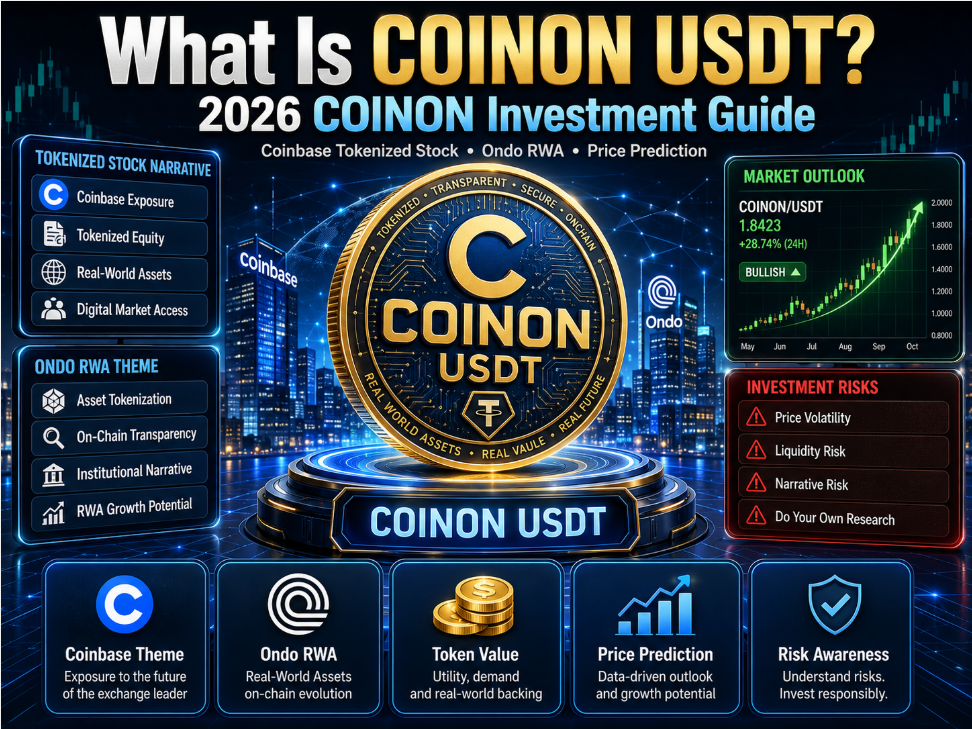
COINON is a tokenized stock product within the Ondo Stocks ecosystem that tracks the economic performance of Coinbase Global’s publicly traded stock, COIN. It is NOT a new cryptocurrency issued by Coinbase.
Even Coinbase’s own COINON price page describes it as the Ondo Tokenized version of Coinbase stock, designed to give token holders economic exposure similar to holding COIN with dividends reinvested. Coinbase also clearly notes that COINON itself cannot be traded directly on Coinbase.
So before digging into COINON, you have to separate three concepts:
Coinbase is a company.
COIN is the NASDAQ ticker for Coinbase Global’s stock.
COINON is the Tokenized Stock built around COIN within the Ondo system.
And when you see:
COINON/USDT
that simply means:
trading COINON using USDT as the quote asset.
Investors can monitor price movements via the COINON Real-Time Price and Market Data page, but the long‑term value isn’t driven by “crypto community hype”—it’s driven by Coinbase the company, COIN stock valuation, and Ondo’s tokenized stock product structure.
That’s the biggest difference between COINON and typical altcoins.
What Is COINON and Why Is It Completely Different from Ordinary Crypto?
For newcomers, here’s a one‑sentence summary:
COINON is an RWA asset that brings the economic price exposure of Coinbase stock onto the blockchain.
Ondo officially defines Ondo Stocks as a tokenization platform that brings traditional public securities on‑chain. As of August 2026, the official page shows support for over 440 tokenized stocks and ETFs across networks like Ethereum, BNB Chain, and Solana.
So COINON is NOT a typical crypto token that gains value from:
- mining;
- staking;
- community voting;
- meme propagation;
- on‑chain gas fees.
Its core value anchor comes from:
Coinbase Global stock – COIN.
What’s the Difference Between Coinbase, COIN, and COINON?
These three are easily confused.
What is Coinbase?
Coinbase Global, Inc. is a U.S.-listed crypto financial infrastructure company, trading on NASDAQ under the ticker:
COIN.
Coinbase’s business is no longer just a traditional crypto spot exchange; it now covers:
- spot and derivatives trading;
- stablecoins and USDC operations;
- institutional services;
- Coinbase Prime;
- Base;
- payments;
- developer infrastructure;
- prediction markets,
among others. In its Q2 2026 investor materials, Coinbase positioned itself as building an “Everything Exchange” covering crypto, equities, derivatives, prediction markets, and more.
What is COIN?
COIN is the NASDAQ‑traded stock of Coinbase Global.
Traditional investors buy COIN through brokerage accounts:
they are essentially investing in Coinbase the company.
COIN’s price is influenced by:
- company revenue;
- earnings;
- crypto trading volume;
- regulation;
- USDC;
- institutional business;
- overall stock market valuations,
among other factors.
What is COINON?
COINON is a Tokenized Stock product issued by Ondo Stocks.
It aims to give on‑chain investors:
economic exposure similar to COIN stock.
Ondo’s official documentation notes that Ondo Stocks use the “on” suffix—e.g., TSLA becomes TSLAon. These tokens aim to track the underlying stock’s Total Return, including price changes and the value of reinvested dividends after applicable withholding taxes.
So a simple way to think about it:
COIN
↓
Ondo Stocks Tokenization
↓
COINON.
But we must immediately add:
Similar economic exposure does not mean COINON is the same as holding COIN stock in a traditional brokerage account.
We’ll explain this in detail later.
What Is COINON USDT?
COINON/USDT is simply a trading pair.
If the market shows:
COINON/USDT = 170
that roughly means:
the market is willing to trade 1 COINON for about 170 USDT.
Where:
- COINON is the Tokenized Stock asset;
- USDT is the quote asset.
Therefore:
COINON USDT is NOT a new stablecoin.
Nor is it an official Coinbase platform token.
To check market prices, you can view the COINON Price Chart and USDT Quote.
However, for this type of Tokenized Stock:
Knowing just the COINON price isn’t that meaningful.
More important questions:
- What’s the underlying Coinbase stock (COIN) trading at right now?
- Is COINON trading at a noticeable premium or discount to COIN?
- Is the underlying U.S. equity market open?
- Are mint and redemption mechanisms functioning normally?
These factors together determine whether the COINON price you see is reasonable.
Why Should Crypto Investors Pay Attention to Coinbase?
If you want to analyze COINON, the first step isn’t to study Ondo.
It’s to:
study Coinbase.
Because if Coinbase’s fundamentals deteriorate—
even if Ondo’s tokenization technology is excellent,
COINON’s long‑term price will likely decline.
Conversely,
if Coinbase’s business grows, profitability improves, and the market assigns a higher valuation to COIN,
then COINON has a chance to deliver corresponding economic returns.
Coinbase’s First Revenue Driver: Crypto Trading Business
Coinbase’s easiest‑to‑understand business is:
users trading crypto.
The more active the market,
the higher the trading volume typically is.
As volume increases,
trading‑related revenue may rise.
So in early market perceptions,
COIN was often seen as a:
Beta play on the crypto market.
The logic roughly went:
Bitcoin rises
↓
crypto热度 increases
↓
more users trade
↓
volume increases
↓
Coinbase revenue expectations improve
↓
COIN valuation may rise.
That’s why, when researching COINON, it still makes sense to look at BTC Price Predictions and Bitcoin Market Cycles to gauge the overall Risk‑On / Risk‑Off environment for crypto.
But by 2026, Coinbase can no longer be understood simply as:
“Bitcoin goes up, Coinbase makes money.”
Coinbase Is Reducing Its Reliance on Trading Fees Alone
Coinbase’s Q2 2026 official earnings materials show that the company’s crypto trading volume market share reached 10.3%, a record high for the third consecutive quarter. At the same time, Coinbase emphasizes that its revenue sources are becoming significantly more diversified.
More notably:
Coinbase disclosed that Q2 2026 Subscription & Services Revenue reached **$555 million**, accounting for about 48% of Net Revenue—a massive jump from just $6 million in Q2 2020.
This means that when analyzing COIN stock today, you can’t just watch:
Bitcoin volume.
You also need to study:
- stablecoins;
- USDC;
- subscriptions and services;
- custody;
- interest income;
- institutional business;
- Base;
- payments;
- derivatives;
- prediction markets,
among other revenue streams.
Why Is USDC Also a Key Variable in Coinbase’s Valuation?
Coinbase has a close relationship with the USDC ecosystem.
In Q2 2026, Coinbase disclosed that:
the average amount of USDC held on its platform reached a record high of about $20 billion, representing over 30% of total USDC circulating supply at quarter‑end. Coinbase also stated that it has captured roughly 50% of the economic benefits of USDC over the past year.
This means:
even if crypto spot trading fees decline,
USDC’s growth can still create new revenue streams for Coinbase.
So the future COIN valuation logic may increasingly resemble that of a:
crypto financial infrastructure company
rather than a:
pure‑play crypto exchange.
This is a critical point for understanding COINON’s long‑term value.
If Bitcoin Rises, Will COINON Automatically Rise?
Not necessarily.
Bitcoin is indeed an important variable for Coinbase’s business.
But Coinbase’s stock price is also affected by:
- the company’s own earnings;
- operating expenses;
- market share;
- USDC;
- regulation;
- stock market valuations;
- interest rates;
- investor risk appetite.
For example:
BTC rallies 20%.
But if Coinbase’s earnings miss expectations,
COIN can still fall.
Conversely,
even if BTC trades sideways for a while,
if Coinbase gains market share, grows USDC revenue, cuts costs, or beats expectations on new businesses,
COIN can rise.
So a more accurate analytical chain is:
BTC and the crypto market → Coinbase’s operating environment → Coinbase’s financial performance → COIN stock valuation → COINON price.
Not:
BTC goes up = COINON must go up.
How Does COINON Bring Coinbase Stock “On‑Chain”?
To understand COINON, you next need to understand Ondo Stocks.
Ondo’s core idea isn’t to:
create a completely separate “virtual stock market.”
Instead, it leverages the assets, custody, and liquidity of the traditional securities market while tokenizing economic exposure.
Ondo’s official materials show that its Tokenized Stocks are backed by underlying U.S. stocks, ETFs, and related cash assets. The underlying assets are held through a U.S. registered Broker‑Dealer framework, with independent Verification Agents and Security Agents providing additional protections.
A simple way to visualize COINON’s structure:
Coinbase stock (COIN)
↓
Traditional U.S. securities infrastructure
↓
Ondo Stocks
↓
On‑chain COINON
↓
Wallet / CEX / DeFi / RWA trading venues
This is more helpful than diving straight into complex smart contracts.
Does 1 COINON Equal 1 Share of COIN?
Here we need to be very careful.
Many articles like to write:
“1 COINON = 1 COIN share.”
That phrasing can be misleading.
Ondo’s official definition of the product is:
token holders receive economic exposure similar to holding the underlying asset and reinvesting dividends—Ondo Stocks use a Total Return Tracker design.
This means:
as dividends are reinvested or other corporate actions occur,
the economic relationship between each token and the underlying stock may not always remain a static:
1 Token = 1 Share.
A more professional approach is to check the specific COINON asset page for:
- Shares Per Token;
- official reference price;
- mint / redemption rules;
- corporate action adjustments.
So it’s best to avoid the fixed “always 1:1 with a share” description.
How Are COINON Tokens Issued and Redeemed?
Ondo Stocks connect on‑chain token demand with traditional securities market liquidity through mint and redemption mechanisms.
In simple terms:
When eligible users mint tokens,
the system acquires corresponding economic exposure to the underlying securities in the traditional market and then issues the relevant Ondo tokens.
When users redeem,
tokens are burned and the corresponding value can be converted into stablecoins or cash value.
Ondo’s official page indicates that minting and redemption are generally available 24/5, while the tokens themselves can be transferred peer‑to‑peer 24/7 on supported blockchains. In 2026, Ondo began rolling out 24/7 mint and redemption for some popular assets, so whether COINON specifically supports around‑the‑clock minting/redemption should be confirmed on the live asset page.
This mechanism is very important.
Because it provides:
an arbitrage channel.
If COINON trades at a significant premium to its reference value,
arbitrageurs could theoretically mint new tokens and sell them.
If COINON trades at a discount,
arbitrageurs could buy and redeem them.
This mechanism helps keep the token price
aligned with
the economic value of the underlying stock.
Does Buying COINON Mean You Actually Own Coinbase Stock?
Not exactly.
This is one of the most important risk‑education sections in this article.
Ondo’s official disclaimer makes it clear:
Ondo Stocks provide token holders with economic exposure to the value of the underlying public securities, including dividends, but Ondo Stocks themselves are not stocks, ETFs, or ADRs, and token holders have no right to directly hold or demand delivery of the underlying securities.
So:
buying COINON
and
buying COIN through a broker
cannot be treated as the same thing.
What Does “Economic Exposure” Mean?
Suppose COIN stock rises from:
$150
to:
$180.
If COINON properly tracks COIN,
COINON’s theoretical value should show a similar economic change.
So:
you gain economic exposure to the upside of Coinbase stock.
But a COIN share held in a traditional brokerage account represents:
a direct securities ownership structure.
COINON, on the other hand, is:
a Tokenized Security product issued by Ondo.
What investors actually hold is:
the token.
Behind it, Ondo’s legal, custody, collateral, and redemption structures connect it to the underlying asset.
That’s the difference between:
Economic Exposure
and
Direct Share Ownership.
Does COINON Come with Voting Rights at Coinbase?
Here we need to update based on the latest 2026 structure, rather than simply writing “no governance participation at all.”
In April 2026, Ondo partnered with Broadridge to allow holders of over 250 Ondo Tokenized Stocks and ETFs to submit Voting Preferences on the underlying stocks, and to view proxy statements, regulatory filings, and other shareholder information.
But note the wording:
Submitting Voting Preferences does not turn COINON into a COIN share registered in your name in a traditional brokerage account.
Ondo’s own legal disclaimers still distinguish between:
the token
and
the underlying stock itself.
So a more accurate understanding is:
Ondo is gradually bringing traditional shareholder governance experiences into Tokenized Securities,
but COINON’s legal and asset structure still differs from direct shareholding.
Does COINON Pay Dividends?
Ondo Stocks use a:
Total Return Tracker.
This means that if the underlying stock generates dividends,
the product’s goal is not simply to deposit cash dividends into your wallet.
Ondo states that dividends, after applicable withholding taxes, are reinvested into the underlying assets so that the token reflects:
stock price changes
dividend reinvestment returns.
So when analyzing COINON’s returns,
you should focus on Total Return,
not just the price displayed on screen.
Why Is COINON Considered RWA?
RWA stands for:
Real World Assets.
Broadly speaking, it refers to:
tokenizing real‑world financial assets, commodities, or rights through blockchain.
Common RWAs include:
- U.S. Treasuries;
- gold;
- stocks;
- ETFs;
- real estate;
- private credit.
COINON’s value comes from a real‑world asset—Coinbase stock listed on NASDAQ—so it is a very typical example of:
Tokenized Equities / Tokenized Stocks RWA.
Ondo Stocks had expanded to over 440 Tokenized Stocks and ETFs by 2026, showing that equity RWAs have moved from early experiments to a scaled product line.
What’s the Biggest Difference Between COINON and BTC?
BTC is a Crypto Native Asset.
Its value comes from:
- the Bitcoin network;
- fixed supply;
- global liquidity;
- decentralized consensus;
- store‑of‑value demand.
COINON’s value, however, is anchored in:
the Coinbase company.
So when analyzing BTC,
you can study hashrate, ETF flows, macro liquidity, long‑term holders, etc.
When analyzing COINON,
you should study:
- Coinbase earnings;
- COIN valuation;
- crypto trading markets;
- USDC;
- regulation;
- Ondo’s token structure.
The two analytical frameworks are completely different.
What’s the Difference Between COINON and ETH?
ETH’s long‑term value is more about:
the Ethereum network economy.
Investors study:
- gas fees;
- DeFi;
- stablecoins;
- Layer 2s;
- staking;
- developer activity.
You can look at ETH Price Predictions and Ethereum Long‑Term Trends to understand the market cycles of major crypto infrastructure assets.
But COINON has none of:
- gas demand;
- staking yield;
- on‑chain developer ecosystem,
as native token value drivers.
What it really asks is:
How much is the Coinbase company worth in the future?
Why Would COINON’s Price Rise? Six Variables to Watch
When analyzing COINON, it’s not advisable to use the typical altcoin framework like:
“how strong is the community,”
“is any KOL shilling it,”
“does it have 100x potential.”
Instead, you should watch six variables.
1. Coinbase Stock (COIN)
This is the most central variable.
If COIN rises,
normally COINON’s economic value should improve in tandem.
If COIN falls,
COINON will find it hard to decouple from the underlying stock over the long term.
So any COINON price prediction
should start with COIN stock.
2. Bitcoin and Crypto Cycles
Coinbase’s business is still clearly correlated with crypto market activity.
If BTC enters a strong bull market,
that may bring:
- more users;
- higher trading volume;
- stronger derivatives demand;
- higher stablecoin activity;
- stronger institutional participation.
All these can improve market expectations for Coinbase.
However, Coinbase’s Q2 2026 data also show that revenue has become significantly more diversified: 88% of Net Revenue came from non‑Bitcoin spot trading, and Subscription & Services accounted for about 48% of Net Revenue.
So Bitcoin remains important,
but it’s no longer the only variable.
3. Coinbase Quarterly Earnings
To research COINON, you must learn to read Coinbase’s earnings reports.
Key items to watch:
- Total Revenue;
- Transaction Revenue;
- Subscription & Services Revenue;
- Trading Volume;
- USDC Balance;
- Net Income;
- Adjusted EBITDA;
- Operating Expenses;
- Market Share.
For example, in Q2 2026, Coinbase’s crypto trading volume market share reached 10.3%, while Subscription & Services Revenue hit $555 million.
Compared to just looking at
“how much BTC rallied,”
these numbers more directly determine
the quality of Coinbase’s business.
4. U.S. Crypto Regulation
Coinbase is a U.S.-listed crypto company.
So changes in the U.S. regulatory environment can directly affect:
- which products it can offer;
- institutional business opportunities;
- stablecoin business models;
- crypto market structure;
- the size of the trading market.
Regulatory improvements
could lower the risk premium for the industry.
Greater regulatory uncertainty
could pressure COIN’s valuation.
Therefore, even though COINON operates on‑chain,
its core fundamentals remain tied to:
U.S. capital markets and crypto regulation.
5. Development of the Tokenized Stocks Market Itself
Beyond the Coinbase stock beta,
COINON also has an independent variable:
RWA Adoption.
If more users are willing to allocate to traditional assets like
AAPL, TSLA, META, COIN, QQQ
via on‑chain methods,
then the Tokenized Stock market’s:
- trading volume;
- liquidity;
- wallet support;
- DeFi integrations,
could further improve.
In May 2026, Ondo Stocks announced TVL exceeded $1 billion, and cumulative platform trading volume had reached the $18 billion level, indicating that Tokenized Equities are growing significantly.
This could improve the market infrastructure for COINON itself.
6. COINON’s Own Liquidity and Premium/Discount
This is the aspect most easily overlooked by newcomers.
Even if COIN stock hasn’t moved,
COINON on different trading venues may deviate temporarily due to:
- liquidity;
- order books;
- mint suspensions;
- redemption suspensions;
- weekends;
- market sentiment.
So when investing in COINON,
you shouldn’t just ask:
“Can COIN still go up?”
You should also ask:
Am I paying more than the fair reference value for the COINON I’m buying right now?
Why Might COINON Deviate from COIN Stock?
Under normal conditions,
COINON should trade around the Total Return economic value of COIN.
But:
the two are not identical at every second.
You can think of prices in three layers.
Layer 1: COIN Stock Price
This is the underlying price formed on NASDAQ.
Layer 2: COINON Reference Economic Value
Derived from:
- underlying stock;
- Shares Per Token;
- dividend reinvestment;
- corporate actions.
Layer 3: Actual Traded Price on Exchanges
This is the price at which users actually buy and sell.
If the market lacks liquidity,
Layer 3 may temporarily deviate from Layer 2.
What Is a COINON Premium?
Here’s a simple example.
Assume:
after adjusting for the token ratio,
COINON’s theoretical reference value is:
$150.
But on a particular platform, buyers pile in,
and the actual traded price hits:
$156.
That would be about a:
4% premium over $150.
In that case, you need to consider:
even if Coinbase stock doesn’t fall,
if the premium eventually shrinks from 4% to zero,
the token price could still decline.
So the real question isn’t just:
“Can COIN still go up?”
It’s:
Am I paying an unreasonable token premium to get COIN exposure?
What Is a COINON Discount?
Conversely:
reference value $150.
Market only trades at $144.
That’s about a 4% discount.
A discount could come from:
- thin liquidity;
- selling pressure;
- redemption restrictions;
- regional restrictions;
- market risk aversion.
Theoretically,
if mint/redemption works properly and arbitrage costs are low enough,
arbitrageurs will try to push the price back toward the reference value.
Ondo also states that low‑cost minting/redemption and traditional market liquidity are important mechanisms for reducing price dislocation and slippage.
Can COINON Still Trade After U.S. Markets Close?
You need to distinguish between:
token transfers
and
official mint / redemption.
Ondo Stock tokens themselves can be transferred on‑chain and traded on some secondary markets 24/7.
But the underlying COIN stock isn’t traded 24/7.
Ondo generally offers 24/5 mint/redemption, and has expanded to 24/7 for some popular assets, so whether COINON can be minted or redeemed at a given time should be checked on Ondo’s live status.
This means:
during weekends or periods when the underlying stock has thinner liquidity,
on‑chain markets may still form a COINON price.
But the traditional securities market doesn’t have equally deep real‑time price discovery.
So:
Off‑hours trading requires even more attention to Premium / Discount.
How to Invest in COINON in 2026 – First Confirm These 5 Things
For Tokenized Stocks like COINON, the purchase process itself isn’t the most important part.
What really matters is:
whether you understand the product before trading.
1. Confirm the Platform Currently Offers COINON
The availability of Tokenized Stocks can change across different trading platforms.
On HIBT, for example, you can check market information via the COINON Real‑Time Price Page.
But before placing an order, you should still confirm:
- whether trading is currently open;
- deposit and withdrawal status;
- supported networks;
- trading rules.
Don’t assume all features are still available just because you can find a historical page.
2. Check COINON Trading Liquidity
Focus on:
- 24‑hour volume;
- order book depth;
- Bid / Ask spread.
Example:
the screen shows price $150.
But:
best bid $149;
best ask $153.
That spread is already significant.
In such a market, using a large market order
could incur extra execution costs.
3. Compare COINON with the COIN Reference Price
Before buying, at least check:
the current Coinbase stock price.
Then, using COINON’s:
- Shares Per Token;
- reference value;
- actual traded price,
judge whether there is a significant Premium / Discount.
If COINON is already at a noticeable premium,
don’t ignore that extra cost just because:
“I’m bullish on Coinbase.”
4. Confirm Whether Your Country or Region Allows Trading
This is one of the biggest differences between Tokenized Securities and ordinary crypto.
Ondo explicitly states that its international Ondo Stocks products are subject to significant geographic and investor eligibility restrictions. The products are not simply available to users in all countries; U.S. users and certain other regions are restricted, and requirements vary by jurisdiction.
So:
being able to open a webpage
does not necessarily mean:
you are legally eligible to buy.
Before purchasing, always refer to the platform’s KYC and the actual product terms.
5. Confirm You’re Buying a Tokenized Stock, Not an Official Coinbase Token
Again:
COINON is NOT a Coinbase platform token.
Nor is it a “Coinbase 2.0 Coin.”
Even Coinbase’s own COINON page clearly shows:
COINON is not currently tradable directly on Coinbase.
This is a great reminder for newcomers.
How to Read COINON Price Predictions?
For typical altcoins, many low‑quality articles like to write:
price for 2027;
price for 2028;
price for 2030.
and then give a seemingly precise number.
For COINON,
that kind of prediction is especially limited.
Because COINON already has an underlying:
publicly listed company.
A more reasonable analytical path is:
Coinbase earnings
↓
fair COIN valuation
↓
crypto market cycles
↓
COINON tracking relationship
↓
Premium / Discount.
Investors can also refer to COINON Price Predictions and Trend Analysis and then consider the three scenarios below.
Bull Case: When Could COINON Get a Higher Valuation?
An optimistic scenario might include:
- Bitcoin entering a stronger market cycle;
- crypto trading volume growing;
- Coinbase continuing to gain market share;
- USDC supply growing;
- Subscription & Services continuing to improve;
- institutional crypto adoption expanding;
- Tokenized Stock and RWA markets developing rapidly.
If these conditions coincide,
Coinbase’s earnings expectations could improve.
COIN’s valuation could rise.
COINON could then see higher economic value as well.
Base Case: Coinbase Continues to Grow, but the Industry Normalizes
A neutral scenario might be:
Coinbase remains a core crypto platform;
stablecoins, institutional, and derivatives continue to grow;
but Bitcoin enters a relatively normal market cycle.
In that case,
Coinbase could gradually transform from a highly cyclical stock
into a:
crypto financial infrastructure growth stock.
COINON’s long‑term performance may depend more on
the company’s actual earnings growth
rather than pure bull‑market sentiment.
Bear Case: Crypto Cycle Declines + COIN Valuation Compresses
A pessimistic scenario could come from:
- Bitcoin entering a bear market;
- trading volume dropping;
- Coinbase trading revenue falling;
- new U.S. regulatory uncertainty;
- intensifying stablecoin competition;
- new business growth missing expectations;
- overall U.S. growth stock valuations declining.
Even if Ondo’s Tokenized Stock structure works perfectly,
if the underlying COIN stock falls,
COINON can also suffer significant losses.
So:
RWA is not a synonym for low risk.
Tokenized stocks still carry
the market risk of the stock itself.
A More Practical COINON Valuation Framework
You can think of COINON’s long‑term value as:
COINON Value ≈ COIN Fundamentals × Coinbase Valuation × Crypto Cycle × Token Tracking Efficiency × Premium/Discount.
This isn’t a strict mathematical formula.
Its value is to remind investors:
COINON is not an independent “new coin.”
If you don’t study Coinbase at all,
you can’t really study COINON.
What’s the Difference Between COINON and PLTRON?
Both COINON and PLTRON are in the Tokenized Stock space.
But their underlying asset logic is completely different.
To learn about Palantir’s on‑chain asset, you can read What Is PLTRON USDT? Palantir Tokenized Stock and AI Data Analytics Investment Logic.
PLTRON is more exposed to:
- AI;
- big data;
- government contracts;
- enterprise software.
COINON is more exposed to:
- crypto trading;
- stablecoins;
- financial infrastructure;
- Bitcoin cycles.
So even though both are RWAs,
they represent different investment theses.
What’s the Difference Between COINON and INTCON?
Semiconductor Tokenized Stocks are yet another category.
You can refer to What Is INTCON? Semiconductor Tokenized Stock Asset Analysis.
Semiconductor assets require analysis of:
- AI compute;
- chip cycles;
- capacity;
- product competitiveness;
- capital expenditures.
COINON requires analysis of:
- crypto adoption;
- trading volume;
- stablecoins;
- regulation;
- Coinbase’s business model.
This shows:
Tokenized Stock is just the asset form.
What really determines value is still the
underlying company.
What’s the Difference Between COINON and QQQON?
If you don’t want to take on the single‑company risk of Coinbase,
index‑based Tokenized Assets may offer another approach.
For example, you can read What Is QQQON USDT? NASDAQ Tech ETF Tokenized Investment Analysis.
QQQON represents a basket of tech companies.
COINON is concentrated in:
one company—Coinbase.
So if Coinbase experiences:
- an earnings miss;
- a regulatory event;
- a security incident;
- market share changes,
COINON will bear stronger Company‑Specific Risk.
What’s the Difference Between COINON and METAON?
Large‑cap tech platform companies are another asset logic.
You can further refer to What Is METAON USDT? Meta Tokenized Stock and AI Investment Logic.
META is more influenced by:
- ad revenue;
- AI;
- social networks;
- VR;
- capital expenditures.
COIN is more sensitive to:
- crypto financial markets.
So if you want to build a portfolio with Tokenized Stocks,
COINON is more like:
a crypto‑financial thematic asset.
METAON is more like:
a large‑cap tech and AI asset.
Is COINON Better for Long‑Term Investing or Short‑Term Trading?
There’s no single answer.
It depends on:
why you’re buying.
Who Is More Suited to Research COINON?
First:
people who want to gain economic exposure to U.S. stocks using their on‑chain wallet.
Second:
people already familiar with RWA and Tokenized Stocks who want to bring traditional assets into DeFi or an on‑chain portfolio.
Third:
people who are long‑term bullish on Coinbase and understand Ondo’s Tokenized Stock structure.
The key skill for these users is:
understanding both
Traditional Equity
and
On‑chain Asset frameworks.
Who Might Be Better Off Buying COIN Directly?
If you already have:
a mature U.S. brokerage account;
legal trading permissions;
and you place more importance on:
- traditional securities custody;
- direct stock ownership;
- full brokerage infrastructure,
then buying COIN directly may be simpler.
Because:
each extra layer of tokenization
also adds one more layer of:
- issuance structure;
- smart contract;
- custody;
- redemption;
- trading liquidity,
risk.
Who Should Avoid COINON?
If an investor has no idea:
how Coinbase makes money;
what COIN is;
what RWA is;
what Ondo is;
what Premium / Discount is,
but sees “new coin COINON”
and is ready to chase it,
the biggest risk isn’t the market.
It’s:
not even understanding what you’re buying.
8 Key Risks You Must Understand Before Investing in COINON
Tokenized Stock does not eliminate stock risk.
It simply adds a layer of on‑chain product structure on top of stock risk.
Risk 1: Coinbase’s Business Risk
If Coinbase:
- loses market share;
- revenue declines;
- expenses grow;
- new businesses fail;
- competition intensifies,
COIN stock could fall.
COINON will naturally be affected as well.
Risk 2: High Volatility of COIN Stock Itself
Coinbase is a growth‑oriented crypto financial stock.
It can be influenced simultaneously by:
- crypto cycles;
- tech stock valuations;
- company earnings.
So COINON is not a:
“stable version of Coinbase.”
It inherits COIN’s own price volatility risk.
Risk 3: Crypto Market Cycle Risk
Even though Coinbase’s revenue is now more diversified,
the health of the crypto industry remains an important variable.
If Bitcoin enters a deep bear market,
trading activity declines,
which can affect Coinbase’s operating expectations.
Risk 4: Issuer and Product Structure Risk
COINON is issued within the Ondo system.
Investors do not directly hold stock on Coinbase’s shareholder register.
So you need to understand:
- Issuer;
- Legal Structure;
- Redemption Rights;
- Collateral Structure.
Ondo emphasizes that its tokens use a Bankruptcy‑Remote design and that an independent Security Agent holds a first‑priority Security Interest over the underlying collateral, but this is a legal structure separate from traditional direct shareholding.
Risk 5: Custody and Infrastructure Risk
The underlying stock must pass through:
- Broker‑Dealer;
- Custodian;
- Tokenization Infrastructure;
- Blockchain Smart Contract,
all working together.
This means investors bear not only
Coinbase company risk,
but also
token infrastructure risk.
Serious issues at any intermediate link
could affect trading, minting, or redemption.
Risk 6: Liquidity and Spread
If trading volume for COINON on a particular platform is low,
the Bid / Ask spread may widen significantly.
Large orders
may incur slippage.
So:
“the underlying COIN is very liquid”
doesn’t necessarily mean
every secondary market for COINON has the same depth.
Ondo tries to let mint/redemption inherit traditional market liquidity, but the order book structure at each specific venue still deserves checking.
Risk 7: Token Premiums and Discounts Relative to the Stock
If you buy COINON at a 5% premium,
even if COIN stock doesn’t fall,
a return of that premium to zero
could still cause a loss.
So,
beyond studying the underlying stock,
always study:
Token Price Dislocation.
Risk 8: Regulatory and Geographic Restrictions
This is one of the most important risks for Tokenized Securities.
Ondo explicitly warns that its international Tokenized Stocks are subject to different jurisdictional restrictions and are not unconditionally available to all users.
In the future, if:
- securities regulation;
- RWA rules;
- KYC requirements;
- cross‑border securities product rules,
change,
they could affect COINON’s:
- trading;
- transfer;
- minting;
- redemption.
Could COINON Go to Zero?
In theory, no risk asset can promise
no extreme losses.
But you need to distinguish between two extreme scenarios.
First:
Coinbase’s corporate value deteriorates materially.
That’s:
underlying asset risk.
Second:
the tokenization product or its legal, custody, or redemption structure experiences a major failure.
That’s:
product structure risk.
Ondo’s own risk disclosures also explicitly warn that
token investors may suffer losses, including the loss of their entire principal.
So:
COINON should NOT be understood as:
“backed by stock, so it’s risk‑free.”
Is COINON Like USDT with a Fixed Peg?
No.
USDT aims for:
1 USDT ≈ 1 USD.
COINON tracks:
the economic performance of Coinbase stock (COIN).
If COIN falls from
$180
to
$120,
COINON will not stay at $180 just because of the “RWA” label.
Therefore:
COINON is NOT a stablecoin.
It is a:
high‑volatility equity‑type RWA.
Is COINON Expensive Right Now? A 5‑Layer Checklist
This is more practical than directly asking “is it worth buying.”
Layer 1: Check COIN Stock First
First judge:
whether Coinbase stock itself is currently expensive.
Look at:
- Revenue Growth;
- profitability;
- P/S ratio;
- market expectations;
- future growth.
If COIN itself is already at a very high valuation,
even a “cheap” COINON can’t escape the underlying valuation risk.
Layer 2: Look at the Bitcoin Cycle
Ask:
is crypto currently in:
- bear market bottom;
- early bull market;
- mid‑bull market;
- or extreme FOMO?
If Coinbase’s stock price already fully prices in
future bull‑market volume,
the risk/reward of chasing higher may change.
Layer 3: Read Coinbase’s Earnings Report
Don’t just rely on
Bitcoin’s price chart
to judge Coinbase’s value.
At least check:
- Subscription & Services;
- USDC;
- trading revenue;
- market share;
- profit;
- Adjusted EBITDA.
Coinbase’s Q2 2026 already shows a much more diversified revenue structure than earlier periods, so BTC alone is not enough to fully understand COIN.
Layer 4: Check Whether COINON Has a Premium
If COINON is noticeably above its fair reference value,
that could mean:
even if you’re right on COIN’s direction,
you’re still overpaying by a premium.
So before buying, compare:
Token Price
with
Underlying Exposure.
Layer 5: Check Market Liquidity
Finally, observe:
- volume;
- order book;
- bid‑ask spread;
- impact of large orders.
If the spread is already very wide,
that means:
the market itself has additional trading costs right now.
Frequently Asked Questions
What kind of coin is COINON?
Strictly speaking, calling COINON an ordinary “coin” isn’t quite accurate. It’s a Coinbase Tokenized Stock product launched by Ondo Stocks, designed to provide economic exposure similar to COIN stock.
Is COINON issued by Coinbase?
No. Coinbase is the listed company behind the underlying COIN stock. COINON belongs to the Ondo Tokenized Stock ecosystem. Coinbase’s own price page describes it as the Ondo Tokenized version of Coinbase and explicitly shows that the asset cannot be traded directly on Coinbase.
What’s the difference between COINON and COIN?
COIN is the NASDAQ‑listed stock of Coinbase Global. COINON is a Tokenized Stock product that offers similar economic exposure to COIN. One is a traditional equity security holding; the other is an on‑chain Tokenized Security structure issued by Ondo.
Is COINON the same as Coinbase stock?
You cannot simply equate them. Ondo’s official disclaimer states that the token provides economic exposure to the underlying stock, but the token itself is not the stock and does not give the right to receive the underlying stock directly.
What is COINON USDT?
COINON/USDT means trading COINON using USDT as the pricing unit. You can check the market price via the COINON USDT Real‑Time Quote.
How do you buy COINON?
First, you need to confirm:
- a platform that supports COINON;
- your country’s eligibility;
- trading status;
- trading pair;
- network;
- liquidity;
- Premium / Discount.
On HIBT, you can check market info via the COINON Price Page, but actual trading availability should be confirmed on the platform’s live page.
Is COINON worth investing in?
That depends on at least five variables:
- Coinbase’s fundamentals;
- COIN stock valuation;
- crypto market cycles;
- Ondo’s tokenization structure;
- COINON’s current premium/discount.
If you only study one of them, your investment judgment is incomplete.
If Bitcoin rises, will COINON necessarily rise?
Not necessarily. Bitcoin may improve the crypto industry climate and Coinbase’s business outlook, but COIN is still affected by earnings, valuation, regulation, market share, and overall stock market conditions. So BTC is just one important variable.
Can COINON be held long‑term?
Whether you can technically hold it and whether it’s suitable for long‑term investment are two different questions. A long‑term investor, besides watching Coinbase, also needs to continuously monitor Ondo’s product rules, issuance structure, redemption, regulation, and liquidity. If your goal is simply to hold Coinbase stock for the long term, you should also compare the pros and cons of holding COIN directly versus holding COINON.
Conclusion: Buying COINON Means Studying Coinbase First, Not “Crypto Narratives”
The easiest mistake for newcomers is that
COINON looks like a crypto ticker.
It can be paired with USDT.
It can go into a wallet.
It can be transferred on‑chain.
It can even enter DeFi.
So many people instinctively apply
altcoin investing methods
to analyze it.
But the real analytical order for COINON should be the exact opposite.
Step 1:
Study the Coinbase company.
Is Coinbase still gaining market share?
Are Subscription & Services continuing to grow?
Can the USDC ecosystem expand?
Can new businesses improve the revenue mix?
Step 2:
Study COIN stock.
Great fundamentals don’t mean
every price is a good entry.
Valuation matters too.
Step 3:
Study the crypto cycle.
Coinbase has clearly diversified,
but the overall health of the crypto industry still affects revenue and market valuation.
Step 4:
Study the Ondo Tokenized Stock structure.
What you get is
economic exposure to the stock,
not simply a NASDAQ COIN share dropped into your wallet.
Ondo explicitly distinguishes the token from the underlying real security.
Step 5:
Study COINON’s own market.
Is liquidity sufficient?
Is there a premium?
Is there a discount?
Are mint and redemption working?
Are you eligible in your region?
Only then can you decide:
whether COINON is worth investing in at this moment.
So COINON’s core value proposition is not:
“hunt for the next 100x crypto.”
It is:
bringing the economic value of Coinbase stock on‑chain through Tokenized Stock infrastructure.
That’s what makes RWA truly worth watching.
It changes the questions crypto investors ask.
In the past, users asked:
“What’s the narrative of this token?”
With COINON, the real question is:
How much can Coinbase earn in the future? What is COIN stock worth? And how much tokenization premium am I paying today for this on‑chain economic exposure?
If you can answer those three questions,
you’ve truly begun to understand:
what COINON is,
and whether it deserves a place in your portfolio.
Risk Disclosure: This article is for educational and research purposes only regarding RWA, Tokenized Stocks, and crypto markets. It does not constitute a buy or sell recommendation for COINON, COIN, BTC, or any other securities or digital assets. Ondo Stocks are subject to jurisdictional, investor eligibility, issuance structure, and product rule restrictions. Before making any investment decision, please review the latest legal documents, product status, and applicable regional requirements from the relevant platforms and Ondo.