
As blockchain technology continues to penetrate traditional finance, RWA (Real World Assets tokenization) is emerging as one of the most important trends in crypto.
In the past, investors who wanted exposure to U.S. equity markets typically needed a brokerage account, identity verification, and compliance with local regulations. Today, thanks to tokenization, traditional assets—including stocks, ETFs, and government bonds—are increasingly accessible through blockchain infrastructure and into the crypto ecosystem.
SPYON USDT is exactly the kind of tokenized asset that has emerged from this shift.
It combines the return profile of the S&P 500 ETF from traditional markets with blockchain-based trading, allowing users to gain exposure to a broad basket of leading U.S. companies through crypto-native transactions.
But SPYON is not a cryptocurrency in the usual sense, nor is it a new stock.
Rather, it represents:
A financial product that digitally expresses the value performance of a traditional financial asset via blockchain technology.
In this guide, we’ll cover:
- What exactly is SPYON USDT?
- How does SPYON relate to the SPY ETF?
- Why is Ondo pushing into RWA?
- What drives the price of SPYON?
- Is SPYON worth considering for your portfolio?
- How can you buy SPYON?
- What are the risks of tokenized ETFs?
1. What Is SPYON USDT? And Why Is the S&P 500 ETF Entering Crypto?
What this chapter addresses
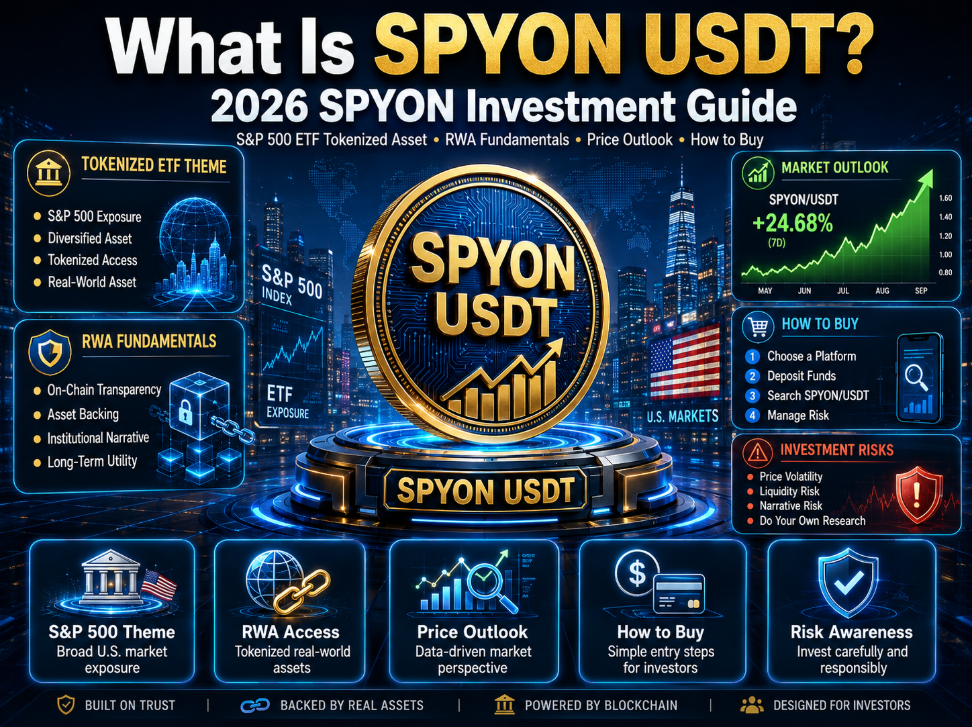
Many first-time viewers ask:
- What is SPYON?
- Is SPYON a stock?
- Is SPYON a new crypto coin?
- Why would a U.S. ETF be available in a USDT trading pair?
Understanding these questions is the first step to evaluating SPYON as an investment.
1.1 Basic Definition of SPYON
SPYON is a tokenized asset.
Think of it this way:
Traditional asset:
S&P 500 ETF
↓
Mapped via blockchain infrastructure
↓
On-chain tradable asset
↓
SPYON
The underlying traditional asset it references is primarily:
SPDR S&P 500 ETF Trust (SPY)
In other words, SPYON’s value doesn’t come from a new blockchain project—it comes from the performance of large-cap U.S. equities.
You can check real-time SPYON data, including current price and trading activity, via the SPYON market page.
Important distinction:
SPYON ≠ SPY ETF itself.
It is NOT:
- A new ETF issued by SPDR
- A stock ticker
- An ordinary crypto project
More accurately, SPYON is a digital instrument that delivers exposure to a traditional asset’s return profile through blockchain rails.
1.2 What Does the Name "SPYON" Mean?
Understanding the name helps clarify Ondo’s tokenized asset framework.
SPY
Stands for:
SPDR S&P 500 ETF Trust – one of the largest and most widely traded S&P 500 ETFs. It tracks the aggregate performance of 500 major U.S. publicly traded companies.
ON
Stands for:
Ondo Tokenized Asset series.
Ondo has launched a family of tokenized traditional assets, including:
- COINON
- GOOGLON
- GLWON
The common thread: they wrap traditional stocks or ETFs into a format that’s more accessible for crypto users and DeFi applications.
For similar cases, see:
These products collectively signal a clear trend: traditional financial assets are moving on-chain.
2. What Is Ondo? And Why Is It Driving Asset Tokenization?
What this chapter addresses
Common questions:
- Who is behind SPYON?
- Why is RWA suddenly so popular?
- Where does Ondo fit in the crypto landscape?
2.1 Ondo’s Position in the RWA Sector
Ondo is a fintech company focused on tokenizing real-world assets.
Its core verticals include:
- Tokenized Treasuries
- Tokenized Stocks
- Tokenized ETFs
The overarching goal is to bridge two worlds:
Traditional Financial Markets
↕
Blockchain Financial Markets
For decades, stocks, bonds, and funds have lived primarily within the traditional system. Investors needed:
- Bank accounts
- Brokerage accounts
- Broker-dealer services
- Geographically restricted access
Blockchain, by contrast, offers:
- Global accessibility
- 24/7 trading
- On-chain settlement
- DeFi composability
That’s why RWA is viewed as a critical bridge between legacy finance and crypto.
2.2 Why Do Traditional Assets Need Tokenization?
The traditional system works, but it has limitations:
Trading Hours
U.S. stock markets:
- Fixed trading sessions
- Closed on weekends
Blockchain:
- Runs continuously
- Accessible worldwide
Geographic Barriers
Some investors:
- Can’t open U.S. brokerage accounts
- Face local regulatory restrictions
Tokenization aims to lower those access barriers.
Financial Composability
Traditional assets (ETFs in a brokerage account)
↓
When tokenized
↓
Can be combined with on-chain tools like:
- Lending/borrowing protocols
- DeFi yield strategies
- On-chain portfolio management
This composability is a major reason RWA continues to attract attention.
3. What’s Behind SPY? Why Does the S&P 500 Matter?
What this chapter addresses
Before understanding SPYON, you need to know why the S&P 500 ETF has long-term value.
3.1 What Is the SPDR S&P 500 ETF?
The SPDR S&P 500 ETF Trust (ticker: SPY) tracks the S&P 500 Index.
The index includes 500 of the largest U.S. publicly traded companies, such as:
- Apple
- Microsoft
- NVIDIA
- Amazon
- Alphabet (Google)
So investing in SPY is not a bet on any single company—it’s a bet on the aggregate earnings power of America’s largest enterprises.
3.2 What Are You Actually Investing In When You Buy SPY?
The core logic:
U.S. economic growth
↓
Corporate revenue growth
↓
Rising profits
↓
Higher stock prices
↓
ETF value increases
Over the long term, the S&P 500’s importance stems from the enduring growth capacity of U.S. capital markets.
Therefore, SPYON’s long-term value proposition is fundamentally tied to:
the profitability of large U.S. companies – not crypto market speculation.
4. How Does SPYON Work? Does It Really Correspond to SPY?
What this chapter addresses
For any tokenized asset, investors want to know:
- Is SPYON just vapor?
- Is there real asset backing?
- Does buying SPYON equal owning SPY?
These questions determine whether an RWA asset has lasting value.
4.1 How Is SPYON Structured?
Think of it as an asset mapping process:
Traditional asset:
SPDR S&P 500 ETF (SPY)
↓
Custody and financial infrastructure
↓
Tokenization issuance mechanism
↓
SPYON
↓
Traded by users on crypto exchanges
In short, SPYON isn’t trying to create a new investment vehicle—it’s trying to give users price exposure to the underlying asset with the convenience of crypto.
When you buy SPYON, you’re effectively gaining:
- Exposure to S&P 500 index performance
- Access to U.S. large-cap market growth
- On-chain trading convenience
4.2 Does SPYON Equal Owning the SPY ETF?
This is a common point of confusion, especially for newcomers.
Answer: Not exactly.
Although SPYON references SPY’s performance, token holders typically do not become direct holders of the SPY ETF.
There are important differences:
When you buy traditional SPY ETF shares, you may have:
- ETF units
- A brokerage account record
- Fund investment rights
When you buy SPYON, you get:
- A token
- Corresponding economic exposure
- On-chain trading rights
But you usually do not get:
- ETF voting rights
- Shareholder rights of the underlying companies
- Fund governance rights
Therefore, SPYON is closer to an economic exposure mapping tool than a substitute for traditional securities ownership.
5. What Determines SPYON’s Price? Why Won’t It Pump Like a Meme Coin?
What this chapter addresses
Many crypto natives are used to evaluating assets with a “low market cap = high growth” mental model.
But SPYON is an RWA asset—its pricing logic is fundamentally different.
5.1 Core Pricing Logic
A simplified formula:
SPYON price ≈
SPY ETF performance
± market supply/demand
± on-chain liquidity
± tokenization premium or discount
Unlike meme coins, whose prices are driven primarily by:
- Community sentiment
- Hype cycles
- Speculative inflows
SPYON behaves more like a traditional financial asset.
Its appreciation depends mainly on:
- Growth in U.S. corporate earnings
- Rising S&P 500 index
- Increasing RWA market demand
5.2 Five Key Factors That Influence SPYON’s Price
1. S&P 500 Index Performance
This is the most direct driver.
If the S&P 500 rises → SPY rises → SPYON’s underlying value strengthens.
Conversely, if U.S. equities enter a bear market, SPY falls → SPYON comes under pressure.
2. U.S. Corporate Profitability
Long-term S&P 500 performance depends on whether large U.S. companies continue to generate profits.
Key drivers include:
- Tech sector growth
- AI industry developments
- Consumer spending trends
3. Federal Reserve Interest Rate Policy
Interest rates affect equity valuations.
Generally:
- Low rates → lower financing costs → higher valuations
- High rates → higher cost of capital → valuations may compress
So Fed policy is a critical factor for SPYON investors.
4. U.S. Dollar Strength
Since SPY assets are USD-denominated, the dollar’s strength affects:
- Purchase costs for international investors
- Global attractiveness of U.S. assets
5. RWA Market Demand
Beyond the underlying asset, SPYON has an additional variable: demand for tokenized assets.
If more investors want to access traditional assets via crypto in the future:
- On-chain RWA demand increases
- SPYON liquidity may improve
You can explore market perspectives via the SPYON price prediction page.
Keep in mind: price predictions are not guarantees. All forecasts are subject to market conditions, macroeconomics, and liquidity.
6. How Does SPYON Handle Dividends? Do Investors Get SPY Distributions?
What this chapter addresses
Traditional ETF investors care about:
- Does SPY pay dividends?
- Do SPYON holders receive those dividends?
- How are dividends handled?
6.1 Does SPY Itself Pay Dividends?
SPY holds S&P 500 constituents, many of which pay dividends. So SPY generally has dividend income.
However, whether SPYON distributes that income to token holders depends on the specific product rules.
6.2 Possible Dividend Treatments for SPYON
Different tokenized assets may adopt different mechanisms. Common approaches include:
Automatic Reinvestment
Dividends are received → converted into additional asset value → reflected in the token price.
Cash Distribution
Some products may make periodic cash payments to token holders.
Protocol-Level Handling
Some tokens adjust asset value through issuance mechanics.
So don’t assume that "buying SPYON = getting all of SPY’s dividend entitlements."
Before investing, review:
- Official issuance rules
- Custody arrangements
- Distribution policies
7. SPYON vs. SPY: Why Choose a Tokenized ETF?
What this chapter addresses
A common question: if you can buy SPY directly, why bother with SPYON?
7.1 Advantages of Traditional SPY ETF
SPY offers:
- Established market acceptance
- High liquidity
- Decades of historical data
- Traditional regulatory oversight
For investors with brokerage access, buying the ETF directly is often simpler.
7.2 Where SPYON Excels
SPYON doesn’t change the asset—it changes how you access it.
It provides:
Crypto wallet accessibility – manage your position through blockchain wallets.
Global Trading Flexibility
Traditional securities rely on stock market hours. Tokens enable more flexible around-the-clock trading.
DeFi Composability
In the future, tokenized ETFs may integrate with:
- Lending protocols
- On-chain funds
- Automated DeFi strategies
7.3 New Risks Introduced by SPYON
Tokenization also brings fresh risks:
- Issuer risk
- Custodian risk
- Smart contract risk
- Legal and structural risk
- Liquidity risk
So SPYON is not simply an "upgraded" SPY—it’s a new financial access vehicle with its own trade-offs.
8. SPYON vs. BTC vs. ETH: Three Completely Different Asset Logics
What this chapter addresses
Newcomers often lump all digital assets together. In reality, SPYON, BTC, and ETH represent entirely different value propositions.
8.1 SPYON: U.S. Corporate Earnings Asset
Core value: the future profitability of 500 large U.S. companies.
Drivers:
- Corporate profits
- Economic growth
- Equity market performance
8.2 BTC: Digital Scarcity Asset
Bitcoin’s core logic is fixed supply.
BTC’s value derives from:
- Decentralization
- Scarcity
- Global consensus
For BTC outlook, see the BTC price prediction.
8.3 ETH: Blockchain Infrastructure Asset
Ethereum is not an equity asset.
ETH’s value comes from:
- Smart contract ecosystem
- DeFi applications
- Layer 2 development
- Web3 infrastructure
Check the ETH price prediction for more.
9. How to Buy SPYON USDT
What this chapter addresses
The practical steps for trading SPYON.
9.1 Step 1: Prepare USDT
To buy SPYON, you’ll typically need:
- USDT as trading capital
- An account on a supporting exchange
- A crypto wallet (depending on platform requirements)
9.2 Step 2: Choose a Platform That Supports SPYON
Verify:
- Whether the exchange offers SPYON trading
- Whether the SPYON/USDT pair is available
- Platform liquidity
Don’t just check "can I buy?" – also evaluate:
- Order book depth
- Trading fees
- Withdrawal rules
9.3 Step 3: Confirm Token Details
Because crypto has many similarly named assets, always confirm:
- Official token information
- Contract address
- Issuer source
- Trading pair
Avoid counterfeit tokens.
9.4 Step 4: Trade SPYON/USDT
Basic flow:
Deposit USDT
↓
Go to SPYON/USDT trading page
↓
Set your buy price (market or limit)
↓
Confirm the trade
↓
Manage your position
Monitor live data via the SPYON market page.
10. What Are the Biggest Risks of Investing in SPYON?
What this chapter addresses
While SPYON represents a promising direction, every investment has risks. Understanding them is key to deciding if SPYON fits your profile.
Key risk categories:
- Underlying asset risk
- Tokenization structural risk
- Liquidity risk
- Legal and regulatory risk
- Market price risk
10.1 Underlying Market Risk
Although SPYON trades in crypto markets, it ultimately depends on the S&P 500 index.
If U.S. equities decline:
S&P 500 falls → SPY ETF value drops → SPYON price under pressure
So SPYON is not a crypto asset that escapes traditional markets. It cannot avoid:
- U.S. economic cycles
- Changes in corporate earnings
- Equity market volatility
For example, if the U.S. enters a recession, corporate profits fall → investors re-rate equities lower → the S&P 500 may decline → SPYON will likely be affected.
10.2 Tokenization Structural Risk
RWA’s greatest strength is also its greatest challenge: it connects two different systems—traditional finance and blockchain finance.
This adds extra layers of risk:
Issuer Risk
Investors should ask:
- Who issued the token?
- Is it properly authorized?
- Is there transparent disclosure?
If the issuer faces problems, the token’s value could suffer.
Custody Risk
The underlying assets typically require third-party custody.
Questions to consider:
- Where are the underlying ETF assets held?
- Who is the custodian?
- Are there regular audits?
These affect investor confidence.
Legal and Structural Risk
Tokenized assets involve:
- Securities regulation
- Cross-border financial rules
- Local legal restrictions in your jurisdiction
Different countries treat tokenized stocks differently.
10.3 De-pegging Risk
In theory, SPYON’s price should track the underlying asset’s value. But in practice, deviations can occur:
Above NAV: Excess demand → premium
Below NAV: Insufficient liquidity → discount
Causes of price deviation include:
On-Chain Liquidity Shortage
Low trading volume can make large orders move the price.
Time Zone Mismatch
U.S. stock markets have fixed hours. Crypto trades 24/7.
So on weekends or when U.S. markets are closed, SPY’s price is static, but SPYON may still trade – leading to short-term price divergence.
10.4 Shareholder Rights Risk
Investors must understand: buying SPYON usually does not give you ownership of:
- Apple stock
- Microsoft stock
- NVIDIA stock
Nor does it typically confer:
- Voting rights
- Attendance at shareholder meetings
- Corporate governance privileges
It provides economic exposure – not traditional equity ownership.
SPYON is better understood as a financial return instrument, not a stock replacement.
11. The Future of RWA: Why SPYON Deserves Long-Term Attention
What this chapter addresses
Is SPYON just a short-lived concept, or does it represent the future of finance?
11.1 Stock Tokenization Is Likely a Secular Trend
In the past, stocks belonged to securities markets; crypto belonged to digital asset markets. They were largely separate.
RWA aims to bridge that:
Stocks
↓
Tokenized
↓
On-chain assets
↓
Global trading
In the future, we may see many more:
- Tokenized U.S. stocks
- Tokenized ETFs
- Tokenized funds
- Tokenized bonds
SPYON is a representative case in this trend.
11.2 More Traditional Stocks Are Moving On-Chain
Beyond SPYON, we’re already seeing more tokenized equity cases.
For example:
- What is COINON – Coinbase-related tokenized asset
- What is GOOGLON – Google stock tokenization
- What is GLWON – Corning-related tokenized asset
These products collectively show that RWA is actively bringing traditional assets into on-chain finance.
11.3 AI Infrastructure as an RWA Direction
Over the next few years, AI infrastructure may become a major focus:
Data centers
↓
Chips
↓
Optical communications
↓
AI infrastructure companies
These traditional assets could also enter crypto via tokenization.
Related cases:
11.4 Bitcoin Treasury RWA Direction
Beyond stocks and ETFs, corporate balance sheet tokenization is another RWA frontier.
For example, MicroStrategy holds significant Bitcoin.
Tokenized example: What is MSTRON – representing a tokenized product tied to that corporate strategy.
11.5 ETF Tokenization – Future Potential
ETFs are inherently portfolio vehicles. If they become further tokenized, we could see:
- Global investor access
- On-chain portfolio construction
- Automated financial strategies
Another example: What is EWYON – an ETF tokenization case.
12. Is SPYON Worth Investing In? Ask Yourself These 5 Questions
What this chapter addresses
This guide won’t tell you “SPYON will definitely go up.” Every investment requires independent judgment. Use these five questions to evaluate.
1. Is the Underlying Asset Structure Transparent?
Confirm:
- What asset does it correspond to?
- Is there actual asset backing?
- How is it custodied?
- Is there public disclosure?
Higher transparency → stronger long-term trust.
2. Is the Issuance and Custody Mechanism Reliable?
Look into:
- Issuer background
- Partner institutions
- Audit status
- Proof of reserves
RWA’s real value comes not from packaging, but from genuine asset connectivity.
3. Is SPYON’s Liquidity Sufficient?
Check:
- Daily trading volume
- Bid-ask spread
- Order book depth
Low liquidity can mean easy to buy but difficult to sell.
4. Does Tokenization Create Real Demand?
This is the most important question for RWA value.
If tokenization merely replicates stock prices, the advantage is limited.
Real value comes when tokenization enables:
- Global access
- DeFi composability
- New financial use cases
5. Compared to Traditional SPY, Does It Offer a Clear Advantage?
Ask yourself: if you can buy SPY, why choose SPYON?
The answer should be rooted in:
- Easier access
- Stronger on-chain utility
- Lower barriers to entry
…not just a hope for price appreciation.
FAQ: Common Questions About SPYON USDT
What is SPYON USDT?
SPYON USDT is a tokenized asset designed to deliver S&P 500 ETF performance exposure through blockchain rails, allowing crypto users to trade a traditional index asset.
Is SPYON a stock?
No. SPYON is not a stock, nor is it a new SPDR-issued equity. It is a tokenized financial product based on a traditional asset’s performance.
What’s the relationship between SPYON and SPY?
SPYON references the performance of the SPDR S&P 500 ETF Trust (SPY). However, buying SPYON does not equate to directly holding the SPY ETF.
Does buying SPYON mean investing in the S&P 500?
From an exposure standpoint, SPYON aims to offer a return profile close to the S&P 500. But actual results may be influenced by token liquidity, market supply/demand, and issuance mechanics.
Is SPYON safe?
No investment is absolutely safe. Risks include:
- Stock market risk
- Token issuer risk
- Custody risk
- Legal risk
- Liquidity risk
Where can I buy SPYON?
First, confirm which exchanges support SPYON trading. The typical process:
Prepare USDT
↓
Choose a supporting platform
↓
Find the SPYON/USDT pair
↓
Execute your trade
Check the SPYON market page for live data.
Does SPYON pay dividends?
The underlying SPY ETF may generate dividends, but whether SPYON distributes them depends on the specific product’s rules. Do not assume that buying SPYON automatically gives you full SPY dividend rights.
Is SPYON part of RWA?
Yes. SPYON is an RWA (Real World Assets) product. It attempts to bring traditional financial assets – stocks, ETFs, index exposure – into the blockchain ecosystem.
Will SPYON go up in the future?
SPYON’s future depends on:
- S&P 500 trends
- U.S. corporate earnings
- Federal Reserve policy
- RWA market development
- Token liquidity
No price prediction can guarantee results. For market views, you can check the SPYON price prediction page.
Final Take: SPYON Represents a Bold Attempt to Bridge Traditional Assets into the RWA Era
SPYON’s greatest significance is not that it could become the “next moonshot coin.”
It represents a new way for traditional financial assets to enter the blockchain world.
It connects:
U.S. equity markets
–
ETF investment logic
–
Blockchain infrastructure
–
RWA financial trends
For investors, SPYON’s core value comes from three sources:
- The long-term growth potential of the S&P 500.
- The changed access and portability enabled by tokenization.
- The growing demand for traditional asset exposure within on-chain finance.
At the same time, you must recognize that SPYON is not a typical crypto speculative asset.
It remains subject to U.S. equity market fluctuations, issuance and custody structures, and regulatory environments.
So the key question when evaluating SPYON is not about chasing short-term pumps – it’s about understanding:
Whether SPYON can become a meaningful piece of infrastructure connecting traditional finance and blockchain finance.
As the RWA sector matures, tokenized ETF products like SPYON may well become an integral part of the future digital financial system.