
Why does CASHCAT keep appearing on the leaderboards? More than a one‑day spike, the real puzzle is this: Robinhood Chain’s mainnet has been live for nearly two months, and most of the tokens that launched alongside it have already lost volume and community attention—yet CASHCAT keeps popping up on gainers lists, hot coins rankings, and market chatter.
That tells you CASHCAT is no longer just a “new chain launch pump.” The first‑mover attention advantage, Robinhood Chain’s ecosystem expansion, relatively deep liquidity, an easily shareable piece of cultural history, and the more recent CashCat Chain Layer‑3 narrative have all extended its market lifecycle.
But staying hot doesn't mean investment risk has dropped. In fact, CASHCAT’s core question has shifted from “will this token survive?” (the July concern) to “can a ~$200 million market cap be sustained by ecosystem growth, liquidity, and real usage?”
Risk Disclosure: Data in this article is as of August 26, 2026. It is for research and project information purposes only—not investment advice, price guarantees, or trading recommendations. CASHCAT is a highly volatile meme asset and may see sharp drawdowns due to declining liquidity, shifting attention, or weaker market conditions.
1. Why Does CASHCAT Keep Ranking While So Many New Coins Fade?
You can’t understand CASHCAT’s performance by looking at just the last 24 hours.
On July 1, 2026, Robinhood Chain’s public mainnet officially launched. Soon after, CASHCAT gained traction on the back of “Robinhood’s early Cash Cat lore” and a new‑chain meme narrative, pushing its price near $0.22 by mid‑July.
After that first wave cooled, CASHCAT retraced hard. In early August, it bounced roughly 120% within a week to around $0.087, but still below its July peak.
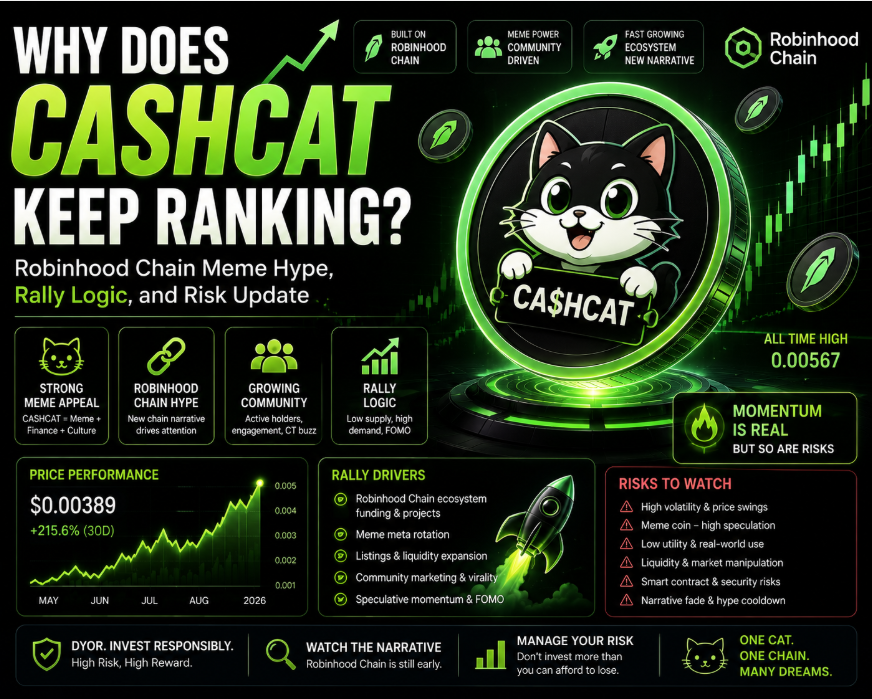
By late August, as crypto risk appetite picked up, Robinhood Chain on‑chain data improved, and more trading venues opened up, CASHCAT climbed again. According to CoinGecko’s snapshot on August 26:
- CASHCAT price ~$0.20
- +127% over the past 7 days
- 24‑hour volume over $53 million
- Circulating market cap near $198 million
- All‑time high ~$0.2354
- Circulating supply ~1 billion tokens
Prices and percentages change quickly. You can track real‑time volume, order books, and market trends via the CASHCAT live price & CASHCAT/USDT chart.
CASHCAT has roughly gone through:
- early new‑chain explosion in July,
- a pullback after the first peak,
- renewed attention in early August,
- and a late‑August move back toward its ATH as meme mania returned.
That trajectory shows CASHCAT has already completed at least one full “pump → retrace → re‑pump” cycle. The second leg up is more telling than the first, because it happened after most other tokens on the same chain had already lost liquidity.
2. “Staying Ranked” Is More Than Just a Price Pump
Investors often lump gainers lists, volume rankings, and “hot” lists together—but they measure different things.
- Price heat = 24h or 7d percentage moves.
- Trading heat = volume, liquidity, number of traders, and order‑book depth.
- Attention heat = social discussion, search queries, media coverage, watchlists, and platform search rankings.
CASHCAT isn’t ranking just because it pumped on a single day. Around August 25, its 24‑hour volume briefly approached 80 million against a ~215 million market cap—a turnover rate noticeably higher than most tokens of similar size.
High volume means money is flowing in and out fast. But it doesn’t automatically mean everyone is buying and holding. High turnover can also signal:
- intense short‑term speculation,
- early holders taking profits,
- market‑making and cross‑exchange arbitrage,
- widening bull/bear disagreement,
- and a redistribution of coins at higher price levels.
So the real takeaway is this: after the first wave of new‑coin hype on Robinhood Chain faded, CASHCAT still managed to sustain price, volume, and attention—not just that it went up on any given day.
3. What CASHCAT Is (No Need to Rehash—Just Two Facts)
If you’re new to the project, start with What Is CASHCAT & Full Risk Analysis for contract details, supply, background, and its relationship with Robinhood Chain.
Here we’ll just reconfirm two essential facts.
First, CASHCAT is a community‑run meme token on Robinhood Chain.
Second, CASHCAT is not Robinhood’s official network token, nor does it represent Robinhood Markets equity.
Robinhood Chain is an open, permissionless, EVM‑compatible Ethereum Layer‑2. Any developer can deploy smart contracts on it. The network uses ETH for gas, so “deployed on Robinhood Chain” does not automatically mean “endorsed by Robinhood.”
Important nuance: Robinhood does now offer a CASHCAT trading page, so users can buy or sell it through Robinhood’s services. That improves accessibility and brand visibility—but “Robinhood offers trading” and “Robinhood issued or guarantees CASHCAT” are two completely different things.
Investors must distinguish between:
- Robinhood’s official financial products,
- Robinhood Chain as an open network,
- third‑party ecosystem projects,
- community meme tokens,
- Robinhood stock tokens,
- and crypto assets that Robinhood merely facilitates trading for.
CASHCAT’s biggest communication advantage comes from its Robinhood brand association—and that also creates the most common misunderstanding risk.
4. Reason #1: CASHCAT Established Itself as a Representative Meme
When a new L1 or L2 enters the market, it often produces a handful of representative cultural assets.
Ethereum has PEPE and other meme cultures; Solana produced BONK and WIF; Base has BRETT. After Robinhood Chain’s mainnet launch, the market naturally looked for a community asset that could represent the new chain.
CASHCAT’s edge was occupying that spot early.
In early August, CoinDesk’s market recap described CASHCAT as one of Robinhood Chain’s most representative and liquid memes. While many contemporaries faded, CASHCAT retained a relatively large holder base, trading volume, and liquidity.
That created an attention flywheel:
More people know CASHCAT → more searches and trades → more volume → more exchange and data‑site exposure → more media mentions → new users discover it → reinforcing its status as Robinhood Chain’s go‑to meme.
For a meme coin with no corporate revenue, profits, or cash flow, attention is a critical resource.
But attention ≠ intrinsic value. It can improve liquidity, but it can also vanish overnight when the next shiny object appears.
5. Reason #2: Robinhood Chain Hasn’t Cooled Off
CASHCAT isn’t rising in a vacuum—it’s also benefiting from Robinhood Chain’s overall ecosystem beta.
Robinhood Chain has moved from its early‑2026 testnet phase to a live public mainnet. Robinhood positions it as an Ethereum L2 connecting traditional finance, crypto, RWA, stock tokens, and DeFi.
As of August 26, DefiLlama data for Robinhood Chain shows:
- DeFi TVL ~$624M
- Stablecoin market cap ~$750M
- Active RWA market cap ~$138M
- 24h DEX volume ~$701M
- 7‑day DEX volume ~$3.948B
- Bridged TVL ~$1.795B
Different data platforms use different TVL methodologies. Early August media reports cited ~774M in broader locked value, while DefiLlama currently shows ~624M for DeFi TVL. Always check whether the figure includes bridged assets, lending, asset management, or total on‑chain funds—don’t compare apples to oranges.
The indirect transmission from Robinhood Chain growth to CASHCAT works like this:
More capital flows into Robinhood Chain → more wallets and DEX activity → new users looking for ecosystem assets are more likely to spot CASHCAT (which already has brand recognition and liquidity) → CASHCAT gets more exposure and trading opportunities.
That’s the “ecosystem beta.”
But avoid the wrong inference:
- Robinhood Chain TVL growth ≠ CASHCAT generates equivalent revenue.
- Robinhood Chain’s success ≠ CASHCAT will necessarily go up.
CASHCAT may get traffic from ecosystem expansion, but it does not own Robinhood Chain’s revenue or assets.
6. Reason #3: CashCat Chain Brings a New L3 Narrative
The most significant recent narrative shift is CASHCAT evolving from a pure community meme into the CashCat Chain project.
According to the CashCat Chain official docs, CashCat Chain is described as an EVM‑compatible Layer‑3 built on Arbitrum Nitro and settling to Robinhood Chain, with CASHCAT designed as its native gas asset.
The structure looks like:
Ethereum (base security + data) → Robinhood Chain (L2) → CashCat Chain (L3 on top of Robinhood Chain).
That means the community is trying to expand CASHCAT from:
- a cultural / speculative price asset,
- into a network gas asset used for application and transfer fees.
Why Does a Gas‑Token Narrative Make for a Good Second‑Act Story?
The original demand logic was mainly:
Users buy CASHCAT because of meme culture, Robinhood lore, or price expectations.
If CashCat Chain gets real users, new demand could theoretically become:
Users need to pay CASHCAT as gas to use apps, transfer funds, or deploy contracts—creating functional demand beyond trading.
That adds a new valuation dimension.
But “designed to use CASHCAT as gas” ≠ there’s already significant gas demand. A Layer‑3 going live doesn’t automatically mean it has a vibrant ecosystem.
What investors really need to verify:
- CashCat Chain active addresses
- Daily transaction count
- Actual gas consumed
- Number of independent developers
- Live DApps
- Bridge TVL
- RPC and block explorer stability
- Whether activity is concentrated in a few addresses
- Whether there’s repetitive or bot‑like usage
If the network lacks real users, the gas narrative may be just a design‑level story—not actual demand that can support a multi‑hundred‑million dollar market cap.
Also note: there are other tokens named Cashcat Chain (ticker CCC) floating around. They are not the same asset as the original CASHCAT. Always double‑check the official website, network, and contract address.
7. Reason #4: CASHCAT Has Deeper Market Liquidity
The typical meme‑coin lifecycle is:
Launch → moon → KOL shilling → hype fades → volume dries up → liquidity evaporates → forgotten.
To keep ranking, a token must first solve one basic problem: are people still willing to trade it?
Early August data showed CASHCAT had 41,200 holders, with 989 million tokens in circulation. The largest single address was the Uniswap pool providing liquidity (2.47% of supply), with $5 million in the pool—still one of the deeper meme pools on Robinhood Chain at the time.
By late August, trading venues expanded further. Beyond Robinhood Chain DEXs, CASHCAT/USDT appeared on centralized exchanges like KuCoin, Gate, and MEXC, and Robinhood itself added a trading page.
CEX and DEX liquidity can reinforce each other:
CEXs lower the barrier for newcomers; DEXs provide on‑chain price discovery and composability; arbitrageurs narrow spreads across venues; more volume attracts data sites and media attention.
To gauge whether CASHCAT’s heat is real, keep watching:
- 24h volume
- Volume‑to‑market‑cap ratio
- DEX liquidity depth
- CEX order‑book depth
- Bid‑ask spread
- Price differences across exchanges
- Estimated slippage for large trades
- CEX vs. DEX volume split
Price can be pumped with relatively little capital, but sustained volume and depth are much harder to fake. That’s why liquidity is a more reliable signal than a single day’s gain.
8. Reason #5: The Cash Cat Has Easy‑to‑Share Robinhood Lore
CASHCAT’s most powerful hook isn’t just “cat”—it’s the cultural link to Robinhood’s early history.
Public sources indicate that before Robinhood adopted its current brand name, the founding team used “CashCat” as an early project name or internal mascot. The community later tied that story to Robinhood Chain, creating a very easy‑to‑grasp narrative:
Robinhood’s early Cash Cat lore → Robinhood Chain launches → community creates CASHCAT on‑chain → CASHCAT becomes the new chain’s meme.
A good meme should be explainable in ten seconds.
“Robinhood Chain’s Cash Cat” travels far better on X, Telegram, TikTok, and Reddit than a complex whitepaper.
But cultural origins cannot be stretched into legal or commercial relationships. Historical association ≠ official issuance, nor does it mean Robinhood is responsible for CASHCAT’s price, contract, or operations.
9. Why Haven’t Later Tokens Replaced CASHCAT?
New memes usually compete not on tech, but on attention.
A later entrant would need to build from scratch:
- user awareness
- holder addresses
- community size
- DEX liquidity
- CEX listing access
- search volume
- media coverage
- KOL amplification
CASHCAT has already accumulated a good chunk of that. A newcomer might pump harder in the short term, but that doesn’t automatically displace CASHCAT’s position in the Robinhood Chain ecosystem.
This can also create a reflexive loop:
Positive news on Robinhood Chain → traders look for ecosystem assets → CASHCAT gets noticed first because of its brand → volume spikes → it enters hot lists → more users see it and trade → volume climbs further.
That reflexivity helps CASHCAT stay in the spotlight—but it’s not a permanent moat.
If a new Robinhood Chain meme builds a stronger brand, deeper liquidity, or a broader community, attention can still shift.
10. Is This a Fundamental Improvement or Just Sentiment Persisting?
When analyzing CASHCAT, separate evidence into three tiers.
Tier 1: Verifiable Facts
Things you can check via block explorers and market data:
- Robinhood Chain mainnet is live.
- CASHCAT has a real on‑chain contract.
- CASHCAT trades on DEXs and CEXs.
- Robinhood offers a CASHCAT trading page.
- Robinhood Chain has measurable TVL and DEX volume.
- CashCat Chain has published its L3 architecture.
- CashCat Chain’s design uses CASHCAT for gas.
- CASHCAT has actual volume and holder addresses.
Tier 2: Plausible but Unproven Expectations
These are logical possibilities, not confirmed facts:
- Robinhood Chain will become a major RWA ecosystem.
- CASHCAT will remain the top meme on the chain.
- CashCat Chain will attract developers.
- The L3 will generate significant CASHCAT gas demand.
- Robinhood’s trading support will drive long‑term new users.
- Ecosystem growth will keep lifting CASHCAT’s valuation.
Tier 3: Community Narratives to Treat with Caution
These should not be used as investment rationales:
- CASHCAT is Robinhood’s official platform token.
- Robinhood will back CASHCAT’s price.
- Robinhood Chain up = CASHCAT up for sure.
- Robinhood listing equals an investment endorsement.
- CashCat Chain launch = CASHCAT now has mature fundamentals.
- CASHCAT is now a permanent representative asset of Robinhood Chain.
CASHCAT’s continued ranking includes both verifiable on‑chain/liquidity data and a large dose of market sentiment and future expectations already priced in.
11. Seven Metrics to Keep Watching
1. CASHCAT Volume
Rising price + rising volume = broader participation. Rising price + shrinking volume = caution (new money may be lacking).
2. DEX Liquidity
Don’t just look at the price ticker—check how much slippage a large buy/sell would incur. If liquidity drops, your actual ability to exit may worsen even if the market cap stays high.
3. Holder & Holder Concentration
Growing addresses are good, but combine with active addresses, whale concentration, and new wallet sources. One user can control multiple addresses, and exchanges often use single addresses for custody—so holder count alone isn’t a fundamental metric.
4. Robinhood Chain Ecosystem Data
Watch TVL, stablecoin cap, DEX volume, active addresses, RWA size, and new DApps. Always check methodology—don’t confuse bridged TVL, DeFi TVL, and total on‑chain assets.
5. CashCat Chain Real Usage
Track transaction count, active users, gas consumption, developers, live DApps, and bridge inflows. This is the key to judging whether the “L3 gas token” story is moving from narrative to actual demand.
6. Community Attention
X mentions, Google Trends, Telegram activity, watchlist additions, and internal search rankings can signal attention—but they don’t replace on‑chain data.
7. New Meme Competition
A meme’s biggest moat is attention, so its biggest competitor is often the next more‑shareable meme—not a competing technical protocol.
12. Is CASHCAT Expensive Right Now?
Don’t judge valuation by the single‑token price alone.
“CASHCAT is only $0.20, so it’s cheap” is a common mistake. Token price must be combined with supply and market cap.
With ~1 billion circulating supply, 0.20 implies a ~200 million market cap. The real questions are:
- How much Robinhood Chain growth is already priced into that $200M?
- How does CASHCAT compare to other ecosystem memes?
- Can current volume sustain?
- How large is actual CashCat Chain gas demand?
- Is ownership overly concentrated?
- Is market cap far above real liquidity?
- Has the new demand from Robinhood’s trading page already been priced in?
You can check the CASHCAT price prediction page for trend scenarios, but technical forecasts are no substitute for on‑chain data and project research.
A project doing well doesn’t mean every price is a good entry. The higher the valuation, the more future growth the market expects.
13. Future Scenarios: Bull, Base, and Bear
Bull Case: Ecosystem + Real Usage Grow Together
An optimistic scenario requires simultaneous:
- Continued Robinhood Chain user growth
- TVL, stablecoins, and DEX trading expanding
- CASHCAT maintaining its representative meme status
- Deeper CEX and DEX liquidity
- Real apps on CashCat Chain
- Rising CASHCAT gas consumption
- Active community
- Overall risk‑on crypto environment
Under that scenario, CASHCAT could sustain a higher valuation—but sharp pullbacks along the way remain likely.
Base Case: Ecosystem Grows, Price Enters Wide Range
A neutral scenario might be:
- Robinhood Chain keeps growing
- CASHCAT community stays reasonably active
- But novelty fades gradually
- Volume normalises
- CashCat Chain usage is modest
- Price swings in a broad range
For a meme coin that ran up fast, a long consolidation period is often more normal than continuous moonshots.
Bear Case: Attention and Liquidity Both Weaken
A pessimistic scenario includes:
- Robinhood Chain hype cools
- CASHCAT volume shrinks persistently
- DEX liquidity dwindles
- CashCat Chain sees no real users
- A newer meme steals the spotlight
- Whales sell in size
- BTC enters risk‑off mode
- Overall meme mania reverses
If ecosystem, liquidity, and community heat all fade, CASHCAT could see drawdowns significantly steeper than major cryptos.
14. Why BTC and ETH Still Set the Macro Tone
CASHCAT is a triple‑high‑beta asset: small‑cap, meme, and new‑chain.
When BTC rallies and risk appetite expands, capital tends to rotate from large caps into smaller tokens. Conversely, when BTC drops sharply or deleveraging hits, meme coins—being less liquid—usually fall even harder.
Check the BTC price prediction & market cycle to gauge whether we’re in a risk‑on phase.
Robinhood Chain uses ETH for gas and sits on Ethereum infrastructure, so the ETH price prediction & Ethereum trends are also worth watching.
No bad news about the project doesn’t mean the token won’t drop. A broad liquidity squeeze alone can drag CASHCAT down.
15. CASHCAT’s Risks Have Shifted Since July
From “Survival Risk” to “High‑Expectations Risk”
In July, the key question was whether CASHCAT would survive after the first wave.
Now, the market has already given it significant recognition and a ~$200M valuation—the question is whether those expectations can be met.
Robinhood Brand‑Association Risk
Robinhood now offers CASHCAT trading, but CASHCAT is still not Robinhood’s official network token.
Trading support is not a price guarantee or operational endorsement.
Meme Attention‑Migration Risk
Hot today doesn’t mean CASHCAT will permanently hold the “Robinhood Chain meme” crown.
If a new token with stronger viral appeal emerges, attention, volume, and liquidity could shift.
CashCat Chain: Narrative vs. Usage Risk
L3 and gas token are a new valuation story—but what really matters is users, apps, and actual gas consumption, not the letters “L3.”
If network activity is mostly generated by the project team or a handful of addresses, the functional demand may be overestimated.
Whale and Concentration Risk
Before making trading decisions, re‑check the top‑10 holder addresses, exchange wallets, liquidity pools, team‑related addresses, and large transfers. Multiple addresses may be controlled by the same entity—surface‑level dispersion doesn’t mean real distribution.
High Volatility and Chase Risk
CASHCAT has already shown the classic pump‑dump‑repump pattern.
A renewed rally doesn’t mean earlier risks have disappeared. Approaching all‑time highs actually calls for more scrutiny on volume, liquidity, and expectations—not less.
16. How Does CASHCAT Differ from Other Recently Hot New Coins?
CASHCAT’s main narratives are Robinhood Chain, community meme, historical lore, and CashCat Chain L3. For first‑time research, start with What Is CASHCAT.
What Is BASECAT covers Base ecosystem, the blue‑hat cat, and a community‑meme angle. Both are ecosystem memes, but they rely on different blockchains, user bases, and cultural references.
CYBERLEEK is more about cyberculture, gaming events, and attention‑driven momentum—don’t simply classify it as a mature AI infrastructure play.
HMM USDT introduces Thinking Cat—another community meme on Robinhood Chain, with value driven by the “thinking cat” meme and social spread.
These new coins can all gain heat quickly thanks to fresh narratives, new liquidity, and community buzz. But the real question isn’t which one pumped harder today—it’s which narrative still has new users, sustainable liquidity, and upcoming catalysts.
CASHCAT stands out because it’s trying to evolve from a pure ecosystem meme into an L3 gas asset. Whether that transition actually increases its fundamental value still needs to be proven by CashCat Chain’s real‑world usage data.
17. How to Research CASHCAT Right Now
Step 1: Check the CASHCAT live quote for current price, volume, and order‑book depth.
Step 2: Read What Is CASHCAT to confirm background and contract details—avoid mistaking it for an official Robinhood token.
Step 3: Review Robinhood Chain’s TVL, stablecoins, active addresses, DEX volume, RWA size, and new applications.
Step 4: Examine CASHCAT’s own liquidity, holder addresses, whale wallets, trading venues, and community trends.
Step 5: Verify whether CashCat Chain has real users, DApps, transactions, and gas consumption.
Step 6: Check BTC and ETH to gauge whether the broader crypto market is in risk‑on mode.
Step 7: Finally, use the CASHCAT price prediction to frame bull, base, and bear scenarios.
The right order is: look at data first → validate narratives → assess price last. Don’t start from the price being up and then search for reasons it should keep going.
18. CASHCAT FAQs
Why does CASHCAT keep appearing on leaderboards?
It’s driven by a combination of Robinhood Chain ecosystem heat, first‑mover meme recognition, market liquidity, community buzz, Robinhood’s trading portal, and the new CashCat Chain narrative—not a single catalyst.
Why is CASHCAT up recently?
The recent move reflects a broader crypto and animal‑meme risk‑on environment, along with Robinhood Chain growth, CEX liquidity, community attention, and expectations around the L3 gas token.
Is CASHCAT an official Robinhood token?
No. CASHCAT is a community token deployed on Robinhood Chain. Robinhood currently offers trading services for CASHCAT, but that does not mean Robinhood issued it or guarantees its price.
What’s the relationship between CASHCAT and Robinhood Chain?
CASHCAT runs on Robinhood Chain, and its early cultural narrative references the “Cash Cat” name/mascot once used by Robinhood. However, the project was built by the community—it is not Robinhood Chain’s official gas token.
What is CashCat Chain?
CashCat Chain is an EVM‑compatible Layer‑3 built on Arbitrum Nitro and settling to Robinhood Chain, as disclosed by the project team.
Is CASHCAT the gas token for CashCat Chain?
According to the project’s current public design, CashCat Chain uses CASHCAT for gas. But investors should also monitor actual transactions, active addresses, and gas consumption to judge whether that demand is real.
Can CASHCAT still go up?
That depends on Robinhood Chain growth, CASHCAT liquidity, community heat, CashCat Chain usage, token distribution, and the broader BTC/meme market cycle. Staying on leaderboards does not guarantee further upside.
What’s the biggest risk for CASHCAT right now?
The main risk has shifted from “survival” to high‑valuation expectations, brand misinterpretation, attention migration, insufficient L3 usage, whale selling, and a macro risk‑off turn.
What’s the price prediction for CASHCAT?
Fixed price targets are unreliable. A better approach is to build bull/base/bear scenarios based on Robinhood Chain data, CASHCAT volume and liquidity, and CashCat Chain real usage.
Is CASHCAT worth investing in?
You can’t decide based solely on its ranking. Evaluate price level, liquidity, holder concentration, Robinhood Chain metrics, CashCat Chain usage, and overall market conditions—and only allocate capital you can afford to lose.
19. Conclusion: CASHCAT Keeps Ranking—What You Really Need to Study Is Whether Expectations Can Materialise
CASHCAT’s sustained presence on hot lists comes down to five main factors:
- It established early recognition as a representative meme on Robinhood Chain.
- Robinhood Chain has moved from mainnet launch into real ecosystem building, keeping the chain—and its assets—in the conversation.
- CASHCAT enjoys higher volume and more trading venues than most contemporaries.
- The Cash Cat / Robinhood early‑history connection is highly shareable.
- CashCat Chain adds a new Layer‑3 gas‑asset narrative.
These factors show that CASHCAT has evolved from a one‑off “new‑chain meme pump” into a community asset with meaningful recognition and liquidity within the Robinhood Chain ecosystem.
But as the market piles on higher expectations, the investment logic has changed.
The most important question is no longer “is this cat still hot?”—it’s whether Robinhood Chain’s ecosystem momentum, CASHCAT’s market liquidity, and CashCat Chain’s actual usage can long‑term support a valuation near its all‑time highs.
Staying ranked proves the market is still watching—but it does not prove the current price is justified. For investors, the valuable call isn’t predicting the next spike—it’s distinguishing when attention is turning into real demand versus when it’s just price sentiment.
Disclaimer: This content is based on publicly available information for educational and research purposes only. It does not constitute investment advice, an offer, or a solicitation. Cryptocurrencies are high‑risk assets with extreme price volatility. Please do your own research (DYOR) and comply with applicable laws in your jurisdiction before making any decisions.