
What is DEBIT coin? Why is it categorized simultaneously as an AI Agent, a DeFi lending protocol, and an on-chain credit project? As DEBIT enters its concentrated listing phase on August 26, 2026, this new Token from the Teller ecosystem has quickly drawn market attention.
Unlike typical "AI narrative coins," Teller tackles a more concrete financial problem: how to use conversational AI Agents to translate complex on-chain operations—lending, swapping, bridging, and yield management—into straightforward financial services that everyday users can understand and execute.
However, understanding Teller’s product story is only the first step for investors.
Current public data shows that DEBIT has a maximum supply of 100 million tokens, with a circulating supply of approximately 17.22 million, representing an initial circulation ratio of about 17.22%. A low float can amplify early price volatility, and it also means that the gap between circulating market cap and fully diluted valuation—along with future token unlocks—could become a key factor in DEBIT’s long-term performance.
Therefore, researching DEBIT should not stop at "what’s the price now?" or "how many times can it multiply?" Instead, you should simultaneously assess:
- Does Teller have real users?
- Can its on-chain credit business achieve meaningful scale?
- Does the AI Agent genuinely improve the financial experience?
- Can DEBIT capture the value generated by Teller’s ecosystem growth?
- Has the current valuation already priced in overly optimistic expectations?
- How much supply pressure will future token releases create?
Risk Disclosure: Data in this article is updated as of August 26, 2026. It is intended solely for project information organization, market research, and investment education. It does not constitute investment advice, performance guarantees, or trading recommendations. DEBIT is a newly listed, highly volatile Token that may be significantly affected by liquidity, token unlocks, market sentiment, and product adoption rates.
1. What Is DEBIT? Why Is Teller Classified as Both AI Finance and DeFi?
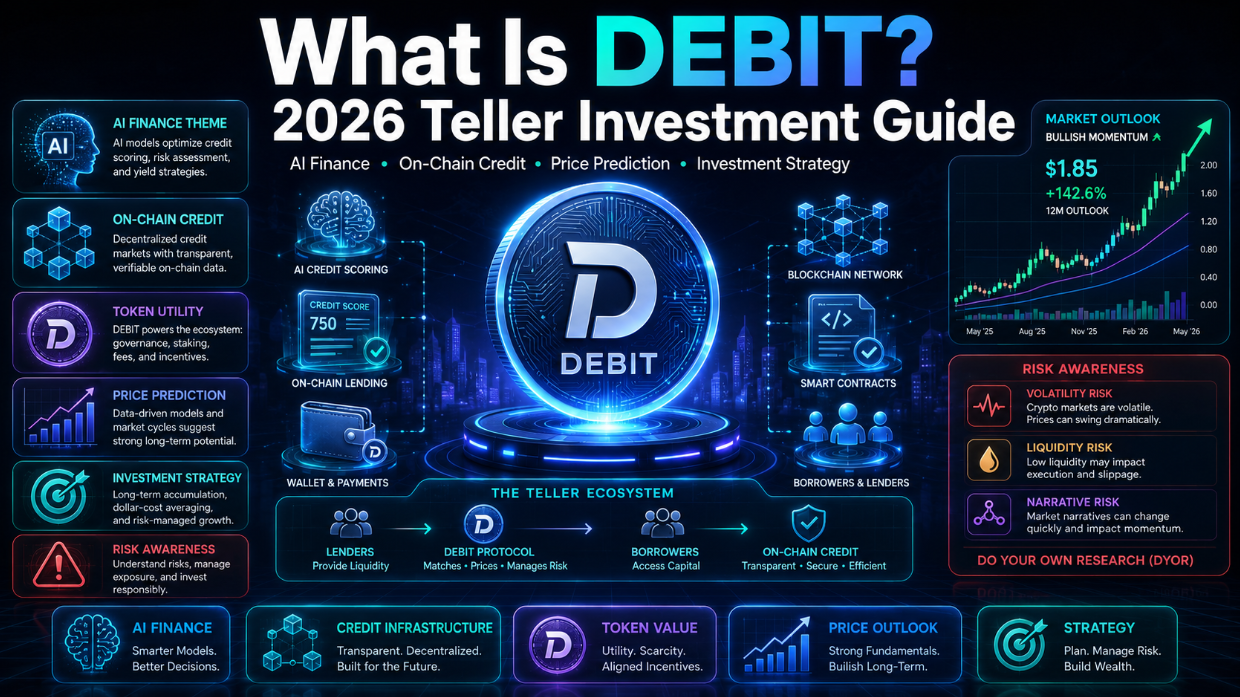
DEBIT is the native Token of the Teller ecosystem, while Teller is the protocol, product, and financial services platform behind it.
First-time DEBIT investors need to distinguish two concepts:
- Teller represents the entire product and protocol ecosystem.
- DEBIT represents the Token issued by that ecosystem.
They are related, but they are not interchangeable.
A protocol may have excellent products, users, and revenue—but if the Token lacks clear use cases, fee accrual, or value-capture mechanisms, protocol growth will not necessarily translate into Token price appreciation.
Conversely, a Token may rally rapidly before its product matures, driven by exchange listings, airdrops, AI narratives, or speculative trading.
You can check the DEBIT real-time price and DEBIT/USDT market data for the latest trading price, changes, and volume—but a price chart only tells you "what the market is pricing right now," not whether the project has fundamental value.
What’s the Relationship Between DEBIT and Teller?
Teller is a platform centered on on-chain credit, lending markets, and AI‑powered financial interactions. DEBIT is described by multiple exchanges as the native utility Token of the Teller ecosystem.
A simple way to think about it:
- Teller provides the products, lending services, and AI financial gateway.
- DEBIT may support ecosystem incentives, governance, fees, staking, or other functions.
However, investors must rely on Teller’s official tokenomics and documentation. If a claimed utility—such as buybacks, dividends, fee burns, or guaranteed staking yields—isn’t backed by official sources or on‑chain contracts, you should not assume it exists just because of community chatter.
What Financial Problem Is Teller Trying to Solve?
Traditional DeFi lending typically relies on over‑collateralization.
For example, a user who wants to borrow 1,000 USDT may need to deposit $1,500 or more worth of ETH, BTC, or other assets. If the collateral’s price drops, the loan’s health factor declines, and the collateral risks being liquidated.
This model reduces lender losses from defaults, but it creates a clear problem:
Users usually need to own more assets than they want to borrow before they can get a loan.
That means many DeFi loans are closer to "unlocking liquidity from assets you already own" than to traditional credit‑based lending.
Teller aims to expand the boundaries of on‑chain credit by exploring:
- Credit‑based lending
- Uncollateralized or low‑collateral loans
- More flexible collateral structures
- Isolated lending pools
- Borrower credit assessment
- Loan designs without traditional margin calls
- On‑chain risk pricing and capital matching
According to public project descriptions, Teller emphasizes permissionless and non‑custodial lending—meaning users can participate via an open protocol while retaining control over their assets.
But "permissionless" and "non‑custodial" do not mean risk‑free. They change how financial services are accessed, but they do not eliminate credit risk, smart contract risk, or borrower default risk.
Why Is DEBIT Also Called an AI Finance Project?
Teller uses a Conversational AI Agent as a key gateway to reduce the complexity of financial operations.
Traditional DeFi users often need to understand wallets, gas fees, networks, bridges, slippage, collateral ratios, health factors, and multiple protocol interfaces. For newcomers, these steps are daunting and can lead to losses from selecting the wrong network or misinterpreting contract interactions.
Teller aims to let users express their needs in natural language, for example:
"I want to get liquidity from my existing assets without selling them."
The AI Agent may then help the user:
- Browse available loan options
- Compare interest rates and collateral terms
- Evaluate risks of different proposals
- Execute token swaps
- Choose bridging paths
- Initiate lending/borrowing operations
- Find yield opportunities
- Manage on‑chain financial positions
This is the main reason Teller is categorized under AI finance.
To determine whether a project is truly AI finance, don’t just look for the word "AI" on its website. Check whether AI is actually involved in user interactions, recommendation logic, risk explanations, and trade execution.
If the AI is just a chat interface without robust data, risk controls, and on‑chain execution capabilities underneath, its product value remains limited.
2. Why Did DEBIT Suddenly Gain Market Attention in August 2026?
August 26, 2026, marked a major public‑market milestone for DEBIT.
Hibt opened DEBIT/USDT trading, while KuCoin, Bitget, and other platforms announced or launched related trading markets around the same time. Concurrently, airdrop claims, exchange promotional events, and community buzz amplified DEBIT’s market visibility.
Such concentrated listings tend to attract several types of capital:
- Short‑term traders focused on new listings
- Early airdrop participants looking to realize gains
- Arbitrageurs hunting cross‑exchange price differences
- Thematic investors drawn to AI and DeFi narratives
- Momentum chasers following gainers’ lists
- Market makers providing liquidity depth
Therefore, DEBIT’s initial trading volume and price volatility reflect not only market expectations of Teller’s future value, but also significant short‑term price discovery and speculative activity.
Why Do New Listings Often Experience Extreme Volatility?
When a new Token first enters trading, it typically lacks a stable historical price range.
Early price influences include:
- Low initial circulating supply
- Thin order‑book depth
- Staggered opening times across exchanges
- Low cost basis for airdrop recipients
- Market‑maker quote adjustments
- Rising community FOMO
- Exchange‑driven traffic surges
- Early investors and ecosystem participants may choose to cash out
- The market has yet to form a consensus valuation
With low liquidity, a relatively small amount of capital can push the price significantly higher. But when profit‑taking, airdrop selling, or new supply hits the market, the price can reverse just as quickly.
That’s why new coins can surge dramatically within hours, then retrace sharply afterward.
Does DEBIT’s Rally Mean the Market Has Already Validated Teller?
Not necessarily.
A price increase can reflect at least three different scenarios:
- Fundamental repricing – The market believes Teller’s products, users, or revenue are worth more.
- Event‑driven – Multiple exchange listings boost liquidity and visibility.
- Speculative demand – Short‑term money flows in due to gainers’ list appearance, airdrops, AI narratives, or low‑float dynamics.
DEBIT’s post‑listing rally proves that market attention is rising, but it does not prove that Teller’s on‑chain credit model has achieved mass adoption.
A more reliable validation is to watch, after the listing hype fades, whether Teller can sustain user growth, loan volume, protocol revenue, and genuine Token demand.
3. How Do Teller’s Core Products Work? Why Would an Ordinary User Need Them?
What makes Teller worth studying isn't just the "AI + DeFi" label, but how it attempts to reshape the risk structure and user experience of on‑chain lending.
Why Does Traditional DeFi Require Over‑Collateralization?
In a permissionless on‑chain environment without banks, credit bureaus, or legal recourse, protocols cannot easily verify an anonymous borrower's ability to repay.
To protect lenders, traditional DeFi protocols typically require borrowers to post collateral worth more than the loan amount.
If the collateral’s price falls near the risk threshold, the protocol automatically liquidates it to cover the loan and prevent bad debt from growing.
The advantages: transparent rules and automated execution. The downsides:
- Low capital efficiency
- Borrowers must already own substantial assets
- Sharp market moves can trigger cascading liquidations
- Repeated liquidations can amplify downward price pressure
- It fails to serve borrowers who genuinely lack initial capital
How Does Teller Aim to Change the Over‑Collateralization Model?
Teller attempts to give lenders the ability to choose loans with varying risk profiles through loan terms, isolated markets, borrower information, and risk‑based pricing.
Key concepts to understand:
- LTV (Loan‑to‑Value) – the ratio of loan amount to collateral value. Higher LTV may mean higher capital efficiency, but also a thinner collateral buffer.
- Isolated lending pools – separate loan markets and risks so that a default in one pool does not automatically affect all other pools.
- Credit risk pricing – interest rates are determined by the borrower’s repayment capacity, historical behavior, loan duration, and default probability—rather than solely by collateral prices.
This model may improve capital efficiency but shifts some risk from "asset price and liquidation risk" to:
- Borrower default risk
- Credit assessment errors
- Bad debt risk
- Pool liquidity risk
- Counterparty risk
- Identity and data reliability risk
Thus, "no forced liquidation" does not mean no risk.
Traditional over‑collateralized lending primarily fears collateral price drops and liquidations. Credit‑based lending, on the other hand, requires greater focus on whether borrowers repay on time and whether the protocol can effectively handle defaults.
What Is the Real Role of the AI Agent?
The AI Agent’s most direct value is not predicting Token prices, but lowering the cognitive and operational cost of complex financial services.
For example, a user wants liquidity but isn’t sure which asset to pledge, which network to use, or which loan pool to choose.
The AI Agent can help by:
- Translating user needs into specific financial terms
- Comparing different rates and maturities
- Explaining collateral ratios and default risks
- Illustrating possible worst‑case scenarios
- Selecting swap or bridge routes
- Coordinating across multiple on‑chain protocols
- Generating executable transactions
- Initiating on‑chain operations after user confirmation
However, AI Agents also introduce new risks.
If the model misinterprets the user’s intent, references stale rates, chooses the wrong network, or underestimates smart contract risks, automation could amplify losses instead of reducing them.
Therefore, a mature AI finance product should have:
- Clear transaction confirmation workflows
- Traceable data sources
- Real‑time rate and liquidity updates
- Explicit risk disclosures
- Secondary confirmations for high‑risk actions
- No packaging of model outputs as guaranteed returns
- Allow users to review the final on‑chain transaction details
AI can improve the experience, but it cannot replace the user’s responsibility for financial risk.
4. What Are DEBIT’s Utilities? Does Teller’s Success Automatically Mean DEBIT Will Rise?
DEBIT is described by trading platforms as the native utility Token of the Teller ecosystem, but to assess its investment value, you must verify its official tokenomics.
Investors should confirm whether DEBIT genuinely supports any of the following functions:
- Protocol governance
- Staking
- Fee payments
- User incentives
- Lending market rewards
- AI Agent service fees
- Protocol revenue distribution
- Buybacks or burns
- Collateral or margin roles in the credit network
These utilities cannot be inferred from the project name—they must be backed by official documentation, governance proposals, or on‑chain contracts.
What Value Chain Should You Look for When Evaluating DEBIT?
A complete value chain should look like this:
Teller attracts more real users → they generate more lending, swaps, bridges, and yield operations → increased ecosystem activity produces more fees or financial demand → those activities create scenarios where DEBIT must be used, staked, or held → finally, ecosystem growth translates into DEBIT demand.
If the last link is missing—for example, users can use Teller without DEBIT, and protocol revenue does not buy back, distribute, or burn DEBIT—then:
Teller’s product success does not necessarily equal DEBIT price appreciation.
That is the most important question when researching utility tokens:
Why would Teller’s growth increase DEBIT demand?
If the project cannot provide a clear, verifiable answer, then DEBIT’s price may remain more dependent on narrative, trading liquidity, and market sentiment than on protocol fundamentals.
5. How to Read DEBIT’s Tokenomics? Why Does 17.22% Circulation Matter?
As of August 26, 2026, CoinMarketCap shows DEBIT supply data approximately as:
- Maximum supply: 100,000,000 DEBIT
- Total supply: 100,000,000 DEBIT
- Circulating supply: ~17,220,000 DEBIT
- Current circulation ratio: ~17.22%
This means about 82.78% of the total supply is not yet counted in the current circulating supply.
Not yet circulating does not mean all tokens will hit the market immediately, but investors must continue to check:
- Team allocation
- Investor allocation
- Community and ecosystem incentives
- Airdrop allocation
- Market‑making allocation
- Treasury reserves
- Lock‑up periods
- Cliff periods
- Linear unlock schedules
- Monthly new circulating supply
Why Does a Low Float Tend to Inflate Short‑Term Prices?
With the same level of market demand, fewer tradable tokens mean that buy‑side capital can push the price up more easily.
A low float can also make the Token appear very strong on gainers’ lists, attracting more short‑term traders and further amplifying price elasticity.
But there is another side to this structure.
When more tokens unlock, the market needs fresh capital to absorb the supply. If real user demand and buy‑side growth are slower than the token release rate, the price may face sustained downward pressure.
Thus, a low float can be both a short‑term upside condition and a medium‑to‑long‑term supply risk.
Why Must You Look at Both Market Cap and FDV When Investing in DEBIT?
Assume DEBIT trades at $1, with a circulating supply of 17.22 million:
- Current circulating market cap ≈ $17.22 million.
- But based on the maximum supply of 100 million, the fully diluted valuation (FDV) ≈ $100 million.
If DEBIT rises to $5:
- Circulating market cap ≈ $86.1 million
- FDV ≈ $500 million
If it reaches $10:
- Circulating market cap ≈ $172.2 million
- FDV ≈ $1 billion
So, "DEBIT is only $1" or "DEBIT is under $5" does not prove it's cheap.
The per‑token price can be changed by adjusting supply. What truly matters is comparing:
- Token price
- Circulating market cap
- FDV
- Current circulation ratio
- Unlock schedule
- Valuation of comparable projects
- Protocol users and revenue
- The market's capacity to absorb new supply
6. What Factors Could Drive DEBIT’s Future Upside?
Whether DEBIT will rise in the future should not rely on a single price target, but on a set of continuously verifiable variables.
Can the AI Agent Truly Acquire Users?
Teller needs to prove that users aren’t just visiting briefly because of airdrops or Token rewards, but are genuinely willing to use the AI Agent for financial operations.
Metrics to watch:
- Monthly active users
- Unique wallet addresses
- User retention rates
- Real transaction conversions after AI conversations
- Number of borrowers
- Repeat usage rates
- Average transactions per user
If the AI Agent significantly lowers the barrier to on‑chain operations, Teller may attract a broader user base than traditional DeFi protocols.
Can On‑Chain Credit Lending Achieve Scale?
Teller’s core product validation isn’t social media followers—it’s lending activity itself.
Investors should consistently monitor:
- Loan volume
- Active loans
- Total value locked (TVL)
- Number of borrowers
- Number of lenders
- Average interest rates
- Repayment rates
- Delinquency rates
- Bad debt size
- Liquidity across different pools
Rising loan volume accompanied by rapidly increasing bad debt does not necessarily indicate improving business quality.
Can DEBIT Establish Genuine Value Capture?
If Teller’s users, lending volume, and protocol revenue grow, DEBIT needs explicit mechanisms to capture that growth.
For example: does the ecosystem require DEBIT to pay fees, participate in governance, access services, provide security, or receive incentives?
The clearer the value capture, the tighter the link between DEBIT’s price and Teller’s fundamentals.
More Exchanges Providing Liquidity
Additional exchange listings may improve:
- Market exposure
- Order‑book depth
- User accessibility
- Cross‑market arbitrage efficiency
- Overall trading volume
But listings are typically temporary catalysts, not long‑term value drivers.
If trading volume and user interest fade after the listing events, the price may revert to fundamental pricing.
AI and DeFi Narratives Continue to Heat Up
DEBIT sits at the intersection of three market labels: AI Agent, DeFi, and credit lending. When capital flows into these sectors, DEBIT may benefit from narrative spillover.
However, thematic investing carries a clear risk: markets may trade the concept first and wait for product delivery later. If product progress lags, the narrative premium may evaporate quickly.
BTC and ETH Are in a Risk‑On Expansion Cycle
As a newly listed, low‑float, high‑volatility asset, DEBIT’s price is generally more sensitive to overall crypto liquidity conditions.
When BTC rallies and market liquidity is ample, some capital may rotate from majors to new tokens and small‑caps. Conversely, when BTC drops sharply or the market deleverages, DEBIT may experience even larger drawdowns.
You can use BTC price prediction and market cycle analysis to gauge whether the broader market is in a risk‑on phase.
Since Teller is in the DeFi and on‑chain finance space, ETH price prediction and Ethereum market trends can also serve as a reference for on‑chain liquidity and risk appetite.
7. What Scenarios Could Cause DEBIT’s Price to Fall?
DEBIT carries the AI finance and on‑chain credit narrative, but it also faces a triple layer of risk: new‑coin dynamics, low float, and credit business exposure.
Listing Hype Gradually Fades
New tokens often receive peak attention during their concentrated listing phase.
As trading activity and exchange marketing wind down, short‑term capital may rotate to other projects. Without product data to sustain interest, both volume and price may decline.
Airdrop Recipients Concentrate Their Selling
Airdrop recipients typically have a lower cost basis than secondary‑market buyers.
Once the airdrop claim is open, some users may sell immediately, while others may sell in batches during price bounces. Watch for airdrop address transfers, wallet movements, and exchange deposit activity.
Token Unlocks Increase Market Supply
The current circulation ratio of ~17.22% implies substantial future supply potential.
If team, investor, or ecosystem incentive tokens unlock in a concentrated manner, and if Teller user growth and DEBIT demand are slower than the release rate, the market may struggle to absorb the new supply.
Teller’s User Growth Falls Short of Expectations
AI finance is a compelling narrative, but users ultimately choose products based on:
- Safety
- Convenience
- Competitive rates
- Sufficient liquidity
- Whether loans are actually obtainable
- Transparency of risks
If Teller fails to generate real loan volume, revenue, and user retention, DEBIT may gradually lose fundamental support.
Uncollateralized Credit Inherently Carries High Risk
Uncollateralized lending does not eliminate risk—it changes the nature of risk.
The project must contend with:
- Borrower defaults
- Identity fraud
- Credit model failures
- Incomplete data
- Bad debt accumulation
- Lender liquidity shortages
- Cross‑jurisdictional recovery difficulties
When loan growth outpaces risk‑management capabilities, a larger protocol scale can mean larger potential bad debt.
Smart Contract, Oracle, and AI Execution Risks
Teller involves lending, swapping, bridging, and multiple financial operations. Potential technical risks include:
- Smart contract vulnerabilities
- Oracle price anomalies
- Cross‑chain bridge attacks
- Permission management issues
- Front‑end hijacking
- AI Agent generating erroneous transactions
- Users signing approvals they don’t understand
- Security incidents at third‑party protocols
Non‑custodial does not prevent users from signing malicious or mistaken transactions, so transaction confirmation and permission management remain critical.
8. How Should You Approach DEBIT Price Predictions?
You can view DEBIT price prediction models for market trend analysis, but for a newly listed Token, fixed price targets are generally unreliable.
The reason: DEBIT lacks sufficient historical price data, and it faces multiple variables including airdrop realization, token unlocks, liquidity changes, and market sentiment.
A more sensible approach is to build Bear, Base, and Bull scenarios.
Bear Case: Product and Market Both Weaken
A pessimistic scenario might include:
- Slow AI Agent user growth
- Insufficient real loan volume
- Unclear Token utility
- Sustained selling pressure from airdrops and unlocks
- Listing hype fading
- BTC and ETH entering a weak cycle
- High bad debt in credit pools
- Market downgrades DEBIT’s valuation
In this case, even if Teller continues developing, DEBIT’s price may decline due to supply and liquidity pressures.
Base Case: Product Develops Normally, Token Enters Price Discovery
A neutral scenario might be:
- Teller continues product updates
- Users and lending volume grow slowly
- No major security incidents
- Token unlocks are gradually absorbed by the market
- DEBIT’s utility becomes clearer over time
- Crypto markets remain relatively stable
Under this scenario, DEBIT may experience prolonged wide‑range volatility, gradually shifting from listing‑driven sentiment to fundamental pricing.
Bull Case: Product Adoption and Value Capture Both Deliver
An optimistic scenario requires multiple conditions to align:
- Teller gains a large number of real users
- The AI Agent significantly improves financial conversion rates
- Loan volume and protocol revenue grow rapidly
- Bad debt rates remain manageable
- DEBIT has a clear and sustained value‑capture mechanism
- Token unlocks do not overwhelm market demand
- More financial protocols and partners integrate
- The broader crypto market enters a risk‑on expansion
Only after these conditions are progressively validated by data can higher valuations gain more stable fundamental support.
9. What Investment Strategies Fit DEBIT?
DEBIT is in its early listing and price‑discovery phase. Different investment horizons should use different analytical frameworks.
Short‑Term Event Trading Strategy
Short‑term traders focus on:
- New exchange listings
- Volume changes
- Order‑book depth
- Breakouts confirmed by volume
- Airdrop address transfers
- Cross‑exchange price spreads
- BTC’s short‑term direction
- Market sentiment
The biggest mistake is chasing DEBIT just because it appears on gainers’ lists—without a stop‑loss plan.
New‑coin prices can spike rapidly due to low float, but they can also reverse sharply due to thinning liquidity and profit‑taking.
Medium‑Term Thematic Investment Strategy
Medium‑term investors trade the narrative of AI, DeFi, and on‑chain credit development.
Continuously track:
- Teller product updates
- AI Agent actual usage
- Lending volumes
- TVL
- User growth
- Protocol revenue
- Partnerships
- DEBIT use cases
- Token unlock timelines
If the price rises but product data doesn’t improve in parallel, be wary that the valuation may be driven primarily by narrative.
Long‑Term Fundamental Investment Strategy
Long‑term investors need to answer the core question:
Can Teller become on‑chain credit infrastructure with real users, sustainable revenue, and manageable bad debt?
Holding DEBIT long‑term also requires answering:
If Teller succeeds, can DEBIT holders capture a verifiable Token demand?
If these two questions lack clear answers, long‑term holding is closer to betting on a future narrative than investing in a proven business model.
Why Is Dollar‑Cost Averaging (DCA) More Suitable for New Tokens?
DEBIT has just entered public trading, and the market has not yet formed a stable valuation.
Compared to deploying all planned capital at once, phased buying allows you to reassess at different stages:
- Is listing momentum persisting?
- Is there genuine support on pullbacks?
- Is volume healthy?
- Are product data growing?
- Are unlocks creating sell pressure?
- Is the market cycle changing?
DCA does not guarantee profits, but it can reduce the risk of buying a concentrated position at a single high point.
Specific allocation percentages should not be uniform for all investors. Position sizing should depend on your risk tolerance, investment horizon, and depth of research.
10. How to Buy DEBIT? Example: DEBIT/USDT Trading on Hibt
Hibt opened DEBIT/USDT trading on August 26, 2026.
DEBIT/USDT means using USDT as the quote and settlement asset to trade DEBIT. For example, if DEBIT/USDT shows 1, that means the market quotes roughly 1 DEBIT for 1 USDT.
The basic trading process is as follows:
Register or Log in to Hibt
Complete account registration, login, and required security verifications on the platform.
We strongly recommend enabling two‑factor authentication (2FA) and never sharing your password, verification codes, or private keys with anyone.
Prepare USDT
You can acquire USDT through supported methods on the platform or deposit from other wallets/exchanges.
Before depositing, confirm:
- Deposit network
- Deposit address
- Whether a Memo or Tag is required
- Minimum deposit amount
- Whether the network is operating normally
Using the wrong network may result in loss of funds.
Search for DEBIT/USDT
Go to the spot trading section and search for DEBIT or DEBIT/USDT.
You can check DEBIT real‑time market data for the current price, changes, and volume.
Check Price and Market Depth
Before placing an order, don’t just look at the last traded price. Also review:
- Bid/ask order book
- Bid‑ask spread
- 24‑hour volume
- Potential slippage from large orders
- Whether the current price is in a volatile post‑listing phase
Choose Limit Order or Market Order
A limit order lets you set the price you’re willing to pay, but it may not execute immediately.
A market order executes quickly at the best available price in the market, but it can incur significant slippage when liquidity is thin.
For newly listed tokens, especially check the order‑book depth before using market orders.
Confirm Transaction Details
Before submitting your order, verify:
- The trading pair is DEBIT/USDT
- Purchase quantity
- Estimated execution price
- Fees
- Actual account debit
- Whether you’ve set a reasonable position size
If you need to withdraw DEBIT to an on‑chain wallet, also confirm the platform’s supported network, official contract address, and minimum withdrawal amount.
Tokens with the same name may exist on different networks, and counterfeit assets may appear. Never judge authenticity solely by the token name.
11. How Does DEBIT Differ from Other Recent Hot Assets?
Many new tokens in the market use labels like AI, tech, or innovative finance, but their underlying asset logic can be completely different.
DEBIT vs. QCOMON: AI Finance Project vs. AI Chip Asset
What is QCOMON USDT discusses assets more oriented toward traditional tech companies, AI chips, and asset tokenization.
DEBIT, on the other hand, is a crypto‑native project whose value depends primarily on:
- Teller’s products
- On‑chain credit demand
- AI Agent usage
- Tokenomics
- Protocol revenue
- Crypto market cycles
QCOMON’s research focus is closer to traditional company operations, profitability, chip cycles, and tokenized asset mechanisms.
Investors must distinguish between crypto‑native utility tokens and traditional asset‑backed tokenized products. Even if both are related to AI, their risk profiles and valuation methods are completely different.
DEBIT vs. The Toad Pepe: Fundamental Narrative vs. Meme Attention
What is The Toad Pepe introduces a Solana‑based meme coin whose market performance depends more on:
- Community
- Meme culture
- Attention
- KOL influence
- Liquidity
- Market sentiment
While DEBIT may also be driven by market narratives, it still needs to validate its fundamentals through products, lending scale, users, and Token value capture.
This doesn’t mean DEBIT is necessarily safer than a meme coin—only that they require different research frameworks.
DEBIT vs. NBISON: AI Project Token vs. AI Company Tokenized Asset
What is NBISON USDT follows a research logic closer to tokenized assets linked to AI companies.
DEBIT is a Teller ecosystem Token—it does not represent shares, profits, or equity in any traditional AI company.
Even if both assets carry the "AI" label, investors need to confirm:
- Is the underlying asset a protocol token or a stock mapping?
- Does it represent actual equity?
- Does the return come from corporate profits or on‑chain demand?
- Are there redemption and custody mechanisms?
- Which market primarily drives the price?
The word "AI" in an asset name cannot replace a structural analysis of its underlying fundamentals.
12. Is DEBIT Worth Investing In? Use Six Indicators to Build an Observation Framework
Whether DEBIT is worth investing in cannot be judged simply by "the project concept is good" or "the price isn’t high yet."
A more rational approach is to monitor these six indicators.
Teller’s Real User Count
Without real users, AI finance and on‑chain credit remain only narratives.
User numbers should also be analyzed alongside retention rates and genuine transaction behavior. Airdrop‑driven wallet growth is not equivalent to long‑term adoption.
Lending Volume and Quality
Focus on:
- Loan volume
- TVL
- Active loans
- Number of borrowers
- Repayment rates
- Delinquency rates
- Bad debt ratios
Loan volume growth must be assessed together with loan quality.
Protocol Revenue
Whether the protocol can generate sustainable revenue is a key indicator of business model viability.
If usage increases but sustainable revenue does not follow, Teller may still rely on Token incentives to maintain growth.
DEBIT’s Value Capture Capability
Investors must find a clear answer to this question:
Why would Teller’s growth increase DEBIT demand?
If the only answer is "the bigger the ecosystem, the more valuable the Token," that suggests the value‑capture mechanism is still unclear.
Token Unlock Schedule
Check how many DEBIT tokens enter circulation each month and who the recipients are.
The same amount of unlocks can have different market impacts depending on whether they come from team, investors, community incentives, or liquidity programs.
Market Cap vs. FDV
Current market cap reflects the valuation of already‑circulating tokens, while FDV estimates the value of the entire supply at the current price.
When the circulation ratio is low and FDV significantly exceeds circulating market cap, investors need to assess whether future growth is sufficient to absorb the new supply.
Ultimately, evaluate comprehensively:
Project quality + Token value capture + Current valuation + Unlock pressure + Market cycle.
A good project does not mean any price is a good entry; a rising Token does not mean the project has already succeeded.
13. Eight Risks You Must Know Before Investing in DEBIT
New‑Coin Price Discovery Risk
DEBIT has just entered public trading with no long‑term price history. Initial quotes may be significantly influenced by low float and short‑term capital flows.
High Volatility Risk
DEBIT may experience substantial swings in either direction within short periods. The execution price you see and the price you can actually exit at may differ due to slippage.
Token Unlock Risk
The current circulation ratio is ~17.22%, and subsequent new supply may create persistent market pressure.
Low‑Float Valuation Risk
A low float can produce strong price performance, but the FDV may already reflect high future expectations.
Product Adoption Risk
AI Agent experience, lending rates, protocol security, and genuine capital demand all affect whether Teller can retain long‑term users.
Credit Default and Bad Debt Risk
Uncollateralized or credit‑based lending increases reliance on borrower assessment, identity data, and risk‑pricing capabilities.
Smart Contract and Oracle Risk
Contract vulnerabilities, oracle anomalies, cross‑chain bridge attacks, and third‑party protocol incidents can all affect user funds.
AI Finance Regulatory Risk
Teller may involve credit, identity, data privacy, automated financial advice, and cross‑border services. Different jurisdictions may impose different regulatory requirements.
Regulatory changes may affect product availability, user access, and operational costs.
14. DEBIT FAQs
What coin is DEBIT?
DEBIT is the native Token of the Teller ecosystem. Teller focuses on AI financial interactions, on‑chain lending, and credit markets, while DEBIT is designed to support ecosystem functions and incentives. Specific utilities should be confirmed via official tokenomics.
What is Teller?
Teller is an on‑chain credit and financial services platform that attempts to provide lending, swapping, bridging, and yield operations through permissionless, non‑custodial lending and conversational AI Agents.
Is DEBIT an AI coin?
DEBIT can be categorized under AI finance because Teller uses a Conversational AI Agent to improve financial interactions. However, its long‑term value still needs to be validated by real users and on‑chain business data.
Is DEBIT a DeFi project?
Yes. Teller provides on‑chain lending and other financial services, so it falls under DeFi, while also combining credit lending and AI Agent concepts.
What is the total supply of DEBIT?
As of August 26, 2026, CoinMarketCap shows DEBIT’s maximum supply and total supply are both 100 million tokens, with a circulating supply of approximately 17.22 million and a circulation ratio of ~17.22%. Data may change; always refer to the latest official and market sources.
Why is DEBIT rising?
Possible reasons include concentrated exchange listings, low initial circulating supply, airdrop and trading activity, AI finance narratives, short‑term capital flows, and improving market risk appetite. A price rally alone does not prove that Teller’s fundamentals are mature.
Can DEBIT be withdrawn?
Whether you can withdraw DEBIT depends on whether the specific exchange has enabled DEBIT deposits and withdrawals, and which networks it supports. Always check announcements, network status, and official contract addresses before operating.
Where can I buy DEBIT?
As of August 26, 2026, Hibt, KuCoin, Bitget, and other platforms have opened or announced DEBIT‑related trading markets. Availability and service conditions may vary by region.
Is DEBIT worth investing in?
You cannot judge solely by AI concepts or listing gains. Investors should simultaneously assess Teller’s users, lending volume, protocol revenue, DEBIT’s value capture, token unlocks, and market cap/FDV.
Is DEBIT suitable for long‑term holding?
The prerequisite for long‑term holding is that Teller can build a real credit market, and that protocol growth translates into sustained DEBIT demand. Currently, the project is still in its early token‑listing and product‑validation phase.
Can DEBIT reach $5 in the future?
If DEBIT reaches $5, with a maximum supply of 100 million, the FDV would be approximately $500 million. Whether that is reasonable depends on Teller’s future users, loan scale, revenue, Token utility, unlock schedule, and market cycles—not just the per‑token price.
What’s the difference between DEBIT and ordinary DeFi lending protocols?
Teller places greater emphasis on on‑chain credit, flexible loan markets, isolated lending pools, and AI Agent interactions. Ordinary DeFi lending relies more on over‑collateralization and automated liquidations.
Does Teller truly offer uncollateralized loans?
Teller’s product positioning includes credit lending and more flexible loan structures, but whether a specific loan is uncollateralized, which users qualify, who provides the funds, and what the terms are—depend on actual market conditions and protocol rules.
What is the biggest investment risk for DEBIT?
At this stage, the main risks include high new‑coin volatility, low‑float valuation, future token unlocks, insufficient Teller product adoption, credit bad debt, smart contract security, and AI finance regulatory changes.
15. Conclusion: What DEBIT Really Needs to Validate Is Not the AI Label, but Whether Teller Can Build a Real Credit Market
DEBIT sits at the intersection of three compelling market narratives: AI Agent, DeFi lending, and on‑chain credit.
Teller aims to use conversational AI Agents to lower the operational barriers of on‑chain finance and expand the lending model beyond over‑collateralization toward more flexible credit and loan markets.
This direction addresses a genuine need, but the project still must answer several critical questions:
- Can Teller attract real and sustained users?
- As loan volume grows, can bad debt rates remain manageable?
- Does the AI Agent genuinely improve financial efficiency, or is it just an added chat interface?
- Can protocol revenue form a sustainable business model?
- Can Teller’s growth translate into real demand for DEBIT?
For investors, the current ~17.22% circulation ratio cannot be ignored. A low float may amplify early upside, but it can also make future token unlocks a long‑term valuation headwind.
Therefore, the right sequence for researching DEBIT is:
First, verify Teller’s products and real business data. Then, study DEBIT’s value capture and token unlock schedule. Finally, evaluate price in the context of market cap, FDV, and market cycles.
What DEBIT deserves the most attention for right now is not the short‑term heat from the word "AI," but whether Teller can connect AI interactions, on‑chain lending, and credit risk management into a financial market that people actually use, that generates revenue, and whose risks are controllable.
Until that value chain is consistently validated, DEBIT remains a high‑risk asset in the early stages of price discovery and fundamental validation.
Disclaimer: This article is based on publicly available information and is intended for educational and research purposes only. It does not constitute investment advice, an offer, or a solicitation. Cryptocurrencies are high‑risk assets with extreme price volatility. Please conduct your own independent research (DYOR) before making any decisions and comply with the laws and regulations of your jurisdiction.