
What is XAVGO? Is it a cryptocurrency issued by Broadcom, or a tokenized asset tied to the NASDAQ-listed shares of Broadcom Inc.? Does buying XAVGO equate to directly holding AVGO stock through a traditional brokerage account?
Answering these questions is the first step in analyzing XAVGO.
XAVGO is Broadcom xStock, with its core market exposure derived from Broadcom Inc. A HiBT announcement indicates that the XAVGO/USDT trading pair will open on August 28, 2026. Users can trade XAVGO using USDT, but this does not mean XAVGO is an ordinary crypto project whose value relies on token supply, burn mechanisms, or community hype.
XAVGO's medium- to long-term price logic depends first and foremost on Broadcom's corporate fundamentals.
Broadcom is no longer just a traditional semiconductor company. It simultaneously owns custom AI accelerators, data center networking, Ethernet switching chips, wireless communications, storage connectivity, and VMware infrastructure software.
In the second quarter of fiscal 2026, Broadcom reported:
- Total revenue of approximately $22.187 billion, up 48% year-over-year;
- AI semiconductor revenue of approximately $10.8 billion, up 143% year-over-year;
- Free cash flow of approximately $10.262 billion;
- Guidance for Q3 AI semiconductor revenue of approximately $16 billion, up over 200% year-over-year.
These figures demonstrate that Broadcom is not merely riding AI market expectations—its AI business is generating real revenue and cash flow.
However, XAVGO investors still need to address five core questions:
- Can global AI capital expenditure continue to grow?
- Will hyperscalers continue to expand demand for custom AI chips?
- Can Broadcom's XPU and AI Networking revenue sustain high growth?
- Can VMware provide stable software profits and cash flow?
- Has the current AVGO and XAVGO price already priced in future growth prematurely?
Risk Disclosure: This article is intended for asset mechanism introduction, company fundamental research, and investment education. It does not constitute investment advice, performance promises, or trading recommendations. XAVGO may be simultaneously affected by AVGO's U.S. stock price, AI capex, customer orders, VMware integration, company valuation, xStock issuance structure, market liquidity, and regulatory changes. Before trading, please verify the latest product documents, issuer, underlying asset arrangements, contract addresses, and whether participation is permitted in your jurisdiction.
1. What Is XAVGO? Why Does Broadcom Stock Become XAVGO/USDT?
XAVGO is Broadcom xStock, primarily designed to provide crypto market users with economic exposure related to Broadcom Inc. stock.
Broadcom trades on NASDAQ under the ticker AVGO. XAVGO, via the XAVGO/USDT pair, allows users to participate in Broadcom-related market movements using USDT.
Investors can view XAVGO real-time price and XAVGO/USDT market data to see the latest price, 24-hour change, volume, and market trends.
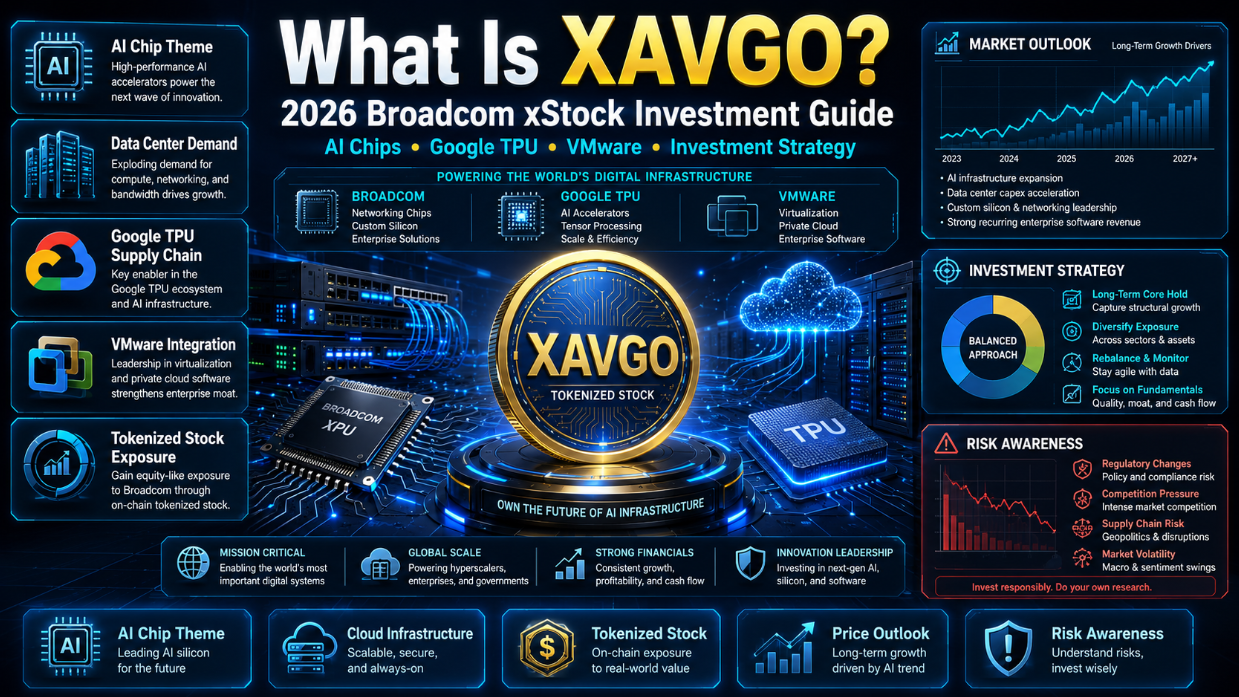
But a price page only shows what XAVGO is currently trading at; it does not alone prove how the underlying stock is custodied, nor guarantee that XAVGO perfectly tracks AVGO's price at every moment.
Is XAVGO a Crypto Token Issued by Broadcom?
XAVGO should not be understood as a project coin that Broadcom launched to build a blockchain ecosystem.
XAVGO's primary value does not depend on:
- Token burns;
- Mining;
- Staking;
- DeFi lockups;
- Governance voting;
- Token unlocks;
- Community memes;
- On-chain gas fees.
When analyzing XAVGO, one should instead focus on:
- Broadcom AI semiconductor revenue;
- Custom XPU customers;
- Google TPU demand;
- AI Networking revenue;
- VMware growth;
- Free cash flow;
- Corporate debt;
- AVGO stock valuation;
- XAVGO liquidity and premium/discount.
Therefore:
Studying XAVGO essentially means studying Broadcom first—not an independent crypto ecosystem.
What Is the Relationship Between XAVGO and AVGO?
AVGO is Broadcom's NASDAQ ticker.
XAVGO is a tokenized asset that provides AVGO-related economic exposure within a crypto or on-chain trading environment.
Under normal circumstances, an AVGO rise may provide upward momentum for XAVGO, and an AVGO decline may pressure XAVGO.
But "price correlation" does not mean the two are identical in legal structure or holder rights.
Traditional AVGO shares are held through brokerage accounts and grant corresponding shareholder rights under securities regulations.
What rights XAVGO holders actually receive depends on the xStock product documentation, including:
- The token-to-AVGO conversion ratio;
- Who holds the underlying stock;
- Whether voting rights are included;
- How dividends are handled;
- Whether minting and redemption are supported;
- Whether ordinary users can redeem;
- How underlying assets are custodied;
- What happens in the event of issuer bankruptcy;
- Any geographic restrictions.
Thus, a more accurate understanding is:
XAVGO primarily provides economic exposure to Broadcom stock, but should not be directly equated to holding identical AVGO common shares in a traditional brokerage account.
Why Can Broadcom Stock Be Traded Using USDT?
The traditional purchase path typically involves:
Opening a securities account, depositing fiat, and buying AVGO on NASDAQ.
XAVGO offers an alternative path:
Users hold USDT and gain Broadcom-related market exposure through a platform that supports XAVGO/USDT.
This reduces the friction of switching funds and trading environments for crypto users, but it does not reduce the need for fundamental and structural research.
XAVGO investors must simultaneously bear:
Broadcom operating risk + stock valuation risk + xStock structural risk + crypto trading environment risk.
2. What Is Broadcom? Why Does It Have Both Chip and Software Businesses?
Broadcom is a technology company spanning advanced semiconductors and infrastructure software.
Calling Broadcom merely a "chip company" is incomplete; calling it only a "VMware parent" is equally inaccurate.
Its current business structure can be summarized as:
Semiconductor infrastructure + custom AI compute + AI networking + enterprise software.
This combination differentiates Broadcom from companies focused on just one type of chip product.
What Does Broadcom's Semiconductor Business Include?
Broadcom's semiconductor business covers multiple important markets, including:
- Custom AI accelerators;
- Data center networking chips;
- Ethernet switching chips;
- SerDes and interconnect technologies;
- Optical communications products;
- Wireless communication chips;
- Storage connectivity products;
- Broadband chips;
- Enterprise and telecom infrastructure.
For XAVGO investors in 2026, the two most critical threads are:
Custom AI Accelerators + AI Networking.
The former helps large tech companies develop custom AI chips; the latter helps thousands or even tens of thousands of AI accelerators exchange data.
Where Does Broadcom's Software Business Come From?
Broadcom built its infrastructure software business through a long history of acquisitions, with VMware being one of the most significant assets.
After acquiring VMware, Broadcom formed a dual-structure business of semiconductors and Infrastructure Software.
This combination brings two different growth profiles:
- AI semiconductors offer potentially high growth;
- Enterprise software offers high margins, subscription revenue, and cash flow.
Therefore, Broadcom should not be compared only with NVIDIA, AMD, or Marvell—its software business's impact on margins, cash flow, and valuation stability also needs to be studied.
3. Why Has Broadcom Become a Core AI Chip Company?
The AI chip market is most visible through NVIDIA GPUs, but AI compute is not a single-technology path.
Google, Meta, Amazon, Microsoft, and other large tech enterprises may design or procure custom AI accelerators tailored to their own workloads.
One of Broadcom's key opportunities is helping hyperscalers develop and deploy these custom chips.
How Large Is Broadcom's AI Revenue?
In Q2 FY2026, Broadcom reported AI semiconductor revenue of approximately $10.8 billion, up 143% year-over-year.
The company guided Q3 AI semiconductor revenue to approximately $16 billion, up over 200% year-over-year.
Combined with Q1's approximately $8.4 billion in AI semiconductor revenue, a rapid growth trajectory emerges:
Q1 ~8.4B → Q2 ~10.8B → Q3 guidance ~$16B.
This shows Broadcom's AI business is already in the financial statements, not just product launches and future narratives.
What Does Rapid AI Revenue Growth Imply?
It at least indicates:
- Custom AI accelerator demand is expanding;
- Large customers continue increasing AI infrastructure investments;
- AI Networking is also generating significant revenue;
- Broadcom has entered key hyperscaler supply chains;
- AI business is reshaping the company's revenue mix.
But revenue growth does not automatically make any stock price reasonable.
Investors should also watch:
- Whether AI revenue growth can persist;
- Whether customer count is increasing;
- Single-customer concentration;
- Gross margins;
- XPU project deliveries;
- Networking business growth;
- Next-quarter guidance;
- How much future growth is already priced in.
4. Broadcom and NVIDIA: Competition or Complement?
Broadcom is not simply copying NVIDIA's GPU playbook.
The two companies compete in some areas of AI compute and networking, yet they may both benefit from the same wave of AI infrastructure expansion.
What Does NVIDIA Primarily Offer?
NVIDIA's main AI products include:
- GPUs;
- CUDA software ecosystem;
- AI server platforms;
- Networking;
- Systems and development tools;
- AI enterprise software.
The GPU's core strengths are versatility and a mature ecosystem.
Different companies can use NVIDIA GPUs to train and run a wide variety of AI models without designing chips from scratch.
Where Is Broadcom's Opportunity?
Broadcom's key AI path is Custom AI Accelerators—designing or co-developing chips tailored to specific workloads for large customers.
A general-purpose GPU is like a high-performance sports car that handles different roads.
A custom ASIC or XPU is more like a race car built for a fixed track.
It may sacrifice some generality in exchange for:
- Higher efficiency;
- Lower power consumption;
- Lower long-term compute costs;
- Higher performance on specific tasks;
- Deep integration with the customer's software and data center.
Can Broadcom Replace NVIDIA?
Not in a simple binary sense.
NVIDIA has a powerful combination of GPUs, CUDA, networking, and a complete platform ecosystem. Broadcom leans more toward custom chips for large customers and Ethernet-based network infrastructure.
A more plausible industry trend is:
GPUs + custom ASICs/XPUs coexisting.
Large tech companies can continue using GPUs for general-purpose and rapid-deployment needs, while using self-developed XPUs for high-volume, repetitive, or cost-sensitive core workloads.
If this dual-track approach expands, both NVIDIA and Broadcom could benefit—but in different ways.
5. What Is XPU? Why Is It One of the Most Important Keywords for XAVGO?
XPU is not a single, strictly defined chip type. In the Broadcom investment context, it generally refers to custom AI compute accelerators built for large customers.
What Is a Custom AI Accelerator?
A Custom AI Accelerator is an AI chip developed for specific customers, models, software, or data center environments.
Compared to general-purpose GPUs, custom chips typically require longer design and validation cycles, but can achieve higher efficiency for specific workloads.
Potential advantages include:
- Lower cost per training or inference run;
- Reduced power consumption;
- Improved performance;
- Optimization for specific models;
- Greater supply chain control;
- Reduced dependence on a single GPU supplier;
- Deep integration with the customer's cloud platform.
Why Do Hyperscalers Need In-House AI Chips?
Google, Meta, Amazon, Microsoft, and other large enterprises have enormous compute demands.
When AI training and inference reach multi-billion-dollar cost levels, even a few percentage points of savings per compute cycle can amount to substantial long-term savings.
Hyperscalers also want control over:
- Chip roadmaps;
- Software stacks;
- Data center deployment;
- Supply cadence;
- Energy efficiency;
- AI service differentiation.
This creates a market for Broadcom's custom chip design, interconnect, and mass-production capabilities.
Are There Downsides to Custom Chips?
Yes.
Custom ASICs often face:
- Long development cycles;
- High upfront investment;
- Limited product flexibility;
- Risks from changing models and technology roadmaps;
- High customer concentration;
- Project delays;
- Dependence on advanced process nodes and packaging;
- Mass-production challenges.
If customer requirements shift, a dedicated chip's applicability may be narrower than a general-purpose GPU.
So Broadcom's XPU growth must be continuously monitored through real customers, project progress, and production scale.
6. Why Is Google TPU Critical to Understanding Broadcom's AI Business?
Google has long developed TPUs (Tensor Processing Units) for AI training, inference, Google Cloud, and Gemini workloads.
TPU is an important commercial case study for the hyperscaler custom-AI-chip route.
Why Did Google Develop TPUs?
Google has massive search, advertising, cloud, and AI businesses.
If all AI compute relied entirely on general-purpose GPUs, cost, supply, and product roadmaps would be subject to external platform influence.
Developing in-house TPUs helps Google:
- Optimize for specific AI models;
- Lower compute costs;
- Improve energy efficiency;
- Control hardware and software roadmaps;
- Offer differentiated services on Google Cloud;
- Reduce single-supplier risk.
What Role Does Broadcom Play in the TPU Supply Chain?
Broadcom has long been involved in custom AI chips and related network infrastructure for large customers.
Its value may cover:
- Chip design collaboration;
- High-speed interconnects;
- SerDes;
- Advanced data center networking;
- Mass-production support;
- Related infrastructure.
In FY2026 earnings communications, Broadcom indicated continued growth in Google's next-generation TPU demand and expansion into multiple core XPU customers.
This forms a key investment thesis for XAVGO:
If large tech companies increasingly adopt a "GPU + in-house ASIC" dual-track strategy rather than relying solely on general-purpose GPUs, Broadcom could be a major beneficiary.
Does Google Demand Also Create Concentration Risk?
Yes.
If Broadcom's custom AI chip revenue is highly dependent on a few customers, any project delay, design change, order reduction, or supplier shift could materially impact revenue.
Thus, XAVGO investors should not only watch Google orders but also track whether Broadcom is adding Meta, Anthropic, OpenAI-related projects, and other XPU customers.
7. Why Might AI Networking Be as Important as AI Chips?
An AI cluster is not a single chip.
Large-model training may require thousands, tens of thousands, or even more AI accelerators working simultaneously.
These accelerators constantly exchange model parameters, gradients, and training data.
If network speed is insufficient, expensive compute chips will wait for data, lowering overall cluster utilization.
What Network Components Does an AI Cluster Need?
AI data center networks may involve:
- Switches;
- Ethernet;
- SerDes;
- NICs;
- Optical components;
- Interconnects;
- Routing and switching chips;
- High-speed connectivity technologies.
Broadcom has extensive products and technical expertise across these areas.
Why Does Network Value Rise With Cluster Size?
When an AI cluster scales from 1,000 GPUs to 10,000, and then to 100,000, the communication relationships and data exchange complexity increase significantly.
The system must address not only bandwidth but also:
- Latency;
- Congestion;
- Packet loss;
- Load balancing;
- Scalability;
- Reliability;
- Power consumption.
Therefore, AI infrastructure investment is not just about buying GPUs—it also requires synchronous network build-out.
How Important Is Broadcom's AI Networking Revenue?
In Q2 FY2026, Broadcom management stated that AI Networking accounted for nearly 40% of its AI revenue for the quarter.
This proportion indicates that Broadcom's AI revenue does not come exclusively from custom accelerators.
AI Networking has become another important growth engine.
This gives Broadcom a:
AI compute + AI networking dual-benefit structure.
8. Why Might Ethernet Be Another AI Growth Vector for Broadcom?
Different technology routes exist for AI cluster networking. NVIDIA has its own networking products and a complete AI platform. One of Broadcom's key advantages comes from the Ethernet ecosystem.
Why Do Cloud Providers Value Ethernet?
Large cloud providers typically want networks that offer:
- Open standards;
- Multi-vendor support;
- Scalability;
- Supply chain flexibility;
- Compatibility with existing data centers;
- Avoidance of single-vendor lock-in.
Ethernet has a massive deployed base and industrial ecosystem in data centers.
If AI Ethernet can continuously improve congestion control, latency, and large-cluster performance, it is likely to retain a critical position in AI data centers.
Why Might Broadcom Benefit From Both GPU and XPU Growth?
Whether customers buy general-purpose GPUs or deploy custom XPUs, as long as AI cluster scale expands, they will need more switching, interconnect, and network infrastructure.
Thus, Broadcom does not bet solely on "custom chips replacing GPUs."
It also bets on:
As total AI compute grows, all accelerators will require stronger networking.
This structure reduces Broadcom's dependence on a single compute-chip path, though it does not eliminate competition from NVIDIA, Marvell, and other networking vendors.
9. What Is Broadcom's Relationship With OpenAI, Meta, and Anthropic?
In FY2026 earnings communications, Broadcom management mentioned multiple AI compute customers and projects, including Google, Anthropic, Meta, and OpenAI-related initiatives, and noted that custom AI accelerator business is expanding across several core clients.
Specific customer projects, order sizes, revenue recognition, and partnership depths should be confirmed through official company disclosures.
Why Does Customer Count Matter?
If Broadcom relies on a single mega-client, short-term revenue may be high, but concentration risk is also very high.
If custom chip platforms expand to multiple customers, the pattern may become:
Customer A, B, C, and D each adopt different custom XPUs. Broadcom reuses its design, interconnect, and production experience across more projects, gradually building scale across customers and platforms.
This model can enhance:
- Revenue visibility;
- Customer diversification;
- Technology reuse;
- Supply chain scale;
- Platform value.
Does More Customers Automatically Mean Higher Profits?
Not necessarily.
Different customers have different chip designs, production timelines, costs, and contract structures.
New projects typically require heavy R&D investment in early stages. If projects are delayed or fail to reach mass production, revenue and profits may fall short of expectations.
Thus, investors should distinguish between:
- Potential customers;
- Design collaborations;
- Confirmed orders;
- Production projects;
- Recognized revenue.
10. Why Is VMware an Often-Underappreciated Asset at Broadcom?
If you analyze Broadcom only through AI chips, you would miss the impact of Infrastructure Software on revenue, profits, and cash flow.
VMware is a critical component of Broadcom's software business.
What Does VMware Do?
VMware primarily serves:
- Virtualization;
- Private cloud;
- Enterprise data centers;
- Hybrid cloud;
- Cloud infrastructure;
- Workload management;
- Enterprise IT infrastructure.
Its products help enterprises run and manage multiple virtual environments on the same hardware resources, and build private and hybrid cloud infrastructure.
What Did Broadcom Do After Acquiring VMware?
Broadcom strengthened VMware Cloud Foundation (VCF) products and business models.
The goal is to integrate compute, networking, storage, and cloud management into a more complete enterprise private cloud platform.
In Q2 FY2026 related disclosures, VMware Cloud Foundation demand was cited as a key driver of infrastructure software business growth.
Why Is VMware Important for XAVGO?
VMware gives Broadcom a revenue stream different from AI semiconductors.
The AI chip business may be subject to capex cycles, customer orders, and semiconductor cycles.
Enterprise software, by contrast, can offer:
- Subscription and long-term contracts;
- Higher margins;
- Strong customer stickiness;
- Stable cash flow;
- Enterprise infrastructure demand.
Thus, Broadcom's business structure can be seen as:
High-growth AI semiconductors + high-margin infrastructure software.
However, VMware also faces risks around pricing, customer satisfaction, competition, and integration—it should not be treated as an entirely stable cash cow.
11. Why Does Broadcom Have Such Strong Free Cash Flow?
Revenue growth shows business expansion; free cash flow shows how much of that revenue the company can convert into actual discretionary funds.
In Q2 FY2026, Broadcom's operating cash flow was approximately $10.493 billion, and free cash flow approximately $10.262 billion, representing about 46% of revenue.
This cash-generating ability is a key quality metric for Broadcom as an investment.
What Can Free Cash Flow Be Used For?
Companies can use free cash flow to:
- Fund R&D;
- Complete acquisitions;
- Pay dividends;
- Repurchase stock;
- Pay down debt;
- Increase financial flexibility;
- Support long-term product development.
Why Shouldn't You Look Only at AI Revenue?
AI revenue may grow rapidly, but if the company requires heavy capital, inventory, and operating expenses, the funds ultimately available to shareholders may not increase proportionally.
Thus, XAVGO investors should also track over time:
- Free cash flow;
- FCF margin;
- EBITDA margin;
- Dividends;
- Share buybacks;
- Net debt;
- Interest expense;
- VMware integration costs.
What Is the Relationship Between VMware and Cash Flow?
Software businesses like VMware may provide high-margin, recurring revenue that helps sustain Broadcom's cash flow.
But the VMware acquisition also added debt, integration costs, and management complexity.
So strong cash flow is not only for capital returns—it also supports post-acquisition debt management.
12. What Is Broadcom's True Moat?
Broadcom's moat is not a single chip product—it is a multi-layered combination of capabilities.
Advanced Chip Design Capability
Custom AI ASIC development requires handling:
- Chip architecture;
- Advanced process nodes;
- High-speed interconnects;
- SerDes;
- Packaging;
- Power consumption;
- Software adaptation;
- Large-scale validation;
- Mass production.
Hyperscalers have algorithms and workloads, but not necessarily the full chip-to-interconnect production experience.
Broadcom can provide these capabilities to customers.
Long-Term Relationships With Hyperscalers
From requirement definition to design, validation, and production, large AI chips typically take years.
Changing partners is not like swapping a standard commodity supplier.
Long-term relationships build:
- Technical accumulation;
- Understanding of customer workloads;
- Hardware-software co-optimization;
- Production experience;
- High switching costs.
But larger customers also have stronger bargaining power.
AI Chips and Networking Combined
Broadcom participates not only in compute chips but also in data center networking technologies.
This allows it to capture multiple value layers within AI clusters and leverage synergies between XPU and networking.
Massive Cash Flow Capacity
VMware and other mature businesses generate cash flow, enabling Broadcom to continuously invest in:
- R&D;
- New chip projects;
- Software development;
- Acquisitions;
- Capital returns;
- Debt reduction.
13. What Factors Determine XAVGO's Price?
AVGO Stock Performance
Broadcom Inc.'s AVGO stock is the core anchor for XAVGO.
Under normal conditions, an AVGO rise may lift XAVGO, and an AVGO decline will pressure XAVGO.
When comparing the two, confirm:
- The XAVGO-to-AVGO unit ratio;
- Whether U.S. markets are open;
- Data update timing;
- Dividend treatment;
- Product fees;
- Bid-ask spreads;
- Any premium or discount.
AI Semiconductor Revenue
AI semiconductor revenue is currently the most important metric in Broadcom's financial reports.
Investors should monitor:
- Actual revenue;
- Year-over-year and sequential growth;
- XPU vs. Networking contribution;
- Customer count;
- Next-quarter guidance.
If AI revenue and guidance continue rising, valuation may find fundamental support.
If revenue still grows but growth decelerates sharply, the market may revalue downward.
Hyperscaler AI Capex
Focus on AI capex from Google, Meta, Microsoft, and Amazon.
The complete transmission chain is:
Hyperscalers increase AI spending → build more servers and data centers → deploy more GPUs and custom XPUs → expand switching and networking equipment demand → Broadcom's chip and networking revenue may grow.
VMware Growth
VMware Cloud Foundation and infrastructure software may provide a second growth and profit engine for Broadcom.
If semiconductor growth slows, software revenue can offer partial support.
But if VMware experiences customer churn, contract reductions, or weaker-than-expected growth, that support will also weaken.
Valuation
Great Broadcom results do not make any price worth paying.
If the market has already priced in years of high growth, even continued earnings growth may lead to a stock decline due to valuation contraction.
XAVGO's Own Liquidity
XAVGO is also affected by:
- USDT trading depth;
- Bid-ask spreads;
- U.S. market session timing;
- Market maker quotes;
- Platform volume;
- On-chain liquidity;
- Deposit/withdrawal status;
- Crypto market risk appetite.
Thus, XAVGO and AVGO may deviate in the short term.
14. How Does XAVGO Differ From Buying AVGO Stock Directly?
Trading Venue
AVGO trades on NASDAQ and other traditional securities markets.
XAVGO trades in a crypto or xStock trading environment.
Pricing Currency
XAVGO/USDT is quoted and settled in USDT.
USDT targets a stable dollar value but is not bank USD in a brokerage account. Investors also bear stablecoin and platform risks.
Trading Hours May Differ
Tokenized stocks may offer longer trading windows than traditional U.S. equities.
But longer hours do not guarantee sufficient liquidity at all times.
During U.S. market holidays, XAVGO may price in company news, AI sector moves, and order book dynamics ahead of the U.S. open—and may also see larger deviations.
Shareholder Rights Are Not Automatically Equivalent
Gaining price exposure to AVGO stock does not necessarily mean becoming a registered Broadcom shareholder.
Investors should review XAVGO's specific terms to confirm:
- Ownership;
- Dividends;
- Voting rights;
- Corporate actions;
- Custody;
- Redemption;
- Geographic restrictions.
Additional Structural Risks
XAVGO also faces:
- Issuer risk;
- Underlying custody risk;
- Smart contract risk;
- Platform risk;
- Liquidity risk;
- Tracking error;
- Premium/discount;
- Regulatory risk.
15. Why Is XAVGO Worth Watching? Five Core Investment Theses
Rapid Growth in Custom AI Chips
Broadcom already generates substantial AI semiconductor revenue.
Rapid revenue and guidance growth provide actual financial data supporting the AI narrative.
Hyperscaler In-House Chip Trend
Large tech enterprises increasingly want to control cost, supply, and roadmaps, driving greater focus on custom AI silicon.
Broadcom can participate through chip design, high-speed interconnects, and production capabilities.
AI Networking Demand Grows in Tandem
The larger the AI cluster, the stronger the need for network bandwidth, switching, and interconnect.
Broadcom's participation in both compute and networking allows it to benefit from multiple layers of AI infrastructure.
VMware as a Second Profit Engine
VMware and other infrastructure software reduce Broadcom's dependence on a single semiconductor cycle.
Strong Free Cash Flow
Cash flow supports R&D, M&A, dividends, buybacks, and debt management—a key advantage over many early-stage AI concept companies.
16. What Are the Biggest Risks for XAVGO?
High Valuation Risk
Broadcom's biggest risk may not be poor company quality, but the market pricing it too richly because of its excellence.
The higher the expectations, the more the earnings need to beat them.
AI Capex Slowdown
If hyperscalers reduce AI build-out, both XPU and AI Networking demand could suffer.
Customer Concentration
Custom chip projects typically rely on a few large customers.
If a core customer delays projects, cuts orders, changes architecture, or switches partners, Broadcom's revenue could change materially.
NVIDIA Competition
NVIDIA offers a complete AI platform through GPUs, networking, and software.
If customers prefer NVIDIA's full-stack solution, Broadcom may face pressure in some compute and networking segments.
Marvell and Other ASIC Competition
Custom AI chips are not a Broadcom monopoly.
Marvell and others are also competing for hyperscaler ASIC and data center projects.
Customers may use multi-supplier strategies to reduce dependence on Broadcom.
VMware Integration Risk
VMware may face:
- Customer churn;
- Pricing disputes;
- Product strategy changes;
- Cloud-native competition;
- Integration execution issues;
- Service quality problems.
If software revenue and renewals deteriorate, Broadcom's second profit engine may underperform.
Debt and M&A Risk
Large acquisitions increase Broadcom's software scale but also add debt and interest burdens.
If cash flow declines, debt management may constrain capital returns and future investment.
XAVGO Structural Risks
XAVGO also bears issuance, custody, smart contract, platform, liquidity, premium/discount, and jurisdictional regulatory risks.
17. XAVGO Investment Strategy: Use AI Revenue to Gauge Medium-Term Trends
Medium-term investors can build an AI Revenue Checklist after each earnings report.
Is AI Semiconductor Revenue Still Growing?
Actual revenue growth confirms customer projects are converting into financial results.
Is the Growth Rate Declining Significantly?
High growth cannot last forever, but the pace of deceleration can affect valuation.
Are XPU Orders and Customers Increasing?
Look beyond a single large customer—observe whether Broadcom can build a multi-customer XPU platform.
Is AI Networking Maintaining Growth?
Broadcom's AI investment value comes not only from XPU. Networking revenue is equally important.
Is Next-Quarter Guidance Increasing?
When actual revenue, orders, and guidance all rise, the fundamental trend is generally healthier.
If revenue is good but guidance misses expectations, the stock can still fall.
18. XAVGO Investment Strategy: Wait for Earnings and Guidance Confirmation
Betting on price moves before earnings means taking on risks from revenue, profits, guidance, and market expectations simultaneously.
A more prudent approach is to review after the release:
- Revenue;
- EPS;
- AI Semiconductor Revenue;
- AI Networking;
- VMware;
- Free Cash Flow;
- Guidance;
- Management commentary.
The market cares not only about past results but also about future growth.
Thus, "great earnings but falling stock price" is not contradictory.
If market expectations were even higher, or if next-quarter guidance did not increase further, a valuation pullback may still occur after good news.
19. XAVGO Investment Strategy: Use Hyperscaler AI Capex as a Leading Indicator
XAVGO investors should not only track Broadcom announcements but also study the capex cycles of its customers.
Key observations:
- Google;
- Meta;
- Amazon;
- Microsoft;
- Other large AI and cloud enterprises.
The transmission logic:
Hyperscalers raise AI capex → deploy more custom XPUs and GPU servers → data centers need more switching, interconnect, and networking gear → Broadcom's custom chip and AI Networking revenue may grow.
Note that capex growth does not guarantee Broadcom gets a fixed share of orders.
Also watch which chip routes customers choose, which projects Broadcom participates in, and when production ramps.
20. XAVGO Investment Strategy: Fundamentals Are Good, but Check Valuation
Valuation assessment can be broken into three layers.
Are Earnings Consistently Rising?
If revenue, EPS, and free cash flow grow in tandem, price increases have more fundamental support.
Is the Stock Price Outpacing Earnings Significantly?
If price growth far exceeds earnings forecast growth, valuation is expanding.
Has the Market Already Priced in Years of Future Growth?
If the current price is built on assumptions of sustained very high AI revenue growth, any normalization of growth could trigger valuation contraction.
Core principle:
A great company and a great investment are not the same thing.
Broadcom can continue to be an excellent company, but if the entry price is too high, investment returns may still be disappointing.
21. XAVGO Investment Strategy: Scale In, Not One-Shot Heavy
For a newly listed and potentially volatile asset like XAVGO, deploying all planned capital at once concentrates the entry timing.
For example, if you plan to allocate 1,000 USDT, consider splitting into four parts:
- First part: build a small observation position;
- Second part: wait for earnings confirmation;
- Third part: observe AI revenue and guidance;
- Fourth part: reserve for a reasonable pullback or new fundamental information.
The exact allocation should depend on your personal risk tolerance; 25% is not a one-size-fits-all rule.
Before each increase, reassess:
- Broadcom fundamentals;
- AI orders;
- Earnings;
- VMware;
- Free cash flow;
- Company valuation;
- XAVGO premium/discount;
- Overall market environment.
Scaling in does not replace risk control. If fundamentals deteriorate, mechanical averaging can enlarge losses.
22. When Should You Consider Reducing XAVGO Exposure?
Reducing should not be driven by a single day's price drop, but by whether the original investment thesis has changed.
Watch for these signals:
AI Semiconductor Revenue Clearly Below Expectations
This may indicate changes in customer demand, project deliveries, or market growth.
XPU Project Delays or Customer Reductions
Custom chip development cycles are long. Delays affect future revenue and market expectations.
Hyperscaler AI Capex Declines
Lower customer data center spending may hit both compute and networking demand.
AI Networking Slows Consistently
If networking revenue falls, Broadcom's dual AI benefit thesis weakens.
VMware Revenue or Customer Trends Deteriorate
Weaker software performance reduces Broadcom's cash flow and business diversification advantages.
Stock Price Rises Sharply but Earnings Forecasts Do Not Follow
This typically means price is increasingly driven by valuation expansion rather than earnings growth.
XAVGO Shows a Significant Premium
Even if Broadcom's fundamentals are unchanged, a clear premium over AVGO's reference value creates an independent risk.
23. XAVGO Price Prediction: Use Three Scenarios Instead of a Fixed Target
Investors can refer to XAVGO price prediction and market trends to observe different time-frame movements.
But it is not advisable to rely solely on one fixed target.
Bullish Scenario
The bullish scenario requires simultaneous:
- Continued growth in global AI capex;
- Google and other customers expanding orders;
- Broadcom adding new XPU clients;
- Custom AI chips ramping as planned;
- AI Networking sustaining high growth;
- VMware stable growth;
- Strong free cash flow and margins;
- Current valuation not excessively stretched;
- Adequate XAVGO liquidity.
In this case, AVGO earnings estimates may continue rising, and XAVGO may benefit from underlying stock appreciation.
Neutral Scenario
The neutral scenario may include:
- AI market still growing;
- XPU and networking revenue still rising, but growth normalizing;
- VMware stable;
- Current valuation already high.
In this scenario, price appreciation relies more on EPS and FCF growth than on rapid valuation multiple expansion.
Bearish Scenario
The bearish scenario may include:
- AI capex declining;
- XPU projects delayed;
- Major customers changing in-house chip strategies;
- AI Networking slowing;
- VMware customer churn;
- Gross margin or cash flow deterioration;
- Market valuation contraction;
- XAVGO liquidity worsening.
If Broadcom's fundamentals and token structure both weaken, XAVGO could see significant drawdowns.
24. Can BTC and ETH Affect XAVGO?
XAVGO, BTC, and ETH are all accessible in crypto trading environments, but their value sources differ.
XAVGO's core value comes from Broadcom's fundamentals.
BTC is primarily influenced by the Bitcoin network, fixed supply, market demand, macro liquidity, and portfolio allocation preferences.
ETH relates to the Ethereum network, gas fees, staking, smart contracts, and on-chain ecosystem activity.
Investors can use BTC price prediction and market cycles to gauge whether the crypto market is in risk-on or risk-off mode.
They can also reference ETH price prediction and Ethereum trends to observe the activity level of on-chain finance and tokenized assets.
BTC and ETH may indirectly affect:
- Overall crypto risk appetite;
- USDT trading activity;
- XAVGO order-book depth;
- Token market premiums/discounts;
- Platform volumes;
- Short-term deleveraging.
But the medium- to long-term value drivers for XAVGO remain:
- AI semiconductor revenue;
- XPU customers;
- AI Networking;
- VMware;
- Free cash flow;
- AVGO valuation.
Bitcoin halvings, Ethereum upgrades, or "alt seasons" do not directly improve Broadcom's corporate earnings.
25. How to View and Trade XAVGO on HiBT?
View XAVGO Market Data
Users can view XAVGO real-time price, charts, and market data to see the latest quotes, 24-hour change, volume, and historical trends.
Prepare USDT
Users can obtain USDT through platform-supported methods or deposit from other wallets/platforms.
Before depositing, verify:
- The deposit network;
- The address;
- Minimum amount;
- Whether the network is open;
- Whether a memo or tag is required.
Search for XAVGO/USDT
Go to the relevant trading section and search for XAVGO or XAVGO/USDT.
Verify the product name, trading pair, and related announcements to avoid buying a similarly named asset.
What to Check Before Placing an Order?
At minimum, check:
- Whether AVGO had a significant move that day;
- Whether Broadcom just released earnings;
- Whether new XPU or AI orders emerged;
- XAVGO bid-ask spread;
- Market depth;
- Whether U.S. markets are open;
- Whether XAVGO deviates from AVGO's reference value.
Choose Limit or Market Order
Limit orders let you set a price, but execution is not guaranteed.
Market orders execute quickly, but may incur significant slippage, especially when liquidity is thin.
When XAVGO is in price discovery, check the order book carefully before using market orders.
26. How Does XAVGO Differ From GOOGLON?
What is GOOGLON and the investment thesis for Alphabet tokenized stock covers Alphabet-related assets.
XAVGO and Broadcom are more about AI infrastructure suppliers, with primary revenue sources including:
- XPU;
- AI Networking;
- Semiconductors;
- VMware.
GOOGLON and Alphabet lean more toward:
- Search;
- Advertising;
- Google Cloud;
- Gemini;
- AI platforms;
- Consumer and enterprise services.
Google is also a major demand side for TPU and AI infrastructure.
Thus, the two form an industrial link:
Google increases AI investment → more TPU and data center infrastructure demand → Broadcom may benefit from custom chips and network supply chains.
But higher Google capex does not automatically mean Broadcom gets all related orders—actual projects and revenue must still be verified.
27. How Does XAVGO Differ From COINON?
What is COINON and the logic behind Coinbase-related assets introduces crypto-platform stock-related assets.
XAVGO's key variables include:
- AI capex;
- Custom chip orders;
- Data center networking;
- VMware;
- Enterprise software;
- Free cash flow.
COINON's key variables are closer to:
- Crypto trading volume;
- BTC price;
- USDC ecosystem;
- Regulatory policy;
- User trading activity;
- Custody and subscription services.
Both trade in crypto environments, but the underlying companies' earnings drivers are completely different.
28. How Does XAVGO Differ From GLWON?
What is GLWON and the investment thesis for Corning-related assets leans more toward AI data center materials, glass, fiber optics, and infrastructure supply chains.
AI data center construction may form the following industry chain:
Server chips, networking equipment, optical communications, and glass, fiber, and related materials.
XAVGO is closer to high-value chips, custom compute, and networking layers.
GLWON's underlying company logic is more about materials, fiber, and foundational infrastructure.
Both may benefit from AI data center expansion, but their profit models, competitive dynamics, and valuation methods differ.
29. Who Is XAVGO Suitable For?
XAVGO may be more suitable for investors willing to study U.S. stock fundamentals and the AI infrastructure value chain.
Those relatively well-suited for XAVGO include:
- Long-term bulls on AI infrastructure;
- Believers in hyperscaler in-house chips;
- Optimistic about AI Networking;
- Able to read company financial reports;
- Willing to track Google, Meta, and other capex;
- Understand stock valuation;
- Can tolerate tech-growth stock volatility;
- Can verify price deviations between XAVGO and AVGO.
Those who should be more cautious include:
- Treating XAVGO as a typical altcoin;
- Doing no research on Broadcom;
- Trading solely based on BTC movements;
- Chasing rallies on impulse;
- Unable to handle valuation pullbacks;
- Not understanding xStock structure;
- Unwilling to continuously track earnings and guidance.
30. XAVGO FAQs
What Is XAVGO?
XAVGO is Broadcom xStock tied to Broadcom Inc. stock, providing economic exposure related to AVGO stock performance.
What Kind of Coin Is XAVGO?
XAVGO exists in token form, but it is not an ordinary crypto project coin issued by Broadcom. Its primary value comes from Broadcom's fundamentals and AVGO stock performance.
What Is the Difference Between XAVGO and AVGO?
AVGO trades on NASDAQ in traditional securities markets, while XAVGO trades in a crypto or xStock environment using USDT. They differ in trading venue, holder rights, custody, trading hours, and additional risks.
Does Buying XAVGO Equal Buying Broadcom Stock?
Not exactly. XAVGO primarily provides AVGO-related economic exposure, but whether it confers traditional voting rights, dividend rights, and direct shareholder status depends on the specific product terms.
Why Is Broadcom Considered an AI Chip Company?
Broadcom participates in custom AI accelerators, XPUs, high-speed interconnects, and AI Networking. Its AI semiconductor revenue has become a major growth driver.
What Is the Relationship Between Broadcom and NVIDIA?
NVIDIA primarily offers general-purpose GPUs, CUDA, and a complete AI platform. Broadcom focuses more on hyperscaler custom XPUs and Ethernet networking. They compete in some areas and also both benefit from AI infrastructure expansion.
What Is the Relationship Between Broadcom and Google?
Google has long developed custom AI chips such as TPUs. Broadcom is involved in custom chips and network infrastructure for large customers. Specific projects and revenue should be confirmed through official disclosures.
What Is Broadcom's XPU?
XPU generally refers to custom AI accelerators built for large customers. They are optimized for specific workloads, potentially lowering power and long-term compute costs, but are less versatile than GPUs.
Why Is VMware Important to Broadcom?
VMware provides enterprise virtualization, private cloud, and infrastructure software revenue, helping improve margins, cash flow, and business diversification.
Why Is XAVGO Rising?
Possible reasons include AVGO stock appreciation, AI semiconductor revenue growth, XPU customer additions, stronger AI Networking, VMware improvement, free cash flow growth, and XAVGO-specific liquidity dynamics.
Is XAVGO Worth Investing In?
This requires simultaneous evaluation of AI revenue, customer count, networking, VMware, free cash flow, company valuation, and XAVGO's asset structure—not just the AI concept.
Is XAVGO Suitable for Long-Term Holding?
The long-term thesis depends on whether Broadcom can continue expanding XPU and AI Networking revenue while maintaining VMware growth, strong cash flow, and reasonable valuation.
Will XAVGO's Price Be Identical to AVGO's?
Not necessarily. The two are theoretically highly correlated, but may show short-term deviations due to trading hours, market depth, product fees, unit conversion, and premium/discount.
What Is XAVGO's Price Prediction?
Fixed price targets have limited reliability. A more reasonable approach is to build bullish, neutral, and bearish scenarios based on AI capex, XPU customers, AI Networking, VMware, free cash flow, and valuation. Investors may also refer to XAVGO latest price prediction.
What Is the Biggest Risk for XAVGO?
The main risks include Broadcom valuation being too high, AI capex slowdown, customer concentration, competition from NVIDIA and Marvell, VMware integration, debt, and XAVGO's issuance, custody, liquidity, and regulatory risks.
31. Summary: To Invest in XAVGO, Essentially Judge Five Things
XAVGO is not an ordinary crypto project where you focus on tokenomics, burn mechanisms, community size, or alt seasons.
Its long-term value stems from whether Broadcom can simultaneously capture three main threads: custom AI compute, AI networking, and enterprise software.
The complete investment logic is:
Global large tech companies increase AI capex → Google, Meta, OpenAI-related projects, and other hyperscalers expand custom AI chip demand → Broadcom wins more customers through XPU design, high-speed interconnect, and production capabilities → As AI clusters scale, Ethernet, switching, SerDes, and other network product demand grows in parallel → VMware and infrastructure software provide high-margin revenue and cash flow → Broadcom converts revenue into free cash flow for R&D, capital returns, and debt management → The market revalues AVGO based on forward earnings → Underlying stock and xStock pricing mechanisms ultimately affect XAVGO's price.
But every layer must be continuously validated.
Investors should sequentially judge five things:
First, will global AI capex continue to grow?
Second, will Google, Meta, OpenAI-related projects, and other customers continue increasing custom AI chip demand?
Third, can Broadcom's XPU and AI Networking revenue sustain growth?
Fourth, can VMware continue delivering stable software profits and free cash flow?
Fifth, has the current AVGO and XAVGO valuation already priced in future growth prematurely?
The first three determine whether Broadcom can still grow.
The fourth determines the company's earnings quality and resilience to cycles.
The fifth determines whether an excellent company becomes an investment at a reasonable price.
Broadcom is not "the second NVIDIA." Its differentiation lies in:
Hyperscaler in-house AI chips + AI network infrastructure + VMware enterprise software cash flow.
If AI compute gradually evolves from a single GPU path to a coexistence of GPUs and custom XPUs, while AI clusters continue expanding network investment, Broadcom could be a major beneficiary of long-term AI infrastructure expansion.
But if AI capex declines, XPU projects are delayed, networking revenue slows, or market valuation outpaces earnings growth far too quickly, even if Broadcom remains a high-quality company, XAVGO could experience significant drawdowns.
Therefore, analyzing XAVGO is better approached with:
AI capex + custom XPU + AI Networking + VMware cash flow + xStock pricing mechanism.
That is far closer to XAVGO's true source of value than just looking at crypto price moves, BTC trends, or short-term candlesticks.