
XIAOMIUSD is an Equity X-Perp derivative launched by OKX that ultimately references Xiaomi Group's stock listed on the Hong Kong Stock Exchange (HKEX: 01810). However, traders are not buying or selling Xiaomi shares, nor are they trading a "tokenized spot" version of Xiaomi stock. It is a price contract that allows going long, going short, and using leverage, supports 24/7 trading, and stays connected to the underlying stock value through index price, mark price, and funding rate mechanisms.
This distinction determines how XIAOMIUSD should be analyzed: traders must not only judge whether Xiaomi's stock price will rise or fall, but also whether the funding rate, contract basis, Hong Kong market closure pricing, leverage level, and liquidation distance will allow them to wait until their view materializes.
OKX officially defines X-Perp as an expiring futures product with a fixed maturity date. It uses a funding rate mechanism similar to perpetual contracts, but has a maximum lifespan of approximately five years—it is not truly "never expiring." Holders do not receive Xiaomi shares, shareholder voting rights, or direct dividend rights. OKX X-Perp Product Description
Therefore, the most important thing to watch out for with XIAOMIUSD is not just "Xiaomi's stock price falling," but rather:
Wrong direction on Xiaomi + amplified leverage + accumulated funding fees + Hong Kong market closure basis + mark price liquidation + expiry rollover risk.
Risk Disclaimer: The data in this article is updated as of September 18, 2026, and is intended solely for product education and market research. It does not constitute investment, securities, legal, or tax advice. X-Perp is a high-risk leveraged derivative that can result in the loss of all margin within a short period, and may not be available in all regions or accounts. All contract parameters should be based on the trading interface and the latest official rules.
Key Takeaways: 8 Things to Know Before Trading XIAOMIUSD
- XIAOMIUSD ultimately references Xiaomi Group 01810.HK, but it is a derivative, not stock spot.
- Traders do not own Xiaomi shares, voting rights, or receive stock dividends as direct cash income.
- The product supports long, short, and leveraged trading, amplifying both gains and losses.
- X-Perp uses funding rates; long-term holding may incur ongoing costs, or may earn funding fees in certain directions.
- X-Perp has a maximum lifespan of approximately five years; upon expiry, it requires cash settlement or rolling the position to a new contract.
- XIAOMIUSD remains tradable when the Hong Kong market is closed, but prices at that time reflect more of the derivatives market's expectations for the next open.
- Liquidation typically references the mark price, not just the last traded price; 10x leverage does not mean "liquidation occurs only after an exact 10% adverse move."
- The most important risk combination is leverage, funding fees, basis, weekend gaps, and liquidity—not a single Xiaomi fundamental risk.
I. What Exactly Is XIAOMIUSD? Breaking Down the Product Structure First
XIAOMIUSD can be understood through the following price chain:
Xiaomi Group 01810.HK stock price → HKD converted to USD reference value → OKX aggregates multiple price sources to form index price → XIAOMIUSD X-Perp independent order book → Traders go long, short, or use leverage.
Xiaomi's official investor relations page confirms the company's HKEX stock code is 01810. Xiaomi 2026 Q2 Results Page
The "USD" in XIAOMIUSD indicates that the contract uses USD-equivalent pricing and settlement logic. It does not mean Xiaomi stock has changed from HKD quotation, nor does it mean users must physically hold US dollars. The specific margin currencies available depend on the region, account mode, and product specifications.
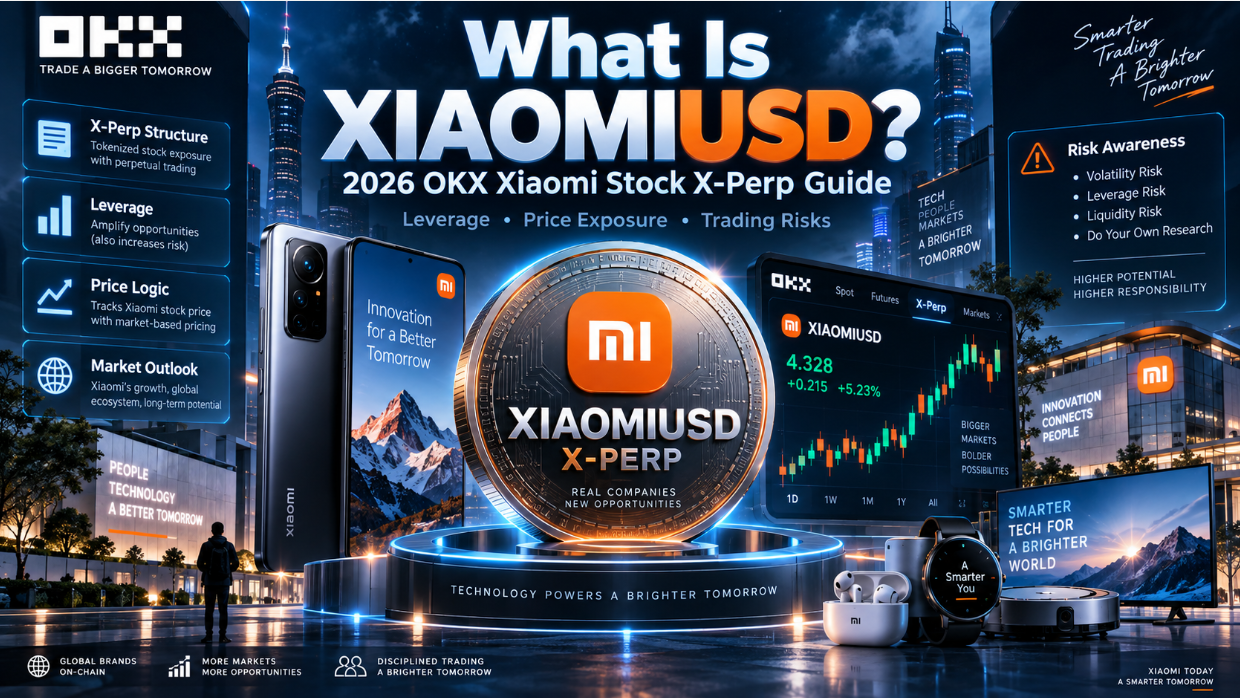
Is XIAOMIUSD Xiaomi Stock?
No. 01810.HK is a common stock listed on the Hong Kong Stock Exchange; XIAOMIUSD is a derivative position that references its price performance.
When directly purchasing stock, investors hold shares through brokerage and custody systems and possess shareholder rights under applicable rules. When trading XIAOMIUSD, users hold a contract position with the platform, and profit or loss comes from the difference between opening and closing prices plus funding fees during the holding period.
Is XIAOMIUSD a Tokenized Stock?
Also no. Tokenized stocks typically attempt to provide on-chain economic exposure related to underlying stocks; XIAOMIUSD instead has margin, leverage, funding rates, liquidation, and expiry settlement mechanisms. Similar names do not mean the product structures are the same.
II. What's the Difference Between XIAOMIUSD and Directly Buying 01810.HK?
Both may be affected by Xiaomi's stock price, but the rights investors receive and the risks they bear are clearly different.
Directly buying 01810.HK, the core risks are Xiaomi's business operations, Hong Kong stock valuation, market liquidity, and the macroeconomic environment. Ordinary spot positions will not be automatically liquidated due to a short-term fluctuation, nor do they have X-Perp funding rates; however, short selling, margin financing, and trading hours are subject to brokerage and market rules.
XIAOMIUSD has the following characteristics:
- Trades a derivative, does not own shares;
- Does not provide shareholder voting rights;
- Does not directly receive stock cash dividends;
- Can go long or short;
- Can use leverage;
- Supports 24/7 trading;
- Has funding rates;
- Has mark price and liquidation mechanisms;
- Has a maximum lifespan of approximately five years, requiring handling of expiry or rollover;
- Uses USD-equivalent pricing, requiring consideration of HKD/USD conversion;
- In addition to Xiaomi risk, adds platform, order book, basis, and regional compliance risks.
Convenience is not free. XIAOMIUSD exchanges more flexible trading hours and leverage for more derivatives risk.
III. Why Is It Called X-Perp but Still Has an Approximately Five-Year Expiry?
Traditional crypto perpetual contracts typically have no fixed expiry date; as long as margin is sufficient and funding fees are paid, they can theoretically be held indefinitely.
OKX calls X-Perp "USD Expiry Perps." It retains the perpetual contract experience of funding rates, margin, long/short, and all-day trading, while setting a future expiry date. Official rules show that X-Perp expiry dates are set approximately five years after issuance, and as expiry approaches, a new forward contract is automatically generated, allowing old and new contracts to trade simultaneously during the transition period. OKX X-Perps Guide
A more accurate understanding is:
X-Perp is a long-dated futures contract with a funding rate mechanism, not a strictly "never-expiring" perpetual contract.
This is also why traders cannot see "Perp" and assume it can be held forever without management.
IV. What Happens to XIAOMIUSD After Five Years?
At expiry, open positions are cash-settled according to contract rules. OKX general X-Perp rules show that the delivery price is determined by the average of the index price every second over the final 30 minutes before delivery.
If traders wish to maintain Xiaomi directional exposure, they typically need to execute a rollover:
Close the expiring old contract → Open a position in the new forward contract.
Rollover is not a zero-cost operation. Considerations include:
- Price difference between old and new contracts;
- Liquidity of both order books;
- Bid-ask spread and slippage;
- Trading fees for closing old and opening new;
- Funding rate of the new contract;
- Market volatility and margin changes before expiry.
Therefore, "long-term bullish on Xiaomi" does not mean it is suitable to leave a high-leverage XIAOMIUSD position untouched for five years. For long-term allocation, direct stock or economic exposure products without liquidation mechanisms may be easier to manage, but availability still depends on the investor's location and account conditions.
V. Why Can XIAOMIUSD Still Trade 24/7 After the Hong Kong Market Closes?
Hong Kong stock market regular trading hours are 9:30 AM to 12:00 PM and 1:00 PM to 4:00 PM Hong Kong time, closed on weekends and market holidays. XIAOMIUSD, as a platform derivative, can continue trading.
When the Hong Kong market is open, the index can rely more on real-time stock data. After the Hong Kong market closes, actual Xiaomi stock no longer generates new trades, and index pricing references more:
- OKX's own contract prices;
- Stock derivatives prices on other exchanges;
- Available tokenized assets or index data;
- Foreign exchange prices;
- Last available stock reference price;
- Market expectations for the next Hong Kong market open.
OKX stock derivatives documentation shows that its index aggregates stock data, other exchanges' stock perpetual prices, OKX contract prices, and other index sources; during market closure, the weight of derivatives price sources increases. OKX Stock Derivatives Index Description
So the XIAOMIUSD price seen on Saturday is not "the price at which 01810.HK traded on Saturday," but rather the derivatives market's collective expectation of what Xiaomi stock would be worth if it could trade immediately.
VI. What Are You Actually Trading on Weekends? Why Are Gap Risks So Common?
Suppose Xiaomi announces new car orders, an accident investigation, regulatory changes, or a profit warning over the weekend. XIAOMIUSD can immediately reflect market sentiment, but 01810.HK can only wait until the Hong Kong market reopens.
Three scenarios may occur at Monday's open:
- Hong Kong opens close to the XIAOMIUSD weekend price, and the two quickly converge;
- Hong Kong reacts more strongly to the news, and XIAOMIUSD needs to adjust further;
- The weekend derivatives market overreacts, and XIAOMIUSD reverses and converges after Hong Kong opens.
High-leverage traders may be liquidated during the price rediscovery process, even if their judgment on the long-term impact of the event is ultimately correct. This is "path risk": contract trading requires not only seeing the destination but also surviving all the volatility along the way.
VII. Does the Price Band Mean Maximum Loss Is Only 10%?
No.
OKX public rules show that stock derivatives indices are typically limited to approximately 10% above or below the data provider's stock reference price, using the last available stock price during market closure to calculate the protection range; the platform also reserves the right to dynamically adjust parameters based on market conditions.
This price band protects index calculation, primarily to reduce deviations caused by abnormal data or market manipulation. It does not mean:
- User positions have a maximum loss of only 10%;
- Contract traded prices can only fluctuate 10%;
- Hong Kong reopening will not gap;
- High-leverage positions will not be liquidated on smaller moves;
- Price band parameters will never change.
For example, a 10x leveraged position may hit maintenance margin requirements when the underlying asset moves far less than 10% adversely. The index protection mechanism cannot be treated as a stop-loss or principal protection.
VIII. Why Does XIAOMIUSD Use USD Quotes While Xiaomi Stock Uses HKD?
01810.HK trades in HKD on the Hong Kong market. XIAOMIUSD needs to convert the underlying value into a USD-equivalent reference, so the simplified chain is:
01810.HK HKD stock price × HKD/USD exchange rate = Xiaomi stock USD reference value.
The actual index may also be adjusted based on product specifications, contract multiplier, index sources, and USD-equivalent settlement currency.
This means XIAOMIUSD is affected by two types of variables simultaneously:
- Xiaomi stock's own rise or fall;
- HKD/USD conversion changes.
Since HKD operates under a linked exchange rate system, exchange rate fluctuations are typically smaller than Xiaomi stock fluctuations under normal conditions, but traders should still not completely ignore conversion and USDT or other USD-equivalent settlement asset deviations.
IX. What's the Difference Between Index Price, Last Price, and Mark Price?
Last Price: Last Traded Price
This is the most recent traded price in the XIAOMIUSD order book. Insufficient liquidity or a large short-term order may cause the Last Price to deviate from the reference value.
Index Price: Index Price
The index price is calculated from multiple external or derivatives data sources to describe the comprehensive reference value of the underlying asset. It is not necessarily the price at which any trader can execute in the order book.
Mark Price: Mark Price
The mark price is an important reference for platform risk management, typically used for unrealized P&L and liquidation determination, with the aim of preventing a single abnormal trade from directly triggering large-scale liquidations.
The OKX stock product public formula is:
Mark Price = Index Price + Basis Moving Average
Where the basis moving average comes from the moving average of the difference between the order book mid-price and the index price. Actual calculations should be based on the XIAOMIUSD product page and rules at the time.
For traders, the most dangerous mistake is watching only the Last Price while not knowing the Mark Price is already approaching the liquidation price.
X. Why Does XIAOMIUSD Deviate from 01810.HK?
Price differences may come from:
- 01810.HK is quoted in HKD, XIAOMIUSD uses USD-equivalent quotes;
- Different Hong Kong market open and closed states;
- XIAOMIUSD has an independent order book;
- Imbalanced long and short positions;
- Changes in market maker depth;
- Funding rate expectations;
- Other stock derivatives prices;
- Weekend or major event expectations;
- Product multiplier and conversion conventions;
- USDT or other settlement currency deviations from USD.
Traders should establish an "XIAOMI Basis Tracker":
Xiaomi USD Reference Price = 01810.HK Price × HKD/USD × Contract Conversion Ratio
Basis Rate = (XIAOMIUSD Price − Xiaomi USD Reference Price) ÷ Xiaomi USD Reference Price
The conversion ratio must first be confirmed from the contract specifications. Without confirming the contract multiplier, directly dividing XIAOMIUSD price by 01810.HK USD price may yield incorrect conclusions.
When recording basis, it is best to distinguish between Hong Kong trading hours, lunch break, overnight, weekends, and around earnings. The same 2% price difference may have completely different meanings during Hong Kong market hours versus on weekends.
XI. What Is Funding Rate? Why Is It Not a Fixed Platform Fee?
Funding rate is a periodic settlement fee mechanism between long and short positions, used to push the contract price toward the index price.
Typically:
- When the funding rate is positive, longs pay shorts;
- When the funding rate is negative, shorts pay longs.
It is different from trading fees incurred when opening and closing positions. Trading fees are paid to the trading platform; funding fees are typically transferred between long and short parties, with the platform completing settlement according to rules.
The OKX general X-Perp example uses three funding fee time points: UTC 00:00, 08:00, and 16:00, i.e., the common every-8-hours schedule. However, the official documentation also states that actual intervals may vary by product and market conditions. Therefore, before trading XIAOMIUSD, one must check the contract specifications and the next funding rate—the general example cannot be treated as a permanently fixed parameter.
XII. Why Can Funding Rates Eat Into Profits Even If You're Long-Term Bullish on Xiaomi?
Assume a notional position of $10,000, a funding rate of 0.03% every 8 hours, and it remains positive for a month:
- Approximately $3 paid each time;
- Approximately $9 paid per day (three times);
- Simple estimate of approximately $270 paid over 30 days;
- Equivalent to approximately 2.7% of the notional position.
If Xiaomi stock rises 5% over the same period, under the notional return framework without considering leverage, funding fees have already consumed more than half of the directional gain. This does not yet include trading fees, bid-ask spread, and slippage.
The true holding cost can be summarized as:
Effective Holding Cost = Funding + Trading Fees + Spread + Slippage + Roll Cost
Funding rates change and can even turn negative, so a single point-in-time rate cannot be used to directly predict the next month's cost. A more practical approach is to build multiple rate scenarios and compare expected directional gains with potential holding costs.
XIII. How Does Leverage Amplify Gains and Losses?
Assume a trader deposits $1,000 in margin.
With 1x exposure, the notional position is approximately $1,000. If the Xiaomi-related reference price rises 5%, theoretical profit is approximately $50 (ignoring fees); if it falls 5%, theoretical loss is approximately $50.
With 5x exposure, the notional position is approximately $5,000. The same 5% rise yields approximately $250 in theoretical profit; a 5% adverse move yields approximately $250 in theoretical loss, equivalent to 25% of the initial margin.
With 10x exposure, the notional position is approximately $10,000. A 5% adverse move results in approximately $500 in theoretical loss, not yet including funding fees, trading fees, and changes in margin requirements.
Leverage does not improve the accuracy of your judgment; it only shortens the time an incorrect judgment can survive.
XIV. Why Does 10x Leverage Not Mean Liquidation Only After a 10% Drop?
Liquidation is not a simple "1 ÷ leverage" calculation. The actual liquidation level is affected by the following variables:
- Initial margin;
- Maintenance margin rate;
- Position tier;
- Mark price;
- Accumulated funding fees;
- Opening and closing fee reserves;
- Account mode;
- P&L of other positions;
- Platform risk parameter adjustments.
OKX uses a tiered maintenance margin system; the larger the position, the higher the maintenance margin requirement may be, and the lower the maximum available leverage. When margin falls below maintenance margin and related fee requirements, the position may be reduced or liquidated.
Therefore, a 10x leveraged position will typically enter the liquidation zone before an adverse move reaches 10%. The correct approach is to check the system-displayed estimated liquidation price before placing an order and reserve additional buffer for volatility and fees.
XV. Isolated vs. Cross Margin: Which Is Safer?
Isolated Margin Mode
Isolated margin segregates specified margin to a single position. Its advantage is that the worst-case loss is more easily limited to the margin allocated to that position; its disadvantage is that short-term volatility more easily triggers liquidation unless margin is actively added.
Cross Margin Mode
Cross margin allows multiple positions to share account margin. A single position can draw on more balance to withstand volatility, but losses can also spread to the entire account.
Therefore, cross margin is not simply "safer." It only reduces the probability of immediate liquidation for a single position while expanding the scope of risk impact. For beginners unfamiliar with margin linkage, isolated margin and low leverage are typically easier to identify maximum loss, but still cannot eliminate liquidation risk.
XVI. If Bullish on Xiaomi, Why Not Just Buy the Stock?
XIAOMIUSD is suitable for expressing the following needs:
- Short-term event trading around earnings, new car launches, or order data;
- Shorting without borrowing stock;
- Using small margin to establish larger notional exposure;
- Managing risk when the Hong Kong market is closed;
- Short-term hedging of existing Xiaomi-related assets;
- Managing crypto and stock-themed positions in the same derivatives account.
Direct stock ownership is more suitable for:
- Not wanting to bear contract liquidation;
- Planning to hold long-term;
- Wanting traditional shareholder rights;
- Not wanting to continuously bear funding fees and rollover costs;
- Being able to use a compliant securities account and accept Hong Kong market trading hours.
Which product to choose does not depend on which has "higher returns," but on investment objectives, time horizon, risk tolerance, and available channels.
XVII. Xiaomi Q2 2026 Fundamentals: Auto Growth and Smartphone Pressure Coexist
XIAOMIUSD is ultimately a Xiaomi stock-related derivative, so one cannot study only funding rates and candlestick charts.
Xiaomi's Q2 2026 disclosed core operating data includes:
- Total revenue of approximately RMB 108.9 billion;
- Adjusted net profit of approximately RMB 6.2 billion;
- Smartphone shipments of approximately 31.2 million units;
- Smart electric vehicle deliveries of 104,199 units;
- AIoT platform connected devices of approximately 1.1608 billion units;
- Global monthly active users of approximately 766.5 million;
- R&D expenses of approximately RMB 9.2 billion.
The company's Q2 revenue declined approximately 6% year-over-year, and adjusted net profit also declined significantly, reflecting pressure from component costs, competition, and new business investment. The above data should be based on Xiaomi's official 2026 Q2 Results Materials and re-verified against report specifications when the article is officially published.
This earnings report cannot be simplified as "Xiaomi's auto business is growing fast, so the company is improving across the board." A more accurate conclusion is:
Auto has formed a second growth curve, but smartphones still determine the revenue base; cost pressure and new business investment are affecting group profits.
XVIII. Why Does the Smartphone Business Still Determine Xiaomi's Foundation?
In Q2 2026, smartphone and AIoT business revenue combined was approximately RMB 84 billion, significantly higher than smart auto, AI, and other new business revenue of approximately RMB 24.9 billion.
This means Xiaomi is still not a pure EV company. When trading 01810.HK or XIAOMIUSD, at minimum one needs to track:
- Global smartphone shipments;
- China and overseas market share;
- Smartphone average selling price;
- High-end model proportion;
- DRAM, NAND, SoC, and other component costs;
- Smartphone business gross margin;
- Channel inventory and promotional intensity.
Even if the auto business grows rapidly, if smartphone revenue and gross margin continue to decline, group profitability may still come under pressure.
XIX. Why Do Memory Prices Affect Xiaomi Stock?
Smartphones require DRAM and NAND memory chips. When Memory prices rise, smartphone bill of materials costs may increase. If the company cannot simultaneously raise prices or optimize product mix, gross margin will decline.
In Q2 2026, Xiaomi smartphone revenue was approximately RMB 42.1 billion, down approximately 7.5% year-over-year; smartphone gross margin declined from approximately 11.5% to approximately 8.5%. In addition to competition and product mix, rising costs of Memory and other key components were also important sources of pressure.
The industry chain can be summarized as:
DRAM/NAND price increase → Smartphone BOM cost increase → Per-unit gross profit contraction → Group profit expectation decline → 01810.HK valuation under pressure → XIAOMIUSD longs face fundamental headwinds.
However, rising costs do not necessarily lead to stock price declines. If Xiaomi offsets costs through premiumization, price increases, supply chain negotiations, or product mix improvement, gross margin can still recover. Therefore, investors should look at actual gross margin, not just chip price news.
XX. Is Xiaomi Auto the Biggest Future Stock Catalyst?
Xiaomi Q2 smart EV deliveries were 104,199 units, up approximately 28.2% year-over-year; smart auto, AI, and other new business revenue was approximately RMB 24.9 billion, with auto revenue accounting for the majority.
Auto has become one of the most important incremental narratives, but delivery volume is not the only metric. More valuable observation variables include:
- New car orders and undelivered orders;
- Factory capacity and ramp-up speed;
- Average selling price and model mix;
- Per-vehicle gross profit;
- Auto business operating loss;
- New model launch cadence;
- Safety, recall, and regulatory events;
- Overseas expansion timing and investment;
- Impact of price wars on profitability.
Sales growth only translates into higher-quality shareholder value when gross margin improves, fixed costs are amortized, and operating losses narrow.
XXI. Why Can New Businesses Still Lose Money Despite Rapid Auto Growth?
The auto business requires investment in factories, R&D, channels, after-sales, charging services, supply chain, and new models. Before production reaches mature scale, these fixed costs suppress profits.
In Q2 2026, the operating loss for smart auto, AI, and other new businesses was approximately RMB 2.6 billion. The real question investors need to answer is not "are deliveries hitting new highs," but:
When can Xiaomi Auto transition from delivery growth to stable scale profitability?
If delivery growth, gross margin improvement, and operating loss narrowing occur simultaneously, the market may raise the valuation of Xiaomi's auto business. If sales growth relies on price cuts while losses expand, the valuation quality of growth declines.
XXII. Why Are In-House Chips and AI Becoming New Valuation Variables?
Xiaomi continues to invest in in-house chips, AI, operating systems, and autonomous driving, hoping to improve hardware-software synergy, product differentiation, and supply chain control.
Such investments may bring three types of long-term value:
- Reducing dependence on certain core technologies;
- Enhancing flagship product differentiation;
- Forming ecosystem synergy through chips, systems, smartphones, autos, and AIoT.
But in-house chips are not "the more investment, the more bullish." Investors should also observe:
- Chip mass production yield and cost;
- Whether they truly enter large-scale products;
- Performance, power consumption, and competitiveness;
- Whether they can improve gross margin;
- Whether they cause long-term R&D expense increases;
- Advanced process supply and export restriction risks.
Xiaomi having in-house chips does not mean it will automatically replicate Apple's business model. Only when technological investment translates into product sales, profit margins, and ecosystem stickiness will it become sustainable valuation support.
XXIII. What 8 Metrics Should Be Tracked Long-Term When Researching Xiaomi Stock?
- Smartphone shipments: Judging the scale of the base business.
- Smartphone average selling price: Judging whether premiumization is succeeding.
- Smartphone gross margin: Judging costs and pricing power.
- Auto deliveries: Judging the speed of the second growth curve.
- Auto gross margin: Judging the quality of sales growth.
- Auto and new business operating results: Judging progress toward scale profitability.
- Group adjusted net profit and free cash flow: Judging whether growth converts into cash.
- R&D investment and commercialization results: Judging returns on AI, in-house chips, and autonomous driving.
Long-term prices ultimately require corporate profit and cash flow support. High contract trading volume does not change Xiaomi's profitability.
XXIV. What Market Conditions Are More Suitable for Using XIAOMIUSD?
XIAOMIUSD is more suitable for directional trades with a clear time window and risk budget, such as:
- Short-term trading around earnings releases;
- New car launch and delivery data catalysts;
- Establishing short-term shorts against negative events;
- Hedging existing Xiaomi stock or industry chain positions;
- Trading major news during Hong Kong market closures.
It is less suitable for:
- Holding high-leverage long positions long-term because of "long-term bullish on Xiaomi";
- Ignoring funding rates and continuously rolling positions;
- Using high leverage on weekends to chase news;
- Placing stop-losses near liquidation prices without understanding mark price;
- Opening positions based only on the Xiaomi story without looking at basis and order book.
XXV. XIAOMIUSD Bull, Base, and Bear Scenarios
Bull Case: Smartphone Margin Recovery, Auto Losses Narrowing Rapidly
The optimistic scenario requires multiple conditions to occur simultaneously:
- Memory cost pressure eases;
- High-end smartphone proportion and ASP increase;
- Smartphone gross margin recovers;
- Auto deliveries maintain high growth;
- Auto gross margin improves;
- New business operating losses continue to narrow;
- In-house chips and AI enhance product competitiveness;
- Group profit re-accelerates.
Even with bullish fundamentals, traders must confirm that XIAOMIUSD funding rates are not excessively high, basis is reasonable, and leverage is controllable.
Base Case: Smartphones Stable, Auto Growing but Still Requiring Significant Investment
The neutral scenario might be:
- Smartphone shipments and revenue roughly stable;
- Cost pressure slowly improving;
- Auto continues to grow;
- New business losses decline at a limited pace;
- Group profit growth is modest;
- Stock enters a wide trading range.
Range-bound markets are not friendly to longs that must continuously pay positive funding fees. Even if the direction is not significantly wrong, holding costs can slowly erode the position.
Bear Case: Smartphone Margin Continues to Decline, Auto Growth Quality Deteriorates
The pessimistic scenario includes:
- Smartphone shipments and revenue continue to decline;
- Memory costs remain elevated;
- Smartphone gross margin contracts further;
- Auto price war intensifies;
- New model orders below expectations;
- Auto gross margin declines or losses expand;
- AI and chip investment has not yet produced returns;
- Global consumption and risk appetite decline.
Such scenarios provide fundamental justification for bearish views, but short sellers still bear negative funding fees, short squeezes, and weekend gap risks.
XXVI. When Should You Admit the Bull Thesis Has Failed?
Longs should not maintain conviction solely on "Xiaomi's ecosystem is large." Signals requiring reassessment include:
- Smartphone revenue declines consecutively;
- Smartphone gross margin persistently below expectations;
- Auto delivery growth rate significantly slows;
- Auto gross margin deteriorates;
- New business operating losses re-expand;
- Group adjusted profit expectations are continuously revised downward;
- Important new products lose competitiveness;
- Market persistently downgrades Xiaomi's medium-to-long-term profit forecasts;
- XIAOMIUSD maintains a long-term high premium with excessively high positive funding rates;
- Leverage and liquidation distance no longer match the original risk budget.
Fundamental logic and position logic should be checked separately. The company's outlook not having completely changed does not mean the current high-leverage position is still reasonable.
XXVII. Why Are Earnings Days and Weekends Most Likely to Underestimate Risk?
The risk of earnings trading is not just "whether the result is good or bad," but also market expectations and the price path.
Xiaomi earnings may be long-term bullish, but the stock could fall 15% before rising 20%. Spot investors can still hold; high-leverage XIAOMIUSD longs may be liquidated during the first leg down.
Weekends lack a real-time Hong Kong price anchor. Liquidity may decline, spreads may widen, and small orders can more easily push contract prices. By Monday's Hong Kong open, the index, contract, and actual stock may rapidly reconverge.
Therefore:
- Reduce leverage before earnings;
- Check margin buffer on weekends;
- Avoid treating liquidation price as stop-loss price;
- Use limit orders to control slippage;
- Do not treat a single weekend quote as Xiaomi's "real stock price."
XXVIII. Using the HIBT Contract Interface as an Example: What to Check Before Trading?
As of September 18, 2026, there is insufficient public information to prove that HIBT has listed XIAOMIUSD, so it cannot be written as "buy XIAOMIUSD on HIBT." The following uses HIBT's existing USDT perpetual contract general trading process only to explain the parameters that should be checked before entering stock-themed contracts; actual trading of XIAOMIUSD should be based on platforms that support the product and local availability.
HIBT has announced USDT settlement, 24/7 trading, and leverage rules for perpetual contracts such as CXMTUSDT, while stating that the platform may adjust margin tiers, maximum leverage, and related parameters based on market risk. HIBT Perpetual Contract Announcement Example
Before entering any similar contract, check:
- Trading Pair: Confirm whether you are trading spot, perpetual, or X-Perp.
- Settlement Asset: Confirm whether USDT, USD, USDC, or another asset is used for settlement.
- Contract Multiplier: Confirm how much underlying value one contract represents.
- Leverage: Confirm the selected leverage and maximum notional exposure.
- Index Price: Confirm the underlying reference price.
- Mark Price: Confirm the reference for liquidation and unrealized P&L.
- Funding Rate: Confirm the next settlement time and estimated cost.
- Liquidation Price: Confirm how much room remains before liquidation.
- Margin Mode: Confirm isolated or cross margin.
- Position Mode: Confirm one-way or hedge mode.
The "Buy Long" button on the interface is the last step, not the first.
XXIX. Why Should Beginners Start by Understanding Positions at Low Leverage?
Assume the account has only 1,000 USDT.
With 2x exposure, the notional position is approximately $2,000. A 5% adverse underlying move results in a theoretical loss of approximately $100, about 10% of principal.
With 10x exposure, the notional position is approximately $10,000. The same 5% adverse move results in a theoretical loss of approximately $500, already close to half the principal, and the actual position may enter liquidation risk even earlier.
Position sizing should start from "how much the account can afford to lose" and work backward, not from "how much leverage the platform offers."
A directional formula is:
Maximum Risk Budget ≥ Notional Position × Preset Stop-Loss Distance + Fee and Slippage Buffer
This is only a risk estimate and does not mean the stop-loss will definitely execute at the specified price. Gaps, reduced liquidity, or system delays can all make actual losses larger.
XXX. Why Are Limit Orders Typically More Suitable When the Stock Market Is Closed?
At night, on weekends, or when liquidity is low, order book bid-ask spreads may widen. Market orders start from the best price and sequentially consume multiple levels; the actual average execution price of a large order may deviate significantly from the price seen on screen.
Limit orders can constrain the worst execution price but cannot guarantee execution. Before placing an order, check:
- Bid-ask spread;
- Order book depth at each level;
- Your order's proportion of visible depth;
- Index Price vs. Mark Price;
- Whether the Hong Kong market is open;
- Whether earnings or major events are approaching.
When liquidity is insufficient, reducing position size is typically more effective than increasing slippage tolerance.
XXXI. Why Can't Stop-Losses Be Set Only by "How Much You're Willing to Lose"?
Stop-loss levels must satisfy both the risk budget and normal market volatility and liquidation mechanisms.
A reasonable check sequence is:
- Determine the thesis invalidation level based on fundamentals or technical structure;
- Estimate normal volatility, spread, and slippage;
- Work backward to position size based on stop-loss distance;
- Check whether the estimated liquidation price is further than the stop-loss price;
- Reserve additional margin for funding fees and extreme market conditions.
The worst structure is when the liquidation price is closer than the stop-loss price. In this case, the trader may be forcibly reduced by the platform before the stop-loss condition is even triggered.
XXXII. What's the Fundamental Difference Between XIAOMIUSD and PYPLON?
What Is PYPLON/USDT describes tokenized economic exposure related to PayPal stock. If the user does not additionally borrow or use leverage, the product itself does not use the contract margin and liquidation structure of XIAOMIUSD.
XIAOMIUSD is a stock price derivative with:
- Margin;
- User-selected leverage;
- Funding rates;
- Liquidation;
- Expiry settlement;
- Rollover risk.
In one sentence: PYPLON is closer to a stock economic exposure product, while XIAOMIUSD is a leveraged contract for trading stock price direction.
XXXIII. What's the Difference Between XIAOMIUSD and XSMH?
What Is XSMH/USDT discusses semiconductor ETF-related economic exposure, with the underlying composed of a basket of semiconductor companies, and the investment logic mainly from industry earnings, AI capital expenditure, and constituent stock valuations.
XIAOMIUSD concentrates on the stock performance of a single company, Xiaomi, and overlays contract leverage and funding rates. The former is more industry-diversified; the latter is more suitable for expressing short-term directional views on a single company.
Being bullish on tech or AI does not mean one must use single-stock leveraged contracts.
XXXIV. Why Is the Leverage Different Between XIAOMIUSD and XSOXS?
What Is XSOXS corresponds to an underlying SOXS that itself uses a daily inverse 3x target. Even if the user does not add additional leverage in the trading account, the underlying product already contains daily reset, path dependency, and volatility decay.
XIAOMIUSD references a single stock price, Xiaomi, and leverage is primarily selected by the user on the contract side.
The difference is:
XSOXS has embedded leverage in the underlying product; XIAOMIUSD has leverage selected by the user in the derivatives position.
If margin is further applied to an embedded-leverage product, risk compounds further, and "both are tech assets" cannot be treated as the same mechanism.
XXXV. Do BTC and ETH Affect XIAOMIUSD?
Long-term, XIAOMIUSD is primarily driven by Xiaomi's company fundamentals and 01810.HK valuation. BTC does not directly change Xiaomi's smartphone revenue or auto gross margin.
However, BTC Price Prediction and Market Cycles can help judge crypto trader risk appetite. When BTC fluctuates significantly, margin, order books, and weekend liquidity on platforms like OKX may be affected, thereby changing XIAOMIUSD short-term basis.
XIAOMIUSD is also not an Ethereum Token. ETH Price Prediction and Ethereum Trends is mainly connected to it through crypto market liquidity and the trend of TradFi assets entering crypto trading environments, not through technical foundations or Xiaomi earnings.
BTC and ETH are trading environment variables; Xiaomi fundamentals are the long-term value variable.
XXXVI. HIBT XIAOMIUSD Ten-Factor Trading Framework
Factor 1: Smartphone Revenue
Judging whether Xiaomi's revenue base is stable.
Factor 2: Smartphone Gross Margin
Judging Memory costs, premiumization, and pricing power.
Factor 3: EV Deliveries
Judging the growth rate of the auto business.
Factor 4: EV Profitability
Judging whether sales can translate into scale profitability.
Factor 5: AI and In-House Chip Progress
Judging whether long-term technological investment improves product differentiation and profit margins.
Factor 6: 01810.HK Trend
Confirming the underlying stock direction, valuation, and market expectations.
Factor 7: HKD/USD
Confirming the conversion impact from HKD stock to USD reference value.
Factor 8: X-Perp Basis
Checking whether the contract is significantly above or below the converted stock reference value.
Factor 9: Funding Rate
Estimating the cost or income of holding each settlement cycle.
Factor 10: Leverage and Liquidation
Judging whether the account can withstand the volatility path before the view materializes.
The ten metrics should ultimately be divided into three layers:
Underlying Strength: Are Xiaomi's fundamentals strong?
Contract Cost: Are basis and funding fees reasonable?
Position Risk: Can leverage and liquidation distance withstand volatility?
Being bullish on the first layer does not mean ignoring the second and third layers.
XXXVII. The 15 Biggest Risks of XIAOMIUSD
- Stock risk: 01810.HK itself may fluctuate significantly.
- Single-company risk: The product is concentrated in Xiaomi's operations and events.
- Leverage risk: Gains and losses are amplified simultaneously.
- Liquidation risk: Even if the view is ultimately correct, the position may be liquidated early.
- Funding rate risk: Unfavorable rates persistently erode the position over time.
- Basis risk: Contract prices may deviate from the stock reference value.
- Weekend risk: Lack of a real-time Hong Kong trading anchor.
- Gap risk: Rapid repricing when the Hong Kong market reopens.
- Exchange rate risk: HKD/USD and USD-equivalent settlement assets affect conversion.
- Index risk: Reference prices depend on multiple data sources and calculation rules.
- Liquidity risk: Insufficient order book depth leads to wider spreads.
- Slippage risk: Market orders or liquidation orders may receive worse prices.
- Expiry and rollover risk: Settlement or position transfer required after approximately five years.
- Platform risk: Contracts, margin, and funds all depend on the trading platform's operation.
- Regulatory and availability risk: The product may be unavailable in certain regions or rules may change.
XXXVIII. Final Check of These 16 Metrics Before Trading
- 01810.HK Price: How is the underlying stock currently priced?
- XIAOMIUSD Price: How is the contract order book quoting?
- Contract Multiplier: How much value does one contract represent?
- Index Price: What is the comprehensive reference value?
- Mark Price: What is the liquidation risk reference?
- Basis: How much does the contract deviate from the stock USD reference price?
- Funding Rate: Pay or receive in the next cycle?
- Open Interest: Is the market position overly crowded?
- Order Book Depth: How much can actually be executed?
- HKD/USD: Is the forex conversion abnormal?
- Smartphone Revenue: Is the smartphone base stable?
- Smartphone Gross Margin: Has cost pressure eased?
- EV Deliveries: Is auto growth continuing?
- EV Operating Result: Is growth improving profits?
- Leverage: How many times the principal is the notional exposure?
- Liquidation Price: How much survival room remains?
The six most critical items are:
01810.HK Trend + Smartphone Gross Margin + Auto Profitability Progress + Basis + Funding Rate + Liquidation Distance.
Price should be looked at last, not first.
XXXIX. FAQ: The Most Common Questions About XIAOMIUSD
What Is XIAOMIUSD?
XIAOMIUSD is an Equity X-Perp derivative launched by OKX that references the price performance of Xiaomi Group 01810.HK, supporting long, short, and leveraged trading.
Which Xiaomi Stock Does XIAOMIUSD Correspond To?
Its ultimate underlying reference is Xiaomi Group's 01810.HK listed on the Hong Kong Stock Exchange.
Is XIAOMIUSD Xiaomi Stock?
No. It is a stock price derivative; traders do not directly hold Xiaomi shares or receive shareholder voting rights.
Is XIAOMIUSD a Tokenized Stock?
No. It has margin, funding rates, liquidation, and expiry settlement mechanisms, making it closer to a long-dated futures contract.
Why Is X-Perp Called Perp but Has an Expiry Date?
It uses funding rate and trading mechanisms similar to perpetual contracts, but is officially designed as a contract with a maximum lifespan of approximately five years, so it is not truly perpetual.
When Does XIAOMIUSD Expire?
The expiry date should be based on the specific contract code and trading page display. The general X-Perp rule is that expiry is set approximately five years after issuance.
Does XIAOMIUSD Have Funding Rates?
Yes. Long and short positions pay each other according to the funding rate and settlement times; specific cycles and rates are subject to the contract page.
Can XIAOMIUSD Be Shorted?
Yes. Shorting means expecting the contract price to fall, but still requires bearing upside risk, negative funding fees, short squeezes, and liquidation risk.
How Much Leverage Can Be Used with XIAOMIUSD?
Maximum leverage depends on region, account, position tier, and real-time platform rules. Do not directly apply the leverage limits of other X-Perps to XIAOMIUSD.
Can XIAOMIUSD Be Liquidated?
Yes. When account margin cannot meet maintenance margin and related fee requirements, the position may be reduced or liquidated.
Why Can It Still Trade After the Hong Kong Market Closes?
Because XIAOMIUSD has an independent derivatives order book. During market closure, the index relies more on platform contracts, other stock derivatives, and the last available stock reference price.
Why Is the XIAOMIUSD Price Different from Xiaomi Stock?
Reasons may include HKD/USD conversion, contract multiplier, trading hours, basis, funding rates, order book depth, and weekend expectations.
Can I Receive Xiaomi Dividends from Buying XIAOMIUSD?
XIAOMIUSD cannot be treated as direct stock ownership. OKX explicitly states that X-Perp does not provide stock ownership, voting rights, or direct dividend rights.
Is XIAOMIUSD Suitable for Long-Term Holding?
High leverage, funding rates, and the approximately five-year expiry mechanism make it more suitable for trading or hedging with a clear time horizon. Being long-term bullish on Xiaomi does not mean long-term holding of X-Perp is the lowest-cost, lowest-risk approach.
Does Xiaomi Auto Growth Necessarily Benefit XIAOMIUSD?
Not necessarily. It also depends on auto gross margin, operating losses, order quality, capacity, and market valuation. If sales growth relies on price cuts and losses expand, the stock price may not benefit.
Is XIAOMIUSD Worth Buying?
It is not a "buy asset" in the traditional sense, but a high-risk directional contract. Whether it is suitable depends on your judgment of Xiaomi's fundamentals, funding rates, basis, leverage, liquidation distance, and personal loss tolerance.
XL. Conclusion: Trading XIAOMIUSD Requires Getting Both Direction and Survival Path Right
XIAOMIUSD is first a derivative, and second a Xiaomi stock directional trade. It allows eligible users to go long or short Xiaomi-related price exposure 24/7 in a crypto trading environment and use leverage, but does not grant Xiaomi stock ownership, and additionally adds funding rates, margin, liquidation, Hong Kong market closure pricing, basis, and an approximately five-year expiry mechanism.
From the underlying company perspective, Xiaomi is in a transition phase where the smartphone base, auto second growth curve, and AI in-house technology investment are running in parallel. Q2 2026 revenue was approximately RMB 108.9 billion, smartphone shipments were approximately 31.2 million units, and quarterly auto deliveries reached 104,199 units; meanwhile, Memory costs are pressuring smartphone gross margin, and auto, AI, and other new businesses still require significant investment.
Therefore, the complete XIAOMIUSD judgment chain is:
Smartphone Revenue and Gross Margin → Auto Deliveries and Profitability → AI and In-House Chip Returns → 01810.HK Valuation → HKD/USD Conversion → X-Perp Basis and Funding Rate → Leverage and Liquidation Distance.
Stock spot mainly tests direction and valuation; X-Perp also tests price path and position survival capability.
The single most important sentence in this entire article is:
Trading XIAOMIUSD requires getting two judgments right simultaneously: First, which direction Xiaomi stock will move in the future; Second, whether the leverage, funding rates, holding period, and liquidation distance you choose will allow you to survive until that judgment materializes.