
BNC4 is not just an ordinary tokenized stock whose price you can understand simply by watching U.S. equities. Its price logic has at least three layers: the bottom layer is the price of BNB; the middle layer is the premium or discount of CEA Industries (NASDAQ: BNC) relative to its digital asset net asset value; and the outer layer is the on-chain premium or discount of BNC4 relative to BNC shares.
In other words, when investors buy BNC4, they simultaneously take on BNB volatility, listed-company capital allocation, equity valuation, 4Stock product structure, and on-chain liquidity risk. Even if Four.Meme describes it as 1:1 backed by BNC stock, one cannot simply conclude that “BNC4 has stock backing, so the risk is low.”
Hibt’s announcement shows that BNC4/USDT opened for trading on September 18, 2026, at 16:00 (UTC+8), on BNB Smart Chain, with contract address 0x7C8D5502b544dDAf8852Fc46D1174E34876D545C. Investors can view BNC4 live market data, but before focusing on price, they should first understand the relationship among BNC4, BNC, 4Stock, and BNB.
Risk disclosure: This article was updated on September 20, 2026, and is for market research and investment education only. It does not constitute investment advice regarding securities, digital assets, or any other financial product. BNC4 is a structurally complex on-chain asset with potentially significant price volatility, and investors may lose all of their principal. Product eligibility, minting, redemption, and regional restrictions should be governed by the latest official documents.
Key Takeaways: 8 Things to Know Before Investing in BNC4
- The underlying stock behind BNC4 is CEA Industries, a NASDAQ-listed company with the ticker BNC.
- BNC4 is not the similarly named 4STOCK meme token, nor is it BNB itself.
- Four.Meme calls BNC4 a 4Stock or pre-bStock product and states that each unit is 1:1 backed by the corresponding BNC stock. This is a product-provider claim and still needs to be verified against custody, proof of reserves, and legal documentation.
- Documents show that BNC4 already offers application-based minting, with a minimum of 10,000 USDC and a 1% fee. As of this article’s update, redemption is still labeled “Coming Soon.”
- As of July 31, 2026, CEA Industries held 515,544 BNB, and digital assets accounted for 93.1% of total assets. BNC is already very close to being a BNB treasury company.
- To evaluate BNC, do not look only at P/E. Focus on adjusted NAV, BNB per share, and mNAV.
- To evaluate BNC4, also check the BNC4/BNC premium, minting and redemption status, and market depth.
- A BNB decline, a contraction in BNC’s valuation multiple, and the disappearance of the BNC4 premium can occur at the same time, creating a multi-layered amplification effect without explicit contract leverage.
1. What Is BNC4/USDT?
BNC4 stands for Cea Industries Tokenized 4Stock. It is an on-chain asset in the Four.Meme 4Stock system tied to CEA Industries stock. Its core details include:
- Underlying company: CEA Industries Inc.
- Underlying stock: NASDAQ: BNC
- On-chain asset ticker: BNC4
- Network: BNB Smart Chain (BSC)
- Contract:
0x7C8D5502b544dDAf8852Fc46D1174E34876D545C - Hibt trading pair: BNC4/USDT
- Hibt trading launch: September 18, 2026, at 16:00 (UTC+8)
The trading information and contract above can be checked in the Hibt listing announcement.
BNC4 is not a crypto-native project token valued through tokenomics, burns, or protocol revenue. It attempts to provide on-chain economic exposure to BNC stock, but holding BNC4 should not automatically be understood as directly holding registered BNC common stock in a traditional brokerage account. Voting rights, dividend treatment, corporate actions, redemption rights, bankruptcy remoteness, and applicable law must all be governed by the issuance and product legal documents.
2. What Is the Difference Between BNC, BNC4, 4Stock, 4STOCK, and bStock?
These names are very similar, but they are not the same asset.
BNC is the common stock of CEA Industries traded on NASDAQ. When investors hold BNC through a traditional securities account, the trading, clearing, and shareholder-rights framework of the securities market applies.
BNC4 is a 4Stock on-chain product related to BNC and can be traded on supported platforms using assets such as USDT. It tracks the economic value of BNC, but adds layers of issuance, custody, smart contracts, and on-chain liquidity.
4Stock is the name of the product system proposed by Four.Meme. BNC4 is a specific asset within it, not the governance token of the entire system.
4STOCK may refer to an independently existing meme token with the same name in the market. A rise in its price does not automatically increase the value of the underlying stock behind BNC4, and the two should not be conflated merely because their names are similar.
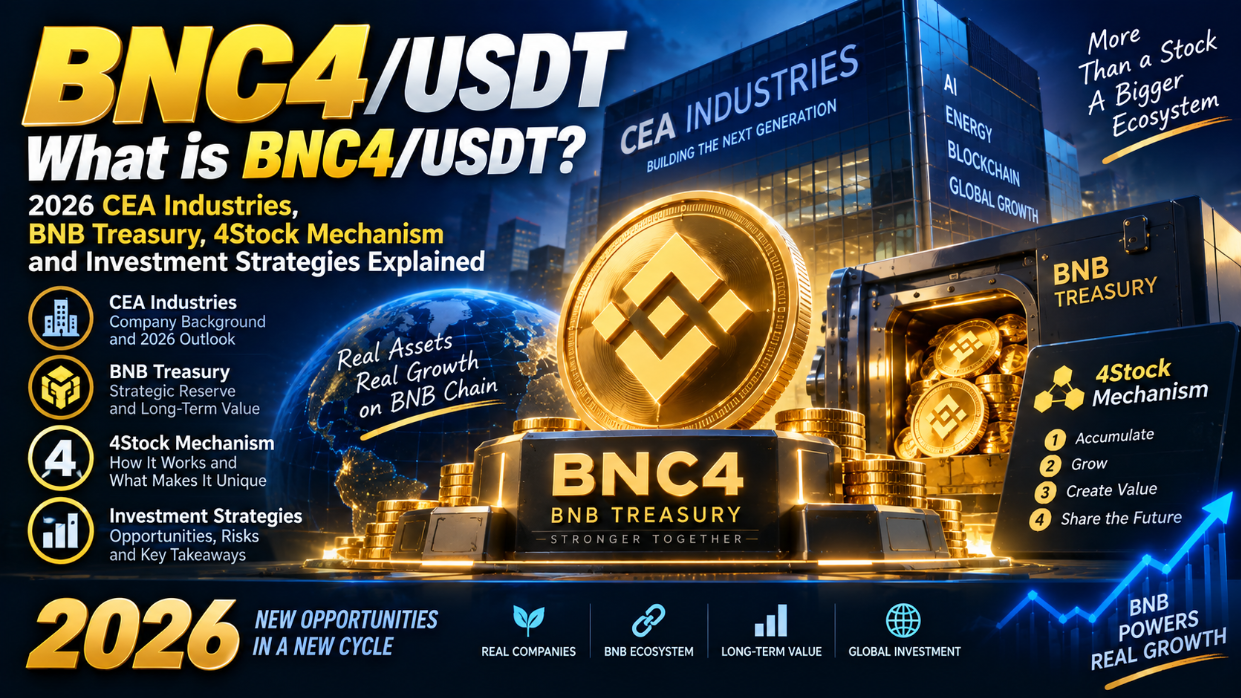
bStock is another tokenized-stock product concept. Documents describe BNC4 as pre-bStock and refer to future conversion arrangements, but any conversion timing, ratio, eligibility, and legal effect should wait for formal terms. A “planned conversion” should not be treated as an already implemented redemption guarantee.
The most practical approach is this: do not look only at the ticker. Check the issuance structure, underlying security, network, contract, custodian, and redemption mechanism item by item.
3. Does BNC4 Really Have 1:1 Stock Backing?
According to Four.Meme’s public product description, after users submit USDC and pass an application, the platform uses a dedicated management account to purchase the corresponding underlying stock and then mints 4Stock based on the actual number of shares purchased. This creates the product logic of “1 BNC4 corresponds to 1 unit of BNC underlying exposure.”
But “the official statement says it is 1:1 backed” and “investors already have an unconditionally enforceable right to redeem 1:1 for stock” are not the same thing. To judge whether this backing is reliable, at least five questions must be answered:
- Which legal entity holds the underlying BNC stock?
- Who is the custodian and broker?
- Is the reserve continuously attested by an independent third party?
- Are the underlying shares segregated from the operating entity’s other debts?
- If the issuer, platform, or custodian runs into trouble, what priority and enforcement rights do BNC4 holders have?
Therefore, this article describes the 1:1 backing as Four.Meme’s product-mechanics claim, not as this article’s independent guarantee of reserves, custody, or legal enforceability. Investors should review the latest terms, proof of reserves, and eligible-region requirements.
4. How Is BNC4 Minted? Why Do Small Users Rely More on the Secondary Market?
The currently disclosed minting process is not like an automated AMM swap. Applicants must submit at least 10,000 USDC and pay a 1% Mint Fee. The platform then purchases the underlying stock in batches and mints BNC4 based on the actual executed quantity. Normal processing time is about 24 hours, but actual speed may be affected by U.S. equity trading hours, order execution, and review.
This means most small users will not participate directly in primary minting. Instead, they will buy BNC4 through Hibt or on-chain markets. There is a threshold and a time gap between the primary and secondary markets, which can produce three outcomes:
- When BNC4 demand suddenly rises, the secondary-market price may exceed the BNC reference price.
- When BNC falls or on-chain liquidity is insufficient, BNC4 may trade at a discount.
- During violent market swings, market-making and arbitrage capital may not be able to close the deviation immediately.
The minimum minting threshold, fees, and manual processing are not minor details. They directly affect how quickly the BNC4 premium can be arbitraged away.
5. Why Is “Redemption Coming Soon” More Important Than the 1:1 Claim?
Underlying backing determines theoretical value. The redemption channel determines whether price deviations can be arbitraged.
Suppose BNC stock is $6 and BNC4 falls to $5. If investors can immediately redeem 1 BNC4 for 1 BNC share or equivalent cash, arbitrageurs have an incentive to buy the discounted BNC4, complete redemption, and sell the underlying asset. The discount would normally be constrained.
If redemption is not yet open, that loop is incomplete. The discount may persist, and holders cannot assume they can exchange back into stock at any time merely because of “1:1 backing.” Conversely, when BNC4 trades at a high premium, the 10,000 USDC threshold, 1% fee, and processing time also limit how quickly supply can enter the market.
Therefore, investing in BNC4 requires continuously checking: whether redemption is actually live, who is eligible to redeem, whether redemption pays stock or cash, what the fees are, how long it takes, and what regional and KYC restrictions apply.
6. How Do You Calculate the BNC4 Premium? What Does a 50% Premium Mean?
The simple premium of BNC4 relative to BNC can be expressed as:
BNC4 Premium = BNC4 Price ÷ BNC Reference Price - 1
For example, if BNC is $6 and BNC4 is $9, the headline BNC4 premium is 50%. This does not mean BNC4 “should” immediately fall back to $6, but investors must understand that of the $9 they paid, only $6 came from the underlying stock reference price at that time. The other $3 comes from on-chain scarcity, trading time gaps, liquidity, or market sentiment.
When calculating, also pay attention to currency, timestamp, and trading session. BNC4 is quoted in USDT, while BNC is quoted in USD. USDT usually trades close to USD, but it is not without depeg risk. If you compare the previous U.S. equity close with the weekend BNC4 live price, what you get is only a “time-gap basis,” not necessarily a risk-free arbitrage opportunity.
If the reason to buy is simply a bullish view on BNB or BNC, while BNC4 already carries a large additional premium, buying BNB directly or holding BNC where compliant may be a structurally simpler expression of that view.
7. Why Does BNC4 Deviate More Easily from BNC When U.S. Markets Are Closed?
BNC is constrained by NASDAQ trading hours, while BNC4 can continue trading on supported crypto markets. On weekends, at night, or during U.S. market holidays, if BNB moves sharply, BNC4 may price in expectations first.
This cuts both ways. On one hand, BNC4 gives crypto users a longer trading window. On the other hand, because the underlying stock is not trading at the same time, price is mainly determined by the BNC4 order book. After U.S. markets reopen, BNC will reabsorb BNB moves and company news, and the previous BNC4 premium may either widen or disappear quickly.
Therefore, seeing BNC4 rise on a weekend does not immediately mean BNC stock has risen in sync. Seeing BNC4 trade at a discount does not guarantee that an executable arbitrage will exist after the U.S. market opens. This is after-hours or weekend basis risk.
8. What Is CEA Industries? Why Has Its Core Shifted to a BNB Treasury?
CEA Industries still owns Canadian retail and vaping-related businesses, but its balance sheet has fundamentally changed. The company’s fiscal 2027 first-quarter materials filed with the SEC show that, as of July 31, 2026:
- It held 515,544 BNB, with a fair value of approximately $302.3 million.
- Of that, 471,346 BNB were unrestricted, while 44,198 BNB were pledged as loan collateral.
- Including BTC and USDT, total digital assets were worth approximately $304.5 million.
- Digital assets accounted for 93.1% of total assets.
- Retail and industrial business quarterly revenue was $7.2 million.
These figures come from CEA Industries’ quarterly results materials filed with the SEC. When digital assets account for more than 90% of total assets, traditional retail revenue is no longer the primary driver of BNC’s valuation. A more reasonable analytical framework is: first calculate digital asset net asset value, then assess debt, operating businesses, management expenses, governance, and potential dilution.
9. What Does 515,544 BNB Mean?
The number of BNB held determines the company’s asset sensitivity to BNB price. If BNB changes by $1, ignoring taxes, liabilities, and other accounting items, the fair value of the 515,544 BNB position changes by approximately $515,500.
But not all holdings should be viewed as completely free and available. The company disclosed that 44,198 BNB were pledged as loan collateral against a $15 million USDC drawdown; the collateral value at period end was approximately $25.9 million. If BNB falls sharply, the company may face collateral-ratio management, additional collateral posting, debt repayment, or liquidity pressure.
In addition, growth in total holdings does not necessarily increase value per share. If the company issues a large number of new shares to raise funds and buy BNB, total BNB may rise, but BNB per share may actually fall. For existing shareholders and BNC4 investors, BNB per share is more important than total BNB holdings.
10. Why Are BNC’s Profits Heavily Affected by BNB Price?
CEA Industries recorded a $11.4 million net loss in that quarter, mainly due to a $15.3 million unrealized loss on digital assets, of which about $15 million came from BNB. At the same time, it recorded a $10 million non-cash gain from the change in fair value of warrant liabilities.
This shows that traditional EPS can be significantly distorted by fair-value accounting for digital assets and derivative warrants. BNB gains may create large unrealized gains, while BNB declines may create large paper losses, even if the retail business itself changes little.
When analyzing, separate the metrics:
- For the traditional business, look at revenue, gross margin, and operating cash burn.
- For the treasury, look at BNB quantity, BNB per share, and fair value.
- For the capital structure, look at debt, warrants, buybacks, and share issuance.
- For final valuation, look at adjusted NAV and the mNAV multiple the market assigns.
11. How Should BNC’s NAV and mNAV Be Calculated?
A simplified adjusted NAV framework is:
Adjusted NAV = BNB + BTC + USDT + Cash + Other Identifiable Assets - Debt - Other Liabilities
Then calculate:
NAV per Share = Adjusted NAV ÷ Adjusted Shares Outstanding
mNAV = BNC Market Cap ÷ Adjusted NAV
An mNAV above 1 means the market is willing to pay a premium for the listed-company access, future BNB accumulation, management ability, financing capacity, or ecosystem benefits. Below 1, it may reflect expenses, governance, litigation, dilution, debt, or market concerns about asset liquidity.
This is not a permanently precise formula. The retail business may have positive or negative value, and taxes and liquidation costs may affect actual realizable net value. But compared with looking only at P/E, NAV and mNAV are closer to BNC’s current economic structure.
12. Why Must Three Share Counts Be Distinguished?
As of July 31, 2026, the company’s common shares outstanding at period end were 41,173,850. However, the SEC filing also disclosed 7,750,510 pre-funded warrants and 3,564,362 strategic advisor warrants, with exercise prices close to zero. Adding these, common stock and common stock equivalents totaled 52,488,722 at period end.
The company also has 49,504,988 Stapled Warrants with an exercise price of $15.15, asset manager warrants, public warrants, RSUs, options, and convertible notes. If all in-the-money and out-of-the-money potential shares were mechanically included, potential total shares at period end could reach approximately 103.9 million. Details can be checked in CEA Industries’ Form 10-Q.
The three counts answer different questions:
- 41,173,850 shares are suitable for describing already issued common stock.
- 52,488,722 shares are better for reflecting economic interests that can become common stock at near-zero cost.
- Approximately 103.9 million shares is an extremely conservative fully diluted observation value, but whether out-of-the-money warrants are exercised depends on future share prices and terms.
Therefore, Basic NAV per share may be significantly higher than NAV per share under economic-equivalent or fully diluted counts. Choosing only the smallest denominator will overstate asset value per share.
13. When Do Buybacks and Share Issuance Create Value?
During the quarter, the company repurchased and canceled 1,434,112 shares at an average price of $2.63 per share, spending approximately $3.8 million. If BNC trades significantly below NAV per share and the company has sufficient liquidity, buying back at a low price may reduce the denominator and increase remaining shareholders’ BNB per share and NAV per share.
Share issuance should be viewed in reverse. If BNC trades at 2x NAV, the company may theoretically increase NAV per share by issuing new shares at a high premium and using the proceeds to buy BNB. If BNC is below NAV and still issues shares on a large scale, it will often dilute existing shareholders.
So the key metric for a Digital Asset Treasury company is not “how much more BNB did it buy,” but:
BNB per Share = Company BNB Holdings ÷ Adjusted Shares Outstanding
As long as the denominator grows faster than BNB holdings, a headline saying “treasury expanded” may not translate into growth in per-share value.
14. Why Can’t Debt, Governance, and Litigation Be Ignored?
At period end, CEA Industries had total debt of $16.8 million, with 44,198 BNB partially securing the loan. The company disclosed at the time that it was in compliance with debt covenants, but that does not mean there will be no collateral-management risk in the future if BNB falls.
On governance, the company reached a cooperation arrangement with YZi Labs in June 2026. Ling “Ella” Zhang, Alex Odagiu, and Matthew Roszak joined the board, and the previous shareholder-activism dispute ended. This change may improve strategic coordination, but it also brings management transition and execution uncertainty. YZi Labs’ involvement should not be treated as an investment endorsement.
The company is also challenging the Asset Management Agreement, seeking a declaration that the agreement is void from the outset or that its liquidated-damages provisions are unenforceable. The litigation was still ongoing when the results materials were published. Its outcome may affect management fees, potential damages, and governance assessment, so it is a contractual risk that must be valued separately from NAV.
15. Is BNC4 a High-Beta BNB Asset?
BNC4 may show high sensitivity to BNB, but beta is not a fixed constant. The price transmission can be expressed as:
BNB Price → BNC Net Assets → BNC mNAV → BNC4 Premium to BNC
When BNB rises, BNC net assets increase. If the market simultaneously raises BNC’s mNAV, BNC shares may rise more than BNB. If on-chain capital then pushes up the BNC4 premium, BNC4’s gain may be amplified further.
The same works on the downside. A 20% drop in BNB does not mean BNC4 will fall only 20%. If BNC’s mNAV compresses from 1.5x to 1x while BNC4’s 30% premium disappears, BNC4 could experience a drawdown far larger than BNB’s. This can be called “reflexive amplification without explicit leverage”: there is no perpetual-contract liquidation, but multiple valuation layers can contract at the same time.
Investors can observe an experimental metric:
BNC4 Effective BNB Beta = BNC4 Period Return ÷ BNB Period Return
But this is meaningful only over the same time window, with sufficient liquidity, and over a longer sample. Short-term single-day ratios are easily distorted by time gaps and premiums.
16. What Is BNC4’s Role in the Stock Meme Ecosystem?
The 4Stock product design does not emphasize only stock-price mapping. It also aims to make BNC4 a base asset for Stock Meme trading pools. For example, a community Stock Meme could form a liquidity pool with BNC4, connecting meme trading with the BNC stock narrative.
This makes BNC4 different from a tokenized stock simply sitting in a wallet, but it also increases the influence of on-chain supply and demand on price. One important correction: Four.Meme’s related “daily buyback and burn” arrangement does not mean BNC4 itself is bought back and burned every day. The public activity description is closer to this: using related trading or liquidity revenue to buy back and burn eligible community Stock Meme Tokens that use BNC4 as a pool asset.
Therefore, “BNC4 Revenue Buyback” should not be shortened to “BNC4 buyback.” Mistaking buying pressure for other tokens as BNC4 value capture will lead to incorrect valuation conclusions.
17. What Is the Difference Between BNC4, RDDTB, and XIAOMIUSD?
The asset introduced in What Is RDDTB? belongs to the bStocks-related system, while BNC4 belongs to the 4Stock or pre-bStock stage. Even if both provide stock-related exposure on BSC, their issuers, legal structures, minting and redemption, custody, and conversion arrangements may differ. “Same chain” should not be treated as “same product.”
What Is XIAOMIUSD? is more suitable for understanding the difference between spot tokenized assets and stock derivatives. By product design, BNC4 is a transferable on-chain spot-type asset and does not include user-elected leverage, funding rates, or liquidations. X-Perp-type products typically involve margin, leverage, funding, and liquidation. Tokenized Spot does not equal Stock Derivative, and the risk models are completely different.
18. How Do BTC and ETH Affect BNC4?
BTC price prediction mainly reflects overall crypto risk appetite, dollar liquidity, and the market deleveraging environment. A BTC rise may increase on-chain asset trading activity, but it does not directly increase the number of BNB held by CEA Industries. For BNC4, BNB is the direct core variable of the balance sheet.
BNC4 runs on BNB Smart Chain, not Ethereum. ETH price prediction is better used as a comparison variable for the health of RWA, tokenized securities, and on-chain financial markets. A rise in ETH does not mean BNC4’s underlying net value rises, but it may affect capital’s valuation and liquidity preference for the on-chain equity sector.
19. BNC4 Price Prediction Should Use a Three-Layer Model
Predicting a target price based only on the BNC4 candlestick chart easily ignores changes in the underlying. A more reasonable conceptual model is:
BNC4 Scenario Value ≈ BNC Adjusted NAV per Share × BNC mNAV × BNC4 Premium Factor
Where:
- The first layer is the BNB scenario, which determines most of the digital asset treasury’s net value.
- The second layer is BNC mNAV, reflecting how much valuation multiple the market is willing to give the treasury company.
- The third layer is the BNC4 premium factor, reflecting minting, redemption, trading hours, and on-chain liquidity.
Investors can refer to BNC4 price prediction to observe technical trends, but technical models cannot replace analysis of underlying NAV and product structure.
Bull Case: All Three Layers Improve Together
The optimistic scenario requires BNB to keep rising, BNC to increase BNB per share, issuance to remain accretive, buybacks to be effective, debt and litigation risk to decline, and governance to stabilize. At the same time, BNC4’s 1:1 reserves remain continuously verifiable, redemption officially launches, trading depth improves, and the premium does not expand excessively.
In this case, BNC4 may benefit simultaneously from BNB gains, BNC valuation re-rating, and on-chain demand. But the more it depends on multiple expansion, the more easily it can reverse-amplify during a drawdown.
Base Case: Net Value Changes Slowly, Premium Gradually Normalizes
The neutral scenario is that BNB trades in a wide range or rises modestly, CEA maintains its current holdings, BNB per share changes little, and BNC maintains a relatively stable mNAV. BNC4 still has some trading-convenience premium, and redemption gradually launches.
In this case, BNC4’s long-term return is closer to changes in BNB net value and the results of BNC’s capital allocation, rather than continuing to rely on new-product hype.
Bear Case: All Three Layers De-Rate Together
The pessimistic scenario includes a sharp BNB decline, rising loan-collateral pressure, falling BNC net value, stock mNAV compression, low-price share issuance or warrant dilution, and worsening governance and litigation. At the same time, BNC4 redemption is delayed, reserve transparency is insufficient, the premium disappears, and liquidity declines.
The greatest danger is not a single variable weakening, but BNB, BNC, and BNC4 all contracting at the same time.
20. What Investment Strategies Suit BNC4?
Short-Term Trading: Focus on Premium and Time Gaps
Short-term traders should open BNB, BNC, and BNC4 quotes at the same time and check whether U.S. markets are open, the BNC4/BNC spread, volume, bid-ask depth, and USDT deviation. On weekends and after major news, the previous BNC close should not be treated as real-time fair value.
Medium-Term Strategy: Track BNB per Share and mNAV
Medium-term investors should recalculate digital asset net value, share-count basis, BNB per share, debt, and mNAV after each earnings report. If BNC’s rise mainly comes from multiple expansion while BNB per share has not increased, the expectation has become more fragile.
Scaling In: Solve Structural Risk Before Talking About Price
Going all-in on a new product at once is especially dangerous. Investors can first use a small observation position to verify trading depth, deposits and withdrawals, contracts, and price tracking, then gradually adjust based on redemption progress, reserve transparency, and financial reports. Scaling in cannot eliminate losses; it can only reduce the impact of being wrong at a single point in time.
Position Limit: Work Backward from Maximum Acceptable Loss
Position size should not be determined by “how many times it could go up,” but by maximum acceptable loss, BNC4 depth, and potential slippage. BNC4 is simultaneously exposed to crypto, a single stock, and on-chain product risk, and is not suitable as a cash equivalent.
21. When Should You Admit the BNC4 Thesis Has Failed?
Any of the following deserves reassessment, rather than continuing to explain it away with “long-term growth of the BNB ecosystem”:
- 1:1 underlying backing cannot be continuously verified.
- BNC4 supply clearly does not match the verifiable number of underlying shares.
- Redemption remains unavailable for a long time or its terms are significantly weaker than market expectations.
- The BNC4 premium over BNC becomes abnormally large and lacks an effective arbitrage channel.
- CEA’s BNB per share continues to decline.
- The company issues a large number of new shares below NAV.
- BNB enters a clear long-term downtrend, increasing collateral pressure.
- AMA litigation, governance, or internal-control risk worsens significantly.
- Hibt or DEX trading depth continues to decline, and exit slippage rises rapidly.
The best reason to sell or reduce is that the original value chain has broken, not merely because price fell on a particular day.
22. HIBT BNC4 Ten-Factor Research Framework
Researching BNC4 can be summarized into ten consecutive checks:
- BNB Price: Determines the bottom-layer digital asset value.
- BNB Holdings: Whether 515,544 BNB increases or decreases.
- BNB per Share: Whether treasury growth truly benefits each share.
- BNC Adjusted NAV: How much value remains after debt and liabilities.
- BNC mNAV: How much stock-level premium the market is paying.
- Dilution and Buybacks: Whether the denominator is expanding or shrinking.
- BNC4 Reserve Backing: Whether the 1:1 claim can be continuously verified.
- Mint and Redemption: Whether two-way arbitrage is open.
- BNC4/BNC Premium: How far the on-chain price deviates from the underlying.
- Market Liquidity: Whether investors can exit near the displayed price.
The four most worth tracking over the long term are: BNB per share, BNC mNAV, BNC4 premium, and Redemption status. They correspond to underlying quality, stock valuation, wrapper-layer pricing, and arbitrage efficiency.
23. The 15 Biggest Risks of BNC4
- BNB Price Risk: The most core underlying variable may fall sharply.
- Treasury Concentration Risk: Digital assets account for 93.1% of BNC’s total assets.
- BNC Stock Risk: BNC is an operating company and treasury company, not a BNB ETF.
- mNAV Compression Risk: The stock premium the market gives BNC may disappear.
- Dilution Risk: Pre-funded warrants, advisor warrants, and other potential shares can reduce NAV per share.
- Debt and Collateral Risk: Some BNB has been pledged as loan collateral.
- Governance Risk: The board and management are still in a transition phase.
- Litigation Risk: The AMA dispute has not been finally resolved.
- Issuance and Operational Risk: Manual purchases, batch minting, and corporate-action processing may make errors or be delayed.
- Custody Risk: The legal and operational security of the underlying stock management account needs continuous verification.
- Redemption Risk: As of this article’s update, a fully open exit loop has not yet been formed.
- Premium/Discount Risk: BNC4 may deviate from BNC reference value for a long time.
- Liquidity Risk: Displayed price does not equal the price at which a large order can be filled.
- Smart Contract and BSC Risk: The on-chain token adds technical risks that traditional stocks do not have.
- Regulatory and Eligibility Risk: Tokenized-securities rules, regional restrictions, and platform policies may still change.
24. How to Buy BNC4: Complete These 12 Checks Before Trading
If users decide to trade BNC4/USDT through Hibt, they can first register or log in, prepare USDT, search for BNC4/USDT, and then choose a limit order or market order based on their needs. But before placing an order, it is advisable to complete the following checks:
- Whether the network is BSC.
- Whether the contract is
0x7C8D5502b544dDAf8852Fc46D1174E34876D545C. - The current BNC4 price and the most recent tradable BNC price.
- Whether U.S. markets are currently open.
- The BNC4/BNC premium or discount.
- BNB’s intraday and weekend trend.
- Hibt order-book depth and bid-ask spread.
- Estimated slippage for a large order.
- BNC’s latest share count and potential dilution.
- BNC’s latest BNB holdings and debt.
- The latest status of BNC4 minting and redemption.
- The maximum loss you can bear.
For tokenized stocks, price should come after verifying asset identity, underlying value, and exit mechanisms, not first.
25. FAQ: The Most Common Questions About BNC4
What is BNC4?
BNC4 is an on-chain asset in the Four.Meme 4Stock system related to CEA Industries (NASDAQ: BNC), running on BNB Smart Chain. It is not BNB, nor is it an ordinary meme coin.
What does BNC4/USDT mean?
It means BNC4 is priced and traded in USDT. USDT is only the settlement asset and does not change the relationship between BNC4’s underlying, BNC stock, and the BNB treasury.
What stock does BNC4 correspond to?
BNC4 corresponds to economic exposure to the BNC common stock of CEA Industries Inc. traded on NASDAQ.
Does buying BNC4 equal directly buying BNC stock?
Not exactly. The two prices should be highly correlated, but the holding channel, legal structure, custody, voting rights, corporate actions, redemption, trading hours, and regulatory environment are different.
What is the difference between BNC4 and 4STOCK?
BNC4 is a BNC-related 4Stock product; 4STOCK may refer to an independent meme token with the same name. A rise in 4STOCK does not mean BNC4’s underlying net value has risen.
Is BNC4 a bStock?
Public materials describe it as 4Stock or pre-bStock. Future conversion arrangements should be governed by formal terms. An expected conversion should not be treated as an already open redemption right.
Does BNC4 have real 1:1 stock backing?
Four.Meme’s product mechanics claim 1:1 purchase and backing of the underlying stock. But investors should also verify the custodian, proof of reserves, bankruptcy remoteness, and legal enforcement rights. An official statement is not the same as an independent audit guarantee.
Why can BNC4 be more expensive than BNC?
It may come from on-chain scarcity, minting thresholds, trading time gaps, liquidity, and speculative demand. Because redemption has not yet formed a complete loop, the premium may not disappear immediately.
Why is BNC highly correlated with BNB?
As of July 31, 2026, CEA Industries held 515,544 BNB, and total digital assets accounted for 93.1% of total assets. Therefore, BNB price is the main variable in BNC’s net asset value.
Can BNC4 be withdrawn?
Hibt’s announcement shows that BNC4 withdrawals opened on September 19, 2026, at 16:00 (UTC+8). But withdrawing from a trading platform to an on-chain wallet is not the same as redeeming the underlying stock from the issuer. The two must be distinguished.
Is BNC4 worth holding long term?
This depends on BNB’s long-term performance, whether CEA can increase BNB per share, whether BNC’s mNAV is reasonable, and whether BNC4 reserves, redemption, and liquidity can improve. “1:1 stock backing” alone is not enough to justify a long-term holding conclusion.
What should BNC4 price prediction focus on most?
At minimum, look simultaneously at BNB price, BNC adjusted NAV, share dilution, BNC mNAV, BNC4/BNC premium, and redemption status, rather than only BNC4’s own candlestick chart.
26. Conclusion: Stock Backing Does Not Mean There Is Only One Layer of Risk
BNC4 is different from an ordinary meme token. Four.Meme defines it as a 4Stock asset and says each BNC4 is 1:1 backed by actually purchased CEA Industries stock. Hibt has also opened BNC4/USDT trading. But the product is still at an early stage: primary minting has a 10,000 USDC threshold, a 1% fee, and a manual processing workflow, while redemption is still labeled “Coming Soon” as of this article’s update.
More importantly, the underlying BNC itself is not a traditional operating stock. As of July 31, 2026, CEA Industries held 515,544 BNB, with digital assets worth approximately $304.5 million, accounting for 93.1% of total assets. Therefore, BNC’s core value is highly dependent on BNB price, BNB per share, debt, dilution, capital allocation, and the mNAV the market gives to treasury companies.
The real question when investing in BNC4 is a three-layer question:
- What is BNB worth, and where is it in its cycle?
- How much net asset value does each BNC share correspond to, and how much mNAV premium is the stock currently paying?
- How much on-chain premium is BNC4 paying relative to BNC, and can minting and redemption constrain it?
When all three layers expand at the same time, BNC4 may show very high sensitivity. When BNB falls, BNC mNAV contracts, and the BNC4 premium disappears at the same time, its drawdown may also significantly exceed investors’ intuitive expectations based on “1:1 stock backing.”
Therefore, judging whether BNC4 is worth researching should not stop at “does it have real stock backing?” It should ask: How much is the backing BNC stock itself worth, and how much additional premium is BNC4 currently paying for this on-chain wrapper?