
ORBIO is an AI inference economy token running on Robinhood Chain. It was initially launched through Pons and chose tokenized NVDA as its quote asset. The project later began converting a portion of ORBIO trading fees into OpenRouter AI usage credits, and in late September 2026 it launched an on-chain CREDIT protocol that allows AI credits to be staked for yield, transferred, traded, or activated into an Orbio Gateway balance.
HIBT opened ORBIO/USDT trading on September 22, 2026. The correct contract is 0xAa07A0e9209e16aC99708C3EC70159c6eF3128A3. However, ORBIO is not an NVIDIA stock token, and holding ORBIO does not give holders NVIDIA equity, dividends, or stock redemption rights.
The value chain truly worth studying for ORBIO is:
ORBIO trading → protocol fees → AI inference budget → holders or stakers receive CREDIT → CREDIT is traded or activated → real calls are made to models such as Claude, GPT, and Gemini.
This chain has a verifiable product usage layer that ordinary “AI concept coins” lack, but the project is still early. What determines ORBIO’s long-term value is not “AI is the future,” but whether, beyond token speculation, developers, users, and AI agents are still willing to buy and consume CREDIT.
Risk Disclosure: This article is current as of September 29, 2026. It is intended for market research and investment education only and does not constitute investment advice, a promise of returns, or a trading recommendation. ORBIO, CREDIT, and related smart contracts have been live for only a very short time and may face price, liquidity, contract, upstream service, regulatory, and mechanism-change risks.
Key Takeaways: Nine Things to Know Before Investing in ORBIO
- ORBIO runs on Robinhood Chain, whose Chain ID is 4663, and uses ETH to pay gas.
- The correct ORBIO contract is
0xAa07A0e9209e16aC99708C3EC70159c6eF3128A3. - ORBIO was initially launched through Pons, with a supply of about 950 million tokens, paired with tokenized NVDA.
- ORBIO is not an NVIDIA stock token. A paired asset does not equal underlying collateral or company endorsement.
- Official legacy mechanics show that each ORBIO trade charges a 1.5% fee, 50% of which is converted into holder AI credits—equal to about 0.75% of trading volume.
- The new CREDIT protocol allows users to stake ORBIO to earn CREDIT. One CREDIT represents $1 of Orbio AI usage credit, but it is not a stablecoin redeemable for $1.
- Once activated, CREDIT is burned and converted into a non-transferable AI balance that cannot be redeemed for cash.
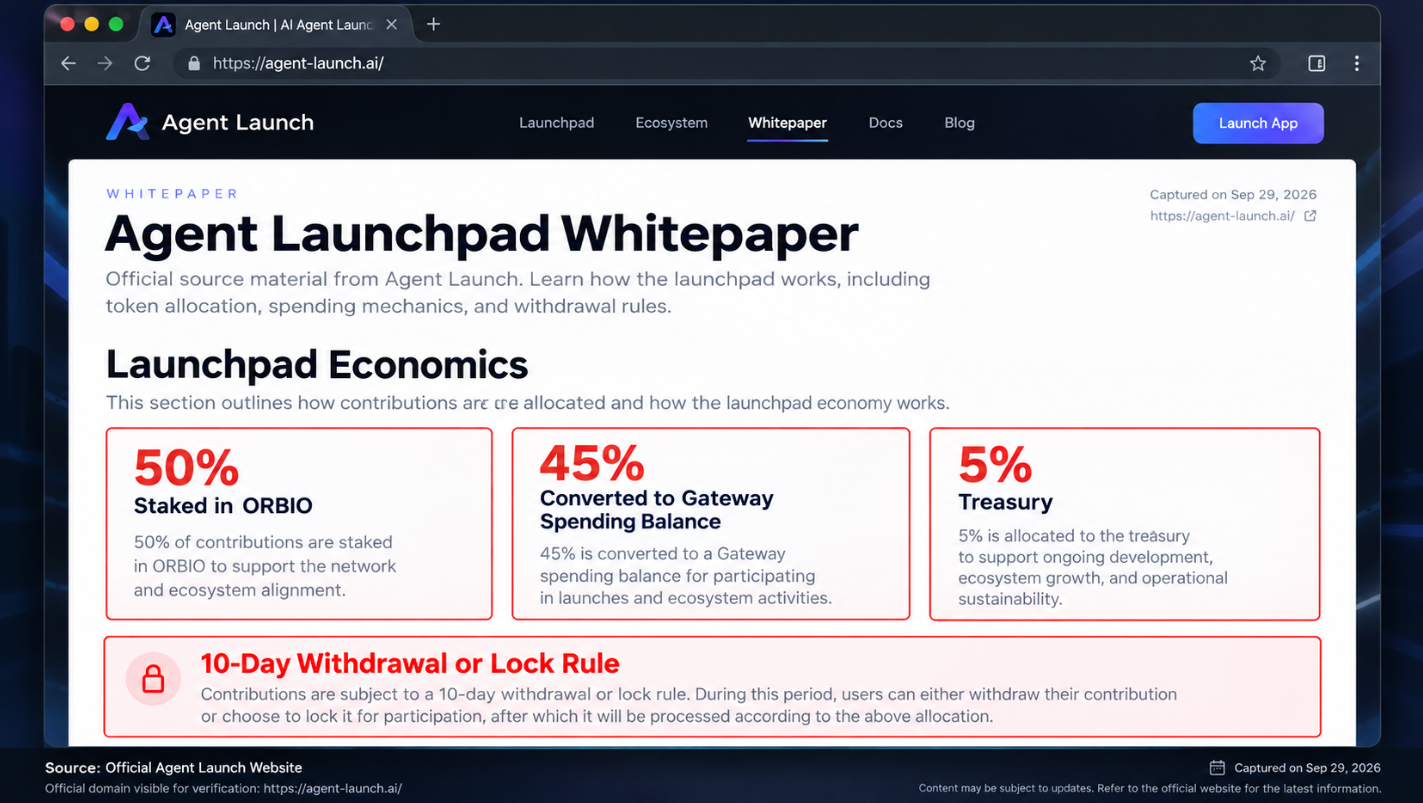
- The latest Agent Launchpad whitepaper splits Creator Fees into 50% staking ORBIO, 45% converted into Agent spending balance, and 5% going to Treasury—not 95% all staked.
- ORBIO’s long-term fundamentals depend on real CREDIT activation volume, external AI buyers, Agent usage, and fee coverage, not just ORBIO trading volume.
1. What Is ORBIO/USDT?
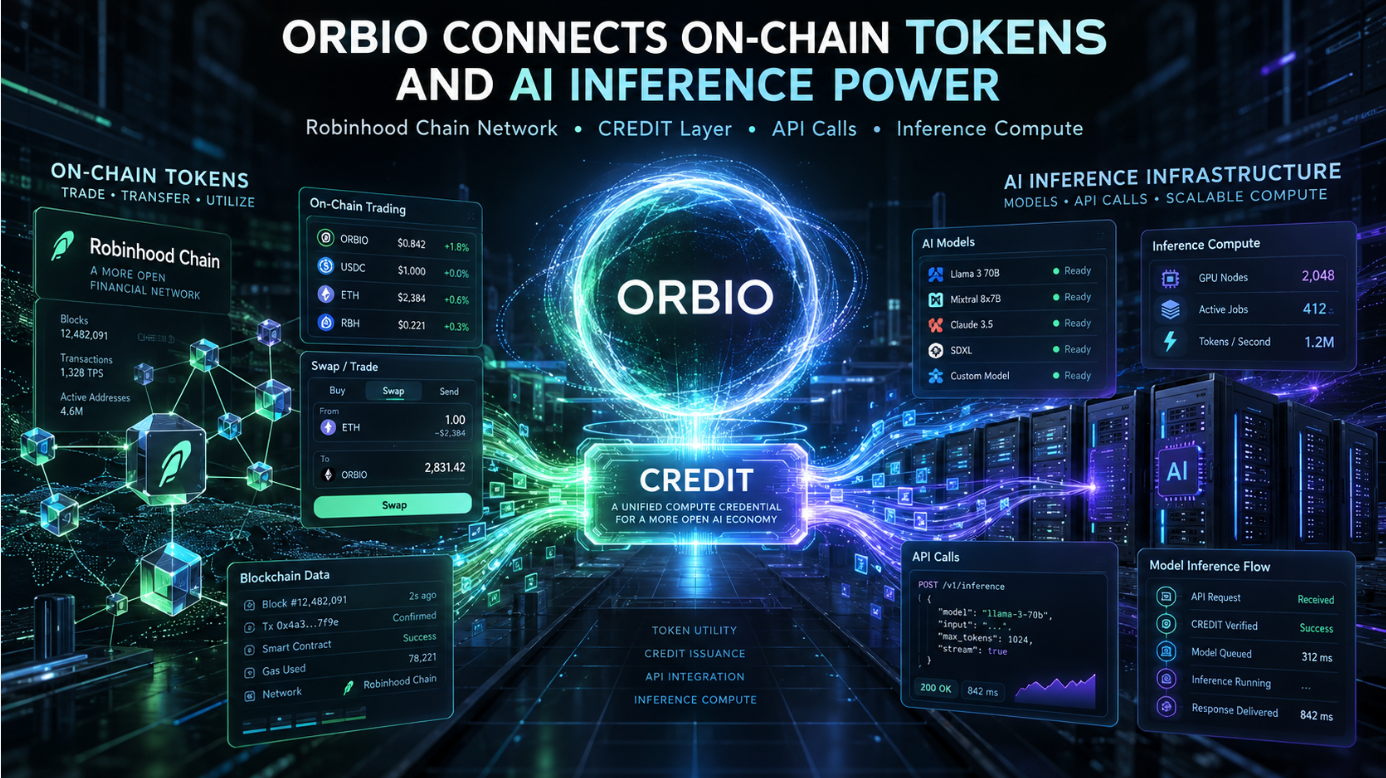
ORBIO is the native token of the Orbio.so ecosystem, running on Robinhood Chain. According to the HIBT listing announcement, ORBIO/USDT opened for trading on September 22, 2026, at 12:00 UTC+8.
ORBIO Basic Information
- Project: Orbio.so
- Token: ORBIO
- Network: Robinhood Chain
- Chain ID: 4663
- Gas Token: ETH
- Contract:
0xAa07A0e9209e16aC99708C3EC70159c6eF3128A3 - Launch platform: Pons
- Original quote asset: Tokenized NVDA
- Supply: 949,999,905 ORBIO
- Supply status: Pons page marks it as fixed at launch
- Initial market: Uniswap v4
- Primary use: Hold or stake to obtain AI usage credits, participate in the CREDIT economy, and engage with Agent Launchpad
A dynamic snapshot of the Pons page on September 29, 2026, showed that ORBIO’s market cap had reached the tens of millions of dollars. Real-time price, volume, and market cap change continuously. Investors can view the latest market data through ORBIO live quotes.
2. Is ORBIO an AI Coin, Meme Coin, or Infrastructure Token?
ORBIO’s positioning has evolved significantly.
In the launch phase, it was closer to a fair-launch token with AI and NVDA narratives. The project has a very short operating history, and its price was mainly driven by the new chain, AI, tokenized stocks, and market attention—giving it meme-like asset characteristics.
In the product phase, Orbio began converting trading fees into OpenRouter credits, linking token holding behavior with AI usage rights.
In the protocol phase, the project launched CREDIT, ORBIO staking, an on-chain order book, activation and burning, AI Gateway, and Agent Launchpad, attempting to build a complete economic model of “fees—inference budget—AI consumption.”
A more accurate positioning is therefore:
ORBIO is an early-stage project transitioning from an AI narrative token to an AI inference utility token.
This does not mean it has already become mature AI infrastructure. Real infrastructure value needs to be proven by a stable Gateway, real usage, external paying users, sustainable fees, and long-term contract security.
3. Why Is ORBIO Paired with Tokenized NVDA?
The Pons launch page shows that ORBIO was initially paired not with USDT or ETH, but with tokenized NVDA. This allowed it to connect four narratives at once: AI, NVIDIA, stock tokens, and Robinhood Chain.
But it must be made clear:
ORBIO/NVDA pair does not mean ORBIO is backed by NVIDIA stock.
ORBIO has not publicly disclosed the following rights:
- Ownership of NVIDIA common stock;
- NVIDIA shareholder voting rights;
- Rights to NVIDIA dividends;
- The right to redeem 1 ORBIO for a fixed number of NVDA shares;
- NVIDIA investment in or official endorsement of the Orbio project.
Tokenized NVDA is only the quote asset in ORBIO’s launch market and continues to play a role in some fee conversion routes under the new protocol. Pairing describes the trading structure, not asset collateral.
4. How Did the Legacy Hold-to-Earn Mechanism Work?
Orbio’s still-live holders page shows that the legacy mechanism required a wallet to hold at least 1,000 ORBIO and distributed AI credits based on time-weighted average balance.
Its main rules include:
- Minimum holding of 1,000 ORBIO;
- No traditional staking operation required;
- Balances are time-weighted, not based on a single snapshot;
- Holder ledger updates hourly;
- Balances below the threshold do not participate in that period’s distribution;
- Ordinary contracts such as LP, Treasury, Fee Escrow, Locker, and Burn addresses are excluded;
- EIP-7702 delegated smart accounts may still be treated as holders with actual control;
- Credits already earned can be spent through Orbio Key.
The essence of this mechanism is that holding wallets share OpenRouter usage credits purchased with trading fees according to relative weight, rather than receiving USDT or cash dividends.
Has the Old Mechanism Been Fully Replaced by CREDIT?
As of September 29, 2026, the legacy Hold-to-Earn page and the new Staking/CREDIT page are both still online. The old page continues to describe OpenRouter credits distributed according to wallet holdings, while the new page describes staking ORBIO and minting CREDIT.
Before the official team releases a clear migration announcement, the more rigorous judgment is: the project is expanding or migrating its reward architecture, but one cannot assume the old mechanism has stopped, nor can one assume both reward systems can be earned simultaneously or repeatedly. Users should confirm current applicable rules through the official Dashboard, contract state, and latest announcements.
5. How Does ORBIO’s 1.5% Trading Fee Become AI Credits?
The legacy official page clearly states that every ORBIO trade charges a 1.50% fee based on trading volume, with fees settled on-chain in Escrow. Fifty percent of the fee actually collected by the Treasury is converted at face value into OpenRouter Credits and distributed according to holders’ time-weighted balances.
Using $100 of trading volume as an example:
- ORBIO trading volume: $100;
- 1.5% total fee: $1.50;
- 50% used for holder AI credits: $0.75;
- The other 50% goes to Treasury or the protocol side: $0.75.
Therefore, the theoretical Holder Credit Rate under the legacy mechanism is:
AI Credits ÷ ORBIO Trading Volume ≈ 0.75%
This is also the most easily quantified part of ORBIO’s early tokenomics.
Note that the Pons page also lists a 0.80% Creator Tax, while the Orbio holders page describes total fees per trade as 1.50%. Different interfaces may show the Creator portion and the full protocol fee separately. Traders should not simply add 0.80% and 1.50% together. Actual trades may also include LP fees, price impact, and gas. The contract execution and quoted price of the specific pool should be treated as authoritative.
6. Why Are AI Credits Not a Dollar Dividend?
The HIBT announcement used the description “paid to holders in USD form,” which can easily lead newcomers to believe wallets will receive USD or USDT.
Orbio’s legacy official page is more accurate: Credits are USD-denominated product access credits, a Promotional Grant of Product Access, not an investment return, and cannot be directly redeemed for cash at face value.
Therefore, what ORBIO holders receive is:
USD-denominated AI usage rights, not USD cash dividends.
Users can consume credits through Orbio Key to call models supported by OpenRouter. Their value depends on whether users truly need AI services, whether the Gateway is stable, and how the same models are priced on other channels.
Calling AI credits a “Token Dividend” is not rigorous. Utility Distribution or Inference Credit Distribution is more appropriate.
7. What Is CREDIT and Why Is It ORBIO’s Most Important Upgrade?
The new protocol further tokenizes AI inference credits. The official page defines CREDIT as an on-chain asset that can be earned, held, transferred, sold, exchanged, or activated.
The basic path is:
Stake ORBIO → settle and mint CREDIT hourly → hold, sell, or transfer → activate CREDIT → token is burned → receive Orbio AI balance → call models or tools through Gateway.
CREDIT runs on Robinhood Chain, with the contract:
0xe33322da1380e61e5ae5dfb21e7f62924c73004c
The Staking contract is:
0xe0710011278bfb63e57c5f227e5980984b1eddca
The Order Book/Exchange contract is:
0x6951ffd32630b05e06f50062aea801625a58ebc0
Officially, 1 CREDIT can be activated into $1 of Orbio AI usage credit. Ownership and activation occur on-chain, while model calls and balance accounting are completed through Orbio Gateway and its upstream model providers.
8. Why Is CREDIT Not a Stablecoin?
One CREDIT represents $1 of AI usage value, but it does not equal a right to redeem $1 in cash.
The difference is:
- Stablecoins generally attempt to give holders monetary value or a redemption path close to $1;
- CREDIT provides a claim on Orbio services;
- Unactivated CREDIT can be transferred or traded;
- Activation permanently burns the token;
- Activated AI balances cannot be transferred again or redeemed for cash;
- AI services are subject to Gateway, model providers, availability, and pricing constraints.
CREDIT is therefore closer to a Service Claim or Tokenized Inference than a Cash Claim.
If Orbio services are interrupted, model coverage shrinks, or there are too few buyers in the market, the secondary market price may fall below $1 even if each CREDIT is still defined as $1 of AI usage.
9. Why Might CREDIT Trade at a Discount?
Unactivated CREDIT can be traded on the on-chain Order Book or in liquidity pools, where sellers set prices and buyers decide how much they are willing to pay.
Suppose CREDIT’s market price is $0.75 while activation gives $1 of AI usage credit. AI users are effectively buying inference services at a 25% discount.
A CREDIT Discount metric can be established:
CREDIT market price ÷ $1 AI usage value
At a price of $0.75, the ratio is 75%, corresponding to a 25% nominal inference discount.
Discounts may come from:
- ORBIO stakers wanting to cash out quickly;
- CREDIT supply growing faster than AI demand;
- The Orbio brand and Gateway still being early;
- Buyers worrying about service or contract risk;
- Upstream models having other discount channels;
- Insufficient secondary market liquidity.
A larger discount is not always better. A moderate discount can attract AI users, but a severe long-term discount may indicate that sellers far outnumber real users.
10. Who Will Buy CREDIT?
Potential demand for CREDIT is not limited to ORBIO holders. It also includes:
- Claude Code, Codex, or Cursor users;
- AI programming tool developers;
- Research Agents;
- Data collection and monitoring Agents;
- Multi-Agent collaboration systems;
- SaaS products using OpenAI-compatible APIs;
- Automation applications needing models, search, scraping, and on-chain data services.
The truly important metric is not total Holder count, but External CREDIT Buyers: how many external users who did not receive CREDIT through ORBIO rewards are willing to use USDG or other assets to buy and activate CREDIT.
If the market is mainly stakers trading among themselves, demand is still stuck in a crypto internal loop. If external developers and Agents keep buying and consuming, the project is beginning to form Product-Market Fit.
11. Which Models Does CREDIT Actually Connect To?
The Orbio protocol page states that CREDIT can access more than 400 models through Gateway and lists model families such as Claude, GPT, and Gemini. The legacy page says Orbio Key can use models routed by OpenRouter.
Three roles must be distinguished here:
- Model providers train and run models;
- OpenRouter or other Providers handle model aggregation, routing, and billing;
- Orbio handles CREDIT, Gateway, balances, authentication, and the usage entry point.
Orbio does not claim to train Claude, GPT, or Gemini itself. What it provides is access, settlement, and an on-chain inference asset layer.
Model names and versions change quickly. For actual calls, the list returned by Gateway’s /api/v1/models should be treated as authoritative. A model listed on a marketing page should not be understood as permanently guaranteed.
12. What Does Dependence on OpenRouter and Model Providers Mean?
Depending on upstream services has clear advantages: Orbio does not need to bear the enormous capital expenditure of training large models itself, can quickly connect to multiple models, and is compatible with existing OpenAI or Anthropic toolchains.
But it also brings risks:
- Upstream APIs may be interrupted;
- Models may be delisted or restricted by region;
- Providers may change account policies;
- Model prices may rise;
- Rate limits may change;
- Settlement accounts between Orbio and Providers may be restricted;
- Data privacy and logging policies may change.
The new Agent documentation clearly states that on-chain ownership and trading of CREDIT do not equal permanent availability of AI services; inference and balance accounting remain subject to the availability and pricing of Orbio Gateway and model providers.
13. Can the “Compute” Bought by 1 CREDIT Change?
Yes.
One CREDIT fixes $1 of billing credit, not a fixed number of tokens, requests, or GPU time.
If a model’s price rises, the input and output tokens that 1 CREDIT can buy will decrease. If model prices fall or routing efficiency improves, purchasing power may increase.
Therefore, CREDIT’s face-value purchasing power can be divided into two layers:
- USD-denominated purchasing power: officially defined as $1 of Orbio AI usage;
- Actual compute purchasing power: depends on the chosen model, context length, input/output pricing, and Provider fees.
Investors and developers cannot look only at “1 CREDIT = $1.” They must also compare the actual cost, latency, and output quality of the same task through Orbio versus other channels.
14. Where Does the Yield from Staking ORBIO to Earn CREDIT Come From?
Staking does not create AI compute out of thin air. The latest Agent Launchpad whitepaper clearly states that protocol market revenue funds inference rewards, and staking share determines a user’s proportion of participation in the budget. More staking does not automatically create more backing.
The funding base for CREDIT mainly includes:
- The portion of ORBIO trading fees used for AI inference;
- Market fees such as protocol Order Book or Activation fees;
- Direct top-ups by the project or users;
- Consumption balances formed by converting Agent project Creator Fees;
- Other protocol revenue explicitly injected into the Inference Budget.
If reward issuance grows faster than real fees and budget growth, a coverage gap will appear. Investors should continuously check CREDIT minting, funding sources, and activation liabilities, rather than looking only at short-term yields shown on the Staking page.
15. How Do You Judge Whether CREDIT Yield Is Sustainable?
An Inference Coverage Ratio can be established:
Real protocol revenue available for inference ÷ CREDIT face value issued in the same period
If the protocol collects $1 million in real fees and issues $800,000 in CREDIT, coverage is about 125%, which is relatively supported economically.
If it collects only $100,000 in fees but issues $2 million in CREDIT over a long period, one must ask who is subsidizing the difference, when the subsidy ends, and whether rewards will be reduced in the future.
Calculations should also avoid double counting: legacy ledger credits, new CREDIT, Agent consumption balances, and direct user top-ups may belong to different liabilities or usage paths and cannot all be treated as new revenue.
A high APR only describes the distribution rate in a certain period; it does not equal sustainable yield. More meaningful metrics are the 90-day rolling fee coverage ratio, actual CREDIT trading price, and activation ratio.
16. Why Is ORBIO Trading Volume Still an Important Fundamental?
Under the legacy mechanism, every $100 of ORBIO trading volume theoretically generates about $0.75 of holder AI credits. Therefore:
Falling volume → falling fees → falling AI budget → falling CREDIT or credit distribution → lower holding and staking appeal.
This can create negative reflexivity.
Conversely, a price increase does not directly equal growth in the inference budget. If ORBIO’s price doubles but trading volume falls 90%, the fee economy may be weaker than before the rise.
ORBIO Inference Yield can be used:
Annualized CREDIT or AI credit distribution ÷ market cap of eligible holdings or staked ORBIO
However, high turnover in the early launch period cannot simply be multiplied by 365 to extrapolate the full year. A longer rolling window should be used, and abnormal launch-period trades should be excluded.
17. Why Can’t “Trading ORBIO” Subsidize AI Forever?
The early economic model may form the following loop:
Users trade ORBIO → pay fees → fees buy AI credits → AI credits increase ORBIO’s appeal → more users trade ORBIO.
This is a Crypto Speculation Loop. When the market is active, it can quickly accumulate an inference budget; when the market cools, fees and rewards shrink in tandem.
A healthy second phase should gradually produce another path:
External AI users buy CREDIT → activate and use models → protocol earns market fees → funds continue to support inference services → more developers and Agents enter.
Only when the share of external demand rises will ORBIO move from “trading subsidizes AI credits” to “AI services in turn create token demand.”
18. What Really Matters Is How Much CREDIT Is Activated
Issuing or minting CREDIT only means users have obtained AI usage rights. It does not mean real AI consumption has occurred.
A CREDIT Utilization Rate can be established:
Activated CREDIT ÷ distributed or minted CREDIT
If 1 million CREDIT are issued and 800,000 are activated, utilization is 80%. If only 50,000 are activated, utilization is just 5%. The quality of these two projects is completely different.
After activation, one should continue to observe:
- API request count;
- Active Gateway Keys;
- Unique calling wallets;
- Model usage composition;
- Average spending per user;
- Repeat purchase rate;
- Agent consumption share;
- Refunds, failed calls, and service availability.
Real product demand should appear as continuous consumption and repeat purchases, not one-time activation with no calls afterward.
19. What Data Should You Watch in the CREDIT Secondary Market?
At least four data points should be observed together:
- CREDIT Price: how much the market is willing to pay;
- CREDIT Volume: whether there is real trading;
- CREDIT Outstanding: unactivated supply;
- CREDIT Activated: amount already converted into AI balance.
One can also calculate:
CREDIT Sell Pressure = CREDIT for sale ÷ 30-day average volume
If sell-side supply keeps increasing while volume and activation do not grow, the discount may widen.
Order Book and Uniswap prices may also differ, and arbitrageurs will try to narrow the spread. But when liquidity is insufficient, the displayed price does not mean large orders can be filled.
20. How Does Agent Launchpad Increase ORBIO Demand?
Orbio released the Agent Launchpad whitepaper on September 25, 2026, allowing projects to issue their own Agent Tokens paired with ORBIO. Creator Fees are split into staking ORBIO, AI consumption balance, and Launchpad Treasury revenue.
The current official whitepaper describes the path as:
Agent Token generates Creator Fees → 50% builds the Agent’s ORBIO Stake → 45% is sold and converted into a USDG-denominated Gateway consumption balance → 5% goes to Launchpad Treasury.
The staking portion can continue to participate in CREDIT rewards, while the consumption balance can be used at the same time for models, search, data, and publishing tools.
A common misreading must be corrected here:
It is not 95% of total trading volume used to stake ORBIO, nor is it 95% of all Creator Fees staked.
The latest whitepaper clearly states that of Creator Fees, 50% is staked, 45% is converted into AI balance, and 5% goes to Treasury. The 50% plus 45% totals 95% used for the Agent economy, but the two parts have different purposes.
21. Why Might Agent Launchpad Be Healthier Than Holding Rewards?
Holding rewards mainly attract token investors seeking yield; Agent demand may come from actual work budgets.
For an Agent to continuously complete research, programming, scraping, on-chain queries, or content publishing, it needs consumable model and tool balances. If Creator Fees automatically form ORBIO Stake and replenish AI balances, project trading activity may support subsequent Agent development.
This second demand chain is:
Agent project generates trading → Creator Fees increase → ORBIO staking rises → CREDIT rewards increase → Agent has more AI budget → product continues to operate.
But the whitepaper also explicitly warns that token issuance itself does not create customers and cannot guarantee that Agents are self-sustaining. What truly needs tracking is:
- Agents Launched;
- Active Agents;
- Agent Creator Fees;
- ORBIO Stake held by Agents;
- CREDIT obtained by Agents;
- Actual Agent AI consumption;
- Whether large amounts of ORBIO are withdrawn after the 10-day lock-up;
- Whether Agents generate external users or revenue.
22. What Can Agents Buy with CREDIT?
The latest whitepaper says that activated CREDIT balances can not only pay for model inference but are also planned or already able to support multiple tool capabilities, including:
- Model calls such as Claude, GPT, and Gemini;
- Firecrawl web search and scraping;
- Apify social data tools;
- SocialData X data reading;
- Alchemy-supported EVM chain data;
- Zernio content publishing;
- MCP or OpenAI-compatible SDK calls.
These integrations expand CREDIT from simple LLM credits into an Agent work budget.
But each tool’s availability, price, regional restrictions, and authorization requirements may differ. An integration list does not mean all functions are permanently available. Investors should distinguish between live, testing, and whitepaper vision.
23. How Should You View ORBIO Supply and Unlock Risk?
The Pons page shows ORBIO’s supply as 949,999,905 and labels it “Fixed at launch.” This means it does not have the large public linear unlock schedules common among many VC tokens.
But fixed supply does not mean there is no selling pressure. One still needs to check:
- Whether the contract retains Mint or Upgrade permissions;
- Top 10 and Top 50 address concentration;
- Treasury, Pons, and LP addresses;
- CEX custody wallets;
- Staking contract balance;
- Early large holder cost basis;
- Selling behavior after reward claims.
When analyzing concentration, system addresses such as LP, Staking, Burn, Treasury, and exchanges should be excluded to calculate Adjusted Top 10. Full circulation only describes how supply is released; it does not prove that tokens are widely distributed.
24. How Should ORBIO’s Current Valuation Be Understood?
A dynamic Pons page snapshot on September 29, 2026, showed ORBIO at about $0.074, corresponding to a market cap of about $70.6 million. This number changes quickly with the market; live quotes should be used at publication time.
Because supply is about 950 million tokens:
- At $0.10, ORBIO corresponds to about $95 million in valuation;
- At $0.50, ORBIO corresponds to about $475 million in valuation;
- At $1, ORBIO corresponds to about $950 million in valuation.
“The coin is under $1” does not mean it is cheap. The real question is: can a protocol less than a month old, with Gateway and CREDIT just beginning operations, support its current or target market cap through real AI consumption, external users, and fees?
25. What Three Valuation Frameworks Should Be Used for ORBIO?
Narrative Valuation
Suitable for the very early stage. Observe the strength of Robinhood Chain, AI, NVDA, Agent, and Tokenized Inference narratives. But narrative cannot replace revenue and usage data.
Fee Valuation
Calculate:
ORBIO Market Cap ÷ annualized sustainable protocol fees
Abnormal launch-period trades must be excluded, and holder credit funding, Treasury revenue, and user top-ups must be distinguished to avoid double counting.
Utility Valuation
Calculate:
ORBIO Market Cap ÷ annualized AI value actually activated and consumed
This is the most important long-term metric. Issuing CREDIT is supply; activation and calls are closer to actual product demand.
This metric can be called the ORBIO Inference Multiple. If market cap is $80 million and annualized actual AI consumption is $8 million, the multiple is 10x. Whether the multiple is reasonable still depends on growth rate, gross margin, supplier costs, and protocol retention.
26. Three Most Valuable Original Metrics
ORBIO Inference Yield
Annualized CREDIT distribution value ÷ market cap of eligible holdings or staked ORBIO
This answers how much AI usage entitlement ORBIO generates, but it cannot replace cash yield.
CREDIT Utilization Rate
Activated CREDIT ÷ distributed CREDIT
This answers how much of the issued inference credit actually enters AI usage balances.
External Demand Ratio
CREDIT purchased and activated by non-ORBIO reward recipients ÷ total CREDIT demand
This answers whether CREDIT demand comes from external AI users or mainly from an internal loop among stakers.
One can also add the Speculation Dependency Ratio:
CREDIT value supported by ORBIO trading fees ÷ total CREDIT funding demand
The higher the external demand share and the lower the speculation dependence, the stronger the project’s economic quality is generally.
27. Can Buying ORBIO on HIBT Directly Earn AI Credits or CREDIT?
It cannot be assumed.
The legacy mechanism identifies holders by on-chain wallet time-weighted balances, while the new mechanism requires depositing ORBIO into the Staking contract. When users buy ORBIO on HIBT, the on-chain holding address is usually HIBT’s custody wallet, not the individual trading account.
Unless HIBT publishes clear announcements supporting snapshots, staking, claiming, and distribution, holding ORBIO on HIBT only confirms token price exposure. OpenRouter credits or CREDIT cannot be counted as guaranteed yield.
If the goal is to participate in on-chain mechanisms, confirm:
- Whether HIBT supports Robinhood Chain withdrawals;
- Whether the withdrawal contract and network are correct;
- Whether the self-custody wallet supports that network;
- Whether at least 1,000 ORBIO is required;
- Whether the current rules are Hold or Stake;
- Whether the Staking contract has been audited;
- ETH gas and claim costs;
- Whether wallet signatures and approvals are secure.
HIBT is better suited to providing ORBIO/USDT spot trading and price exposure. On-chain CREDIT eligibility must be separately confirmed according to the project’s latest rules.
28. Why Must Coin Price Returns and AI Credit Returns Be Kept Separate?
The price return from buying ORBIO may be:
Sell price − buy price − transaction costs.
The economic value of participating in the CREDIT mechanism is:
CREDIT received × CREDIT market price or personal AI usage value − gas, opportunity cost, and contract risk.
The two are driven by different factors. ORBIO’s price can fall even if users receive AI credits; CREDIT returns can also decline even if ORBIO’s price rises.
Therefore, token price returns and AI usage rights cannot be combined into one “ORBIO annualized yield.” For users who do not use AI, valuation should be based on realizable CREDIT market prices. For real AI users, substitute channel costs can be referenced, but service quality and lock-up risk must still be deducted.
29. What Is the Difference Between ORBIO and BNC4?
Users can read What Is BNC4/USDT to better understand the difference between stock asset mapping and the AI inference economy.
BNC4’s core is tokenized stock or stock-asset backing. One needs to study BNC’s underlying value, BNB Treasury, custody, conversion, and premiums/discounts.
ORBIO’s core is AI Inference Utility and fee economics. One needs to study trading fees, CREDIT, AI activation, staking, Gateway, and Agent demand.
Both may appear in new on-chain financial ecosystems, but their valuation models are completely different. BNC4 is closer to securities mapping, while ORBIO is closer to an AI usage-rights protocol with market speculation characteristics.
30. What Is the Difference Between ORBIO and GSTOCK?
One can compare two mechanisms that “convert trading fees into external resources” through What Is GSTOCK/USDT.
GSTOCK converts part of trading fees into Genius Foundation’s BNCB asset accumulation and uses part of the fees for GSTOCK buyback and burn.
ORBIO converts part of trading fees into an AI inference budget and connects models, tools, and automation work through CREDIT and Agent Launchpad.
In summary:
GSTOCK is a Stock-Meme Treasury Thesis; ORBIO is a Tokenized Inference Thesis.
Both must verify external demand: GSTOCK must prove that stock assets and the platform trading narrative can persist, while ORBIO must prove that real AI users are willing to buy and consume CREDIT.
31. How Do BTC and ETH Affect ORBIO?
BTC affects crypto market liquidity, small-cap risk appetite, and ORBIO trading volume, which in turn affects early fees and the AI credit budget. Investors can combine BTC price prediction and market cycles to judge the macro environment, but a BTC rise does not directly increase real AI calls.
Robinhood Chain is an Arbitrum Layer 2 built on Ethereum and uses ETH as its native gas asset. Therefore, Ethereum ecosystem activity, gas environment, and L2 capital flows are more directly related to ORBIO. One can refer to ETH price prediction and Ethereum trends to observe the infrastructure environment, but the real business variables remain ORBIO fees, CREDIT trading, AI activation, and Agent usage.
32. ORBIO Price Prediction: Bull, Base, and Bear Scenarios
Investors can refer to ORBIO price prediction to observe market trends, but for a token less than a month old, fixed multi-year target prices are highly unreliable. A more reasonable approach is to build conditional scenarios and first evaluate market cap.
Bull Case: External AI Demand Forms a Positive Flywheel
The optimistic scenario requires:
- ORBIO trading volume and protocol fees continue to grow;
- CREDIT market forms stable liquidity;
- CREDIT maintains a reasonable discount;
- Activation volume and API consumption continue to grow;
- External developers and Agent buyers increase;
- Agent Launchpad continues to produce projects;
- Agents build and retain ORBIO Stake;
- Gateway remains stable and model/tool integrations expand;
- Fees can cover CREDIT rewards;
- Robinhood Chain continues to attract capital and users.
The most critical variable is External AI Demand, not simply ORBIO’s price.
Base Case: Crypto-Native Utility Persists Stably
The neutral scenario may be:
- ORBIO still has trading and community attention;
- CREDIT can be traded and used;
- Most users still come from the crypto community;
- External developer growth is slow;
- Agent Launchpad has only a few active projects;
- Fees and rewards fluctuate with market cycles.
ORBIO remains a highly volatile crypto asset with strengthened utility, and valuation repeatedly adjusts between product progress and market sentiment.
Bear Case: Subsidized Supply Cannot Be Absorbed by Real Demand
The pessimistic scenario includes:
- ORBIO trading volume falls quickly;
- Fee Revenue and CREDIT rewards decline;
- CREDIT trades at a large discount for a long time;
- CREDIT utilization is very low;
- External buyers are insufficient;
- Agent Launch count and activity stagnate;
- Agent Stake continues to flow out after the 10-day lock-up;
- Gateway or upstream Providers experience long-term problems;
- Liquidity and Holders decline;
- Market cap is far above real AI consumption.
The core Bear Case is: crypto speculation creates a large amount of AI usage rights, but real AI demand cannot absorb them.
33. Short-, Medium-, and Long-Term Investment Strategies
Short-Term Strategy: Volume and Liquidity First
Short-term traders should watch ORBIO volume, order book depth, on-chain liquidity, NVDA pair volatility, large holder addresses, and Robinhood Chain risk appetite. Position size should be determined by maximum acceptable loss. New coin volatility should not be ignored just because “there is an AI product.”
Full trading costs should also be calculated, including HIBT fees, on-chain Creator Tax, protocol fees, LP fees, slippage, and ETH gas.
Medium-Term Strategy: Track CREDIT Product Data
Medium-term investors should focus on CREDIT price, liquidity, activation volume, external buyers, Gateway calls, and Staking balances. If price rises but CREDIT activation falls, it suggests token price action and product adoption are diverging.
Long-Term Strategy: Judge Whether Tokenized Inference Can Form a Market
The core question for long-term holding is: one year from now, why would real AI users still buy inference through Orbio?
The answer needs to come from lower actual costs, broad model and tool support, a stable Gateway, automated Agent procurement, good developer experience, and sustained external demand—not merely staking rewards.
Scaling in gradually can reduce price timing risk, but it cannot eliminate project failure risk. Before each add, recheck fee coverage, CREDIT discounts, and real AI usage.
34. When Should You Admit the ORBIO Investment Thesis Has Failed?
The following invalidation conditions can be set in advance:
- 30-day ORBIO trading volume continues to fall sharply;
- Protocol fees and inference budget decline for consecutive periods;
- CREDIT trades at a severe discount for a long time;
- CREDIT Activation Rate remains low;
- External CREDIT buyers do not grow;
- Active Gateway Keys and API consumption decline;
- Agent Launch and Agent Stake stop growing;
- Large numbers of Agents withdraw ORBIO after the lock-up period;
- Fee coverage remains below CREDIT issuance scale;
- Gateway or upstream services are unstable for a long time;
- Token liquidity and Holders continue to decline;
- Market cap grows far faster than real AI consumption.
“AI is the future” cannot be used forever to explain all deterioration in token price and product data.
35. ORBIO’s 16 Biggest Risks
1. Early-Stage Project Risk
ORBIO and CREDIT have a very short operating history, and their mechanisms have not yet experienced a full market cycle.
2. Speculation Dependence Risk
The early AI budget depends heavily on ORBIO trading fees. A market cooldown will reduce rewards.
3. CREDIT Demand Risk
Real developers and Agents may not be enough to absorb CREDIT supply.
4. CREDIT Discount Risk
$1 of usage value does not equal a $1 market price.
5. Gateway Risk
Activated balances can only be consumed through Orbio services. Gateway interruptions will affect utility.
6. Upstream Provider Risk
OpenRouter, model providers, and tool services may change prices, permissions, or availability.
7. Model Price Risk
CREDIT’s USD face value remains unchanged, but the tokens and task volume it can buy may decline.
8. Robinhood Chain Risk
The project depends on a recently launched Layer 2 and its bridge, RPC, and liquidity environment.
9. NVDA Pairing Risk
Tokenized NVDA’s price, trading hours, issuance structure, and regional restrictions add complexity.
10. New Staking Mechanism Risk
Rewards, unstaking, hourly settlement, and contract operation still lack long-term validation.
11. Smart Contract Risk
ORBIO, CREDIT, Staking, Exchange, Payout, and Launchpad form multiple contract dependencies.
12. Liquidity Risk
Displayed market cap may be far larger than the actual exit depth for large capital.
13. Whale Risk
Fixed supply and near-full circulation do not mean token distribution is dispersed.
14. CEX Reward Risk
Holding on HIBT does not automatically mean receiving legacy credits or new CREDIT.
15. Regulatory Risk
Tradable AI service rights, tokenized stock pairing, and cross-border model access remain new regulatory areas.
16. Valuation Risk
A product being usable does not mean the token is worth buying at any market cap.
36. 18 Metrics to Check Before Investing in ORBIO
- ORBIO real-time price;
- Circulating market cap and FDV;
- DEX and CEX liquidity;
- 24-hour, 7-day, and 30-day volume;
- Holder count and net growth;
- Adjusted Top 10 concentration;
- Total ORBIO staked;
- Unstaking and net inflows;
- Protocol fees;
- CREDIT issuance;
- CREDIT market price;
- CREDIT discount;
- CREDIT activation volume;
- CREDIT utilization rate;
- External CREDIT buyers;
- Active Agents and Gateway Keys;
- ORBIO Stake held by Agents;
- Market cap to annualized real AI consumption multiple.
The most important are: Fees, CREDIT Price, CREDIT Activation, External Buyers, and Valuation.
37. How to Buy ORBIO?
Users who meet platform service regions and rules can follow these steps to learn about ORBIO/USDT spot trading:
First, register or log in to HIBT and complete the account verification required by the platform.
Second, prepare USDT and confirm the deposit network.
Third, search for ORBIO/USDT. Do not select an asset by name alone.
Fourth, verify the network is Robinhood Chain and the correct contract is 0xAa07A0e9209e16aC99708C3EC70159c6eF3128A3.
Fifth, check real-time price, volume, order book depth, and bid-ask spread.
Sixth, compare Pons and major on-chain market prices to judge whether there is an obvious premium or discount.
Seventh, use limit orders to control execution price and set position size according to maximum acceptable loss.
If withdrawing to participate in on-chain mechanisms, prepare a small amount of ETH for Robinhood Chain gas, test with a small amount first, and independently verify the Staking and CREDIT contracts. Any wallet signature should confirm the domain, network, authorized asset, and amount.
38. Is ORBIO Worth Investing In?
ORBIO has one more verifiable product chain than many tokens with only an AI name: trading fees can form an AI budget; CREDIT can be staked for yield, traded, transferred, and activated; Agent Launchpad attempts to let project fees continuously replenish ORBIO Stake and working balances.
But the project still needs to answer three questions.
First, fee quality: is the AI budget mainly dependent on ORBIO speculative turnover, or is protocol market fees, external purchases, and Agent revenue gradually appearing?
Second, product usage: how much of the issued CREDIT is actually activated, called, and repurchased?
Third, market valuation: how much future external AI demand is already priced into the current tens-of-millions market cap?
The judgment framework can be summarized as:
Fee Quality × Product Usage × Market Valuation
If Fees, CREDIT price, activation rate, external buyers, Agent usage, and Gateway consumption grow together, ORBIO may gradually develop into an AI economic asset supported by real Inference Demand.
If trading volume falls, CREDIT trades at a severe discount, few people activate it, and external users are insufficient, then even if the product can operate, the token may still be priced mainly by crypto attention.
39. FAQ: The Most Common Questions About ORBIO
What is ORBIO?
ORBIO is an AI inference economy token on Robinhood Chain. Through trading fees and holding or staking mechanisms, it provides users and Agents with AI usage credits or CREDIT.
What is ORBIO/USDT?
ORBIO/USDT is the spot trading pair that prices ORBIO in USDT. HIBT opened the market on September 22, 2026.
Which chain is ORBIO on?
ORBIO runs on Robinhood Chain, with Chain ID 4663, and uses ETH to pay gas.
What is ORBIO’s contract address?
The correct contract is 0xAa07A0e9209e16aC99708C3EC70159c6eF3128A3.
Is ORBIO an NVIDIA stock token?
No. ORBIO was initially paired with tokenized NVDA, but it does not represent NVIDIA equity and has no stock redemption rights.
Can holding ORBIO earn OpenRouter credits?
The legacy official page still describes earning credits by holding at least 1,000 ORBIO and receiving distributions based on time-weighted balance. The new protocol adds staking ORBIO to earn CREDIT. Current applicable rules should be based on the official Dashboard and latest announcements.
Where does ORBIO’s 1.5% fee go?
The legacy page shows that 50% is converted into holder OpenRouter credits and 50% goes to Treasury or the protocol side. Theoretically, about 0.75% of trading volume enters holder credits.
What is CREDIT?
CREDIT is an on-chain inference usage-rights token issued by Orbio. It can be transferred, traded, or activated into an Orbio AI balance.
Does 1 CREDIT equal $1?
It represents $1 of Orbio AI usage value, but it does not mean it can be redeemed for $1 in cash. Its secondary market price may be below $1.
Can CREDIT be withdrawn?
Unactivated CREDIT can be transferred or sold on-chain. Once activated, the token is burned and becomes a non-transferable AI balance that cannot be redeemed for cash.
Why does CREDIT trade below $1?
Market price is determined by supply and demand. Staker selling, insufficient buyers, service risk, and low liquidity can all cause discounts.
How do you stake ORBIO?
Users should connect a Robinhood Chain wallet through Orbio’s official protocol page and verify the Staking contract before approving. Specific lock-up, settlement, and exit rules are subject to the latest interface.
Can buying ORBIO on HIBT earn CREDIT?
Not by default. Whether HIBT supports on-chain snapshots, staking, or reward distribution must be based on explicit platform announcements.
Does Orbio train AI models itself?
Public information indicates that Orbio mainly provides the Gateway, CREDIT, billing, and access layer. Underlying models come from OpenRouter or other model providers.
Are 95% of Agent Launchpad fees all used for staking?
No. The latest whitepaper dated September 25, 2026, shows that of Creator Fees, 50% is staked in ORBIO, 45% is converted into Agent consumption balance, and 5% goes to Treasury.
Is ORBIO suitable for long-term holding?
The long-term thesis depends on fee coverage, CREDIT activation, external AI buyers, Agent usage, Gateway stability, and current valuation. It remains a high-risk early-stage project.
What should ORBIO price prediction focus on?
It should focus on protocol fees, CREDIT price, activation rate, external buyers, Agent Stake, real AI consumption, and market cap—not just fixed target prices based on candlesticks.
What is ORBIO’s biggest risk?
The biggest risk is that ORBIO speculative trading generates a large amount of AI credits, but real users and Agents are insufficient to continuously buy, activate, and consume those credits.
40. Conclusion: ORBIO Needs to Prove External AI Users, Not Just That the Token Can Generate Credits
ORBIO differs from many memes that only carry an “AI” label. It has already formed an observable product framework: part of trading fees is used for an AI inference budget; the legacy holder mechanism records credits into wallet ledgers; the new CREDIT protocol turns inference usage rights into an on-chain asset that can be held, transferred, traded, and activated; and Agent Launchpad attempts to let Creator Fees build ORBIO Stake and replenish Agent working budgets.
This shows that ORBIO has already produced:
Trading Activity → Protocol Fees → AI Funding → CREDIT → AI Usage
This is a real value chain.
But the first half of the chain still depends heavily on crypto trading. Falling volume reduces fees and rewards. If CREDIT supply increases without enough external buyers, discounts will widen. If Gateway or upstream model services have problems, the actual appeal of $1 of usage value will also decline.
The real fundamental inflection point is not how much CREDIT is issued, but whether the following changes occur:
ORBIO Volume grows → Fee Budget grows → CREDIT market forms liquidity → external developers and Agents buy CREDIT → activation rate rises → API consumption and repeat purchases grow → product demand in turn supports ORBIO staking and ecosystem development.
If this chain can continue to operate, ORBIO may gradually develop from a trading-driven AI reward token into an AI economic asset supported by real Inference Demand.
If ORBIO trading volume falls, CREDIT trades at a severe long-term discount, activation rate is very low, and external users are insufficient, then even if the protocol technology operates normally, the token may still depend mainly on Crypto Attention and speculative turnover.
Therefore, the most important question in analyzing ORBIO is not “how much AI credit can trading fees buy,” but:
After these AI credits leave ORBIO holders, are there still real developers, applications, and AI Agents willing to pay for them and use them continuously?
Sources and Methodology
- HIBT ORBIO listing announcement
- Orbio legacy holder credit mechanism
- Orbio CREDIT protocol
- Orbio Agent protocol description
- Orbio Agent Launchpad whitepaper
- Pons ORBIO launch page
- Robinhood Chain network configuration
Dynamic price, market cap, volume, holding addresses, staking volume, CREDIT price, and activation data all change continuously. Different project pages currently describe both the legacy holding-credit mechanism and the new staking CREDIT mechanism. Without a formal migration announcement, this article does not assume that the two have been completely replaced or that both can be earned repeatedly.