
USDT and USDC are two of the most closely watched USD stablecoins in the global cryptocurrency market. Both aim to be pegged at $1 and are primarily used for cryptocurrency trading, digital asset settlement, and cross-border payments, but they differ significantly in issuing institutions, reserve assets, information disclosure, redemption mechanisms, and market applications.
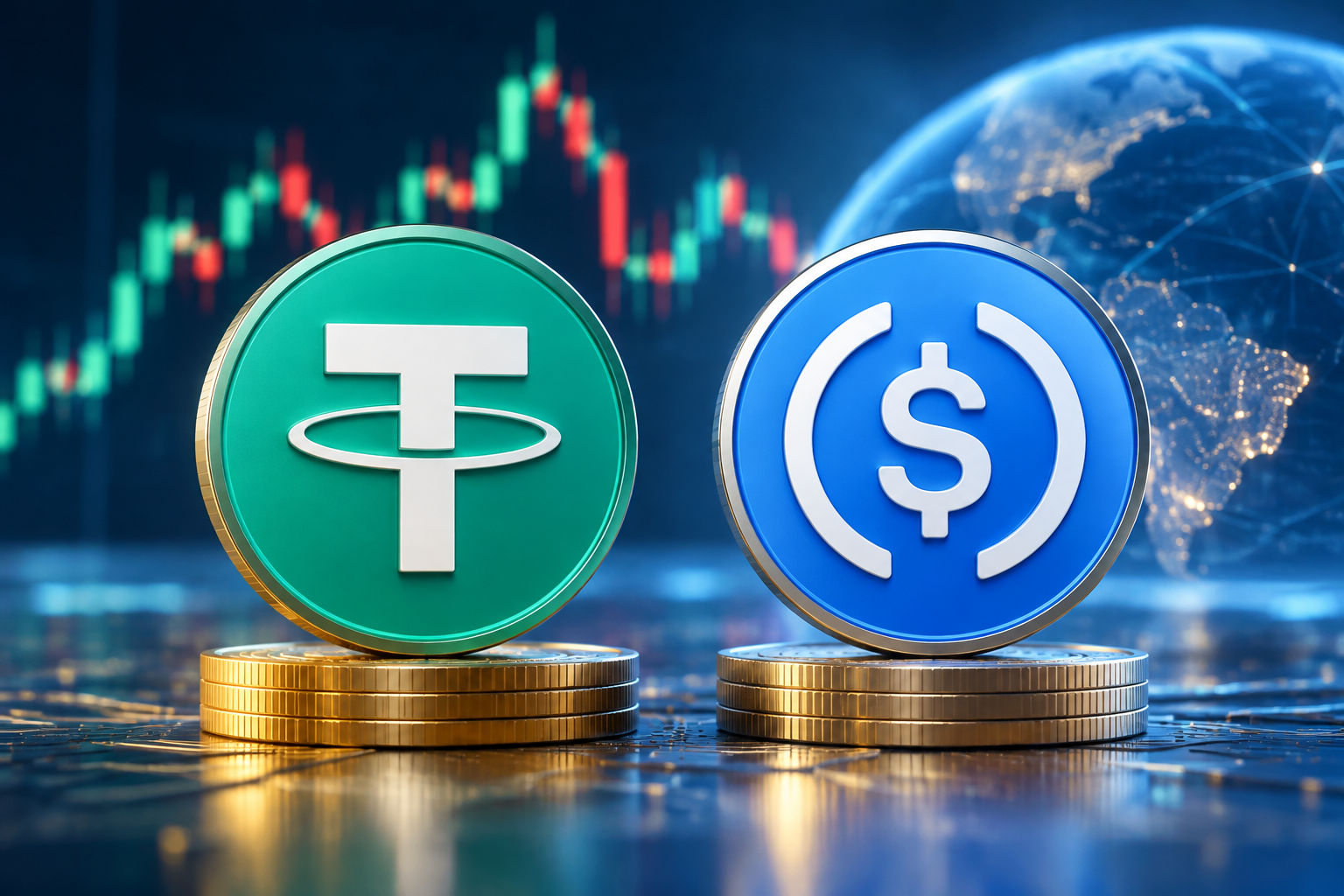
For users new to the cryptocurrency market, USDT and USDC may not seem very different: both can be transferred on blockchains and used to buy Bitcoin and Ethereum. However, when it comes to fund safety, trading liquidity, and long-term holding, choosing which stablecoin to use becomes more important.
So what exactly is the difference between USDT and USDC? Which is better suited for daily trading, cross-border payments, and digital asset management? This article compares them in terms of issuing institutions, reserve assets, market liquidity, regulatory environment, and practical use cases.
I. What Are USDT and USDC?
USDT: A Widely Used USD Stablecoin Globally
USDT is issued by Tether and launched in 2014. It is one of the longer-established and widely used USD stablecoins in the cryptocurrency market.
USDT is designed to maintain approximately 1 USDT = 1 USD. The issuing institution supports tokens in circulation by holding reserve assets and adjusts supply based on issuance and redemption demand.
USDT has been integrated into multiple blockchain networks, including Ethereum, Tron, and Solana, providing users with different transfer and trading channels.
Its main applications include:
- Buying and selling digital assets on cryptocurrency trading platforms.
- Converting assets during market volatility.
- Transferring funds between different wallets and trading platforms.
- Use in some cross-border payments and commercial settlements.
- Participating in DeFi lending and liquidity activities.
Because USDT has broad applications in the global cryptocurrency trading market, many trading platforms use it as a primary trading and pricing asset.
USDC: A USD Stablecoin Emphasizing Reserve Transparency
USDC is issued by Circle and launched in 2018. It was initially established with the joint participation of Circle and Coinbase, and later Circle took responsibility for issuance.
USDC also targets a peg of $1, and its reserves mainly consist of cash and cash-equivalent assets, including short-term U.S. Treasury securities, overnight U.S. Treasury repurchase agreements, and bank deposits.
Compared with USDT, USDC places greater emphasis on reserve information disclosure, third-party attestation, and cooperation with financial institutions.
USDC's main applications include:
- Cryptocurrency trading and asset settlement.
- Blockchain-based cross-border payments.
- DeFi lending and liquidity management.
- Corporate digital payments and financial infrastructure.
- Tokenized assets and on-chain financial applications.
USDC is not only aimed at ordinary cryptocurrency users but is also actively expanding use cases for payment institutions, fintech companies, and institutional investors.
II. What Is the Difference Between USDT and USDC?
Although both are USD reserve-backed stablecoins, their business models and operating methods are not entirely the same.
1.Different Issuing Institutions
USDT is issued by Tether, and USDC is issued by Circle. The two institutions adopt different corporate operating structures, reserve management methods, and compliance strategies.
Tether has long served the global cryptocurrency trading market, and its stablecoin business covers multiple countries and regions. Circle places greater emphasis on establishing cooperative relationships with the traditional financial system, payment service providers, and institutional clients.
Differences in issuing institutions affect stablecoin reserve disclosure methods, redemption channels, and regulatory arrangements, so users should not judge reliability based solely on token price.
2.Different Reserve Asset Composition
Reserve assets are an important factor in judging the reliability of a stablecoin.
According to Tether's Q3 2026 reserve report published on October 30, 2026, as of September 30, 2026, Tether reported total assets of approximately $191.451 billion and total liabilities of approximately $183.496 billion, with assets exceeding liabilities by approximately $7.955 billion.
Its reserve assets include U.S. Treasury securities, reverse repurchase agreements, precious metals, Bitcoin, and other assets. Among them, direct and indirect holdings of U.S. Treasury securities totaled approximately $132.4 billion.
On the USDC side, Circle states that its reserves are backed by highly liquid cash and cash-equivalent assets. Most reserves are allocated to the Circle Reserve Fund, which is managed by BlackRock and mainly invests in short-term U.S. Treasury securities, overnight U.S. Treasury repurchase agreements, and cash, with the remainder mainly held in cash at financial institutions.
The main differences between the two models are:
- USDT's reserve assets are more diversified. In addition to assets such as short-term government bonds and cash, they also include gold, Bitcoin, and other investment categories.
- USDC is more concentrated in cash and cash-equivalent assets, emphasizing the liquidity and transparency of reserve assets.
Note that different types of reserve assets do not mean one can directly determine which stablecoin is absolutely safer. A comprehensive assessment should also consider asset quality, valuation methods, liquidity, and liability coverage.
3.Different Reserve Information Disclosure Methods
Both USDT and USDC provide reserve-related information, but disclosure frequency and third-party verification forms differ.
Tether typically updates token circulation information daily and publishes quarterly reserve reports issued by independent accounting firms such as BDO.
Circle discloses USDC reserve holdings and related minting and burning information weekly, and Deloitte provides monthly third-party attestation confirming that the value of reserve assets is not less than the amount of USDC in circulation.
Here it is necessary to distinguish between third-party attestation and full financial audit, as their scope of work and conclusions are not the same. For users, judging stablecoin transparency requires not only checking whether the issuer publishes reports but also paying attention to report dates, reserve composition, third-party institutions, and actual coverage.
4.Different Market Size and Liquidity
USDT has long held a leading position in the global stablecoin market and has high trading activity on many centralized trading platforms and digital asset markets.
USDC is another important USD stablecoin and has relatively broad applications in payments, institutional settlement, and the DeFi ecosystem.
According to Q3 2026 data published by Tether, as of September 30, 2026, USDT-related token liabilities in circulation were approximately $183.470 billion.
Data published by Circle shows that as of October 29, 2026, USDC circulation was approximately $70 billion.
Note that the two figures correspond to different statistical dates and cannot be directly regarded as an exact market share comparison at the same point in time.
In practical use, liquidity depends not only on the total issuance of a stablecoin but also on trading platform support, trading pair depth, the blockchain network involved, and local fiat currency exchange channels.
5.Different Regulatory and Compliance Environments
Stablecoin regulatory requirements are becoming an important factor affecting industry development.
Circle issues USDC through its regulated affiliated institutions and conducts business according to the requirements of different jurisdictions. Circle listed on the New York Stock Exchange in 2025 and is also subject to corresponding listed company information disclosure obligations.
Tether manages its USDT business through its own issuance and operating structure and applies different regulatory requirements in different regions.
Particular attention should be paid to the fact that USDT and USDC do not have the same regulatory status in all countries and regions around the world.
For example, the EU's Markets in Crypto-Assets Regulation (MiCA) sets specific requirements for stablecoin issuers, reserve assets, and redemption arrangements. Whether different stablecoins meet the relevant requirements needs to be judged based on the issuing entity, token category, and local regulatory status.
Therefore, before choosing a stablecoin, users should confirm whether trading platforms in their region support the relevant token and whether its use complies with local laws and regulations.
III. Core Differences Between USDT and USDC
Based on the above information, the differences between the two stablecoins can be understood from the following dimensions.
USDT's main characteristics are broad market circulation, mature trading applications, and relatively diversified reserve asset categories.
USDC's main characteristics are relatively concentrated reserve assets, higher disclosure frequency, and emphasis on institutional payments and compliant financial applications.
Neither is legal tender directly issued by a government or central bank, nor does holding the token mean having the same protection as a bank deposit.
IV. Which Is More Suitable for Different Users, USDT or USDC?
Choosing USDT or USDC should be based on actual use rather than simply assuming one is necessarily better.
1.If Mainly Used for Cryptocurrency Trading
For users who frequently buy and sell Bitcoin, Ethereum, and other digital assets, USDT can be given priority. The reason is that USDT has relatively broad trading pairs and liquidity on many trading platforms, making it convenient for users to exchange assets and settle trades. However, in practice, users still need to check the specific trading platform's trading depth, fees, and withdrawal networks.
2.If Greater Emphasis Is Placed on Reserve Transparency
If users particularly value reserve asset composition, information disclosure frequency, and third-party attestation, they can focus on researching USDC.
Circle provides weekly reserve disclosure and monthly third-party attestation, and users can view relevant information through the official transparency page. However, transparency is only part of risk assessment and cannot completely eliminate issuer, bank partnership, and market liquidity risks.
3.If Mainly Used for Cross-Border Payments
Both USDT and USDC can be used for cross-border fund transfers, but the specific experience depends on payment service providers, blockchain networks, local fiat currency exchange channels, and recipient support. For corporate payments, attention should also be paid to source-of-funds review, anti-money laundering requirements, recipient identity verification, and local stablecoin regulatory policies.
4.If Used for DeFi and On-Chain Finance
Both stablecoins can participate in some DeFi protocols, but not all protocols and blockchain networks support both USDT and USDC.
Users need to check the token contracts supported by the protocol, liquidity scale, collateral rules, and smart contract risks. In addition, participating in lending or liquidity provision with stablecoins does not mean fixed returns can be obtained, and capital losses may also occur.
V. What Risks Should Be Noted When Using USDT and USDC?
Although both stablecoins target a USD peg, they still face different types of risk.
The first is depeg risk. When market panic occurs, reserve assets are questioned, or redemption channels are blocked, a stablecoin may temporarily or persistently deviate from $1.
The second is issuer risk. Stablecoins rely on issuing institutions to manage reserve assets and process redemption requests. If the issuer experiences operational, legal, or liquidity problems, it may affect the safety of holders' assets.
The third is blockchain network risk. USDT and USDC can be issued or circulate on multiple blockchain networks, but tokens on different networks cannot be freely mixed. If the sender and receiver choose incompatible networks, funds may not arrive properly.
The fourth is platform risk. When users hold stablecoins through trading platforms, wallet service providers, or third-party financial products, they also need to consider platform operations, custody, and cybersecurity issues.
Finally, there is regulatory risk. Different countries and regions have different rules on the use, trading, and exchange of stablecoins, and policy changes may affect users' access.
Therefore, users are advised to verify the token name, network type, and receiving address before transferring, and to learn the latest reserve and redemption information through the issuer's official channels.
VI. Future Development Directions of USDT and USDC
As stablecoins gradually enter payments, settlement, and traditional finance, competition between USDT and USDC is shifting from pure market size competition to competition in financial infrastructure and practical application capabilities.
USDT's advantages are mainly reflected in the global cryptocurrency trading ecosystem, market liquidity, and multi-network applications. In the future, its development will still be affected by international regulation, reserve management, and global payment demand.
USDC continues to expand in institutional payments, compliant financial infrastructure, and blockchain settlement. As traditional financial institutions explore tokenized assets and round-the-clock settlement, USDC has opportunities to play a role in more corporate payments and financial applications.
In the long run, the stablecoin market will not necessarily be dominated by a single product. Different stablecoins may form differentiated competition based on user regions, trading platforms, financial institution cooperation, and application scenarios.
For ordinary users, when choosing USDT or USDC, the most important thing is not to chase market size but to understand the issuing institution, reserve assets, redemption conditions, and actual use cases.
Frequently Asked Questions (FAQ)
Q1. Are USDT and USDC both US dollars?
Answer: No. USDT and USDC are privately issued stablecoins targeting a USD peg, not legal tender or bank deposits. They are designed to maintain approximately 1 token = $1, but market prices may still fluctuate.
Q2. Which is safer, USDT or USDC?
Answer: It cannot simply be concluded that one is absolutely safer. USDT and USDC differ in reserve assets, information disclosure, and issuing institutions. Users should make judgments based on the latest reserve reports, third-party attestation, redemption policies, and regulatory environment.
Q3. Can USDT be exchanged for USDC?
Answer: Yes. Users can usually convert through trading platforms or exchange services that support both stablecoins, but trading fees, price spreads, or network fees may arise. Before exchanging, confirm the tokens and blockchain networks supported by the platform.
Q4. Can USDT and USDC be held long term?
Answer: Both can be used as USD-denominated digital assets, but they are not equivalent to risk-free USD savings. Long-term holding requires attention to issuer credit, reserve assets, depeg risk, regulatory changes, and actual redemption conditions.
Related Reading: How Do Stablecoins Work? Differences Between USDT and USDC and Payment Use Cases