
Preface: Why JTO Is the Most Misunderstood Governance Token in the Solana Ecosystem
JTO is a token that is easily misunderstood.
Some people treat it as the "Solana version of LDO." Others label it an "airdrop farming coin." And some view it as one of the most value-accretive infrastructure tokens in the Solana ecosystem.
All of these perspectives contain partial truths, but none are complete.
Jito, the protocol behind JTO, is more than just a liquid staking protocol. Its real significance lies in building a full-stack infrastructure around MEV on Solana: the Jito-Solana client, Bundle auctions, MEV reward distribution, jitoSOL liquid staking, and a protocol system governed by JTO.
Jito officially positions itself as "MEV-optimized infrastructure" with "deep DeFi integrations," providing MEV optimization infrastructure and liquid staking services for Solana.
This is why JTO price predictions are more complex than those for ordinary governance tokens.
Because JTO's value does not come purely from "voting rights." It depends deeply on three questions:
- Will the Solana ecosystem continue to thrive?
- Will MEV value on Solana continue to grow?
- Can JTO capture clear value from Jito's protocol growth?
If all three hold true, JTO could become the core governance asset for Solana MEV infrastructure. If any one of them breaks, JTO may end up as just another governance token without cash-flow backing.
This article will not simply tell you "JTO will hit $X by 2030." Instead, it will build a framework for judgment:
- What problem does Jito actually solve?
- What is the difference between JTO and jitoSOL?
- Why is MEV the fundamental value driver for JTO?
- Will token unlocks suppress the price long-term?
- Can JTO evolve from a governance token into a value-capture token?
- What is the reasonable price range for JTO from 2026–2030?
In the HIBT research framework, the first question when analyzing JTO should be:
If there were no MEV on Solana, would JTO still be valuable?
This question is the ultimate test of whether you truly understand JTO.
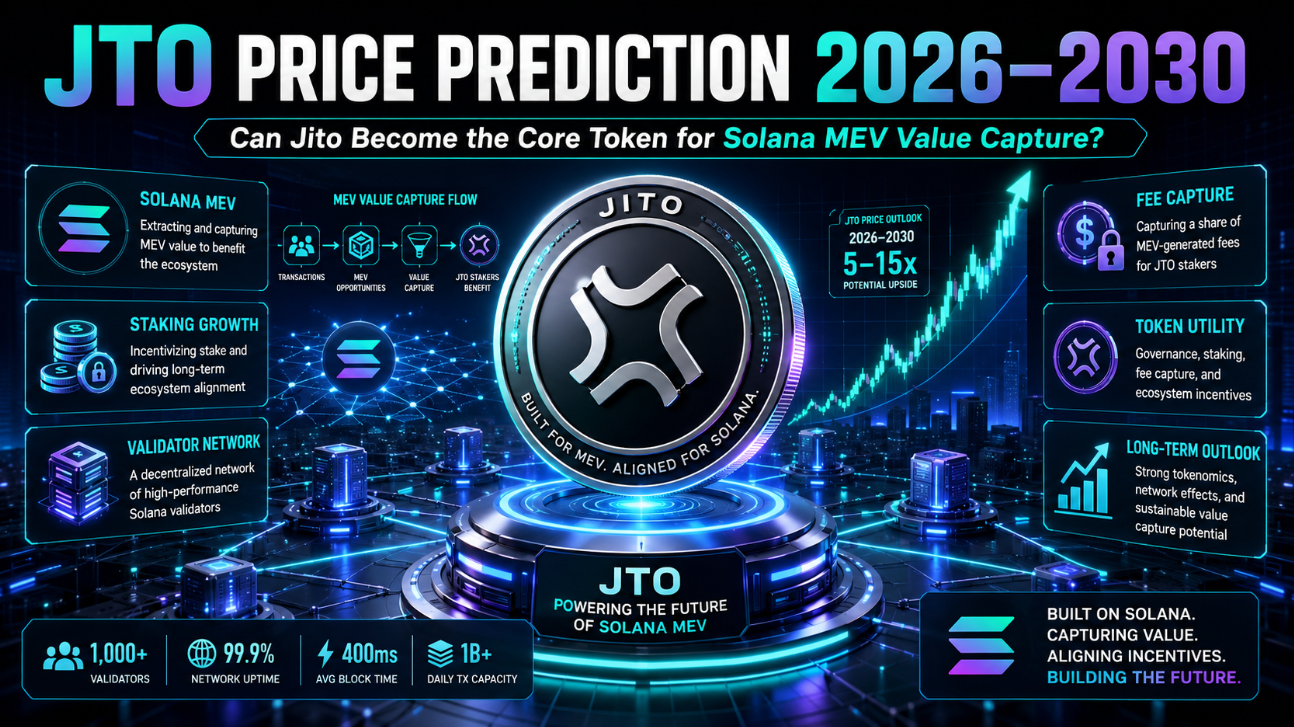
Chapter 1: Before You Buy JTO, You Must Understand What MEV Is
1. What Is MEV in Plain English?
MEV, short for Maximal Extractable Value, is the additional value that block producers, validators, or searchers extract from on-chain transactions by reordering, inserting, or bundling transactions.
Here's a simple example.
You buy a token on a decentralized exchange. Because on-chain transactions are not instant—they must be included in a block—some bots may see your transaction intent before it is confirmed, front-run your buy, and sell to you at a higher price.
This is a common front-running scenario.
Another case is arbitrage. If the same token trades at different prices on two DEXs, bots can profit from the spread by trading quickly. These profits are scattered throughout the market, but are ultimately captured by searchers, validators, or specific infrastructure providers.
MEV is not always bad.
Some MEV is malicious, such as front-running and sandwich attacks. Some is neutral or even beneficial to the market, such as arbitrage that brings prices across venues into alignment.
Jito's goal is not to eliminate MEV entirely, but to transform the chaotic, inefficient, and often user-harmful MEV activity on Solana into something more orderly, transparent, and capable of returning value to validators and stakers.
2. How Is MEV on Solana Different from Ethereum?
Both Ethereum and Solana have MEV, but their structures differ.
Ethereum has longer block times and higher transaction fees. Its MEV ecosystem evolved around Flashbots, builders, relays, and validators. Solana has fast block speeds, high throughput, and low fees, with much higher transaction density. Its MEV structure depends more on high-performance clients and the validator network.
Jito was born in Solana's high-frequency, low-fee, high-throughput environment.
Through the Jito-Solana client, Bundle auctions, and validator reward distribution mechanisms, searchers can submit transaction bundles, validators can capture MEV rewards, and jitoSOL holders can earn enhanced yields through staking.
3. How to Understand Jito's Bundle Auction?
Think of the Bundle auction as a more orderly "transaction ordering market."
When searchers discover an arbitrage opportunity, they do not simply spam the chain to front-run. Instead, they bundle a set of transactions into a Bundle and pay a tip for it. Validators running the Jito client receive these Bundles and select the most valuable ones to include in blocks. Ultimately, these tips flow into the Jito system and are distributed to relevant participants through its mechanisms.
The significance of this is:
- Chaotic MEV competition becomes a standardized auction market.
- Value previously captured by only a handful of bots and validators can be redirected to stakers and the protocol ecosystem.
- High-frequency trading activity on Solana gains a clearer value-capture layer.
This is the commercial foundation of Jito.
4. The Relationship Between Jito Labs, Jito Foundation, and JTO
There are several entities in the Jito ecosystem:
- Jito Labs: Responsible for core technology development and infrastructure.
- Jito Foundation: Drives protocol governance, ecosystem development, and community coordination.
- JTO: The governance token of the Jito Network. Holders can participate in the Jito DAO and influence protocol upgrades, parameter adjustments, and treasury management. Jito's official documentation explicitly states that JTO is the governance token of the Jito Network, enabling community members to participate in protocol decisions and future direction, including protocol upgrades, parameter adjustments, and treasury management.
This means JTO's most clearly defined function today is governance.
But the question investors really care about is:
Can governance rights be converted into economic value?
If JTO only allows you to vote but does not let you share in revenue, its valuation will be limited. If governance can eventually determine fee parameters, revenue distribution, buybacks, incentives, and ecosystem fund allocation, JTO's value proposition expands significantly.
5. Jito Client Market Share: Moat or Centralization Risk?
Jito's penetration in the Solana validator ecosystem is very high.
Third-party analyses have noted that Jito's client commands a large share of Solana validator stake. For example, Token Terminal's Jito analysis page has stated that a significant portion of Solana validator stake uses the Jito client, allowing Jito to route a large volume of Solana MEV. Industry sources from 2026 also suggest that validators using the Jito client account for roughly 60% of stake.
This is a double-edged sword.
From a moat perspective: The more validators use Jito, the more searchers want to connect to it. The more MEV flows through Jito, the stronger its network effects become.
From a risk perspective: If the Solana network becomes overly dependent on the Jito client, it may trigger centralization concerns. If the community feels Jito has too much influence over block ordering, it may push for alternative solutions or protocol-level reforms.
So Jito's high market share is both an advantage and a potential regulatory and governance risk.
HIBT Case: Extreme Assumption Test
When HIBT analyzes JTO, we run an extreme assumption:
If MEV disappeared on Solana, would JTO still be valuable?
If the answer is "not very valuable," then JTO's value foundation is Solana MEV. By investing in JTO, you are essentially betting on:
- Growth in Solana on-chain trading volume;
- Growth in total MEV;
- Jito's continued MEV capture;
- JTO's ability to capture value from Jito's growth.
If any link in this logic chain breaks, the thesis must be re-evaluated.
Chapter 2: Deep Dive into JTO Tokenomics: Has the Governance Token Found a Cure?
Governance tokens are among the hardest assets to value in DeFi.
The biggest problem with many governance tokens is: They let you vote, but they don't necessarily let you share in the revenue.
JTO currently faces this exact problem.
1. Total Supply and Airdrop Background
JTO officially launched in 2023. When Jito released JTO, it stated that the JTO airdrop totaled 100 million tokens, with 90 million distributed immediately and another 10 million unlocking over the following year from the Community Growth allocation.
This is why many people instinctively label JTO an "airdrop coin" or "farming token."
But the airdrop itself is not the problem.
Uniswap, Arbitrum, Optimism, and Jito all did airdrops. The real key is: after the airdrop, can the protocol continue to create value, and can the token find pricing support from protocol growth?
2. Unlock Pressure: 2026 Remains a Critical Variable
A practical issue for JTO is token emissions.
The DefiLlama Unlocks page shows that JTO has ongoing linear unlocks, with Core Contributors and Investors receiving continuous releases. The page lists daily unlock amounts and corresponding JTO quantities, showing that related unlocks began linear release from December 2024.
This means JTO price analysis for 2026 cannot look at fundamentals alone; it must also account for supply pressure.
If new circulating supply keeps entering the market while JTO demand does not grow in tandem, the price will likely face downward pressure. If the Solana ecosystem explodes, Jito revenue grows, and the market is willing to absorb unlocked tokens, the sell pressure may be digested.
This is the core of JTO's 2026 forecast: Can demand growth outpace supply release?
3. Is JTO's Current Value Capture Clear?
JTO's clearest positioning today is as a governance token.
Jito's official JTO page emphasizes that JTO holders participate in the protocol's future through on-chain voting, including treasury management, fee parameters, and other directions.
This shows JTO can influence protocol governance, but it does not mean JTO currently has direct dividend rights.
Investors need to distinguish:
- Governance rights ≠ Revenue rights.
- Voting rights ≠ Cash flow.
- Protocol growth ≠ Token price appreciation.
JTO's long-term ceiling depends on whether future governance will allow the token to more directly capture protocol value, such as:
- Fee buybacks;
- Protocol revenue sharing;
- JTO staking;
- Governance participation incentives;
- Adjustments to jitoSOL or MEV fee parameters;
- Treasury funds used for long-term ecosystem building.
If these mechanisms are implemented in the future, JTO's valuation model will change fundamentally. If not, JTO will continue to be priced at a governance-token discount.
4. Similarities and Differences with LDO
Many people like to compare JTO with LDO.
- LDO is the governance token of Lido, the Ethereum liquid staking leader.
- JTO is the governance token of Jito, which covers both liquid staking and MEV infrastructure on Solana.
Similarities:
- Both are related to liquid staking;
- Both are governance tokens;
- Both depend on the prosperity of their underlying L1 ecosystem;
- Both face the question of whether protocol growth can be transmitted to the token.
Differences:
- LDO's core is the ETH liquid staking market;
- JTO's core is not just jitoSOL, but Solana MEV infrastructure;
- JTO is more sensitive to Solana trading activity and total MEV;
- Jito's high validator client share creates stronger network effects, but also brings centralization controversy.
So JTO cannot simply be called the "Solana version of LDO." It is more accurately described as the "Solana liquid staking + MEV infrastructure governance token."
HIBT Case: Governance Token Value Test
When HIBT evaluates whether a governance token is worth researching, we ask four questions:
- Does the protocol have real revenue?
- Can governance influence revenue distribution?
- Does the token have staking, buyback, or demand scenarios?
- Can holders avoid long-term dilution from unlocks and inflation?
For JTO, the first two questions are the most critical.
If Jito's protocol revenue grows but JTO cannot capture that revenue, valuation will be constrained. If governance gradually allows JTO to participate in revenue distribution or buybacks, the valuation logic improves significantly.
Chapter 3: Six Variables That Will Impact JTO's Price
Variable 1: Total MEV on the Solana Network
This is JTO's most fundamental variable.
Jito's value comes from MEV infrastructure on Solana. If Solana on-chain trading volume grows, DeFi activity increases, arbitrage opportunities multiply, and AI Agents and high-frequency trading expand, total MEV could rise.
Growth in total MEV is a direct positive for Jito.
But whether it is a direct positive for JTO depends on the value-capture mechanism.
Variable 2: jitoSOL TVL and Market Share
jitoSOL is Jito's liquid staking token.
Jito's official website highlights "MEV Powered Staking Rewards," emphasizing that staking SOL through Jito delivers MEV-enhanced yields. DefiLlama also categorizes Jito under Liquid Staking and tracks its TVL, Fees, and Revenue.
The higher jitoSOL's TVL, the more SOL is staked through the Jito system. This strengthens Jito's network position and influence in the Solana ecosystem.
But note: jitoSOL growth does not automatically mean JTO will rise. Only when jitoSOL growth drives protocol revenue, governance value, or buyback expectations will it more strongly transmit to JTO.
Variable 3: SOL Price and Solana Ecosystem Cycle
JTO is highly dependent on Solana.
If SOL enters a strong bull market and Solana DeFi, NFT, Meme, AI Agent, and RWA activity increases, Jito is likely to benefit. If SOL weakens, Solana on-chain activity drops, and total MEV falls, JTO will also face pressure.
So JTO is not an asset that can move entirely independently of SOL.
In many cases, JTO can be viewed as a high-beta play on the Solana ecosystem. When SOL rises, JTO may rise faster. When SOL falls, JTO may fall harder.
Variable 4: Competitors
Jito is strong in Solana liquid staking and MEV, but it is not without competition.
In liquid staking, there are Marinade, BlazeStake, and others. In MEV, new validator clients, searcher networks, or even native Solana protocol-level MEV solutions may emerge in the future.
If Jito's market share is diluted, JTO's valuation will be affected.
Variable 5: Speed of Institutional Adoption of Solana
If institutions begin using Solana more broadly—for RWA issuance, stablecoins, payments, on-chain funds, and trading infrastructure—Solana on-chain activity will increase.
More on-chain activity should theoretically increase MEV opportunities.
But institutional adoption is an indirect positive for JTO, not a direct one.
The path is: Institutional entry into Solana → More on-chain transactions → More MEV opportunities → Jito revenue growth → JTO potential value uplift.
Every step in between needs to be verified.
Variable 6: JTO Unlocks and Whale Behavior
JTO's supply emissions will affect its price long-term.
If whales, investors, and team members sell continuously after unlocking, the price will face pressure. If unlocked tokens are absorbed by long-term capital, supply pressure will ease gradually.
Therefore, JTO investors need to watch:
- Unlock calendars;
- Large transfers;
- Exchange inflows;
- DAO treasury movements;
- Staking or lock-up ratios;
- JTO/SOL ratio.
HIBT Case: Three-Layer Filter
HIBT analyzes JTO across three layers:
- Ecosystem layer: Solana on-chain activity and SOL price.
- Protocol layer: Jito MEV volume, jitoSOL TVL, protocol revenue.
- Token layer: JTO unlocks, governance rights, value-capture mechanisms.
Focus on one core metric per layer:
- Ecosystem layer: Solana activity;
- Protocol layer: Jito revenue;
- Token layer: Whether JTO captures value.
This prevents information overload.
Chapter 4: JTO Price Prediction 2026: Can the Market Digest the Heaviest Unlock Year?
In 2026, the single biggest keyword for JTO is: supply pressure.
JTO's fundamentals may look solid, but if unlock pressure is heavy, the price can still be suppressed.
This is something many newcomers overlook. They only look at whether the project is good, not how many new tokens are hitting the market.
1. The Core Contradiction for JTO in 2026
JTO's price in 2026 depends on the battle between two forces:
Demand side:
- Whether the Solana ecosystem continues to grow;
- Whether total MEV increases;
- Whether jitoSOL TVL rises;
- Whether Jito launches new products;
- Whether JTO gains fee buyback or yield mechanism expectations.
Supply side:
- Team and investor unlocks;
- Remaining airdrop user sell pressure;
- Whether whales are selling;
- Whether the market is willing to absorb new circulating supply.
If demand growth outpaces supply release, JTO can rise. If supply release outpaces demand growth, JTO may face prolonged pressure.
2. Impact of Solana ETF and Institutional Adoption
If Solana ETFs or institutional-grade products make greater progress in 2025–2026, the Solana ecosystem may see new capital and new users.
But the impact on JTO is not automatic.
What really matters is whether institutional capital brings on-chain activity. If institutions only buy SOL without generating on-chain transactions, the pull on Jito MEV will be limited. If institutions bring on-chain asset issuance, trading, RWA, payments, and DeFi usage, Jito will benefit more clearly.
**2026 Bear Case: **0.80–2.00
If the market enters a bear market in 2026, Solana activity declines, JTO unlock pressure continues, and JTO still lacks a clear value-capture mechanism, the price may enter a depressed range.
Bear range: 0.80–2.00
**2026 Base Case: **2.50–5.00
If the Solana ecosystem maintains healthy growth, Jito MEV and jitoSOL TVL rise steadily, and unlock pressure is gradually digested by the market, JTO has a chance to maintain a neutral recovery.
Base range: 2.50–5.00
**2026 Bull Case: **6.00–12.00
If the Solana ecosystem explodes, Jito revenue growth is significant, and the community passes proposals for fee buybacks, staking, or yield-related mechanisms, JTO may be repriced from a governance token to a value-capture asset.
Bull range: 6.00–12.00
HIBT Case: Supply Growth vs. Demand Growth
When HIBT judges whether JTO will face pressure in 2026, the core question is:
Is the speed of new JTO circulation exceeding the speed of new market demand?
If JTO unlocks 20% but Jito revenue, TVL, market attention, and buying power only grow 5%, the price will likely face pressure. If JTO unlocks 20% but Jito revenue and Solana activity grow 100%, the sell pressure may be absorbed.
This is closer to price reality than simply asking "is the project good?"
Chapter 5: JTO Price Prediction 2027: Can Protocol Revenue Become a New Pricing Anchor?
In 2027, the core question for JTO will become:
Can it evolve from a governance token into a revenue-backed value token?
If by 2027 JTO is still just voting rights, its valuation will be constrained. If by 2027 JTO governance has driven fee buybacks, staking yields, protocol revenue distribution, or treasury appreciation, the market will reprice it.
1. Where Does Jito's Revenue Actually Go?
Jito's MEV system generates tips and rewards, which are distributed among validators, stakers, searchers, and the protocol ecosystem.
jitoSOL holders benefit more directly, because their yield includes staking rewards plus MEV-enhanced returns. JTO holders currently rely more on governance rights and future value-capture expectations.
This is the biggest difference between JTO and jitoSOL:
- jitoSOL is more like a yield asset.
- JTO is more like governance and a call option on future cash flow.
2. How to Value It If Fee Sharing Passes?
If JTO can share in protocol revenue in the future, the valuation methodology changes.
Two approaches are possible:
First, P/S (Price-to-Sales). Multiply Jito's annual protocol revenue by a reasonable valuation multiple to back out market cap.
Second, P/E (Price-to-Earnings). If there are clear profits or dividends, an earnings multiple can be used.
P/S is currently more appropriate, because JTO's revenue distribution mechanism is not yet fully mature.
**2027 Bear Case: **1.50–3.50
If JTO still lacks clear value capture, Solana activity is mediocre, unlock pressure has declined but market confidence remains weak, JTO may stay undervalued.
Bear range: 1.50–3.50
**2027 Base Case: **5.00–10.00
If Jito revenue grows steadily, jitoSOL TVL rises, and JTO governance gradually influences fee parameters and treasury usage, the market may assign a higher valuation.
Base range: 5.00–10.00
**2027 Bull Case: **15.00–28.00
If JTO enters a revenue-capture phase—such as buybacks, staking, or fee-sharing mechanisms going live—while Solana becomes a mainstream on-chain trading ecosystem, JTO may see significant repricing.
Bull range: 15.00–28.00
HIBT Case: Cash Flow Valuation Primer
HIBT uses the simplest method to judge whether JTO is undervalued:
Assume Jito's annual protocol revenue is A. Assume B% of it could eventually be used for JTO buybacks or distribution. Assume the market is willing to pay C times that.
Then JTO's theoretical market cap is approximately:
A × B% × C
This is not a precise answer, but it is more reliable than "JTO is a Solana leader so it will go up."
Chapter 6: JTO Price Prediction 2028: Can Solana Become the Protagonist of a New Cycle?
By 2028, the market may be entering a new post-BTC-halving cycle phase.
If Solana becomes one of the mainstream high-performance public chains by 2028, JTO's elasticity will be very strong.
The reason is simple:
The more active Solana is, the more transactions occur, the more arbitrage exists, and the more MEV is generated. The more MEV Jito captures, the more likely JTO is to be repriced by the market.
1. JTO as a High-Beta Solana Ecosystem Play
If SOL is the core asset of the Solana ecosystem, JTO can be viewed as a high-beta play on the Solana MEV sector.
When SOL rises, JTO may rise faster due to both narrative and fundamental improvement. When SOL falls, JTO may fall deeper due to lower liquidity and higher risk.
2. AI Agents and High-Frequency On-Chain Trading
By 2028, if AI Agents enter on-chain trading at scale, Solana's high throughput could make it a key execution layer.
AI Agent high-frequency trading, automated arbitrage, automated market making, and cross-chain strategies will all increase on-chain transaction density.
This could significantly increase MEV opportunities.
But it may also bring new risks:
- Network congestion;
- Degraded user transaction experience;
- MEV regulatory controversy;
- Protocol-level restrictions on MEV;
- New competitors entering Jito's market.
**2028 Bear Case: **2.00–6.00
If Solana ecosystem growth slows and JTO still lacks clear revenue capture, the price may simply follow the broader market.
Bear range: 2.00–6.00
**2028 Base Case: **10.00–22.00
If Solana remains strong in the new cycle, Jito continues to dominate MEV and liquid staking infrastructure, and JTO has a chance to enter a mid-to-high valuation range.
Base range: 10.00–22.00
**2028 Bull Case: **30.00–65.00
If Solana becomes the protagonist of this bull cycle, on-chain trading volume surges, Jito captures massive MEV, and JTO's value-capture mechanism matures, JTO could achieve extremely strong elasticity.
Bull range: 30.00–65.00
HIBT Case: Cycle Overlay Analysis
HIBT does not build positions in JTO based solely on low prices, but on whether two cycles overlap:
- Whether the macro market cycle is entering a risk-appetite expansion phase.
- Whether Jito's fundamental cycle is entering a revenue growth phase.
If the market is good but Jito's data is weak, JTO is just a sentiment rally. If Jito's data is good but the market is weak, the price may not move. Only when both are trending upward is the optimal window.
Chapter 7: JTO Price Prediction 2029: Is Jito a Monopoly or One of Many Players?
By 2029, the Solana MEV infrastructure sector may enter maturity.
The most important question in maturity is not "is there MEV?" but:
Can Jito continue to capture MEV?
1. Does MEV Infrastructure Have Winner-Take-All Dynamics?
Jito has certain network effects.
The more validators use Jito, the more searchers want to connect. The more searchers there are, the more competitive Bundle auctions become, and the higher validator yields go. The higher validator yields go, the more validators want to use Jito.
This looks like a virtuous cycle.
But MEV infrastructure also has replication risk.
If a competitor offers lower fees, better distribution, stronger privacy, or fairer ordering, validators and searchers may migrate.
2. Will Solana Protocol Level Internalize MEV?
This is one of JTO's biggest long-term risks.
If the Solana protocol layer itself provides native MEV solutions in the future, Jito's position as a third-party infrastructure provider could be weakened.
A similar risk exists in the Ethereum ecosystem: Flashbots was once extremely central, but as PBS, MEV-Boost, SUAVE, and protocol-level design changes evolved, the MEV capture structure kept shifting.
Jito could face a similar path.
**2029 Bear Case: **3.00–8.00
If competition in the MEV sector intensifies, Jito's share declines, or the Solana protocol layer weakens the value of third-party MEV infrastructure, JTO may languish.
Bear range: 3.00–8.00
**2029 Base Case: **18.00–40.00
If Jito solidifies its leadership position, Solana on-chain activity continues to grow, and JTO's capture mechanisms improve, JTO has a chance to become a mature infrastructure token.
Base range: 18.00–40.00
**2029 Bull Case: **55.00–110.00
If Solana becomes one of the world's largest on-chain transaction settlement layers, Jito controls the core MEV distribution network, and JTO has clear buyback or yield mechanisms, the price may enter a high-valuation range.
Bull range: 55.00–110.00
HIBT Case: Moat Depth Scorecard
When HIBT scores Jito's moat, we look at four dimensions:
- Replicability: Can competitors copy it quickly?
- Switching costs: Is it difficult for validators and searchers to migrate?
- Network effects: Does it get stronger as more participants join?
- Economies of scale: Does it get more advantageous as transaction volume grows?
If Jito scores high consistently across all four, JTO's valuation will be more stable. If the moat is weakened, price forecasts need to be revised downward.
Chapter 8: JTO Price Prediction 2030: What Is the Value Ceiling for MEV Infrastructure?
By 2030, JTO has three possible outcomes.
- Jito becomes the core infrastructure for Solana MEV and liquid staking.
- Jito remains important, but JTO is only a governance token with limited value capture.
- Solana activity declines, or MEV is internalized by the protocol layer, and Jito is marginalized.
Therefore, JTO's 2030 forecast range will be very wide.
1. The Ultimate Bull Case for JTO
In the most optimistic scenario, Jito could become the MEV distribution layer for Solana.
It connects:
- Validators;
- Searchers;
- Stakers;
- DeFi protocols;
- jitoSOL users;
- The JTO governance community.
If Solana becomes a high-frequency on-chain financial system, Jito could become the key value-distribution infrastructure within that system.
2. The Bear Case for JTO
In the most pessimistic scenario, JTO could become a token with limited governance value.
If:
- The Solana ecosystem declines;
- Total MEV falls;
- Jito's client share is stolen by competitors;
- JTO cannot capture protocol revenue;
- Competitors or the protocol layer replace Jito;
- Regulation restricts MEV;
then JTO's long-term value will drop significantly.
**2030 Bear Case: **2.00–8.00
If the Solana ecosystem is marginalized, the MEV sector landscape is disrupted, and JTO fails to form a revenue-capture mechanism, the price may remain depressed long-term.
Bear range: 2.00–8.00
**2030 Base Case: **35.00–90.00
If Solana firmly holds a top-three public chain position, Jito maintains leadership in MEV and liquid staking, and JTO governance gradually participates in value distribution, the price has a chance to enter a mature infrastructure valuation range.
Base range: 35.00–90.00
**2030 Bull Case: **120.00–280.00
If the on-chain economy explodes, Solana becomes a core network for global high-frequency trading and on-chain finance, Jito captures massive MEV, and JTO becomes a core governance and value-capture asset, then JTO could enter an extreme bull-case range.
Bull range: 120.00–280.00
This scenario requires multiple conditions to hold simultaneously and should not be used as a base-case expectation.
HIBT Case: Four-Step Terminal Valuation
HIBT's terminal valuation for JTO can be done as follows:
- Forecast Solana on-chain transaction scale in 2030.
- Estimate total MEV.
- Judge what share Jito can capture.
- Judge how much protocol value JTO can capture.
Only if all four steps hold does a high 2030 price target make sense.
Chapter 9: JTO vs. LDO, MSOL, EIGEN: The Three Comparisons Newbies Ask Most
1. JTO vs. LDO
- LDO is the governance token of Lido, the Ethereum liquid staking leader.
- JTO is the governance token of Jito in the Solana ecosystem.
LDO's core logic is ETH staking market share. JTO's core logic is Solana MEV + jitoSOL liquid staking.
LDO depends more on the ETH staking landscape. JTO depends more on Solana on-chain trading activity and MEV growth.
If you are bullish on Ethereum long-term staking, LDO is more direct. If you are bullish on Solana high-frequency on-chain trading and MEV, JTO has more elasticity.
2. JTO vs. Marinade / MSOL
Marinade is an important liquid staking protocol in the Solana ecosystem. Jito's differentiator is MEV-enhanced yields and its validator client network.
Marinade emphasizes decentralized stake distribution. Jito emphasizes MEV-optimized yields.
Both can coexist, but they also compete for SOL staking share.
3. JTO vs. EIGEN
- EIGEN belongs to the Ethereum restaking ecosystem.
- JTO belongs to the Solana MEV and liquid staking ecosystem.
EIGEN's core logic is Ethereum security reuse and the AVS ecosystem. JTO's core logic is Solana trading activity and MEV capture.
Both are "infrastructure governance tokens," but their underlying assets, ecosystem paths, and value capture are completely different.
HIBT Case: Five-Dimension Comparison Model
When HIBT compares JTO, LDO, EIGEN, and MSOL/Marinade, we look at five dimensions:

None is inherently better. The key is which ecosystem path you actually believe in.
If you want to compare a token with deeper DeFi infrastructure long-term value-capture logic, you can read HIBT's LQTY Price Prediction 2026–2030 . If you want a higher-volatility narrative asset leaning toward AI and identity networks, you can reference WLD Price Prediction 2026–2030 . If you want to compare a legacy cycle asset, you can also read LTC (Litecoin) Price Prediction 2026–2030 .
Chapter 10: JTO Investment Playbook
1. What Is the Difference Between Holding JTO, jitoSOL, and SOL?
This is the most important question when researching the Jito ecosystem.
Holding SOL: You are betting on the entire Solana ecosystem. Risk is relatively diversified. This is Solana beta.
Holding jitoSOL: You hold a liquid-staked SOL token with MEV-enhanced yields. This is more of a yield asset.
Holding JTO: You are betting on Jito protocol governance, MEV value capture, and future revenue distribution. This is a higher-risk, higher-elasticity asset.
So these three are not substitutes; they are different risk tiers.
Conservative users are better suited to SOL or jitoSOL. Aggressive users are the ones who should consider JTO.
2. What Is the Optimal Buy Signal for JTO?
Focus on three metrics:
First, Jito MEV revenue continues to grow. This is the most fundamental metric.
Second, jitoSOL TVL and market share improve. This shows Jito's strengthening position in the Solana staking ecosystem.
Third, the JTO/SOL ratio strengthens. This shows JTO is not just following SOL, but is actually generating excess returns.
If SOL rises but JTO does not, the market does not recognize JTO's additional value. If SOL goes sideways but JTO strengthens, Jito's own logic may be getting repriced.
3. What Should Your JTO Allocation Be?
Reference allocation:
- Conservative: 0–1%
- Balanced: 1–3%
- Aggressive: 3–7%
We do not recommend that average investors make JTO a core position.
A more reasonable portfolio would be:
- BTC / ETH: Core positions;
- SOL: High-performance L1 core position;
- jitoSOL: Solana ecosystem yield position;
- JTO: MEV high-beta satellite position;
- Other Meme / AI / DeFi: Small opportunistic positions.
4. How to Design a JTO DCA Strategy?
JTO is not suitable for blind dollar-cost averaging.
The reason is unlock pressure and the fact that its value-capture mechanism is not yet fully clear.
A better approach is:
Phase 1: Observation position at lows. When the market is depressed but Jito's data remains solid, build a small position.
Phase 2: Data-confirmed position. When MEV revenue, jitoSOL TVL, and the JTO/SOL ratio improve, add to the position.
Phase 3: Governance catalyst position. When the community introduces proposals for fee buybacks, staking yields, or revenue distribution, consider a higher allocation.
If an unlock peak arrives but demand data does not improve, pause DCA or reduce the position.
5. Trimming and Stop-Loss Triggers
JTO prediction invalidation triggers include:
- Solana activity declining consistently;
- Jito MEV revenue falling for multiple consecutive quarters;
- jitoSOL TVL being clearly overtaken by competitors;
- Large JTO unlocks consistently flowing into exchanges;
- Jito client share declining noticeably;
- The Solana community pushing for protocol-level reforms that weaken third-party MEV;
- JTO governance failing long-term to establish a value-capture mechanism.
When these signals appear, do not hold on through conviction alone. Re-evaluate.
HIBT Case: Complete Investment Decision Flow
HIBT's process for analyzing JTO is:
- Confirm you understand MEV.
- Judge whether Solana is still in a growth cycle.
- Track Jito MEV revenue and jitoSOL TVL.
- Check JTO unlock pressure.
- Judge whether JTO has a value-capture mechanism.
- Set three-scenario price ranges.
- Build or reduce positions in tranches based on data changes.
Conclusion: Before Investing in JTO, You Must Confront Four Uncertainties
Uncertainty 1: JTO Is Highly Dependent on Solana
If Solana continues to thrive, Jito has more room to grow. If Solana is surpassed by the next generation of high-performance chains, JTO's valuation will be severely impacted.
Uncertainty 2: JTO Is Still Primarily a Governance Token
Governance rights have value, but the market prefers cash flow. If there are no buybacks, yields, staking, or clear value capture in the future, JTO may be discounted long-term.
Uncertainty 3: MEV Faces Regulatory and Community Controversy
MEV may be viewed as a market efficiency tool, or it may be seen as harming user trading experience. If regulation or the Solana community restricts MEV in the future, Jito will be affected.
Uncertainty 4: Jito's High Market Share Is Both an Advantage and a Risk
High share means network effects. But excessive share may also trigger centralization concerns, driving competitors or protocol-level alternatives.
Summary: JTO Is a High-Beta Solana MEV Asset, Not a Low-Risk Governance Coin
JTO's opportunity is clear:
- If the Solana ecosystem continues to grow, on-chain MEV will increase;
- Jito is important infrastructure for Solana MEV and liquid staking;
- jitoSOL TVL growth can strengthen Jito's ecosystem position;
- JTO governance may eventually participate in fee parameters, treasury, and value distribution;
- If JTO shifts from a pure governance token to a value-capture token, its valuation could be reshaped.
But JTO's risks are equally obvious:
- Unlock pressure remains;
- Current value capture is not direct enough;
- Highly dependent on Solana;
- The MEV sector faces regulatory and community controversy;
- Competitors or protocol-level solutions may weaken Jito;
- JTO's volatility will be significantly higher than SOL's.
Therefore, JTO is better placed in a high-risk, high-elasticity Solana ecosystem satellite position, not a low-risk long-term core position.
A truly mature investor will not simply ask:
"How high can JTO go by 2030?"
But rather:
"If JTO is going to reach that price, how much MEV does Solana need to generate, how much share does Jito need to capture, and how much value can JTO extract from that?"
That question is the real starting point for a valuable JTO price prediction.
FAQ: Common Questions About JTO Price Predictions
1. What is JTO? JTO is the governance token of the Jito Network. Jito is an MEV optimization infrastructure and liquid staking protocol in the Solana ecosystem. JTO holders can participate in the Jito DAO to govern protocol upgrades, parameter adjustments, and treasury management.
2. What is the difference between JTO and jitoSOL? jitoSOL is Jito's liquid-staked SOL token, primarily representing staked SOL that earns MEV-enhanced yields. JTO is the governance token, used mainly for protocol governance. jitoSOL is more of a yield asset; JTO is more of a governance and future value-capture asset.
**3. Can JTO reach $100 by 2030?** It is possible, but multiple conditions must hold simultaneously, including continued Solana ecosystem growth, Jito maintaining MEV leadership, jitoSOL TVL rising, JTO establishing clear value-capture mechanisms, and the market entering a strong cycle. Above $100 is a bullish scenario and should not be used as a base-case expectation.
4. What is JTO's biggest risk? JTO's biggest risks include Solana ecosystem decline, Jito losing MEV share, token unlock sell pressure, JTO's inability to capture protocol revenue, MEV being restricted by regulation, and the Solana protocol layer internalizing MEV and reducing the value of third-party infrastructure.
5. Is JTO suitable for beginners? JTO is not suitable for beginners who do not understand MEV, Solana, and DeFi governance tokens to buy heavily. Beginners can first understand the differences between SOL, jitoSOL, and JTO, then use a small position to observe.
6. What is the most important thing to watch when deciding whether JTO is worth buying? The five most important metrics are: Solana on-chain activity, Jito MEV revenue, jitoSOL TVL, JTO unlock schedule, and whether JTO establishes buyback or revenue-capture mechanisms.
7. Which is better to hold: SOL, jitoSOL, or JTO? If you are bullish on the entire Solana ecosystem, SOL is more direct. If you want Solana staking yields, jitoSOL is more suitable. If you are bullish on Jito MEV infrastructure and can tolerate high risk, JTO has more elasticity.
Author Info
Author: Luke | Web3 SEO & Crypto Research Contributor Long-term focus on cryptocurrency trading platforms, DeFi protocols, Web3 infrastructure, on-chain data, and SEO growth research. Specializes in breaking down the business models, token value capture, risk structures, and long-term valuation logic of complex crypto assets from the perspective of ordinary investors. This article is for informational and educational purposes only and does not constitute investment advice.
Risk Disclosure & Disclaimer
This content is for cryptocurrency knowledge and market research purposes only. It does not constitute investment advice, financial advice, or trading recommendations. JTO is a high-volatility, high-risk crypto asset that may be affected by Solana ecosystem cycles, MEV regulation, protocol competition, token unlocks, governance changes, liquidity shifts, and overall market cycles. All price predictions carry significant uncertainty. Readers should make independent judgments based on their own risk tolerance and conduct thorough research before investing.
References & Data Sources
- https://www.jito.network/blog/announcing-jto-the-jito-governance-token/
- https://www.jito.network/docs/governance/the-jito-governance-token-jto/
- https://defillama.com/protocol/jito
- https://defillama.com/unlocks/jito