
By the end of this article, you will truly understand YFI's price logic—why it once traded above Bitcoin, why it crashed to current lows, and whether it has any realistic shot at reclaiming its former glory over the next five years.
YFI is an ideal token for educating newcomers.
Because it encapsulates three of the most misunderstood concepts in crypto:
- A high price per token does not mean a strong project.
- Low supply does not guarantee a price increase.
- A DeFi blue chip is not automatically a safe bet.
During 2020–2021, YFI was one of the brightest stars in DeFi. It had minuscule supply, a fair launch, no pre-mine, no VC allocation, and its founder Andre Cronje enjoyed near-mythical status. Yearn Finance hit the core need of DeFi Summer: helping users automatically chase the highest yields.
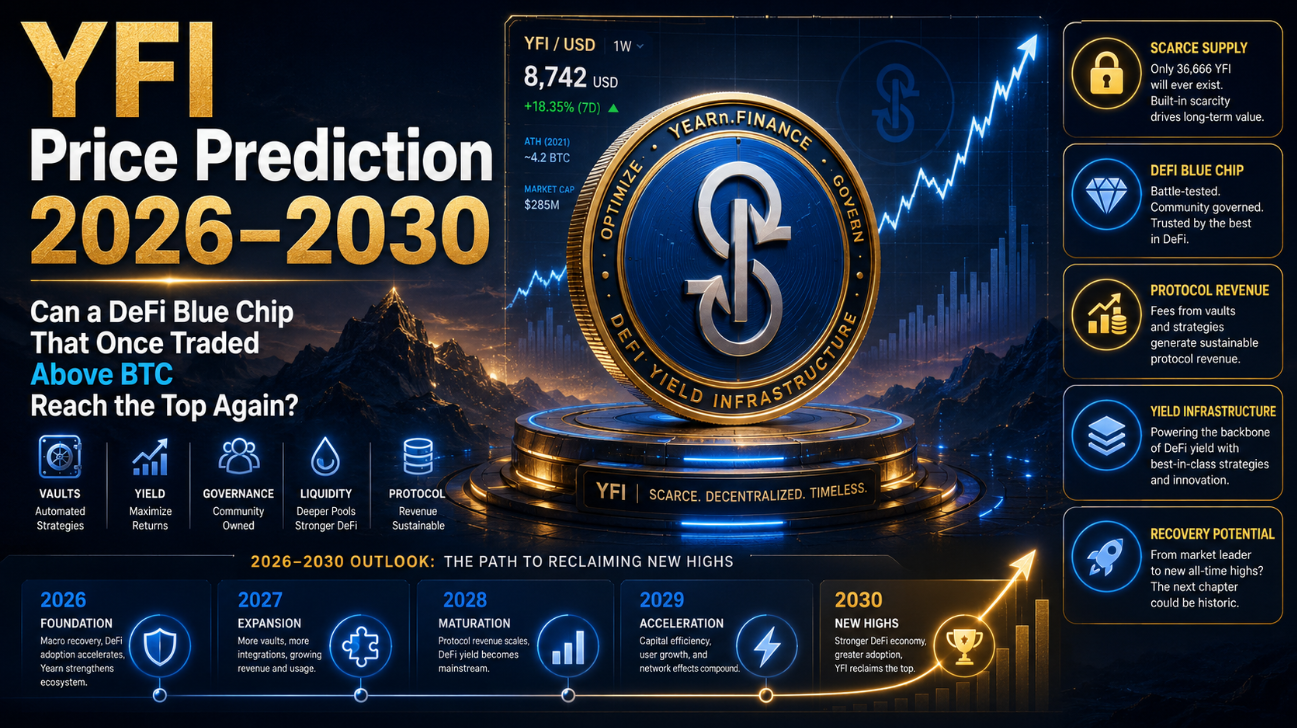
At its peak, YFI traded above $90,000 per token—surpassing Bitcoin's price. Many newcomers see this historical price and develop a dangerous assumption:
"Since YFI once hit $90,000 and now trades at a few thousand, it must be severely undervalued."
That question cannot be answered with a simple yes or no.
Because YFI's price is not determined by its "all-time high." It is determined by how much real value Yearn Finance can create today.
Introduction: A Token That Once Cost More Than BTC—Where Is It Now?
YFI's history is extreme.
When it launched in 2020, there was no traditional fundraising, pre-mine, or team allocation. It was distributed entirely through liquidity mining—a fair launch. This design caused a massive stir in the DeFi community because it represented the ideal version of DeFi ethos: no VC privilege, no team front-running, users contribute liquidity first, and the community governs together.
Combined with YFI's extremely low total supply, the market quickly elevated it to legendary status.
At its most frenzied moment, YFI traded above $90,000 per token. This number left a deep impression on newcomers: an altcoin more expensive than Bitcoin.
But today, YFI's position is entirely different. CoinMarketCap currently shows YFI at approximately 2,786**, with a circulating supply of roughly **35,716 tokens** and a market cap of about **99.5 million. YFI remains a legacy DeFi project, but it is no longer a core narrative asset.
This is precisely what makes YFI worth studying:
It is not a scam coin, nor is it a pure meme token. It once had real product, real TVL, real revenue, and a strong community. Yet even so, it collapsed dramatically from its all-time high.
This illustrates a critical investment reality:
A project that was once great does not guarantee it will remain great.
Chapter 1: What Is YFI, Really? 90% of Newcomers Get It Wrong
Many newcomers simplistically label YFI as a "DeFi farming coin" or "yield aggregator token." That isn't entirely wrong, but it is far too crude.
Yearn Finance, the protocol behind YFI, is fundamentally a DeFi yield aggregation protocol. It helps users deposit assets into various strategies that automatically seek relatively better yield paths. DeFiLlama defines Yearn Finance bluntly: "Yearn Finance is a DeFi yield aggregator, providing individuals, DAOs, and other protocols a way to deposit digital assets and earn yield."
1. A Simple Analogy for Yearn Finance
Think of Yearn Finance as an automated wealth management butler.
For ordinary users to find yield in DeFi manually, they must:
- Identify which protocol offers the highest yield
- Assess which pools carry controllable risk
- Manually deposit assets
- Manually compound returns
- Constantly monitor APY changes
- Avoid excessive gas costs
- Evaluate protocol security
This is extremely complex for newcomers and time-consuming even for veterans.
Yearn's logic is:
Users deposit assets into a Yearn Vault. Yearn's strategy contracts and strategists allocate funds across different DeFi yield opportunities, maximizing returns while minimizing manual operational costs.
So Yearn's business model is not "launch a token and let people speculate." It is:
Use automated strategies to manage on-chain yield for users, and charge fees on that yield.
This is the biggest difference between YFI and meme coins like SHIB, DOGE, or PEPE. Meme coins derive value from attention; YFI derives value from protocol usage, TVL, revenue, and governance utility.
2. What Is the YFI Token Actually For?
YFI is not a traditional platform token. Unlike BNB, it does not offer explicit trading fee discounts, Launchpad access, or exchange ecosystem binding. YFI is closer to a DeFi governance token.
YFI's value sources include:
- Yearn protocol governance
- Protocol revenue and treasury management expectations
- Community consensus
- Scarcity narrative from low supply
- Blue-chip premium during DeFi cycles
- Market valuation of the yield aggregation sector
But here is a critical warning:
Governance rights do not equal cash flow.
If protocol revenue cannot effectively accrue to YFI's value, or if the market perceives governance rights as weak value-capture mechanisms, then YFI's valuation will be compressed.
This is the core reason many DeFi governance tokens crashed after 2022:
The product still exists, but the token fails to capture the product's value.
3. Andre Cronje and the Fair Launch: Why It Mattered So Much Then
YFI's early mythology owed much to Andre Cronje.
He did not use traditional fundraising, issuance, market-making, or exchange listing processes. He launched Yearn with an almost purist, hacker-like ethos: no pre-mine, no private sale, no team allocation. In the 2020 DeFi landscape, this was profoundly disruptive.
Back then, the market did not value "YFI's marketing budget." It valued:
- The founder's technical influence
- The protocol solving real user needs
- A fair launch mechanism
- Strong community governance perception
- The explosive DeFi Summer narrative
But by 2026, the marginal utility of the "fair launch" narrative has declined.
The market now cares about:
- How much TVL does Yearn still have?
- Is revenue growing?
- Is v3 attracting new users?
- Are competitors stronger?
- Does YFI still have value-capture capability?
In other words, in 2020 the market rewarded "DeFi spirit." In 2026, the market rewards "real operational capability."
4. YFI Has Only ~35,000 Tokens: Is Scarcity a Real Advantage or Just a Narrative?
YFI's supply is indeed extremely low. CoinMarketCap shows approximately 35,716 tokens in circulation. Low supply creates an obvious advantage: the per-token price appears very high, forming a psychological "scarce asset" anchor.
But low supply does not automatically mean the price will rise.
A token's price is determined by two things:
Price = Market Cap ÷ Circulating Supply
If supply is low but the market assigns a low market cap, the unit price will still fall.
If supply is high but the market assigns a high market cap, the unit price can still rise.
So YFI's scarcity has value, but it is not the decisive variable. The decisive variable remains whether Yearn Finance can recapture DeFi market share.
5. HIBT Case Study: The Difference Between Platform Tokens and Protocol Governance Tokens
Using HIBT's research framework, the biggest difference between YFI and platform tokens lies in their value sources.
Platform tokens like HIBT derive value primarily from exchange user growth, trading depth, campaign resources, listing capability, and platform operational efficiency.
Protocol governance tokens like YFI derive value primarily from on-chain protocol TVL, revenue, governance activity, strategy security, and DeFi cycles.
This is why we cannot analyze YFI using the same framework as platform coins.
For a horizontal understanding of valuation differences across token types, refer to HIBT's articles on SNX price prediction, RPL price prediction, and DOT price prediction. SNX leans toward DeFi derivatives infrastructure, RPL toward Ethereum staking infrastructure, DOT toward public chain ecosystems, while YFI belongs to the yield aggregation protocol governance token category. Different sectors, entirely different valuation logics.
Chapter 2: The Core Variables Driving YFI's Price—Not What You Think
Many people analyzing YFI only look at price charts.
That is dangerous.
YFI's price is not determined by technical patterns alone. It is driven by a set of DeFi fundamental variables working in concert.
Variable 1: TVL Is YFI's Most Important Valuation Anchor
TVL (Total Value Locked) represents the total value of assets held in a protocol's smart contracts.
For yield aggregation protocols like Yearn, TVL reflects the scale of assets users are willing to entrust to the protocol. Higher TVL means greater market share and higher potential fee revenue.
DeFiLlama classifies Yearn Finance as a yield aggregator, noting that its TVL represents the total value of all assets held in the protocol's smart contracts.
Why does TVL matter for YFI?
Because Yearn's revenue typically comes from managing assets and strategy-generated yields. If TVL declines, the revenue base shrinks. If TVL grows, there is room for revenue and market confidence to recover.
But here is a counterintuitive point:
TVL growth does not automatically drive YFI price up.
Three reasons:
- TVL may come from low-fee products
- TVL may be attracted by short-term incentives
- The token value-capture mechanism may not be direct
So investors must look beyond absolute TVL to TVL quality.
High-quality TVL should feature:
- Long retention periods
- Stable strategy yields
- High fee contributions
- Users not purely farming subsidies
- No reliance on short-term incentives
Variable 2: Protocol Revenue Matters More Than TVL
TVL is scale; revenue is value.
If a protocol has high TVL but generates almost no revenue, its valuation support for the token is limited.
If a protocol has moderate TVL but stable revenue, clear fee structures, and treasury accumulation, it may actually be healthier.
Yearn's fee structure has evolved. Binance Academy notes that after YIP-69, Yearn introduced dynamic fee mechanisms, with some factory-deployed vaults charging performance fees as low as 10%, and some single-asset vaults charging no management fees at all.
This shows Yearn adapting to market competition:
If fees are too high, users migrate to other yield protocols. If fees are too low, protocol revenue suffers.
For YFI's price to rise in the future, it must prove:
- Yearn can generate stable protocol revenue
- Revenue covers security, development, and operational costs
- Treasury or governance mechanisms indirectly benefit YFI holders
- The market is willing to assign higher valuation multiples to protocol revenue
Variable 3: The DeFi Cycle Determines YFI's Beta
YFI is a classic DeFi beta asset.
When the DeFi sector is hot, YFI attracts capital attention.
When DeFi falls out of favor, YFI's valuation compresses even if the product still works.
During DeFi Summer 2020, the market assigned extremely high valuations to yield aggregation, lending, DEX, and liquidity mining protocols.
After 2022, market narratives shifted to L2s, NFTs, memes, AI, RWA, and BTC ETFs, compressing valuations for many legacy DeFi projects.
So, to judge YFI's next five years, you must first judge whether DeFi will enter a new cycle.
Signals of DeFi recovery include:
- ETH ecosystem activity rebounding
- DeFi TVL growing
- On-chain yields becoming attractive again
- Lending, DEX, and derivatives protocol revenue growing
- Institutional capital entering on-chain yield products
- RWA integrating with DeFi yields
- Stablecoin supply expanding
If these signals appear, YFI will benefit.
If DeFi remains dormant, YFI will struggle to stage a solo breakout.
Variable 4: The Competitive Landscape Has Changed
YFI was dominant in 2020 because yield aggregators were novel.
Today, Yearn faces a far more complex competitive environment:
- Convex captured Curve yield optimization
- Pendle split yields into principal and yield tokens, enabling sophisticated rate trading
- Beefy pursues multi-chain yield aggregation
- EigenLayer and restaking ecosystems created new yield sources
- Various RWA yield protocols are competing for capital
This means Yearn is no longer the only choice for DeFi yield.
YFI's long-term price must answer one question:
With so many yield products available, does Yearn still have irreplaceability?
If Yearn v3 makes strategy creation, vault management, and yield aggregation more open and modular, it still has a chance.
If new protocols lead comprehensively in user experience, yield, risk control, and narrative, Yearn may gradually become marginalized.
Variable 5: Yearn v3 Is a Technical Upgrade and a Valuation Reset Opportunity
Yearn v3 is a critical variable for analyzing YFI's future.
Yearn's official documentation states that V3 is a decentralized yield product system designed to be "un-opinionated and customizable infrastructure"—meaning more neutral, more customizable yield infrastructure where anyone can deploy strategies or manage vaults.
This is crucial.
Because it means Yearn is attempting to evolve from "yield aggregation product" to "yield strategy infrastructure."
If v3 succeeds, Yearn's positioning upgrades.
If v3 fails, it may be just another technical update that cannot reverse market share decline.
Therefore, for YFI's price trajectory 2026–2030, v3 is one of the core watchpoints.
Chapter 3: 2026 YFI Price Prediction—Will DeFi Recover or Stay Dormant?
2026 is a "low-base recovery opportunity year" for YFI.
Current YFI price hovers around 2,800**, with a market cap around **100 million. This represents a massive drawdown from historical highs, indicating extremely conservative market expectations.
But low price does not guarantee reversal.
Whether YFI rises in 2026 depends on four questions:
- Is DeFi recovering overall?
- Is Yearn v3 driving TVL growth?
- Is protocol revenue improving?
- Is the market re-pricing DeFi blue chips?
1. Bull Case: DeFi Recovery + v3 Delivery
If ETH ecosystem activity rebounds in 2026, DeFi TVL grows, on-chain yield opportunities multiply, and Yearn v3 attracts more strategists and capital, YFI could stage a low-base recovery.
In an optimistic scenario, YFI could enter the 12,000–18,000 range.
This range does not require YFI to reclaim all-time highs. It only requires the market to re-recognize YFI as a DeFi blue-chip asset.
Achieving this requires:
- ETH and DeFi sector strength
- Meaningful Yearn TVL recovery
- v3 strategy ecosystem expansion
- Protocol revenue improvement
- YFI regaining exchange and community attention
2. Base Case: Mild DeFi Recovery, But Yearn Is No Longer the Protagonist
The more realistic scenario: DeFi sees some recovery, but capital disperses across AAVE, Pendle, EigenLayer, Lido, Uniswap, and others. Yearn is not necessarily the biggest beneficiary.
In this case, YFI may bounce from lows but with limited upside, in a 6,000–10,000 range.
Here, Yearn retains brand and technical accumulation, but the market will not assign it the valuation premium of 2020.
3. Bear Case: DeFi Remains Dormant
If 2026 capital continues concentrating in BTC, ETH ETFs, AI, RWA, and memes, while the DeFi yield aggregation sector fails to regain attention, YFI may remain range-bound.
In a pessimistic scenario, YFI could oscillate between 3,500–5,000, or even briefly probe lower.
4. 2026 Prediction Range
Scenario
Price Range
Core Conditions
Bear
3,500–5,000
No DeFi recovery; Yearn TVL and revenue remain depressed
Base
6,000–10,000
Mild DeFi repair; v3 makes progress but does not explode
Bull
12,000–18,000
Active ETH ecosystem; Yearn TVL and revenue grow meaningfully
2026 Core Conclusion:
YFI has low-base recovery potential, but only if DeFi re-enters the market spotlight. Otherwise, it risks remaining a "legacy but neglected DeFi blue chip."
Chapter 4: 2027—Can YFI Prove That DeFi Protocols Have Long-Term Value?
2027 matters more for YFI than 2026.
Because in 2026 the market may still speculate on "DeFi recovery expectations." But by 2027, investors will demand results.
Has Yearn actually grown?
Has protocol revenue improved?
Has v3 attracted real developers?
Can YFI capture value?
1. What Revenue Scale Does the Protocol Need?
For YFI to sustainably hold above $10,000, the market must believe Yearn is not just an old protocol, but a continuously income-generating on-chain asset management platform.
A simple valuation framework:
YFI Market Cap = Protocol Annual Revenue × Market-Assigned Revenue Multiple
If Yearn's annual revenue is low, even a 10–20x multiple cannot significantly boost market cap.
If annual revenue grows materially and DeFi markets re-assign high multiples, YFI has stronger upside.
This is why YFI cannot rely on "low supply" alone.
Low supply only amplifies unit price. What truly determines market cap is revenue and market expectations.
2. Could a veToken Reform Change YFI?
If YFI introduces veToken-style lock-up incentives, three effects could follow:
- Reduced circulating supply
- Higher governance participation
- Stronger long-term holding motivation
But veToken is not a panacea.
Many protocols saw short-term selling pressure reduction after introducing lock-ups, but long-term prices still depended on protocol revenue and real demand. Without revenue growth, lock-ups merely delay sell pressure.
3. Could RWA Become Yearn's Second Growth Curve?
RWA (Real World Assets) is one of DeFi's most important future directions.
If on-chain yields no longer come solely from liquidity mining but from Treasury bonds, credit, and real asset yields, yield aggregators could regain value. If Yearn can safely integrate RWA yield products and build risk control systems, it may open new growth space.
But this direction is highly difficult.
RWA involves compliance, custody, KYC, legal structures, and yield source transparency—not something solved by simply plugging in a strategy.
So RWA is a potential positive catalyst for YFI, but it cannot be fully priced in prematurely.
4. 2027 Prediction Range
Scenario
Price Range
Core Conditions
Bear
2,500–4,500
Depressed protocol revenue; competitors continue eating market share
Base
7,000–14,000
Mild TVL and revenue recovery; v3 gradually adopted
Bull
16,000–25,000
Clear DeFi recovery; Yearn becomes one of the core yield infrastructure players
2027 Core Conclusion:
Whether YFI can hold higher ground depends on transforming from a "historical DeFi blue chip" into a "protocol asset that still generates income today."
Chapter 5: 2028—The Dual Game of Halving Cycle + DeFi Regulatory Clarity
In 2028, YFI faces two simultaneous forces:
- The potential new cycle from Bitcoin's fifth halving
- Increasingly clear DeFi regulation
These two forces may not align.
1. BTC Halving's Impact on YFI
BTC halving does not directly increase Yearn's TVL or YFI's protocol revenue.
But it may transmit to DeFi through market risk appetite:
BTC halving expectations → BTC rallies → ETH follows → On-chain activity rises → DeFi TVL grows → Yield protocols benefit → YFI gets valuation repair.
If this path materializes, YFI benefits in 2028.
But if halving effects diminish, or capital remains trapped in BTC/ETH ETFs without flowing into on-chain DeFi, YFI's benefit will be limited.
2. DeFi Regulatory Risk
YFI is a governance token; Yearn is a DeFi protocol.
This means it faces more complex regulatory issues than typical meme coins.
Regulatory risks include:
- Whether governance tokens are classified as securities
- Whether protocol frontends require compliance
- Whether yield products are treated as investment products
- Whether DAO governance carries legal liability
- Whether KYC is required
- Whether protocol revenue distribution triggers regulatory issues
If regulation demands stricter user identification on DeFi frontends, Yearn's usage friction increases.
If regulation targets only centralized entry points without directly restricting smart contracts, the impact may be relatively mild.
3. The Tension Between On-Chain Privacy and Compliance
Yearn has long been built on open, permissionless, on-chain transparency.
But future regulation may demand stronger compliance controls.
This creates a tension:
- DeFi users love permissionlessness
- Institutional capital loves compliance
- Protocols want growth
- Regulators demand risk control
If Yearn can balance openness with compliance accessibility, it may attract new capital.
If it fails, more compliant new yield platforms may steal market share.
4. 2028 Prediction Range
Scenario
Price Range
Core Conditions
Bear
3,000–5,500
Intensified regulatory pressure; DeFi capital flight
Base
10,000–20,000
Halving cycle drives DeFi repair; Yearn grows steadily
Bull
25,000–40,000
Major DeFi cycle restart; Yearn v3 becomes yield infrastructure
2028 Core Conclusion:
If DeFi regulation does not stifle innovation, and the BTC halving triggers a new on-chain cycle, YFI has a realistic chance of significant re-pricing.
Chapter 6: 2029–2030—Three Endgames for YFI and the Probability of Reclaiming All-Time Highs
Five-year predictions must be honest.
By 2030, YFI could re-emerge as a core DeFi asset, become a legacy nostalgia token, or be marginalized due to protocol security, regulatory, or competitive failures.
We will not use a single number. We use three scenarios.
Scenario A: Value Accretion—Yearn Becomes DeFi Asset Management Infrastructure
This is the most optimistic scenario.
In this script, Yearn is no longer just a yield aggregator. It becomes on-chain asset management infrastructure:
- v3 is widely adopted
- A thriving strategist developer ecosystem
- DAOs, institutions, and individual users entrust capital to Yearn
- RWA, ETH yields, and stablecoin yields are all integrated
- Protocol revenue grows stably
- YFI becomes the core of governance and value capture
If this scenario plays out, YFI could enter the 40,000–90,000 range, even challenging its all-time high.
But this requires extremely conditions:
- Overall DeFi prosperity returns
- Yearn recaptures meaningful market share
- Protocol revenue grows significantly
- Security record remains clean
- YFI value-capture mechanisms are market-recognized
- Competitors have not fully replaced it
Scenario B: Slow Marginalization—Legacy DeFi Nostalgia Project
This is the neutral, more realistic scenario.
Yearn continues to operate. YFI continues to trade. The community persists. But growth no longer leads.
Like many legacy DeFi projects, it has brand, history, and technical accumulation—but is no longer the market's most exciting direction.
In this scenario, YFI may oscillate in the 6,000–20,000 range long-term.
It will not go to zero easily, but reclaiming $90,000 becomes highly unlikely.
Scenario C: Substantial Protocol Decline
This is the bearish scenario.
Events that could cause severe YFI decline include:
- Major Yearn security incident
- Long-term TVL attrition
- Sustained revenue decline
- v3 fails to gain adoption
- Regulatory restrictions on yield products
- Competing protocols comprehensively outpace Yearn
- Community governance loses vitality
In this scenario, YFI could fall below $4,000 and lose market attention long-term.
2029–2030 Prediction Range
Year
Bear Range
Base Range
Bull Range
Core Judgment
2029
5,000–8,000
12,000–25,000
30,000–55,000
Whether DeFi restarts; whether Yearn recovers revenue growth
2030
4,000–10,000
15,000–35,000
40,000–90,000
Whether Yearn becomes on-chain asset management infrastructure
2030 Core Conclusion:
Reclaiming YFI's all-time high is not impossible, but it is not the base case. It requires Yearn to transform from a "legacy DeFi protocol" back into "DeFi asset management infrastructure."
Chapter 7: Is YFI Right for You? A Newcomer's Positioning Decision Framework
After reading price predictions, the most common question is:
"So, should I buy YFI now?"
The answer cannot be given directly.
You must first judge whether you are suited to hold YFI.
1. What Type of Investor Is YFI For?

2. How to Control Position Size?
YFI should not be the core holding of a typical newcomer's crypto portfolio.
A more prudent framework:
- Conservative investors: Zero allocation, or below 1%
- Moderate risk investors: 1%–3%
- DeFi-familiar investors: 3%–5%
- High risk tolerance investors: Maximum 8%–10%, never exceed
YFI's positioning should be:
A asset for DeFi recovery periods, not a core holding.
Core holdings are better suited to BTC, ETH, and other assets with stronger liquidity and market consensus.
3. What to Watch for Entry Timing?
Buying YFI should not be based on "how far it has fallen."
Watch three metrics instead:
First: Yearn TVL
If TVL declines consistently, even cheap prices may be value traps.
If TVL stabilizes and recovers, that signals capital is returning to the protocol.
Second: Protocol Revenue
Revenue improvement matters more than TVL.
If Yearn generates more revenue with less TVL, strategy efficiency is improving.
Third: ETH/YFI Ratio
YFI is DeFi beta.
If YFI consistently underperforms ETH without fundamental deterioration, a relative mean-reversion opportunity may exist.
If YFI underperforms ETH due to sustained fundamental decline, do not simply "buy the dip."
4. Stop-Loss Logic
YFI's historical maximum drawdown is extremely deep. Standard small-volatility stop-loss methods do not apply.
A more rational approach is "logic-based stop-loss":
- Yearn TVL declines for multiple consecutive quarters
- v3 shows no real adoption
- Protocol revenue continues to shrink
- Major security incident occurs
- Core developers or community governance face severe problems
- DeFi sector as a whole is displaced by new narratives
Price stops can be set, but not too tight.
For an asset like YFI, 20%–30% swings are not unusual. If you cannot tolerate this volatility, you should not own it.
Chapter 8: YFI vs AAVE, UNI, Pendle: Why Choose YFI?
Analyzing YFI requires horizontal comparison.
Because capital always flows to the most attractive DeFi assets.
1. YFI vs AAVE
AAVE is a lending protocol with a clearer business model.
Users deposit, borrow, and pay interest. The protocol has explicit market demand.
YFI is a yield aggregator, more dependent on external DeFi yield opportunities.
If overall DeFi yields drop, Yearn's attractiveness drops too.
So AAVE's advantage is more fundamental demand; YFI's advantage is higher elasticity if the yield market booms.
2. YFI vs UNI
UNI is the DEX governance token backed by Uniswap's trading volume and brand.
But UNI's long-standing controversy is whether protocol revenue effectively accrues to UNI holders.
YFI faces a similar problem:
The product exists, but is the token's value capture strong enough?
This illustrates the common dilemma of DeFi governance tokens:
Product success does not equal token appreciation.
3. YFI vs Pendle
Pendle is a next-generation yield trading protocol. It splits, prices, and tradifies yields—aligning more with the direction of rate markets.
By comparison, Yearn is more like an automated yield management tool.
If future DeFi yield markets grow more complex, Pendle-like protocols may attract more sophisticated users.
If ordinary users and DAOs still need simple custodial yield management, Yearn retains its space.
4. YFI's Core Advantages
YFI still holds several advantages:
- Strong brand history
- Low supply
- Deep DeFi community recognition
- Long-standing Yearn technical accumulation
- v3's infrastructure potential
- Valuation already heavily compressed post-bear market
5. YFI's Core Disadvantages
But its problems are equally obvious:
- Growth narrative weaker than newer protocols
- TVL and revenue need to be re-proven
- Governance token value capture is not direct enough
- Yield aggregation sector is fiercely competitive
- All-time high creates dangerous psychological anchoring for investors
Therefore, choosing YFI is not because it "used to be expensive."
It is because you believe Yearn can find its place again in the next DeFi cycle.
Conclusion: Three Things You Must Know About YFI's 5-Year Prediction
First: YFI's biggest risk is not price decline—it is the protocol losing relevance.
Price declines can reverse.
But if the protocol is forgotten by the market, TVL bleeds out, revenue drops, and developers leave—that is true long-term risk.
YFI's core question is not "can it get back to $90,000?" It is:
Will Yearn still be irreplaceable by 2030?
Second: Low supply cannot save fundamentals.
YFI's low supply is an advantage.
But low supply is not a moat.
If protocol revenue declines, market share drops, and users stop using the product, no amount of supply scarcity can sustain a high valuation long-term.
Third: YFI's value formula is simple.
If you can only remember one formula, it is this:
YFI Value = Yearn Protocol's Real Revenue Capability × Market-Assigned DeFi Valuation Multiple
When revenue grows and DeFi valuation multiples expand, YFI has strong elasticity.
When revenue declines and DeFi multiples compress, YFI will suffer.
This matters more than any "2030 price target."
YFI Price Prediction Summary Table: 2026–2030

Appendix 1: YFI Key Data Table

Appendix 2: YFI vs HIBT Research Framework Comparison

Disclaimer
This article is for crypto asset research and market education only. It does not constitute investment advice, trading advice, or financial advice. YFI is a high-volatility DeFi governance token. Prices may fluctuate dramatically due to TVL, protocol revenue, smart contract security, regulatory changes, market liquidity, and DeFi cycles. Any investment decision should be based on personal risk tolerance, and professional financial advice should be sought when necessary.