
Introduction: Why LINK Is One of the Most Abused Coins by Prediction Sites
Search “LINK price prediction” and you’ll find countless clickbait articles: one day screaming “about to explode to $50,” the next warning “heading to zero.” Most follow the same formula — copy the Chainlink website intro, slap on a few historical charts, draw an arbitrary price range, and end with “DYOR” to sound professional. They create an illusion of expertise by listing irrelevant data while avoiding the real questions: Where does LINK’s actual demand come from? Can protocol revenue effectively flow back to token holders?
Unlike many DeFi governance tokens, LINK has genuine enterprise-grade adoption. It is not purely speculative — it serves as a critical bridge between blockchains and the real world. Without reliable oracles, DeFi lending protocols cannot access external prices, Real World Assets (RWA) tokenization cannot settle safely, and cross-chain applications struggle to function. This makes LINK’s valuation logic more grounded in fundamentals than hype.
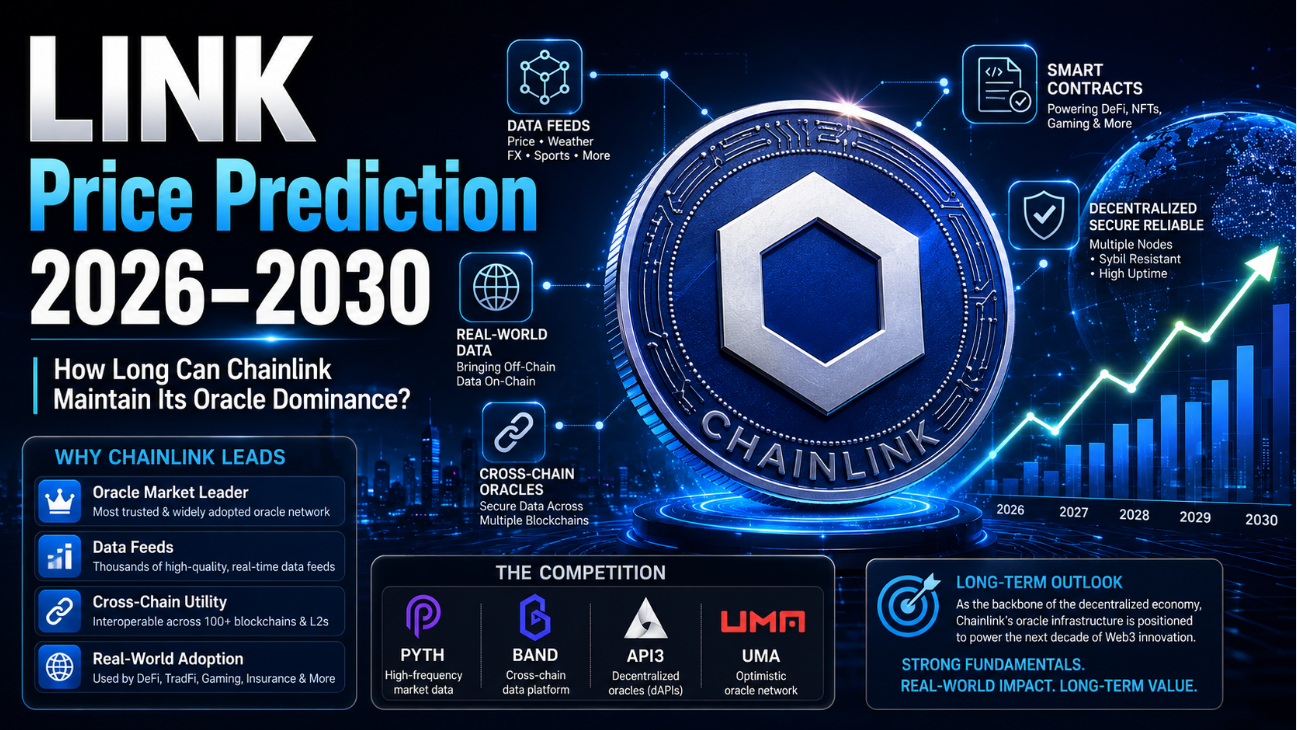
This article uses a multi-scenario framework (Optimistic, Neutral, Pessimistic) and focuses on key drivers such as CCIP progress, staking lockups, and RWA adoption. It provides three practical tools: 1) on-chain and platform signals for entry/exit, 2) a PS valuation model for upside potential, and 3) a risk exit checklist. The goal is to help you build independent judgment rather than chase pumps and dumps.
First: Before Buying LINK, Understand Why This Token Exists
Oracles are the “eyes and ears” of blockchains. Smart contracts cannot directly access off-chain data (such as ETH/USD prices, stock quotes, or weather). Chainlink delivers this information securely through a decentralized network of nodes. Without it, roughly 90% of DeFi protocols would collapse due to untrustworthy data, and RWA projects could not safely map real-world assets on-chain.
LINK’s Role: It serves as the fuel to pay node operators for data services and as collateral for network security. Operators earn LINK rewards for providing accurate data; malicious behavior results in slashed stakes — creating a strong value loop. Staking v0.2 is now live, and community staking pools add extra security while reducing circulating supply.
Real-World Users: From DeFi blue chips like Aave and Synthetix to traditional institutions such as Swift, ANZ Bank, and DTCC. Enterprise adoption means recurring, reliable data demand — not one-off speculation. This provides solid fundamental support for LINK’s price.
Hibt Practical Guide: Before buying LINK on Hibt, check three key metrics: 1) 24h volume and order book depth (to ensure sufficient liquidity and avoid slippage), 2) changes in futures open interest (to gauge whale activity), and 3) funding rates on LINK/USDT pairs (to measure market sentiment). These indicators help determine good entry timing far better than social media hype.
Second: Core Variables That Actually Drive LINK’s Price
A reusable valuation framework for LINK rests on four key dimensions:
CCIP Commercialization: Chainlink’s Cross-Chain Interoperability Protocol upgrades it from a pure data provider to critical financial infrastructure. Early pilots with Swift and others are underway for real cross-border settlements. Large-scale adoption in 2026 would significantly boost LINK payment demand.
Staking Mechanics: Every 10% increase in staked LINK meaningfully reduces circulating supply and creates price support. Although pool capacity is still limited, rising staking ratios are structurally bullish.
RWA Explosion: If tokenization of real-world assets reaches trillions in scale, Chainlink — as the leading pricing and settlement oracle layer — stands to capture massive incremental demand.
Competitive Landscape: Pyth offers advantages in speed and chain coverage, API3 emphasizes direct connections, and Band Protocol remains niche. However, Chainlink maintains the deepest moat thanks to the highest Total Value Secured (TVS) and strong enterprise trust. Competition is currently more complementary than existential — unless a rival breaks through significantly in institutional adoption.
Hibt Sentiment Tool: Watch LINK futures open interest and funding rates on Hibt. Sustained positive funding with rising open interest often signals greed (watch for pullbacks). Negative funding may indicate fear (potential opportunity).
Third: 2026 LINK Price Prediction — Can the Bull Market Push LINK to New All-Time Highs?
LINK relatively underperformed in the 2021 bull run because infrastructure narratives lagged behind memes and Layer-1 tokens. The 2026 cycle could be different: early CCIP adoption, mature staking, and post-Bitcoin halving capital rotation into infrastructure plays.
Scenario Analysis:
- Optimistic (CCIP large-scale commercialization + institutional RWA inflows + sharp rise in staking lockups): $35–55. Requires Swift-style partnerships moving into production and TVS hitting new highs.
- Neutral (steady growth, no explosive catalysts): $18–30. Reflects DeFi recovery with moderate macro conditions.
- Pessimistic (tightening rates + competitive fragmentation): $8–14, consolidation at the bottom.
Hibt Take-Profit Signals: In a bull market, watch for large withdrawals on Hibt, concentrated unstaking by node operators, or extremely positive funding rates — these are good opportunities to scale out profits.
Fourth: 2027 LINK Price Prediction — Can “Infrastructure Premium” Hold Up in a Bear Market?
LINK once fell over 90% from $52 to near $5. In the next bear market, structural improvements (recurring enterprise revenue and higher staking lockups) may cushion the downside and create a higher price floor.
Scenario Outlook:
- Optimistic (continued adoption + high staking): $14–22.
- Neutral (market-wide decline but fundamentals hold): $8–13.
- Pessimistic (prolonged crypto winter + delayed RWA narrative): $4–7.
Hibt Strategy: In bear markets, deploy idle LINK into Hibt Earn/lending products for low-risk yield. This generates annualized returns and reduces psychological pressure of holding through drawdowns.
Fifth: 2028 LINK Price Prediction — Will It Be the Biggest Winner of the RWA Narrative?
As the mid-cycle year, 2028 could see rapid RWA market growth into the trillions. Chainlink, as the core data and cross-chain layer, is positioned as one of the primary beneficiaries. Successful bank-to-bank settlements via SWIFT integration and commercialization of Functions and Data Streams would drive substantial demand.
Scenario Ranges:
- Optimistic (RWA + traditional finance dual explosion): $28–45.
- Neutral (partial realization): $15–25.
- Pessimistic (slow rollout): $8–13.
Hibt Strategy: During range-bound recovery, consider grid trading on Hibt to capture volatility and enhance returns.
Sixth: 2029–2030 LINK Price Prediction — What’s the Next Cycle’s Ceiling?
Long-term, widespread crypto ETF adoption, regulatory clarity, and sovereign institutions moving on-chain will fuel institutional DeFi. Assuming annual protocol revenue reaches $1 billion (driven by RWA and CCIP scale), applying a 20–40x PS multiple (typical for traditional data/service providers) suggests significant re-rating potential.
2030 Scenarios:
- Optimistic (established financial infrastructure status): $75–120. Requires broad CCIP adoption, RWA explosion, and mature staking ecosystem converging.
- Neutral: $40–65.
- Pessimistic (intensified competition or market contraction): $15–28.
Hibt Long-Term Strategy: Combine staking via Earn products, liquidity mining, or dollar-cost averaging to compound returns beyond simple holding.
For broader portfolio construction, consider other infrastructure predictions such as YFI Price Prediction 2026–2030, SHIB Price Prediction 2026–2030, and RPL Price Prediction 2026–2030.
Seventh: How Different Types of Investors Should Use This Analysis
- Beginners: Dollar-cost average (e.g., buy now + on 10–20% dips). Keep initial allocation to 5–10% of total crypto assets.
- Intermediate Holders: Scale out at bull market peaks while keeping a core position.
- Advanced Traders: Focus on three windows — 2026 bull market launch, 2028 RWA catalysts, and 2029–2030 new cycle.
Portfolio Suggestion: LINK works best as a satellite holding (10–20% of crypto portfolio) to complement BTC and ETH.
Full Hibt Path: Register on Hibt → Complete verification → Buy LINK with fiat or crypto → Set price alerts and stop-loss/take-profit → Regularly track Chainlink’s official site, staking data, and Hibt metrics.
Exit Checklist: Main competitors sustainably overtake in TVL/adoption, staking amounts decline long-term, CCIP adoption stalls, or no new enterprise partnerships. Reassess the bullish case if these occur.
Conclusion: LINK’s Core Investment Thesis in One Sentence
Investing in LINK is a bet that “someone must build the bridge between blockchains and the real world — and Chainlink is currently the most qualified to do it.” Price predictions can be wrong, but the infrastructure moat is worth long-term monitoring.
Action Step: Open Hibt now, check LINK’s real-time staking volume, holder distribution, and trading data to validate the points in this article.
Disclaimer: This article is for market analysis and educational discussion only. It does not constitute investment advice. Cryptocurrency investments carry extreme risk and may result in total loss of capital. Always do your own research (DYOR) and make decisions based on your personal risk tolerance. Past performance is not indicative of future results.
Author: Independent researcher focused on DeFi and infrastructure sectors for many years. Analysis emphasizes fundamental drivers and multi-scenario frameworks. Opinions are personal and do not represent any platform.
FAQ
Q1: What’s the biggest difference between LINK and typical DeFi tokens?
A: LINK has real paid usage and enterprise adoption, rather than relying mainly on governance or speculation.
Q2: Is staking worth it?
A: Staking v0.2 offers yields and reduces circulating supply — attractive for long-term holders. Be aware of unstaking periods and network risks.
Q3: Is $100 by 2030 realistic?
A: Possible in the optimistic scenario, but it requires multiple catalysts to align. A more realistic target depends on adoption speed.
Q4: Is Hibt suitable for trading LINK?