
Introduction: Why COMP Price Prediction Is One of the Toughest Topics in DeFi
In the crypto market, many tokens can be roughly forecasted using narrative hype and broader market cycles. However, COMP (Compound’s governance token) is entirely different. As the core governance token of the Compound lending protocol, its price is deeply intertwined with the protocol’s actual borrowing volume (TVL and revenue), overall DeFi adoption rates, regulatory developments, and governance decisions. Traditional chart analysis or simple narrative logic often fails to capture its movements accurately.
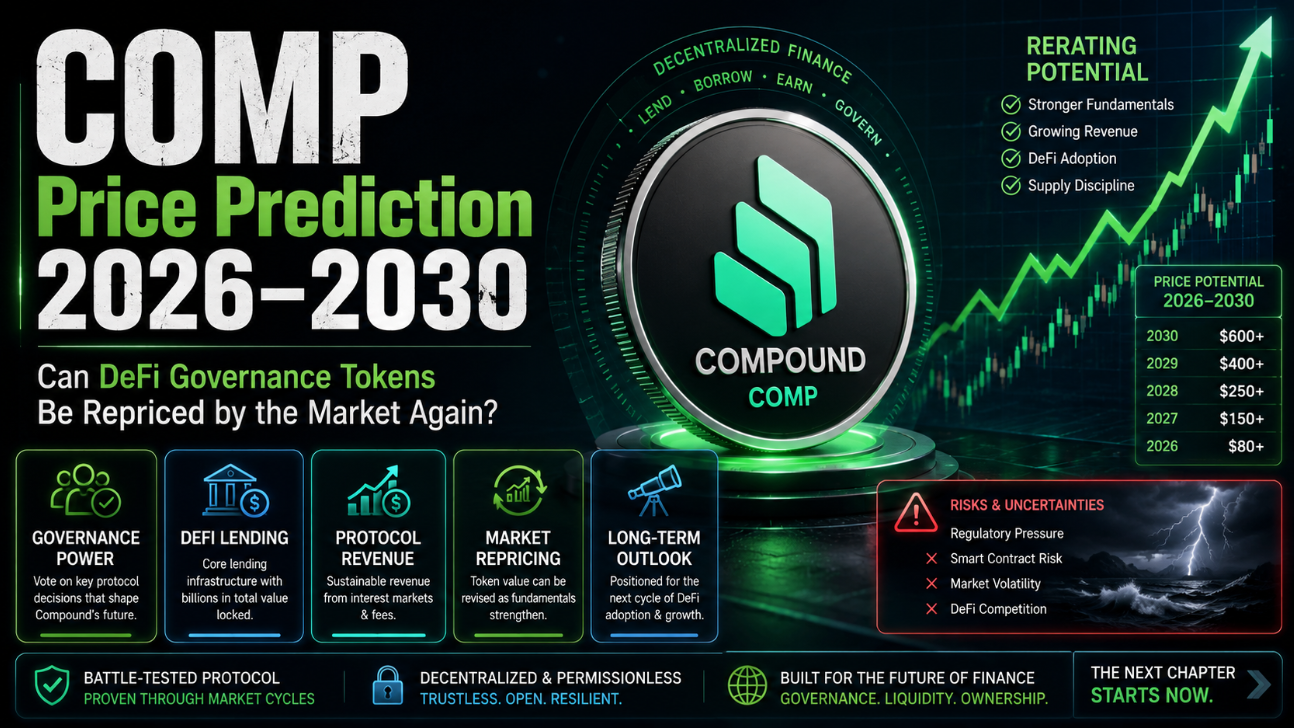
What Exactly Is COMP?
COMP is the governance token of the Compound protocol. Holders can propose and vote on critical decisions such as asset listings, risk parameters, and protocol upgrades. Compound III (Comet) currently has around $1.4 billion in TVL and maintains meaningful daily borrowing activity. However, COMP holders primarily receive governance rights rather than direct cash flow distributions — this is the core of its valuation challenge.
COMP surged to around 23–24 during the 2021 DeFi bull market. Its prolonged underperformance is not due to a failure of the lending model, but rather the “value capture gap” typical of governance tokens: the protocol generates real revenue, yet COMP holders have limited direct ways to share in it, creating long-term pricing pressure.
A key contradiction is that while Compound generates daily lending revenue, it has not yet activated fee distribution to COMP holders. This stands in stark contrast to tokens like GMX and dYdX, which offer revenue sharing. Recent community discussions around a “fee switch” and stCOMP yield mechanisms could significantly reshape COMP’s valuation if implemented.
Like many high-volatility assets, COMP’s price is heavily dependent on ecosystem activity and value capture efficiency. Investors may also reference analyses of other DeFi and platform tokens, such as LINK Price Prediction 2026–2030 and TRB Price Prediction 2026–2030.
1. Understanding COMP’s Value Foundation — 5 Core Questions You Must Answer Before Forecasting
1.1 The Valuation Dilemma of Governance Tokens: Why Is COMP Valuable?
Governance rights essentially grant voting control over a protocol handling billions in lending. Its pricing logic is far more complex than tokens with direct revenue sharing. If the community approves a fee distribution proposal (currently under discussion), COMP could shift from a pure governance token to a hybrid yield + governance model, potentially leading to a significant valuation re-rating. Compared to GMX and similar projects, COMP currently lacks direct cash flow capture.
1.2 The Real Relationship Between TVL and COMP Price
Compound’s TVL has declined from over $10 billion at its 2021 peak to around $1.4 billion today, with COMP price following a similar trajectory. However, history shows frequent divergences where TVL grows but COMP lags. Leading indicators include protocol revenue, liquidity mining incentives, and governance expectations — not just TVL alone.
1.3 Token Inflation Pressure
COMP has a total supply of 10 million tokens, with approximately 96–97% currently circulating — nearly fully unlocked. There is no major future unlock overhang. Historically, rewards were distributed via governance mining. Reducing these rewards could be short-term bearish (less incentive) but long-term bullish (lower inflation).
1.4 Regulatory Risk
Compound is one of the more compliant DeFi protocols, but SEC scrutiny on DeFi remains ongoing. If COMP is classified as a security, it could face significant uncertainty. A more crypto-friendly policy environment in 2025–2026 may provide some relief, but the real impact needs close monitoring.
1.5 Competitive Landscape
Aave leads significantly in TVL, multi-chain support, and innovation. Compound III’s isolated asset lending model is safer but more conservative for growth. Compound could carve out a differentiated edge by focusing on institutional lending or specific market niches.
2. 2026 COMP Price Prediction — Can DeFi’s Recovery Unlock COMP?
DeFi recovery in 2026 will not automatically benefit COMP equally — success depends on value capture reforms and multi-chain expansion.
Catalysts: Compound III expansion across chains (Arbitrum, Base, etc.), institutional partnerships, successful fee switch implementation, and increased collateral demand driven by ETH ETFs.
Risks: Regulatory pressure, Aave’s continued dominance, and slow reforms.
2026 Price Range Predictions:
- Pessimistic: 25–45 (Slow DeFi recovery + regulatory headwinds)
- Base Case: 55–90 (Moderate recovery + stable ecosystem)
- Optimistic: 100–160 (Institutional inflows + value capture upgrades, ~25-35% probability)
3. 2027 COMP Price Prediction — Bull Market Peak: What Is the Valuation Ceiling for Governance Tokens?
Pure governance tokens typically underperform revenue-sharing assets during bull markets. COMP had strong gains in 2021 but lagged behind many yield-bearing tokens. If the fee switch is implemented before 2027, COMP’s narrative would be significantly strengthened.
Market cap ceiling depends on total DeFi lending volume and Compound’s market share. The 2021 all-time high of ~$910 was inflated by bubble conditions; future prices will require genuine revenue support.
2027 Price Range Predictions:
- Pessimistic: 50–90 (Underperforms competitors)
- Base Case: 120–220 (Normal bull market rally)
- Optimistic: 280–450 (Fee mechanism activated + strong institutional inflows)
4. 2028 COMP Price Prediction — Bull-to-Bear Transition: Will DeFi Governance Tokens Be Among the First to Crash?
DeFi governance tokens often experience amplified drawdowns when liquidity dries up (COMP’s 2022 decline far exceeded BTC). In 2028, high-level risks must be carefully monitored.
Top Signals: Large holders moving tokens to exchanges, TVL inflection points, abnormal borrowing rates, and extreme social optimism.
Protocol Risks: Smart contract exploits or major incidents at competitors could trigger contagion.
2028 Price Range Predictions:
- Pessimistic: 30–65 (Early bear market)
- Base Case: 80–150 (High-level consolidation — window for staged profit-taking)
- Optimistic: 200–380 (Bull market extension followed by correction)
5. 2029–2030 COMP Price Prediction — Will DeFi Lending Become Financial Infrastructure or Remain a Niche Market?
If DeFi lending penetration increases by 2030, the overall market will expand significantly. However, Compound must maintain market share and resolve its value capture issues.
Survival Test: Low-cost L2 competition, governance activity levels, and vampire attacks. Overcoming institutional adoption barriers (compliance, etc.) would be a major positive.
2029–2030 Predictions:
- Zero Risk: Below $5 (low probability — severe market share loss + governance failure)
- Pessimistic: 15–35
- Base Case: 45–90
- Optimistic: 100–200 (Mainstream adoption + successful value capture)
6. Practical Decision Framework for Retail Investors
6.1 What Type of Investor Is COMP Suitable For?
Best suited for those who understand DeFi mechanics, can handle 18–24 month cycles, have medium-to-high risk tolerance, and are comfortable with small allocations. Not ideal for short-term traders or those unfamiliar with the protocol. Suggested portfolio allocation: no more than 5–10%.
6.2 Entry Strategies by Capital Size
- Small capital: DCA at TVL bottoms combined with BTC cycle signals.
- Medium capital: Core DCA + opportunistic buying at extreme lows. Governance participation offers limited direct benefit for small holders.
6.3 Stop-Loss & Take-Profit
Use historical max drawdowns as reference — consider stops at 40–50% below entry (combined with fundamentals). Take-profit in stages: breakeven +50%, 2x, and leave a small runner at highs.
6.4 Key Metrics to Monitor
Weekly checks on Compound Dashboard (borrowing volume & revenue), Token Terminal (P/S ratio), DeFiLlama (market share), and large token transfers.
7. Is COMP a Deeply Undervalued DeFi Blue Chip or a Slowly Decaying Governance Zombie?
COMP Overall Score (out of 10):
- Protocol Fundamentals: 8/10 (Established lending leader)
- Token Economics: 4/10 (Value capture needs major upgrade)
- Competitive Moat: 5/10 (Aave leads)
- Team & Governance Activity: 7/10
- Regulatory Risk Exposure: 6/10
- Liquidity & Trading Depth: 7/10
Final Verdict:
COMP retains strong DeFi blue-chip heritage, but without meaningful fee distribution by 2026–2027, a major re-rating is unlikely. It is most suitable for long-term believers in DeFi infrastructure who can actively track or participate in governance. The 2026 low-accumulation window offers relatively attractive risk-reward. Many investors may prefer earning yield directly through Compound lending or holding tokens with clearer revenue sharing (such as Aave) over holding COMP itself.
FAQ: Common COMP Price Prediction Questions
Q1: Can COMP return to its all-time high of $910?
Extremely difficult. It would require DeFi mainstream adoption, Compound regaining significant market share, and complete value capture transformation. Even in optimistic scenarios, this is unlikely by 2030.
Q2: Is the fee switch proposal a major catalyst for COMP?
Yes. If implemented, it would add a yield component and fundamentally reshape COMP’s valuation logic.
Q3: Is COMP suitable for long-term holding?
Yes for investors bullish on DeFi’s long-term infrastructure role, but it requires tolerance for high volatility and governance uncertainty.
Q4: Which is better — COMP or Aave?
Aave currently leads in most metrics. COMP is more suitable for those betting on a differentiated revival or valuation recovery.
Q5: Is 2026 a good time to buy COMP?
It could be a solid observation and gradual accumulation window. Focus on reform progress and DeFi recovery signals.
Q6: What is COMP’s biggest risk?
Prolonged value capture failure, loss of competitiveness, and regulatory shocks that diminish the relevance of its governance model.
Author Bio
Author: Luke|Web3 SEO & Crypto Growth Researcher
Luke has long tracked DeFi protocols, governance token economics, and on-chain data. This article is compiled from public sources including DeFiLlama and Token Terminal for reference only.
Disclaimer
This article is for informational and market research purposes only. It does not constitute investment, financial, or trading advice. Cryptocurrency prices are highly volatile. COMP is a high-risk token that may experience significant fluctuations or loss of value. All investment decisions should be based on your own risk tolerance and independent research (DYOR). Never invest money you cannot afford to lose.
References & Data Sources
- DeFiLlama (TVL & market share)
- Token Terminal (protocol revenue & valuations)
- Compound official website & governance forum
- CoinMarketCap / CoinGecko (price data)
- Messari, Dune Analytics
- HIBT platform-related analysis articles
Investing involves risks. Please trade responsibly.
Stay tuned to the HIBT platform for more in-depth DeFi and governance token analysis.