
Introduction: YGG Is Not Just Another Altcoin — It’s a Sentiment Amplifier for the GameFi Cycle
In the cryptocurrency market, many tokens can be explained simply through broader market cycles and narrative hype. YGG (Yield Guild Games) is different. It was one of the flagship projects of the previous GameFi bull run and remains a representative token of the Web3 gaming guild ecosystem. Its price is highly dependent on real user growth in Web3 games, the sustainability of the guild model, and overall market confidence in Play-to-Earn mechanics.
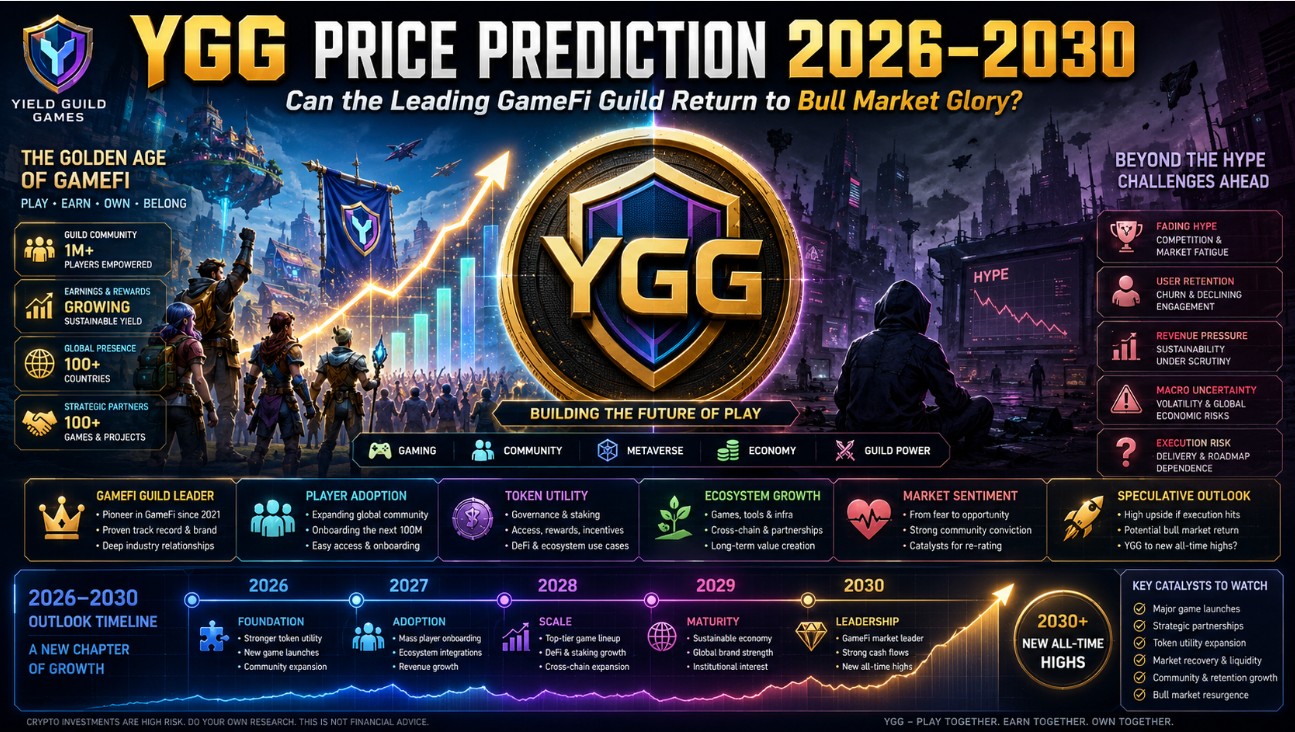
YGG exploded in 2021 alongside Axie Infinity, surging from lows to an all-time high above $11 and becoming a star of the GameFi sector. It later crashed more than 95% in the bear market and currently hovers around $0.04, with a market cap of roughly $30 million. This extreme volatility makes YGG a clear sentiment amplifier for the GameFi cycle: massive upside elasticity when narratives heat up, and brutal drawdowns when they cool.
Why Is YGG Price Prediction More Complex Than Most Altcoins?
Standard altcoins are mainly driven by narrative, liquidity, macro cycles, and community sentiment. YGG requires additional scrutiny of real Web3 game MAU (Monthly Active Users), partner game activity, guild model sustainability, and whether players can actually earn meaningful rewards. These factors make traditional technical analysis insufficient on its own.
What this article will NOT do: Promise YGG will definitely rise, fabricate numbers with “AI models,” treat the all-time high as a target, or encourage all-in bets.
What this article WILL do: Systematically break down YGG’s core logic, reasons for the crash, scenario-based forecasts for 2026–2030, breakout conditions, marginalization risks, and a practical risk management framework for retail investors.
Like many high-volatility crypto assets, YGG’s price is driven not just by charts but by ecosystem activity, user growth, and market sentiment. When reading YGG predictions, investors may also reference cycle analyses of similar volatile tokens, such as LINK Price Prediction 2026–2030 and TRB Price Prediction 2026–2030.
1. What Is YGG and Why Was It a GameFi Bull Market Star?
1.1 YGG’s Core Positioning: Not a Game, but a Web3 Gaming Guild
YGG (Yield Guild Games) is a Web3 gaming guild ecosystem. Its core model involves acquiring or holding game NFTs (such as Axies or virtual land), renting them to “scholars” (everyday players), who earn through Play-to-Earn mechanics. Revenue is then split between the guild and players. The YGG token is used for governance, incentives, and ecosystem participation.
YGG is not focused on developing a single game. Instead, it aims to become:
- A Web3 gaming player organization platform
- A game asset management network
- A player traffic distribution gateway
- A cross-game ecosystem collaboration hub
1.2 Why Did YGG Explode in 2021?
The 2021 surge was driven by four key factors: Axie Infinity igniting the Play-to-Earn narrative, skyrocketing NFT prices, massive influx of new players, and bull market liquidity flooding the GameFi sector. The market broadly believed in a future where “playing games could make money,” and YGG, as infrastructure, received extremely high valuations.
1.3 Why Did YGG Collapse After 2022?
The collapse resulted from multiple overlapping factors: rapidly declining Play-to-Earn yields, fading Axie hype, imbalanced game economies, shrinking NFT values, and bear market selling of high-risk assets. Players shifted from “earning” to exiting. This was not simply a project failure but a market re-pricing of the previous generation of P2E models in a bear market.
2. Four Core Variables You Must Understand Before Predicting YGG
2.1 Variable 1: Will Web3 Gaming Grow Again?
YGG’s long-term value depends first on the broader Web3 gaming industry. Institutional forecasts project the market reaching $28–37 billion by 2025 and potentially hundreds of billions to over a trillion by 2030–2035, with a CAGR exceeding 18%. Key metrics to watch: monthly active users, active wallets, NFT trading volume, and the number of YGG partner games.
2.2 Variable 2: Can YGG Successfully Upgrade Its Model?
The early “buy NFTs and rent them out” model exposed issues with asset volatility and unsustainable yields. YGG needs to evolve into a player growth network, quest platform, and multi-game collaboration organizer. Success will depend less on how many NFTs it holds and more on whether it can consistently bring real players to games.
2.3 Variable 3: Token Supply and Unlock Pressure
YGG has a total supply of 1 billion tokens, with approximately 74% (740 million) currently circulating. Community unlocks remain in 2026 (notably around May). Pressure must be assessed alongside liquidity and narrative strength. The real danger occurs when low liquidity, large unlocks, lack of positive catalysts, and a weak broader market coincide.
2.4 Variable 4: BTC Cycle and Altcoin Liquidity
YGG is a classic high-beta asset. It performs best during the mid-to-late stages of a BTC bull market when capital rotates into GameFi, and it is among the first to be sold in bear markets.
3. YGG 2026 Price Prediction: Bottom Repair or Continued Stagnation?
2026 is more likely to be a “recovery year.” GameFi remains in a trust-rebuilding phase, with capital prioritizing BTC/ETH and stronger narratives.
Potential Catalysts: Better-than-expected new game partnerships, active ecosystem quests, and BTC strength driving altcoin rebounds.
Main Risks: Prolonged GameFi chill, unlock pressure, and lack of new hotspots.
2026 Price Range Predictions:
- Pessimistic: $0.03–0.08 (GameFi remains weak, capital flows out of altcoins)
- Base Case: $0.08–0.25 (Mild market recovery, ecosystem stays active)
- Optimistic: $0.30–0.60 (GameFi hotspots emerge, trading volume expands)
4. YGG 2027 Price Prediction: Can the Bull Market Peak Bring Back the Magic?
2027 could be a major rebound window for YGG. If altcoin rotation and GameFi narratives return, the former leader may be re-rated.
Returning to the 2021 high of $11 is extremely difficult and would require explosive real user growth in Web3 gaming, successful transformation by YGG, and a strong sector-wide bull market. Competitors include Merit Circle, GuildFi, Treasure, Immutable, and others. YGG must evolve from an “old-generation guild” into “player network infrastructure” to maintain its premium.
2027 Price Range Predictions:
- Pessimistic: $0.05–0.15
- Base Case: $0.20–0.80
- Optimistic: $1.00–2.50 (GameFi breakout + successful transformation)
5. YGG 2028 Price Prediction: Bull-to-Bear Transition — How to Spot Top Risks
If the previous two years see a bull market, 2028 may bring high-level consolidation and differentiation. YGG could surge quickly and then retrace sharply.
Top Signals:
- On-chain: Whale distribution, increased exchange inflows, stagnant holder addresses
- Market: Price rises on declining volume, extreme social optimism
- Ecosystem: Declining player activity, reduced governance participation
2028 Price Range Predictions:
- Pessimistic: $0.04–0.12 (Bull market ends early)
- Base Case: $0.15–0.50 (Cyclical correction)
- Optimistic: $0.80–2.00 (Bull market extends)
6. YGG 2029–2030 Price Prediction: Next Cycle Starting Point or Long-Term Marginalization?
Whether YGG survives two full cycles depends on its ability to transition from “2021-era narrative” to “2030 Web3 gaming infrastructure.” If Web3 gaming goes mainstream, YGG could become a player identity network and user acquisition channel. If it fails to break out, it risks long-term valuation compression.
2029 Predictions:
- Pessimistic: $0.03–0.10
- Base Case: $0.15–0.60
- Optimistic: $0.80–2.00
2030 Predictions:
- Rug/Zero Risk: $0.01–0.03 (Low probability — model completely fails)
- Pessimistic: $0.05–0.15
- Base Case: $0.20–0.80
- Optimistic: $1.00–3.00 (Successful transformation + mainstream adoption)
7. YGG vs. HIBT: What Are the Shared Risks of High-Volatility Tokens?
Although YGG and HIBT are different project types, both are high-volatility assets whose prices depend heavily on ecosystem activity, user growth, trading liquidity, and market sentiment.
Shared Upside Logic: Improving on-chain data + rising risk appetite + new narratives.
Shared Downside Logic: Fading hype + liquidity contraction + whale selling pressure.
Investors should focus on questions like “Is the ecosystem still growing?” and “Does the token have real demand?” rather than fixating on all-time highs.
8. How Should Retail Investors Approach YGG? Practical Strategies & Risk Management
8.1 What Type of Investor Is YGG Suitable For?
Suitable for: Those who can tolerate high volatility, understand GameFi cycles, are willing to use small position sizing, and can set stop-loss/take-profit levels.
Not suitable for: Investors seeking stability, those unable to handle 30-50%+ drawdowns, people without position management discipline, or anyone treating YGG as a “sure thing.”
8.2–8.5 Capital Strategies, Stop-Loss & Take-Profit
- Small capital (< $1,000): DCA in + strict stop-loss. Avoid going all-in.
- Medium capital: Limit to 5-10% of total portfolio. Build positions gradually and take profits in stages (first target: 2x to recover capital, then scale out while leaving a small runner).
- Stop-loss guidance: 15-25% for short-term; for longer holds, use key support levels and ecosystem deterioration signals.
- Take-profit emphasis: Having big gains without a plan is one of the most dangerous situations.
8.6 Red Flag Signals
Partner games shutting down, declining player activity, lack of team updates, large exchange inflows, fading GameFi narrative, clear BTC downtrend — reassess immediately upon seeing these.
9. YGG 2026–2030 Comprehensive Price Prediction Table

These forecasts are scenario-based projections, not investment advice. YGG is a high-volatility asset — all ranges should be dynamically adjusted based on market data, ecosystem progress, and macro conditions.
10. Is YGG Worth Buying? Final Risk Rating
YGG Overall Score (out of 10):
- Team & Brand: 7/10 (Legacy recognition remains)
- Ecosystem Activity: 5/10 (Needs to prove real player growth)
- Token Model: 4/10 (Value capture needs strengthening)
- Liquidity: 6/10 (Base exists but highly volatile)
- Long-term Narrative: 6/10 (Depends on Web3 gaming revival)
- Risk Management Difficulty: 8/10 (High volatility)
Final Verdict:
YGG’s opportunity lies in its legacy GameFi leader brand recognition and the potential to evolve from a guild into a player network. Risks are equally significant: the previous model has been re-priced, Web3 gaming mainstream adoption is unproven, and token value capture must improve.
YGG is best suited as a small, high-conviction, high-beta allocation for investors with high risk tolerance. It is not suitable for those seeking stability or unable to handle large drawdowns. The most rational approach: accumulate gradually at lows, take staged profits during strength, and exit promptly if the ecosystem deteriorates.
FAQ: Common YGG Price Prediction Questions
**Q1: Can YGG reach $10 by 2030?** Theoretically not impossible, but extremely unlikely. More realistic ranges are $0.20–0.80 (base) and $1.00–3.00 (optimistic).
Q2: Will YGG return to its all-time high?
Difficult in the short-to-medium term. It needs to prove irreplaceable utility rather than relying purely on sentiment.
Q3: Is YGG suitable for long-term holding?
It can be held as a high-risk watchlist item but should not form a core stable position.
Q4: How is YGG different from regular game tokens?
YGG is a cross-game player guild and ecosystem organizer, not tied to a single game.
Q5: What is YGG’s biggest risk?
Ecosystem value being disproven by the market, leading to chronically weak new demand.
Q6: Is 2026 a good time to buy YGG?
It could be an important bottom-accumulation observation phase, but decisions must be based on multi-dimensional data — not suitable for heavy positioning.
Author Bio
Author: Luke | Web3 SEO & Crypto Growth Researcher
Luke has long focused on crypto trading platforms, Web3 project growth, SEO traffic structures, and crypto asset narrative cycles. Research areas include CEX ecosystems, GameFi, DeFi, on-chain data, token economics, and user growth. This article is compiled from public data, fundamentals, and cycle analysis for reference only.
Disclaimer
This article is for informational and market research purposes only. It does not constitute investment advice, financial advice, or trading recommendations. Cryptocurrency prices are extremely volatile. YGG is a high-risk token that may experience significant fluctuations, prolonged declines, or even go to zero. All investment decisions should be based on your own risk tolerance, financial situation, and independent research (DYOR). Never invest money you cannot afford to lose. Past performance is not indicative of future results.
References & Data Sources
- Yield Guild Games official website and documentation
- CoinMarketCap / CoinGecko: YGG price, market cap, and historical data
- Tokenomist: Token unlock schedule
- DappRadar / Dune Analytics: Web3 gaming and on-chain data
- Token Terminal: Project fundamentals
- Messari, a16z Crypto, Naavik: GameFi and Web3 gaming industry reports
- HIBT platform-related analysis articles
Investing involves risks. Please trade cautiously.
Stay tuned to the HIBT platform for more in-depth GameFi and high-volatility asset analysis and cycle insights.