
The digital frontier is expanding, and at its edge is Web3, the next evolution of the internet powered by decentralization and blockchain technology. For entrepreneurs and investors in Vietnam, a nation at the forefront of digital adoption, this new era presents a landscape rich with opportunity. Understanding and implementing profitable Web3 business models is no longer a futuristic concept; it's a present-day necessity for anyone looking to build a sustainable venture in the digital economy.
This guide provides a comprehensive walkthrough on how to identify, build, and scale profitable Web3 business models specifically for the Vietnamese market. We will explore various blockchain-based revenue streams, from foundational concepts to advanced strategies. Whether you're a newcomer looking for Web3 business models for crypto beginners or a seasoned investor seeking to understand the underlying value of new projects, this article will equip you with the knowledge to thrive.
Why Vietnam is a Prime Ground for Web3 Innovation
Before exploring specific models, it's crucial to understand why Vietnam is an ideal ecosystem for Web3 ventures. The country's unique blend of high cryptocurrency adoption, a young and tech-savvy population, and a burgeoning developer community creates a fertile environment.
- Exceptional Crypto Adoption: Vietnam consistently ranks among the global leaders for cryptocurrency usage. This means there's already a large, addressable market of users who are familiar with digital assets and are actively seeking new platforms and services.
- Mobile-First Population: With high smartphone penetration, the Vietnamese population is accustomed to mobile-first digital experiences. This aligns perfectly with the development of dApps (decentralized applications) and mobile crypto wallets.
- Strong Developer Talent: The nation is known for its skilled and cost-effective pool of software developers, a critical resource for building the complex infrastructure required for Web3 projects.
These factors create immense Vietnam cryptocurrency market opportunities for entrepreneurs who can build business models that cater to local needs while leveraging global technology.
Step 1: Understanding Foundational Web3 Business Models
The shift from Web2 to Web3 introduces new ways of generating revenue that are intrinsically tied to the technology itself. Instead of relying on advertising or data monetization, Web3 models often focus on value creation within a decentralized network.
1. Protocol-Level Revenue (Layer 1 & Layer 2)
At the most fundamental level, the blockchains themselves generate revenue.
- Transaction Fees: Blockchains like Ethereum and Bitcoin charge fees for every transaction processed on their network. A portion of these fees is paid to miners or validators who secure the network. While building a new Layer 1 blockchain is a monumental task, entrepreneurs can participate by becoming validators on Proof-of-Stake (PoS) networks, earning a share of transaction fees.
- Layer 2 Solutions: As Layer 1s like Ethereum become congested, Layer 2 scaling solutions (e.g., Arbitrum, Optimism) have emerged. These protocols process transactions off-chain and batch them onto the main chain, reducing fees for users. Their business model involves capturing a small fee for this service. A venture in Vietnam could focus on building tools or services on top of these Layer 2s to leverage their low-cost environment.
2. Application-Level Revenue (dApps)
This is where most entrepreneurs will find opportunities. dApps are applications built on top of a blockchain, and their revenue models are diverse.
- Usage Fees: Many dApps charge a small fee for using their service. For example, a decentralized exchange (DEX) like Uniswap charges a 0.3% fee on every token swap, which is distributed to liquidity providers.
- Governance Tokens: Many Web3 projects issue governance tokens, which give holders voting rights on the future direction of the protocol. While not a direct revenue stream, the value of these tokens can appreciate as the platform grows, benefiting the founding team and early investors who hold a significant portion.
Case Study: Decentralized Exchanges (DEXs)
The rise of DEXs showcases a powerful Web3 model. Instead of a central company acting as a market maker, users provide liquidity by depositing pairs of tokens into a pool. In return, they earn a percentage of the trading fees. A Vietnamese entrepreneur could launch a DEX focused on assets popular in the local market or create a user-friendly interface that simplifies the process for beginners. Managing the assets for such a platform requires robust security; HIBT provides top-tier security with advanced encryption technology and multi-layer risk controls, ensuring every transaction is fully protected.
Step 2: Exploring Specific Business Models for the Vietnamese Market
With a foundational understanding, you can now explore specific models that are well-suited for the opportunities in Vietnam.
Model 1: The DeFi Service Provider
Decentralized Finance (DeFi) aims to rebuild the traditional financial system on the blockchain. Vietnam’s high crypto adoption and large unbanked population make it a prime market for DeFi services.
- Lending and Borrowing Platforms: Create a platform where users can lend their crypto assets to earn interest or borrow against their holdings. The business model involves taking a small spread between the interest paid by borrowers and the interest earned by lenders.
- Yield Farming Aggregators: Yield farming (moving funds between different DeFi protocols to maximize returns) can be complex. A business can build a platform that automates this process for users, charging a performance fee on the profits generated.
- Staking-as-a-Service: Many users want to earn rewards by staking their tokens but find the technical process daunting. You can offer a service that manages the staking process on their behalf, taking a small commission from the staking rewards.
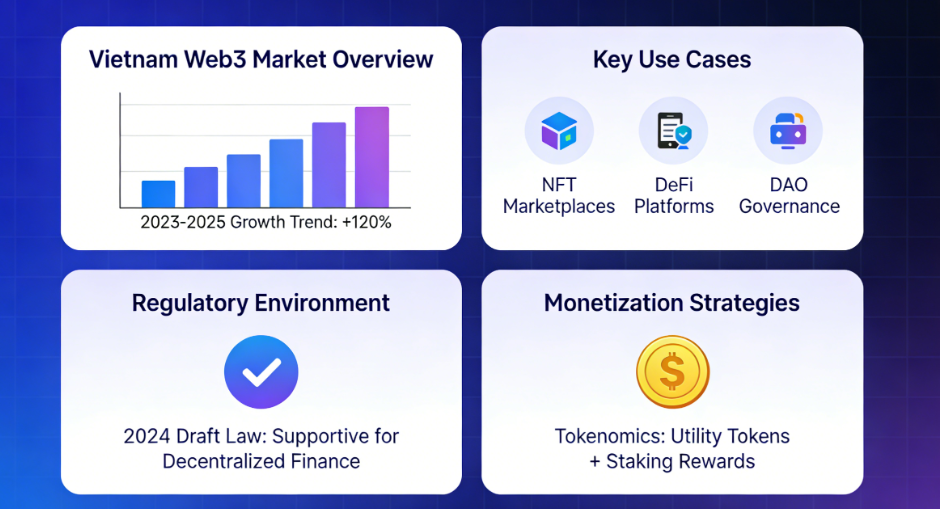
Model 2: The GameFi and Metaverse Creator
GameFi (Game + Finance) has exploded in popularity in Southeast Asia, with Vietnam being a major hub. This model focuses on creating games where players can earn real economic value.
- Play-to-Earn (P2E) Game Development: Develop a game where players earn cryptocurrency or NFTs (Non-Fungible Tokens) that can be traded on open markets. Revenue can be generated from the sale of initial game assets (NFTs), transaction fees on the in-game marketplace, or by retaining a portion of the game’s native token supply.
- Virtual Real Estate and Metaverse Experiences: Build or invest in virtual land within popular metaverses like The Sandbox or Decentraland. You can then develop experiences on that land—such as virtual storefronts, event venues, or mini-games—and charge for access or sell virtual goods.
- Guild Management Platforms: Gaming guilds (like Yield Guild Games) emerged to lend expensive gaming NFTs to players who couldn't afford them, taking a share of their earnings. A business can create a platform to help manage these guilds, providing dashboards, payment processing, and analytics for a subscription fee.
Model 3: The NFT and Digital Collectibles Platform
NFTs represent ownership of unique digital items. While often associated with digital art, their applications are much broader.
- Niche NFT Marketplaces: Instead of competing with giants like OpenSea, create a marketplace focused on a specific niche relevant to Vietnam. This could be a platform for traditional Vietnamese artists, digital fashion from local designers, or collectibles based on Vietnamese folklore. Revenue is typically generated by taking a percentage of each sale.
- NFT-Gated Content and Communities: Create exclusive content, communities, or real-world experiences that are only accessible to holders of a specific NFT. This model, often called "token-gating," creates ongoing value for the NFT beyond simple speculation.
- NFT Utility Platforms: Develop tools that add utility to existing NFTs. For example, a platform that allows users to stake their NFTs to earn yield or a service that enables NFT-based lending.
Platforms for trading these assets must be intuitive. We are committed to building a simple and intuitive trading platform, making it easy for both beginners and experienced traders to navigate. You can explore how leading platforms like https://hibt.com present complex assets to learn how to design a user-friendly interface.
Step 3: Building Your Revenue Streams and Tokenomics
The heart of any Web3 business model is its "tokenomics," or the economic design of its token. A well-designed token aligns the incentives of all participants—users, developers, and investors—to drive network growth.
Designing Blockchain-Based Revenue Streams
- Transaction Fees: Charge a small fee for actions performed on your platform. This is the most straightforward model.
- Subscription Models: For services offering continuous value (e.g., analytics dashboards, advanced trading tools), a recurring subscription fee paid in crypto is a viable model.
- Protocol-Owned Liquidity (POL): Instead of just relying on users to provide liquidity, the protocol itself can own a portion of its liquidity pools. This creates a sustainable source of revenue for the project's treasury.
The Importance of a Governance Token
A governance token serves two primary purposes:
- Decentralized Governance: It allows the community to vote on proposals and guide the project's development.
- Incentive Alignment: By distributing tokens to early users and contributors, you give them a stake in the project's success. As the platform grows, the value of their tokens increases, creating a powerful growth loop.
When designing your tokenomics, consider:
- Total Supply: Will the token have a fixed supply (like Bitcoin) or an inflationary model?
- Distribution: How will tokens be allocated between the team, investors, and the community? A large community allocation is generally seen as favorable.
- Utility: What can users do with the token? Does it grant voting rights, offer fee discounts, or unlock special features? The more utility, the more sustainable its value.
Step 4: Execution - Launching and Scaling Your Venture
With a business model and tokenomics defined, the focus shifts to execution.
Secure Funding and Manage Your Treasury
You can seek funding from traditional VCs, crypto-native funds, or through a community token sale. Once you secure capital, managing your treasury is critical. The volatility of crypto markets means you must have a strategy for converting funds into stablecoins to cover operational expenses. HIBT offers a variety of cryptocurrency trading options, including spot trading, futures contracts, and margin trading, allowing you to adapt to market fluctuations and seize more investment opportunities. Platforms like https://hibt.com provide the tools needed for effective treasury management.
Build a Strong Community
In Web3, your community is your marketing department, your support team, and your user base all in one.
- Engage on Social Media: Be active on platforms like X (Twitter), Discord, and Telegram. Provide regular updates and be transparent about your progress.
- Incentivize Early Adopters: Use airdrops (distributing free tokens) to reward early users and bootstrap your community.
- Listen to Feedback: Use your community as a source of feedback to iterate and improve your product.
Prioritize Security
Trust is paramount. A single security breach can destroy your project.
- Smart Contract Audits: Before launching, have your code audited by reputable security firms.
- Bug Bounties: Offer rewards to ethical hackers who find vulnerabilities in your code.
- Educate Your Users: Teach your community how to protect themselves from scams and phishing attacks.
Conclusion: The Future is Built on New Models
The transition to Web3 is creating a paradigm shift in how businesses are built and how value is created. For entrepreneurs in Vietnam, the combination of a digitally native population and a vibrant tech scene offers a unique opportunity to lead this change. By focusing on models that solve real problems—whether in finance, gaming, or art—and by designing robust tokenomics that align incentives, you can build profitable and sustainable ventures.
Building in this space requires a reliable partner for your financial operations. As a platform deeply embedded in the Vietnamese market, HIBT understands the local needs and provides tailored support. Our customer service team is available 24/7, and we offer payment methods convenient for the local market. To explore the tools that can help you manage your venture's assets or your personal investments, start with a trusted partner like HIBT. The future of business is decentralized, and the time to build is now.
About the Author
Dr. Bao Pham is a leading authority in cryptography and distributed systems. He holds a Ph.D. in Computer Engineering and has authored over 35 peer-reviewed papers on zero-knowledge proofs and blockchain scalability. Dr. Pham has been the lead security auditor for several major Layer 1 and DeFi projects, helping to secure billions in user assets. He is a passionate advocate for leveraging Web3 technology to create more equitable economic systems and frequently advises startups on tokenomic design.