
In Vietnam's booming cryptocurrency market, investors are constantly seeking ways to secure their digital wealth. While you may focus on strong passwords and avoiding phishing links, a more insidious threat is on the rise: the SIM swap attack. This sophisticated scam allows criminals to take control of your phone number, bypass security measures, and drain your crypto accounts before you even realize what has happened. For Vietnamese investors, where mobile phones are central to daily life and financial management, this threat is particularly severe.
Defending against this attack requires more than just personal vigilance; it demands a platform built with robust, multi-layered security. HIBT is engineered to be your fortress against threats like SIM swapping. We provide advanced tools and clear guidance to neutralize this risk, ensuring your assets remain yours. This guide will explain what a SIM swap attack is, detail HIBT's SIM swap prevention measures, and give you the actionable steps needed to secure your crypto journey.
What is a SIM Swap Attack and Why is it a Major Threat in Vietnam?
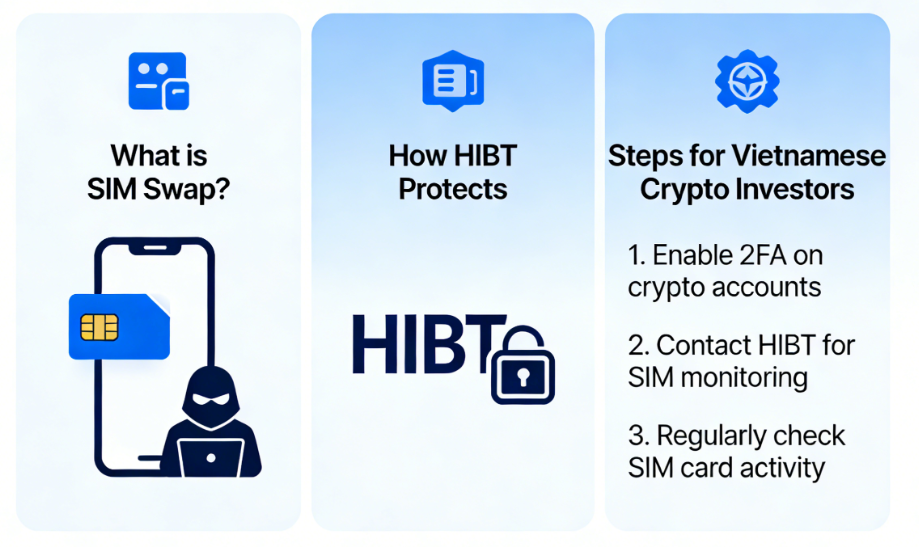
A SIM swap attack, also known as SIM hijacking, is a type of account takeover fraud. Criminals exploit weaknesses in mobile carrier security to transfer your phone number to a SIM card they control. Once they control your number, they receive all your calls and text messages, including one-time passwords (OTPs) and security codes sent via SMS for two-factor authentication (2FA).
How a SIM Swap Attack Unfolds
- Information Gathering: The attacker gathers your personal information through phishing, social media research, or data breaches. They look for your full name, date of birth, phone number, and national ID details.
- Impersonation: The criminal contacts your mobile provider (e.g., Viettel, MobiFone, Vinaphone). They impersonate you, claim your phone was lost or damaged, and request to activate a new SIM card for your number.
- Takeover: If the mobile carrier's employee is convinced, they deactivate your SIM card and activate the one held by the attacker. Your phone suddenly loses network service.
- Account Access: The attacker now controls your phone number. They go to your crypto exchange account, click "Forgot Password," and reset it using the SMS code sent to their device. They then bypass SMS-based 2FA to approve withdrawals and empty your account.
Why This is a Critical Risk for Vietnamese Users
- Reliance on Mobile: In Vietnam, the smartphone is the primary tool for everything from communication to banking and crypto trading. This heavy reliance makes controlling a phone number incredibly powerful.
- Prevalence of SMS 2FA: Many users still rely on SMS for two-factor authentication because it is convenient. However, this convenience is a major security vulnerability that SIM swappers actively exploit.
- Social Engineering Tactics: Attackers are skilled at social engineering, manipulating customer service representatives at mobile carriers to bypass security protocols.
The speed and silence of a SIM swap attack make it devastating. By the time you notice your phone has no service and contact your carrier, your crypto assets could already be gone.
HIBT’s Proactive Defense: How We Prevent SIM Swap Attacks
At HIBT, we understand that SMS is a weak link in security. Our platform is designed to move users away from this vulnerability and toward stronger, more resilient methods of protection. Our strategy for HIBT SIM swap prevention is built on three pillars: superior authentication, withdrawal controls, and intelligent monitoring.
1. Superior Authentication: Moving Beyond SMS
The single most effective way to defeat a SIM swap attack is to remove SMS from your security equation. HIBT strongly encourages and facilitates the use of app-based 2FA.
- App-Based 2FA (TOTP): We guide all users to set up an app-based authenticator like Google Authenticator or Authy. These apps generate time-based one-time passwords (TOTP) directly on your device. Since these codes are not sent via SMS, a SIM swapper cannot intercept them. Even if they control your phone number, they cannot access your HIBT account without physical access to your device and its authenticator app.
- Clear, Directive Guidance: During account setup, our interface, fully localized in Vietnamese, provides clear, step-by-step instructions for installing and linking an authenticator app. We explain why it is more secure than SMS, empowering you to make an informed security decision.
2. Strict Withdrawal Controls: Locking Down Your Assets
Even in a worst-case scenario where an attacker gains some level of access, HIBT has secondary defenses to prevent them from stealing your funds.
- Withdrawal Whitelisting: This is one of your most powerful defenses. By enabling this feature, you create a pre-approved list of cryptocurrency addresses where your funds can be sent. A SIM swapper who gets into your account cannot add their own address to the whitelist without passing additional security checks, which often include a time-lock. This delay gives you a critical window to detect the breach and freeze your account.
- Mandatory 2FA for Withdrawals: Every withdrawal attempt on HIBT requires a 2FA code. If you are using an app-based authenticator, the SIM swapper is stopped cold. They cannot approve the transaction.
3. Intelligent Account Monitoring: Detecting Suspicious Activity
Our systems are always watching for signs of an account takeover.
- New Device and IP Alerts: If a login occurs from a device or IP address that our system doesn't recognize, we immediately send you an email notification. This alert prompts you to review the activity and, if necessary, lock your account with a single click.
- Password Change Freezes: If your password is changed, HIBT automatically imposes a 24-hour freeze on withdrawals. This "cooling-off" period is a crucial defense against SIM swap attacks. It ensures that even if an attacker resets your password, they cannot immediately drain your funds, giving you ample time to contact our support team and regain control.
Real-World Scenarios: HIBT’s SIM Swap Defenses in Action
Theory is one thing, but results are what matter. Let’s look at how HIBT’s security framework has protected Vietnamese users from this dangerous threat.
Case Study 1: The Failed Takeover in Da Nang
Profile: Bao, a 32-year-old freelance photographer and active crypto trader.
The Incident: Bao’s phone suddenly lost all signal. Confused, he assumed it was a network outage. An hour later, he received an email from HIBT: "A login to your account occurred from a new device in a different province." Simultaneously, he received another email: "Your HIBT password has been successfully changed."
The Attack: A criminal had successfully performed a SIM swap on Bao's number. They had used his phone number to reset his HIBT password.
How HIBT Prevented a Loss:
- App-Based 2FA: The attacker, now logged in, attempted to withdraw Bao’s Bitcoin. However, they were prompted for a 6-digit code from his Google Authenticator app. Since they did not have Bao's physical phone, they were completely stuck.
- 24-Hour Withdrawal Freeze: The password change had automatically triggered HIBT’s 24-hour withdrawal freeze. This meant that even if the attacker could somehow bypass the 2FA, they would have to wait a full day to move any funds.
- The Outcome: Alerted by the HIBT emails, Bao immediately used his laptop to contact HIBT's 24/7 support via the official HIBT website. Our team verified his identity and froze the account. Bao then contacted his mobile carrier to reclaim his number. Because he used app-based 2FA, no funds were lost.
Case Study 2: The Whitelist That Saved a Portfolio
Profile: Thuy, a 40-year-old business owner in Ho Chi Minh City, holding a long-term crypto portfolio.
The Incident: Thuy was traveling abroad and her primary phone was in airplane mode. An attacker, using information from a past data breach, executed a SIM swap. They managed to reset her email password and subsequently her HIBT password, as both were linked to her phone number for recovery.
The Attack: The attacker gained full access to her HIBT account. They were not prompted for 2FA on login because they were using a device Thuy had used before (a compromised family tablet).
How HIBT Prevented a Loss:
- Withdrawal Whitelisting: The attacker attempted to withdraw Thuy's entire Ethereum holdings to their own wallet. The transaction was immediately blocked. An error message stated: "Withdrawal address is not on the approved whitelist."
- Alerts for Failed Attempts: HIBT's system logged the multiple failed withdrawal attempts and sent security alerts to Thuy’s secondary email address.
- The Outcome: When Thuy connected to Wi-Fi at her hotel, she saw the alerts. She contacted HIBT support, who secured her account. The withdrawal whitelist feature acted as a final, unbreakable line of defense, saving her entire portfolio.
Your Action Plan: Steps to Prevent SIM Swap Attacks
While HIBT provides powerful platform-level security, your personal security habits are equally important. Follow these steps to make yourself a hard target for criminals.
1. Upgrade Your 2FA Immediately
This is the most critical step. If you are using SMS for 2FA on any financial account, especially HIBT, switch to an app-based authenticator today.
Action: Go to the security settings in your HIBT account. Select "Two-Factor Authentication" and follow the on-screen instructions to link Google Authenticator or a similar app. Securely back up the 2FA recovery key.
2. Enable Withdrawal Whitelisting
Give yourself peace of mind by restricting where your funds can go.
Action: In your HIBT security settings, find the "Withdrawal Address Management" or "Whitelist" feature. Add your personal hardware wallet addresses or other trusted exchange addresses. Enable the whitelist function.
3. Strengthen Your Mobile Carrier Account Security
Contact your mobile provider and ask what security measures they offer to prevent unauthorized SIM swaps.
Action: Ask your carrier (Viettel, MobiFone, etc.) if you can add a PIN, a password, or a verbal passphrase to your account. This adds another layer of verification that a criminal would need to bypass. Inquire about any high-security plans they may offer.
4. Use a Unique Email for Your Crypto Accounts
Do not use the same email for social media and your financial accounts.
Action: Create a new, dedicated email address exclusively for your crypto trading on platforms like HIBT. Use a strong, unique password and enable app-based 2FA on this email account as well.
5. Limit Personal Information Online
Be mindful of what you share on social media. Attackers use this information to answer security questions and impersonate you.
Action: Avoid publicizing your phone number, full date of birth, or other sensitive personal details. Review the privacy settings on your social media accounts.
HIBT: Your Partner in Proactive Security
In the fast-paced world of cryptocurrency, security cannot be an afterthought. It must be the foundation upon which you build your investments. SIM swap fraud is a severe threat, but it is a preventable one. By choosing a platform that prioritizes your safety and by adopting strong personal security habits, you can effectively neutralize this risk.
HIBT’s commitment to security goes beyond just technology. We are dedicated to educating and empowering the Vietnamese crypto community. We provide the tools, the knowledge, and the support to help you trade with confidence, knowing your assets are protected by a world-class security framework.
Don’t wait for a threat to become a reality. Take proactive steps today to secure your digital life.
Fortify your crypto assets against modern threats.
Join HIBT today and experience the peace of mind that comes with superior security.
About the Author
Dr. Nguyen Minh
Dr. Nguyen Minh is a renowned cybersecurity strategist and expert in telecommunications fraud. With over 20 years in the field, he holds a Ph.D. in Network Security, focusing his research on mitigating account takeover attacks like SIM swapping.
He has published 15 influential papers on mobile network vulnerabilities and digital identity protection. Dr. Minh has led security audits for major telecommunication companies and financial institutions across Southeast Asia, helping them build more resilient systems against fraud. He is a passionate advocate for user awareness and works to educate the Vietnamese public on practical methods to secure their digital lives.
FAQ: HIBT SIM Swap Prevention
Q: If I use app-based 2FA, am I completely safe from SIM swaps?
A: Using an app-based authenticator makes you highly resistant to SIM swap attacks against your HIBT account. The attacker cannot intercept the 2FA code via SMS. This is the single most effective defense you can enable.
Q: What should I do if I suddenly lose mobile service?
A: Contact your mobile provider immediately from another phone to ask why your service was cut off. If you suspect a SIM swap, your next call should be to HIBT support to freeze your account while you resolve the issue with your carrier.
Q: Can HIBT get my money back if I'm a victim of a SIM swap?
A: Due to the irreversible nature of blockchain transactions, recovery is never guaranteed. However, HIBT’s security measures, like the 24-hour withdrawal freeze, are designed to prevent the loss from happening in the first place. If a loss does occur, our team will assist with forensic analysis and cooperate with law enforcement.
Q: Does enabling a withdrawal whitelist delay my withdrawals?
A: Adding a new address to the whitelist may involve a short time-lock (e.g., 24 hours) for security reasons. However, withdrawals to already-approved addresses are processed normally without delay.
Q: Is it difficult to set up an authenticator app?
A: Not at all. The process is simple and takes only a few minutes. The HIBT platform provides easy-to-follow, localized instructions to guide you through scanning a QR code and backing up your key.
Disclaimer: This article is for informational purposes and does not constitute financial or security advice. Securing your accounts is your responsibility. Always remain vigilant and do your own research.