The world of digital assets offers vast opportunities, but it also brings new questions about financial privacy. While many early cryptocurrencies like Bitcoin operate on a public ledger, a new generation of coins has emerged with a core focus on confidentiality. Zcash (ZEC) stands at the forefront of this movement, offering powerful privacy enhancements that are critical for users to understand.
This guide will provide a comprehensive look at Zcash and its privacy technology. We will break down what Zcash is, explore its key privacy features like zk-SNARKs and shielded transactions, and analyze why these matter for everyone from crypto beginners to seasoned investors in markets like Vietnam. Get ready to explore the cutting edge of on-chain privacy.
What is Zcash (ZEC)?
Zcash is a cryptocurrency launched in 2016 that was built on the original Bitcoin codebase. However, it introduced a significant modification: the ability for users to conduct confidential transactions. While it shares many similarities with Bitcoin, including a fixed total supply of 21 million coins, Zcash's primary mission is to provide enhanced privacy for its users.
The core innovation of Zcash is giving users a choice between two types of addresses:
- Transparent Addresses (t-addresses): These function just like Bitcoin addresses. Transactions between t-addresses are publicly recorded on the Zcash blockchain, meaning anyone can see the sender, receiver, and transaction amount.
- Shielded Addresses (z-addresses): These addresses use advanced cryptographic techniques to encrypt transaction details. When you send ZEC from one z-address to another, the transaction is still verified by the network, but the sender, receiver, and amount remain completely private.
This dual-address system gives users the flexibility to choose the level of privacy they need. They can use transparent addresses for public transactions or shielded addresses for confidential ones. This choice is central to the Zcash design and represents a major step forward in financial privacy.
The Core of Zcash Privacy: zk-SNARKs Explained
The technology that powers Zcash's private transactions is called a zk-SNARK, which stands for "Zero-Knowledge Succinct Non-Interactive Argument of Knowledge." While the name is complex, the concept is revolutionary.
A zero-knowledge proof allows one party (the prover) to prove to another party (the verifier) that a specific statement is true, without revealing any information beyond the validity of the statement itself.
Imagine this scenario:
You have a friend who is colorblind and has two marbles, one red and one green. You can tell them apart, but he cannot. You want to prove to him that the marbles are different colors without revealing which one is red and which one is green.
Here’s how you could do it using a zero-knowledge proof:
- Your friend takes the two marbles and hides them behind his back.
- He shows you one marble, then hides it again. He can choose to either switch the marbles in his hands or not.
- He then shows you a marble again and asks, "Did I switch the marbles?"
- Because you can see the color, you can always answer correctly. If he showed you the red marble first and then the green one, you know he switched them. If he showed you the red marble both times, you know he didn't.
- If you answer correctly just once, it could be luck (a 50% chance). But if you repeat this process 20 times and answer correctly every single time, the probability of you just guessing is astronomically low. You have proven to your friend that you can tell the marbles apart (the "knowledge") without ever revealing which marble has which color (the "zero-knowledge" part).
This is the principle behind zk-SNARKs. In Zcash, a shielded transaction uses a zk-SNARK to prove that all the rules of the transaction have been followed:
- The sender has the funds they are trying to send.
- The sender has not double-spent the funds.
- The transaction inputs equal the transaction outputs.
The network can verify this proof is mathematically correct without needing to see the addresses or the amount involved. This allows for complete confidentiality while maintaining the integrity of the blockchain. For traders looking to manage their portfolio with discretion, using a secure platform like HIBT is the first step toward leveraging these advanced technologies.
Key Privacy Enhancements in Zcash
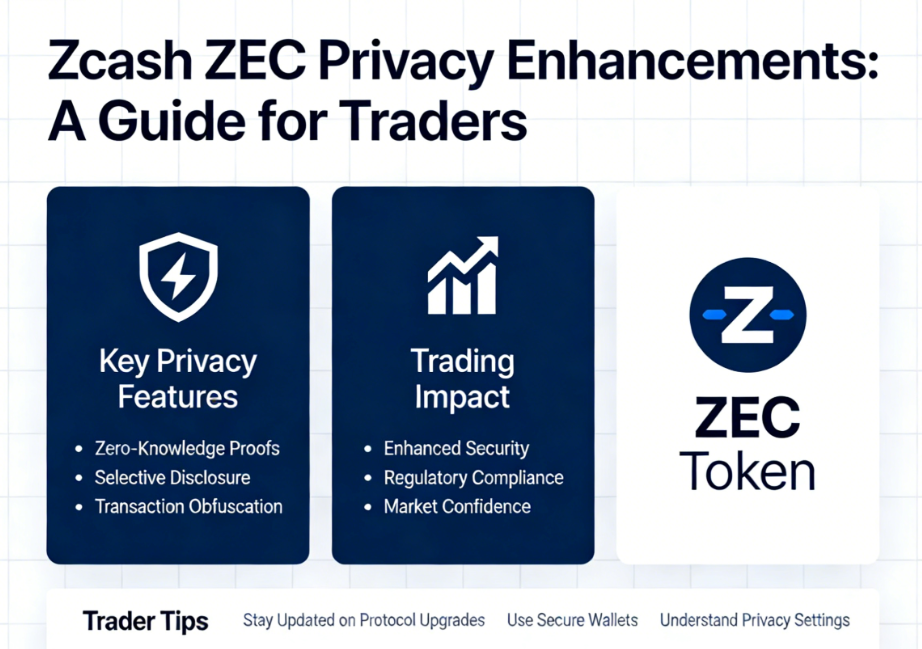
Zcash's privacy is not a single feature but a system of interlocking technologies. Let's break down the most important components that ensure confidentiality for users.
1. Shielded Transactions: The Heart of Zcash Privacy
The most fundamental privacy enhancement in Zcash is the ability to conduct shielded transactions. There are four main types of transactions possible on the Zcash network:
- Transparent to Transparent (T-to-T): This is a public transaction, identical to how Bitcoin works.
- Transparent to Shielded (T-to-Z): This is a "shielding" transaction. Funds move from a public t-address to a private z-address. The amount sent becomes private, but the public address it came from is visible.
- Shielded to Shielded (Z-to-Z): This offers the highest level of privacy. The sender's address, receiver's address, and the transaction amount are all encrypted and invisible on the public blockchain.
- Shielded to Transparent (Z-to-T): This is a "de-shielding" transaction. Funds move from a private z-address to a public t-address. The amount being de-shielded becomes public, but the originating z-address remains private.
This system provides users with granular control over their privacy. For example, a business might receive payments to a public t-address for accounting purposes, then move those funds to a private z-address for security and confidentiality.
2. Selective Disclosure and Viewing Keys
While shielded transactions are private by default, Zcash provides a mechanism for users to share transaction details with trusted third parties. This feature is called selective disclosure and is managed through viewing keys.
Every shielded address (z-address) has an associated viewing key. The owner of the address can share this key with others, such as an auditor, a business partner, or a regulatory body. Anyone with the viewing key can see all the incoming and outgoing transactions associated with that address, but they cannot spend the funds.
This is a powerful feature for several reasons:
- Compliance: Businesses and individuals can comply with auditing or tax requirements without having to make their entire financial history public.
- Transparency on Demand: It allows users to prove payment or share financial information with specific parties while maintaining overall privacy.
- Control: The user remains in complete control of who can see their transaction data. They can revoke access at any time, although they cannot "un-share" information that has already been seen.
This combination of default privacy with optional transparency gives Zcash a level of flexibility that is unmatched by most other cryptocurrencies.
3. Network Upgrades: Halo and the Elimination of the "Trusted Setup"
One of the early criticisms of the zk-SNARKs used by Zcash was the requirement of a "trusted setup." The initial cryptographic parameters for the Zcash network had to be generated in a complex, multi-party ceremony. During this ceremony, a piece of cryptographic "toxic waste" was created. If all pieces of this toxic waste were not destroyed, it could theoretically be used to create counterfeit Zcash without being detected.
While the ceremony was designed with extreme security measures to ensure the toxic waste was destroyed, it remained a point of concern for some in the crypto community.
To address this, the Zcash development team, along with the Electric Coin Company, worked on a major cryptographic breakthrough. The Halo upgrade, implemented in 2022, introduced a new type of zero-knowledge proof that eliminates the need for a trusted setup.
This is a monumental enhancement for Zcash. It removes the single biggest trust assumption in the protocol, making the system even more secure and decentralized. It proves that the Zcash team is committed to continuous improvement and to addressing valid community concerns. This dedication to security makes Zcash an asset worth exploring on a trusted platform like HIBT, which prioritizes the integrity of the assets it lists.
Case Study: Why On-Chain Privacy Matters for a Business
Let's consider a practical example to illustrate the importance of Zcash's privacy enhancements.
Imagine a company in Vietnam, "Saigon Supplies," that decides to accept cryptocurrency for its goods.
Scenario 1: Using a Transparent Cryptocurrency (like Bitcoin)
Saigon Supplies sets up a public Bitcoin address for payments.
- Competitor Analysis: A competitor can easily monitor this address. They can see how many payments the company receives, the value of each payment, and the total revenue. This gives the competitor sensitive business intelligence they can use to undercut prices or target Saigon Supplies' customers.
- Supplier Risk: The company's suppliers can also see its revenue. If a supplier sees that Saigon Supplies is doing very well, they might decide to increase their prices, knowing the company can afford it.
- Customer Privacy: Every customer who pays Saigon Supplies has their transaction recorded publicly. This links the customer's wallet to a purchase, eroding their financial privacy.
- Security Risk: A large balance accumulating in the public address makes it a prime target for hackers.
Scenario 2: Using Zcash with Shielded Transactions
Saigon Supplies uses a shielded Zcash address (a z-address) for payments.
- Confidentiality: All incoming payments are private. Competitors, suppliers, and the public cannot see the company's revenue, transaction volume, or customer list. This protects sensitive business data.
- Improved Negotiation: Since suppliers cannot see the company's cash flow, Saigon Supplies maintains a stronger negotiating position.
- Customer Protection: Customers can pay from their own shielded addresses, ensuring their financial privacy is preserved. They are not publicly linked to the purchase.
- Enhanced Security: The balance of the shielded address is not publicly visible, making it a less obvious target for thieves.
- Auditing: When it's time for tax season, Saigon Supplies can provide its accountant with the viewing key for its z-address. The accountant can see all the necessary transaction data for compliance without the company having to expose its financial activity to the world.
This case study clearly demonstrates that on-chain privacy is not about hiding illicit activity; it's a fundamental requirement for conducting legitimate business in the digital age.
Challenges and Considerations for Zcash
Despite its powerful technology, Zcash faces several challenges that potential investors and users should be aware of.
- Optional Privacy: Because privacy is optional in Zcash, a significant portion of transactions are still transparent. For privacy to be most effective, it needs widespread adoption. If most users continue to use t-addresses, the "anonymity set" for shielded transactions is smaller, making traffic analysis potentially easier. The Zcash community is actively encouraging more wallet providers and exchanges to support shielded addresses by default.
- Regulatory Perception: Privacy-enhancing technologies can sometimes attract negative attention from regulators, who may worry about their potential for use in money laundering or other illicit activities. However, Zcash's selective disclosure feature (viewing keys) was specifically designed to allow for compliance and auditing, providing a strong counter-argument to these concerns.
- Computational Requirements: Creating the proof for a shielded transaction is computationally more intensive than a simple transparent transaction. While modern computers and smartphones can handle this, it was a barrier in the early days. Thanks to network upgrades like Sapling and Halo, the time and memory required to create shielded transactions have been dramatically reduced, making them practical for everyday use, even on mobile devices.
- Exchange and Wallet Support: Not all exchanges and wallets offer full support for Zcash's shielded features. Some may only allow deposits and withdrawals from transparent addresses. This can force users to de-shield their funds to move them onto an exchange, reducing privacy. It is crucial to use a forward-thinking platform that embraces privacy technology. For a seamless trading experience with a wide range of assets, explore your options on HIBT.
Conclusion: Take Control of Your Financial Privacy with Zcash
Zcash (ZEC) represents a major advancement in the pursuit of a private and fungible digital currency. Its implementation of zk-SNARKs, shielded addresses, and selective disclosure provides a robust framework for confidential transactions. These are not niche features for paranoid users; they are essential tools for individuals and businesses who value their financial privacy in an increasingly transparent world.
The recent Halo upgrade, which eliminated the trusted setup, has further solidified Zcash's position as a leader in cryptographic innovation and security. By solving one of the most significant theoretical concerns with the protocol, Zcash has become more decentralized and trustless than ever before.
For anyone in the Vietnamese crypto market—from a newcomer learning about different digital assets to an experienced investor diversifying their portfolio—understanding Zcash's privacy enhancements is crucial. It opens the door to a new level of financial sovereignty.
Ready to explore the world of privacy-focused digital assets? Start your journey on HIBT, a secure platform for trading a diverse range of cryptocurrencies.
About the Author
Dr. Nguyen Anh Tuan, a renowned figure in applied cryptography and network security, has made significant contributions to the field of blockchain technology. He is the author of over 30 academic papers focusing on decentralized identity and privacy-preserving protocols. Dr. Tuan has also led the security audits for multiple top-tier Layer-1 blockchain projects, helping to secure billions in user funds and setting new standards for network integrity.