
In the bustling streets of Ho Chi Minh City or the vibrant markets of Hanoi, cash has always been king. It’s fast, it’s private, and it doesn’t require a third party to approve your purchase. But as the world moves digital, the need for a currency that mimics the best properties of physical cash—speed and privacy—has never been greater. Enter Dash, or "Digital Cash."
For Vietnamese investors and crypto newcomers alike, understanding privacy in cryptocurrency is the next step in mastering the market. While Bitcoin led the revolution, Dash refined it, offering features that make digital transactions not just faster, but significantly more private.
This guide explores the core privacy features of Dash, specifically designed for the modern trader who values financial freedom. Whether you are just starting your journey on HIBT or are a seasoned pro, understanding Dash is essential.
What is Dash Digital Cash?
Dash (DASH) was launched in 2014, originally under the name XCoin, then Darkcoin, before rebranding to Dash. It was built on the core technology of Bitcoin but with significant modifications designed to solve Bitcoin's biggest limitations: slow transaction speeds and a lack of true privacy.
The name "Dash" is a portmanteau of "Digital Cash." The project's goal is straightforward: to be the most user-friendly and scalable payments-focused cryptocurrency in the world.
For the Vietnamese market, where mobile payments and digital wallets are becoming ubiquitous, Dash offers a compelling alternative. Unlike traditional bank transfers that can take days, or Bitcoin transactions that might take 10 minutes or more to confirm, Dash is built for speed and utility. However, its most debated and powerful feature remains its approach to privacy.
The Privacy Problem in Public Blockchains
To appreciate Dash, you must first understand the problem with "transparent" blockchains like Bitcoin or Ethereum.
On a public blockchain, every transaction is recorded on a public ledger. If you send Bitcoin to a friend, anyone in the world can see:
- The sending address.
- The receiving address.
- The exact amount sent.
- The time of the transaction.
While your name isn't explicitly on the blockchain, your "address" acts as a pseudonym. If someone links your real-world identity to your wallet address (which happens often when you use a centralized exchange without privacy features), they can trace your entire financial history. They can see how much you earn, where you spend your money, and how much you have saved.
This lack of fungibility—where one coin can be distinguished from another based on its history—is a major hurdle for mass adoption. Dash aims to solve this.
Dash Privacy Features: How CoinJoin Works
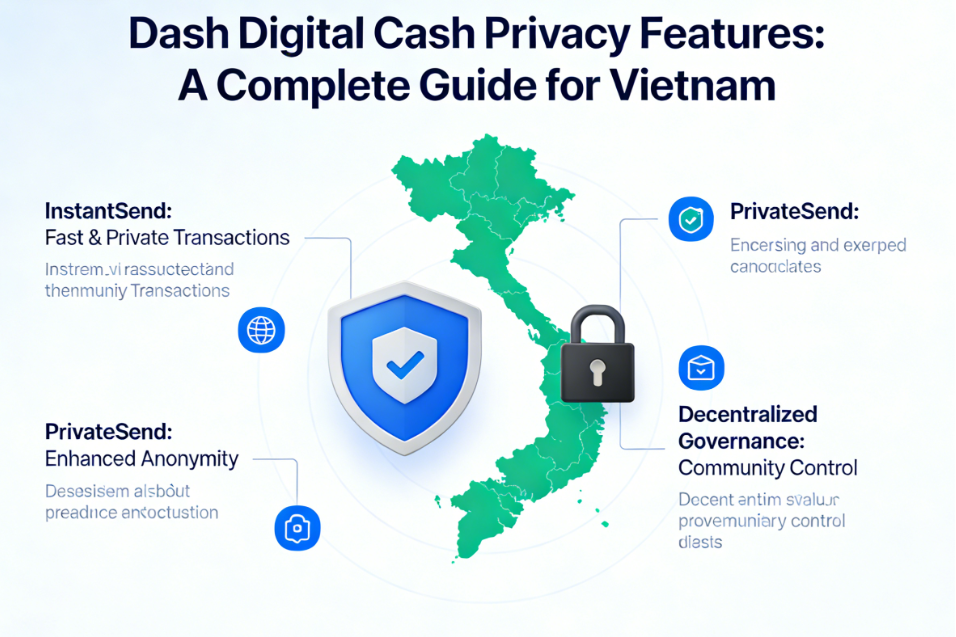
The cornerstone of Dash’s privacy is a feature formerly known as PrivateSend, which has been rebranded in recent wallet updates to CoinJoin.
The Mechanism of CoinJoin
CoinJoin is a trustless method of mixing coins. It protects your financial privacy by obscuring the origin of your funds. Here is a simplified breakdown of how it works for a user holding Dash:
- The Request: When you decide to mix your Dash to gain privacy, your wallet sends a request to the network.
- The Masternodes: Unlike Bitcoin, which has a single-tier network of miners, Dash has a two-tier network. The second tier consists of "Masternodes." These are powerful servers that perform specialized services. CoinJoin mixing is handled exclusively by these Masternodes.
- The Mixing: Your wallet breaks your transaction amount into standard denominations (like 0.01, 0.1, 1, and 10 DASH). The Masternode then finds two other users who also want to mix their coins.
- The Swap: The Masternode mixes your coins with the other two users' coins. It instructs your wallet to pay the mixed coins back to yourself at a new address (called a change address).
- Repetition: This process is repeated multiple times (rounds). Each time your coins are mixed, it becomes exponentially harder for anyone to trace where they came from.
The beauty of this system is that the Masternode never takes custody of your coins. It simply coordinates the mixing process. Even if a Masternode was compromised or run by a bad actor, they could not steal your funds, nor could they de-anonymize the transaction fully because they don't know the inputs and outputs of the other rounds happening on other Masternodes.
Why CoinJoin Matters for Vietnamese Traders
In Vietnam, where financial privacy is highly valued within families and businesses, CoinJoin offers a digital equivalent to physical cash.
Imagine a local business owner in Da Nang who accepts crypto payments. If they use a transparent ledger, their competitors could theoretically track their sales volume and supplier payments. By using Dash with CoinJoin enabled, that business owner protects their trade secrets and financial data.
Investors trading on platforms like HIBT can utilize Dash to move funds between wallets without leaving a transparent trail that links all their assets together. This is crucial for security, preventing potential hackers or scammers from seeing your total net worth simply by looking at one transaction.
InstantSend: Privacy Meets Speed
While CoinJoin handles the confidentiality aspect, Dash’s InstantSend feature handles the speed. While not a privacy feature in the strictest sense, it complements privacy by making Dash usable for everyday commerce.
In many cryptocurrencies, you have to wait for block confirmations to be sure a transaction is final. With InstantSend, Dash utilizes its Masternode network to lock the transaction inputs.
- A user initiates a transaction.
- A quorum of Masternodes is selected to verify the transaction.
- If the transaction is valid, the Masternodes "lock" the inputs, preventing them from being double-spent.
- The transaction is confirmed in less than 2 seconds.
For a user in Vietnam paying for a coffee or transferring funds to a relative, this speed is non-negotiable. When combined with CoinJoin, you get a transaction that is both private and instant—a powerful combination that mimics the utility of physical VND notes.
The Importance of Privacy in Cryptocurrency
Why should a regular user care about "privacy features"? Is it only for people with something to hide? The answer is a resounding "No." Privacy is a fundamental human right and a necessary component of a functional currency.
1. Fungibility
For a currency to be sound, it must be fungible. This means every unit of the currency must be worth the same as every other unit.
If a specific Bitcoin was previously used in a hack, exchanges might "blacklist" that Bitcoin. Suddenly, that specific coin is worth less than a "clean" Bitcoin. This destroys the concept of money.
Dash’s privacy features ensure fungibility. Because the history of a coin can be obscured, all Dash coins remain equal in value and acceptance.
2. Personal Security
In the digital age, data is money. If your financial history is public, you become a target for targeted advertising, phishing scams, or even physical theft. By obscuring your balance and transaction history, Dash protects your personal security.
3. Business Confidentiality
No business wants its balance sheet published to the world in real-time. Supply chains, employee salaries, and profit margins are sensitive data. Dash allows businesses to utilize the efficiency of blockchain technology without sacrificing their competitive advantage.
Case Studies: Dash in Action
To understand the real-world application of Dash, let’s look at how its features solve actual problems.
Case Study 1: The Cross-Border Worker
Tuan is a freelance developer in Hanoi working for a client in Europe.
- The Problem: Bank transfers take 3-5 days and have high fees. Bitcoin is faster, but Tuan doesn't want his client to see exactly how much money he holds in his main savings wallet.
- The Dash Solution: Tuan asks to be paid in Dash. Once the funds arrive, his wallet automatically mixes the Dash using CoinJoin. When he sends a portion of his earnings to HIBT to convert into VND or other assets, the transaction cannot be linked back to his savings or his client's wallet. He maintains his privacy while enjoying low fees.
Case Study 2: The Merchant in Ho Chi Minh City
Lan runs a popular coffee shop and accepts crypto.
- The Problem: Customers don't want to stand at the counter for 10 minutes waiting for a block confirmation. Furthermore, Lan doesn't want customers to see how much revenue the shop made that day by looking at the shop's wallet address.
- The Dash Solution: Lan uses Dash. With InstantSend, the payment is confirmed instantly, just like swiping a credit card. Because she periodically mixes her funds, her daily revenue remains private, protecting her business data from competitors.
Challenges and Considerations
While Dash offers robust features, users should be aware of the nuances.
- Optional Privacy: Unlike Monero, where privacy is mandatory for every transaction, Dash’s privacy is optional. Users must choose to enable CoinJoin. If a user forgets to use it, their transaction is as transparent as Bitcoin’s. This requires user education.
- Regulatory Landscape: Some regulators view "privacy coins" with skepticism due to concerns over anti-money laundering (AML). However, Dash argues that it is no different from Bitcoin, as its privacy is a mixing service built into the protocol, similar to third-party Bitcoin mixers but safer. Dash is widely listed on major exchanges, including HIBT, which indicates a strong level of acceptance in the compliance-heavy crypto industry.
- Mixing Time: The CoinJoin process takes time. You cannot mix coins instantly; it requires several rounds and other users to mix with. Therefore, users need to "pre-mix" their funds so they are ready for private spending when needed.
Comparing Dash to Other Privacy Options
It is helpful to see where Dash sits in the ecosystem.
- Bitcoin (BTC): Transparent. Privacy is low unless you use third-party tools which carry risk.
- Monero (XMR): Private by default. Uses ring signatures and stealth addresses. Often considered the "gold standard" for pure privacy but can be harder to use and faces stricter regulatory hurdles.
- Dash (DASH): User-friendly privacy. Offers a balance between the transparency of Bitcoin and the privacy of Monero. It focuses heavily on speed and ease of use (UX), making it very suitable for the Vietnamese market where mobile adoption is high.
How to Get Started with Dash in Vietnam
For Vietnamese investors looking to add Dash to their portfolio, the process is straightforward.
- Choose a Platform: Select a reliable exchange that supports Dash and understands the local market. HIBT is an excellent choice, offering a localized interface and robust security measures tailored for Vietnamese users.
- Acquire Dash: You can trade USDT or other cryptocurrencies for DASH.
- Secure Your Wallet: Download the official Dash wallet or a multi-coin wallet that supports Dash features.
- Enable Privacy: Go into your wallet settings and enable CoinJoin (formerly PrivateSend). Set the number of mixing rounds you prefer (usually 4-16 rounds).
- Transact: You are now ready to send and receive digital cash privately and instantly.
Conclusion: Empower Your Financial Future
Dash Digital Cash represents a powerful evolution in the cryptocurrency space. By combining the speed of digital payments with the privacy of physical cash, it offers a practical solution for real-world usage.
For the Vietnamese community, Dash aligns perfectly with the need for fast, low-cost, and private transactions. Whether you are protecting your business data or simply valuing your personal financial sovereignty, Dash provides the tools you need.
As the crypto market matures, privacy features will likely become standard. Dash is ahead of the curve, offering these features today. Don't leave your financial data exposed on public ledgers. Take control of your assets.
Ready to start trading Dash? Join the thousands of Vietnamese traders who trust HIBT for their cryptocurrency journey. Sign up today and experience a platform built for you.
About the Author
Dr. Tran Minh Hieu, a leading researcher in blockchain scalability and privacy protocols, has spent over a decade analyzing distributed ledger technologies. He has authored 18 peer-reviewed papers on cryptographic privacy mechanisms and Masternode incentives. Dr. Hieu has also served as the lead technical auditor for several high-profile DeFi projects in Southeast Asia, ensuring code security and economic stability for decentralized networks.