
As RWA (Real World Assets), Tokenized Stocks, and AI chip investing continue to gain momentum, more traditional financial assets are making their way into the crypto trading ecosystem. In the past, investors who wanted exposure to U.S. stocks, ETFs, or semiconductor indices needed a brokerage account. Today, several trading platforms offer USDT-denominated tokenized stocks or tokenized ETFs, allowing crypto users to gain price exposure to traditional financial assets directly from their digital asset wallets.
SOXSB is one such asset.
When first encountering SOXSB, most users have a few immediate questions: What exactly is SOXSB? Is it a new cryptocurrency? How does it relate to semiconductor stocks and ETFs? How do you buy it? Will it go up? And does it benefit from the AI chip boom?
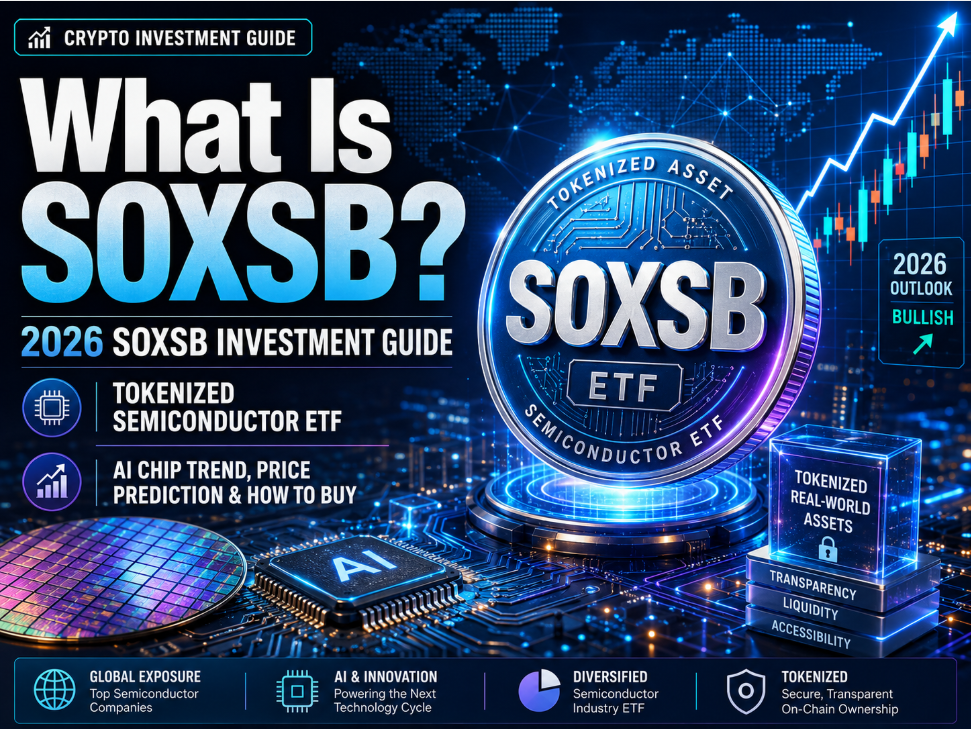
Simply put, SOXSB is not a regular crypto coin, nor is it a token issued by a chip manufacturer. It is a tokenized stock / tokenized ETF asset linked to a semiconductor ETF, falling under the RWA umbrella — that is, Real World Assets represented on-chain.
More precisely, SOXSB is commonly understood in the market as a tokenized bStock asset tied to the Direxion Daily Semiconductor Bear 3X ETF — meaning it provides price exposure to a 3x inverse semiconductor ETF. CoinMarketCap lists SOXSB as the Direxion Semiconductor Bear 3X ETF Tokenized bStocks, with its underlying direction corresponding to inverse leveraged semiconductor ETFs like SOXS.
This means SOXSB is not simply a "bullish AI chip" play. Rather, it packages a traditional inverse-leveraged semiconductor ETF into a tokenized stock that can be traded in a crypto environment. Investors who miss this distinction often mistake SOXSB for a plain long semiconductor ETF, leading to faulty investment decisions.
You can check SOXSB's real-time price, trading data, and market performance on HIBT:
SOXSB Live Quote:
https://hibt.com/quotes/SOXSB-USDT
This guide will walk you through what SOXSB is, its relationship to semiconductor ETFs, the mechanics of tokenized stocks, the impact of AI chip trends, price forecasts, purchase procedures, and risk management — giving beginners a complete understanding of the SOXSB investment thesis.
1. What is SOXSB? Why Are Semiconductor Index Assets Entering Crypto?
This chapter answers: What exactly is SOXSB? Is it a semiconductor stock or a new cryptocurrency?
SOXSB is not a "new layer‑1 coin" or an "AI‑themed meme coin." It is a digital representation of a traditional financial asset within a blockchain trading environment. It falls under the category of Tokenized Stock or Tokenized ETF assets, essentially allowing users to gain price exposure to a traditional financial instrument through their crypto accounts.
However, SOXSB has a crucial trait: it is not a straightforward tokenized long semiconductor ETF. Instead, it is closer to a tokenized version of an inverse‑leveraged semiconductor ETF.
According to Direxion's official materials, the Direxion Daily Semiconductor Bull and Bear 3X ETFs seek 300% or -300% of the daily performance of a semiconductor index. SOXS specifically represents the Daily Semiconductor Bear 3X ETF — the inverse leveraged direction.
Therefore, when understanding SOXSB, you must not just read "Semiconductor ETF" but pay close attention to the keywords: Bear 3X, Inverse, and Daily Leverage.
- If the semiconductor sector rises, a regular long semiconductor ETF may go up, but an inverse 3X ETF like SOXS will likely decline.
- If the semiconductor sector falls, SOXS will likely rise.
Thus, SOXSB is not a tool for simply betting on long‑term AI chip growth; it is more suited for short‑term downside moves, volatility trading, or hedging against the semiconductor sector.
1.1 What Is the Basic Definition of SOXSB?
SOXSB can be understood as a tokenized financial asset linked to a semiconductor ETF. It uses tokenization to bring price exposure of a traditional ETF into the crypto trading space.
From an asset classification standpoint, SOXSB belongs to the RWA category.
RWA refers to the tokenization of real‑world assets — stocks, ETFs, bonds, gold, funds, real estate income streams, etc. — represented via blockchain tokens, enabling users to trade price exposure to these traditional assets in digital asset markets.
SOXSB is NOT:
❌ A new token issued by a semiconductor company
❌ A cryptocurrency issued by NVIDIA, AMD, Intel, or any chip firm
❌ An AI chip meme coin
❌ A standard spot semiconductor ETF
❌ A stable asset suitable for everyone to hold long‑term
SOXSB is BETTER UNDERSTOOD AS:
✅ A tokenized asset related to a semiconductor ETF
✅ A Tokenized ETF product within the RWA asset class
✅ A crypto‑tradable asset linked to the price exposure of an inverse‑leveraged semiconductor ETF
✅ A high‑volatility asset that should be approached only after thoroughly understanding its mechanics and risks
This is why, when newcomers search "what is SOXSB," they must look beyond the name and dig into its underlying asset, leverage mechanism, inverse structure, issuance model, and trading rules.
1.2 How Does SOXSB Relate to Traditional Semiconductor ETFs?
Many beginners ask: Does buying SOXSB equal buying a semiconductor ETF directly?
The answer is: not exactly.
Traditional semiconductor ETFs are purchased through brokerage accounts. Investors open an account with a licensed broker, fund it with USD, and buy ETF shares. These ETFs are managed by fund providers, hold a basket of semiconductor stocks or derivatives, and are subject to traditional financial regulation.
SOXSB, on the other hand, is a Tokenized Stock / Tokenized ETF asset that appears on crypto trading platforms. Users typically trade SOXSB against USDT, gaining price exposure to the underlying asset.
Traditional ETF path:
Investor opens brokerage account → deposits USD → buys ETF shares → trades on securities market
SOXSB path:
Investor registers on a crypto trading platform → deposits USDT → searches SOXSB/USDT → trades the tokenized asset on the digital asset market
The key difference is that a traditional ETF represents an actual fund share in the securities market, whereas a Tokenized Stock or Tokenized ETF generally only provides price exposure to the underlying asset — it does not necessarily confer full beneficial ownership in the traditional sense.
OKX's documentation on Tokenized Stocks notes that, unless explicitly stated, tokenized stocks typically do not include voting rights or other shareholder privileges; their core function is price exposure, not direct equity ownership.
Binance Academy's explanation of bStocks also emphasises that bStocks are tokenised securities that allow users to gain exposure to U.S. stocks via blockchain technology, and they can be traded like crypto assets on spot markets.
So beginners must remember: SOXSB is not the traditional ETF itself — it is a tokenized trading asset linked to the price performance of that ETF.
1.3 Why Are Semiconductor Assets a Hot RWA Sector?
Semiconductors have become a focal point for RWA primarily because they sit at the infrastructure layer of the AI era.
- AI models require compute power.
- Compute power needs GPUs, AI chips, servers, data centers, and high‑performance computing clusters.
- Chip manufacturing demands fabs, semiconductor equipment, advanced packaging, memory, EDA software, and global supply chains.
Thus, the semiconductor value chain is one of the most critical underlying asset classes of the AI age.
In the past, crypto AI narratives centred on AI tokens, decentralised compute, AI data networks, and Web3 infrastructure. But as Tokenized Stocks and RWA assets grow, investors now want to gain direct price exposure to traditional AI‑related assets using USDT.
This creates a new convergence:
AI trends + semiconductor assets + RWA tokenisation + crypto trading access
SOXSB is one such asset in this convergence. However, investors must note that SOXSB corresponds to the inverse‑leveraged semiconductor direction — not a plain long semiconductor play. The stronger the AI chip sector, the less likely SOXSB benefits; if semiconductor stocks rally due to AI hype, the inverse asset will likely face headwinds.
2. Why Is SOXSB Attracting Attention? The Investment Logic Behind the AI Chip Cycle
This chapter addresses: Why are investors paying attention to SOXSB rather than just buying regular stocks or ETFs?
SOXSB draws interest not because it's a typical crypto coin, but because it combines three hot market themes: AI chips, semiconductor ETFs, and RWA asset tokenisation.
But before investing in SOXSB, you must understand that it is not a simple "long AI chip" asset.
When retail investors see "semiconductor," they often think of NVIDIA, AMD, Broadcom, TSMC, ASML, Applied Materials, etc. And with AI chips, they assume any related asset will benefit long‑term. However, if SOXSB tracks a Bear 3X direction, its price logic is closer to "potentially benefiting when semiconductor stocks decline."
Such assets are better understood as short‑term trading tools, volatility instruments, or hedging vehicles — not as traditional long‑term DCA ETFs.
2.1 Why Is Semiconductors the Core Asset of the AI Era?
AI development depends entirely on compute power.
Whether it's large language models, AI search, autonomous driving, robotics, AI video generation, or enterprise AI applications — all require massive computational resources. Behind that compute are chips, servers, data centers, and semiconductor manufacturing capabilities.
The semiconductor supply chain broadly covers several key segments:
- Chip design — GPUs, CPUs, AI accelerators, networking chips, memory controllers.
- Wafer fabrication — advanced nodes, mature nodes, capacity expansion.
- Semiconductor equipment — lithography, etching, deposition, inspection, packaging equipment.
- Data centers and cloud infrastructure — AI servers, liquid cooling, high‑speed networking, power supply.
- End applications — smartphones, PCs, automotive, robotics, industrial automation.
So semiconductors are not a single‑company story; they represent the entire infrastructure chain of the AI era.
That's why the Tokenized Stock market now features assets like AMATB, TSMB, SOXLB, SOXSB, and others tied to semiconductors or AI infrastructure.
2.2 Does SOXSB Invest in a Single Company or the Entire Semiconductor Industry?
SOXSB is not a single‑company stock.
It is closer to a tokenized version of a semiconductor‑sector ETF, tracking a basket of semiconductor assets or an index's directional movement.
Compared to individual names like NVIDIA, AMD, Intel, Broadcom, or TSMC, a semiconductor ETF provides broader industry exposure. It is influenced not just by one company's earnings, but by the entire semiconductor sector, AI capital expenditure, industry valuations, chip cycles, and macro liquidity.
But SOXSB has another critical distinction: it is tied to an inverse‑leveraged ETF.
So SOXSB does not follow the simple logic of "semiconductor sector up → SOXSB up." Instead, it works more like:
- Semiconductor sector falls → inverse ETFs like SOXS rise → SOXSB may follow that price exposure.
- Semiconductor sector rallies → SOXS declines → SOXSB likely faces pressure.
This is the single most important warning for beginners in this guide.
If you are bullish on long‑term AI chip growth, you should probably research standard semiconductor ETFs, long semiconductor assets, or SOXLB (the Bull 3X direction) — rather than mistakenly treating SOXSB as a long semiconductor tool.
2.3 Why Are Semiconductors Suitable for Tokenisation?
Semiconductors are well‑suited for tokenisation for three main reasons:
First, strong global investment demand.
AI chips, data centers, cloud computing, and HPC have become core investment themes worldwide. Crypto users also want to participate in these traditional asset opportunities.
Second, semiconductors offer a clear, compelling narrative.
Compared to complex financial products, the link between semiconductors and AI is intuitive: AI needs compute, compute needs chips, and chip demand drives semiconductor value.
Third, RWA requires underlying assets with high recognisability.
For Tokenized Stocks to gain user adoption, the underlying assets must be well‑known. Semiconductor ETFs, tech stocks, gold ETFs, S&P 500 ETFs — these are naturally easier for crypto users to understand.
Thus, SOXSB reflects a broader trend: the crypto market is no longer just about BTC, ETH, and meme coins — it is also trading on‑chain representations of traditional financial assets.
3. How Does SOXSB Work? The Technical Mechanics Behind Tokenized Stocks
This chapter answers: How can an ETF or a stock be turned into a token?
The basic logic of a Tokenized Stock or Tokenized ETF is to bring the price exposure of a traditional financial asset onto a blockchain or digital asset trading platform via a token representation.
Typically, the structure involves the underlying asset, a custody or issuance framework, token issuance, trading platforms, and a price‑tracking mechanism.
However, rules vary across platforms, issuers, and jurisdictions. Investors should never assume all Tokenized Stocks offer the same rights.
3.1 What Is the Issuance Process for SOXSB?
A typical Tokenized Stock or Tokenized ETF asset can be understood as follows:
- The underlying asset comes from traditional markets — e.g., a stock, ETF, or other security.
- The issuer or relevant entity establishes a link between the token and the underlying asset's price via custody, synthetic structures, collateral, or other methods.
- The token is listed on a crypto trading platform, and users can buy it with stablecoins like USDT.
- The token price fluctuates around the underlying asset's price, also affected by platform liquidity, trading depth, market sentiment, and exchange rates.
Binance's bStocks materials describe bStocks as tokenised securities and emphasise that they are not stocks or shares, nor do they represent direct ownership of the underlying listed company's stock.
Therefore, investors should not simplistically think "I am buying a traditional ETF share." A more accurate understanding is: you are trading a tokenised security or price‑exposure instrument on a crypto platform that tracks an underlying inverse semiconductor ETF.
3.2 Why Does the Price of SOXSB Rise or Fall?
SOXSB's price is driven by four main factors:
1. Performance of the underlying inverse semiconductor ETF.
If SOXSB is linked to an inverse 3X ETF like SOXS, the most critical factor is the daily movement of the semiconductor sector. When semiconductor indices fall, the inverse ETF may rise; when they rally, the inverse ETF may drop.
2. AI chip cycle.
If AI chip demand is strong and the semiconductor sector trends upward, long semiconductor assets may benefit, but inverse assets like SOXSB will likely face pressure.
If AI chip valuations become stretched, or if markets worry about capex slowdowns and semiconductor stocks correct, SOXSB may attract short‑term interest.
3. Leverage and daily rebalancing.
Direxion's official materials stress that leveraged and inverse ETFs seek daily leveraged results, are not suitable for all investors, and their long‑term performance is affected by compounding, volatility, rebalancing, and holding periods.
This means even if you get the long‑term direction right, frequent oscillations can cause volatility drag, making actual returns deviate from expectations.
4. Crypto market liquidity.
Since SOXSB trades in the digital asset environment, it is also influenced by USDT liquidity, platform trading depth, crypto risk appetite, fund flows, and session‑time differences.
4. SOXSB Investment Value Analysis: Dual Logic of AI Chip Trends + RWA Assets
This chapter addresses: Where is SOXSB's long‑term value?
SOXSB's investment value cannot be reduced to "AI chips going up." It should be analysed on two levels:
Level 1 — RWA asset value:
SOXSB brings traditional semiconductor ETF exposure into crypto, allowing users to participate in traditional asset price swings using USDT.
Level 2 — Semiconductor volatility trading value:
If SOXSB corresponds to an inverse 3X ETF, it functions more as a tool for short‑term downside moves or volatility in the semiconductor sector, rather than a long‑term bullish instrument.
Thus, SOXSB's value lies not in "long‑term holding will definitely benefit from AI," but in providing crypto users with an entry point to inverse semiconductor price exposure.
4.1 Why Does the AI Era Need Semiconductors?
Over the next few years, AI applications are likely to continue driving compute demand:
- Enterprises training large models need GPU clusters.
- Cloud platforms require data center expansion.
- Autonomous driving needs in‑vehicle chips and sensor compute.
- Robotics demand edge computing and AI inference chips.
- AI phones, AI PCs, and smart hardware require terminal chip upgrades.
These trends will keep the semiconductor supply chain in the spotlight.
But investors must also recognise that semiconductors are cyclical. Even with long‑term demand growth, short‑term fluctuations can be caused by inventory, valuations, interest rates, corporate capex, geopolitics, and supply chain shifts.
This is precisely why an inverse asset like SOXSB has trading demand:
- When markets become overly optimistic, some traders use inverse leveraged ETFs for short‑term trades or hedging.
- When semiconductor stocks correct sharply, SOXSB may attract speculative flows.
However, such trading requires higher risk tolerance and is not suitable for beginners who don't understand the mechanics and choose to go heavy.
4.2 How Does SOXSB Differ from Other RWA Assets?
SOXSB can be placed within HIBT's AI + RWA + Tokenized Stock thematic cluster, alongside assets like AMZNB, AAPLB, AMATB, and AIOZ.
- AMZNB represents Amazon Tokenized Stock — core logic: e‑commerce ecosystem, AWS cloud, AI infrastructure, and traditional company asset tokenisation.
- Related reading: https://hibt.com/news/47-7494
- AAPLB represents Apple Tokenized Stock — core logic: consumer electronics, software ecosystem, AI endpoints, and Apple's enterprise value.
- Related reading: https://hibt.com/news/47-7489
- AMATB represents Applied Materials Tokenized Stock — core logic: semiconductor manufacturing equipment, chip supply chain infrastructure, and the AI chip cycle.
- Related reading: https://hibt.com/news/48-7484
- AIOZ is not a traditional stock tokenisation but a decentralised content delivery, AI compute, and Web3 infrastructure crypto project.
- Related reading: https://hibt.com/news/47-7479
SOXSB differs from these in that it is not a single‑company tokenised stock nor a pure Web3 infrastructure token; it is closer to a tokenised trading asset linked to a semiconductor ETF direction.
Moreover, if SOXSB tracks a Bear 3X direction, its risk profile is more complex than ordinary Tokenized Stocks. It combines RWA risk, ETF risk, leverage risk, inverse risk, liquidity risk, and crypto‑platform trading risk.
5. How to Buy SOXSB: A Beginner's Investment Process
This chapter answers: How do you buy SOXSB?
For beginners, before placing an order, you should first confirm three questions:
- Does the platform support SOXSB/USDT trading?
- What exactly is the underlying asset of SOXSB?
- Do you understand the risks of inverse 3X ETFs and Tokenized Stocks?
If you haven't sorted out these three, do not buy directly.
5.1 What Do You Need to Invest in SOXSB?
To invest in SOXSB, you typically need three things:
First, a crypto trading account.
Choose a platform that supports SOXSB trading, complete registration, security verification, and necessary KYC.
Second, USDT funds.
SOXSB is usually quoted in USDT, so you need to have USDT ready to trade the SOXSB/USDT pair.
Third, a risk management strategy.
SOXSB is not a low‑volatility asset. Especially with inverse leverage involved, price swings can be extreme. Determine your position size, stop‑loss, holding period, and exit plan in advance.
5.2 Step‑by‑Step Guide to Buying SOXSB
Step 1: Register and log in to a platform that supports SOXSB trading.
Step 2: Complete account security settings — e.g., two‑factor authentication, fund password, anti‑phishing code.
Step 3: Deposit USDT or buy USDT through the platform.
Step 4: Search for SOXSB in the trading section.
Step 5: Find the SOXSB/USDT trading pair.
Step 6: Go to the quote page to view real‑time price, 24‑hour change, volume, order book depth, and candlestick charts.
Step 7: Choose a limit order or market order to complete your purchase.
Step 8: After buying, continuously monitor the semiconductor sector, AI chip news, underlying ETF performance, and platform announcements.
You can first check SOXSB quotes on HIBT:
SOXSB Live Quote:
https://hibt.com/quotes/SOXSB-USDT
For beginners, it's highly recommended to start with a tiny amount and observe — do not go heavy just because you see keywords like "AI chips," "semiconductor," or "Tokenized Stock."
6. SOXSB Price Prediction: Where Does Future Upside Come From?
This chapter addresses: How should we view SOXSB price predictions?
You can check HIBT's SOXSB price prediction page here:
SOXSB Price Prediction:
https://hibt.com/symbolPrediction/detail/SOXSB
However, no price prediction should be taken as guaranteed returns. For an asset like SOXSB, forecasting is much harder than for standard spot tokens, because it is affected by the semiconductor index, inverse leveraged ETF mechanics, crypto liquidity, and RWA regulatory environment all at once.
6.1 Factors That Could Drive SOXSB Up
First, short‑term declines in the semiconductor sector.
If SOXSB tracks a Bear 3X direction, then when semiconductor indices or related ETFs drop in the short term, SOXSB may gain upward momentum.
This is the opposite of the usual AI chip investment logic — long semiconductor assets want AI chips to rise, while SOXSB tends to perform better during semiconductor pullbacks, tech sell‑offs, or risk‑off sentiment.
Second, AI valuation corrections.
If the market perceives AI chip valuations as excessive, or if data center capex slows, the semiconductor sector may correct. In that environment, inverse semiconductor assets could attract speculative flows.
Third, short‑term hedging and risk‑off demand.
Some traders may use SOXSB to hedge long semiconductor positions or to trade volatility during tech‑stock turbulence.
Fourth, expansion of the RWA market.
If more crypto users start trading traditional financial assets via USDT, the overall attention on Tokenized Stocks and Tokenized ETFs may increase, and SOXSB, as a semiconductor‑oriented asset, could benefit from additional liquidity.
6.2 Factors That Could Drive SOXSB Down
Downside factors are equally clear:
First, if AI chip trends remain strong and the semiconductor sector continues to rally, inverse assets like SOXSB will likely remain under pressure.
Second, if market volatility persists, inverse leveraged ETFs may suffer from compounding and volatility drag, causing long‑term performance to deviate from intuition.
Third, if platform liquidity is thin, SOXSB may experience wider bid‑ask spreads, higher slippage, and tracking errors.
Fourth, if the regulatory environment shifts, Tokenized Stock or RWA products may face regional restrictions, trading limitations, or compliance adjustments.
6.3 Risk Analysis for SOXSB Investment
SOXSB carries high risk, particularly in the following areas:
1. Token ≠ Traditional ETF share.
SOXSB is a Tokenized Stock / Tokenized ETF asset and should not be equated with an ETF share held in a brokerage account. You need to verify the issuer, custody mechanism, redemption rights, full asset backing, and any economic entitlements.
2. Inverse leverage risk.
If SOXSB tracks a Bear 3X direction, its price moves inversely to the semiconductor sector, with leverage magnifying both gains and losses. Wrong‑way bets can lead to amplified losses.
3. Daily rebalancing and volatility drag.
Leveraged ETFs typically target daily returns and are not suitable for simple buy‑and‑hold. SEC filings also note that the Direxion Daily Semiconductor Bear 3X ETF seeks daily -3X investment results and is materially different from most ordinary ETFs.
4. Semiconductor cycle risk.
The semiconductor industry itself is cyclical, affected by inventory, demand, pricing, interest rates, supply chains, geopolitics, and capex. Short‑term industry moves do not always align with long‑term AI trends.
5. AI valuation risk.
If the market overheats on AI, semiconductor stocks may correct; but if AI continues to exceed expectations, the inverse asset may keep declining.
6. Liquidity and regulatory risk.
Tokenized Stocks are still in a rapid development phase. Reuters has reported that major global exchange organisations have urged regulators to step up scrutiny of tokenised stocks due to potential investor protection and market integrity risks.
Therefore, SOXSB is not suitable for beginners who only read the headline and ignore the underlying mechanics.
7. Is SOXSB Worth Investing In? How Different Investors Should Decide
This chapter answers: Is SOXSB right for me?
Whether SOXSB is worth it cannot be answered with a simple "yes" or "no." It depends on whether the investor understands the semiconductor industry, RWA mechanisms, Tokenized Stock structures, inverse ETF mechanics, and leverage risks.
7.1 Who Should Consider SOXSB?
SOXSB is more suitable for the following types of investors:
- Those who understand semiconductor sector volatility. If you are familiar with AI chips, tech stocks, semiconductor ETFs, and market cycles, SOXSB can serve as one tool to observe inverse semiconductor movements.
- Those who understand leveraged ETF risks. SOXSB is not for complete beginners. It is better suited for those who know about daily leverage, inverse returns, compounding, and volatility drag.
- Those who want to access traditional financial assets via crypto accounts. If you are already comfortable with USDT trading and want to explore RWA and Tokenized Stocks, SOXSB offers a case study in how traditional ETFs enter the crypto space.
- Those with short‑term risk management skills. SOXSB leans more toward short‑term trading; you need to set stop‑losses, control position sizes, and track semiconductor sector moves continuously.
7.2 Who Should Avoid SOXSB?
SOXSB is not suitable for:
- Those who simply want to be long AI chips. If your thesis is "AI chips will grow long‑term, so I'll buy semiconductor assets," SOXSB is likely the wrong tool, as it tracks the inverse direction.
- Those who don't understand Tokenized Stocks. If you don't know the difference between tokenized stocks and traditional stocks/ETFs, you should not participate directly.
- Those seeking stable returns. SOXSB is not a yield‑generating asset nor a low‑risk product. It can experience extreme volatility.
- Those who want full traditional ETF rights. SOXSB typically provides price exposure only, not all the rights attached to a traditional ETF share. Check the specific issuance rules and platform disclosures.
- Those unwilling to research the underlying asset. Buying just because you see "Semiconductor," "AI," or "ETF" in the name is a recipe for bad decisions.
8. The Future of RWA: SOXSB Is Just the Beginning of Traditional Finance Entering Blockchain
This chapter addresses: Why will more and more stocks and ETFs be tokenised in the future?
RWA is one of the most important growth directions in crypto.
In the past, the crypto market revolved around BTC, ETH, stablecoins, DeFi, NFTs, and meme coins. But with the growth of stablecoins, on‑chain settlement, regulated custody, and Tokenized Stocks, traditional financial assets are gradually moving into the blockchain environment.
Assets that may be tokenised in the future include:
- Stock tokens
- ETF tokens
- Gold tokens
- Bond tokens
- Fund tokens
- Real estate income tokens
- Private equity tokens
- Index tokens
This means crypto could evolve from a pure digital asset trading market into a global layer for digitalised asset trading.
Ethereum, as a smart contract infrastructure, is also closely tied to RWA development. You can check ETH's long‑term price reference here:
ETH Price Prediction:
https://hibt.com/symbolPrediction/detail/ETH
However, RWA does not mean risk‑free. On the contrary, RWA stacks traditional financial risks, on‑chain technical risks, issuer risks, regulatory risks, and liquidity risks together. SOXSB is a classic example of this complexity — it connects the semiconductor industry, leveraged ETFs, Tokenized Stocks, and crypto trading.
That is precisely why SOXSB is both intellectually interesting and demands great caution.
9. FAQ: Common Questions About SOXSB
What is SOXSB?
SOXSB is a Tokenized Stock / Tokenized ETF asset linked to a semiconductor ETF, belonging to the RWA asset class. It is not a regular crypto coin, nor a token issued by a chip company — it is a digital expression of a traditional financial asset within a crypto trading environment.
What is the SOXSB coin?
Many users search "what is SOXSB coin," but a more accurate term is "tokenised financial asset." SOXSB is closer to a Tokenized bStock tied to an inverse semiconductor ETF, not an ordinary cryptocurrency.
Is SOXSB an AI chip coin?
No. SOXSB is not an AI chip project token, nor an AI infrastructure crypto project. It is linked to semiconductor ETF price exposure, with particular attention to its potential Bear 3X inverse leveraged direction.
What is the difference between SOXSB and a semiconductor ETF?
A traditional semiconductor ETF is bought through a brokerage account and is a traditional financial market product. SOXSB is traded as a token on crypto platforms, usually quoted in USDT, providing price exposure to the underlying asset — but it does not necessarily equate to holding a traditional ETF share directly.
Is SOXSB bullish on semiconductors?
Not necessarily. Based on market data, SOXSB is more closely associated with the Direxion Semiconductor Bear 3X ETF Tokenized bStocks — i.e., an inverse 3X semiconductor asset. Therefore, it is not a plain long semiconductor tool.
What is the difference between SOXSB and SOXLB?
From naming and market data, SOXLB appears to be closer to the Semiconductor Bull 3X ETF Tokenized bStocks (long 3X direction), while SOXSB is closer to the Semiconductor Bear 3X ETF Tokenized bStocks (inverse 3X direction). Always verify the platform's description and underlying asset information before investing.
How do you buy SOXSB?
Typically, you can buy it on platforms that support SOXSB/USDT trading. You need a crypto trading account and USDT funds, then search for the SOXSB/USDT pair to execute your trade.
SOXSB Live Quote:
https://hibt.com/quotes/SOXSB-USDT
Will SOXSB go up in the future?
Whether SOXSB rises depends on semiconductor sector movements, inverse leveraged ETF performance, the AI chip cycle, crypto liquidity, and the RWA market environment. If the semiconductor sector declines, SOXSB may benefit; if it continues to rally, SOXSB may face headwinds.
SOXSB Price Prediction:
https://hibt.com/symbolPrediction/detail/SOXSB
Is SOXSB suitable for long‑term holding?
SOXSB is not simply a long‑term holding asset. Due to its potential inverse 3X ETF mechanics, long‑term holding may be affected by daily rebalancing, compounding, and volatility drag. It is more suited for experienced traders focused on short‑term strategies or hedging.
Is SOXSB safe?
The safety of SOXSB depends on the issuer, custody mechanism, underlying asset backing, platform liquidity, regulatory environment, and trading rules. You must also understand that a Tokenized Stock does not necessarily equate to direct ownership of traditional stock or ETF shares.
10. Conclusion: SOXSB Connects Semiconductor Volatility, AI Chip Trends, and Crypto Finance
SOXSB is not a traditional cryptocurrency, nor a token issued by a chip company.
It represents a new asset format:
- Semiconductor ETF price exposure
- Tokenized Stock mechanics
- RWA asset tokenisation
- USDT trading access
- Crypto market liquidity
But the most critical point about SOXSB is: it is not a plain long semiconductor asset — it is closer to a tokenised ETF asset with a Bear 3X semiconductor direction. In other words, if you are bullish on AI chips long‑term, you cannot simply assume SOXSB will benefit.
Before investing in SOXSB, you must focus on the following:
- What is the underlying asset that SOXSB tracks?
- Is it a long or inverse direction?
- Does it carry 3X leverage?
- Does the Tokenized Stock provide any rights to the underlying asset?
- Is platform liquidity sufficient?
- Are there regional regulatory restrictions?
- Can you tolerate high volatility?
The research value of SOXSB lies in its representation of a new phase where crypto markets access traditional financial assets. In the future, more stocks, ETFs, bonds, and commodities may enter digital asset markets via tokenisation.
But for the average investor, the more complex the RWA product, the greater the caution required. SOXSB is not a simple investment tool for everyone — it is a high‑risk asset that combines semiconductor cycles, AI trends, leveraged ETFs, and Tokenized Stock mechanisms.
Overall, SOXSB fits well within HIBT's AI + RWA + Tokenized Stock thematic cluster, alongside AMZNB, AAPLB, AMATB, AIOZ, and others. This approach covers direct search queries like "what is SOXSB," "how to buy SOXSB," "SOXSB price prediction," and "SOXSB USDT," while also helping search engines understand HIBT's depth in crypto investment guides, RWA investing, semiconductor tokenised stocks, and AI infrastructure asset research.