
If this is your first time seeing AIRH on a trading platform, price chart, or social media feed, the most common questions are: What is AIRH? Is AIRH a coin or a stock? What does it have to do with AI robots? How do you buy AIRH? Is AIRH worth investing in?
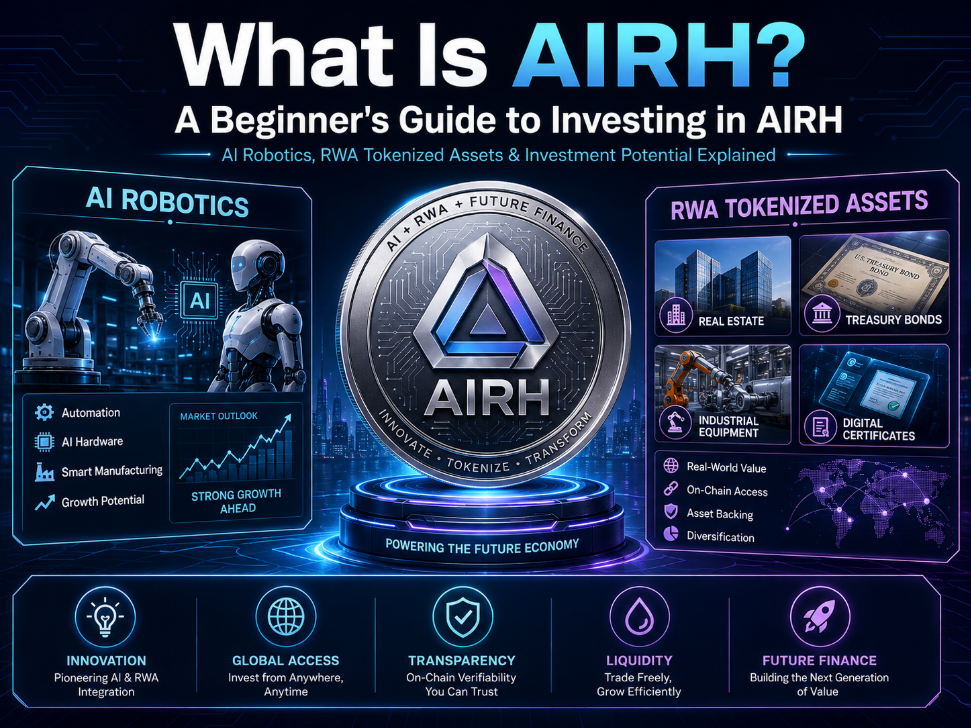
Simply put, AIRH is best understood as a tokenized asset tied to AI Robotics. It is not a typical AI-themed crypto coin, not a meme token, and not a short-term asset riding on AI hype alone. AIRH’s core logic is closer to a combination of “AI industry assets + RWA + a crypto trading gateway.” Public materials also position AIRH as an RWA and tokenized asset related to AI Robotics, rather than a conventional blockchain utility token or an AI chatbot token.
For beginners, the first step in understanding AIRH is not to ask “will it go up?” but to figure out: What underlying asset does AIRH actually represent? How is it different from traditional AI stocks? Why are AI robotics assets entering the crypto market? What drives its price? And what risks come with investing in AIRH?
1. What Is AIRH, and Why Are AI Robotics Assets Entering the Crypto Market?
This section addresses the user’s first search query: “What exactly is AIRH, and why would an AI robotics–related asset show up in crypto?”
AIRH can be understood as a tokenized expression of AI robotics–related assets within the crypto market. It is not a native cryptocurrency like BTC or ETH, nor is it a typical DeFi governance token. Instead, it leans more toward the RWA category of crypto trading instruments.
RWA stands for Real World Assets. This includes stocks, ETFs, bonds, gold, real estate, commodities, funds, or corporate equity. When these assets are brought into the crypto market via blockchain, trading platforms, or tokenized structures, they become RWA assets.
So, the core of AIRH is not “some AI project issued a coin,” but rather “AI robotics–related assets entering the crypto market through tokenization.” Users who want to check the current AIRH market data can visit AIRH Real-Time Price to see the AIRH/USDT price, 24‑hour change, trading volume, and price trends.
This distinction is crucial. Many newcomers see the keyword “what is AIRH coin” and assume it behaves like a typical AI token, with price determined purely by ecosystem metrics, on‑chain users, or protocol revenue. But AIRH is more complex. It is simultaneously influenced by the AI robotics industry, underlying asset performance, the RWA structure, exchange liquidity, and broader crypto market sentiment.
2. Why Is AI Robotics Becoming a New Hotspot in Crypto?
In the past, the crypto market followed a few major asset classes: Bitcoin as digital gold, Ethereum as the smart‑contract and on‑chain application platform, DeFi as decentralized finance, and memes as community sentiment and narrative drivers.
But in the AI era, the market is turning to new narrative combinations: AI, robotics, DePIN, RWA, and the financialization of on‑chain assets.
AI robotics draws attention because it goes beyond software‑level AI applications. It represents a key gateway for AI to enter the physical world. In the past, AI was mostly confined to text, images, code, search, and office automation. Robotics brings AI capabilities into factories, warehouses, logistics, healthcare, service industries, home environments, and industrial production.
The AI robotics value chain typically includes several core segments: AI models for understanding and decision‑making, sensors for environmental perception, control systems for executing actions, mechanical structures for physical tasks, and industrial/commercial applications that generate real revenue.
That is why AIRH is worth watching. It does not simply bet on an “AI concept” — it uses AI Robotics as the underlying industry narrative and then brings these industrial assets into the crypto trading environment through RWA and tokenized asset structures.
3. Why Do AI Robots Need Blockchain and Tokenization?
This section answers: What is the actual connection between AI robots and blockchain?
On the surface, AI robots belong to hardware, manufacturing, and automation — while blockchain belongs to digital assets and financial infrastructure. They may seem unrelated. But over the long term, there are at least three intersection points.
First: monetizing machine data.
Robots generate massive amounts of data during operation — e.g., movement paths, environmental recognition, equipment status, service logs, energy consumption, task efficiency, and user interactions. This data itself may hold value. As data rights verification and machine‑asset operations mature, blockchain can be used to record, verify, and trade data‑related rights.
Second: the machine economy.
We may see more automated devices and robots participating in economic activities. For example, robots provide services, systems automatically settle fees, devices earn income based on tasks, and that revenue is distributed to asset holders or operators. This “machines provide services, generate cash flow, and settle automatically” model has natural synergies with blockchain payments, smart contracts, and asset tokenization.
Third: financialization of AI assets.
Traditional investors typically gain exposure to AI, robotics, or automation companies through stock accounts. Crypto users, on the other hand, are more accustomed to using USDT, exchange accounts, or wallets to trade assets. Tokenized assets try to bridge these two worlds, allowing traditional AI industry assets to be traded and allocated within the crypto market.
4. What Type of Asset Is AIRH? How Does a Token Differ from a Traditional Stock?
This section asks: Does buying AIRH equal buying shares in an AI company?
The answer is: not exactly.
AIRH can be viewed as a tokenized asset related to AI Robotics, but that does not necessarily mean you directly own common stock of any particular AI robotics company. Tokenized stocks or tokenized assets typically provide economic exposure — meaning price correlation — but whether they confer actual equity rights depends on the issuance structure, custody arrangements, platform rules, and jurisdiction.
Traditional stocks are usually purchased through securities accounts, traded on stock exchanges, and investors are protected by securities laws and exchange rules. Stock investors may have shareholder rights, voting rights, dividend rights, and corporate disclosure protections.
AIRH and similar tokenized assets are typically traded in crypto trading environments, often priced in USDT, and the trading experience is closer to digital assets. Their advantages are lower barriers to entry, greater flexibility, and familiarity for crypto users. The risks, however, include more complex asset structures, and investors may not have traditional shareholder rights.
This is a key point that must be emphasized for all tokenized stocks and RWA assets. Tokenized stocks can improve global trading convenience, but investors still need to pay attention to counterparty risk, custody risk, legal ownership, voting rights, dividend rights, and regulatory scope. Research from Crypto.com on tokenized stocks reminds investors to watch for counterparty risk from centralized custodians, as some products may lack direct legal ownership or voting rights.
To further understand the trend of traditional financial asset tokenization, you can read What Is SOXSB and What Is PYPLB. These assets help beginners understand how stocks, ETFs, and corporate assets enter the crypto market through RWA structures.
5. Why Is the RWA Market Gaining Institutional Attention?
RWA is not a short‑term fad — it is a major direction in the convergence of traditional finance and crypto.
Traditional financial assets are massive in scale, but they face limitations such as trading hours, cross‑border access hurdles, settlement cycles, complex account systems, and difficulty in asset fragmentation. Tokenized assets aim to improve circulation efficiency through blockchain and digital asset trading environments.
For example, NYSE parent company ICE announced in 2026 that it is developing a Tokenized Securities platform, targeting 24/7 trading, instant settlement, USD‑denominated orders, and stablecoin funding support. This shows that tokenized securities are no longer just a crypto‑native narrative — they are entering discussions within traditional financial infrastructure.
For crypto users, the value of RWA lies in the future possibility of trading not only BTC, ETH, DeFi tokens, or meme coins, but also gaining price exposure to stocks, ETFs, bonds, gold, commodities, and other real‑world assets via USDT.
AIRH is a niche example of this trend. It combines the high‑growth industry theme of AI Robotics with RWA asset tokenization, allowing crypto users to observe and participate in AI robotics–related assets in a more familiar way.
6. AIRH Core Value Logic: What Are Investors Really Buying?
This section answers: What fundamentally drives AIRH’s price appreciation?
AIRH’s value cannot be read from price charts alone, nor simply by asking whether “AI is hot.” It is driven by at least three layers of factors.
First: growth of the AI Robotics industry.
If the AI robotics sector continues to develop — e.g., rising demand for industrial robots, warehouse robots, service robots, humanoid robots, machine vision, automated production lines, and smart manufacturing — then market attention toward AI robotics–related assets is likely to increase.
Second: the trend of tokenized finance.
As more traditional assets move into on‑chain trading environments, the user base, liquidity, and market awareness of tokenized stocks and RWA assets will grow. AIRH, as a tokenized asset focused on AI robotics, may benefit from the overall expansion of the RWA sector.
Third: the crypto market cycle.
Even though AIRH is not a typical crypto project, it is still priced within a crypto trading environment. BTC, ETH, USDT liquidity, overall risk appetite, sentiment in the AI sector, and the RWA narrative all affect AIRH’s short‑term price performance.
Therefore, when researching AIRH, do not just ask “is AIRH an AI coin?” — ask simultaneously: Is the AI robotics industry growing long‑term? Is AIRH’s underlying asset structure clear? Is trading liquidity sufficient? Is the RWA sector continuing to expand? Is the crypto market in a risk‑on phase?
Also, as a foundational crypto asset, ETH’s trend often influences the liquidity environment for altcoins and RWA assets. You can track overall market conditions with ETH Price Prediction.
7. AIRH Tokenomics: How to Evaluate Long‑Term Value?
This section asks: Does AIRH have long‑term investment potential?
For assets like AIRH, investors should not rely on name and narrative alone. Instead, focus on a few key metrics.
Total supply – This sets the upper limit of long‑term dilution. If supply is too large relative to genuine demand, price may face pressure.
Circulating supply – Many new assets have low early circulating supply, making them susceptible to short‑term speculative moves, but subsequent unlocks can bring selling pressure. Beginners should check whether AIRH has large‑scale unlocks, team releases, early‑investor vesting, or ecosystem incentives.
FDV (Fully Diluted Valuation) – Many people look only at market cap and ignore FDV. If the circulating market cap appears low but FDV is already high, that suggests significant valuation pressure from future unlocks.
Liquidity – The bid‑ask spread, depth, volume, and order‑book stability of the AIRH/USDT pair directly affect actual trading experience. Small‑cap or low‑liquidity assets can experience extreme price swings.
Holder concentration – If holdings are overly concentrated, a few addresses or institutions may have outsized influence on price. For beginners, the less transparent the distribution, the more cautious the position sizing should be.
8. AIRH Price Prediction: Where Could Future Upside Come From?
Many users search for “AIRH price prediction” or “AIRH price prediction 2026,” but for this type of asset, giving a specific target price is not rigorous. A more reasonable approach is scenario‑based analysis.
You can check AIRH Price Prediction for related trend references, but never treat any prediction as guaranteed returns.
Potential upside drivers for AIRH include three directions:
- Growth of the AI robotics market – If AI Robotics moves from concept to scaled commercialization (e.g., factory automation, logistics automation, humanoid robot adoption, medical robotics, and home service robots), market attention to AI robotics assets is likely to rise.
- Expansion of the RWA sector – If tokenized stocks, tokenized ETFs, on‑chain bonds, on‑chain commodities, and real‑world asset onboarding continue to develop, assets like AIRH will gain broader market understanding and liquidity support.
- A crypto bull cycle – If BTC and ETH drive risk appetite upward, capital often flows from core assets into high‑narrative sectors like AI, RWA, DePIN, and robotics — and AIRH may attract sector‑specific capital inflows.
However, AIRH also has clear downside risks.
AI industry competition is fierce, and robotics commercialization cycles may take longer than the market expects. Hardware costs, supply chains, mass‑production challenges, application scenarios, and corporate budgets all affect the speed of AI Robotics deployment.
Token liquidity risk is also real. If trading volume is insufficient, prices can be pushed sharply up or down by small orders, and ordinary investors may face high slippage when buying or selling.
Additionally, AI narratives can rotate quickly. When market sentiment is high, AI‑related assets are chased; once the hype cools, price corrections can be severe.
9. How to Buy AIRH: A Beginner’s Step‑by‑Step Process
This section answers: How do you actually buy AIRH?
Step 1: Check the AIRH market page.
Beginners can start with AIRH Real‑Time Price to see whether the AIRH/USDT pair exists, the current price, 24‑hour change, volume, and market trends.
Step 2: Prepare a trading account or crypto wallet.
If AIRH is listed on a centralized exchange, you typically need to register, complete necessary security settings, and perform identity verification as required by the platform. If AIRH trades on‑chain, you will need a wallet compatible with the relevant network.
Step 3: Prepare USDT.
AIRH is usually priced in USDT. USDT’s advantages include relative price stability, strong cross‑platform liquidity, and convenience as a medium for crypto trading. Beginners can start with a small amount of USDT, double‑check the deposit network and address, then move to larger amounts.
Step 4: Find the AIRH/USDT trading pair.
Search for “AIRH” or “AIRH USDT” on the exchange and go to the corresponding trading page. Before placing an order, confirm the pair name, platform announcements, and market liquidity to avoid fake tokens or incorrect contracts.
Step 5: Choose your order type.
Beginners are better off using limit orders. Since AIRH can be volatile, using market orders during low liquidity may result in significant slippage.
Step 6: Size your position carefully.
Do not go all‑in just because the AI robotics narrative is exciting. A safer approach is to start small, scale in gradually, set stop‑loss levels, and continuously track AI industry developments, RWA policy changes, token liquidity, and platform rules.
10. How Does AIRH Differ from Other Popular Assets?
This section clarifies what sets AIRH apart from other hot projects.
AIRH vs. typical AI crypto projects.
Most AI tokens revolve around AI models, compute networks, data markets, AI agents, decentralized inference, or AI application ecosystems. Their value depends more on protocol revenue, user adoption, on‑chain demand, and developer growth. AIRH, in contrast, focuses on financializing AI industry assets — it is not about buying a governance token for an AI app, but gaining exposure to AI robotics–related assets through tokenization.
AIRH vs. generic RWA tokens.
Some RWA assets represent tokenized U.S. stocks, others tokenized ETFs, commodities, or bonds. AIRH’s distinctive feature is its AI Robotics focus, emphasizing the combination of AI robotics industry trends with crypto liquidity.
To compare different asset types, you can read What Is MARSCOIN and What Is SMHB. MARSCOIN leans more toward a crypto‑native narrative asset, while SMHB follows a more traditional consumer‑brand tokenization logic. These examples help clarify where AIRH fits within Hibt’s RWA content matrix.
11. What Are the Risks of Investing in AIRH?
This section meets Google EEAT requirements — we must cover not just opportunities but also clear risk factors.
1. AI industry risk.
AI robotics has huge potential, but execution is not easy. Robots require hardware, software, sensors, control systems, supply chains, scenario adaptation, and after‑sales service — all of which must mature together. Many AI projects can launch software quickly, but robotics commercialization cycles are often longer, more costly, and more competitively complex.
2. RWA regulatory risk.
Tokenized stocks and RWA assets touch securities regulation, asset custody, issuing entities, investor suitability, geographic restrictions, and disclosure requirements. Different countries and regions may take different stances. If regulation tightens, AIRH’s trading, circulation, or user access could be affected.
3. Asset‑structure opacity risk.
Investors need to confirm what underlying asset AIRH actually corresponds to, whether real assets back it, who the issuer and custodian are, whether a redemption mechanism exists, and whether dividend, voting, or other shareholder rights apply. If these are unclear, AIRH cannot be treated as equivalent to a traditional stock.
4. High token volatility.
Even if AIRH falls under the RWA umbrella, it still trades in the crypto market, which is far more volatile than traditional financial markets. Short‑term prices can be driven by sentiment, capital flows, trading depth, and sector narratives.
5. Liquidity risk.
If AIRH trading volume is low, users may find it easy to buy but difficult to sell — especially during sharp downturns, where low‑liquidity assets often suffer wide spreads and high slippage.
6. Hype and speculation risk.
AI, robotics, and RWA are all keywords that attract speculative attention. Beginners who focus only on labels like “AI Robotics,” “Tokenized Stock,” or “RWA” without studying the underlying structure and risks are prone to buying at the top.
12. Future Outlook: Will AI + Blockchain Create a New Financial Market?
This section asks: Could AIRH have opportunities over the next five years?
Over the long term, AIRH’s opportunity stems from three trends.
First: assetization of the AI industry.
In the future, AI will go beyond models and software — it will embed deeply into robotics, automation equipment, industrial manufacturing, healthcare services, logistics, warehousing, and home environments. As AI moves from the digital world to the physical world, robotics assets, machine data, automation service capacity, and related enterprise value will likely be repriced by financial markets.
Second: expansion of the RWA ecosystem.
Traditional financial assets entering blockchain and crypto trading environments could become a major direction in the coming years. Stocks, ETFs, bonds, funds, commodities, and real‑income assets all have the potential to enter digital asset markets via tokenization. AIRH, as a tokenized asset focused on AI robotics, sits at the intersection of these trends.
Third: crypto shifting from speculation to real‑asset connectivity.
Early crypto relied heavily on narrative, community, and liquidity. A more mature crypto market will increasingly value real assets, real yields, real trading demand, and real industry connections. If AIRH continues to be tied to AI Robotics and RWA asset structures, it could become more than a short‑term hype play — it could serve as an entry point for observing the trend of AI assets moving on‑chain.
That said, this does not guarantee AIRH will succeed. Long‑term prospects depend on whether the underlying asset is clear, whether platform liquidity grows, whether the regulatory environment allows it, whether the AI robotics industry genuinely expands, and whether investors are willing to participate in traditional industry assets via crypto rails.
13. Summary: Is AIRH Worth Investing In?
AIRH is worth paying attention to, but it should not be simplistically categorized as an “AI concept moonshot coin.”
Its strengths:
- AIRH connects to the long‑term trend of AI Robotics — robots may be a key vehicle for AI moving from online applications to real‑world productivity.
- AIRH connects to the innovative direction of RWA assets, representing an attempt to bring traditional industry assets into the crypto market through tokenization.
- AIRH connects to global crypto liquidity, allowing users to gain exposure to AI‑related assets via USDT trading without relying entirely on traditional securities accounts.
But its risks are equally clear:
- The AI robotics industry is highly competitive, and commercialization cycles may be longer than expected.
- Tokenized assets carry uncertainties around regulation, custody, issuance structure, and equity rights.
- The crypto market is volatile, and AIRH’s price can be influenced by sector sentiment and liquidity shifts.
For beginners, before investing in AIRH, focus on four key areas:
- Actual trading data – volume, spread, depth, and price volatility.
- Underlying asset logic – confirm whether it is just a marketing label or genuinely tied to AI Robotics and RWA assets.
- Tokenomics – supply, circulating supply, FDV, unlock schedule, and holder concentration.
- AI industry progress – robot deployments, enterprise adoption, hardware costs, commercial revenue, and market valuations.
If you are bullish on AI Robotics, understand RWA asset structures, and can tolerate the high volatility of crypto markets, AIRH can be an interesting case study for observing the trend of AI asset tokenization.
But if you are buying purely because “AIRH is an AI concept” or “it might go up,” the risk is very high.
A more rational approach: start by checking AIRH Real‑Time Price to understand market performance, then build a broader crypto asset knowledge base using AIRH Price Prediction, ETH Price Prediction, What Is SOXSB, What Is PYPLB, What Is MARSCOIN, and What Is SMHB.
AIRH is not for everyone, but it is an important gateway to understanding the convergence of AI Robotics, RWA, tokenized stocks, and crypto finance.