
Why is PONS climbing again? If you only look at the candlesticks, this rally is easy to dismiss as “another hot Robinhood Chain coin pumping.” But from the first surge, the early-August pullback, to the late-August breakout to new all-time highs, the market logic behind PONS has shifted.
The first leg was driven primarily by the Robinhood Chain mainnet launch, early-chain tailwinds, Launchpad first-mover advantage, and meme-community speculation. The initial retracement came from short-term profit-taking, valuation expansion that got ahead of itself, and the market reassessing Pons’ competitive position after Uniswap introduced Pools.trade.
The second rally has a more complex explanation: the Pons Launchpad is still live and generating trading fees; a portion of protocol revenue is being used to buy back and burn PONS; the Robinhood Chain ecosystem narrative hasn’t faded; new centralized exchange listings have boosted USDT liquidity; and the community has begun re‑interpreting PONS from a “new‑chain meme coin” into a “Launchpad platform token.”
As such, this round can be viewed as a market re‑pricing of Pons’ value—but it cannot be directly concluded that fundamentals have proven PONS should rise. Price action now reflects a mix of platform data, buyback expectations, ecosystem imagination, and strong market sentiment.
Risk Disclosure: This article is for market review and project research only. It does not constitute investment advice, profit promises, or trading recommendations. PONS is a high‑volatility, small‑cap crypto asset that may experience sharp drawdowns due to declining liquidity, large‑holder selling, intensifying competition, or shifting market cycles.
1. Why Is PONS Rising Again? First, Look at What Actually Happened
PONS entered the market in July 2026 and quickly rode the new Robinhood Chain ecosystem and Launchpad narrative to its first surge. Then, in early August, prices pulled back noticeably, and many thought Pons’ first‑mover edge might be eroded by a larger competitor.
But from mid‑to‑late August, PONS regained institutional and retail attention, breaking through its previous high on August 26.
According to CoinGecko data recorded on August 26, 2026, PONS briefly touched an all‑time high of approximately $0.1337, while the historical low around July 17 was about $0.003317—a maximum expansion of over 39× from trough to peak.
At that data snapshot, PONS had posted a 7‑day gain of over 350%, 24‑hour volume exceeding $27 million, and a circulating market cap near $90 million. The simultaneous expansion of price, volume, and market cap suggests this is not just a low‑volume flash spike.
However, these figures change quickly. Investors should check the PONS real‑time price and PONS/USDT market for the latest price, volume, and order book depth, rather than relying on outdated social media screenshots of percentage gains.
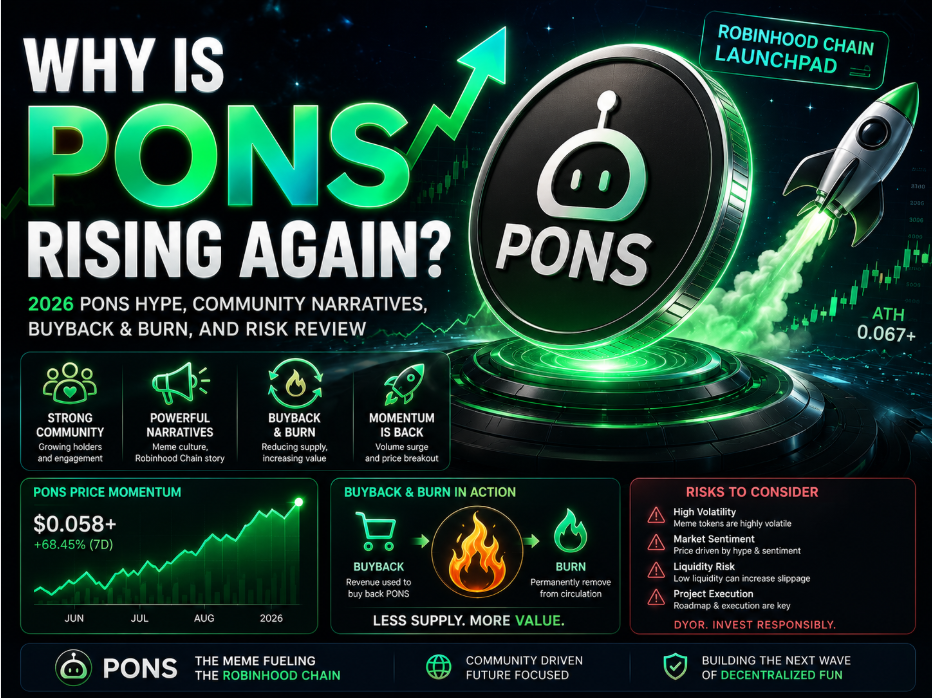
From a structural perspective, PONS has gone through four phases:
- Phase 1: Early‑chain hype after the July launch.
- Phase 2: Profit‑taking after the rapid price surge.
- Phase 3: Competitive re‑assessment following the Pools.trade launch.
- Phase 4: A second pricing wave driven by protocol revenue, buyback & burn, Robinhood Chain growth, and new trading venues.
So the key to “why PONS is rising again” isn’t finding one single decisive catalyst—it’s understanding why the market, even after a major competitor appeared, is willing to re‑rate Pons at a higher valuation.
2. Why Did the First PONS Rally End?
2.1 The First Rally Relied on Robinhood Chain Early‑Cycle Tailwinds
Robinhood Chain officially launched its public mainnet on July 1, 2026. Robinhood positions it as an Ethereum Layer 2 built for financial services, stock tokens, RWAs, and on‑chain trading—based on Arbitrum technology, EVM‑compatible, and using ETH for gas.
When a new chain goes live, the market typically looks for the earliest infrastructure:
- DEXs
- Bridges
- Launchpads
- Meme coins
- Lending protocols
- Wallets and trading tools
Pons captured the “early Token Launchpad on Robinhood Chain” slot. Users can create, discover, and trade new tokens on Pons, while the platform earns trading fees.
Thus, the first PONS rally stacked three layers of expectations:
- Robinhood Chain’s new‑chain growth
- Pons Launchpad’s first‑mover advantage
- PONS community and meme appeal
In a young ecosystem without mature projects, early applications often command a scarcity premium. But that premium rests on “temporarily limited competition”—once a major player enters, the market naturally re‑evaluates that logic.
2.2 Excessive Short‑Term Gains Triggered Profit‑Taking
Early PONS participants had significantly lower cost bases than later buyers. After a rapid price run‑up, early wallets sat on large unrealised profits.
Even without negative news, a pullback can occur due to:
- Early holders taking profits
- Insufficient fresh buy‑side demand
- Declining KOL and social media buzz
- Thin liquidity amplifying selling pressure
- Market rotation away from new‑chain hype to other themes
- Investor concern that valuation has overshot
For small‑cap tokens, price rises don’t require huge capital—and drops don’t require massive sell orders either. Historical spikes themselves are evidence of future volatility.
2.3 Why Did Pools.trade Force the Market to Re‑Evaluate Pons?
On August 5, 2026, Uniswap Labs officially launched Pools.trade, a Launchpad for Robinhood Chain.
Pools.trade supports token creation, discovery, and trading, with features like permanent liquidity locks, automatic fee compounding, Crowd Launch and Instant Launch modes. Uniswap also emphasises zero additional Launchpad fees, a standard pool fee of ~0.25%, and direct distribution through Uniswap’s app, wallet, and API.
This created direct competition for Pons.
If PONS’ earlier valuation was built on the expectation that “Pons is the primary Launchpad on Robinhood Chain,” then Uniswap’s entry naturally erodes Pons’ monopoly premium.
Competition isn’t just about features—it includes:
- Who attracts more token creators
- Who aggregates more traders
- Who provides deeper liquidity
- Who lowers issuance and trading costs
- Who gets stronger wallet and aggregator distribution
- Who sustains protocol revenue
So it was entirely rational for PONS to be re‑priced after Pools.trade appeared. The real question is: after a strong competitor launched, why hasn’t Pons lost all market demand?
3. Reason #1 for PONS’ Resurgence: Pons Still Has Real Usage Data
The biggest difference between PONS and a typical meme coin is that it simultaneously carries meme attributes, Launchpad platform‑token utility, and Robinhood Chain ecosystem beta.
PONS’ basic value chain can be summarised as:
The Pons platform attracts users to issue tokens → tokens generate trading fees → a portion of fees become protocol revenue → protocol uses part of that revenue to buy PONS and burn it.
This doesn’t mean PONS is no longer speculative—it means price, in addition to community sentiment, may also correlate with on‑platform trading activity.
3.1 Token Launch Count Isn’t the Only Metric
How many tokens Pons launches daily reflects whether creators are still engaged, but it doesn’t alone prove economic value.
Because:
- People launching tokens ≠ people trading them.
- People trading ≠ sustainable volume.
- Rising volume ≠ enough fee revenue to support the current PONS market cap.
So when evaluating real usage, watch these together:
- Daily token launches
- Number of tokens with actual trading activity
- Daily unique creators
- Active trading wallets
- Total trading volume
- Protocol fees
- Creator fees
- Token graduation rate
- Buyback and burn amounts
Among these, Protocol Fees are much closer to real economic activity than raw launch counts.
3.2 Why Does Pons Still Have First‑Mover Advantage?
Even with Pools.trade in the picture, Pons retains a solid first‑mover edge.
It entered the Robinhood Chain ecosystem early and has already accumulated tokens, trading pools, creators, community, and brand recognition. User habits and liquidity don’t vanish overnight just because a competitor shows up.
Moreover, PONS itself is both a platform token and a community meme asset. Platform data can support the token narrative, while a rising token price can, in turn, drive traffic to the Launchpad.
This “product ↔ token” flywheel is one reason PONS can generate a second rally more easily than a standalone cat‑or‑dog meme.
But first‑mover advantage is not a permanent moat. If creators and volume keep migrating to Pools.trade, Pons’ edge will gradually erode.
4. Reason #2 for PONS’ Resurgence: Protocol Revenue Buyback & Burn Narrative
The buyback‑and‑burn mechanism is one of the most important variables in this round of re‑pricing.
4.1 Where Does Pons’ Fee Revenue Come From?
According to Pons’ current public rules, tokens issued via the new factory follow this fee split:
- Creator gets 70%
- Protocol gets 30%
Older tokens created with the legacy factory retain their original split (90% Creator / 10% Protocol). This is not retroactively changed for all tokens—it depends on which factory version was used at creation.
The more active the trading, the more fees are generated; the protocol’s 30% (or 10%) share grows accordingly.
So Pons’ revenue is directly tied to:
- Active token count
- Token volume
- Trading frequency
- Platform market share
- Creator retention
- Overall Robinhood Chain activity
4.2 What Does “80% of Protocol Fees Used to Buy Back PONS” Mean?
According to the Pons official documentation, the current arrangement is:
- 80% of Protocol Fees are used to buy PONS via a TWAP (time‑weighted average price) mechanism, and the purchased PONS are sent to a burn address.
- The remaining 20% covers infrastructure costs and team expansion.
TWAP execution spreads purchases over time to minimise immediate price impact, unlike a single large market order.
This means buyback funds are not simply a team top‑up—they come from protocol fees generated by the Pons platform.
If platform trading activity keeps growing, the theoretical feedback loop is:
More platform trading → higher protocol revenue → more buyback capital → additional market buy pressure for PONS → tokens bought and burned → circulating supply shrinks.
As of August 26, 2026, CoinGecko shows an initial total supply of 1 billion PONS, with approximately 287.9 million already sent to the burn address—leaving an estimated circulating supply of ~712.1 million.
These burn figures are verifiable on‑chain, but supply reduction alone does not guarantee price appreciation.
4.3 Can Buyback & Burn Create Positive Feedback?
Assuming stable or growing demand, buybacks create market bids, while burns reduce circulating supply.
The potential positive feedback loop:
Pons Launchpad heats up → more tokens and trades → more fees → higher protocol revenue → larger PONS buybacks → tokens burned → reduced supply and renewed attention → PONS price rises → more traffic to Pons platform.
This is why the market is now asking a more meaningful question:
“Is PONS price starting to correlate with Pons platform revenue?”
That’s far closer to a real valuation framework than “is PONS the next 100x coin?”
But the loop is not automatic. If volume drops, protocol revenue, buyback size, and market attention may all fall together. Buybacks may also be dwarfed by selling pressure and fail to halt a decline.
4.4 The Current Buyback Mechanism Is Not Fully Immutable
This is a risk that cannot be ignored.
Pons’ public information states that the current 80% protocol‑fee buyback ratio is not yet fully immutable. The project plans to make the mechanism more automated, decentralised, and unchangeable in the future—but for now, parameters remain adjustable.
Therefore, investors should not treat “80% of protocol fees will forever be used for buybacks” as a fact permanently guaranteed by immutable smart contracts.
When assessing buybacks, continuously verify:
- The buyback wallet address
- Each buyback transaction
- Source of funds used
- Purchase amounts
- TWAP execution cycles
- Burn address
- Cumulative burned supply
- Whether rules have been modified
On‑chain verifiable execution matters far more than social media hype.
5. Reason #3 for PONS’ Resurgence: The Robinhood Chain Narrative Hasn’t Faded
Robinhood Chain is the most important ecosystem backdrop for PONS.
The network is an Ethereum Layer 2 built on Arbitrum tech, EVM‑compatible, using ETH for gas, and focused on stock tokens, RWAs, trading, lending, and on‑chain financial applications.
Pons sits at the token‑creation and trading‑entry point of that chain.
New chains typically follow this development sequence:
Base network launches → bridges, wallets, and DEXs appear → Launchpads and meme coins emerge → expansion into lending, derivatives, NFTs, prediction markets, and RWA apps.
Along the way, projects that build user bases, volume, and brand recognition early may enjoy “ecosystem beta” and “scarcity premiums.”
PONS still benefits from part of that pricing logic:
- Robinhood Chain growth may bring more users to Pons
- More users may generate more token launches and trades
- More trades may increase protocol fees
- Higher fees may expand PONS buybacks
- Buybacks and burns reinforce the token narrative
But it must be clear:
Robinhood Chain is not PONS, and PONS is not an official Robinhood platform token.
PONS runs on Robinhood Chain, but that does not mean it is issued, invested in, or price‑supported by Robinhood. Robinhood Chain is an open network—any developer can deploy applications on it.
6. Reason #4 for PONS’ Resurgence: CEXs Are Expanding Liquidity On‑ramps
PONS’ initial price discovery happened mainly on Robinhood Chain DEXs. As centralised exchanges add PONS/USDT spot markets, users no longer need to set up a chain wallet, hold ETH for gas, or bridge assets—they can trade directly with USDT.
BingX announced its PONS spot listing on August 24, 2026, with a limited‑time zero‑fee campaign. New CEX on‑ramps can bring:
- More USDT trading demand
- Exposure to new users
- Higher reported volumes
- Cross‑platform price discovery
- Arbitrage between on‑chain and centralised markets
- Increased attention on tickers and search channels
But the more accurate framing is:
New CEX liquidity is likely one of several auxiliary catalysts for PONS’ second rally—not the sole reason for the price increase.
Exchange listings are not necessarily a lasting positive. They may increase buy pressure, but they also make it easier for early holders to sell. The net effect depends on whether fresh inflows outweigh selling interest.
7. Why Is the PONS Community Heating Up Again?
The PONS community is currently spreading four narratives simultaneously.
Narrative 1: The Representative Meme Asset of Robinhood Chain
PONS has strong meme and community DNA. The Pons name, visuals, and early‑chain culture provide fertile ground for social sharing.
Narrative 2: The Top Launchpad on Robinhood Chain
Pons is one of the earliest token Launchpads on Robinhood Chain. Even with Pools.trade in the market, Pons retains a base of creators, traders, and brand recognition.
Narrative 3: Protocol Revenue + Buyback & Burn
The fee‑revenue, TWAP buyback, and burn mechanism give PONS a more quantifiable value chain than a typical meme coin.
Narrative 4: Robinhood Chain Ecosystem Beta
If Robinhood Chain continues to grow, the market expects Pons to benefit. Some traders thus treat PONS as a high‑beta proxy for Robinhood Chain ecosystem expansion.
The stacking of these four narratives makes PONS more capable of building community consensus than a standalone meme coin.
But community heat can also form a FOMO loop:
Price rises → more discussions → KOLs and community amplify → new users FOMO in → fresh bids push price higher.
The loop works in reverse too. Falling prices reduce chatter, community interest cools, and transaction volume and new demand shrink.
To gauge PONS community heat, watch official X follower growth, mentions, independent content creators, Telegram activity, search trends, exchange ranking, and volume changes.
Social media follower counts are only a sentiment gauge—they do not prove that Pons protocol revenue is growing.
8. Is PONS a Meme Coin or a Launchpad Token?
PONS does not fit neatly into a single label.
It has clear meme attributes—price is influenced by community culture, KOL propagation, and market sentiment. But at the same time, Pons operates a functional Token Launchpad on Robinhood Chain, with fees, protocol revenue, buybacks, and burns.
Thus, a more accurate positioning is:
A meme‑styled Launchpad platform token within the Robinhood Chain ecosystem.
Its market pricing is likely influenced by three factors:
- Meme community and attention
- Launchpad usage data and protocol revenue
- Overall development of Robinhood Chain
For readers new to the project, you can continue with the complete introduction to PONS and the Pons Launchpad to understand the contract, tokenomics, Robinhood Chain background, and how to buy.
This article, however, is not about repeating basics—it’s about analysing why PONS rallied again after its first pullback.
9. How Much of This Rally Is Fundamental, and How Much Is Sentiment?
Analysing PONS requires separating information into three layers.
Layer 1: Verifiable Facts
These can be confirmed via the official website, docs, on‑chain data, and exchange announcements:
- Robinhood Chain public mainnet is live.
- Pons Launchpad is operational.
- Users can create and trade tokens on Pons.
- Platform trading generates fees.
- PONS buyback and burn records exist.
- Pools.trade has entered Robinhood Chain.
- PONS has added some CEX trading pairs.
- PONS supply has decreased due to burns.
Layer 2: Reasonable but Unprovable Market Assumptions
These have logical grounding but remain uncertain expectations:
- Robinhood Chain will continue expanding.
- Pons can maintain a high Launchpad market share.
- Protocol fees will keep growing.
- Buybacks will strengthen PONS demand.
- CEX listings will bring long‑term users.
- Community enthusiasm can be sustained.
Layer 3: Emotion‑Driven Claims Lacking Evidence
These should not be treated as investment facts:
- PONS is Robinhood’s official token.
- Robinhood will certainly support PONS.
- Pons will definitely become the largest Launchpad on Robinhood Chain.
- Buyback & burn will always drive price up.
- Breaking ATH guarantees further upside.
- A shrinking supply means it can’t crash.
The second rally can be interpreted as a fundamental re‑pricing—the market reassessing Pons as a Robinhood Chain Launchpad—but that is a market interpretation, not a proven certainty.
10. Can PONS Continue to Rise? Six Key Indicators to Watch
10.1 Daily Token Launch Count
Rising launches suggest the platform still attracts creators; a prolonged decline indicates waning Launchpad interest.
But don’t rely on count alone—low‑cost issuance can produce many tokens with zero trading.
10.2 Protocol Fees
Protocol fees matter more than launch count.
People issuing tokens ≠ people trading them. Fee revenue is closer to real economic activity.
Watch daily fees, weekly fees, growth rates, and whether revenue is overly concentrated in a few hot tokens.
10.3 PONS Buyback and Burn
Focus on:
- Daily buyback amount (USD)
- Daily buyback quantity (PONS)
- Cumulative burned supply
- Buyback amount as % of market cap
- Buyback amount as % of trading volume
- Whether the buyback mechanism changes
If market cap grows much faster than protocol revenue and buybacks, price may have already priced in a lot of future expectations.
10.4 Trading Volume and Market Depth
Rising price with rising volume shows broader participation. If price rises but volume shrinks, the move may be fragile.
Also check order book and DEX pool depth—high volume doesn’t always mean large positions can exit with low slippage.
10.5 Overall Robinhood Chain Activity
Track:
- Active addresses
- DEX volume
- Stablecoin supply
- TVL
- New DApps
- Bridged funds
- Token issuance
- RWA trading activity
Pons cannot grow independently of its underlying ecosystem for long.
10.6 Competitors Like Pools.trade
Researching PONS means not only studying Pons itself.
If Pools.trade gains more creators, traders, and liquidity, Pons’ market share and fee revenue may decline. Conversely, if Pons holds usage after competition, its first‑mover edge becomes more credible.
11. PONS Price Scenarios: Bull, Base, and Bear
You can view technical indicators and trend references on the PONS price prediction page, but for a recently‑listed, high‑volatility token, a fixed target price is unsuitable.
Bull Case: Platform Revenue and Ecosystem Expand Together
Optimistic scenario requires:
- Robinhood Chain activity continues to grow
- Pons maintains a high Launchpad market share
- Token volume and Protocol Fees increase
- 80% buyback arrangement stays in effect
- Burns continue to rise
- More CEXs provide liquidity
- Community remains engaged
- Crypto markets are in risk‑on mode
In this case, PONS may test new price levels. But even with an upward trend, 30%, 50%, or larger corrections are possible along the way.
Base Case: Pons Stays Active, but Competition Caps Valuation
Neutral scenario may show:
- Pons sustains moderate users and fee revenue
- Platforms like Pools.trade take a share of the market
- Buybacks continue but at a limited scale
- Community heat gradually normalises
- PONS enters a wide trading range
- Price largely follows altcoin market trends
Here, PONS may retain market attention but no longer enjoys the full scarcity premium of its early‑chain phase.
Bear Case: Usage Declines and Sentiment Fades Simultaneously
Pessimistic scenario includes:
- Token launches and trading volume drop
- Protocol Fees shrink
- Buyback size contracts
- Pools.trade captures more market share
- Community interest evaporates
- Large holders sell concentrated positions
- CEX liquidity dries up
- Broader market turns risk‑off
If both fundamentals and sentiment weaken, PONS could see another deep retracement.
12. Why Do BTC and ETH Affect PONS?
PONS is still a high‑beta crypto asset.
When BTC enters liquidity expansion, risk‑on, or altseason phases, capital is more likely to flow from majors into small‑cap tokens. Conversely, when BTC drops sharply or macro risk‑aversion rises, investors tend to dump high‑volatility assets first.
Before judging PONS’ independent move, consider overall risk appetite via BTC price prediction and market cycles, and monitor ETH price prediction for signs of Ethereum, Layer 2, and EVM ecosystem fund flows.
A project with no bad news doesn’t mean the token won’t fall. If the broader market deleverages, PONS could still suffer larger losses due to liquidity and beta factors.
13. Most Noteworthy Risks After PONS’ Rally
13.1 High Volatility Risk
PONS has experienced a spike, a pullback, and another spike. Historical volatility is not a guarantee of future gains—it’s direct evidence of risk.
Late buyers have cost bases dramatically higher than early wallets; even a sizable pullback may leave early holders profitable.
13.2 Liquidity Risk
Some tokens on the Pons platform may have thin liquidity, high slippage, and extreme moves. PONS’ own market depth has improved, but don’t rely solely on market cap or 24h volume.
Before a large sale, check real order book depth and price impact.
13.3 Launchpad Competition Risk
Pools.trade has Uniswap’s brand, wallet, app, API distribution, and permanent liquidity locks.
If creators find Pools.trade cheaper and better distributed, Pons could lose users and volume, hurting protocol revenue and buybacks.
13.4 Buyback Rule Adjustment Risk
The 80% protocol‑fee allocation is not yet fully immutable. If the team changes the ratio, frequency, or use of funds, PONS’ valuation assumptions may shift.
13.5 Whale and Concentration Risk
Investors need to distinguish burn addresses, liquidity pools, platform wallets, and ordinary whales to assess true concentration.
If a small number of early addresses hold large amounts of liquid PONS, their selling could have a significant market impact.
13.6 Community FOMO Risk
A rising price creates the illusion that “the project has already proven itself.”
But a rising price only proves that buy pressure exceeded sell pressure at that moment—it does not alone prove that platform revenue, market share, and buyback scale support the current valuation.
14. How Does PONS Differ from Other Recent Hot Coins?
PONS’ core narrative is:
Robinhood Chain, Launchpad, meme community, protocol revenue, and buyback & burn.
For a complete project overview, read What is PONS.
Compared to PONS:
- What is BASECAT is primarily a Base‑ecosystem cat meme, with value more dependent on community culture, Base hype, and market liquidity.
- What is CYBERLEEK is a cyber‑culture, gaming‑event, community‑driven token, more attention‑driven.
- What is HMM USDT describes Thinking Cat, a community meme asset on Robinhood Chain, mainly relying on cat culture and ecosystem spread.
The common thread among these new coins is fresh narratives, new liquidity, and community propagation. PONS stands out because it has an observable Launchpad fee structure, protocol revenue, buyback, and burn economic model.
That gives PONS one extra layer of fundamental analysis compared to pure memes—but it does not mean lower risk.
15. If You’re Just Discovering PONS, How Should You Research?
Step 1: Check the PONS real‑time market data for latest price, volume, change, and order book depth.
Step 2: Read the introduction to PONS and the Pons Launchpad to understand the project mechanics, contract, network, and tokenomics.
Step 3: Examine real protocol data for Pons—launch counts, trading volume, Protocol Fees, buybacks, and burns.
Step 4: Analyse competitors like Pools.trade to assess whether Pons’ market share is rising or falling.
Step 5: Factor in BTC, ETH, and Robinhood Chain overall activity to gauge whether we’re in a risk‑expansion phase.
Step 6: Estimate how much future growth is already priced into the current market cap.
Research order: Look at data first, then understand mechanics, and finally assess price.
Don’t start with “PONS has already rallied” and then search for reasons it will keep rallying.
16. Is PONS Worth Investing In?
Whether PONS is worth investing in is not about “how many more multiples” but three core questions.
Can Pons sustain user activity?
If the Launchpad lacks creators and traders, the fee, buyback, and burn logic collapses.
Can Protocol Revenue keep growing?
Launch counts are surface‑level. What truly determines buyback capacity is ongoing protocol revenue.
Is the current market cap already pricing in too much future growth?
A project with a product and a revenue model doesn’t mean any price is a good entry.
If PONS’ market cap is rising much faster than platform users, volume, Protocol Fees, and buyback size, then price may already reflect overly optimistic expectations.
So the second PONS rally can be understood as the market shifting from “new‑chain meme speculation” to “Launchpad platform value re‑pricing”—but it still contains substantial sentiment and future assumptions.
17. PONS FAQs
Why did PONS suddenly rise?
PONS’ rise may be driven by a mix of Robinhood Chain ecosystem heat, Pons Launchpad usage data, protocol‑fee buybacks and burns, new CEX liquidity, and community attention—not a single piece of news.
What is PONS coin?
PONS is a Launchpad platform token on Robinhood Chain, with strong meme and community attributes. The Pons platform allows users to create, discover, and trade new tokens.
Is PONS an official Robinhood token?
No. PONS runs on Robinhood Chain, but there is no evidence it is an official Robinhood platform coin, nor does it represent Robinhood equity or receive official price backing.
What is the relationship between PONS and Robinhood?
Pons is a third‑party application deployed on Robinhood Chain. Robinhood Chain provides the underlying network; Pons runs its own Launchpad product and token economy.
Does PONS have a buyback‑and‑burn mechanism?
Yes. Pons’ current public mechanism allocates 80% of Protocol Fees to TWAP buybacks and burns of PONS, with the remaining 20% for infrastructure and team operations. However, the 80% allocation is not yet fully immutable.
What is the total supply of PONS?
The initial maximum supply is 1 billion PONS. As of on‑chain stats on August 26, 2026, approximately 287.9 million have been sent to the burn address, leaving an estimated ~712.1 million. Figures change—always check the block explorer.
Can PONS continue to rise?
It depends on Pons usage, Protocol Fees, buyback scale, Robinhood Chain growth, competition, market liquidity, and the BTC cycle. Breaking an ATH does not guarantee further upside.
What is the price prediction for PONS?
For a recently‑listed, high‑volatility token, fixed price targets are unreliable. It’s better to use Bull, Base, and Bear scenarios rather than trust a single forecast.
Who is PONS’ biggest competitor?
The most notable direct competitor is Uniswap Labs’ Pools.trade. Other Robinhood Chain Launchpads may also compete for creators, traders, and liquidity.
Is PONS worth holding long‑term?
Long‑term value depends on whether Pons can sustain market share, generate consistent protocol revenue, and convert that revenue into verifiable PONS buybacks and burns. Investors also need to assess whether the current price already over‑discounts those expectations.
What’s most worth watching about PONS’ second rally is not how much it has gained, but whether the market is beginning to re‑price PONS from a pure new‑chain meme into a Launchpad token with platform usage, protocol revenue, and a buyback‑and‑burn mechanism.
This interpretation has some data support, but it still needs ongoing verification from Protocol Fees, buybacks, burns, and market share. For investors, the real priority is not predicting the next candle—it’s observing whether this value chain continues to function.
Disclaimer: This content is based on publicly available information for educational and reference purposes only. It does not constitute investment advice, an offer, or a solicitation. Cryptocurrencies are high‑risk assets with extreme price volatility. Please conduct your own research (DYOR) and comply with the laws and regulations of your jurisdiction before making any decisions.