
What exactly is XAAOI? Is it a standalone cryptocurrency, or is it a tokenized asset tied to Applied Optoelectronics, Inc. (NASDAQ: AAOI) stock? Does buying XAAOI equate to directly holding AAOI shares in a U.S. brokerage account?
These questions determine the appropriate analytical framework for investors.
If you treat XAAOI as an ordinary crypto token, you might focus on total supply, token unlocks, community engagement, burn mechanisms, and on-chain ecosystem metrics. However, XAAOI's primary value doesn't derive from a standalone tokenomics model—it comes from AAOI's orders, revenue, profits, 800G and 1.6T optical module production capacity, and the global AI data center construction cycle.
In 2026, Applied Optoelectronics' fundamental thesis has become increasingly clear:
800G products are scaling up, 1.6T has secured volume orders, hyperscaler demand is growing, the company is expanding U.S. production capacity, and it's working to convert orders into revenue and profits.
This has gradually repositioned AAOI in the market—from a traditional optical communications supplier to a significant player in the AI data center high-speed interconnect supply chain.
However, for XAAOI investors, company fundamentals are just the first layer. Since XAAOI trades against USDT on crypto platforms, investors must also consider the tokenized stock structure, underlying asset tracking mechanisms, issuance and custody arrangements, market liquidity, trading time differences, and short-term premiums or discounts.
Therefore, researching XAAOI should address four sequential questions:
- Is AI data center investment still growing?
- Can demand for 800G and 1.6T high-speed optical modules sustain?
- Can AAOI convert orders into production, revenue, gross profit, and net income?
- Have current XAAOI and AAOI prices already priced in overly optimistic expectations?
Risk Disclosure: This article is intended for asset mechanism introduction, company fundamental research, and investment education purposes only. It does not constitute investment advice, performance guarantees, or trading recommendations. XAAOI may be simultaneously affected by AAOI's U.S. stock price, AI capital expenditures, customer orders, company production expansion, token issuance structure, crypto market liquidity, and regulatory changes. Before trading, please verify the latest product documentation, issuer information, underlying asset arrangements, contract addresses, and eligible trading regions.
1. What is XAAOI? Why is a U.S. Optical Communications Stock Appearing in Crypto Markets?
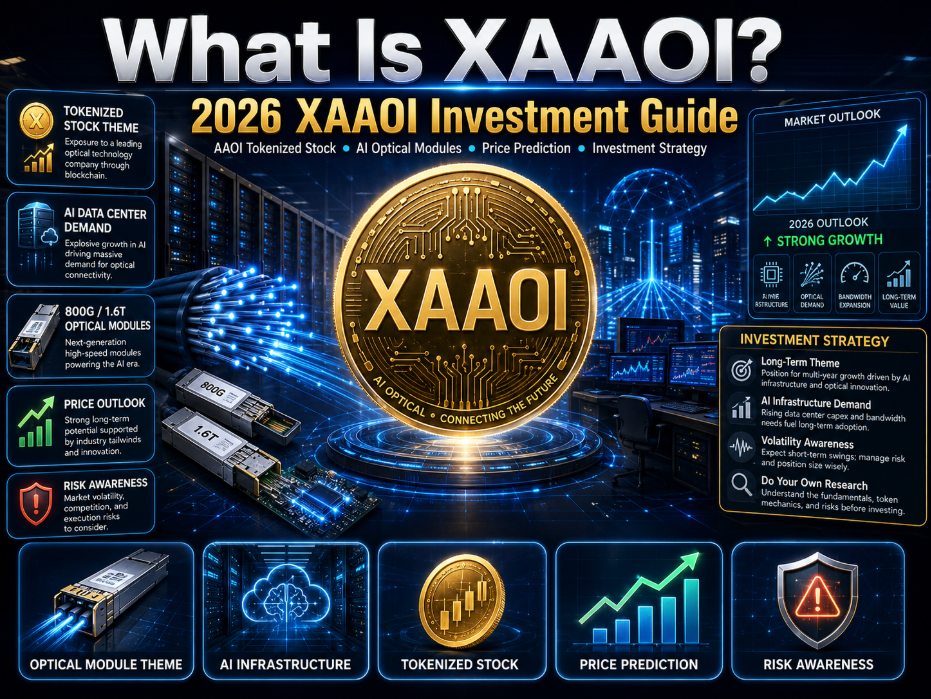
XAAOI is a tokenized stock asset linked to Applied Optoelectronics, designed for on-chain or crypto trading environments.
Applied Optoelectronics trades on the NASDAQ under the ticker AAOI. XAAOI, through the XAAOI/USDT trading pair, enables users to gain market exposure linked to AAOI's stock price using USDT.
A HiBT announcement indicates that XAAOI/USDT opened for trading on August 27, 2026, with the associated network noted as Solana. Investors can view XAAOI real-time prices and XAAOI/USDT market data to check the latest trading prices, 24-hour changes, and market activity.
However, the market data page only answers "what price XAAOI is currently trading at"—it does not independently verify how the underlying assets are custodied, nor does it guarantee that XAAOI perfectly tracks AAOI's U.S. stock price at all times.
Is XAAOI an Ordinary Crypto Token?
XAAOI utilizes token and crypto trading infrastructure, but it is not a typical crypto-native project.
It is not like BTC, ETH, meme coins, or DeFi governance tokens that derive value primarily from network usage, tokenomics, on-chain protocols, or community narratives.
XAAOI is closer to:
A digital representation of Applied Optoelectronics' economic value within a crypto trading environment.
Therefore, when analyzing XAAOI, the focus should not be on:
- Token burns;
- Community memes;
- FDV (Fully Diluted Valuation);
- Airdrops;
- Governance voting;
- DeFi total value locked (TVL);
- Token unlocks.
Instead, the focus should be on:
- AAOI's data center business;
- 800G and 1.6T orders;
- Hyperscaler customer demand;
- Company production capacity;
- Revenue;
- Gross margins;
- Profitability;
- U.S. stock valuations;
- XAAOI's deviation from AAOI's reference value.
The core of understanding XAAOI is not "what ecosystem does this token have," but whether Applied Optoelectronics can achieve sustainable growth in the AI high-speed optical communications market.
What is the Relationship Between XAAOI and AAOI Stock?
AAOI is the traditional stock ticker trading on the NASDAQ.
XAAOI is the AAOI-linked asset quoted in USDT within crypto markets.
Theoretically, XAAOI and AAOI should exhibit high price correlation. If AAOI's U.S. stock rises, XAAOI typically gains upward momentum; if AAOI declines, XAAOI is likely to face downward pressure.
However, "price correlation" does not equal "identical legal structure."
Traditional AAOI stock is typically held by investors through brokerage accounts, with corresponding rights under securities regulations.
What rights XAAOI holders receive depends on the specific product documentation, including:
- Whether it is backed by actual AAOI shares;
- Who custodies the underlying assets;
- The token-to-stock ratio;
- Whether minting and redemption are offered;
- Whether ordinary users can directly redeem;
- How dividends are handled;
- Whether voting rights are included;
- How assets are handled if the issuer encounters issues;
- Whether there are investor geographic restrictions.
Therefore, it cannot be stated as:
Buying XAAOI is exactly equivalent to buying AAOI stock in a traditional brokerage account.
A more accurate statement is:
Buying XAAOI primarily provides economic exposure linked to AAOI's stock performance, but the holding structure, legal rights, custody arrangements, and trading mechanisms may differ from traditional stock ownership.
Why Can U.S. Stocks Be Traded Using USDT?
Tokenized stocks aim to bridge traditional securities and on-chain capital.
The traditional path is typically:
Users open a brokerage account, deposit funds, and buy AAOI through the U.S. stock market.
XAAOI offers an alternative path:
Users hold USDT on supported platforms and gain AAOI-related price exposure through the XAAOI/USDT pair.
This model may lower the barrier for some crypto users to switch trading environments, while offering more flexible asset transfer and trading access.
But easier trading does not mean lower risk. Investors also take on additional risks from issuers, custody, smart contracts, platforms, and regulations.
2. What is Applied Optoelectronics? What Does XAAOI Really Invest In?
Applied Optoelectronics is a fiber optic network product supplier serving data centers, cable broadband, telecom, and FTTH (Fiber to the Home) markets.
Its stock ticker, AAOI, forms the core of XAAOI's fundamental research.
When users buy XAAOI, they are essentially betting not on a new token community's growth, but on whether:
AAOI can capitalize on the AI data center upgrade from 400G to 800G and 1.6T high-speed optical interconnects.
What Are AAOI's Primary Revenue Streams?
Applied Optoelectronics operates across four main markets.
The Internet Data Center business provides optical transceivers and related optical communications products to large data centers and cloud computing providers.
The Cable Broadband (or CATV) business serves cable broadband networks, helping operators enhance transmission capabilities.
The Telecom business supplies optical communications components and equipment for telecommunications networks.
The FTTH business relates to Fiber to the Home deployments.
AAOI has not historically relied solely on AI data centers. CATV, telecom, and FTTH are all part of its traditional business scope.
However, in 2026, market focus is increasingly concentrated on the Internet Data Center segment, particularly 800G and 1.6T high-speed optical modules.
What is Vertical Integration?
AAOI emphasizes its vertical integration capabilities in optical communications products.
This means the company may start with lasers, optical devices, and components, then manufacture complete optical modules and communications products.
Vertical integration can offer several potential advantages:
- Control over critical components;
- Greater supply chain autonomy;
- Reduced procurement costs;
- Faster product design adjustments;
- Enhanced customer customization capabilities;
- Improved production coordination during demand growth.
However, vertical integration also means the company must bear more manufacturing, equipment, personnel, and capacity investment.
If order growth falls short of expectations, substantial fixed costs could pressure gross margins and profits.
Therefore, vertical integration can be both a competitive advantage and a source of operating leverage.
Why is AAOI Increasingly Seen as an AI Infrastructure Stock?
AI servers are about more than just GPUs.
A large AI training cluster typically includes:
- GPUs or AI accelerators;
- HBM and server memory;
- Switches;
- Network interfaces;
- Optical modules;
- Fiber optics;
- Storage systems;
- Power and cooling equipment.
GPUs handle the computations, but large numbers of GPUs must exchange data with each other.
As cluster sizes scale from hundreds to thousands or more GPUs, network speed, latency, and reliability become increasingly critical.
If data transfer speeds between GPUs are insufficient, expensive compute capacity may be underutilized while waiting for data.
Consequently, the market has shifted from focusing "only on GPUs" to studying the complete AI infrastructure stack, including:
- 400G;
- 800G;
- 1.6T;
- Silicon photonics;
- CPO (Co-packaged optics);
- High-speed switching chips;
- Optical interconnects.
AAOI sits squarely in the high-speed optical module segment of this stack.
3. Why Are 800G and 1.6T Important? Does AAOI's AI Narrative Have Order Backing?
800G and 1.6T refer to the data transmission capacity of high-speed optical modules.
Simply put, higher numbers mean more data can be transmitted per unit of time.
How to Understand 800G and 1.6T?
Think of an AI data center as a large city. GPUs are the city's computing centers, switches manage traffic flow, and optical modules are like highway on-ramps connecting different servers, racks, and network equipment.
As AI models grow larger and GPU clusters scale higher, the volume of data exchanged between computing centers increases.
Networks thus evolve through:
100G, 400G, 800G, and onward to 1.6T.
1.6T typically represents data transmission capability at 1.6 Terabits per second. It doesn't mean a single AI model requires a fixed number of 1.6T modules, but rather reflects the broader trend of data center networks evolving toward higher bandwidth.
Why Do AI Training Workloads Specifically Require High-Speed Optical Modules?
Distributed AI training distributes computational tasks across large numbers of GPUs.
These GPUs need to frequently exchange:
- Model parameters;
- Gradients;
- Training data;
- Intermediate results;
- Synchronization information.
Insufficient network speed or excessive latency can cause GPUs to wait for communications, reducing overall cluster efficiency.
Therefore, high-speed optical modules are not decorative components for AI servers—they are critical infrastructure affecting cluster scale and utilization.
What Orders Has AAOI Already Secured?
In March 2026, Applied Optoelectronics announced it had secured its first volume order for 1.6T data center optical modules from a major hyperscale customer.
The significance of this event is that it shows AAOI's 1.6T products are moving from R&D, testing, and customer qualification into commercial order stage.
The company subsequently also disclosed 800G data center optical module orders.
In April 2026, AAOI announced an additional approximately $71 million in 800G orders, noting that cumulative orders from this customer since mid-March had reached approximately $124 million.
These orders provide more concrete fundamental evidence for AAOI's AI data center narrative than mere market concepts.
However, orders cannot be directly equated with realized profits.
Investors still need to verify:
- Whether orders are non-cancelable;
- Delivery timelines;
- Actual shipment volumes;
- Customer acceptance;
- Product yields;
- Average selling prices;
- Production costs;
- Gross margins;
- Payment cycles;
- Whether follow-on orders are expected.
Why Can't a Single Order Directly Determine Company Value?
The journey from orders to profits involves a complete cycle:
Order confirmation → material procurement → production scheduling → yield improvement → delivery completion → customer acceptance → revenue recognition → deducting production and operating costs → ultimately generating profit and cash flow.
Any issues along the way can cause final results to fall short of market expectations.
For example, the company may secure substantial orders, but if yields are inadequate, deliveries are delayed, or expedited production expansion costs are too high, revenue may grow while gross margins do not improve correspondingly.
Therefore, for XAAOI investors, what matters isn't just how many orders the company announces, but how much of those orders translate into sustainable profitability.
Why is AAOI Expanding Production Capacity?
In 2026, AAOI continues to expand its Texas manufacturing facility to increase 800G and 1.6T optical module production capacity.
Expanding facilities and production capability suggests management has a degree of confidence in future demand and needs to prepare for order fulfillment.
But production expansion is not inherently bullish.
Expansion requires incurring:
- Construction costs;
- Capital equipment expenditures;
- Hiring and training;
- Raw material procurement;
- Yield ramp-up;
- Depreciation;
- Operating expenses;
- Customer demand variability.
If demand consistently exceeds capacity, expansion can drive revenue and profit growth.
If market demand softens, the additional fixed costs can conversely pressure margins.
Investors should view capacity expansion as high operating leverage, not guaranteed returns.
4. What Are AAOI's Latest Results? What Fundamental Conditions Does XAAOI Need for Upside?
Q2 2026 is a key observation point for assessing changes in AAOI's fundamentals.
The company described Q2 as a pivotal quarter and disclosed:
- A fifth consecutive quarter of record revenue;
- Return to profitability on a non-GAAP basis;
- 800G product sales more than doubling sequentially;
- High-speed optical module demand potentially exceeding capacity through mid-2027.
These data points indicate AAOI's AI data center business is moving from order expectations to actual revenue growth.
However, investors still need to distinguish between GAAP and non-GAAP results.
Non-GAAP profits typically exclude certain one-time expenses, stock-based compensation, or other accounting items. It helps observe operational trends but does not fully replace GAAP net income and cash flow analysis.
Does Record Revenue Mean the Company Has Already Transformed?
Not necessarily.
While consecutive record revenues demonstrate growing product demand and shipments, long-term value creation depends on:
- Duration of growth;
- Customer mix;
- Gross margins;
- Operating expenses;
- Net income;
- Free cash flow;
- Capital expenditures;
- Accounts receivable;
- Inventory;
- Order visibility.
If revenue growth comes primarily from low-margin orders while expansion and operating expenses increase in tandem, the company's value improvement may fall short of market expectations.
Data Center Revenue Growth
This is the primary metric for whether AAOI can command an AI infrastructure valuation.
Investors should monitor whether data center revenue as a percentage of total company revenue continues to increase, and whether growth is driven by a few one-time orders.
If the Internet Data Center business continues to expand and the customer base gradually diversifies, AAOI's revenue structure may improve.
800G Product Shipments
Orders represent customer intent; shipments begin to approach actual revenue realization.
Key metrics to track include:
- 800G shipment volumes;
- Sequential growth;
- Average selling prices;
- Order backlog;
- Delivery lead times;
- Capacity utilization;
- Product gross margins.
If 800G sales continue to grow while gross margins improve concurrently, the company may be achieving higher-quality revenue growth.
1.6T Ramp-Up Speed
1.6T represents AAOI's next major growth story.
Investors should monitor:
- Customer qualifications;
- Volume orders;
- Production timeline;
- Actual shipments;
- Revenue contribution;
- Yields;
- Subsequent customer additions.
Securing the first volume order is an important starting point, but it does not yet prove that 1.6T has become a large-scale, sustainable revenue source.
Gross Margins
Gross margin is a critical metric for assessing order quality and production expansion efficiency.
Revenue growth with continuously declining gross margins may indicate:
- Intense product price competition;
- Insufficient production yields;
- Rising raw material costs;
- Excessive early-stage expansion expenses;
- Strong customer bargaining power;
- Suboptimal product mix.
Conversely, if revenue, gross margins, and operating cash flow improve in tandem, AAOI's fundamental upside thesis becomes more compelling.
Hyperscaler Orders
Hyperscalers typically refer to companies operating massive cloud computing and data center infrastructure.
Orders from these customers can be very large, but customer concentration also increases.
Key research points include:
- New customer additions;
- Revenue concentration from single customers;
- Order duration;
- Customer switching risk;
- Pricing pressure in contracts;
- Stability of customers' own AI capital expenditures.
5. What Determines XAAOI's Price? Why Can't You Just Watch BTC?
XAAOI's price is influenced by at least five layers of factors.
Layer 1: AAOI's U.S. Stock Price
AAOI is XAAOI's most core pricing reference.
Under normal circumstances:
When AAOI's U.S. stock rises, XAAOI typically gains upward momentum; when AAOI declines, XAAOI usually faces pressure.
However, actual comparisons also require verifying:
- The unit correspondence between XAAOI and AAOI;
- Whether U.S. markets are open;
- Data update timing;
- Product fees;
- Dividend handling;
- Bid-ask spreads;
- Whether a premium or discount exists.
Layer 2: AI Infrastructure Market Sentiment
AAOI's valuation is influenced by the broader AI infrastructure sector.
Investors can monitor AI capital expenditure trends at major technology companies like Microsoft, Meta, Amazon, and Google, as well as performance of NVIDIA, Broadcom, and other data center supply chain companies.
When large tech companies increase AI investment, markets may form expectations along these lines:
More data center construction → more GPU clusters → larger GPU clusters requiring higher-speed switching and optical interconnects → increased 800G and 1.6T optical module demand → AAOI and suppliers securing more orders → upward revisions to company revenue and profit expectations.
But sector strength doesn't guarantee AAOI will benefit synchronously. It's still necessary to confirm the company is actually winning customers, orders, and capacity.
Layer 3: AAOI Orders and Earnings Reports
Company-specific events that may drive price include:
- New hyperscaler customer wins;
- Increased 800G orders;
- 1.6T volume orders;
- Revenue guidance upgrades;
- Production capacity expansion;
- Gross margin improvements;
- Return to profitability;
- Positive cash flow;
- New product qualifications.
Markets typically trade on expectations in advance.
If positive news has already been fully priced in, the actual announcement may trigger a "sell-the-news" reaction.
Layer 4: XAAOI's Own Liquidity
Even when AAOI's U.S. stock price shows no significant change, XAAOI may experience short-term deviations due to crypto market structure.
Influencing factors include:
- Order book depth;
- Bid-ask spreads;
- Platform trading volume;
- Short-term concentrated capital flows;
- U.S. market holidays;
- Deposit/withdrawal status;
- Market maker quoting;
- Issuance and redemption efficiency;
- Solana network status.
If XAAOI market depth is insufficient, large market orders can significantly push prices up or down.
Layer 5: Overall Crypto Risk Appetite
BTC and ETH don't directly increase AAOI's 800G orders or improve the company's gross margins.
However, crypto markets can affect the trading-side capital activity for XAAOI.
Investors can use BTC price predictions and market cycles to observe whether the crypto market is in a risk-on or risk-off environment.
They can also reference ETH price predictions and Ethereum trends to gauge on-chain finance and tokenized asset market activity.
BTC and ETH influence XAAOI indirectly through channels such as:
- USDT capital scale;
- Crypto user risk appetite;
- CEX trading volume;
- On-chain asset demand;
- Market deleveraging;
- XAAOI short-term premiums or discounts.
Therefore:
BTC and ETH are trading environment variables for XAAOI; AAOI's orders, revenue, and profitability are the core fundamental variables.
6. What Are the Differences Between XAAOI and Traditional AAOI Stock?
Before buying XAAOI, it's essential to understand how it differs from the NASDAQ stock.
Different Trading Venues
AAOI trades on NASDAQ, governed by U.S. securities market rules and trading hours.
XAAOI trades in token form within crypto trading environments, with different platform rules, settlement mechanisms, and participant structures.
Different Settlement Assets
Traditional AAOI stock is typically settled using fiat currency or broker funds in a securities account.
XAAOI/USDT is quoted and traded in USDT.
While USDT aims to maintain a stable value relative to the U.S. dollar, it remains a stablecoin—not U.S. dollar cash in a bank account. Investors also bear stablecoin and crypto platform risks.
Different Trading Hours
U.S. stocks have fixed trading sessions with pre-market and after-hours trading options.
XAAOI may offer extended trading windows, but longer trading hours don't guarantee sufficient liquidity at all times.
When U.S. markets are closed, XAAOI may price in company news, U.S. stock futures, AI sector performance, and crypto market order flow in advance.
This offers both more flexible trading opportunities and potentially larger price deviations.
Different Shareholder Rights
Holding traditional AAOI stock typically means investors own company shares through the securities system.
Whether holding XAAOI confers voting rights, dividend rights, corporate action participation rights, or direct recourse to underlying shares depends on the product's legal documentation.
One cannot assume that tracking AAOI's price automatically makes XAAOI holders registered shareholders of Applied Optoelectronics.
Additional Tokenized Stock Infrastructure Risks
Beyond AAOI's own operational risks, XAAOI may also face:
- Issuer risk;
- Underlying asset custody risk;
- Asset segregation risk;
- Smart contract risk;
- Solana network risk;
- Trading platform risk;
- Liquidity risk;
- Regulatory changes;
- Premiums and discounts;
- Deposit/withdrawal suspensions;
- Counterfeit token risk.
This means XAAOI's risk structure can be understood as:
AAOI stock risk + Tokenization structure risk + Crypto trading environment risk.
7. Why Does XAAOI Merit Attention? Three Investment Theses for 2026
AI Compute Is Driving High-Speed Optical Communications Upgrades
After rapid growth in AI compute capacity, networking is increasingly becoming a bottleneck affecting cluster efficiency.
The more GPUs in a cluster, the more data that must be exchanged between servers. Data centers need to upgrade from 400G to 800G and evolve further toward 1.6T.
If this upgrade cycle persists, the optical module industry may benefit from structural demand.
XAAOI therefore is not simply an "NVIDIA-related concept"—it represents an investment exposure to AI data center interconnect infrastructure.
AAOI May Be Repriced from Traditional Optical Communications to AI Data Center Supplier
AAOI's historical valuation logic derived more from CATV, telecom, FTTH, and traditional data center businesses.
As 800G scales up, 1.6T secures orders, and data center revenue grows, the market may gradually revalue the company through an "AI Optical Infrastructure" lens.
This valuation reset requires two conditions.
First, AI data center revenue must continue to grow in importance within the company's overall business.
Second, the company must translate growth into gross margin, net income, and cash flow—not just orders and revenue.
If only the narrative changes without earnings improvement, the valuation reset may prove unsustainable.
XAAOI Lowers the Barrier for Crypto Users to Access U.S. Equity Themes
For users accustomed to USDT, XAAOI offers an alternative path to AAOI-related price exposure:
USDT enters the XAAOI market → XAAOI tracks AAOI's related value → AAOI provides AI optical communications industry exposure.
This represents an important use case for RWA (Real World Assets) and tokenized stocks.
However, lower trading barriers do not mean lower research barriers. Users still need to understand U.S. stock earnings reports, company orders, valuations, and token product structures.
8. What Are XAAOI's Biggest Risks? Why Can the AI Story Be Right and Still Lose Money?
Even if AI data center growth is strong over the long term, XAAOI investors can still lose money.
The reason is that a good industry, a good company, and a good price are three separate questions.
AAOI Overvaluation
If AAOI's stock price has already priced in years of high growth ahead, subsequent earnings reports—even if they continue to grow—may decline because they fail to exceed already-elevated expectations.
Common scenarios include:
- The stock rises before good news is announced;
- Earnings beat last year but miss market expectations;
- Revenue grows but gross margins miss expectations;
- Orders increase but deliveries are delayed;
- Management guidance doesn't continue to be raised.
Therefore:
Correct company fundamentals don't mean any price is worth buying.
AI Capital Expenditure Declines
AAOI's high-speed optical module demand is closely tied to hyperscaler data center investment.
If large customers cut:
- GPU procurement;
- Data center construction;
- Network equipment upgrades;
- AI server deployments;
Optical module orders may be affected.
Even if capital expenditures continue growing, growth rates below previous market expectations can trigger repricing.
Customer Concentration Risk
Large data center suppliers often depend on a small number of major customers.
A few hyperscalers can bring substantial orders but also wield significant bargaining power.
If major customers:
- Cut orders;
- Delay deliveries;
- Switch suppliers;
- Demand price reductions;
- Adjust technology roadmaps;
- Build their own supply chains;
AAOI's revenue and profits could be significantly impacted.
Competition Risk
800G and 1.6T are not markets exclusive to AAOI.
Competitors include Lumentum, Coherent, Fabrinet, Innolight, and other global optical module and supply chain players.
Competition may manifest in:
- Product performance;
- Power consumption;
- Yields;
- Pricing;
- Capacity;
- Customer qualifications;
- Delivery speed;
- Technology roadmaps;
- Supply chain stability.
If competitors offer lower prices or faster delivery, AAOI's orders and gross margins may come under pressure.
Production Expansion Execution Risk
Expanding facilities does not automatically generate profits.
The real value chain is:
Customer orders received → company procures and produces → product yields improve → timely shipment and acceptance → revenue recognized → gross margin improves → ultimately generating net income and free cash flow.
If any link in this chain breaks down, expansion can shift from a growth driver to a cost burden.
Technology Upgrade Risk
The optical module industry experiences rapid technology refresh cycles.
Current 800G products may gradually mature, while 1.6T requires new design, production, and customer qualification capabilities.
If AAOI cannot execute product upgrades as planned, or if the industry accelerates toward different technology pathways like CPO, the company's current advantages may erode.
XAAOI Additional Risks
XAAOI also carries underlying tracking errors, limited market depth, platform operations, smart contract, Solana network, regional regulatory, and premium/discount risks.
Even if the AAOI stock call is correct, buying XAAOI at a significant premium could result in lower actual returns than the underlying stock.
9. XAAOI Investment Strategy: How Should Beginners Assess Entry Points?
XAAOI is a fundamentally driven stock-linked asset and cannot be analyzed using simple "low-cap altcoin" strategies.
Fundamental Trend Strategy
Mid-term investors can confirm three core conditions:
First, AAOI's data center revenue continues to grow.
Second, 800G shipments and 1.6T production ramp-up continue to progress.
Third, hyperscaler AI capital expenditures show no clear weakening.
If all three conditions hold, AAOI's fundamental trend remains relatively positive.
But a fourth question must be added:
Has the current valuation already fully or excessively priced in this growth?
Fundamental growth and entry price must be considered together.
Post-Earnings Confirmation Strategy
AAOI is a high-volatility growth stock, and significant expectation trading often occurs ahead of earnings.
Investors uncomfortable with earnings gap risk can review after the report:
- Revenue;
- GAAP and non-GAAP EPS;
- Gross margin;
- Guidance;
- 800G orders;
- 1.6T orders;
- Data center revenue;
- Capacity;
- Operating cash flow.
If results beat expectations, guidance is raised, gross margins improve, and the stock breaks out with volume confirmation, then assess whether the trend is sustainable.
This approach may miss some post-earnings upside but reduces the uncertainty of simply betting on earnings outcomes.
Staggered Buy on Pullbacks Strategy
For a newly listed and volatile asset like XAAOI, deploying all planned capital in a single transaction can create over-concentrated entry timing.
For example, investors could split planned positions into multiple parts:
- Part one for establishing a watch position;
- Part two for waiting until the underlying AAOI trend confirms;
- Part three for deciding after further earnings or order validation;
- A final part reserved for pullbacks or new fundamental information.
Proportions should be determined based on individual risk tolerance—25% or other percentages should not be treated as a universal allocation.
Staggered buying also does not replace stop-loss discipline and ongoing research.
If prices decline due to order cancellations, margin deterioration, or declining AI capital expenditures, mechanical averaging down can amplify losses.
AI Supply Chain Momentum Strategy
XAAOI's upside credibility can be cross-validated through the broader AI infrastructure supply chain.
Investors can simultaneously monitor:
- AI compute companies like NVIDIA;
- Networking and custom chip companies like Broadcom;
- High-speed switching and networking equipment;
- The optical module supply chain;
- AAOI's own orders and earnings.
If GPUs, networking, optical communications, and data center capital expenditures are all strengthening in tandem, AAOI's rally is more likely to have industry support.
If only AAOI is rallying alone without corresponding changes across the supply chain and earnings expectations, caution is warranted around short-term sentiment and valuation expansion.
Premium/Discount Control Strategy
Before buying XAAOI, compare AAOI's U.S. stock price with XAAOI's reference price.
If the underlying U.S. market is closed and XAAOI shows significant premium due to short-term concentrated capital flows, investors should assess the risk of price regression.
Key checks include:
- The unit correspondence between XAAOI and AAOI;
- AAOI's latest price;
- Whether U.S. markets are open;
- XAAOI bid-ask spreads;
- Large order slippage;
- Whether there is any company-specific news.
10. When Should You Consider Reducing XAAOI Exposure?
Entry strategies address how to build positions; exit strategies address when the investment thesis breaks down.
800G Order Growth Slows Significantly
If new orders decline, customers delay deliveries, or 800G shipments fall short of expectations, AAOI's near-term growth thesis may weaken.
1.6T Production Continues to Be Delayed
1.6T is a key support for the next growth phase.
If product qualifications, production ramp-up, yields, or deliveries continue to be delayed, the market may downgrade future revenue expectations.
Hyperscalers Cut AI Capital Expenditures
Large customers reducing data center and network investment can directly impact high-speed optical module demand.
Revenue Grows but Gross Margins Continue to Deteriorate
This could indicate the company is cutting prices to win orders, or that expansion and production costs are higher than expected.
The quality of revenue growth matters more than the revenue number itself.
Stock Rises but Earnings Expectations Don't Keep Pace
If AAOI's stock continues to rally without corresponding improvements in analyst earnings forecasts, company guidance, and cash flow, valuation risk may be accumulating.
Customer Concentration Continues to Increase
If growth becomes increasingly dependent on a single customer, any order adjustments will have a disproportionate impact on the company.
XAAOI Deviates Significantly from AAOI's Reference Value
Even if the company's thesis remains intact, a severe token premium can constitute an independent reason to reduce exposure.
Selling or reducing exposure is best based on investment thesis, valuation, and structural changes—not simply because the price dropped 5% in a single day.
11. XAAOI Price Prediction: Using Three Scenarios Instead of a Fixed Target
Investors can reference XAAOI price predictions and market trends as a supplementary tool for observing market movements across different timeframes.
However, for XAAOI, fixed price targets have limited reliability.
AAOI is a high-volatility growth stock, and XAAOI adds token market liquidity and premium/discount variables. A more reasonable approach is to construct Bull, Base, and Bear scenarios.
Bull Case
The bull case requires concurrent developments:
- Hyperscalers continue increasing AI capital expenditures;
- 800G demand consistently exceeds expectations;
- 1.6T begins volume shipments;
- AAOI's expansion proceeds as planned;
- Product yields improve;
- Data center revenue grows rapidly;
- Gross margins continue to improve;
- Company achieves sustainable profitability and cash flow;
- XAAOI maintains sufficient liquidity;
- No severe token premium.
In this scenario, the market may continue revaluing AAOI as an AI infrastructure supplier, and XAAOI may benefit from underlying stock appreciation.
Base Case
The base case might include:
- AI demand still growing;
- 800G orders remaining healthy;
- 1.6T gradually shipping;
- Intensifying competition;
- Gross margin improvement limited;
- Expansion adding costs;
- Revenue growing but profit elasticity moderate.
In this case, price appreciation may rely more on actual earnings rather than rapid P/E multiple expansion.
Bear Case
The bear case might include:
- AI capital expenditures slowing;
- Hyperscalers cutting or delaying orders;
- 800G market pricing competition intensifying;
- 1.6T production delayed;
- Capacity expansion exceeding demand;
- Gross margins declining;
- Cash flow under pressure;
- AAOI valuation contracting;
- XAAOI liquidity decreasing;
- Crypto market entering risk-off.
If both company fundamentals and token liquidity weaken simultaneously, XAAOI could experience drawdowns exceeding broader market declines.
12. How to View and Trade XAAOI on HiBT?
HiBT has opened XAAOI/USDT trading.
XAAOI/USDT means using USDT as the quote and settlement asset for trading XAAOI.
Viewing XAAOI Market Data
Investors can view XAAOI real-time prices, changes, and market data to check current quotes and trading activity.
Preparing USDT
Users can acquire USDT through supported platform methods or deposit from other wallets/platforms.
Before depositing, verify:
- Deposit network;
- Address;
- Minimum deposit amount;
- Whether the network is operational;
- Whether a Memo or Tag is required.
Selecting the wrong network may result in assets not being credited.
Searching for XAAOI/USDT
Navigate to the platform's trading section and search for XAAOI or XAAOI/USDT.
Be careful to avoid other similarly named assets and verify the platform product announcement and network information.
What to Check Before Placing an Order?
At a minimum, check:
- XAAOI's current price;
- 24-hour change;
- Trading volume;
- Bid-ask spread;
- Order book depth;
- AAOI's latest U.S. stock movement;
- Whether U.S. markets are currently open;
- Any company news that day;
- Whether XAAOI is significantly deviating from AAOI's reference value.
Choosing Limit Orders vs. Market Orders
Limit orders allow setting a desired execution price but do not guarantee execution.
Market orders execute quickly against existing orders but may incur significant slippage when depth is insufficient.
For newly listed stock-linked assets like XAAOI, checking the order book is especially important before using market orders.
Don't Chase Just Because of a Big Green Candle
Newly listed assets may go through price discovery, market-making adjustments, and short-term concentrated capital flows.
Large upward moves may come from:
- Underlying AAOI stock positive news;
- New platform liquidity;
- Expectation trading during U.S. market closures;
- Insufficient market depth;
- Short-term momentum chasing;
- Temporary premium expansion.
Investors should first determine whether the move is driven by fundamental changes or trading structure dynamics.
13. How Does XAAOI Compare to Other Tokenized Assets?
XAAOI, DRAMON, and XSKHY are all related to AI hardware, but each corresponds to different segments of the industry.
XAAOI vs. DRAMON: AI Optical Communications vs. AI Memory
What is DRAMON USDT introduces tokenized assets related to the Roundhill Memory ETF.
XAAOI's industry thesis is:
AI compute scaling requires high-speed networking → driving 800G and 1.6T optical module demand → AAOI secures orders and expands capacity.
DRAMON's industry thesis is:
AI compute scaling increases demand for HBM, DRAM, NAND, and data storage → Samsung, SK hynix, Micron, and other memory companies potentially benefit.
Together, they represent different directions within AI hardware infrastructure:
- GPUs handle compute;
- HBM and DRAM provide memory;
- Optical modules handle high-speed interconnects;
- SSDs and HDDs handle data storage.
XAAOI concentrates on a single optical communications company, while DRAMON diversifies across multiple memory and storage companies via an ETF.
Therefore, XAAOI has higher company-specific risk but potentially more concentrated upside.
XAAOI vs. XSKHY: Optical Modules vs. HBM
What is XSKHY and SK Hynix Investment Thesis focuses on HBM, DRAM, and memory cycles.
XSKHY is primarily influenced by:
- HBM demand;
- DRAM pricing;
- AI GPU shipments;
- SK Hynix market share;
- Memory cycles.
XAAOI is primarily influenced by:
- 800G and 1.6T demand;
- Hyperscaler networking buildouts;
- AAOI orders;
- Expansion and yields;
- Optical module pricing competition;
- Company gross margins.
Being bullish on AI servers doesn't mean these two assets will move in tandem.
Optical interconnects and HBM sit in the same supply chain, but their industry structures, competitive dynamics, and earnings cycles differ.
XAAOI vs. DEBIT: Stock-Linked Assets vs. Crypto-Native Project Tokens
What is DEBIT and Teller AI Finance Investment Thesis introduces AI finance, DeFi lending, and on-chain credit project tokens.
DEBIT's value depends on:
- Teller users;
- Lending volumes;
- Protocol revenue;
- Token value capture;
- Token unlocks;
- FDV.
XAAOI requires analysis of:
- AAOI orders;
- Data center revenue;
- 800G and 1.6T shipments;
- Gross margins;
- U.S. stock valuations;
- Token tracking structure.
Even though both can be traded against USDT, their value sources are completely different.
Seeing a USDT trading pair does not mean all assets should be analyzed using "crypto project" methods.
14. Who Is XAAOI Suitable For? Who Should Be Cautious?
XAAOI may be more suitable for investors willing to research company fundamentals and the AI hardware supply chain.
Those relatively suited to consider XAAOI include:
- Bullish on long-term AI data center growth;
- Understand 800G and 1.6T optical module demand;
- Willing to read AAOI earnings reports;
- Can track hyperscaler capital expenditures consistently;
- Can understand stock valuations;
- Comfortable with growth stock volatility;
- Can verify token price versus underlying stock deviations;
- Only use capital they can afford to lose.
Those who should be more cautious include:
- Have no understanding of U.S. stocks and earnings reports;
- Rely solely on crypto charts for long-term decisions;
- Treat XAAOI as a low-cap altcoin;
- Chase after seeing gainers lists;
- Cannot tolerate 20% or larger drawdowns;
- Unwilling to track company orders and gross margins;
- Don't understand tokenized stock structures;
- Cannot assess premiums and discounts.
Whether XAAOI can be traded and whether it is suitable for a specific investor are two separate questions.
15. XAAOI Frequently Asked Questions
What is XAAOI?
XAAOI is a tokenized stock asset linked to Applied Optoelectronics, Inc. (NASDAQ: AAOI), traded against USDT in crypto markets.
What kind of coin is XAAOI?
XAAOI exists in token form but is not a traditional crypto-native project coin. Its primary value derives from AAOI's stock performance and company fundamentals.
What's the difference between XAAOI and AAOI?
AAOI is a NASDAQ-listed stock; XAAOI is an asset offering AAOI-related economic exposure within a crypto trading environment. Their trading venues, settlement methods, holder rights, and additional risks may differ.
Does buying XAAOI equal holding AAOI stock?
They cannot be simply treated as equivalent. XAAOI may provide price exposure related to AAOI, but whether it confers traditional shareholder rights, dividend rights, and direct redemption rights depends on the product documentation.
Is XAAOI an AI concept asset?
Yes. Its underlying company, AAOI, supplies high-speed optical communications products to data centers, and 800G and 1.6T optical modules are tied to AI GPU cluster high-speed interconnect requirements.
What does AAOI primarily do?
Applied Optoelectronics provides optical communications components, modules, and related products primarily for data centers, cable broadband, telecom, and FTTH markets.
What are 800G and 1.6T?
800G and 1.6T represent high-speed optical module data transmission capabilities. As AI data center GPU clusters expand, higher-bandwidth networks are needed to connect different servers and computing equipment.
Why did XAAOI rise?
Possible reasons include AAOI's U.S. stock rising, 800G or 1.6T order increases, higher AI capital expenditures, earnings improvements, market valuation expansion, and XAAOI-specific liquidity or premium changes.
Will XAAOI's price be exactly the same as AAOI's?
Not necessarily. While theoretically highly correlated, they may experience short-term deviations due to unit conversion, trading hours, market depth, product fees, and premiums/discounts.
Is XAAOI worth investing in?
It requires simultaneous assessment of AI data center demand, AAOI orders, shipments, gross margins, company valuation, and XAAOI's token structure—not just the AI narrative alone.
Is XAAOI suitable for long-term holding?
The long-term thesis depends on whether AAOI can consistently secure orders in the 800G and 1.6T markets and translate expansion into profit and cash flow. Investors also bear tokenized stock-related risks.
How do you buy XAAOI?
Use USDT on platforms supporting XAAOI/USDT. Before ordering, check real-time prices, order books, AAOI's U.S. stock movement, and whether XAAOI has a significant premium.
What's the price prediction for XAAOI?
Fixed price targets have limited reliability. A more reasonable approach is to build Bull, Base, and Bear scenarios based on AI capital expenditures, AAOI orders, 1.6T production, earnings, valuations, and token liquidity. Investors can also reference the latest XAAOI price predictions.
What is the biggest risk with XAAOI?
Key risks include AAOI overvaluation, slowing AI capital expenditures, customer concentration, intensifying competition, expansion execution falling short, gross margin compression, as well as XAAOI's custody, platform, on-chain, liquidity, and regulatory risks.
16. Conclusion: What Are You Really Investing in When You Buy XAAOI?
XAAOI is not an ordinary crypto project where the focus should be on token burns, community memes, governance voting, or FDV.
Its long-term value derives from whether Applied Optoelectronics can achieve real business growth in the AI data center high-speed interconnect upgrade.
The complete investment thesis is:
Large tech companies increase AI capital expenditures → data centers deploy more GPU clusters → GPUs require higher-speed network connections → data transmission upgrades from 400G to 800G and 1.6T → AAOI secures hyperscaler customer orders → the company expands Texas production capacity → orders convert to shipments, revenue, gross profit, and cash flow → the market revalues AAOI based on future earnings → underlying stock and token pricing mechanisms ultimately affect XAAOI's price.
Based on publicly available fundamentals in 2026, AAOI's current market thesis is relatively clear:
800G scaling → 1.6T orders → AI data center demand → U.S. production expansion → earnings improvement.
But every arrow requires subsequent data validation.
800G orders must be delivered on time; 1.6T must complete production ramp and customer qualifications; expansion must increase output and yields; revenue growth must convert into gross margin, net income, and free cash flow.
If growth remains at the order and expansion stage while earnings improvement disappoints, the market may downgrade valuations.
XAAOI investors also bear additional risks that traditional AAOI stock does not have—or has in different forms—including issuance and custody structures, Solana network, platform liquidity, trading time differences, and premiums and discounts.
Therefore, evaluating XAAOI requires not just asking "Is AAOI an AI concept stock?" but sequentially answering:
Is the AI data center continuing to expand?
Are 800G and 1.6T demand continuing to grow?
Can AAOI secure orders and complete deliveries?
Can revenue growth convert into profit and cash flow?
Have current AAOI and XAAOI prices already priced in future growth?
If the preceding questions are still supported by positive data, and current valuations and XAAOI premiums remain within a reasonable range, XAAOI's medium-term thesis becomes more compelling.
Ultimately, analyzing XAAOI should use:
AI infrastructure demand + Optical communications industry upgrade + AAOI company fundamentals + Tokenized stock pricing mechanisms.
This approach gets closer to XAAOI's true source of value than looking only at crypto percentage gains, charts, or market sentiment.