
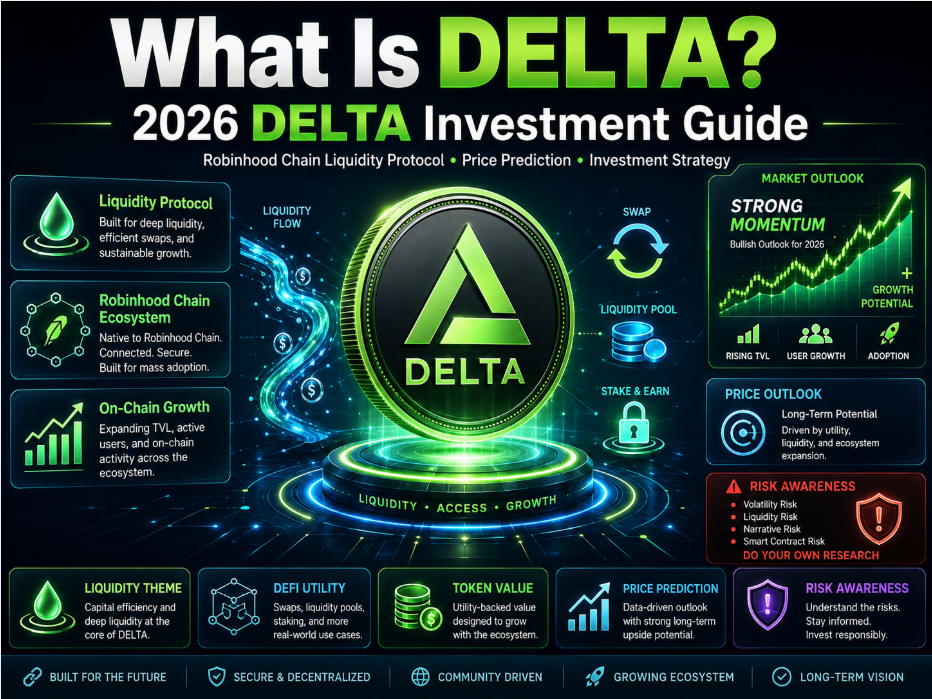
What is DELTA? It is neither a payment-focused cryptocurrency nor a Meme Coin driven by community hype. Based on currently available information, DELTA is the native token of the Delta Liquidity Protocol within the Robinhood Chain ecosystem. The project aims to help users create and manage liquidity positions, participate in staking, and earn trading fees through self-custodial, on-chain verifiable mechanisms.
This means analyzing DELTA goes far beyond price action, exchange listings, or short-term gains. The more critical questions are: Does Robinhood Chain have real users and capital? Can Delta attract TVL and trading volume? Will the protocol generate sustainable fees? And will those values ultimately accrue to the DELTA token?
On September 1, 2026, Hibt listed DELTA/USDT, adding a new market entry point for DELTA. Investors can check live prices, volume, and order books via DELTA Real-Time Price & DELTA/USDT Market Data, but new listings typically come with elevated volatility – market price does not equal fair valuation.
Risk Disclosure: This article is for informational and research purposes only. It does not constitute investment advice, profit guarantees, or trade recommendations. DELTA is a new-chain DeFi asset exposed to smart contract risks, impermanent loss, low liquidity, token unlocks, and ecosystem underperformance.
1. What Is DELTA, and Why Does Robinhood Chain Need a Liquidity Protocol?
DELTA is the ecosystem token associated with the Delta protocol. According to Hibt’s listing announcement for DELTA, Delta is positioned as a self-custodial liquidity infrastructure built on Robinhood Chain, enabling users to create and manage on-chain liquidity positions, stake assets, earn fees, and verify their holdings and returns.
In simpler terms:
- Robinhood Chain provides the underlying blockchain network;
- Delta offers liquidity-related services for on-chain trading;
- DELTA is the protocol’s ecosystem token;
- DELTA/USDT denotes the trading pair using USDT to quote DELTA.
Therefore, DELTA is not Robinhood the company’s stock, nor should it be described as an “official Robinhood token” without strong evidence. More accurately, it is a third-party DeFi asset deployed on Robinhood Chain.
Why Does Liquidity Matter?
Imagine a user wants to buy ETH with USDC on-chain. If the corresponding trading pool has ample assets, even large orders execute near market price.
If the pool is shallow, you may see:
- Wider bid-ask spreads;
- Higher slippage on larger trades;
- Significantly worse execution prices;
- Difficulty exiting positions quickly;
- Overall poor DEX trading experience.
A liquidity protocol’s job is to attract capital into trading pools, improve capital efficiency, and establish a sustainable fee structure among traders, LPs, and the protocol.
For a new chain, stablecoins, bridges, DEXs, lending, and liquidity infrastructure are typically critical to early ecosystem growth. Without these services, even strong network technology won’t keep capital anchored.
2. What’s the Relationship Between DELTA and Robinhood Chain?
Hibt’s announcement labels DELTA’s network as Robinhood Chain, meaning all contract interactions, deposits, withdrawals, and on-chain operations must use that network.
But investors must distinguish three concepts:
- Robinhood – the fintech company offering traditional securities and crypto services;
- Robinhood Chain – the associated blockchain network;
- Delta – the liquidity protocol deployed on that network.
“Running on Robinhood Chain” does not mean “issued by Robinhood,” nor does it imply Robinhood guarantees DELTA’s price, contract security, or protocol operations.
How Could Robinhood Chain Growth Affect DELTA?
The theoretical transmission path:
Robinhood Chain user growth
→ On-chain assets & trading increase
→ Liquidity demand rises
→ Delta’s TVL and volume grow
→ Protocol fees increase
→ DELTA gains more utility or market attention
But this chain is not automatic.
If Robinhood Chain grows but users choose other DEXs or liquidity protocols, Delta may not capture the same upside. Thus, investing in DELTA is not just a bet on Robinhood Chain – it’s also a bet on Delta’s ability to win market share within that ecosystem.
3. How Might the Delta Liquidity Protocol Work?
Traditional AMMs rely on liquidity pools.
For example, an ETH/USDC pool holds both ETH and USDC. LPs deposit both assets into the smart contract, traders swap through the pool, and pay fees to LPs.
The basic flow:
- Users deposit assets into a liquidity pool;
- Traders execute Swaps through the pool;
- Each trade generates fees;
- Fees are distributed per protocol rules;
- LPs earn yields while bearing asset price risk.
Based on available info, Delta emphasizes not just providing liquidity but also position creation, management, staking, and on-chain yield verification. So it’s closer to a liquidity management infrastructure than a plain Swap interface – though a full product review is needed before final classification.
What Does Self-Custody Mean?
Self-custody typically means users interact with smart contracts via personal wallets; assets are not fully entrusted to a single custodian as on centralized platforms.
Advantages include:
- Direct wallet control;
- On-chain queryable transactions and asset movements;
- Transparent LP positions and contract interactions;
- No traditional financial intermediaries for settlement.
But self-custody does not eliminate risk – it shifts risk from centralized custody to:
- Private key/seed phrase security;
- Wallet approvals;
- Smart contract bugs;
- Malicious frontends;
- Bridges;
- Oracles;
- User errors.
On-chain verifiability proves transaction records are public – it does not prove smart contracts are bug-free.
4. Where Do DELTA Staking and LP Yields Come From?
When seeing “staking,” “mining,” or high APR, investors should first ask: where do the yields come from?
DeFi yields typically stem from three sources:
Trading Fees
Traders pay fees when swapping in pools. If the protocol has real volume, this revenue is closer to sustainable business income.
Token Incentives
The project may issue DELTA or other tokens to attract liquidity. Such incentives can quickly boost TVL but also increase supply and potential sell pressure.
If LPs continuously sell their reward tokens, TVL may rise while token price does not necessarily benefit.
Other Strategy-Based Returns
Some liquidity management protocols may allocate assets to various pools or yield strategies. But the more complex the structure, the more risks from contract combinations, liquidations, oracles, and strategy execution.
Thus, high APR ≠ high protocol revenue. To assess yield quality, ask three questions:
- Do yields come mainly from trading fees or from newly issued tokens?
- If incentives stopped, would capital stay?
- Can actual protocol fees cover the rewards paid to users?
If yields are mostly from token inflation, the model is exchanging future supply for current TVL – not a proven sustainable business.
5. Is There Impermanent Loss When Providing DELTA Liquidity?
If Delta involves dual-asset pools, impermanent loss is a key consideration.
Example: a user deposits ETH and USDC. If ETH price surges, the AMM algorithm gradually sells ETH and accumulates USDC. Compared to simply holding ETH+USDC, the LP position’s final value may be lower.
That difference is impermanent loss.
Whether it’s worthwhile depends on:
- Whether trading fees cover the loss;
- Whether token incentives are sufficient;
- Volatility of the asset pair;
- Position management effectiveness;
- Slippage and gas costs on exit;
- Whether yields are paid in high-inflation tokens.
“LP earns yield” ≠ “LP profits.” Fees, incentives, price moves, and impermanent loss must be netted together.
If the protocol uses concentrated liquidity, LPs may also stop earning fees when price moves outside the set range. Always verify Delta’s official documentation for pool structures, price range rules, and position management.
6. If Delta Protocol Performs Well, Will DELTA Price Automatically Rise?
Not necessarily.
One of the most overlooked issues in DeFi investing is that protocol value and token value are not naturally equal.
The full value chain should be:
Robinhood Chain user growth
→ Delta users & TVL increase
→ Volume & fees grow
→ Protocol generates real revenue
→ DELTA captures protocol value
→ Token demand increases
The first four steps are protocol fundamentals; the last two determine whether DELTA directly benefits.
Investors need to verify whether DELTA has a clear value-accrual mechanism, such as:
- Governance rights;
- Staking entitlements;
- Fee distribution;
- Yield boosts;
- Token locks;
- Liquidity incentives;
- Buybacks or burns;
- Product-specific utility.
If DELTA is used only for short-term liquidity farming, protocol usage may not create sustained token demand. Conversely, if staking DELTA gives real fees, governance, or product rights, the link between protocol growth and token value strengthens.
Until official Tokenomics are fully disclosed, do not assume fee dividends, buybacks, or burns exist.
7. How to Evaluate DELTA Tokenomics?
At minimum, confirm:
- Maximum supply;
- Total supply;
- Current circulating supply;
- Circulating ratio;
- Team allocation;
- Investor allocation;
- Community incentives;
- Liquidity mining budgets;
- Token unlock schedule;
- Top-10 address concentration.
If some data is not yet public, the rational approach is to treat “insufficient disclosure” as a risk – not to fill in unverified numbers.
Why Is FDV More Important Than Price per Token?
DELTA at $0.10 doesn’t mean it’s cheap.
Assume total supply of 10 billion; at $0.10, fully diluted valuation is $1 billion. If early circulating supply is low, a small amount of capital can push the price up – but future unlocks will require more capital to sustain that valuation.
Investors should track:
- Token price;
- Circulating market cap;
- FDV;
- Circulating ratio;
- Upcoming unlocks.
Low unit price is merely a denomination – it does not independently indicate valuation.
8. Why Could DELTA Rise? Seven Factors to Watch
Robinhood Chain Ecosystem Heat
If Robinhood Chain’s active addresses, transaction count, TVL, stablecoin size, and dApp count consistently rise, the market may assign higher valuations to its infrastructure.
But ecosystem heat must translate into Delta usage to become effective fundamental support.
Delta Protocol TVL
TVL represents the scale of assets entering the protocol – a key metric for liquidity protocols.
Watch:
- Absolute TVL;
- 7-day and 30-day changes;
- TVL distribution across pools;
- Concentration in incentivized pools;
- Retention after incentives end.
TVL attracted via high subsidies is qualitatively different from TVL growing without excessive incentives.
Protocol Trading Volume
Liquidity only generates fees if it’s actually used.
High TVL with persistently low volume suggests poor capital efficiency. Conversely, limited TVL supporting high volume indicates real trading demand.
Protocol Fees
Fees are closer to business activity than raw TVL.
Distinguish:
- Total fees paid by traders;
- Fees earned by LPs;
- Revenue retained by the protocol;
- Rewards subsidized by new token issuance.
Only when real fees grow sustainably does Delta approach a verifiable DeFi business model.
More Exchange Listings
On September 1, 2026, Hibt listed DELTA/USDT. Listings can boost:
- Market exposure;
- Trading convenience;
- Liquidity;
- Search interest;
- Cross-market arbitrage.
But a listing is a liquidity catalyst – it does not prove real users or validate current valuation.
BTC and ETH Market Cycles
DELTA is a new-chain, small-cap, high-beta DeFi asset, sensitive to crypto risk appetite.
Check BTC Price Predictions & Market Cycles to gauge whether capital is rotating from majors into small caps.
Also watch ETH Price Predictions & Ethereum Ecosystem Trends. A strong ETH often benefits DeFi, L2s, and on-chain narratives – but it doesn’t automatically boost Delta’s revenue.
Robinhood & On-Chain Finance Narratives
Robinhood Chain connects Tokenized Stocks, RWA, On-chain Finance, and DeFi themes.
If tokenized equities and on-chain finance expand, those assets need trading, lending, and liquidity services – potentially creating new use cases for Delta. But “narrative relevance” still cannot replace TVL, volume, and fee data.
9. How to Approach DELTA Price Predictions?
Fixed price targets have limited value for newly listed DeFi tokens. A more sensible approach: build a valuation framework, then analyze Bull, Base, and Bear scenarios.
You can use DELTA Price Prediction as a supplemental trend reference, but no technical model replaces Tokenomics, on-chain data, and protocol fundamentals.
Using FDV/TVL to Gauge Market Expectations
FDV/TVL compares the fully diluted market valuation to the protocol’s asset size.
If FDV rises rapidly without TVV growth, price may embed significant narrative premium.
However, FDV/TVL alone doesn’t determine price – TVL can be attracted by temporary incentives and isn’t protocol revenue. It’s a screening tool, not a final verdict.
Using FDV/Fees to Assess Revenue Quality
If Delta generates sustainable fees, examine FDV relative to annualized fees or protocol revenue.
Keep in mind:
- Gross fees ≠ protocol revenue;
- Short-term high volume cannot be annualized blindly;
- Incentive-driven volume may not persist;
- Fee splits vary across protocols.
Bull Scenario
A Bull Case requires simultaneous:
- Sustained Robinhood Chain user & capital growth;
- Delta becoming the dominant liquidity protocol;
- TVL, volume, and fees rising in tandem;
- Clear token value accrual;
- Expanded trading markets and liquidity;
- Crypto in risk-on cycle.
Under these conditions, the market may reprice DELTA from a “new-chain concept token” to a DeFi infrastructure asset with real usage.
Base Scenario
A Base Case may show:
- Moderate Robinhood Chain growth;
- Delta gaining some users and TVL;
- But intense competition among similar protocols;
- Limited fee growth;
- Unclear DELTA value capture;
- Listing hype gradually fading.
In this case, DELTA may trade in wide ranges, driven by sentiment and event-based catalysts.
Bear Scenario
A Bear Case may include:
- Robinhood Chain user growth below expectations;
- Delta TVL steadily bleeding;
- LP yields declining;
- Volume and fees insufficient;
- Competitors taking market share;
- Token unlocks or high inflation adding sell pressure;
- Crypto entering risk-off mode.
If ecosystem, protocol, and token supply/demand all weaken, DELTA could see significantly larger drawdowns than BTC and ETH.
10. Investment Strategy: Treat DELTA as New-Chain DeFi Beta, Not a BTC Substitute
Start with Ecosystem, Then Protocol, Finally Token
Research order:
Robinhood Chain
→ Delta Protocol
→ DELTA Token
If Robinhood Chain has no users, Delta can’t get sustained trading demand. If Delta has no TVL and fees, DELTA upside is largely narrative-driven. If the protocol grows but the token can’t capture value, price may still underperform.
Use TVL and Fees to Confirm Price Trends
A relatively healthy pattern:
Price rises
→ TVL grows
→ Volume increases
→ Protocol Fees rise
A pattern to be cautious about:
Price surges
→ TVL unchanged
→ Fees stagnant
→ Social media hype spikes suddenly
The latter is more likely a narrative-driven rally.
Avoid Going All-In at Launch
Early trading often involves:
- Incomplete price discovery;
- Shallow order-book depth;
- Evolving market-making ranges;
- Early holders cashing out;
- Cross-exchange spreads;
- High volatility and wicks.
DCA (dollar-cost averaging) over time is more risk-managed than a single lump sum. Sizing depends on individual capital and loss tolerance – not a fixed template.
Observe Capital Behavior After the First Major Pullback
After initial listing excitement fades, watch:
- Whether volume spirals during pullbacks;
- Whether TVL exits simultaneously;
- Whether LPs remain in the protocol;
- Whether Robinhood Chain data continues growing;
- Whether large addresses are moving tokens to exchanges;
- Whether new users appear after price stabilizes.
If price drops but TVL, volume, and fees keep rising, fundamentals may be diverging from sentiment.
If price, TVL, and volume all decline, the investment thesis may be breaking down.
Use FDV to Gauge Valuation
Don’t judge “cheap vs. expensive” by token price. Compare:
- Current circulating market cap;
- Fully diluted valuation;
- Delta TVL;
- Protocol fees;
- Peer valuations;
- Future unlock size.
Higher valuations demand more future growth from Delta to justify them.
Predefine Exit Rules
Before holding DELTA, define:
- Max position size;
- Max acceptable loss;
- Gradual take-profit levels;
- Conditions for thesis invalidation;
- Whether you accept lock-up periods;
- Whether you accept smart contract risk.
Exit decisions shouldn’t be based on a single day’s move. More rational invalidation signals: sustained TVL decline, falling fees, shrinking market share, weaker value capture than expected, or clear Robinhood Chain deterioration.
11. How Does Delta Differ from Traditional DEXs, and Who Are Its Competitors?
Delta competes with multiple protocol types.
General-Purpose DEXs
These compete for traders, volume, pools, and LPs. On a new chain, users typically prefer deeper liquidity and lower slippage.
Concentrated Liquidity Protocols
Concentrated liquidity allows capital to work within specific price ranges, improving capital efficiency but increasing LP management complexity.
If Delta offers similar features, its competitiveness depends on:
- Capital efficiency;
- Position management UX;
- Fee yields;
- Range management tools;
- Risk controls;
- Automation capabilities.
Liquidity Managers
Some protocols specialize in automated LP position and strategy management – they may compete with Delta in sophistication and automation.
Native Robinhood Chain DeFi Protocols
The most direct competitors are other native projects vying for the same users and capital.
Thus, assessing Delta’s moat requires not just its own TVL but also:
- TVL ranking within Robinhood Chain;
- Volume ranking;
- Market share trends;
- User retention;
- Capital stability after incentives end;
- Pool depth.
DeFi capital is relatively sticky-less. If competitors offer higher yields, deeper liquidity, or better UX, capital can migrate quickly.
12. If Robinhood Chain Takes Off, How Much of That Benefit Can Delta Capture?
Delta Becomes the Dominant Liquidity Protocol
If Delta emerges as the leading liquidity gateway on Robinhood Chain, ecosystem growth directly boosts its TVL, volume, fees, and token demand – the most attractive bull case.
Delta Is Just One of Many Protocols
If Robinhood Chain gains many users but liquidity is fragmented across multiple platforms, Delta’s growth may lag behind the chain’s overall expansion. “Chain growth” ≠ “Delta growth.”
A Stronger Competitor Emerges
If another protocol offers higher capital efficiency, deeper pools, better incentives, or superior UX, Delta could lose market share quickly.
So investing in new-chain DeFi infrastructure is essentially betting not just on network growth, but on a specific protocol’s share of that growth.
13. How Does DELTA Differ from BABAON and BLUECHIP?
Though all trade against USDT, their value sources are entirely different.
DELTA is a DeFi infrastructure asset – core metrics: Robinhood Chain users, protocol TVL, volume, fees, market share, and token value capture.
BABAON Explained covers Alibaba tokenized stock – its value derives from Alibaba’s corporate earnings, cloud/AI business, buybacks, and stock valuation – not DeFi TVL.
BLUECHIP Explained corresponds more to Base ecosystem Meme, AI chip narratives, and market attention – price is more sensitive to community chatter and capital flows.
One-line distinction:
BABAON = enterprise value; DELTA = protocol value; BLUECHIP = narrative value.
So when you see a USDT pair, the first step isn’t comparing which token moves faster – it’s identifying the underlying value source and valuation method.
14. Eight Key Risks Every DELTA Investor Must Know
Robinhood Chain Ecosystem Risk
Robinhood Chain is relatively new – user scale, infrastructure, dApp count, and long-term capital retention require ongoing validation.
Smart Contract Risk
Interacting with liquidity protocols means exposure to code bugs, permission errors, oracle attacks, or economic model flaws – all can lead to asset loss.
Impermanent Loss Risk
LP participation may incur impermanent loss due to price moves. High APR doesn’t guarantee coverage of that loss.
TVL Flight Risk
Capital attracted by high token incentives may lack loyalty. When rewards decline, TVL can swiftly migrate to other protocols.
Tokenomics & Unlock Risk
Team, investor, community, and mining token releases can add sell pressure. Low initial circulating supply makes future unlocks particularly critical.
High FDV Risk
Low-float, high-FDV is common among new tokens. Early price may be driven by limited capital, but sustaining valuation requires more capital to absorb new supply over time.
Competition Risk
DeFi users face low switching costs – other protocols with better yields, deeper liquidity, or superior UX can draw users and capital away.
Liquidity & Exchange Risk
Hibt’s announcement specifies DELTA on Robinhood Chain with corresponding contract info. Before deposits/withdrawals, always verify token name, contract address, and network.
Also monitor:
- DELTA/USDT order-book depth;
- Bid-ask spreads;
- Large-trade slippage;
- Withdrawal status;
- Exchange service risks;
- Imposter token risks.
15. How to Buy DELTA – Six Pre-Trade Checks
Step 1: Confirm Asset Name
Verify the trading pair is DELTA (Delta). Do not search by ticker alone – imposter projects may exist on other networks.
Step 2: Confirm Network
Per Hibt, DELTA is on Robinhood Chain. Deposit/withdrawal networks must match.
Step 3: Verify Contract Address
Cross-check the contract address via official project channels, exchange announcements, and block explorers. Never copy addresses from social media comments.
Step 4: Check DELTA/USDT Market Data
Go to DELTA Real-Time Price & DELTA/USDT Market Data for current price, volume, K-lines, and order book.
DELTA/USDT means USDT quotes DELTA – e.g., 0.1 means ~$0.10 per DELTA.
Step 5: Assess Market Depth
Before placing orders, check:
- 24h volume;
- Bid-ask spread;
- Order depth;
- Estimated slippage;
- Any abnormal price prints.
For shallow new tokens, limit orders typically give better price control; market orders may incur higher-than-expected costs due to slippage.
Step 6: Set Your Risk Budget
DELTA is not suitable as a primary holding for newcomers unfamiliar with DeFi. Invest only what you can afford to lose without affecting daily living and essential obligations.
16. What Data Should You Track After Buying DELTA?
A sustainable monitoring framework should include:
- DELTA price;
- Circulating market cap;
- FDV;
- Circulating supply;
- Delta protocol TVL;
- 24h protocol trading volume;
- Protocol fees;
- Robinhood Chain TVL;
- Robinhood Chain active users;
- Token unlock schedule.
Once official disclosures become more complete, add:
- Number of LPs;
- Unique interacting wallets;
- DELTA staking ratio;
- Top-10 address concentration;
- Protocol market share;
- Real revenue vs. token incentive ratio;
- TVL retention after incentives end.
These data points are far more useful than daily price changes for assessing whether DELTA’s long-term thesis is improving.
17. Is DELTA Worth Investing In? Let Seven Questions Replace a Simple Answer
To decide, answer these sequentially:
Is Robinhood Chain User Growth Sustained?
No new users on the underlying network means limited long-term growth for ecosystem liquidity protocols.
Is Delta TVL Steadily Increasing?
Filter out inflows artificially created by short-term high rewards.
Is Protocol Trading Volume Genuinely Growing?
TVL is only useful if it’s being used – that’s what generates fees and network effects.
Are Protocol Fees Consistently Rising?
Real fees are closer to sustainable business activity than pure token rewards.
Can DELTA Capture Protocol Value?
Verify governance, staking, fees, locking, or other official utilities – do not assume.
Is Current FDV Overstretching Future Growth?
Having a product doesn’t make any price fair. Higher FDV demands more market share and revenue growth.
Are There Large Unlocks Ahead?
Even if fundamentals improve, concentrated unlocks can pressure price over certain periods.
If Robinhood Chain growth, Delta usage growth, protocol revenue growth, and DELTA value capture all align, the medium-to-long-term thesis becomes stronger.
If the only confirmable factors are rising price and social media buzz, tread cautiously.
18. DELTA FAQs
What coin is DELTA?
DELTA is the native token of the Delta Liquidity Protocol on Robinhood Chain – more a DeFi infrastructure asset than a payment coin or Meme Coin.
What is the Delta project?
Delta is publicly positioned as a self-custodial liquidity infrastructure covering LP position creation, management, staking, fee earning, and on-chain verification.
Which chain does DELTA run on?
Per Hibt’s listing, DELTA runs on Robinhood Chain. Always reconfirm the network and contract address before deposits/withdrawals.
Is DELTA an official Robinhood token?
There is currently no strong evidence for that claim. More accurately, Delta is an ecosystem protocol deployed on Robinhood Chain.
Is DELTA a DEX?
Delta is related to on-chain liquidity and trading infrastructure, but whether it qualifies as a full-fledged DEX depends on official product functions and documentation – not solely on liquidity services.
Can DELTA be staked?
Hibt’s introduction mentions staking features, but specific conditions, yield sources, lock-up periods, and risks should be confirmed via Delta’s official product pages and contract rules.
Where do DELTA LP yields come from?
They may come from trading fees, token incentives, or other on-chain strategies. Users must distinguish real fee revenue from new token subsidies.
Is there impermanent loss when providing DELTA liquidity?
If participating in dual-asset AMM pools, impermanent loss is generally possible. Specific risk depends on pool design, asset volatility, and position management.
Why is DELTA rising?
It may be driven by Robinhood Chain ecosystem heat, exchange listings, market liquidity, TVL expectations, DeFi narratives, and crypto risk appetite – but a price rise does not mean fundamentals are proven.
Is DELTA worth holding long-term?
It depends on Robinhood Chain growth, Delta market share, TVL, volume, fees, token value capture, valuation, and future unlocks.
How high can DELTA go in the future?
New tokens lack sufficient historical data – fixed price targets are unreliable. Better to use Bull/Base/Bear scenarios with FDV, TVL, and fees.
How to buy DELTA?
Through platforms supporting DELTA/USDT. Before trading, confirm token name, Robinhood Chain network, contract address, order depth, and risk budget.
What is DELTA’s maximum supply?
Refer to official Tokenomics, contract data, and trusted market data sources. Do not cite unverified supply numbers.
How is DELTA different from BABAON?
DELTA is a DeFi protocol asset – focus on TVL, fees, and token value capture. BABAON is Alibaba tokenized stock – focus on corporate earnings and stock valuation.
How is DELTA different from BLUECHIP?
DELTA centers on liquidity protocol usage; BLUECHIP leans toward Meme & AI chip narratives. Their value sources and valuation methods differ.
19. Conclusion: Robinhood Chain Growth Is Only the First Step in DELTA’s Investment Thesis
DELTA carries market narratives around Robinhood Chain, new-chain DeFi, and liquidity infrastructure – but these labels explain why it garners attention, not why it holds long-term value.
The truly trackable logic is:
Does Robinhood Chain have sustained user and capital growth? Will those users actually use Delta? Can Delta build stable TVL, volume, and protocol fees? And does the value created by the protocol flow back to the DELTA token?
In other words, analyzing DELTA requires verifying four layers in sequence:
Layer 1: Does Robinhood Chain have real users?
Layer 2: Are those users using Delta?
Layer 3: Is Delta generating real fees?
Layer 4: Is protocol value accruing to DELTA?
Only when all four layers progressively hold can DELTA evolve from a listing-hype and new-chain narrative token into a DeFi asset backed by real usage, protocol revenue, and network effects.
Therefore, whether DELTA is worth investing in cannot be decided by a single day’s gain – it must be determined by the interplay of ecosystem growth, protocol usage, real revenue, value capture, valuation, and unlocks. For newcomers ready to participate, the correct order is always: research Robinhood Chain first, then verify Delta protocol data, and finally assess DELTA price – not the other way around, buying because price already moved and then searching for reasons it might go higher.