
Introduction: Why Should Investors Seriously Evaluate CTR Right Now?
Dozens or even hundreds of new tokens launch every week in the digital asset market. If you are hunting for hyper-volatile, sentiment-driven assets, you might default to analyzing a SHIB Price Prediction to capture a meme coin bull run. However, the vast majority of newly listed tokens turn out to be highly copy-pasted DeFi governance place-holders or "castles in the sky" completely stripped of underlying logic. The emergence of CTR (Citrea) breaks this cycle.
The Dynamic Launch Performance of CTR
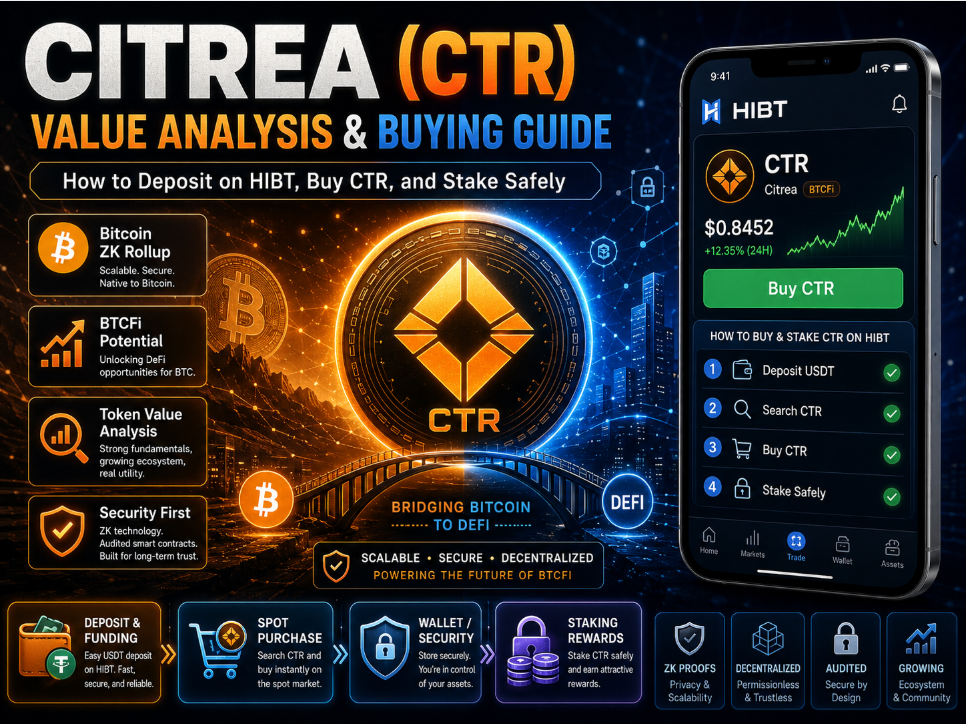
On May 26, 2026, CTR achieved simultaneous spot listings across more than 10 premium centralized trading venues on day one of its Token Generation Event (TGE), including Binance Alpha, KuCoin, Kraken, Gate, MEXC, and Hibt—a platform specifically recognized for deep coverage of emerging Web3 assets. Securing an institutional-grade liquidity matrix across the entire network on day one is exceptionally rare in the history of the Bitcoin scaling sector.
Core Value Thesis: CTR is not a generic DeFi governance token. It serves as the core coordination asset for a foundational infrastructure layer designed to give Bitcoin native, trust-minimized smart contract capabilities for the first time.
Who Is This Guide For?
- Crypto Newcomers: Skips dense cryptographic jargon to deliver an instant, intuitive breakdown of Citrea's core architecture.
- Value Investors: Provides granular on-chain metrics, structural valuation comparisons, and macro tokenomics analysis to aid your deployment decisions.
- Hibt Users: Offers a complete, beginner-friendly manual covering account registration, identity verification (KYC), fiat onboarding, and spot limit order execution.
💡 Author Research Disclosure: This analytical profile is compiled utilizing official Chainway technical documentation, real-time on-chain data streams from CoinGecko and CoinMarketCap, deep research reports from The Block, and official operational updates from the Hibt exchange. This material is prepared strictly for objective technological and market analysis and does not constitute financial or investment advice. Always conduct your own research (DYOR).
Section 1: What is CTR/Citrea? Unpacking the Foundational Architecture
1.1 The Ultimate Structural Bottleneck of Bitcoin
Despite commanding a multi-trillion-dollar global market cap as pristine digital gold, the Bitcoin network has historically been bound by a massive operational constraint: it can process basic peer-to-peer value transfers, but it cannot execute complex, multi-layered smart contracts.
While Ethereum achieved Turing completeness via the Ethereum Virtual Machine (EVM)—igniting a massive, multi-billion-dollar DeFi and NFT economy—Bitcoin’s native script language was intentionally left restrictive to preserve absolute base-layer security and decentralization. As a result, hundreds of billions of dollars worth of pristine BTC capital have remained completely passive and economically underutilized for nearly two decades.
1.2 The Citrea Solution: Demystifying ZK-Rollup Technology
Engineered by the Chainway development team, Citrea functions as Bitcoin's first native Zero-Knowledge (ZK) Rollup layer.
To picture this intuitively, imagine constructing a high-velocity express highway right alongside the legacy Bitcoin mainnet. Citrea batches thousands of complex smart contract transactions off-chain, processes them at lightning speeds on this secondary highway, compresses the data, and utilizes zero-knowledge cryptography to generate a highly compact, mathematical "validity proof."
[Thousands of L2 Transactions] ──> [Batched & Compressed on Citrea] ──> [ZK Validity Proof Generated] ──> [Settled onto Bitcoin Mainnet]
This compact proof is permanently settled into a standard Bitcoin block. The Bitcoin mainnet does not need to audit the individual details of every single secondary transaction; it only needs to cryptographically verify the integrity of the mathematical proof. Consequently, Citrea introduces advanced smart contract execution to the Bitcoin network while cleanly inheriting 100% of Bitcoin's absolute, sovereign base-layer security.
1.3 How BitVM Changes the Scaling Game
Historically, early Bitcoin L2 configurations (such as standard sidechains) were forced to rely on centralized custodial bridges or demand a highly unrealistic hard fork of the Bitcoin core code. The emergence of BitVM (Bitcoin Virtual Machine) completely dismantled these limitations.
BitVM enables the on-chain verification of complex computations on Bitcoin without requiring a single modification to the network's existing source code. Citrea utilizes BitVM to position the Bitcoin mainnet as the ultimate "Supreme Court" for its zero-knowledge validity proofs. If an adversarial node attempts to execute fraud on Layer 2, any independent observer can leverage BitVM to trigger a cryptographic challenge directly on the Bitcoin mainnet, programmatically punishing the bad actor.
1.4 The "Trust-Minimized" Architecture of the Clementine Bridge
The Clementine Bridge, engineered by the Citrea core team, functions as a BitVM-powered, trust-minimized, two-way cross-layer bridging facility.
Its core value proposition rests on trust minimization: when global users bridge their native BTC up to the Citrea execution layer, they are no longer forced to trust a centralized corporate custody provider or an opaque multi-signature federation. As long as at least one independent validator out of the entire global node network remains honest, your underlying bridge capital remains cryptographically secure. This design addresses a major historic vulnerability of Bitcoin L2 sidechains—the risk of bridge exploits or team rug pulls.
1.5 The Strategic Mandate of ctUSD
ctUSD operates as an native, over-collateralized stablecoin minted directly within the Citrea network and backed exclusively by pristine BTC collateral. The Bitcoin ecosystem has long lacked a fully decentralized, capital-efficient stablecoin pegged precisely to the US dollar. The introduction of ctUSD allows Bitcoin holders to unlock deep liquidity from their assets without being forced to sell their underlying positions, supplying the essential financial lifeblood for the wider BTCFi (Bitcoin Finance) ecosystem.
1.6 Concrete Utility of the CTR Token
CTR operates as the primary coordination and incentive asset across the Citrea network ecosystem. Its structural value capture is driven by three core primitives:
- Ecosystem Governance: Empowers holders to vote on network upgrades, parameters, and capital distribution maps from the public Treasury.
- The xCTR Staking Flywheel: Users stake raw CTR to generate non-transferable xCTR governance certificates. A portion of the network's transaction execution fees (Gas) is programmatically routed to buy back CTR from secondary markets. This model of capturing base infrastructure value via staking dynamics mirrors the proven economics of protocols like Rocket Pool within the Ethereum network. For a deeper understanding of how staking place-holders capture value over a multi-year horizon, review our analysis of the RPL Price Prediction. Citrea ports this exact yield-bearing flywheel to the Bitcoin network for the first time.
- Liquidity Mining and Incentives: CTR is systematically emitted to subsidize early adopters who provide liquidity to Citrea-native money markets, lending protocols, and automated market makers.
1.7 Strategic Funding and Elite Institutional Backing
Citrea’s development organization, Chainway Labs, secured $16.7 million in funding across its strategic seed and private equity lifecycles.
- Lead Venture Allocator: Founders Fund—the elite Silicon Valley venture firm backed by tech visionary Peter Thiel (early institutional backer of SpaceX, Palantir, and Facebook).
- Participating Venture Entities: Galaxy Ventures (the venture arm of digital asset powerhouse Galaxy Digital), Delphi Digital, Robot Ventures, and other prominent Web3 firms.
This level of tier-one venture backing confirms that Citrea commands an exceptional starting position regarding international compliance, engineering delivery, and long-term ecosystem capital allocation.
Section 2: Core CTR Tokenomics and On-Chain Metrics
Before allocating capital to any digital asset, you must step away from social media narratives to audit its underlying quantitative parameters. For an early-stage asset that has just logged its TGE, tracking these core metrics is vital to identifying fair valuation ranges.
2.1 The Ten Hard Indicators of CTR Valuation
1. Total Supply Cap: 10 Billion CTR
The maximum global supply is programmatically fixed at exactly 10,000,000,000 CTR. Within the context of institutional Layer-2 infrastructure assets, this parameter aligns with industry standards. Comparable scaling tokens like ARB and OP deploy identical multi-billion total supply maps. The core variable to monitor is not the absolute size of the supply cap, but how smoothly these tokens enter circulation over time and whether the network's growth velocity can outpace emission dilution.
2. Initial TGE Circulating Float: ~12% (1.2 Billion CTR)
On day one of the TGE, the active circulating supply floating across secondary markets was fixed at approximately 12% of the global cap (roughly 1.2 billion tokens). This light initial float helps minimize localized sell-side pressure during early price discovery. When early buy-side demand concentrates within a thin circulating float, it can easily drive up spot prices, explaining why newly listed assets often record intense early volatility. However, the flip side is that the remaining 88% of the supply will be systematically unlocked over a multi-year horizon, meaning investors must evaluate CTR based on its forward Fully Diluted Valuation (FDV) rather than its opening circulating market cap.
3. Opening Price Action: All-Time High (ATH) of $0.04118
Following its TGE in late May 2026, CTR logged an initial market peak at approximately $0.04118. This peak reflects the maximum short-term premium secondary markets applied to the asset during its phase of peak social sentiment and restricted opening supply. The subsequent rapid technical retracement indicates that the market rejected this overextended valuation once early liquidity settled.
This behavior is standard for early-stage infrastructure tokens post-listing. It establishes three clear data points: first, genuine buy-side interest exists for the Bitcoin ZK-Rollup narrative; second, early airdrop liquidations and market-maker inventory adjustments quickly capped the initial pump; and third, price discovery is transitioning away from sentiment toward fundamental validation. Therefore, $0.04118 should be viewed as an initial psychological ceiling rather than an automatic short-term target. Rechallenging this territory requires sustained metric expansion across Citrea's TVL, dApp adoption, and the wider BTCFi macro landscape.
+------------------------------------+------------------------------------+------------------------------------+
| Metric Indicator                   | Live Quantitative Value            | Structural Market Analysis         |
+------------------------------------+------------------------------------+------------------------------------+
| 4. Spot Trading Territory          | $0.0160 – $0.0184                  | Reflects a healthy post-TGE        |
|                                    | (Current accumulation corridor)    | consolidation phase, shaking out   |
|                                    |                                    | short-term airdrop hunters.        |
+------------------------------------+------------------------------------+------------------------------------+
| 5. Fully Diluted Valuation (FDV)   | ~$160 Million – $180 Million       | Compared to legacy L2 platforms    |
|                                    |                                    | like Stacks (STX) with multi-      |
|                                    |                                    | billion-dollar FDVs, CTR sits in a |
|                                    |                                    | highly compelling value corridor.  |
+------------------------------------+------------------------------------+------------------------------------+
| 6. 24-Hour Spot Trading Volume     | ~$22,000,000                       | Realized trading volume outpaces   |
|                                    |                                    | the immediate circulating market   |
|                                    |                                    | cap, indicating high liquidity turn|
|                                    |                                    | over and healthy market depth.     |
+------------------------------------+------------------------------------+------------------------------------+
| 7. Centralized Listing Footprint   | 10+ Tier-1 Venues                  | Mitigates single-exchange pool     |
|                                    | (Including Hibt, Binance Alpha)    | manipulation risks, distributing   |
|                                    |                                    | arbitrage across global networks.  |
+------------------------------------+------------------------------------+------------------------------------+
2.2 Structural Supply Allocation Architecture
[██████████████████████████████ 60.00% Community Ecosystem & Emissions Pool]
[███████████ 19.35% Strategic Private Seed & Institutional Investors]
[████████████ 20.66% Founders, Early Core Contributors & Team]
2.3 The Multi-Year Structural Unlock Schedule
- The 12-Month Absolute Cliff: The 40.01% collective supply held by institutional private investors, founders, and core team members is programmatically locked for exactly 12 months post-TGE. This prevents early insider distribution from disrupting secondary spot markets during the initial year of price discovery.
- The 48-Month Linear Vesting Wall: Once the 1-year cliff concludes in Q2 2027, the institutional and team allocations will begin vesting into circulation on a monthly linear basis over a 48-month horizon. Long-term accumulators must note that from Q2 2027 onward, the market will face a steady expansion in circulating supply, requiring a corresponding expansion in network utility, transaction fees, and xCTR staking lockups to absorb the incoming float.
Section 3: The Hibt Exchange Profile — Why Use It for CTR Execution?
3.1 Corporate and Regulatory Standing
Established in 2021 and headquartered in Canada, Hibt (formerly operating as HotsCoin) functions as a premier digital asset trading platform engineered to provide comprehensive spot execution and ecosystem asset management for global market participants.
- Compliance Framework: The platform holds a Money Services Business (MSB) registration issued by FINTRAC in Canada, alongside a reciprocal MSB registration under FinCEN within the United States, confirming a strong corporate emphasis on international compliance and anti-money laundering (AML) controls.
- Operational Footprint: Backed by an enterprise team of over 200 security engineering and risk management professionals, Hibt commands a global footprint serving more than 3 million registered trading accounts.
3.2 Targeted Ecosystem Incentives for CTR Traders
Hibt formally deployed the CTR/USDT spot trading pair on May 27, 2026. To incentivize early liquidity and onboard spot accumulators, the exchange initiated a dedicated "Trade CTR — Share 25,000 Tokens" campaign:
- Mechanism: Any market participant who logs a cumulative spot trading volume (buys + sells) matching or exceeding 500 USDT within the promotional window becomes automatically eligible to capture a proportional share of a 25,000 CTR rewards pool. For active retail allocators, this structural distribution effectively offsets trading execution friction and commission costs.
3.3 Institutional-Grade Asset Protection and Security Track Record
- Multi-Signature Offline Cold Storage: Hibt enforces a strict security policy requiring more than 90% of user digital asset inventories to be stored within air-gapped, multi-signature offline cold wallet arrays, providing a robust defense perimeter against remote exploits.
- Verified Risk Mitigation Record: CoinGecko applies a positive Trust Score rating to the Hibt architecture. Since its operational inception in 2021, the venue has maintained a clean record with zero major security breaches or systemic capital exploits.
3.4 Head-to-Head Comparison: Hibt vs. Alternative Asset Access Pathways
1. Entry Thresholds and Capital Requirements
- Binance Alpha Platforms: Enforce high entry thresholds, frequently requiring users to maintain significant balances of native platform tokens or clear restrictive alpha point matrices to unlock early spot pairs. This can lock out everyday retail allocators during the early stages of a token's price discovery.
- The Hibt Route: Removes access friction entirely. The venue enforces zero platform token lockups or tier restrictions; all verified accounts gain instant, equal access to the CTR/USDT trading pair from day one.
2. Spot Trading Fee Architecture
- Binance Alpha Platforms: Charge a baseline standard fee of 0.10% for both Maker and Taker execution paths.
- The Hibt Route: Deploys a highly competitive, tier-based fee schedule. Baseline Maker commissions range from 0.0125% to 0.10%, while Taker execution scales between 0.03% and 0.10% depending on your account's VIP volume profile. For retail market participants utilizing limit orders, Hibt's maker discount significantly minimizes execution costs over frequent trading cycles.
3. Retail Incentive Density
- Binance Alpha Platforms: While launch pools feature large absolute token rewards, the sheer volume of global participants dilutes individual payouts, resulting in minimal token distributions for retail accounts.
- The Hibt Route: Features targeted campaigns (such as the 25,000 CTR allocation pool) with lower participant concentration, making it easier for active retail accounts to secure meaningful token rewards.
3.5 Global Fiat Onboarding Channels
To streamline capital onboarding, Hibt maintains an integrated peer-to-peer (P2P) over-the-counter desk alongside certified third-party credit gateway partnerships. The system natively supports seamless fiat-to-crypto execution across dozens of sovereign currencies—including USD, HKD, CNY, THB, and JPY—allowing international investors to instantly convert fiat capital into liquid USDT.
Section 4: Step-by-Step Guide to Buying CTR on Hibt (Beginner-Friendly Manual)
Step 1: Secure Account Registration
- Access the Interface: Navigate to the verified web domain at hibt.com or download the official mobile application via the iOS App Store or Google Play.
- Input Credentials: Select "Email Registration" for enhanced long-term account management. Input a secure, primary email address and construct an advanced password featuring uppercase and lowercase letters, numbers, and special characters.
- Execute Activation: Click "Send Code" to request an automated verification pin. Input the pin into the registration window to activate your account. 💡 Troubleshooting Tip: If the verification code fails to appear within 120 seconds, audit your spam, junk, or promotional email folders.
- Deploy Security Baselines: Once logged in, navigate instantly to the [User Dashboard] -> [Security Center]. You must activate Google Authenticator (2FA) and establish a dedicated Fund Password. These protocols are mandatory; the platform restricts outbound withdrawals and P2P purchasing if these security layers are absent.
Step 2: Clear Identity Verification (KYC)
- Initiate Verification: Select the [Identity Verification] module and choose to clear Level 1 (Basic) and Level 2 (Advanced) compliance matrices.
- Submit Documentation: Prepare an unexpired government-issued identification asset, such as a passport or driver's license. Ensure your uploads feature clear, high-resolution photographs of both the front and back of the document. Higher-tier operational volume accounts may require submitting a verified Proof of Address document (such as a bank statement or utility bill PDF dated within the last 90 days).
- Processing Verification: Hibt utilizes an automated, AI-driven compliance engine that typically processes and approves standard KYC submissions within 10 to 30 minutes.
- Avoiding Common KYC Rejections: To ensure instant approval, avoid these common mistakes: blurry or out-of-focus imagery where text is obscured, cropped document edges, a mismatch between your typed registration data and legal document text, or attempting to submit utility bills older than 90 days.
Step 3: Capital Onboarding — Acquiring Your Base Currency (USDT)
To execute secondary spot transactions for CTR, you must first deposit or acquire the stablecoin Tether (USDT).
- Access the On-Ramp: Select the [Buy Crypto] or [P2P Trading] modules directly from the primary navigation interface.
- Execute a P2P Purchase:
- Filter the global merchant directory to prioritize verified sellers displaying high historical order completion ratios (ideally exceeding 98%).
- Input the precise amount of fiat currency you intend to deploy and click [Buy USDT].
- Review the merchant's verified payment details (such as a local bank transfer layout). Open your independent banking application to transmit the fiat funds directly to the merchant.
- Once the bank transfer is complete, return to the Hibt interface and click [I Have Paid]. Once the merchant verifies receipt, the escrow system will automatically release the USDT into your funding wallet.
Capital Purchasing Power Projections (Estimated at a Base Rate of $0.0160)
To plan your portfolio allocation, consider these rough purchasing power estimations based on an entry spot price of $0.0160 per CTR token:
- An allocation of $100 USDT yields approximately 6,250 CTR tokens.
- An allocation of $500 USDT yields approximately 31,250 CTR tokens.
- An allocation of $1,000 USDT yields approximately 62,500 CTR tokens.
Step 4: Executing Your CTR Spot Market Transaction
- Internal Capital Transfer: Navigate to your wallet interface, select [Transfer], and route your newly acquired USDT from your [Funding Wallet] directly into your [Spot Trading Wallet]. This internal ledger adjustment carries zero fees.
- Access the Trading Pair: Select the [Spot] module from the central mobile navigation dock. Enter the search asset window in the upper left corner, input "CTR", and select the official CTR/USDT market view.
- Select Your Order Architecture (Critical Execution Choice):
- Market Orders: Execute your trade instantly at the absolute best available price on the order book. Caution: During phases of intense network volatility or immediately following listing events, market orders expose your capital to high slippage and execution premiums.
- Limit Orders (Highly Recommended for Value Accumulators): Allow you to specify the exact maximum price you are willing to pay. For example, by configuring a limit price of 0.0160, your order enters the book and will only execute if the market price matches or drops below $0.0160, protecting you from sudden volatility spikes.
[Spot Trading Pair View: CTR/USDT]
+--------------------------------------------------------+
| [Order Book: Asks]                                     |
| $0.0164 - 120,500 CTR                                  |
| $0.0162 - 85,000 CTR                                   |
+--------------------------------------------------------+
| Last Price: $0.0160                                    |
+--------------------------------------------------------+
| [Order Book: Bids]                                     |
| $0.0158 - 94,000 CTR                                   |
| $0.0156 - 110,000 CTR                                  |
+--------------------------------------------------------+
| Order Type: [Limit Order]                              |
| Price Input: [ 0.0160 ] USDT                           |
| Quantity Slider: [████████████████████ 100%]           |
|                                                        |
|                 [ BUY CTR ]                            |
+--------------------------------------------------------+
- Order Submission: Select [Limit Order], manually enter your target entry price of 0.0160, and slide the asset allocation bar to 100%. The trade desk interface will display your estimated order metrics and baseline maker/taker fees. Click the green button labeled [Buy CTR] to place your order on the book.
- Campaign Campaign Validation: If your total purchase volume matches the parameters of Hibt's active promotional campaigns, your account is automatically logged into the 25,000 CTR rewards pool. Retaining or liquidating the position within campaign rules ensures your bonus will be automatically distributed to your spot wallet post-campaign.
- Portfolio Tracking: Once your limit boundaries are triggered and filled, navigate to [Assets] -> [Spot Account] to monitor your live CTR token inventory and portfolio balance.
Step 5: Post-Execution Capital Management
1. Centralized Exchange Storage vs. On-Chain Self-Custody
If your strategy centers on short-to-medium-term swing trading, maintaining your CTR tokens directly within your Hibt exchange wallet is the most cost-effective option, eliminating blockchain gas friction. If you are a long-term HODLer looking to secure sovereign key control or directly participate in ecosystem applications, you should withdraw your tokens to a secure decentralized Web3 wallet (such as MetaMask or the OKX Web3 Wallet).
2. Deploying Algorithmic Risk Protection
Utilize the [Trigger Order / Conditional Order] modules inside the Hibt spot workspace to automate your risk management. You can configure automated protection parameters, such as: "If the spot price of CTR drops to $0.0120, trigger an automated market sell order at $0.0118 to cap losses," or "If the asset rallies to $0.0350, execute an automated limit take-profit order to secure principal returns."
3. Accessing the On-Chain Staking Infrastructure (xCTR)
Important Operational Note: Centralized exchanges do not natively process official, core cryptographic ZK-validation staking rewards. To convert your raw CTR tokens into interest-bearing xCTR certificates and capture a share of network fees, you must withdraw your assets from Hibt to an external ERC-20 compatible wallet, and connect directly to the official Citrea staking portal at citrea.xyz/staking.
Section 5: The Comprehensive Transaction Cost Audit
A common pitfall for retail traders is executing positions based entirely on nominal ticker prices while ignoring the combined impact of transaction friction. To help you manage your portfolio efficiently, we break down the true cost layers of acquiring and holding CTR below.
5.1 Individual Fee Layers Breakdown
- Spot Commissions: Assuming your account sits at the baseline standard VIP1 level on Hibt, your Taker commission is fixed at 0.10%. Executing a spot buy order for a block of CTR worth $1,000 USDT incurs a direct transaction cost of:
$\$1,000 \times 0.10\% = \$1.00\text{ USDT}$
- Fiat Onboarding Premium: Due to banks and merchants pricing in compliance tracking overhead and regional liquidity risks, local P2P fiat desks typically charge a localized premium ranging from 0.5% to 1.5% above global mid-market foreign exchange rates. If you onboard capital via third-party credit card payment gateways, processing fees typically scale between 2.0% and 3.0%.
- On-Chain Network Transmission (Gas) Fees: During its initial TGE lifecycle, the CTR token handles primary settlement and exchange multi-routing via the Ethereum mainnet as an ERC-20 token. Moving assets from a centralized exchange to an independent self-custodial wallet requires paying an Ethereum network gas fee. This fee fluctuates dynamically between $2 and $15 depending on live block-space demand, remaining entirely independent of your transaction size.
- Secondary Market Order Book Slippage: When trading assets with emergent market depth, executing large-scale market orders can introduce noticeable execution friction. For example, deploying a single $10,000 market buy order into a medium-depth book can clear out immediate asks, driving your average realized entry price 1% to 2% higher than the quoted spot price.
5.2 Comprehensive Cost Scenario Analysis
To see how onboarding premiums and trading fees affect your investment, consider this realistic scenario for a market participant deploying $1,000 of principal via a P2P fiat desk to execute a limit spot order on Hibt:
- Initial Principal Allocation: $1,000
- P2P Onboarding Friction (Estimated at a 0.8% Premium): Acquiring your baseline stablecoins introduces an immediate cost of approximately $8.00 due to fiat-to-crypto spread differentials. This means your starting trading capital balances at roughly $992.00 USDT before placing a trade.
- Spot Execution Fee (Hibt Baseline 0.1% Taker Rate): Executing a limit buy order to convert your capital into spot CTR tokens incurs a commission charge of approximately $1.00.
- Future Liquidation Fee (Estimated Take-Profit Event): Assuming the asset appreciates and you execute a future limit sell order to lock in profits, the spot transaction fee will scale relative to the new principal value, costing approximately $1.20.
Summing these individual friction layers reveals a total round-trip transaction cost of approximately $10.20. Consequently, your investment does not cross into net profitability the moment the token ticks upward. CTR must rally by at least 1.02% above your nominal entry price just to clear your transaction costs. Any returns generated beyond this baseline represent your true net profit margin.
This scenario highlights why short-term, frequent day-trading can be highly inefficient for emergent tokens. Frequent buying and selling causes onboarding spreads, spot commissions, and order book slippage to continuously eat away at your principal. For newly listed tokens experiencing high post-TGE volatility, a 2% to 3% short-term bounce can easily be wiped out by combined transaction costs if executed inefficiently.
Section 6: Fundamental Drivers of CTR’s Long-Term Market Valuation
6.1 Unlocking Dormant Bitcoin Liquidity
According to comprehensive macro market data, Bitcoin’s global aggregate market capitalization consistently balances around the $2 trillion milestone. However, while premium alternative layer-1 smart contract ecosystems like Ethereum systematically retain more than 10% of their native asset value inside decentralized finance applications, lending protocols, and liquidity mining networks, Bitcoin’s native capital utilization ratio remains stuck below 0.5%.
[Ethereum Ecosystem: >10% Capital Utilization inside DeFi Rails]
[Bitcoin Ecosystem:  <0.5% Capital Utilization (Massive Passive Dormancy)]
Consider the underlying economics: if the deployment of advanced, native ZK-Rollup architectures like Citrea encourages just 1% of long-term Bitcoin holders to route their assets across trust-minimized bridges into programmable smart contracts, Citrea’s network TVL would scale past $20 billion. This influx of capital would easily eclipse the aggregate value of most alternative layer-1 networks, providing an exceptionally strong economic foundation for CTR as the core governance and security coordination asset of the network.
6.2 Narrative Confluence: Why 2026 is the Catalyst Year
Prior to the current cycle, launching a true Bitcoin Layer-2 network was technically unfeasible. Early attempts were forced to rely on centralized, sovereign sidechains because the BitVM validation framework had not yet been engineered.
The year 2026 stands out as the definitive launch era for real BitVM deployments and the wide-scale commercial production of zero-knowledge proof verification. Combined with a shifting international regulatory landscape and the mainstream adoption of spot Bitcoin ETFs by traditional asset managers, global institutions are actively seeking out highly secure, native infrastructure rails capable of generating risk-adjusted yields on their Bitcoin holdings. Citrea is positioned at the absolute frontier of this structural narrative shift.
6.3 Verifiable Institutional Liquidity Guarantees
To reinforce the security and growth of the emerging Layer-2 ecosystem, Galaxy Digital deployed a formal $50 million liquidity commitment dedicated to supporting native L2 frameworks.
By auditing public blockchain ledgers, investors can verify that these institutional allocations are not mere marketing statements. These capital pools are structured as pre-signed, locked collateral bonds within specific multi-signature security nodes, backing the Clementine Bridge architecture. This institutional capital runway provides a robust safety buffer that protects retail asset transit from systemic liquidity crunches.
Section 7: Systemic Risk Audit — Vectors to Monitor
While the structural potential of the Bitcoin scaling thesis is immense, managing a portfolio responsibly requires a thorough audit of active risk vectors.
7.1 Analyzing Post-TGE Retracements
Following its initial market launch, CTR retraced more than 50% from its opening ATH, causing short-term retail anxiety. However, evaluating historical data reveals that premium infrastructure rollups—including platforms like Arbitrum (ARB), Optimism (OP), and Starknet (STRK)—routinely record deep technical corrections ranging between 50% and 70% during their opening months post-TGE.
This drawdown is a standard market dynamic driven by predictable forces: early airdrop recipients liquidating tokens at zero cost basis, and private pre-seed participants handing over inventory to secondary buyers. While this correction does not mean the underlying protocol is failing, it serves as an important warning: investors should avoid blindly chasing initial vertical listing spikes during the opening minutes of price discovery.
7.2 The Q2 2027 Institutional Supply Unlock Wall
As detailed in our tokenomics section, the 19.35% allocation held by strategic private seed investors and the 20.66% block assigned to core founders will conclude their 12-month absolute cliff in the second quarter of 2027. Once this threshold is crossed, a steady stream of newly unlocked tokens will begin entering secondary market circulation daily. If your strategy involves multi-year accumulation, you must closely monitor on-chain institutional wallet activity heading into Q1 2027 and adjust your position scaling to account for the incoming supply expansion.
7.3 Code Security Vulnerabilities within Advanced Cryptographic Frameworks
Although zero-knowledge rollup architecture is mathematically sound, implementing real-world BitVM verification models and building out the complex code bases powering the Clementine Bridge introduces real software development risks. At this early stage, the aggregate TVL moving across the bridge is still in its initial deployment phase.
The underlying code bases have not yet been exposed to prolonged, adversarial stress tests or multi-dimensional exploit attempts by sophisticated actors. If a critical smart contract exploit or a cryptographic exception manifests within the bridge code, the network could face severe capital drawdowns, which would heavily impact the market value of CTR.
7.4 Order Book Depth Constraints on Emerging Trading Venues
While Hibt provides an exceptionally cost-effective fee architecture and targeted rewards pools, its localized order book depth for newly listed assets like CTR remains lighter compared to legacy trading giants. For high-volume allocators managing multi-thousand-dollar positions, executing large-scale, single-block market orders on the spot desk can trigger noticeable negative slippage. To preserve capital efficiency, large-scale exits or entries must be broken up into smaller blocks and executed via patient limit orders over extended time windows.
Section 8: CTR vs. Spot Bitcoin Allocations — What is the Core Trade-Off?
8.1 The Reality of Risk-Reward Profiles
- Direct Spot Bitcoin (BTC) Exposure: Prioritizes absolute principal safety, institutional censorship resistance, reliable inflation protection, and long-term capital preservation. Bitcoin’s macro volatility is bounded by global consensus and institutional adoption, offering an ironclad defensive foundation for your wealth.
- Ecosystem Infrastructure (CTR) Exposure: Focuses on capturing high-beta, asymmetric alpha returns. By allocating capital here, you accept a complex matrix of risk factors—including multi-year token unlocks, smart contract vulnerabilities, and early-stage platform adoption metrics. In exchange for absorbing these operational risks, you position your portfolio to capture exponential returns if the underlying Bitcoin DeFi ecosystem triggers a massive growth cycle.
8.2 The Underlying Thesis You Are Backing
When you allocate capital to CTR, you are not simply trading a short-term price trend. You are making a structural bet on a specific macro outcome: that over the next 24 to 36 months, the BTCFi landscape will successfully replicate or outpace the historic DeFi growth cycle that transformed the Ethereum network in 2020. If this macro thesis plays out, Citrea—backed by top-tier cryptography and premier venture capital—is positioned to be a major beneficiary of the resulting capital migration.
8.3 A Balanced Portfolio Framework
To maintain rigorous risk management and preserve capital safety, investors should avoid overallocating to newly listed, high-beta assets. Consider this balanced portfolio allocation model as a reference framework for your digital asset exposure:
+------------------------------------------+------------------------------------------+
| Asset Allocation Segment                 | Target Portfolio Weight                  |
+------------------------------------------+------------------------------------------+
| Sovereign Foundational Assets (BTC/ETH)  | 70% – 80% (Core Long-Term Capital Base)  |
+------------------------------------------+------------------------------------------+
| High-Growth Alpha Rails (e.g., CTR)     | 5% – 10% (Asymmetric Growth Satellite)   |
+------------------------------------------+------------------------------------------+
| Liquid Stablecoin Reserves (USDT/USDC)   | 10% – 20% (Dry Powder & Risk Protection) |
+------------------------------------------+------------------------------------------+
Section 9: Frequently Asked Questions (FAQ)
Q1: Does Hibt enforce a minimum order size for CTR spot purchases? Can I execute an order worth only $10 USDT?
A: Yes. Hibt maintains highly accessible trading thresholds, fixing its minimum spot order size at 5 USDT or 10 USDT depending on the pair configuration. If your strategy involves small-scale position testing, you can easily deploy a $10 limit order to secure several hundred CTR tokens to test the onboarding pipeline.
Q2: Are there any regional compliance restrictions when accessing the Hibt exchange?
A: Hibt operates in strict compliance with international Anti-Money Laundering (AML) standards under its Canadian and US MSB registrations. Global users can smoothly complete account registration and Level 1 KYC. If you utilize the P2P over-the-counter desk, ensure you are using your own verified personal bank accounts to prevent payment delays or compliance flags.
Q3: Are Hibt's "Trade CTR" campaign rewards distributed in CTR tokens or USDT? How do I claim them?
A: All promotional campaign payouts are calculated and distributed directly in CTR tokens. Following the formal conclusion of the promotional window, the exchange's auditing systems calculate proportional volume metrics within 7 business days and automatically air-drop the token bonuses directly into your Spot Account. There is no need for manual claiming; the tokens arrive fully liquid and can be held or instantly sold for USDT.
Q4: What is the expected Annual Percentage Yield (APY) for on-chain CTR staking, and where does the yield originate?
A: During the initial network bootstrapping phase, the Citrea Foundation distributes additional CTR tokens from its ecosystem emissions pool to incentivize early validators, driving early estimated APYs into the 15% to 35% range. Over a multi-year horizon, this yield profile shifts to rely entirely on organic network revenue: a share of the transaction gas fees generated by users on the L2 and execution routing fees processed by the Clementine Bridge nodes. This ensures the yield is backed by real network utilization rather than permanent token inflation.
Q5: When withdrawing my CTR tokens from Hibt to MetaMask, which network must I select?
A: During its initial launch phase, the CTR token utilizes the Ethereum Mainnet (ERC-20 standard) for multi-exchange liquidity routing. You must explicitly select the ERC20 network option on Hibt's withdrawal interface and confirm that your target MetaMask wallet holds a small reserve of native ETH to cover future on-chain transaction gas fees. Critical Warning: Selecting an incorrect network will result in the permanent, irreversible loss of your tokens.
Q6: Which decentralized applications (dApps) are currently live and operational on the Citrea mainnet?
A: According to Citrea's official development updates, the opening wave of core ecosystem applications features CitraSwap (the network's primary native automated market maker), ClemLend (the core decentralized money market and credit protocol), and a dedicated, BitVM-enforced NFT launchpad. Once you acquire CTR and convert it to xCTR via staking, you can utilize your xCTR as premium collateral inside ClemLend to borrow native ctUSD stablecoins.
Q7: Is ctUSD the same token as CTR? How do these two assets interact?
A: No, they serve entirely different functions within the ecosystem. CTR operates as the network's volatile utility, governance, and staking asset. ctUSD, by contrast, functions as a decentralized stablecoin engineered to maintain a strict 1:1 value peg with the US dollar. Their interaction mirrors the economic relationship between the MKR governance token and the DAI stablecoin within the Maker/Sky ecosystem.
Q8: If a centralized trading venue experiences a temporary service outage or maintenance window, are my underlying CTR tokens safe?
A: When you maintain assets inside a centralized exchange wallet, your holdings rely on the platform's internal ledger. This counterparty risk is exactly why Hibt isolates more than 90% of aggregate user inventories within multi-signature cold storage arrays. If you prefer to eliminate platform dependency entirely, your optimal path is to execute your spot trades on Hibt, pay the minor network gas fee, and withdraw your tokens directly into a secure self-custodial hardware or Web3 wallet where you command your private keys.
Conclusion: A Disciplined Investor’s Decision Framework
Successful digital asset investing relies on maintaining absolute clarity regarding your portfolio strategy before deploying a single dollar. Before onboarding capital to trade CTR, ensure you can cleanly answer these five baseline filtering questions:
- Do I clearly understand that Citrea is an infrastructure asset engineered to solve Bitcoin's native smart contract scaling bottleneck, rather than a sentiment-driven meme coin?
- Am I fully aware that the project faces a structural institutional token unlock wall in Q2 2027, and have I built a clear plan to scale out of the position and secure profits ahead of that threshold?
- Is the capital I am allocating to CTR on Hibt entirely composed of discretionary, risk-tolerant funds that will not impact my real-world financial security if the position faces an extended drawdown?
- Have I cleared the necessary identity verification steps on Hibt and executed small test deposits and withdrawals to confirm my transfer pipelines work flawlessly?
- Do I know exactly how to track on-chain data metrics, such as monitoring verified TVL expansion via CoinGecko or official Citrea network monitors?
Recommended Action Plan for Investors
Phase 1: Micro Allocation Testing
Avoid deploying large blocks of capital immediately. Begin by onboarding a minor test allocation of $50 to $100 USDT to run through the entire operational flow on Hibt: Account Setup $\rightarrow$ Identity Verification $\rightarrow$ Funding $\rightarrow$ Executing a Spot Limit Buy Order $\rightarrow$ Monitoring your dashboard balance. This builds technical familiarity with zero downside risk.
Phase 2: Systematic Milestone Tracking
Over the next 1 to 3 months, monitor Citrea's official engineering updates and ecosystem metrics. If the network's verified on-chain Total Value Locked (TVL) maintains a consistent upward trend every two weeks, it confirms that organic users and developers are actively onboarding. You can use this fundamental growth to justify building a larger position via dollar-cost averaging during market pullbacks.
Phase 3: Strategic Profit-Taking Cycles
Keep your focus fixed on the upcoming Q2 2027 institutional unlock milestone. Approximately three months prior to the arrival of the unlock wall (early 2027), evaluate the broader state of the Bitcoin macro bull market. Use this window to systematically scale out of your CTR position, converting holdings back into stablecoins or pristine spot BTC to permanently secure your investment returns.
Appendix A: Primary Data Sources
- Hibt Official Spot Listing Database: hibt.com/support/announcements/ctr-launch (Note: URL paths update dynamically based on live exchange architecture updates)
- CoinGecko Real-Time Analytics Matrix: coingecko.com/en/coins/citrea
- Citrea Core Development Blog: blog.citrea.xyz
- The Block Deep-Dive Institutional Profile: theblock.co/post/chainway-citrea-founders-fund
Appendix B: Core Technical Glossary
- ZK-Rollup (Zero-Knowledge Rollup): An advanced Layer-2 scaling framework that processes thousands of transactions off-chain, compresses the data, and generates a compact mathematical proof to guarantee transaction validity onto the base network.
- BitVM (Bitcoin Virtual Machine): A landmark computing framework that enables the verification of complex smart contract logic on Bitcoin without requiring any structural changes to Bitcoin's core source code.
- xCTR: The interest-bearing cryptographic certificate generated when users stake raw CTR tokens, allowing holders to capture a share of Citrea network transaction fees.
- TGE (Token Generation Event): The official date on which an native cryptographic token is programmatically minted and introduced to public global markets for the first time.
- Cliff: A fixed freeze window built into tokenomics vest schedules during which assigned allocations are completely locked and cannot enter market circulation.
- FDV (Fully Diluted Valuation): The theoretical aggregate market capitalization of a digital asset assuming its maximum global supply cap is completely unlocked and circulating at current market prices.
- TVL (Total Value Locked): The aggregate value of all crypto assets deposited inside a specific blockchain's smart contracts, serving as a primary metric for evaluating ecosystem health and capital retention.
- MSB License (Money Services Business): A formal financial compliance registration administered by national treasury departments (such as FinCEN or FINTRAC) to regulate financial transmissions and anti-money laundering compliance.