
Introduction: Why SNDKON is Trailing a Completely Different Path from Altcoins
If you are looking at SNDKON for the first time, your immediate thought might be: Is this just another new token? Is it a meme coin driven by social media hype? Is it about to pull an overnight 10x?
That assumption is completely off base.
SNDKON is not a typical cryptocurrency, it is not a meme coin, and it is not a native token for an independent Layer-1 blockchain. At its core, SNDKON is a tokenized version of SanDisk equity. To put it simply, when you buy SNDKON, you are not investing in a traditional "crypto project"—you are securing direct economic exposure to SanDisk stock wrapped in an on-chain token.
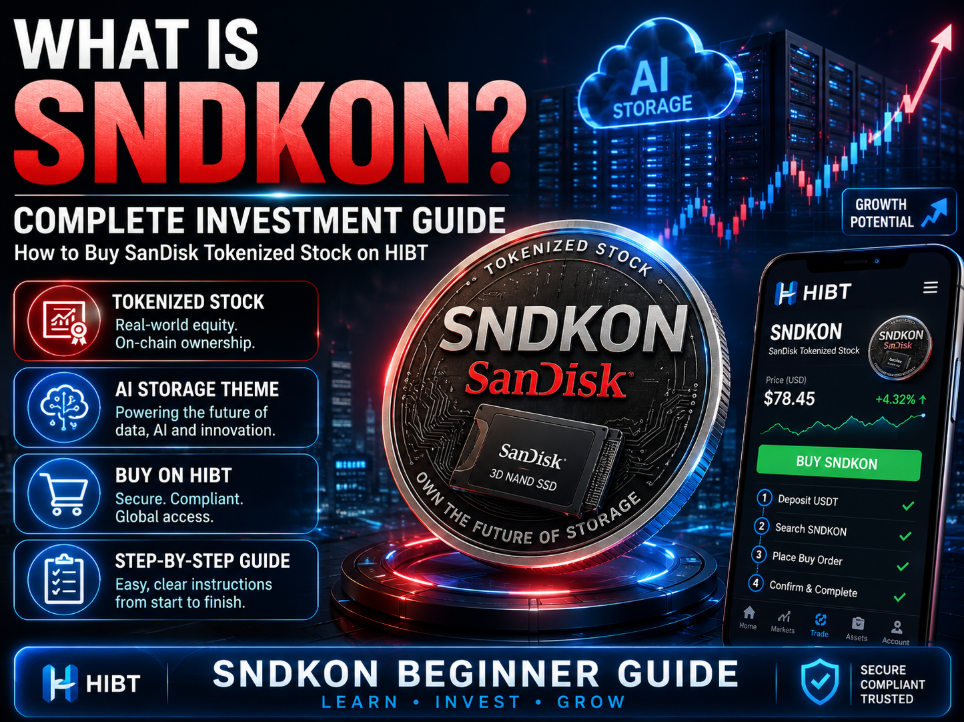
This is the fundamental differentiator between SNDKON and 99% of the crypto market:
- Bitcoin (BTC) derives its price from global consensus, programmatic scarcity, macroeconomic liquidity cycles, and institutional asset allocation.
- Ethereum (ETH) is priced based on smart contract ecosystem activity, network gas dynamics, staking yields, and dApp utility.
- Shiba Inu (SHIB) trades heavily on community sentiment, meme culture, and localized retail speculation.
- SNDKON, however, is structurally designed to mirror the actual stock price of SanDisk.
Consequently, evaluating SNDKON requires stepping away from traditional crypto charting or standard altcoin logic. The real questions you need to audit are: How are SanDisk's corporate fundamentals looking? Is Ondo’s tokenization architecture secure and compliant? Does the HIBT exchange provide adequate trading liquidity? And do local regulations in your jurisdiction permit trading tokenized securities?
This comprehensive guide is designed specifically for three types of readers:
- Crypto natives who have never touched traditional US equities but already hold active portfolios in stablecoins like USDT or USDC.
- Global investors seeking seamless exposure to Wall Street assets via digital asset exchanges but who want a transparent breakdown of the underlying structural risks.
- Real-World Asset (RWA) researchers analyzing the operational maturity and infrastructure rails of tokenized equities.
Conversely, this guide is explicitly not for short-term day traders looking for an overnight crypto pump. Because SNDKON is fundamentally anchored to SanDisk common stock, it cannot detach from real-world corporate performance to pull speculative, long-term altcoin rallies.
Disclaimer: This material is compiled strictly for educational and research purposes and does not constitute financial, investment, or legal advice. Before executing any transactions, you are solely responsible for verifying the latest parameters, rules, and compliance requirements across HIBT, Ondo Finance, SanDisk Corporation, and your local regulatory bodies.
Section 1: What is SNDKON? Master the Asset Before Deploying Capital
1.1 What Kind of Company is SanDisk?
SanDisk is a globally recognized premier brand in the digital storage industry. Its core business centers on NAND flash memory, solid-state drives (SSDs), flash memory cards, enterprise data center storage solutions, and consumer retail hardware. Historically operated as a core division of Western Digital, SanDisk was strategically spun off into a standalone, independently managed public enterprise traded on the Nasdaq.
The mechanism that allows a traditional semiconductor storage equity to actively trade on a digital asset exchange is known as stock tokenization.
The essence of a tokenized stock involves taking the real-world economic exposure of a traditional equity and packaging it inside an on-chain smart contract token, allowing global participants to buy, hold, and trade it fractionally utilizing stablecoins. It does not convert the underlying enterprise into a crypto project; it simply ports traditional financial instruments onto programmable blockchain settlement layers.
Therefore, the underlying reality of SNDKON is not that "SanDisk has launched a token," but rather that SanDisk’s public equity has been tokenized via Ondo Finance's structural infrastructure and listed across selected trading venues.
1.2 The Three Critical Differentiators Between Tokenized Stocks and Cryptocurrencies
To safely navigate this asset class, you must maintain clear boundaries between tokenized stocks and native crypto tokens:
- Divergent Value Anchors: The market valuation of a standard cryptocurrency is dictated by a highly fluid mix of decentralized supply-demand curves, narrative cycles, on-chain ecosystem utility, exchange liquidity, and retail sentiment. A tokenized stock, however, is structurally tethered to its underlying equity. For SNDKON, its absolute value anchor remains the real-world performance of SanDisk stock.
- Distinct Price Catalysts: Traditional altcoins frequently break out on the back of community trends, major exchange listings, retroactive airdrops, or protocol-level upgrades. SNDKON’s valuation, by contrast, responds directly to SanDisk’s corporate earnings reports, semiconductor industry supply-demand cycles, institutional analyst guidance, and macro AI data center expenditures.
- Contrasting Volatility Mechanics: While a koin meme can easily register 50% daily swings on pure social media momentum, SNDKON should theoretically never drift far from the spot price of SanDisk stock. Should a massive premium or deep discount manifest on-chain, it serves as a structural warning flag indicating deficiencies in trading liquidity, market-maker order books, redemption pipelines, or platform mechanics.
When interacting with SNDKON, you must always maintain the perspective that you are acquiring an on-chain equity exposure rail, not a speculative utility token.
1.3 Who is Ondo Finance?
Ondo Finance stands out as a premier institutional player within the Real-World Asset (RWA) ecosystem. Their core business focus centers on porting institutional-grade financial instruments—such as tokenized US Treasuries, sovereign debt funds, tokenized equities, and corporate ETFs—onto public blockchain networks.
Ondo does not participate in speculative meme assets or algorithmic DeFi farming structures. Instead, they position themselves as a bridge linking legacy corporate asset management with automated blockchain settlement layers. SNDKON functions as a tokenized equity asset within the broader Ondo Global Markets architecture.
From a structural credibility standpoint, Ondo commands significant brand equity, an institutional-first compliance track record, and a strong first-mover advantage in the RWA sector. However, from a risk management standpoint, investors must explicitly recognize that holding SNDKON means owning a tokenized credit claim within Ondo's structured system, not direct shares of common stock nestled within a traditional, SIPC-insured US brokerage account. This reality demands that you audit Ondo's internal custody agreements, corporate compliance structures, redemption channels, geographical restrictions, and risk disclosures just as thoroughly as you analyze SanDisk’s balance sheet.
1.4 How Does SNDKON Function Operationally?
The mechanical pipeline behind the issuance and lifecycle of SNDKON can be broken down into five fundamental steps:
- A global user prepares an allocation of verified stablecoins, such as USDC.
- The user deploys capital into the SanDisk tokenized asset pool through Ondo or an integrated secondary trading venue.
- The underlying protocol framework matches or mints the corresponding tokenized exposure based on actual traditional equity positions.
- The SNDKON tokens are dynamically created and held by the user on-chain or within an exchange wallet.
- When a user decides to sell or execute a redemption, the matching systems liquidate or clear the asset exposure according to programmatic rules.
While this flow sounds effortless on paper, every single transition introduces distinct operational risks. If the stablecoin deposit channel encounters technical friction, your purchase execution fails. If the platform implements sudden regional or geographic blocks, your utility is restricted. If the underlying Nasdaq equity experiences a severe gap down, your SNDKON holdings will suffer an identical loss. Furthermore, if the on-chain liquidity pools are thin, entry and exit orders will suffer heavy execution slippage, and if the platform or its third-party custodian encounters solvency or administrative hurdles, the redemption pipeline could freeze. Ultimately, SNDKON is not a "safer" version of a US stock; it is a highly structural, on-chain exposure mechanism.
1.5 The Implications of the "Non-US Investor Only" Mandate
The vast majority of institutional tokenized stock initiatives enforce an absolute restriction barring US persons from participating. The reason is straightforward: the United States Securities and Exchange Commission (SEC) maintains an incredibly strict, unforgiving regulatory stance regarding securities registration, brokerage operations, and retail investor protection. Issuing or distributing un-registered tokenized securities to US retail investors introduces catastrophic legal liabilities for the platform.
For the global, non-US investor base, this structural exclusion functions as a double-edged sword:
- The Opportunity: If you find yourself structurally cut off from opening an affordable, compliant, offshore US brokerage account due to regional restrictions, but you possess deep, fluid access to stablecoin liquidity, SNDKON serves as an accessible alternative channel to capture premium corporate equity exposure.
- The Risk: These products rely entirely on specialized, highly engineered legal and corporate structures. Any future shifts in international compliance, unexpected exchange geo-blocking, or localized regulatory updates in your home country can immediately jeopardize your portfolio security, freeze asset utility, or eliminate your exit ramps.
Never assume that because an asset is technically accessible via a crypto exchange, it is automatically safe or legally sound for your specific jurisdiction. Regulatory risk must be accounted for before a single dollar is deployed.
1.6 The Ultimate Beginner Misconception: Can SNDKON Pull a 10x Breakout Like BTC?
Under normal, rational market conditions, this expectation is mathematically groundless.
The structural valuation ceiling for SNDKON is entirely dictated by the real-world market capitalization of SanDisk stock. If SanDisk stock logs a spectacular 30% rally on the Nasdaq, SNDKON should theoretically mirror that move and gain approximately 30%. If SanDisk shares experience a 30% correction, your SNDKON position will face an identical drawdown.
While it is true that due to low circulating supplies and thin order books, the token can experience localized, short-term premiums or discounts where the price detaches from the Nasdaq spot price, these deviations are symptoms of shallow market depth and inefficient market-making—not sustainable, healthy, long-term capital appreciation. If your investment mandate is to hunt for hyper-volatile, low-cap altcoins that can pull parabolic multiples on pure momentum, SNDKON is fundamentally the wrong asset for your portfolio. It is engineered strictly for market participants who want clean, on-chain exposure to a multi-billion-dollar semiconductor corporate equity.
Section 2: How is the Price of SNDKON Determined?
2.1 Primary Valuation Driver: The Spot Price of SanDisk Stock
The absolute, non-negotiable anchor for SNDKON's valuation will always be SanDisk common stock.
If your goal is to analyze the price direction or fair value of SNDKON, your first step must never be looking at cryptocurrency exchange charts or technical on-chain indicators. Instead, you must open a traditional financial terminal to evaluate SanDisk’s live Nasdaq spot price, historical price-to-earnings (P/E) ratios, quarterly revenue growth, gross margins, institutional forward guidance, and macroeconomic semiconductor industry cycles.
SanDisk operates inside the highly cyclical memory and hardware storage sector. During an industry upswing, NAND flash memory suffers severe supply deficits, driving unit prices higher, expanding corporate profit margins, and pushing stock valuations aggressively upward. During an industry down-cycle, manufacturing capacity overextends, market inventories bloat, unit prices collapse, and corporate earnings compress, forcing a downward re-rating of the stock. Therefore, forecasting the price of SNDKON requires you to master the corporate forecasting of SanDisk as an enterprise, rather than tracking standard crypto token demand.
2.2 Secondary Valuation Driver: Corporate Re-Rating Following the Standalone Listing
Because SanDisk was strategically unbundled from Western Digital to operate as a completely independent public corporation, global equity markets now have the freedom to price and value its assets cleanly on a standalone basis. This corporate restructuring represents a major fundamental catalyst.
Prior to the spin-off, SanDisk’s high-growth flash memory enterprise was structurally blended with Western Digital's legacy hard disk drive (HDD) business line, which clouded the company's ultimate valuation framework. Operating as an independent corporate entity allows global Wall Street analysts and institutional funds to value SanDisk with extreme precision, evaluating its pure-play exposure to enterprise solid-state drives and the overarching artificial intelligence storage buildout. If institutional capital decides to re-rate SanDisk as a core, high-moat winner of the AI data infrastructure era, its valuation multiples will expand significantly, directly lifting the price floor of SNDKON. Conversely, if the market views it conservatively as merely another cyclical hardware manufacturer, its valuation will remain capped.
2.3 Tertiary Valuation Driver: The Secular Demand for AI Data Storage
The global artificial intelligence boom demands far more than raw computational GPUs; it requires an astronomical expansion of high-performance storage infrastructure.
Training massive large language models (LLMs) requires the ingestion of petabytes of clean training data. Running real-time inference services requires ultra-low latency data retrieval systems. Deploying localized enterprise AI software models calls for elite-tier, enterprise-grade solid-state drives. Furthermore, the rapid scaling of hyperscaler data centers, long-term cold storage repositories, and advanced vector databases are all driving an unprecedented secular demand for high-capacity storage components.
This infrastructure rush explains why global capital has aggressively returned to SanDisk. However, retail participants must tread carefully: while the macro AI storage boom is an undeniable structural trend, it does not mean SanDisk's stock price will go up indefinitely in a straight line. Equities are bound by competitive dynamics, capital expenditure constraints, supply chain capacity expansions, corporate gross margins, and institutional expectations. If global markets prematurely price in five years of flawless growth into the current stock price, the asset can easily suffer a severe correction upon the release of healthy earnings reports due to a classic "sell the news" institutional profit-taking event.
2.4 Auxiliary Driver: The Real-World Asset (RWA) Sector Sentiment
SNDKON will experience secondary price movements based on the prevailing speculative sentiment surrounding the wider RWA asset class within the crypto ecosystem.
When institutional narratives favor tokenized real-world assets, or when massive waves of capital flow into RWA issuers like Ondo Finance, SNDKON naturally captures elevated retail attention and improved market-making depth. If global investment institutions actively publish research papers detailing the long-term cost efficiencies of on-chain equity settlement, tokenized assets as a whole can command a distinct speculative valuation premium. However, you must always remember that RWA sector sentiment is purely an auxiliary, secondary driver. It cannot override or decouple from the underlying corporate equity reality. If SanDisk stock plunges on the Nasdaq due to deteriorating business fundamentals, a booming RWA market narrative cannot prevent SNDKON from collapsing along with it over the long term.
2.5 Market Microstructure: Understanding Shallow Liquidity Realities
SNDKON remains an early-stage, specialized, and highly liquidity-sensitive on-chain asset. The total circulating supply and realized market capitalization visible on crypto data trackers can shift dramatically, and during specific operational phases, the active circulating supply floating across secondary exchanges may be limited to mere hundreds or thousands of units.
This thin market architecture introduces three inescapable trading realities:
- Buy-Side Slippage: Deploying large-scale buy orders will rapidly chew through shallow ask books, forcing your average execution price significantly higher than the quoted spot price.
- Sell-Side Cascades: Executing large-scale market sell orders will instantly crush the available bid depth, driving your realized cash-out value into a steep discount.
- Illusionary Pricing: The last traded spot price displayed on your exchange interface does not guarantee that you can actually execute a large position at that exact rate.
If your trade sizes are limited to double or triple-digit dollar allocations, these liquidity bottlenecks will have a minimal impact on your execution. However, if you intend to trade multiple whole tokens or deploy significant blocks of capital, you must meticulously audit order book depth, live bid-ask spreads, and daily realized trading volumes. When interacting with low-depth tokenized stock pools, utilizing strict limit orders is paramount to protecting your capital from execution slippage.
2.6 The Operational Inefficiency of Standard Technical Analysis
A common pitfall among crypto-native newcomers is opening an on-chain token chart, overlaying technical indicators like the Relative Strength Index (RSI), Moving Average Convergence Divergence (MACD), or Bollinger Bands, and attempting to chart short-term entry and exit signals. While these algorithmic indicators possess utility when trading deep, organic, highly liquid assets like Bitcoin, their predictive capacity is heavily degraded when applied to an asset like SNDKON.
The structural reason is that SNDKON’s price action is not generated by autonomous on-chain order flow; its movements are bound to the external equity trading of SanDisk Corporation on the Nasdaq. If you analyze the token's localized chart in isolation while completely ignoring the real-time spot adjustments, institutional block trades, and macroeconomic indicators affecting the actual stock, you will fall victim to tracking errors and false breakout traps. To execute cleanly, your order of operations must follow a strict top-down structure: First, analyze the fundamental direction of SanDisk stock on the traditional market. Second, verify the health of Ondo Finance's on-chain price-tracking peg. Third, evaluate the live order book depth and liquidity spreads directly on your execution exchange. Only after satisfying these layers should you look at technical indicators.
Section 3: What is the HIBT Exchange? Why Use It to Trade SNDKON?
3.1 Corporate and Regulatory Profile of HIBT
HIBT functions as a global digital asset trading platform offering comprehensive spot execution, derivatives trading, and ecosystem asset management. According to corporate public records, HIBT is formally registered as a financial entity within Canada, and its operational literature notes a global footprint serving millions of active accounts, supported by a corporate team of over 200 industry professionals. Furthermore, the venue holds Money Services Business (MSB) registrations under both Canadian and United States regulatory frameworks.
However, as a sophisticated investor, you must maintain absolute clarity regarding licensing structures: an MSB registration is fundamentally distinct from a formal national securities exchange license or a comprehensive national broker-dealer authorization. An MSB registration certifies that a venue is registered to track and process currency transmissions for anti-money laundering compliance; it does not mean its tokenized equity trading features are globally authorized or compliant within every sovereign nation. This operational profile should serve as contextual background information regarding the platform's scale, but it can never replace your personal due diligence regarding asset legality and localized compliance mandates.
3.2 Internal Platform Security Mechanisms
HIBT’s public architecture documentation states that the platform deploys standard institutional security frameworks, utilizing an asymmetrical mix of cold and hot wallet storage alongside automated, real-time risk mitigation algorithms. For any modern digital asset exchange, the strict deployment of offline cold storage arrays, multi-signature corporate approval gates, advanced behavioral risk monitors, stringent automated Anti-Money Laundering (AML) transaction tracking, and manual operational reviews for high-value withdrawals are absolute necessities to preserve platform integrity.
Nevertheless, regardless of how robust an exchange’s marketing literature or security statements appear, a disciplined trader must never treat a centralized trading venue as a permanent, bulletproof storage solution. Interacting with any centralized exchange introduces an inescapable layer of counterparty risk:
- Malicious external exploits or smart contract network breaches.
- Unexpected compliance-driven or operational withdrawal freezes.
- Automated algorithmic account risk flags or lockouts.
- Sudden regional geo-blocking or identity restrictions.
- Localized maintenance windows or sudden trading pair delistings.
- Abrupt operational pivots driven by shifting international compliance laws.
Therefore, if your objective is short-term execution, capital turnover, or active tactical trading, keeping an allocation on HIBT is operationally optimal. However, if you are building a high-value, multi-year investment position, you must continuously evaluate whether to migrate assets to an independent on-chain web3 wallet or interact directly with Ondo’s native primary issuance frameworks.
3.3 The Strategic Logic Behind HIBT Listing SNDKON
The decision by HIBT to support and list the SNDKON trading pair demonstrates a clear strategic push by the venue to capture market share within the rapidly expanding RWA and tokenized equity landscape. These synthetic and tokenized asset classes are highly lucrative for crypto platforms because they function as an onboarding mechanism, bridging traditional equity investors looking for blockchain efficiency with crypto-native market participants holding idle stablecoin capital.
For you as an investor, HIBT's listing of SNDKON streamlines the operational onboarding process. Instead of navigating the complex, highly institutional primary onboarding, verification, and manual minting procedures directly on Ondo Finance's corporate website, you can buy and sell exposure assets instantly using standard USDT allocations within a familiar trading interface.
The structural trade-off, however, is that your trading execution relies entirely on HIBT’s localized market maker liquidity and order book depth. If the order book on HIBT is shallow during periods of intense market volatility, the quoted price on the platform can experience temporary tracking errors, drifting away from Ondo's primary peg or the real-time spot adjustments of the underlying Nasdaq equity. In short, the platform offers unmatched operational convenience, but it introduces distinct liquidity and platform counterparty exposures.
3.4 Comparing HIBT Against Alternative Access Pathways
If your goal is to gain economic exposure to SanDisk's business operations via the tokenized asset lifecycle, you have three primary operational pathways to evaluate:
- The Primary Protocol Pipeline (Ondo Finance Official Channels): This involves completing direct corporate onboarding and verification on Ondo's native platform to execute primary minting and redemptions. The advantage is that you are interacting directly with the asset source, eliminating exchange counterparty risks and ensuring absolute price accuracy. The disadvantage is the high capital onboarding thresholds, complex institutional compliance verification, and rigid geographical restrictions.
- Centralized Digital Asset Venues (The HIBT Route): This involves purchasing and trading the asset via secondary spot markets using stablecoins like USDT. The advantage is that it eliminates complex onboarding friction, uses familiar trading infrastructure, provides instant settlement, and allows low minimum order sizes. The disadvantage is that you assume the platform risk of the exchange and are bound to local order book liquidity.
- Traditional Brokerage Rails (Direct US Equity Purchase): This involves opening an account with a traditional, regulated international broker to buy actual common shares of SanDisk (SNDK) on the Nasdaq. The advantage is that it offers deep liquidity, comprehensive investor protections, clear legal title to the asset, and an ironclad regulatory environment. The disadvantage is that for many international, non-US retail investors, opening these offshore accounts involves severe banking friction, high wire-transfer fees, complex foreign tax disclosures, and lengthy identity validation.
If your financial profile allows you to easily maintain a traditional, low-cost international brokerage account, buying actual common shares remains the most transparent route. However, if your wealth is entirely stablecoin-native and you are cut off from legacy international banking networks, executing through HIBT's tokenized pairs offers a functional solution.
3.5 Evaluating Trading Friction for Small-Scale Capital Allocations
HIBT enforces a dynamic tiered fee structure that scales based on your account's VIP level, 30-day trailing trading volume, and native platform token holdings. For everyday retail participants deploying modest capital allocations, the baseline spot trading commission (typically a minor fraction of a percent) is rarely your largest source of financial friction. Instead, your true operational costs are driven by the following factors:
- The premium paid above spot rates when acquiring USDT via peer-to-peer (P2P) desks.
- The processing and gateway percentages charged by third-party credit card fiat ramps.
- The bid-ask spread discrepancy native to the SNDKON order book.
- The immediate execution slippage caused by deploying market orders into shallow books.
- The localized gas or platform network fees required to execute future on-chain token withdrawals.
To illustrate this with a practical scenario: suppose you allocate 700 USDT to purchase exactly one whole unit of SNDKON. Even if HIBT offers a microscopic spot trading commission, if you execute a market order into a shallow book that carries a 1% bid-ask spread gap, you have immediately overpaid by 7 USDT right at entry. If you suffer an additional 1% execution slippage when you later liquidate the position, your round-trip operational costs will have completely eclipsed your baseline exchange trading fees. Consequently, while small-scale investors must track baseline commission structures, medium-to-large-scale allocators must relentlessly prioritize order book depth and liquidity spreads.
Section 4: Step-by-Step Operational Guide to Acquiring SNDKON on HIBT
Step 1: Secure Account Registration
Navigate to the official HIBT web interface or download their verified mobile application. Initiate the registration protocol by inputting a valid, secure corporate email address or a verified mobile phone number, and establish an alphanumeric login password.
During this stage, ensure that you double-check your email entry to prevent communication errors, monitor your spam or promotional folders if the automated verification code faces delivery delays, and generate a completely unique, high-entropy password that is never shared with any other web service. Once registration is confirmed, immediately navigate to your security dashboard to activate mandatory Time-based One-Time Password (TOTP) two-factor authentication via Google Authenticator or a hardware key. Do not deposit capital until your security perimeter is fully established.
Step 2: Complete the Identity Verification Protocol (KYC)
Prior to unlocking trading features for tokenized real-world assets like SNDKON, you must complete the platform's Know Your Customer (KYC) identity verification stack. The precise document mandates and account tiers adapt dynamically based on regional compliance demands and your intended transactional volume; always follow the live parameters displayed on your dashboard.
The verification process typically requires a high-resolution photograph of a valid government-issued passport or national identification card, an automated biometric selfie check to confirm identity match, and a formal proof of address document such as a recent utility bill or bank statement. The most common operational causes for KYC rejection include blurry document scans, a mismatch between your typed data and the legal document text, trying to utilize an expired document, poor lighting conditions during the biometric selfie scan, or trying to register from a restricted geographical jurisdiction. Always submit pristine, authentic documentation; utilizing synthetic or falsified data will trigger automated risk algorithms, resulting in immediate account freezes and asset lockouts.
Step 3: Capital Onboarding—Procuring Your Base Currency (USDT)
Secondary market execution for the SNDKON asset on HIBT requires you to hold an active allocation of Tether (USDT) within your spot wallet. If you do not hold digital assets, you can procure your baseline USDT using three primary onboarding rails:
- Executing an instant purchase via integrated third-party credit/debit card fiat payment gateways.
- Utilizing the decentralized peer-to-peer (P2P) over-the-counter market to exchange local fiat currency directly with verified merchants.
- Initiating an inbound blockchain deposit from an external self-custodial wallet or an alternative trading venue.
For market participants entering via the P2P desk, always prioritize high-reputation merchants boasting stellar historical order completion percentages, carefully monitor the local exchange premium, and strictly follow platform security rules. If you are conducting an inbound blockchain deposit from an external wallet, meticulously verify that your selected transfer network—whether TRC-20, ERC-20, or BEP-20—perfectly matches the specific deposit address generated by HIBT. For your initial deposit, it is prudent to execute a modest test transfer of 20 to 100 USDT to confirm the pipeline is fully functional before transmitting significant capital.
Step 4: Accessing the SNDKON/USDT Market Interface
Log into your verified HIBT account, navigate to the primary spot trading interface, and type "SNDKON" into the market asset search bar.
Once the system surface matches the official SNDKON/USDT spot market pair, click through to initialize the active trading workspace. Before configuring an order, train your focus onto four core areas of the interface:
- The real-time last-traded market execution price.
- The depth, density, and spread visible within the live limit order book bids and asks.
- The total realized 24-hour trading volume tracking active market turnover.
- The historical candlestick chart tracking structural price trends.
If you observe a significant percentage gap between the highest active buy bid and the lowest active sell ask, it indicates a thin liquidity environment. If the total order book density shows sparse limit orders, the market is ill-suited for large-scale market orders. If the 24-hour turnover volume is extremely low, you must account for heavy execution slippage when later attempting to liquidate the asset.
Step 5: Order Configuration—Executing via Limit Orders
When trading specialized, low-depth assets like SNDKON, it is highly recommended to completely avoid market orders, opting instead for strict limit orders. Because tokenized stocks do not command the immense, structural order book density of macro assets like Bitcoin, executing a large market order can easily clear out the entire immediate book, causing severe execution slippage where your realized average entry price lands far above your target.
The operational logic of a limit order requires you to manually input the precise maximum price you are willing to pay per token, specify the exact fractional or whole quantity of SNDKON you intend to purchase, audit the calculated total USDT cost of the transaction, and confirm the order submission to place it onto the book where it will wait to be filled. Before clicking confirm, perform a final manual check to ensure the trading pair is explicitly set to SNDKON/USDT, confirm that no decimal point errors were made in your price configuration, and verify that the total asset cost aligns precisely with your broader portfolio management strategy.
Step 6: Tracking Portfolio Balances and Active Order Status
Once your limit order is submitted, you can track its execution progression via the active orders tab at the bottom of your workspace. If the spot price shifts away from your configuration, your order will remain on the book as an unfilled limit; you retain the right to let it sit, or cancel the order entirely to re-configure your price parameters based on live market conditions.
Never allow execution delays to provoke you into canceling a limit order just to chase a vertical spike with a market order. Chasing price action in illiquid tokenized asset pairs will instantly expose your capital to severe, unnecessary execution premiums. Once a fill occurs, the transaction history tab will display your exact realized purchase price, filled volume, and the exchange commission charged, while your asset dashboard will reflect your updated SNDKON balance.
Step 7: Executing Liquidation (Selling Your Position)
The structural pipeline for liquidating your SNDKON holdings back into liquid stablecoins follows an identical, inverse sequence to your purchase protocol. Navigate back to the primary SNDKON/USDT spot trading interface, select the sell module, configure a strict limit order price, specify the quantity you intend to clear from your portfolio, and confirm the order submission.
If you intend to exit a substantial position, avoid trying to dump the entire allocation through a single block execution. Instead, distribute your liquidation across multiple smaller limit orders spaced out over time. This phased execution mitigates sell-side slippage, prevents your order flow from breaking through local bid depth, and ensures you capture a cleaner average realized price.
Step 8: Evaluating Self-Custody vs. Exchange Storage Trade-Offs
Once you hold an active allocation of SNDKON tokens, you face a fundamental operational choice: do you maintain storage within your centralized HIBT account, or do you execute an outbound withdrawal to a self-custodial on-chain Web3 wallet?
- Centralized Exchange Storage: Keeping assets on HIBT maximizes operational convenience, allows immediate liquidation flexibility, and eliminates personal wallet management overhead. However, it exposes your portfolio to centralized platform counterparty risk and external exchange vulnerabilities.
- On-Chain Self-Custody Wallet: Withdrawing your tokens to a private ERC-20 wallet eliminates exchange counterparty dependencies and gives you absolute control over your keys. However, it demands that you assume total personal responsibility for secure seed phrase management, protection against phishing exploits, and the gas costs associated with Ethereum network operations.
If you are a newcomer who is unfamiliar with managing Ethereum network nodes, handling private keys, or calculating network gas fees, attempting to move large sums onto the blockchain right away introduces severe operational risks. A safer path is to leave initial holdings on the venue while executing small test withdrawals to build your technical proficiency before fully committing to absolute self-custody.
Section 5: Comprehensive Cost Calculation Framework
5.1 Direct Exchange Spot Commission
Assuming you configure a limit order to purchase exactly one whole unit of SNDKON at a spot price of 700 USDT, and your current HIBT tier carries a standard baseline spot maker/taker commission of 0.1%, your direct execution trading fee will equal exactly 0.7 USDT. While tracking baseline exchange commissions is necessary, trading fees are almost never your primary source of financial friction when dealing with specialized tokenized equities; your true costs are driven by order book spreads and execution slippage.
5.2 Fiat-to-Crypto Onboarding Friction
The real-world cost of your investment begins right at the fiat onboarding stage. If you utilize a P2P market network to buy your baseline USDT, you will almost always pay a localized percentage premium over the official mid-market fiat exchange rate.
For instance, if the official global macro exchange rate sits at 1 USDT to 7.20 local currency units, but active P2P merchants are quoting an optimized rate of 7.25 units to account for local liquidity and payment risks, your onboarding capital has already taken an immediate haircut before you have even placed a spot order. Alternatively, utilizing instant credit card gateways can introduce processing fees that can drastically alter the unit cost of your capital. You must calculate the comprehensive cost of acquiring your stablecoins, not just the spot ticker price of the token.
5.3 Spot Inventory Carrying Costs
When you maintain a direct, fully paid spot allocation of SNDKON within your HIBT spot wallet, the venue does not levy ongoing management percentages or inventory carrying costs. This represents a distinct structural advantage over traditional financial derivatives or specialized leveraged products.
However, you must note that this fee-free carrying structure applies strictly to fully funded spot holdings. If you choose to trade asset exposure through specialized margin accounts or perpetual contract markets, you will find yourself exposed to dynamic funding rates, ongoing leverage borrowing fees, and the absolute risk of automated liquidation events. Beginners should steer completely clear of margin and derivatives instruments when interacting with tokenized stocks.
5.4 On-Chain Network Transmission (Gas) Fees
If you choose to migrate your SNDKON tokens out of HIBT into a private, self-custodial wallet, you must cover the network gas fees required to execute an outbound ERC-20 token transmission. Because these transfers settle directly on the Ethereum mainnet, the network fees scale dynamically based on real-time block space demand and network congestion, completely independent of the size of your transaction.
If your tokenized position is small—for example, if you hold an allocation worth only 50 to 100 USDT—the baseline gas fee required to execute an on-chain transfer could represent a highly destructive percentage of your total principal. For small-scale market participants, frequent on-chain migrations are economically irrational; capital is better consolidated within the exchange environment until your position reaches a scale where gas fees become statistically negligible.
5.5 Calculating Your Absolute Break-Even Point
To calculate your true break-even point on a 700 USDT allocation, you must factor in every layer of operational friction across a complete round-trip transaction lifecycle. Consider this realistic cost scenario:
- P2P stablecoin onboarding premium: 0.5%
- Inbound exchange spot purchase fee: 0.1%
- Buy-side limit execution spread/slippage: 0.5%
- Outbound exchange spot liquidation fee: 0.1%
- Sell-side exit execution slippage: 0.5%
Summing these individual friction layers reveals a round-trip operational cost of approximately 1.7%. This means that if you purchase SNDKON at a quoted spot price of 700 USDT, the underlying market asset must rally past 711.9 USDT before your investment crosses into actual net profitability. If local order books thin out further or you execute sloppy market orders that trigger higher slippage, your structural break-even threshold will climb even higher. Do not evaluate performance based on raw chart upticks; track your real net returns after deducting all onboarding, transaction, slippage, and liquidation friction.
Section 6: Comprehensive Investment Risk Checklist
6.1 Ondo Finance Structural Platform Risk
SNDKON is completely dependent on the structural architecture, compliance frameworks, legal vehicles, and redemption pipelines engineered by Ondo Finance. If Ondo encounters unforeseen operational roadblocks, catastrophic regulatory challenges, structural red-tape freezes, or complications regarding its corporate custody agreements, the price peg and exit pathways of SNDKON will be immediately compromised. This structural layer represents an entirely different dimension of risk compared to holding traditional common stock; when you buy direct shares of SanDisk, your counterparty risk is limited to your broker and the clearinghouse, whereas buying SNDKON adds an inescapable layer of platform issuer counterparty risk.
6.2 Centralized Exchange Counterparty Exposure
While HIBT serves as a highly functional, accessible interface for trading tokenized equities, it is a centralized digital asset platform, not a legacy, government-backed national securities exchange. By maintaining funds on the platform, you assume classic exchange counterparty vulnerabilities, including sudden account verification blocks, localized withdrawal processing queues, sudden trading pair delistings driven by internal corporate policy shifts, shallow order book collapses during macro panic events, regional geo-blocking, or platform-level security breaches. HIBT is a powerful tool for trade execution, but it should never be treated as a risk-free sovereign vault.
6.3 Microstructure Liquidity Deficits
Shallow trading depth represents one of the most immediate hazards when dealing with niche tokenized stock instruments. When an asset operates with a microscopic circulating supply and thin limit order books, the quoted spot ticker price becomes highly deceptive. Small retail orders can fill cleanly, but any sudden institutional-scale volume or macro panic liquidations will completely obliterate the local bids, causing deep price slippage. If you choose to manage large whole-token positions, you must be comfortable with the reality that getting into and out of the market will require patience, tactical limit orders, and an acceptance of wider spreads.
6.4 Regulatory Black Swan Vulnerabilities
Because tokenized equities mirror the economic value of real-world corporate stocks, they inherently possess the legal characteristics of securities products. Cryptocurrency-focused regulatory frameworks across the globe remain highly volatile and subject to sudden, unannounced revisions.
If your home country or a major international regulator passes a sudden mandate declaring tokenized stocks to be unauthorized or illegal securities distributions, centralized platforms will instantly move to geo-block users or enforce emergency delistings. Regulatory environments across jurisdictions vary dramatically, and you are solely responsible for continually auditing your local legal landscape to ensure your capital remain compliant.
6.5 Underlying Corporate Equity Business Risk
The value of SNDKON is tied directly to the public equity valuation of SanDisk Corporation on the Nasdaq. If the global NAND flash memory sector enters a severe macro down-cycle, if SanDisk's corporate profit margins contract due to aggressive semiconductor price wars, if secular AI storage demands fail to meet Wall Street's lofty growth expectations, or if the company's quarterly earnings reports miss consensus estimates, the underlying stock price will collapse, forcing an immediate, equivalent drop in the value of your SNDKON tokens. On-chain narratives cannot shield your capital from traditional stock market realities.
6.6 Smart Contract and Technical Security Risks
SNDKON exists as a programmable digital token deployed on public blockchain infrastructure, exposing the asset to smart contract vulnerabilities, token minting/redemption code flaws, multi-signature administrative key exploits, and cross-chain bridge vulnerabilities. Even within premier, institutional-grade RWA protocols like Ondo Finance, the technical risk of smart contract bugs or protocol code exceptions can never be statistically reduced to zero.
6.7 Foreign Exchange Volatility Exposure
If you utilize local fiat currencies to buy stablecoins on P2P desks in order to trade SNDKON, you are actively exposing your portfolio to global foreign exchange risk. Because SNDKON mirrors a US-dollar-denominated asset listed on the Nasdaq, you are essentially holding a synthetic long position on the US Dollar.
If the spot price of SanDisk stock remains completely unchanged, but your local home currency appreciates aggressively against the US Dollar, your net purchasing power will shrink when you ultimately liquidate back into your local currency. Conversely, a weakening home currency will generate an unearned foreign exchange premium. You must track currency macro trends alongside stock indicators.
Section 7: Structural Comparison of Investment Pathways
- Ondo Finance Primary Issuance: Offers the highest structural proximity to the underlying asset pool and zero tracking errors, operating under a highly compliant framework. However, it enforces steep institutional capital minimums, complex onboarding friction, and rigid geographical restrictions, making it best suited for institutional allocators and high-net-worth DeFi professionals.
- HIBT Secondary Exchange Spot: Delivers unmatched operational simplicity and low capital thresholds, allowing anyone holding stablecoins to buy fractional tokens inside a standard, familiar interface. The trade-off is that you assume centralized platform counterparty risk and are bound by the depth of localized order book liquidity.
- Traditional Brokerage (Direct Equity Shares): Represents the gold standard for investor protection, backed by comprehensive securities insurance (e.g., SIPC), deep institutional liquidity, and clear legal title to actual common stock. The downside is that international retail investors frequently face extreme banking friction, high wire fees, and restrictive offshore onboarding compliance.
The Ultimate Decision Framework
If you possess the legal status, sovereign banking connections, and documentation required to maintain a low-cost, fully compliant international brokerage account, your optimal choice is to buy actual shares of SanDisk (SNDK) directly on the traditional market.
If you are cut off from international banking rails but hold native stablecoin capital and want a convenient way to gain exposure to SanDisk's business lifecycle, executing through HIBT offers a practical solution—provided you accept the platform and liquidity trade-offs. If you lack a clear understanding of smart contract token mechanics or how tokenized stocks track underlying assets, you should avoid this asset class entirely until you have built a stronger foundation.
Section 8: Frequently Asked Questions (FAQ)
Q1: Since the unit price of SNDKON is quite high, can I participate if I only have 100 USDT?
Yes, provided that the HIBT exchange interface supports fractional order matching for the pair. Fractional spot markets allow retail users to purchase small denominations, such as 0.1 or 0.01 units. Always verify the absolute minimum order size specified directly within the live HIBT spot order module.
Q2: Can individuals located within restricted jurisdictions legally trade SNDKON on HIBT?
This involves local compliance mandates and changing platform terms of service. You are solely responsible for confirming whether digital asset exchanges and tokenized securities trading are permitted under your local national laws. This guide explicitly provides zero legal or regulatory advice.
Q3: How are corporate dividend distributions handled for SNDKON?
Corporate actions and dividend payouts for tokenized equities are dictated entirely by the specialized rules established by the token issuer (Ondo Finance). Specific tokenized assets choose to systematically reinvest cash dividends back into the underlying asset pool to boost the token's net asset value, while others utilize distinct distribution protocols. You must audit Ondo's master asset documentation for SNDKON; never assume it will match a traditional stock account.
Q4: Can I utilize HIBT newcomer sign-up rewards or promotional bonuses to trade SNDKON?
This depends entirely on the specific terms governing the promotional campaign active on HIBT. The vast majority of centralized exchange trading credits carry distinct usage boundaries, strict trailing volume milestones, or absolute withdrawal restrictions. Treat promotional credits as specialized margin tools rather than unconditional cash.
Q5: What operational steps should I take if my HIBT account undergoes an automated risk freeze?
You must immediately submit a formal ticket to HIBT’s verified customer service center. Be prepared to present definitive proof of identity alongside a comprehensive audit trail demonstrating the legal, legitimate source of your deposited funds. The ultimate resolution speed and asset release depend on the underlying trigger conditions and platform risk guidelines.
Q6: Is the SNDKON market available for active trading during standard weekend hours?
On-chain tokenized equities are technically capable of supporting continuous secondary market trading timelines that go far beyond traditional market hours (e.g., 24/5 networks). However, because the underlying Nasdaq equity market is completely closed on weekends, any on-chain price adjustments occurring during weekend hours are driven entirely by localized platform market makers and thin order book speculation. Always cross-reference the active operational disclosures on HIBT and Ondo.
Q7: What is the safest way to execute an order if I intend to purchase more than five whole tokens at once?
Never deploy a single, large market order into the book. You must analyze the live order book depth, split your total capital into manageable allocations, and execute them using patient limit orders over time. If your intended deployment volume is substantial, check if the platform offers a dedicated, high-depth over-the-counter (OTC) desk to minimize market distortion.
Conclusion: Is SNDKON a Proper Fit for Your Portfolio?
SNDKON stands out as a premier example of modern Real-World Asset tokenization. It bridges legacy corporate finance with blockchain engineering by taking a major Nasdaq technology equity and wrapping it into an accessible, stablecoin-settled on-chain asset.
Its underlying value proposition is not about delivering wild, speculative crypto pumps; it is about providing global, programmatic access to US corporate equity exposure.
SNDKON is an operationally suitable tool for your portfolio if:
- You face significant institutional barriers when trying to open offshore brokerage accounts.
- Your investment capital is heavily stablecoin-native.
- You maintain a strong, mid-to-long-term bullish fundamental outlook on SanDisk's business.
- You possess a mature, clear understanding of stock tokenization risks.
- You accept the liquidity constraints and shifting regulatory landscapes.
SNDKON is a dangerous mismatch for your portfolio if:
- You are hunting for explosive short-term speculative pumps.
- You have zero understanding of SanDisk's balance sheet, market share, or business operations.
- Your total deployment capital is small enough that gas fees, premiums, and spreads will destroy your margins.
- Your local jurisdiction explicitly outlaws interaction with tokenized security wrappers.
- You lack the risk tolerance to manage exchange counterparty and custodial dependencies.
If you choose to enter this market, the most prudent approach is to build your exposure through a minimal viable path: secure your HIBT account, complete your mandatory identity validation, execute a modest stablecoin deposit, deploy a small test order of 50 to 100 USDT to verify order matching, analyze the realized spreads and fees, and only then determine whether to scale your position.
To widen your understanding of asset valuation frameworks across the broader Web3 landscape, it can be useful to cross-reference this equity-anchored logic with long-term forecasts for entirely different asset classes—such as the 2030 SHIB Price Prediction, the 2030 RPL Price Prediction, and the 2030 DOT Price Prediction. While SHIB trades purely on community trends and meme culture, RPL serves as functional infrastructure for Ethereum staking, and DOT represents decentralized cross-chain communications, SNDKON remains a pure tokenized equity. Evaluating these models side-by-side will sharpen your ability to identify distinct valuation drivers and risk vectors across the financial landscape.
Final Judgment
SNDKON is a highly compelling RWA asset that is deeply worth studying, but it is entirely unsuited for speculative, blind trend-chasing. It offers genuine utility for non-US investors who hold stablecoin capital and want exposure to SanDisk stock while managing RWA constraints. A sophisticated investor does not buy an asset simply because an exchange lists a new ticker; they invest only after mastering the underlying equity dynamics, platform frameworks, order book microstructure, and regulatory parameters.
Appendix: Core Financial and Technical Glossary
- ERC-20: The universal token standard utilized across the Ethereum blockchain network. The vast majority of institutional RWA and tokenized stock initiatives adopt the ERC-20 framework to maximize ecosystem compatibility.
- RWA (Real-World Assets): The technological process of onboarding physical or traditional financial assets—including sovereign bonds, public equities, real estate, corporate funds, and commercial credit—onto public blockchain infrastructure.
- KYC (Know Your Customer): Mandatory identity validation frameworks deployed by centralized digital asset platforms to confirm the identity of their users, maintain legal compliance, and combat illicit capital flows.
- MSB Registration: Money Services Business registration. Administered by financial enforcement networks to monitor currency transmission compliance. It does not constitute a comprehensive securities exchange license.
- Market Maker: Institutional liquidity providers that constantly quote simultaneous buy bids and sell asks within an order book. Low-depth or specialized assets are heavily dependent on market makers to ensure trading continuity.
- Slippage: The direct mathematical discrepancy between the expected price configured by a user and the actual average execution price realized upon order settlement. Slippage expands dramatically within illiquid markets.
- Cold Wallet: An offline or air-gapped cryptographic hardware storage solution engineered to keep private keys entirely isolated from internet connectivity, providing an elite security perimeter against remote hacking threats.
Master Educational Disclaimer
The analytical commentary and step-by-step documentation contained within this guide are presented strictly for educational and research purposes. They must never be construed as explicit financial, investment, legal, or tax advice. SNDKON operates as a tokenized equity derivative asset, exposing your capital to a multi-layered matrix of risks including underlying equity drawdowns, platform issuer defaults, custodial insolvency, order book illiquidity, shifting international compliance regulations, and smart contract system vulnerabilities. Prior to deploying capital into any tokenized instrument, you are solely responsible for independently cross-referencing live documentation, compliance terms, and market variables across Ondo Finance, HIBT, SanDisk Corporation, and your local legislative bodies.