
If you are searching for "What is RAIL token," "How to buy Railgun," or "Is RAIL worth investing in," the first step is not to look at the price chart, but to confirm one thing: Which RAIL asset have you actually found?
The cryptocurrency market is saturated with projects sharing similar names or identical tickers. The "RAIL" ticker is uniquely confusing for newcomers. Some users refer to it as the governance token for Railgun, others mix it up with Rail Network, and some may accidentally purchase copycat memecoins deployed on decentralized venues.
The RAIL token discussed in this guide refers strictly to the native Ethereum governance token of the RAILGUN protocol.
Railgun is an on-chain privacy protocol powered by Zero-Knowledge cryptography, built to enable users to execute private transfers, interact with DeFi, and manage digital portfolios across public mainnets like Ethereum. RAIL serves as the governance and staking token for the Railgun DAO.
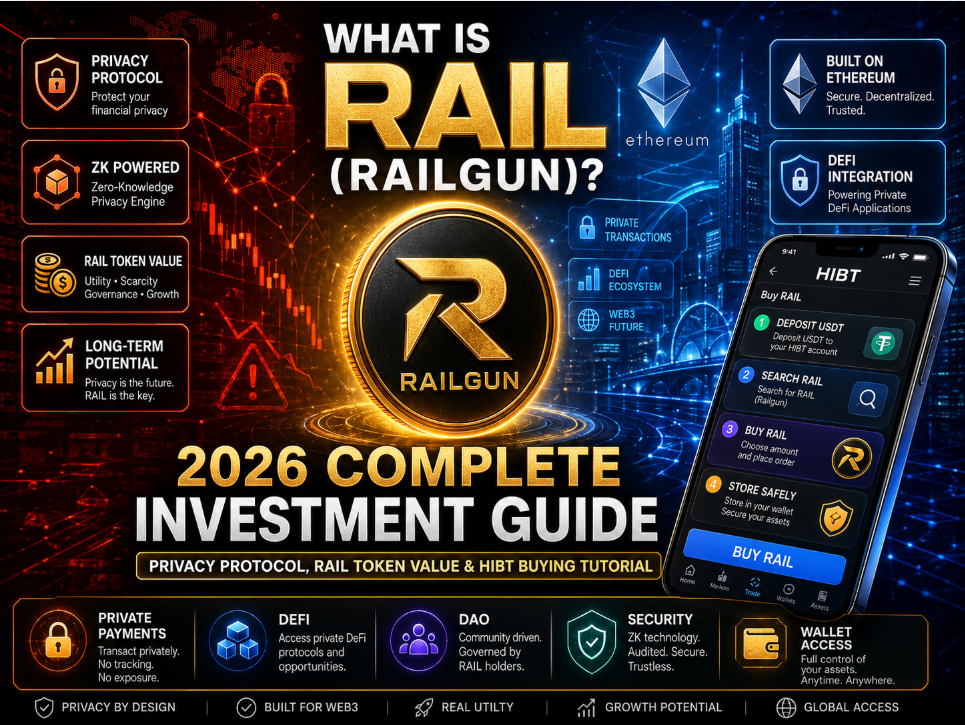
However, you must internalize one core rule before moving forward:
RAIL is not the privacy coin itself, nor is it a gas token required to use Railgun's privacy features. Its valuation is derived entirely from governance utility, staking rewards, aggregate protocol utilization, and market expectations surrounding Ethereum’s privacy layer infrastructure.
This comprehensive investment guide deconstructs contract address verification, core protocol mechanics, token utility, tokenomics, 2026 market catalysts, a step-by-step HIBT platform tutorial, structural risks, and defensive portfolio positioning strategies.
1. Three Core Crucial Distinctions to Verify Before Buying RAIL
When investing in micro-to-mid-cap assets like RAIL, your primary risk is not a market correction—it is purchasing the wrong asset entirely. Because open-source public networks permit anyone to deploy a smart contract under any chosen ticker, matching logos, descriptions, and graphics can be easily cloned. The definitive identifier of a digital asset is its on-chain smart contract address.
1. The Legitimate Railgun Governance Token (RAIL)
The core subject of this profile is the official governance asset for Railgun deployed natively on Ethereum. Its verified smart contract address is:
0xe76c6c83af64e4c60245d8c7de953df673a7a33d
You must audit this specific string before executing any buy orders. Do not trust exchange display names or third-party graphic interfaces blindly, particularly when routing orders through decentralized protocols (DEXs), browser wallet extensions, or unverified link paths found on social channels.
2. Rail Network or Adjacent Projects
Alternative projects such as Rail Network or unrelated tokens trading under variations like "RAILS" occupy separate niches in the market. These projects represent independent layer-2 protocols, logistics concepts, or small-cap assets that hold zero technical or corporate alignment with the Railgun ecosystem.
3. Arbitrary Copycats and Malicious Memecoins
Malicious actors frequently deploy fraudulent tokens matching the exact name and visual branding of hot protocols, going as far as linking cloned documentation portals. If you purchase an unverified contract address, your capital cannot be recovered.
2. The 30-Second Verification Framework for Smart Contracts
To verify the integrity of your asset before swapping capital, adopt this standard check:
- Navigate to a reputable data aggregator like CoinGecko or CoinMarketCap.
- Run a targeted search for Railgun.
- Locate the verified Ethereum contract address.
- Open Etherscan and paste the copied string into the explorer bar.
- Manually confirm the total supply parameters, holder count expansion, and verifiable transaction logs.
- Copy the string directly from your audited explorer page into your interface for final execution.
3. Dissecting Cross-Chain Variants: RAIL vs. RAILPOLY vs. RAILBSC
Railgun features independent deployments across multiple smart contract mainnets, giving rise to network-specific governance assets:
- Ethereum (Mainnet): Governed by RAIL.
- Polygon: Governed by RAILPOLY.
- BNB Smart Chain (BSC): Governed by RAILBSC.
These variants represent independent cryptographic assets that handle isolated governance parameters for their respective network deployments. They are not natively fungible or directly swappable without bridging.
If you execute an external wallet transfer or attempt an exchange deposit while selecting a mismatched network layer, the receiving system will fail to identify the transaction, which can result in a permanent loss of funds.
4. Understanding the Core Architecture of the RAILGUN Protocol
To evaluate the valuation of the RAIL token, you must first understand the utility engine driving the underlying protocol.
Why Public Ledgers Lack Transactional Privacy
Blockchains like Ethereum function as globally transparent public ledgers. Every state transition, token balance, and smart contract call is permanently indexed for public consumption via explorers and on-chain intelligence tools. For participants, this transparency presents persistent challenges:
- Liquid asset wallets are exposed to real-time wallet tracking and algorithmic targeting.
- Institutional position rebalancing is easily exposed to front-running software.
- Proprietary quantitative DeFi yield strategies are visible and easily replicated by competitors.
- Individual net worth metrics are permanently tied to public cryptographic keys.
While traditional banking models protect ledger data by default, public Web3 applications are transparent by design. Privacy must therefore be introduced via specialized cryptographic tooling.
The Role of Railgun
Railgun functions as a specialized, on-chain privacy layer. Utilizing Zero-Knowledge proofs (zk-SNARKs), the protocol enables users to establish private balances on a public chain while masking the key attributes of a transaction:
[ Unshielded Public Wallet ] ───> ( Shield Action ) ───> [ Railgun Shielded Pool ]
                                                                   │
[ Hidden Counterparties ] <─── ( Masked Execution ) <─── [ Encrypted zk-SNARKs ]
Once a user executes a "Shield" action, moving an asset into the protocol's dark pool, they can conduct transfers or execute complex DeFi yield loops across integrated protocols without exposing their wallet path, token type, or exact capital quantities to secondary onlookers.
5. Architectural Differences: Railgun vs. Tornado Cash
Discussions regarding on-chain privacy naturally invoke comparisons to Tornado Cash. While Tornado Cash proved the massive demand for cryptographic privacy on Ethereum, it ultimately faced unprecedented regulatory enforcement from global bodies due to its structural use by malicious actors and sanctioned entities. This created a persistent compliance shadow over the entire privacy sector.
The core distinction lies in their technical architecture: Tornado Cash functioned primarily as an automated asset mixer, whereas Railgun is a dynamic, multi-token privacy system that supports non-custodial asset balances, programmatic DeFi integrations, and sophisticated compliance tracking tools.
The Compliance Integration: Proof of Innocence (PoI)
Railgun differentiates itself by natively incorporating a cryptographic tool known as Proof of Innocence (PoI).
PoI allows users to mathematically prove via zero-knowledge logic that their shielded assets did not originate from flagged exploits, documented hacks, or sanctioned block lists. Critically, this proof is generated without disclosing the user’s broader private transaction history or personal identifying data.
By giving users a tool to demonstrate funds are clean while preserving transaction privacy, the protocol addresses the primary concern of global regulatory frameworks: preventing illicit capital from using privacy layers to evade tracking.
6. Evaluating the Non-Custodial User Experience
Railgun abstracts complex cryptographic proofs into a functional asset experience that mirrors standard Web3 wallets, introducing a dedicated private balance tier on top of existing accounts.
Users retain full, non-custodial custody over their private keys and underlying assets throughout the shielding lifecycle. Capital is never handed over to a centralized intermediary, specialized relayer, or protocol-managed multi-sig server. This design choice mitigates counterparty vulnerabilities such as platform freezes or contract misappropriation, allowing users to interact with DeFi under an encrypted canopy.
7. The True Function of the RAIL Token: Value Capture and Staking Utility
A common point of confusion is treating RAIL as a transactional privacy coin. Railgun documentation clearly states that RAIL is purely a governance and staking token. It is not burned to generate privacy parameters, nor is it a mandatory item to utilize the shielding architecture.
Its real value capture engine runs on three distinct pillars:
- DAO Governance Rights: Staked RAIL holders steer the evolution of the Railgun DAO, casting binding votes on protocol parameter variations, smart contract upgrades, expansion paths, and developer grant allocations. If Railgun achieves standard infrastructure status across Web3 wallet suites, the premium for this structural governance authority scales accordingly.
- Direct Protocol Fee Distribution: Railgun assesses a standardized 0.25% fee whenever a user triggers a Shield or Unshield transaction. These protocol fees are automatically routed directly into the governance module and distributed proportionally over time to active RAIL stakers who participate in governance. This mechanism directly links the staking utility of the token to organic protocol volume.
- Ecosystem Allocation: The DAO retains treasury reserves to allocate toward ecological incentives and protocol scaling, giving long-term holders direct authority over supply distribution.
8. Analyzing the Voting Mechanism of the Railgun DAO
The Railgun DAO employs a disciplined governance framework to protect the protocol from malicious exploits and governance spam. Tokens cannot simply sit passively in an external wallet to influence changes; they must be actively locked within the governance staking architecture.
To prevent governance noise from overwhelming development teams, new proposals must clear a specific sponsor threshold before advancing to an official on-chain vote. For everyday retail allocators, this structural barrier means individual micro-positions are best used to vote on existing trends rather than to independently launch new proposals.
9. Privacy-Preserving Governance: A Niche Standard
A unique aspect of Railgun’s architecture is that its governance system can leverage its own underlying privacy tech. In standard DAOs, voting history is entirely public, allowing outside observers to trace exactly how an address voted on controversial updates. If an address is ever linked to a public profile, this transparency can lead to outside pressure or social engineering vulnerabilities.
Railgun's privacy-centric governance allows stakers to participate in protocol votes confidentially, reducing the risks of on-chain tracking or targeted social pressure.
10. RAIL Tokenomics: Circulating Supply Dynamics and FDV Calculations
A sound investment thesis requires an assessment of an asset's structural supply and demand dynamics.
Initial Token Distribution Architecture
The maximum supply of RAIL on the Ethereum network is strictly capped at 100,000,000 tokens. Its foundational allocation model is structured as follows:
- 25% allocated via an initialized retroactive airdrop.
- 25% allocated to the Foundation for ongoing research and ecosystem development.
- 50% retained under the direct control of the Railgun DAO treasury.
Strategic Airdrop Targeting
The early airdrop was intentionally routed away from generic retail sybils, targeting historical donor addresses that had funded open-source privacy and digital liberty organizations (such as the Tor Project and the Free Software Foundation). This choice aligned early token distribution with users who inherently understood the value proposition of encryption, creating a high-conviction early community.
Fully Diluted Valuation (FDV) Assessment
To evaluate real market capitalizations, you must look at the Fully Diluted Valuation formula:
$\text{FDV} = \text{Current Token Price} \times \text{Maximum Token Supply}$
For example, assuming a spot market price of $2.37 and the absolute maximum cap of 100,000,000 tokens, the protocol's FDV is calculated as:
$\$2.37 \times 100,000,000 = \$237,000,000$
The difference between the active circulating market cap and the total FDV represents the unreleased tokens remaining in the DAO treasury. Long-term investors must monitor the release schedule of these treasury assets to correctly anticipate potential supply dilution over extended timelines.
11. Core 2026 Price Catalysts: The Kohaku Protocol and Ethereum Privacy Expansion
Over the 2025–2026 market window, RAIL experienced severe valuation expansions driven by two key trends:
[ Vitalik Buterin Privacy Endorsements ] ──┐
                                           ├──> [ Massive RAIL Valuation Re-Pricing ]
[ Kohaku Modular Privacy SDK Integrations] ──┘
The Kohaku development roadmap is focused on bringing modular privacy, advanced account abstraction, and native security tooling directly into standard Web3 wallet software. Railgun’s inclusions within these development frameworks elevated the project's profile from an isolated dApp to a structural infrastructure component for Web3 wallets.
Furthermore, public endorsements from Vitalik Buterin regarding full-stack privacy on Ethereum generated significant speculative momentum for the token. When assessing these valuation spikes, you must distinguish between Narrative Hype (rapid, short-term price adjustments driven by news cycles) and Structural Growth (sustainable long-term appreciation backed by measurable increases in Total Value Locked (TVL), protocol fee generation, and active wallet integrations).
12. Global Regulatory Shifts: Navigating Compliance and Delisting Risks
While zero-knowledge tooling faces intense scrutiny from global regulatory watchdogs, tightening global compliance mandates can ironically act as a catalyst for institutional privacy tools.
Jurisdictional Nuances
- The US Market: Regulatory frameworks like FinCEN and the SEC maintain a strict stance on asset tracking and compliance transparency. If an asset mixer is heavily utilized by malicious state actors, it faces immediate enforcement action. However, the US market also contains the world's highest concentration of institutional funds, corporate treasuries, and DAOs—all of which require transactional confidentiality to execute business strategies safely. A protocol that integrates zero-knowledge privacy with provable compliance tools like Proof of Innocence is uniquely positioned to capture this institutional market share.
- The European Market: The European Union’s MiCA frameworks impose rigorous, complex parameters on anonymous transactions and asset anonymity. Centralized trading venues frequently opt to de-risk their platforms by delisting privacy-focused assets entirely to stay compliant. If primary tier-1 exchanges remove or restrict spot access to RAIL due to regional legal interpretations, secondary market liquidity will suffer.
13. Step-by-Step Operations Guide for the HIBT Exchange
This operational guide details how an investor can navigate account creation, security implementation, identity verification, funding, and order execution on HIBT.
Step 1: Understand the Exchange Profile
HIBT is a digital asset trading platform that hosts spot markets, perpetual contracts, and developer API tools, listing a diverse range of early-stage, mid-cap, and niche thematic tokens like RAIL.
Compared to massive tier-1 global platforms, HIBT operates as a agile, mid-sized trading venue. This model allows the exchange to move quickly to list emerging assets before they hit larger platforms, giving traders early access to niche market trends.
However, trading on mid-sized exchanges requires careful risk management: order book depth may be thinner during periods of high market volatility, asset quality can vary, and keeping large sums of capital on smaller platforms exposes you to exchange counterparty risk. Best practice is to use mid-sized platforms for targeted trading opportunities rather than long-term asset storage.
Step 2: Account Registration Process
- Navigate to the verified HIBT web interface.
- Click the Register or Sign Up portal.
- Supply a secure, active email address to initialize your profile.
- Input the confirmation code routed to your inbox.
- Create an intricate, high-entropy password using mixed casing, digits, and unique symbols.
- Log into your dashboard, go to the Security Settings, and immediately link Google Authenticator (2FA).
Step 3: Enforcing Two-Factor Security (2FA)
2FA is your primary defense against unauthorized access. Even if your email account is compromised, external actors cannot withdraw assets from your exchange account without entering the rotating code generated by your physical device. Make sure to write down your 2FA backup recovery key on a physical document and store it securely offline.
Step 4: Identity Verification (KYC)
To unlock standard spot trading, higher funding tiers, and lifting withdrawal holds, you must complete the platform's Know Your Customer (KYC) checks. Prepare a valid government-issued passport or national ID, complete the real-time facial biometric scan, and input your basic residential history.
┌───────────────────────────────────────────────────────────────────────────┐
│                      COMMON KYC REJECTION TRIPPERS                        │
├───────────────────────────────────────────────────────────────────────────┤
│ • Low lighting conditions obscuring biometric facial data scans.          │
│ • Uploading cropped or obscured images of your identity documents.        │
│ • Inputting data that mismatches your government documents.               │
│ • Using expired identification credentials.                               │
└───────────────────────────────────────────────────────────────────────────┘
Step 5: Depositing USDT to Your Account
Most mid-cap assets use USDT (Tether) as their primary quoting pair. To fund your spot trading wallet:
- Navigate to the Assets dashboard and select Deposit.
- Search for USDT in the token list.
- Select your intended transfer network layer (e.g., Ethereum/ERC-20, Tron/TRC-20, BNB Chain/BEP-20).
- Copy the unique deposit address generated on your screen.
- Paste this destination string into your external wallet or sending platform.
Critical Warning: Your deposit network must match your sending network exactly. If you generate a Tron/TRC-20 deposit address on HIBT but route your transaction over the Ethereum/ERC-20 network from your wallet, your tokens will be permanently lost in the network layers. Always verify the network matching parameters and run a low-value test transfer when funding an account for the first time.
Note on Market Pair Access: Traders often utilizefunded USDT balances to gain diversified exposure across alternative ecosystem layers listed on the exchange, balancing their privacy positions with allocations in decentralized storage networks, cross-chain assets like Polkadot ($DOT), or innovative raw infrastructure frameworks like Citrea ($CTR) and Sondkon ($SNDKON).
14. Locating and Executing Your RAIL Order on HIBT
Once your USDT deposit is credited to your spot account balance, you can proceed to acquire the token:
- Open the HIBT exchange interface and select Spot Trading.
- Type RAIL into the search query console located in the upper terminal quadrant.
- Select the official RAIL/USDT pair to initialize the trading engine.
- Review the real-time charting interfaces, order book spreads, and aggregate volume prints.
- Select either a Limit Order or a Market Order depending on your execution strategy.
- Input your intended purchase size or defined USDT capital amount.
- Click Buy RAIL to route your order to the matching engine.
Decoding the Spot Execution Terminal
- Last Traded Price: The valuation at which the most recent transaction was cleared.
- Highest Bid (Bid 1): The maximum buy price currently standing in the order book.
- Lowest Ask (Ask 1): The minimum sell price currently standing in the order book.
- 24H Volume Summary: An indicator of active market liquidity and localized trader participation.
Order Type Selection Strategy
- Market Orders: Execute instantly at the current market price. While fast, using market orders on mid-cap tokens with thin order books can result in high slippage, which can significantly increase your average entry price.
- Limit Orders: Give you full control over your execution price. Your order will only fill if the market hits your exact target. Limit orders are highly recommended when trading mid-cap tokens like RAIL to protect your entry points from sudden spikes in volatility.
Fee Allocation Example (100 USDT Trade Size):
Taker Fee (0.10%):  $100.00 × 0.0010 = 0.10 USDT Allocated Fee Cost
Maker Fee (0.03%):  $100.00 × 0.0003 = 0.03 USDT Allocated Fee Cost
15. Standard Portfolio Risk Allocation Strategies
Because RAIL is a volatile, narrative-driven DeFi privacy asset subject to strict regulatory factors, it should not be treated as a core portfolio holding.
A disciplined approach is to scale into a small testing position, capping your total exposure at a single-digit percentage of your speculative crypto capital.
[ FOUNDATIONAL LIQUIDITY: 70–80% ] ──> Bitcoin (BTC) / Ethereum (ETH)
               │
[ DEVELOPED PROTOCOL BETA: 15–20% ] ──> Tier-1 Layer-1s, High-Volume DeFi
               │
[ THEMATIC SATELLITE PLAYS: 1–3% ] ───> RAIL (Programmable Privacy Layer)
- Conservative Allocators: Choose to retain a 0% position or limit involvement to observation.
- Standard Risk Allocators: Maintain a strict position ceiling below 1% of active capital.
- Aggressive Speculators: Scale positions up to 3% to 5% of active capital, keeping automated risk frameworks active to protect against sudden market drops.
16. Custody Decisions: Managing Counterparty Risks
Once your order is filled on HIBT, you must decide where to store your assets based on your personal trading style and risk tolerance:
- Centralized Exchange Storage: Best suited for short-term swing trading, as it eliminates the need to manage private keys manually and avoids network gas fees. However, it exposes your capital to exchange counterparty risk, wallet maintenance freezes, and platform lockouts.
- Self-Custody Wallets (e.g., MetaMask): Gives you full ownership of your private keys and protects your assets from exchange-specific risks, making it the ideal choice for long-term holders. However, it places the full burden of operational security on you, exposes you to phishing risks, and requires you to navigate Ethereum network gas fees.
If you choose to withdraw your tokens to a self-custody wallet, ensure you select the Ethereum ERC-20 network and verify that your wallet software is pointed to the verified contract address: 0xe76c6c83af64e4c60245d8c7de953df673a7a33d.
17. How to Manually Import RAIL Into MetaMask
If your RAIL balance does not automatically appear in your wallet dashboard after executing a withdrawal, you can import the asset manually using these steps:
- Open your MetaMask extension or mobile interface.
- Ensure your active network configuration is set to the Ethereum Mainnet.
- Scroll to the bottom of the asset interface and click Import Tokens, then choose Custom Token.
- Paste the verified contract address string into the prompt window:
0xe76c6c83af64e4c60245d8c7de953df673a7a33d. - The application should automatically populate the token symbol (RAIL) and decimal precision metrics.
- Click Add Custom Token to confirm. Your balance will now appear in your active wallet dashboard.
Security Warning: Never click on unauthorized pop-ups or connect your wallet to unfamiliar sites claiming to automatically import tokens. These interfaces are often phishing fronts designed to drain your wallet via malicious approval permissions.
18. Five Structural Risks Every Investor Must Understand
- Risk 1: Regulatory Crackdowns and Delisting Pressures: Privacy protocols are a primary target for global regulatory compliance bodies. If pressure from enforcement agencies forces centralized exchanges to remove RAIL trading pairs, liquidity will drop sharply, making it difficult to exit positions without suffering high slippage.
- Risk 2: Smart Contract Exploits: Railgun relies on a complex architecture of zero-knowledge smart contracts. While the protocol undergoing third-party security audits mitigates risk, no smart contract system is completely immune to zero-day exploits or logic bugs. A critical vulnerability could compromise user capital, damage protocol trust, and trigger a sharp sell-off.
- Risk 3: Narrative Fatigue and Ecosystem Shifts: Much of RAIL's current valuation premium is driven by narrative hype surrounding modular privacy tools and public endorsements by prominent industry figures. If developer focus shifts to alternative privacy solutions, or if major upgrade roadmaps choose competing privacy layers over Railgun, that narrative premium can quickly vanish.
- Risk 4: Thin Market Order Book Depth: RAIL is not a large-cap asset. Because its daily trading volume and order book depth are lower than major cryptocurrencies, executing large market orders can trigger significant price swings, making it difficult to enter or exit positions at predictable prices.
- Risk 5: Small-to-Mid Exchange Counterparty Risks: While mid-sized exchanges provide early trading access to emerging assets, they also introduce higher operational uncertainty. Best practice is to use these venues for targeted trading execution rather than long-term asset storage.
19. Defining the Target Allocator Profile
The RAIL token is a specialized asset that is poorly suited for passive, long-term retail portfolios.
Ideal Target Allocators:
- Deep EVM and DeFi power users who understand the structural demand for transactional confidentiality and can monitor active metrics like TVL growth and wallet integrations.
- Macro infrastructure researchers who believe that enterprise-grade Web3 adoption cannot scale globally without a robust, compliant zero-knowledge privacy layer.
- High-risk tactical swing traders who are comfortable managing volatile asset allocations and setting disciplined stop-losses.
Unsuitable Profiles:
- Absolute beginners looking for stable, long-term capital compounding.
- Risk-averse allocators who cannot tolerate sudden 50%+ asset drawdowns.
- Retail momentum buyers who chase vertical green candles based on social media hype without understanding the underlying protocol or structural regulatory risks.
20. Establishing Risk Mitigation and Position Ceilings
To protect your broad portfolio from unexpected market shocks or sector-specific drops, enforce strict position limits based on your personal risk tolerance:
- Conservative Risk Profile: 0% allocation (pure observation).
- Moderate Risk Profile: A strict cap at 1% or less of total digital asset capital.
- Progressive Risk Profile: An exposure ceiling between 1% and 3% of your active portfolio.
- Speculative Risk Profile: A maximum position limit between 3% and 5%, using automated trailing stops to lock in capital gains during market rallies.
21. Event-Driven Exit and Risk Reduction Triggers
Because macro changes can quickly shift the fundamentals of a niche asset like RAIL, you should monitor specific event-driven triggers to de-risk your position:
- Ecosystem Deprioritization: If core development roadmaps choose to integrate alternative privacy solutions over Railgun, signaling a loss of market share.
- Exchange Delisting Sweeps: If multiple centralized platforms remove RAIL trading pairs due to regional compliance pressures, severely impacting liquidity.
- Protocol Metrics Decay: If the token price spikes or holds its ground while core on-chain usage metrics (shielded pool TVL, active staking participation, protocol fee generation) enter a prolonged downtrend.
- Direct Regulatory Warnings: If enforcement agencies issue explicit compliance actions targeting the protocol's developer base or core smart contracts.
- Critical Contract Vulnerabilities: If a code bug or security exploit is discovered within the protocol's dark pools or privacy architecture.
22. Evaluating the Viability of a DCA Accumulation Strategy
Traditional, mechanical dollar-cost averaging (DCA) is not an optimal strategy for RAIL.
Automated, time-based accumulation strategies are best reserved for highly liquid, broad-market assets with predictable, decades-long growth paths (like BTC or ETH). Because RAIL operates as an event-driven infrastructure asset subject to sudden regulatory shifts, buying into a prolonged down-cycle without analyzing live macro developments can result in capital stagnation.
A more effective approach is an Event-Driven Milestone Scaling Strategy:
- Scale in only when the asset is consolidating within proven historical support zones.
- Increase position size when audited data reveals structural growth in active protocol users and wallet integrations.
- Take partial profits mechanically during major narrative-driven rallies when prices disconnect from underlying utility metrics.
- Halting all buying parameters instantly if regulatory friction escalates.
23. Summary Conclusions: Tactical Asset Position
The investment thesis for RAIL can be summarized as follows:
If Railgun successfully establishes itself as a core privacy layer for the Ethereum ecosystem, its long-term potential is significant. However, if its adoption stalls and it remains driven primarily by short-term narrative hype, it carries considerable downside risk.
The project's key strengths include its strategic position within Ethereum's privacy architecture, its modular integration potential with wallet software, its non-custodial design, and its compliance-focused Proof of Innocence toolset. Conversely, these strengths must be balanced against intense regulatory scrutiny, thin order book depth, a competitive privacy landscape, and the technical complexities of zero-knowledge smart contracts.
For disciplined allocators, RAIL functions as a high-volatility satellite play rather than a core portfolio holding. Over the 2026 to 2030 market window, your focus should remain on organic protocol growth metrics rather than short-term price movements: monitor real-world wallet integrations, track active protocol fee generation, and evaluate how global compliance frameworks adapt to cryptographically provable privacy systems.
Methodology and General Disclaimer
This architectural market profile is compiled from verified public project documentation, tokenomic releases, historical asset performance records, exchange announcements, and established blockchain analytics frameworks. The analysis follows a disciplined data-priority methodology, favoring official technical disclosures and verified on-chain metrics over social media trends or automated market forecasting models. This content is prepared strictly for educational, informational, and historical context. It does not constitute formal financial planning, investment advice, legal counsel, or an endorsement to buy, sell, or hold any digital asset or structured financial note. Digital assets—particularly mid-cap thematic infrastructure tokens and privacy protocols—carry immense price volatility and structural hazards, including total capital loss. Readers must conduct independent due diligence and evaluate their personal risk tolerance before entering any trades.