
Risk Warning
This article is for cryptocurrency trading knowledge popularization and risk education purposes only and does not constitute any investment advice, trading advice, financial advice, legal advice, or tax advice. Cryptocurrency leverage trading carries extremely high risks, which can lead to the loss of all principal within a short period or even generate account risks that exceed expectations. Please fully understand leverage, margin, liquidation, funding rates, liquidation mechanisms, and platform rules before making independent judgments based on your financial situation and risk tolerance.
When many people first encounter cryptocurrency, they usually start by buying spot: if they are bullish on BTC, they buy BTC; if they are bullish on ETH, they buy ETH; if they are bullish on an altcoin, they buy it in the exchange's spot market and wait for it to rise.
However, when you enter the exchange's futures, margin, or perpetual contracts section, you will discover a completely different market: here you can go long, and you can also go short; you can use $100 to control positions worth $500, $1,000, or even higher value; you can make money when the market rises, and you can also make money when the market falls.
It sounds very tempting.
But the problem is: leverage does not just amplify returns; it amplifies losses equally or even faster.
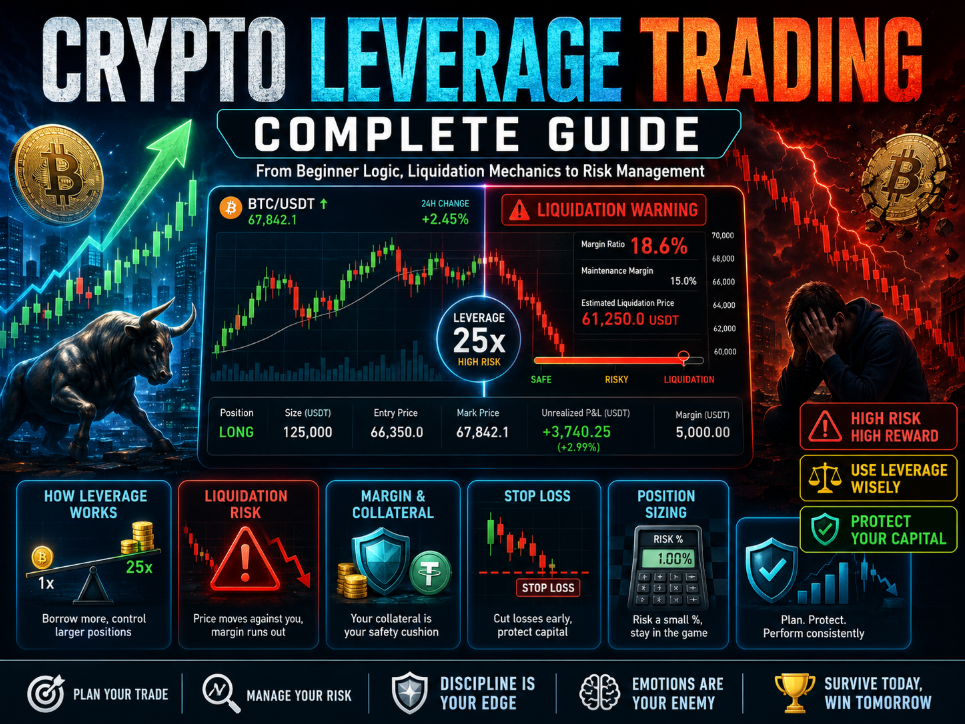
Many newcomers lose money not because they completely misjudge the direction, but because they do not understand the leverage mechanism, margin, liquidation price, fail to set stop-losses, fail to control their positions, and are ultimately wiped out of all their principal by a single wave of volatility.
This article will systematically explain the complete logic of cryptocurrency leverage trading, including:
- What leverage trading actually is;
- How it differs from regular coin buying;
- What spot margin, perpetual contracts, delivery contracts, leveraged tokens, and options are;
- How liquidation, funding rates, liquidation price, isolated margin, cross margin, and ADL operate;
- How newcomers can understand their first leverage trade using HIBT as a case study;
- How professional traders handle position management, stop-losses, and trading reviews;
- What tax, compliance, and platform selection issues are involved in leverage trading;
- The 12 most common fatal mistakes made by newcomers;
- What capabilities need to be built to transition from losing money to establishing a stable trading system.
If you just want to get rich quick, this article might cool you down.
If you want to truly understand leverage trading, this article will help you build a more complete and safer cognitive framework.
Part 1: What Exactly Is Leverage Trading? What Is Its Fundamental Difference From Regular Coin Buying?
1.1 Controlling a $1,000 Position with $100: The Underlying Logic of Leverage
The core logic of leverage trading is simple:
You use a smaller amount of principal to control a larger trading position.
For example, you only have $100 in your account. If you do not use leverage, you can only buy $100 worth of BTC. If BTC rises 10%, you make a profit of $10; if BTC falls 10%, you lose $10.
But if you use 10x leverage, you can use $100 of margin to control a $1,000 position. If BTC rises 10%, this $1,000 position makes a profit of $100, which is equivalent to doubling your principal.
Conversely, if BTC falls 10%, this $1,000 position loses $100, and your margin could be completely wiped out, triggering a forced liquidation.
Therefore, leverage trading is not a tool to "amplify returns for free," but a tool that amplifies both profits and losses simultaneously.
It can be understood in one sentence:
The higher the leverage multiplier, the smaller the margin for price error.
- Under 2x leverage, it takes a relatively large adverse price movement to become dangerous;
- Under 10x leverage, an adverse movement of around 10% can bring you close to liquidation;
- Under 100x leverage, an adverse price movement of around 1% can make the position highly precarious.
This is why the ultimate thing a newcomer should avoid is opening high leverage on their very first trade.
1.2 Long vs. Short: Why Can You Make Money in a Falling Market?
In spot trading, you can generally only buy first and then wait for the price to rise. If you buy BTC, you make money if BTC goes up, and you lose money if BTC goes down.
However, in leverage and futures trading, you can choose two directions:
- Go Long (Long): You judge that the price will rise, buy the contract, and profit when the price increases;
- Go Short (Short): You judge that the price will fall, sell the contract, and profit when the price decreases.
For example, the current price of BTC is 100,000 USDT.
If you judge that BTC will rise to 105,000 USDT, you can open a long order.
If you judge that BTC will fall to 95,000 USDT, you can open a short order.
This means that in the leveraged market, opportunities can arise whether the market goes up or down. But this also brings a problem: newcomers can easily fall into the trap of constantly guessing directions, feeling that they can make money from any fluctuation, and eventually getting caught up in overtrading.
A correct directional judgment is not based on a "feeling it will rise" or a "feeling it will fall," but should at least combine:
- Macro cycle trends;
- Key support and resistance levels;
- Changes in trading volume;
- Funding rates;
- Open interest;
- Market sentiment;
- Major news and macro events;
- The stop-loss room you can personally afford.
Going long or going short is not the problem; the problem is whether you have a clear trading plan.
1.3 What Is Margin? What Is the Difference Between Initial Margin and Maintenance Margin?
Margin can be understood as the funds you pledge as collateral to the exchange in order to open a position.
In leverage trading, you do not need to pay the entire value of the position, but rather a portion of it as margin. Based on your leverage multiplier, the platform allows you to control a larger position.
For example:
- 1x Leverage: A $1,000 position requires approximately $1,000 in margin;
- 2x Leverage: A $1,000 position may require approximately $500 in margin;
- 5x Leverage: A $1,000 position may require approximately $200 in margin;
- 10x Leverage: A $1,000 position may require approximately $100 in margin.
Two important concepts are involved here:
- Initial Margin: The margin that must be committed when opening a position.
- Maintenance Margin: The minimum level of margin that must be kept in the account to maintain the position without being liquidated.
When the market price moves against you, unrealized losses will continuously consume your margin. If the margin falls below the maintenance margin required by the platform, the exchange will trigger a forced liquidation, commonly referred to as getting liquidated (or "blowing up" your account).
Therefore, liquidation does not only happen when the "price drops to zero," but rather whenever your margin is insufficient to support the risk of the position.
1.4 What Risks Does the Leverage Multiplier Actually Imply? Letting the Numbers Speak
Many newcomers see 10x, 20x, 50x, or 100x and think it is just a profit multiplier. What it actually represents is: how much adverse fluctuation you can withstand.
Assuming transaction fees and maintenance margin are ignored for a simplified understanding:

In actual trading, because maintenance margin, transaction fees, funding rates, slippage, and exchange liquidation rules also exist, liquidation often occurs earlier than the theoretical values.
Therefore, newcomers should remember:
High leverage is not the hallmark of a master; the ability to survive long-term is what defines trading capability.
2x, 3x, and 5x are already enough to significantly amplify returns and risks. For most beginners, anything above 10x should be approached with extreme caution, and 50x or 100x are entirely unsuitable as regular trading tools.
1.5 Leverage Trading vs. Spot Trading vs. Futures Trading: Core Differences Comparison Table

If you are not yet familiar with spot buying and selling, K-line charts, limit orders, market orders, and stop-loss/take-profit setups, it is not recommended to enter high-leverage contract trading directly.
Part 2: Product Classifications of Leverage Trading—Which One Are You Using?
Many people say, "I am doing leverage trading," but in reality, they might be trading completely different products. Some do spot margin trading, some trade perpetual contracts, some buy leveraged tokens, and others trade options. They all carry leverage attributes, but their risk structures are completely different.
2.1 Spot Margin Trading: How Does Borrowing Coins to Buy Coins Work?
Spot margin trading, also known simply as Margin Trading, revolves around the core concept of "borrowing funds or coins to trade."
For example, if you have 100 USDT and want to buy more BTC, you can borrow additional USDT from the platform and buy BTC along with your own principal. If BTC rises, you sell the BTC, pay back the loan and interest, and the remainder is your profit.
If you want to short BTC, you can borrow BTC to sell it, and then buy it back to return it after BTC falls, pocketing the price difference as profit.
The core risks of spot margin trading include:
- Borrowing interest;
- Liquidation risk;
- Coin price volatility risk;
- Changes in borrowable limits;
- Platform risk control rules;
- Inability to close positions in time due to insufficient liquidity.
It is more complex than regular spot trading, but its logic is closer to real asset lending compared to perpetual contracts.
2.2 Perpetual Contracts: Why Are Contracts with No Expiration Date the Mainstream?
Perpetual contracts are one of the most common leverage trading products in the cryptocurrency market. Their characteristics include:
- No fixed expiration date;
- Positions can be held long-term;
- Can go both long and short;
- Utilizes margin and leverage;
- Employs funding rates to keep contract prices close to spot prices;
- Usually settled in USDT, USDC, or coin-margined assets.
Perpetual contracts are popular because they are more flexible than traditional delivery contracts. Users do not need to worry about expiration and delivery; they only need to focus on positions, margin, liquidation prices, funding rates, and market direction.
However, precisely because perpetual contracts have no expiration date, many newcomers mistakenly believe they can hold them indefinitely. In reality, as long as the margin is insufficient, the position can be liquidated at any time.
2.3 Delivery Contracts: Use Cases for Quarterly Contracts and Perpetual Contracts
Delivery contracts have fixed expiration dates, such as weekly, bi-weekly, quarterly, or bi-quarterly contracts. Upon expiration, the contracts are delivered or settled according to the rules.
Delivery contracts are commonly used for:
- Hedging;
- Basis trading;
- Institutional risk management;
- Medium-to-long-term directional judgments;
- Spot-futures arbitrage.
For the average beginner, delivery contracts are harder to grasp than perpetual contracts because they involve expiration dates, basis, delivery prices, and price gaps between different maturities. If you are just starting out, it is recommended to master spot and perpetual contracts first, rather than trading complex expiration contracts from the get-go.
2.4 Leveraged Tokens: Are BTC3L / BTC3S Suitable for Newcomers?
Leveraged tokens look very simple on the surface, for example:
- BTC3L: When BTC rises, it theoretically yields approximately 3x the return;
- BTC3S: When BTC falls, it theoretically yields approximately 3x the return.
Their advantages are:
- No need to manually adjust margin;
- Generally do not liquidate directly like contracts;
- Operate just like buying and selling spot;
- Suitable for short-term trend trading.
However, they carry a very important hidden risk: the daily rebalancing mechanism.
In a sideways, range-bound market, leveraged tokens can suffer significant volatility decay. Even if the underlying price eventually returns to its starting point, the price of the leveraged token may decrease.
Therefore, leveraged tokens are not suitable for long-term holding; they are better suited for short-term, clear-direction, high-volatility market conditions. If newcomers do not understand the rebalancing mechanism, they might mistake them for "3x contracts that won't liquidate," which is a highly dangerous misunderstanding.
2.5 Options: How Does the Risk Structure Differ When Used as a Leverage Tool?
Options are also a leverage tool, but they are entirely different from contracts.
- Buying a Call Option grants you the right to buy an asset at a certain price in the future.
- Buying a Put Option grants you the right to sell an asset at a certain price in the future.
The characteristics of options include:
- The buyer's maximum loss is typically capped at the premium paid;
- Small capital can be used to capture large volatility gains;
- Time value decays over time;
- Prices are heavily influenced by volatility;
- High strategy complexity;
- The seller's risk can be potentially infinite.
If you cannot yet understand Delta, Gamma, Theta, and Vega, it is highly discouraged to use options for high-risk trading.
Part 3: Core Mechanisms of Leverage Trading—Not Knowing These Is Just Gambling
If you only know that "you make money when it goes up, and lose money when it goes down," you do not truly understand leverage trading. What actually determines whether you can survive are mechanisms like liquidation, funding rates, liquidation prices, isolated margin, cross margin, and ADL.
3.1 How Does Liquidation Happen?
Liquidation, also known as forced liquidation, refers to the exchange system forcibly closing your position when your margin is insufficient to maintain it.
For example, if you open a 10x long position with 100 USDT of margin, controlling a 1,000 USDT BTC position. If BTC drops, your losses are deducted from your margin. When the losses approach the limit of what your margin can bear, the system triggers a liquidation.
Exchanges enforce liquidation to prevent your account losses from exceeding your margin, which would otherwise impact the platform's risk management system and other traders.
Liquidation typically includes several stages:
- Market price moves in an unfavorable direction;
- Unrealized losses increase;
- Margin ratio drops;
- Approaches maintenance margin requirement;
- Liquidation is triggered;
- The liquidation engine takes over the position;
- The position is closed out by the system.
Note: You do not have to wait until your losses hit 100% to get liquidated. The platform will handle the position ahead of time according to its risk rules.
3.2 Funding Rate: What Is the Money Deducted Every 8 Hours in Perpetual Contracts?
Perpetual contracts have no expiration date, so a mechanism is needed to ensure the contract price does not deviate from the spot price over the long term. This mechanism is the funding rate.
To put it simply:
- When the contract price is higher than the spot price, longs usually pay shorts;
- When the contract price is lower than the spot price, shorts usually pay longs;
- Funding rates are typically settled at fixed intervals, such as every 8 hours, depending on the specific platform's rules.
The funding rate is not a fee collected by the exchange; it is a transfer of funds between longs and shorts. The platform usually just handles the settlement.
The funding rate may have a negligible impact on short-term trades, but it heavily impacts long-term holdings. If you keep holding a popular long position while the funding rate stays positive for a long time, you will continuously pay funding fees. Therefore, when evaluating the cost of a contract trade, you cannot just look at the opening and closing transaction fees; you must also factor in the funding rate.
3.3 How Is the Liquidation Price Calculated? How Much Price Volatility Triggers Liquidation at 10x Leverage?
For a simplified understanding:
$\text{Adverse Price Volatility Ratio} \approx \frac{1}{\text{Leverage Multiplier}}$
For example:
- 5x Leverage: Theoretical adverse volatility of around 20% nears the danger zone;
- 10x Leverage: Theoretical adverse volatility of around 10% nears the danger zone;
- 20x Leverage: Theoretical adverse volatility of around 5% nears the danger zone;
- 100x Leverage: Theoretical adverse volatility of around 1% nears the danger zone.
However, the real liquidation price is also affected by the following factors:
- Maintenance margin rate;
- Opening transaction fees;
- Closing transaction fees;
- Funding rates;
- Margin mode;
- Whether margin is added;
- The platform's risk tier;
- The Mark Price rather than the Last Price.
Therefore, never use a simple formula to replace the liquidation price displayed by the platform. When trading, you should directly monitor indicators such as "Estimated Liquidation Price," "Margin Ratio," and "Account Risk Ratio" on the trading page.
3.4 "Wick" Market Conditions and Forced Liquidation: Why Did the Price Instantly Bounce Back, But My Position Is Gone?
Many traders have experienced this: the price wicks down in a split second, wiping out their long positions, only to bounce back minutes later—but their position is already gone.
The reason behind this is:
The liquidation system only cares about whether the risk conditions are triggered at that exact moment; it will not wait for you to see "if it will bounce back later."
In extreme market conditions, the following can occur:
- Liquidity suddenly vanishes;
- Large market orders dump;
- Insufficient order book depth;
- Cascading liquidations;
- Market order slippage;
- Rapid changes in the mark price;
- Severe short-term volatility.
This is precisely why high leverage is extremely dangerous. Your direction might ultimately be right, but the interim volatility is enough to kick you out of the game. A crucial quote in trading goes:
Being right on direction does not mean your position will survive until the end.
3.5 Isolated Margin Mode vs. Cross Margin Mode: The Risk Isolation Logic of the Two Margin Modes
Leverage trading commonly features two margin modes: Isolated and Cross.
- Isolated Margin Mode: Each position uses a separate, specific portion of margin. If that position gets liquidated, you generally only lose the margin allocated to that specific position without directly consuming the rest of your account balance.
- Cross Margin Mode: The available balance of the account is shared across positions to support them. If a position incurs a loss, the system may use more funds from the account to maintain it, reducing the probability of liquidation, but this can also lead to a larger overall loss for the entire account.
For beginners, isolated margin is usually more suitable for learning because it confines the risk of a single trade to a smaller, controlled scope. Cross margin is not unusable, but it demands strict position control. If you use cross margin with a full account size, high leverage, and no stop-loss, an extreme market event can instantly wipe clean your entire account.
3.6 ADL (Auto-Deleveraging): Under What Circumstances Can a Profitable Position Be Forcibly Closed?
ADL stands for Auto-Deleveraging.
In extreme market conditions, if a liquidated position cannot be filled normally in the market and the insurance fund is insufficient to cover the risk, the exchange may activate ADL to automatically deleverage certain profitable positions.
This means:
Even if you are on the winning side of a trade, your position could still be forcibly closed by the system during extreme market volatility.
Generally, the priority of being selected for ADL may relate to factors like your profit rate and leverage multiplier. Rules vary across platforms; please refer to specific platform documentation for details. This is also why, when choosing a trading platform, you cannot just look at transaction fees and leverage multipliers; you must also evaluate the insurance fund, liquidation mechanism, history during extreme market events, and risk control transparency.
Part 4: Case Study on HIBT—How Newcomers Can Start Their First Leverage Trade
This chapter uses HIBT as an example to explain the basic workflow for a newcomer's first leverage trade. Since exchange products, trading pairs, leverage multipliers, fees, and risk rules can adjust at any time, please refer to the official HIBT website, App pages, and the latest announcements before operating.
4.1 Overview of HIBT Leverage Trading Products
The official HIBT Help Center provides basic explanations for margin trading and perpetual contracts. Generally, the core features of contract trading include:
- Ability to go long;
- Ability to go short;
- Utilization of margin;
- Choice of leverage;
- Presence of a forced liquidation mechanism;
- Need to monitor funding rates;
- Profits and losses derived from the price change between opening and closing.
For beginners, the most important question is not "what is the maximum leverage I can use?", but rather:
- Do I understand this product?
- Do I know where the liquidation price is?
- Can I set a stop-loss?
- Do I know the maximum amount I can lose per trade?
- Can I accept losing this trade?
- Do I know the specific rules of the platform?
The maximum leverage for different trading pairs on HIBT may vary. For instance, certain tokenized stocks or forex contracts might have separate leverage rules, and regular crypto pairs might have different risk tiers. Therefore, when publishing an article, it is recommended to supplement specific page data with backend screenshots rather than writing rigid, hardcoded leverage rules for all pairs.
4.2 Preparation Before Opening a Futures Account
Before beginning leverage trading, you usually need to complete the following preparations:
- Register an HIBT account;
- Complete KYC identity verification;
- Enable Two-Factor Authentication (2FA);
- Set a fund password;
- Read and confirm the risk disclosure;
- Activate your futures account;
- Transfer margin from your spot or funding account;
- Practice first using a demo account or a very small amount of capital.
Do not trade with real money directly without understanding the rules. Especially do not jump into high leverage right after registering, depositing, or just learning how to place an order.
4.3 Interpretation of the HIBT Futures Trading Page Modules
A standard futures trading page usually contains the following modules:
- K-Line Area: Displays price trends; allows switching timeframes such as 1m, 5m, 15m, 1h, 4h, daily, etc.
- Order Book Area: Displays the depth of buy and sell orders, helping you assess short-term execution pressure and liquidity.
- Recent Trades Area: Displays the transaction records that just occurred in the market.
- Order Placement Area: Used to choose buy/long, sell/short, market orders, limit orders, stop-loss/take-profit setups, leverage multipliers, and margin modes.
- Positions Panel: Displays the current position direction, entry price, mark price, liquidation price, unrealized PnL, margin, and ROI.
- Funding Rate Display Area: Used to view the current funding rate and the next countdown to settlement.
- Account Risk Area: Displays the margin ratio, available balance, risk level, and other information.
Newcomers shouldn't just stare at the K-lines. What truly decides life and death are often the liquidation price, margin ratio, and stop-loss settings inside the positions panel.
4.4 Example of the First Demo Order: Taking BTC/USDT Perpetual Contract as an Example
It is highly recommended that newcomers practice with a demo account first or trade with tiny amounts. The standard process is as follows:
- Select the BTC/USDT Perpetual Contract: BTC is one of the mainstream assets with the best liquidity, making it ideal as a learning sample.
- Choose the Margin Mode: Beginners are advised to prioritize Isolated Margin Mode to prevent a single trade from impacting the whole account.
- Set the Leverage Multiplier: Beginners are advised to start with 2x or 3x, and avoid using leverage higher than 10x at the beginning.
- Choose Order Type: If you want immediate execution, you can use a market order; if you want execution at a specified price, use a limit order. In violently volatile markets, market orders can experience slippage.
- Enter Position Quantity: Do not deploy all your account funds at once. Your first learning order should be small enough that losing it will not affect your peace of mind.
- Set Stop-Loss (SL) and Take-Profit (TP): Before opening a position, you should know exactly where to exit if you are wrong, and where to lock in profits if you are right.
- Confirm Liquidation Price: Ensure there is ample distance between the liquidation price and the stop-loss price. The stop-loss should trigger well before liquidation, rather than letting the system force-close you.
- Submit Order: Once executed, immediately review the position details, including entry price, mark price, liquidation price, fees, and unrealized PnL.
4.5 Market Orders vs. Limit Orders: How Should Newcomers Choose?
- Market Orders: Pros: Fast execution. Cons: Potential slippage. Suitable for scenarios requiring rapid entry or exit, but unsuitable for large sizes in highly volatile conditions or thin order books.
- Limit Orders: Pros: Price is controllable. Cons: Execution is not guaranteed. Suitable for planned trading, such as waiting for BTC to retrace to a support level before entering.
A common newcomer mistake is chasing a rapidly surging market with a market order, only to panic-close it with another market order the moment it retraces. After a few rounds of this, transaction fees and slippage will heavily erode the principal.
4.6 How Do Maker / Taker Fees Affect Actual Returns?
Trading transaction fees are generally divided into Maker and Taker fees:
- Maker: Places an order to provide liquidity; typically, a limit order that is not filled immediately enters the order book to await a match.
- Taker: Takes an existing order; typically, a market order or a limit order that executes instantly.
Taker fees are often higher than Maker fees. For high-frequency traders, transaction fees will significantly impact long-term returns. For instance, if you frequently open and close positions using market orders every time, even if your directional calls are decent, your profits can be slowly consumed by fees, funding rates, and slippage. Professional traders watch their transaction costs just as closely as they watch market trends.
4.7 How to View Liquidation Price and Account Risk Ratio?
In the HIBT futures page positions panel, the following are typically displayed:
- Entry price;
- Mark price;
- Last price;
- Liquidation price;
- Margin;
- Unrealized PnL;
- ROI;
- Account risk ratio.
You need to pay heavy attention to the Liquidation Price. If you are long BTC, the liquidation price sits below. The closer the price gets to the liquidation price, the higher the risk. If you are short BTC, the liquidation price sits above. The closer the price gets to the liquidation price, the higher the risk. Do not wait for the price to creep up to the liquidation price before dealing with your position. A truly sound trading plan establishes the stop-loss position before the position is even opened.
4.8 Closing Positions: Manual Close vs. Stop-Loss Trigger
There are two common ways to close a position:
- Manual Close: You actively click the close button to end the position via a market or limit order.
- Stop-Loss Trigger: The price hits your pre-set stop-loss condition, and the system automatically sends out a position-closing order.
The most common issue for beginners is that they think clearly when opening a position, but become unwilling to execute their stop-loss once they start losing, constantly telling themselves "it will come back if I just wait a bit." Eventually, small losses snowball into big losses, and big losses turn into liquidations.
A stop-loss is not a failure; it is part of the trading plan. Failing to use a stop-loss is where the real danger lies.
4.9 Suggested Standards for Transitioning from Demo to Real Trading
Do not instantly jump into large real-money trading just because you made a profit a few times on a demo account. It is recommended to meet at least the following criteria first:
- Consecutively record more than 30 demo trades;
- Every trade has a clear reason for entry;
- Every trade has an explicit stop-loss location;
- You know the maximum allowed loss amount;
- No high leverage is used;
- You can accept consecutive losses calmly;
- You do not blindly add positions due to a single profit;
- You do not engage in emotional, revenge trading after a single loss;
- You can stably execute your own trading plan.
If you cannot do these things yet, it means what you truly need is more practice, not a larger deposit.
Part 5: Risk Management in Leverage Trading—The Core Gap Between Professionals and Newcomers
The vast majority of newcomers lose money not because they are always wrong about direction, but because they have zero risk control.
- Professional traders first consider: If I am wrong, how much do I lose?
- Beginners first consider: If I am right, how much do I make?
That is the gap.
5.1 Position Management: How Much Capital Should Be Used per Trade?
A common rule of thumb is: The risk per trade should not exceed 1% to 2% of total account capital.
Note that what is being said here is not "use 1% of capital per trade," but rather "if the stop-loss is triggered, the loss should not exceed 1% to 2% of the account."
For example, your account has 1,000 USDT. If you adopt the 1% risk rule, you can lose a maximum of 10 USDT per trade. Supposing your stop-loss distance is 5%, you can back-calculate your position size based on that stop-loss distance instead of opening a random size.
Many newcomers do the exact opposite: they check how much money they have, open the absolute maximum position size, and only think about a stop-loss as an afterthought.
The correct sequence should be:
- Determine the entry location;
- Determine the stop-loss location;
- Determine how much money you are willing to lose;
- Finally, calculate the position size.
5.2 Three Methods for Setting Stop-Losses
- Fixed Amount Stop-Loss: For example, losing a maximum of 10 USDT per trade. Suitable for beginners to control risk, though it may ignore market structure.
- Technical Stop-Loss: For example, placing a long stop-loss below a support level, or a short stop-loss above a resistance level. Suitable for individuals with some basic technical analysis skills.
- Volatility Stop-Loss: Setting stop-losses based on ATR (Average True Range), recent volatility ranges, or market fluctuation bands. Suitable for high-volatility coins.
The worst way to stop loss is: "Stop loss when I can no longer stand the pain." This approach lacks any objective standard and is entirely dictated by emotion.
5.3 Risk-to-Reward Ratio: Why a 60% Win Rate Can Still Lose Money Long-Term?
Many people think that a high win rate guarantees profitability. That is not necessarily true. If you make 10 USDT every time you win but lose 50 USDT every time you lose, you can still lose money in the long run even with a 70% win rate.
Trading depends on expected value:
Expected Value= (Win Rate x Average Profit) - (Loss Rate x Average Loss)
Suppose:
- Win rate is 50%;
- Average profit is 30 USDT;
- Average loss is 10 USDT.
- Over the long term, this is a positive expectancy strategy.
Now suppose:
- Win rate is 70%;
- Average profit is 5 USDT;
- Average loss is 30 USDT.
- Over the long term, this will likely lose money instead.
Therefore, you should not only focus on raising your win rate; you must control your losses and let your winning trades run.
5.4 Position-Adding Strategies: The Difference Between Adding to Winners and Averaging Down
Adding positions falls into two categories:
- Adding to Winners (Pyramiding): The market moves in your predicted direction, the position is already profitable, and you add more size after a pullback or a breakout.
- Averaging Down (Martingale/Fighting the Trend): The market moves against your judgment, the position is already in a loss, and you keep adding to it hoping to lower your average entry cost.
Adding to winners carries risks, but at least you are adding size after the market has validated your direction. Averaging down is incredibly dangerous for beginners because it can turn small losses into massive losses, and massive losses into liquidations. Especially under high leverage, averaging down is rarely a strategy; it is usually just an emotional refusal to admit a mistake.
5.5 Psychological Management After Consecutive Losses: Why Set a Cooling-Off Period?
The most dangerous time in trading is not necessarily when the market is at its most volatile, but when your emotions are completely out of control. After consecutive losses, common newcomer behaviors include:
- Instantly jacking up the leverage;
- Trying to win it all back in one shot;
- Ignoring the trading plan completely;
- Overtrading;
- Blindly reversing positions;
- Moving stop-losses further and further away.
This is called revenge trading. It is recommended to set strict cooling-off period rules for yourself:
- If you suffer 2 consecutive losses, stop trading for the day;
- If your single-day loss exceeds 3% of the account, stop trading;
- Do not open new positions when emotions are noticeably swinging;
- Do not place impulsive trades right before or after major news events;
- Do not hold high-leverage positions overnight while sleeping.
Knowing when to stop trading is a core trading capability.
5.6 Intro to Hedging Strategies: How to Use Shorts to Hedge Spot Risk?
Leverage trading is not just for speculation; it can also be used for risk hedging. For instance, if you hold BTC spot long-term but worry about short-term downside, and you don’t want to sell your spot while wanting to mitigate downside risk, you can open a small short position to hedge.
- If BTC drops, your spot suffers a loss, but your short gains a profit, offsetting a portion of the loss.
- If BTC rises, your spot makes a profit, but your short suffers a loss, which is equivalent to sacrificing a portion of the upside gain in exchange for downside protection.
The core of hedging is not to make more money, but to reduce net risk exposure. However, hedging also requires position control. If the short position is too large, it can turn from a protective shield into a new source of risk.
Part 6: Taxation, Compliance, and Platform Selection Standards for Leverage Trading
Leverage trading is not just a technical issue; it also touches on taxation, compliance, and platform risks. Policies vary across countries and regions, and users must operate carefully in line with local rules.
6.1 How Are Leverage Trading Profits Taxed?
Generally speaking, whether you owe taxes depends on the tax laws of your country or region, not on whether the exchange sends you a notification. Actions that might trigger tax logging obligations include:
- Futures profits;
- Futures losses;
- Spot sales;
- Crypto-to-crypto swaps;
- Funding rate income or expenses;
- Borrowing interest;
- Rewards, rebates, and airdrops;
- Cost basis logs after cross-platform transfers.
Some regions treat digital asset gains as capital gains, some handle them as regular income, and others require separating personal investments from commercial trading. The safest practice is to keep comprehensive records:
- Opening time;
- Closing time;
- Trading pair;
- Direction;
- Leverage multiplier;
- Margin;
- PnL;
- Fees;
- Funding rates;
- Exchange statements;
- Deposit and withdrawal records.
6.2 Overview of Regional Regulatory Landscapes
- Mainland China: Maintains strict regulations regarding cryptocurrency transactions and related financial activities. Users should pay special attention to local policy boundaries and refrain from participating in high-risk activities like illegal trading, unauthorized fundraising, money laundering, or proxy payments.
- Hong Kong: Implements a licensing and regulatory framework for virtual asset trading platforms and publishes relevant platform lists. Users should distinguish between "licensed platforms," "platforms with applications pending," and "unlicensed platforms."
- Singapore: Implements regulatory requirements for digital payment token services and has repeatedly reminded the public of the risks surrounding crypto assets and related derivatives trading. Retail users should exercise extreme caution with high-volatility, high-leverage products.
- United States: Tax authorities require taxpayers to fulfill reporting obligations regarding digital assets. Derivatives, spot trading, and income-generating digital asset actions can all involve tax logging and declarations.
Given that policies shift, it is highly recommended to add a "Last Updated Date" when publishing articles and remind users to refer to the latest rules from local official bodies.
6.3 Six Core Indicators for Selecting a Leverage Trading Platform
When choosing a leverage trading platform, you shouldn't just look at "what is the highest leverage available." What truly matters are the following 6 indicators:
- Compliance Licenses or Clear Entity Information: Does the platform have an explicit operating entity? Is it regulated in specific jurisdictions? Does it publish risk disclosures? Are there user agreements, risk control rules, and contract specifications? The higher the risk of a product, the more clarity you need regarding platform rules.
- Size of the Insurance Fund: The insurance fund is used to cover bankruptcy risks during extreme market conditions. If a platform's insurance fund is lacking, it may be more prone to triggering ADL or other risk mechanisms during extreme anomalies.
- Transparency of the Liquidation Mechanism: Users should be able to clearly view liquidation prices, margin ratios, mark prices, index prices, funding rates, risk limits, and ADL rules. If a platform fails to make its basic liquidation rules clear, newcomers should stay far away.
- Historical Performance in Extreme Market Conditions: Extreme market events are the ultimate test of an exchange's risk management: Does it crash frequently? Are users locked out from closing positions? Do abnormal spikes or wicks occur? Are there widespread ADL events? Are there withdrawal delays? Are there public accident reports?
- Reasonableness of Funding Rates: When holding perpetual contracts long-term, funding rates heavily impact real costs. If a platform's funding rates are consistently abnormal, it indicates potential issues with market structure or liquidity.
- Smooth Deposits and Withdrawals: Beyond the execution experience, leverage trading depends on whether deposits are credited timely, withdrawals flow smoothly, risk checks are transparent, customer service responds effectively, and account security configurations are robust.
6.4 How to Properly Phrase HIBT’s Security Mechanisms safely?
When introducing HIBT in an article, it is recommended to adopt a factual description coupled with user self-verification, rather than over-promising. You can write:
"Before engaging in margin or contract trading on HIBT, users should focus on reviewing the contract rules, funding rates, liquidation mechanisms, risk limits, fee schedules, KYC requirements, and account security settings provided by the platform. For different trading pairs, the maximum leverage multiplier, minimum order unit, maintenance margin rate, and risk control rules may vary, and the actual parameters displayed on the official HIBT pages shall prevail."
This approach integrates platform application examples while avoiding safety exaggerations.
Part 7: Twelve High-Frequency Fatal Mistakes Made by Newcomers
- 7.1 Using Maximum Leverage on the First Trade: Many beginners see 100x, 200x, or higher leverage and view it as a fast-track wealth ticket. But high leverage means a near-zero fault tolerance. A normal market hiccup can bring a position to immediate liquidation. A beginner's primary goal is survival, not fast cash.
- 7.2 Going to Sleep Without Setting a Stop-Loss: The crypto market trades 24/7; the market will not pause just because you are asleep. If you hold a high-leverage position without a stop-loss, a sudden overnight market move could mean waking up to an empty account.
- 7.3 Averaging Down on Losing Positions Until Liquidation: Averaging down is not inherently wrong in all contexts, but it is lethal under high leverage. If you have no predefined plan and add size simply because you refuse to accept a loss, that is not a trading plan—it is an emotional meltdown.
- 7.4 Going All-In (Maxing Out Cross Margin): In cross margin mode, more account funds are pulled in to back the position. If you max out your size, a violent market swing will not just wipe out one order; it will devastate the entire account.
- 7.5 Blindly Entering Positions Around Major News: Non-farm payroll data, Fed rate decisions, CPI prints, ETF approvals, regulatory news, exchange hacks, or exploit announcements can all trigger extreme volatility. It is fine to trade around news, but never without a structured plan.
- 7.6 Only Going Long and Refusing to Short, or Shorting and Refusing to Accept Mistakes: Futures allow two-way trading, but many people develop an obsession with a single direction. They think it will rise forever in a bull market and crash forever in a bear market. The market never rewards stubbornness; it only rewards discipline.
- 7.7 Using Borrowed Money or Rent/Living Money for Leverage Trading: This is one of the most dangerous behaviors. Leverage trading must only utilize discretionary idle cash that you can completely afford to lose. If you use living expenses, loans, credit cards, or borrowed funds, a loss instantly transitions from a trading setback into a life crisis.
- 7.8 Blindly Following Calls on Twitter / Telegram: Many signal callers only post screenshots of their winning streaks, never their losing streaks. You see what they want you to see, not their real trading system. If you do not understand the entry logic, stop-loss location, position size, and exit criteria, you should never follow a trade blindly.
- 7.9 Overtrading and Letting Fees Devour Profits: Overtrading brings more transaction fees, more slippage, more flawed decisions, more emotional swings, and poorer execution. You do not have to trade every day. When no setups present themselves, holding cash is a valid strategy.
- 7.10 Only Planning the Entry, Never Planning the Exit: Many newcomers only think about "where to buy" before opening a trade, but fail to plan: Where do I stop loss if I am wrong? Where do I take profit if I am right? How long do I wait in a sideways market before exiting? What if the funding rate gets too high? Do I de-risk ahead of major news? Do I scale out in batches upon hitting targets? Entry is just a tiny part of a trade; the exit dictates the ultimate outcome.
- 7.11 Using Market Orders During Severe Volatility and Incurring Major Slippage: Market orders guarantee instant execution, but when order books are thin, trends are fast, or volatility is high, the filled price can differ massively from your expectations. Especially in low-cap coins or extreme market wildness, slippage can make your stop-loss cost far more than planned.
- 7.12 Skipping the Pre-Trade Self-Check List: Before every single leverage trade, you must ask yourself:
- Why am I opening this trade?
- Is it a long or a short?
- What is my entry price?
- What is my stop-loss price?
- What is my take-profit target?
- Where is my liquidation price?
- Am I using isolated or cross margin?
- Is the leverage multiplier too high?
- If my stop loss hits, how much money do I lose?
- Can I completely accept this loss?
- Is there any major news dropping soon?
- Is there a costly funding rate involved?
- Am I entering because of FOMO/emotion?
- Am I currently on a losing streak?
- Is it truly necessary to trade right now?
- If you cannot answer even a few of these questions, you should not be opening the position.
Part 8: Advanced Leverage Trading—What Kind of System Do You Need to Transition from Losing Money to Consistent Profitability?
Leverage trading success does not rely on a single massive windfall; it relies on long-term survival powered by a robust system. If you want to move away from random trades toward systematic trading, you must build the following capabilities:
8.1 The Correct Way to Log a Trading Journal
A trading journal is not just a basic log of "how much I made or lost"; it is a record of your trading process. It is highly recommended to record:
- Date;
- Trading pair;
- Long/Short;
- Reason for entry;
- Entry price;
- Stop-loss price;
- Take-profit plan;
- Leverage multiplier;
- Position size;
- Margin mode;
- Liquidation price;
- Real reason for exit;
- Profit/Loss amount;
- Did you follow the plan?
- Emotional state;
- Post-trade review conclusion.
After a period, you will discover your genuine flaws: whether you entry too hastily, stop loss too late, oversized your positions, became addicted to high leverage, failed to hold winners, refused to admit losing trades, performed well only in trends but poorly in ranges, or performed well only during specific hours. Without a trading journal, you are merely repeating your losses.
8.2 Building Your Own Trading System
A baseline trading system must include at least:
- Tradable assets;
- Timeframes;
- Entry signals;
- Filter conditions;
- Position rules;
- Stop-loss rules;
- Take-profit rules;
- Scaling-in rules;
- Scaling-out rules;
- Prohibited trading conditions;
- Review methods.
For example:
- Only trade BTC/USDT and ETH/USDT;
- Only analyze the 4h trend and look for 15m entries;
- Only trade when the trend is clear;
- Risk per trade must not exceed 1%;
- Stop trading for the day after 2 consecutive losses;
- Do not open new positions before major data releases.
A system doesn't have to be complex, but it must be crystal clear.
8.3 Using Technical Analysis Indicators in Contract Trading
Common indicators include RSI, MACD, Bollinger Bands, Moving Averages, and Volume.
- RSI: Can highlight overbought and oversold states, but should never be used as a standalone entry trigger. In strong trends, RSI can remain pinning at extreme highs or lows for a very long time.
- MACD: Useful for observing momentum shifts in trends, but its signals are lagging. Best used as a supplementary tool to judge trend continuation or divergence.
- Bollinger Bands: Useful for observing volatility bands. In range-bound markets, price bounces often happen when hitting the upper or lower bands; in trending markets, the price can ride along the upper or lower bands continuously.
- Moving Averages (MA/EMA): Help identify the directional trend. For instance, if the price sits above key moving averages, it points to a stronger bullish structure; if it cracks below key moving averages, it signals the trend may be weakening.
Indicators are not answers; they are merely tools. What truly matters is how you weave indicators together with position sizing, stop-losses, and risk-to-reward ratios.
8.4 Leveraging On-Chain Data for Guidance: How to Read OI and Long/Short Ratios?
In contract trading, beyond the K-line, you can also pay close attention to derivatives data:
- Open Interest (OI): Represents the total volume of outstanding contract positions in the market that haven't been closed. A rising OI indicates fresh capital flowing into the derivatives market; a falling OI shows positions are closing out.
- Long/Short Ratio: Reflects the relative proportions of longs versus shorts in the market. However, the long/short ratio cannot be naively read as "it must rise if more people are long" or "it must fall if more people are short." Sometimes, the overly crowded side is the one most vulnerable to a massive liquidation squeeze.
- Funding Rate: If the funding rate remains excessively high for a long time, it shows crowded longs and climbing costs to hold longs; if it remains deeply negative, it indicates crowded shorts.
- Liquidation Data: Helps pinpoint which side suffered a massive forced wipeout during extreme market swings.
While this data cannot directly dictate a buy or sell execution, it helps you grasp market sentiment and risk concentrations.
8.5 Introduction to Quantitative Strategies: Grid and Arbitrage Concepts for Regular People
Quant trading doesn't always require writing complex code. For everyday users, you can begin by grasping simple strategies:
- Grid Strategies: Tailored for range-bound, sideways markets, automatically buying low and selling high within a set price band. The downside is that they can experience massive drawdowns if the market breaks out into a strong single-direction trend.
- Funding Rate Arbitrage: Involves pairing spot and contract positions simultaneously to harvest funding rate yields. However, you must meticulously account for transaction fees, slippage, funding rate shifts, and platform risks.
- Cross-Platform Spread Arbitrage: Exploiting price differentials across distinct exchanges. This demands high execution speed, efficient capital routing, fast withdrawal processing, and strict risk control, making it tough for beginners to execute stably.
Quantitative strategies are never risk-free. Any strategy can underperform or fail when the underlying market environment shifts.
Part 9: The Relationship Between Leverage Trading and Different Crypto Assets
Different assets suit different trading styles. Mainstream coins like BTC and ETH boast thick liquidity, making them ideal learning samples for contract trading newcomers. Small-cap tokens exhibit wilder volatility, harsher slippage, and liquidation risks that are far tougher to manage.
If your focus extends beyond BTC and ETH, it is wise to master the fundamental logic of those alternative assets before deciding whether they suit short-term trading or long-term observation.
For example, SPCX-related assets touch upon tokenized equities and special market narratives. Trading them requires a solid grasp of their product attributes, pricing feeds, and liquidity risks. You can review HIBT’s extended analysis: "What is SPCX**?" .
Similarly, RAIL (Railgun) is an asset tied to privacy protocols. Its price volatility can be collectively shaped by privacy narratives, regulatory discussions, DeFi adoption use cases, and market sentiment. To unpack this asset’s background, you can read: "What is RAIL (Railgun)?**" .
It cannot be stressed enough:
Understanding an asset does not mean you have to trade it with leverage.
Many small-cap or narrative-driven assets are far better suited for basic fundamental research and tiny spot observations rather than direct high-leverage contract trading.
FAQ: Frequently Asked Questions About Cryptocurrency Leverage Trading
1. Is cryptocurrency leverage trading suitable for beginners?
Strictly speaking, no. It is entirely unsuitable for beginners who lack basic trading experience. If you do not yet grasp spot trading, K-lines, order types, stop-losses/take-profits, and position sizing, steer clear of leverage. Beginners can practice risk-free on a demo account or use microscopic capital amounts combined with low leverage to understand the mechanics first.
2. What leverage multiplier is safe?
There is no such thing as an absolutely safe leverage. For beginners, 2x to 3x is more than enough for learning purposes. Anything above 5x demands ironclad stop-loss discipline and position control. Risks spike drastically once you cross 10x, and 50x or 100x are completely unsuitable as regular choices for ordinary beginners.
3. Can I lose more than my principal in leverage trading?
Most crypto exchanges deploy automated liquidation mechanisms to cap account risk. However, during extreme market anomalies, severe liquidity blackouts, or under specific platform risk rules, unexpected losses, negative balances (clawbacks), or other risk-control consequences can still happen. The specific platform rules shall prevail.
4. Can I hold a perpetual contract indefinitely?
Theoretically, perpetual contracts have no expiration date, but that does not mean you can hold them long-term risk-free. You must constantly track your margin, liquidation price, funding rates, and market movements. If the funding rate remains continuously adverse to your direction, your carrying costs will steadily drain your capital.
5. Is shorting more dangerous than going long?
Both long and short positions carry inherent risks. The ultimate risk of going long is a price crash driving losses, while the risk of shorting is a price spike driving losses. Because sudden, explosive upward spikes occur frequently in cryptocurrency markets, short orders can face lightning-fast liquidations if they lack an explicit stop-loss.
6. What is isolated margin? What is cross margin?
Isolated margin dedicates a separate, specific margin allotment to a single position, isolating its risk. Cross margin pools your entire available account balance to support your positions; while it can lower the immediate liquidation probability of an individual trade, it risks inflicting an extensive, total wipeout across your entire account balance. Beginners are usually better off starting with isolated margin.
Disclaimer
This article is intended solely for cryptocurrency trading knowledge popularization and risk education and does not constitute investment advice, trading advice, financial advice, tax advice, legal advice, or platform endorsements.
Cryptocurrencies are high-risk assets. Leverage trading, contract trading, margin trading, options trading, and leveraged token trading can all trigger rapid losses. Users run the risk of losing their entire principal in a short timeframe. Any historical data, case studies, simulated calculations, or trading examples do not represent future returns and do not constitute a guarantee of profitability.
Mentions of HIBT, SPCX, RAIL (Railgun), or any other trading platforms, tokens, tools, or data streams in this article serve purely to illustrate trading mechanisms and educational concepts, and do not imply an endorsement of any platform, project, asset, or trading strategy. Leverage multipliers, transaction fees, funding rates, liquidation rules, KYC demands, deposit/withdrawal criteria, and risk policies differ across platforms and can change at a moment's notice; the official pages and latest announcements of the respective platforms shall prevail before any real operation.
Different nations and regions maintain varying regulatory frameworks for crypto assets, leverage trading, derivatives, tax reporting, and cross-border fund flows. Users must independently discover and comply with their local laws and regulations. For any tax, legal, or financial inquiries, please consult qualified professionals.
Any trading, investing, withdrawing, leveraging, contracting, or asset allocation actions performed by users based on the contents of this article are undertaken entirely at the user's own risk. Never participate in leverage trading using living expenses, loans, credits, or any funds you cannot afford to lose.