
Risk Disclosure: This article is compiled from public materials, market data, and project documentation for educational and research purposes only. It does not constitute investment advice. INTCB belongs to a category of tokenized securities / stock-mirroring assets — it is not equivalent to an ordinary cryptocurrency, nor is it the same as directly holding Intel stock. Tokenized stocks may carry multiple layers of risk involving the issuer, custodian, pegging mechanism, regulatory jurisdiction, liquidity, and de-pegging. Always independently verify platform rules and applicable law before investing.
Many beginners who first see the ticker "INTCB" tend to treat it like a new token: checking the chart, the percentage gain, the community, whether short-term pumps are happening, and then deciding whether to chase it.
This is actually a starting point that's easy to get wrong.
INTCB isn't an ordinary altcoin, isn't the native token of some blockchain, and isn't the governance token of a Web3 project. The more accurate way to understand it is as an on-chain mirrored product tracking Intel's stock, INTC — essentially, "a shadow of a stock."
The ticker INTCB can be split into two parts:
- INTC: Intel Corporation's stock ticker on Nasdaq
- B: generally corresponds to the suffix used by bStocks-type tokenized stock products
- INTCB: an on-chain tradable asset whose price is tied to the performance of Intel's stock
So the right way to research INTCB isn't to ask "does this token have 100x potential" — it's to first ask:
- What is actually happening at Intel right now?
- Is its turnaround a genuine fundamentals improvement, or is it just market expectation hype?
- Does INTCB actually represent Intel equity?
- How is it pegged to the real INTC stock?
- If Intel's stock drops, how does that affect INTCB?
- If the tokenized product itself faces insufficient liquidity or de-pegs, what risk does the user bear?
This article will walk through INTCB from the angles of company fundamentals, the tokenization mechanism, investment logic, the buying process, and a risk framework, to help beginners get a clear picture.
I. First, Get This Straight: Are You Buying "Chips," or "A Stock's Shadow"?
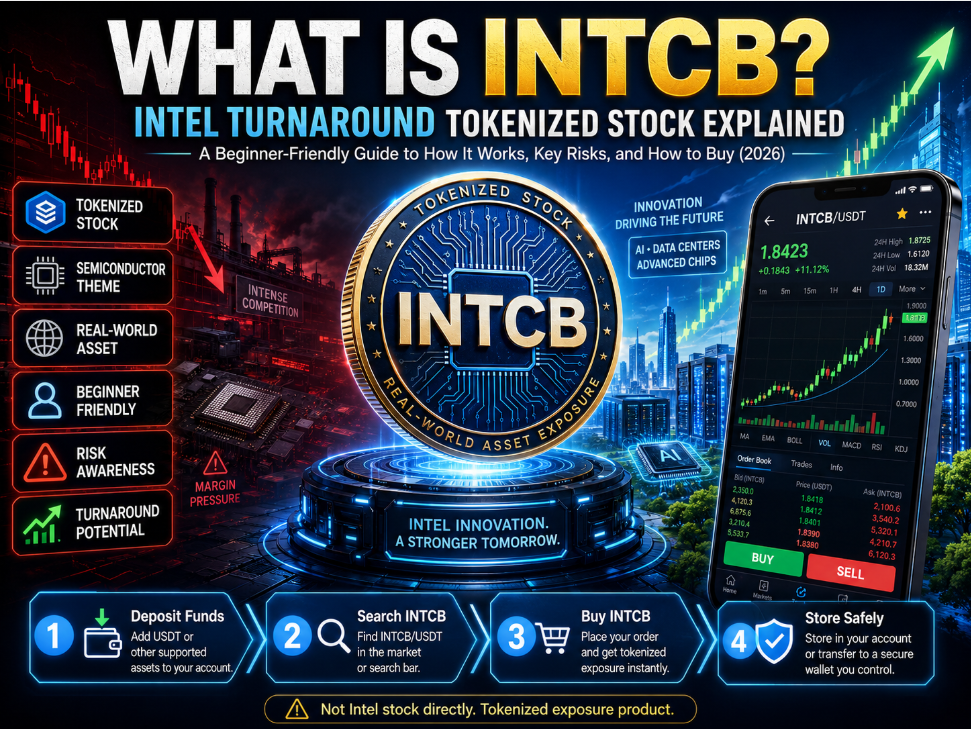
Many people hear "Intel" and think of CPUs, computer chips, data centers, AI, semiconductors, American manufacturing, and competition with TSMC. But when you buy INTCB, you're not buying a chip, and you're not buying a stake in Intel's actual product revenue.
What you're buying is an on-chain asset tied to the price of INTC stock.
This is completely different from native crypto assets like SOL, ETH, or BTC.
If you buy SOL, you hold a native asset of the Solana network. Its value comes from network usage, ecosystem applications, fees, staking, security, developer activity, and market risk appetite.
If you buy ETH, you hold a native asset of the Ethereum network. It functions both as a gas asset and is tied to longer-term narratives around the Ethereum ecosystem, Layer 2s, staking, DeFi, and RWAs.
But if you buy INTCB, what you really need to pay attention to is the performance of Intel's stock as a company. INTCB's price logic doesn't come from some blockchain's ecosystem — it comes from the ups and downs of INTC stock.
So INTCB carries at least three layers of characteristics:
First, it isn't a native cryptocurrency. It has no independent blockchain ecosystem, no miner network of its own, and doesn't rely on on-chain application growth to generate value. Its core is economic exposure to Intel's stock price.
Second, it isn't equivalent to directly holding US stock. Holding INTCB generally doesn't mean you become a registered shareholder of Intel. You likely don't have voting rights, the ability to participate in shareholder meetings, full dividend rights, or genuine equity held in a brokerage account.
Third, it's a financial product built around "stock tokenization." It packages a traditional US equity into an asset tradable on a crypto exchange or in an on-chain environment, letting users gain exposure to US stock prices using assets like USDT.
Why would an exchange turn a traditional US stock like Intel into an on-chain token?
There are three main reasons.
First, lowering the barrier for ordinary crypto users to access US equities. Many users don't have a US brokerage account, or find account opening, deposits, currency conversion, and trading too cumbersome. Tokenized stocks let them participate in US equity price movements directly with USDT, within a crypto trading interface they're already familiar with.
Second, meeting the demand for 24/7 trading. Crypto markets trade around the clock, while traditional US equities have fixed trading hours. Tokenized stocks attempt to let users manage their exposure over a longer window, which is especially appealing to traders already accustomed to the rhythm of crypto markets.
Third, expanding the range of assets a trading platform offers. Exchanges used to mainly offer BTC, ETH, altcoins, and derivatives. Now, more and more platforms are trying to bring US stocks, ETFs, commodities, and bond-yield-type products on-chain, aiming to turn the exchange into a multi-asset investment gateway.
But convenience doesn't mean low risk. The more a product looks like a stock while trading like a crypto asset, the more important it is to fully understand the underlying rules.
II. The Company Behind INTCB: What's Actually Happening at Intel?
To understand INTCB, you first need to understand Intel.
Intel was once one of the absolute core companies in the global semiconductor industry. For a long time, Intel was nearly synonymous with the PC chip industry standard, and "Intel Inside" was a brand symbol familiar to consumers worldwide.
But over the past decade or more, Intel has gradually lost several key advantages.
In the CPU market, AMD re-emerged through its Zen architecture, steadily taking share in desktop, server, and high-performance computing markets.
In the AI chip market, Nvidia became the biggest winner of the global AI compute boom, with its GPUs, the CUDA ecosystem, and data-center AI accelerator cards forming a strong moat.
In advanced process manufacturing, TSMC became the world's most important foundry, backed by stable process iteration, customer trust, and advanced packaging capability. Core customers like Apple, Nvidia, AMD, and Qualcomm all rely on TSMC to manufacture their advanced chips.
Intel's problem isn't that a single product is selling poorly — it's facing challenges across multiple fronts simultaneously:
- A slowing PC cycle
- Intensifying competition in server chips
- AI accelerators lagging behind Nvidia
- Repeated delays in advanced process manufacturing
- High costs from its own manufacturing system
- Long-running losses in its Foundry contract-manufacturing business
- Enormous capital expenditure
- The market losing confidence in management's execution
This is why Intel's stock has been so volatile in recent years. The market isn't simply pricing a mature tech company — it's pricing a "turnaround story."
A turnaround story means: the company has performed poorly in the past, but if a new strategy succeeds, it could regain market trust going forward, and the stock could see a major recovery.
Intel's most important turnaround narrative right now is its Foundry contract-manufacturing business.
Put simply, Foundry means contract chip manufacturing. In the past, Intel mainly manufactured chips it designed itself, while companies like TSMC mainly manufactured chips for external customers. Intel is now trying to open up its manufacturing capability to external customers, positioning itself as an advanced-process foundry alternative to TSMC and Samsung.
Why does this matter?
Because if Intel's Foundry transition succeeds, it would no longer just be a company that sells CPUs — it could become one of the core foundry platforms in the global semiconductor supply chain. This is especially strategically valuable against the backdrop of US efforts to promote domestic chip manufacturing, the explosion in AI compute demand, and tech giants wanting to diversify their supply chains.
But the problem is just as clear: contract manufacturing isn't something you succeed at just by spending money to build factories.
What customers actually care about is:
- Whether yields are stable
- Whether costs are controllable
- Whether delivery is reliable
- Whether the process technology is leading-edge
- Whether advanced packaging capability is sufficient
- Whether it can serve external customers long-term, rather than only serving Intel itself
Since Intel's new CEO took over, the market has been hoping he'll push for more aggressive restructuring, cut inefficient spending, focus on core businesses, improve Foundry execution, and rebuild customer trust. This is also the core reason behind Intel's recent sharp stock-price swings.
But two things need to be distinguished here:
One is a confirmed business contract. The other is market expectation or rumored partnership.
For example, the market frequently discusses whether major customers like Apple, Google, or Nvidia might use Intel's foundry or advanced packaging capabilities. Whenever related rumors surface, the stock can react sharply. But beginners must understand: a rumor isn't a production order, a stated intent to collaborate isn't long-term meaningful revenue, and a trial run isn't commercial success.
In the semiconductor industry, what's genuinely valuable isn't "such-and-such giant is considering a partnership" — it's:
- Whether a long-term order has been signed
- Whether mass production has begun
- Whether yield targets are being met
- Whether gross margin is improving
- Whether customers keep placing orders
- Whether Foundry losses are narrowing
- Whether the company's free cash flow is improving
If these metrics don't keep pace, a rising stock price may simply reflect expectations that have run ahead of reality.
III. How Tokenized Stocks Work: What Rights Does Your INTCB Actually Represent?
This is the question beginners most easily overlook — and the most critical one.
Does buying INTCB mean you hold actual Intel shares?
Generally speaking, you can't simply equate the two.
Buying INTCB may give you price exposure tied to Intel's stock, but it doesn't necessarily make you a registered shareholder of Intel. You may not have full voting rights, the ability to attend shareholder meetings, or direct dividend rights the way a traditional shareholder would.
The structure of tokenized stocks can also differ across platforms.
Some platforms use a physical share-custody model. That is, the issuer or its custodial partner holds the corresponding shares off-chain, and issues a corresponding token on-chain. In theory, the token is backed by a proportional amount of real underlying shares.
Some platforms function more like a price-mirroring or synthetic-asset model. The user gets economic exposure to the stock's price movement, rather than full equity ownership.
Some platforms also offer a structure closer to a genuine security token within specific jurisdictions, but this usually comes with stricter KYC, regional restrictions, accredited-investor requirements, and transfer limitations.
So before buying INTCB, beginners absolutely need to distinguish between two concepts:
Price exposure does not equal real equity ownership. An on-chain token does not equal a share held in a brokerage account.
Price exposure means: INTCB's price may follow INTC's stock movements, and you can earn gains or bear losses through buying and selling based on price fluctuations.
Real equity ownership means: you are a company shareholder, entitled to shareholder rights under corporate and securities law.
What most ordinary users buy on an exchange in the form of a tokenized stock is closer to the first category than the second.
So how does INTCB peg to INTC's stock price?
This generally relies on a few mechanisms:
First, issuer asset backing. If an issuer claims a token is backed by real shares, this needs to be supported by custody arrangements, audits, proof of reserves, or other disclosures to build trust.
Second, market-maker quoting. Exchanges generally need market makers to maintain an order book, reducing the deviation between the token's price and the underlying stock's price.
Third, arbitrage mechanisms. If certain users or institutions can subscribe for, redeem, or convert between the token and the underlying stock, that can help bring the price back in line. But whether ordinary users can participate in this arbitrage depends on the platform's rules.
Fourth, trading hours and pricing rules. US stocks don't trade 24/7, while crypto markets do. When US equities are closed, INTCB's price may continue moving based on expectations, which can create short-term deviation.
So judging whether INTCB is reliable isn't just about whether "it's an Intel-themed asset" — it comes down to:
- Who is the issuer?
- Is the custody structure clear?
- Are reserves disclosed?
- Is redemption supported?
- Is there a mechanism for handling price deviation?
- Are certain regions of users restricted?
- Do users hold any shareholder rights at all?
- Are withdrawal, transfer, and trading rules transparent?
Platforms or products like Binance bStocks, xStocks, and Ondo may differ significantly in legal structure, custody arrangements, compliance approach, and user rights. Ordinary users shouldn't assume one platform's rules apply to another.
IV. What Are You Actually Betting On If You Buy INTCB Right Now?
If you buy INTCB right now, you're not simply buying into "the Intel brand" — you're essentially betting on several variables improving at the same time.
The first variable: whether Intel's Foundry transition can succeed.
This is the most central variable. If Intel can prove that its 18A and 14A processes, along with its advanced packaging capabilities, can meet the needs of major external customers, the market will re-rate its long-term value.
If the Foundry business succeeds, Intel could go from being seen as "a lagging legacy chip company" to "a critical platform for American advanced manufacturing and the AI supply chain." That would trigger a valuation rerating.
But if Foundry keeps losing money, external customers continue to stay away, yields don't hit targets, and heavy capex keeps draining cash flow, the market could grow disappointed all over again.
The second variable: is the stock's rise driven by fundamentals, or by expectations?
If Intel's stock rises because of revenue growth, improving gross margin, narrowing Foundry losses, and confirmed external orders, then the rally has real fundamental support.
But if the rally is mainly driven by rumors, policy stimulus, market sentiment, and the "turnaround story" imagination, the risk is much higher — because if earnings fail to meet those expectations, the stock can quickly retrace.
The third variable: has current valuation already priced in optimistic expectations?
Turnaround stocks commonly fall into a trap: the company hasn't actually turned around yet, but the stock is already priced as if the turnaround has succeeded.
This means that any shortfall relative to expectations — for instance:
- 18A yield progress not being fast enough
- A major customer order failing to be confirmed
- Foundry losses continuing to widen
- Gross margin improvement being unimpressive
- Rising capex pressure
- Conservative management guidance
— could cause the stock to drop sharply.
The fourth variable: can the tokenized product stably track the underlying stock?
Even if you correctly judge Intel's direction, that doesn't guarantee INTCB will perfectly follow INTC. INTCB itself still carries liquidity risk, trading-depth risk, market-making risk, de-pegging risk, and platform-rule risk.
So buying INTCB is really a compound judgment call:
Can Intel actually turn around? Is the market still willing to assign the turnaround story a high valuation? Can INTCB reliably stay pegged to INTC? Can you tolerate the high volatility along the way?
This kind of surge — driven by a "turnaround narrative" — follows completely different logic than a major blockchain token that's already been tested through multiple market cycles. If you want to understand the logic for evaluating a relatively more mature asset, you can check our earlier analysis on whether now is a good time to buy SOL at. The risk-pricing approach for the two is fundamentally different — one is a bet on a single company's transformation succeeding or failing, while the other reflects the network value of an entire ecosystem.
V. Multi-Scenario Price Projections: Where Might INTCB Go?
The following scenario projections are based on public information, industry logic, Intel's transformation progress, and tokenized-stock mechanics. They do not constitute investment advice. INTCB's ultimate price mainly depends on INTC's stock performance, which in turn depends on Intel's fundamentals, the Foundry transition, the semiconductor cycle, market valuation, and the macro environment.
1. Bear Case: 18A Progress Falls Short, External Customers Keep Failing to Materialize
If the following conditions play out:
- 18A advanced-process yields fail to hit targets
- External foundry customers keep delaying signing contracts
- Rumors involving Apple, Google, Nvidia, and similar names fail to convert into formal commercial orders
- Foundry losses remain elevated
- The company keeps cutting capex but still can't improve cash flow
- The broader semiconductor sector pulls back
- The market stops believing Intel can turn around in the near term
Then INTC's stock price could revert back to a more conservative valuation range, and INTCB would follow it downward.
In this scenario, the market would go back to viewing Intel as a "high-investment, low-return, uncertain-transformation" company, rather than a core beneficiary of AI and American manufacturing.
For INTCB, the decline could feel sharper than for the underlying stock itself, since a tokenized stock under extreme sentiment can also stack on additional problems like insufficient liquidity and widening bid-ask spreads.
The bear case can be understood this way:
- If the underlying stock falls 30%, INTCB should theoretically follow it down
- If insufficient trading depth, deteriorating liquidity, or short-term de-pegging occurs at the same time, the actual trading price could deviate even further
- If the platform restricts trading or market-making is insufficient, users could face higher exit costs
2. Base Case: Intel's Transition Progresses Steadily, but Hasn't Yet Proven a Full Success
In the base case, Intel won't quickly return to its former peak, but it also won't keep deteriorating.
Possible developments include:
- The client computing business remaining stable
- The data-center business gradually improving
- Foundry losses narrowing slowly
- 18A being used for internal products and gradually being validated
- External customers running trial production or small-scale collaborations, but not yet generating large-scale revenue
- The market continuing to assign Intel some turnaround premium, but not pushing the valuation indefinitely higher
In this case, INTC could trade within a wide range, and INTCB would follow the underlying stock's fluctuations.
In the base case, the most important thing for beginners to keep in mind is: this isn't a linear uptrend. Turnaround companies tend to move in a rhythm of "good news drives a rally → earnings either validate or disappoint → pullback → wait for the next catalyst."
If you buy INTCB, you shouldn't just watch the short-term percentage gain — you should continuously track:
- Quarterly revenue changes
- Gross margin changes
- The size of Foundry losses
- Progress on 18A and 14A
- Confirmation of external customers
- Management guidance
- Capex and cash flow
Only if these metrics steadily improve does INTCB's medium-to-long-term case become more solid.
3. Bull Case: The Foundry Business Genuinely Lands Major Customers, Triggering a Valuation Rerating
The bull case requires a much stronger set of preconditions.
If the following conditions play out:
- 18A yields keep improving
- The 14A roadmap gains recognition from major external customers
- Apple, Google, Nvidia, or other major tech companies form a clear foundry or advanced-packaging partnership with Intel
- Foundry losses narrow significantly
- US domestic manufacturing policy continues to support Intel
- AI chip demand drives tightness in advanced packaging and manufacturing capacity
- The market re-recognizes Intel as a major alternative to TSMC
Then Intel could see a genuine valuation rerating.
In this case, INTC's rise wouldn't just be recovering past losses — it would reflect the market redefining the company's identity: from "a lagging legacy CPU giant" to "infrastructure company for American advanced-process manufacturing and the AI supply chain."
If this kind of rerating happens, INTCB would benefit significantly as well.
But it's worth emphasizing here: the bull case can't be established on rumors alone. It must be validated jointly by earnings, orders, yields, gross margin, and cash flow. Otherwise, the earlier expectations get priced in, the greater the downside risk later on.
This approach of breaking down key variables into bear/base/bull paths applies equally well to other tokens carrying significant uncertainty. Our earlier 2030 price prediction for LFI coin at used a similar framework, with the same core goal: avoiding a falsely precise single number that could mislead judgment.
VI. How Beginners Can Actually Buy INTCB, Using HiBT as an Example
If you understand INTCB's asset characteristics, Intel's turnaround logic, and the risks of tokenized securities, and still want to participate, you can use a platform that supports the INTCB/USDT trading pair. Below, we use an exchange like HiBT as an example to walk through the general process beginners follow from registration to placing an order. Whether this trading pair is actually listed, which regions are supported, whether withdrawals are allowed, and the related trading rules should always be confirmed on the platform's actual pages.
Step 1: Why Does a Tokenized Security Require Even Greater Scrutiny of Platform Credentials?
When buying an ordinary altcoin, users mainly care about the project team, liquidity, and exchange security. Buying a tokenized security like INTCB involves more complex risk.
You need to care not just about whether the platform is secure, but also about:
- Who the issuer is
- Whether there's genuine share custody backing it
- Whether the custodian is trustworthy
- Whether you're eligible to buy
- Whether stricter KYC is required
- Whether the platform discloses risk
- Whether your region is permitted to trade
- How assets would be handled if regulations change
For example, if a platform's public materials cite Canadian registration, US/Canada MSB status, and a Dubai headquarters, beginners should further verify the license information, service regions, user agreement, and tokenized-security risk disclosures published on the platform's official site — rather than relying only on marketing language.
The core issue with tokenized securities isn't "can I buy it" — it's "how are your rights confirmed and protected after you buy it."
Step 2: Register an Account and Complete KYC
The typical process includes:
- Opening the platform's website or app
- Registering with an email or phone number
- Setting a strong password
- Completing email or SMS verification
- Enabling Google Authenticator
- Going to the identity verification page
- Uploading an ID card, passport, or other supported document
- Completing facial verification as prompted
- Waiting for approval
Tokenized stock products generally place more emphasis on identity verification than ordinary tokens, since they may involve securities-type assets and regional restrictions.
Beginners should keep in mind:
- Don't use someone else's identity documents
- Don't buy a pre-registered account from someone else
- Don't give a verification code to anyone
- Don't use false information to bypass regional restrictions
- If verification fails, re-upload clear documents as the platform requests
Review time generally depends on the platform's processing efficiency and how clear the documents are — it can take anywhere from a few minutes to several hours, sometimes longer.
Step 3: How to Choose a Deposit Method?
There are two common deposit methods.
Fiat channels are suited for beginners who don't yet have USDT. You can purchase USDT through the platform's supported fiat-to-crypto service, then use that USDT to trade INTCB. The upside is a relatively straightforward process; the downside is that fees, exchange rates, payment method, and processing speed can be inconsistent.
On-chain USDT transfer — if you already hold USDT on another exchange or wallet, you can deposit it into your HiBT account.
Before transferring, you must confirm:
- The deposit currency is actually USDT
- The network matches, e.g., TRC20, ERC20, BEP20
- The address has been copied in full
- Whether a Memo or Tag needs to be filled in
- Whether a small test transfer arrives successfully
- Double-checking the network and address again before a larger transfer
The most common mistake beginners make isn't buying the wrong asset — it's transferring USDT to the wrong chain or the wrong address.
Step 4: Search for INTCB/USDT and Place an Order
Once your USDT arrives, go to the spot trading page and search for "INTCB" or "INTCB/USDT."
Once you're in the trading interface, you'll typically see:
- The latest price
- The 24-hour change
- The price chart
- The bid and ask order book
- Trading volume
- Limit order and market order options
For a high-volatility, transformation-story mirrored asset like INTCB, it's generally recommended that beginners prioritize limit orders.
Market orders fill quickly, but if trading depth is insufficient, slippage can occur. This is especially true around US market open and close, right after major news breaks, and around earnings releases, when price swings can be extremely sharp.
Limit orders let you control your buy price. For example, if you're only willing to buy at a certain price, you can place that order and wait for it to fill. The downside is it may not execute immediately.
Beginners can adopt a more cautious approach:
- Don't chase the price all at once during a sharp rally
- Place orders in batches
- Avoid placing orders blindly right before or after major earnings releases
- Watch whether the bid-ask spread is too wide
- If the order book is thin, reduce the size of each individual order
- Get familiar with the trading process using a small amount first
Step 5: How to Set Position Size and Stop-Loss After Buying?
Because INTCB is pegged to Intel — a stock carrying a high-volatility transformation narrative — position management is extremely important.
Beginners can think about this across three tiers.
First, if you're just learning and experimenting. You can participate with an extremely small position, such as under 1% of your total funds. The goal isn't to make money — it's to get familiar with how tokenized stock trading works and how the price behaves.
Second, if you're bullish on Intel's turnaround but unsure about the timing. You can buy in batches rather than committing a large position all at once. For example, split your planned position into 3 to 5 portions, and only add to it gradually as earnings, orders, yield data, or Foundry metrics continue to improve.
Third, if you can't tolerate a major drawdown. Then you're not suited to taking a large position in INTCB. Once a turnaround stock's expectations fail to materialize, a drawdown of 30% or more isn't unusual. A tokenized product can also stack on liquidity risk, making your actual sell price even worse.
A stop-loss level should be set according to your own risk tolerance, but the most important thing is to set it in advance — not decide on it after the price has already fallen.
VII. Risks You Must Think Through Before Buying INTCB
If an article only talks about "Intel's turnaround," "AI chips," "American manufacturing," and "on-chain US stocks" without discussing the risks, that's irresponsible toward beginners.
INTCB carries at least the following categories of risk.
1. Binary-Outcome Risk
Intel's Foundry transition has a strongly binary nature.
If it succeeds, the market may grant it a very large valuation rerating. If it fails, the market may quickly pull back the turnaround premium.
This is what's meant by a "binary outcome": the result isn't a small swing of better or worse — it changes the market's overall perception of the company.
Semiconductor history isn't short of failed transformation attempts. If a company falls consistently behind on process technology, yields, customer trust, and capital efficiency, even a strong brand may not be enough to keep it from being long-term overshadowed by competitors.
For Intel, what matters most isn't announcing a strategy — it's delivering results.
2. Continued Foundry Loss Risk
Contract manufacturing requires enormous capital investment. Building factories, equipment, R&D, advanced packaging, process validation, and customer onboarding all require sustained, heavy spending.
If Foundry losses keep widening while external customer orders fail to reach scale, the market may conclude this isn't a turnaround opportunity at all, but rather a business that continuously drains cash flow.
What investors need to watch isn't "does Intel have a Foundry story" — it's:
- Whether Foundry losses are narrowing
- Whether gross margin is improving
- Whether capex is becoming more disciplined
- Whether the share of revenue from external customers is rising
- Whether yield data is improving
- Whether management is providing credible guidance
3. Rumor-Disappointment Risk
Names like Apple, Google, and Nvidia carry enormous pull on the market. Whenever a related partnership rumor surfaces, the stock can react.
But there's a huge gap between a rumor and a formal order.
What can genuinely support a sustained stock rally isn't "a major customer might partner with us" — it's:
- A formal contract
- A mass-production plan
- Confirmed revenue contribution
- Gross margin improvement
- Continued follow-on orders
If the market prices in a rumor as if it were a confirmed order, any disappointment can trigger a very fast pullback.
4. Tokenized Stock De-Pegging Risk
INTCB should, in theory, follow INTC's stock price, but real-world trading can see deviation.
Causes include:
- US equities being closed while crypto markets continue trading
- Insufficient order book depth
- Unstable market-maker quoting
- An imbalanced order book during extreme conditions
- The platform pausing deposits/withdrawals
- Panic selling by users
- Regulatory or technical issues restricting trading
In traditional financial markets, ETFs, depositary receipts, and closed-end funds can all trade at a premium or discount. Tokenized stocks face similar issues.
5. Liquidity Risk
INTC is a real US stock, with trading depth that's generally far better than a tokenized product's. But as a new on-chain asset, INTCB's trading depth and bid-ask spread may not compare to a Nasdaq stock.
Insufficient liquidity carries hidden costs:
- Higher buy prices
- Lower sell prices
- Larger slippage on market orders
- Large trades moving the price significantly
- Difficulty exiting quickly during extreme conditions
Before buying INTCB, don't just look at the chart — also check the order book depth and trading volume.
6. Regulatory Risk
Tokenized stocks carry securities-like characteristics. Regulatory attitudes toward this type of product differ across countries and regions.
Possible scenarios include:
- Users in certain regions being unable to trade
- The platform tightening KYC
- The product being restricted, delisted, or suspended
- Withdrawal and transfer being restricted
- The issuer adjusting the product's structure
- User rights depending on the platform's jurisdiction
Beginners shouldn't use false identities or try to bypass regional restrictions to participate. It may look convenient in the short term, but could lead to account, withdrawal, or compliance risk down the line.
7. Excessive-Optimism Valuation Risk
The most dangerous thing about a turnaround stock is that its price can rally sharply ahead of actual performance.
If the market has already priced in a "successful transformation," then the company must keep delivering good results to sustain that valuation. As soon as a single key metric falls short of expectations, the stock can decline.
For INTCB holders, that kind of pullback would be directly reflected in the token's price.
VIII. Conclusion: A Reusable Decision Framework for Beginners
INTCB isn't an ordinary cryptocurrency — it's an on-chain price-exposure product tracking Intel's stock. Its opportunity comes from Intel's turnaround story, the Foundry business's potential rerating, the AI and advanced-manufacturing narrative, and the convenience that tokenization brings by lowering the trading barrier.
But its risks are just as layered.
When facing INTCB, or any turnaround-themed tokenized stock, beginners can check things in the following order.
First, check fundamentals validation.
Don't just look at the percentage gain in the stock price — look at:
- Whether revenue has returned to growth
- Whether gross margin is improving
- Whether net profit is stable
- Whether Foundry losses are narrowing
- Whether cash flow is improving
- Whether capex is controllable
- Whether external customers have genuinely materialized
- Whether advanced-process yields are hitting targets
Second, check whether the turnaround narrative is being delivered.
A turnaround isn't about telling a good story — it's about delivering results. Distinguish between:
- Rumors
- Stated intent
- Trial production
- Mass production
- Formal revenue
- Sustained profit contribution
The further down this list you get, the higher the certainty.
Third, check the pegging mechanism.
Before buying INTCB, confirm:
- How it tracks INTC
- Whether it's backed by real assets
- Whether there's a custody arrangement
- Whether redemption is supported
- Whether risks are disclosed
- Whether de-pegging could occur
- Whether users hold any shareholder rights
Fourth, check the issuer and platform credentials.
Focus on:
- Whether the platform discloses registration and compliance information
- Whether KYC is required
- Whether your region is supported
- Whether there's a clear user agreement
- Whether tokenized-security risks are explained
- Whether there's a track record of operations
Fifth, check liquidity.
Look at the order book before placing an order — don't just look at the percentage gain or loss.
You need to pay attention to:
- 24-hour trading volume
- Bid-ask spread
- Buy-side depth
- Sell-side depth
- Whether large trades easily cause slippage
- Whether the price deviates during US market open and close
Sixth, check your own position sizing.
For most beginners, INTCB isn't suited as a core holding — it's better suited as a small speculative position.
A core position should be the asset you understand best, with the strongest liquidity and the clearest risk structure. While INTCB carries the Intel-turnaround and on-chain-US-stock narrative, it also stacks on corporate-transformation risk, tokenized-product risk, regulatory risk, and liquidity risk.
If you only see "Intel surging" and want to chase it, you can easily get caught when expectations pull back.
If you genuinely understand the Foundry transition, INTC's valuation, the tokenized-security mechanism, and your own risk tolerance, participating with a small position is a much more rational approach.
The bottom line: INTCB isn't an Intel chip, and it isn't an ordinary altcoin — it's an on-chain price-exposure product tracking INTC stock. It makes it easier for crypto users to participate in the price swings of a traditional tech stock like Intel, but it also brings risks involving incomplete equity rights, de-pegging, liquidity, the issuer, regulation, and the possibility that the corporate turnaround simply fails.
Before buying INTCB, what you really need to ask yourself isn't "can it still go up" — it's:
Do I understand what Intel is actually betting on? Do I know what the consequences would be if the Foundry transition fails? Do I clearly understand that INTCB isn't the same as real shares? Can I tolerate the de-pegging and liquidity risks of a tokenized stock? Am I only using a small portion of funds I can afford to lose?
If you can answer all of these clearly, deciding whether to participate in INTCB will be a far more sound decision than simply chasing the hype.