
As of June 2026, RPL sits in a genuinely unusual position.
On one hand, its price has fallen to around $1.3, with circulating market cap of only about $29 million, and a market rank hovering around #600. Compared to its mainstream all-time high near $62 in 2021, the drawdown is nearly 98%. Using the more extreme historical-high figures recorded on some platforms or early data sources, RPL's drawdown looks even more dramatic.
On the other hand, Rocket Pool completed the most pivotal upgrade in the project's history around February 2026: Saturn One.
This wasn't a simple UI refresh or a routine technical iteration — it directly rewrote RPL's tokenomics in a structural way. In the past, RPL functioned more as a "node-operator collateral + governance + inflationary incentive" token. After Saturn One, it's beginning to transform into "an asset that shares in ETH protocol revenue."
This is exactly what makes RPL worth discussing right now:
The price has fallen into small-cap territory, while its tokenomics just underwent a major change.
So is RPL around $1.3 today an opportunity following a deep overcorrection, or a value trap squeezed by Lido that's hard to recover from?
If we stretch the timeline out to 2030, 2040, or even 2050, where does a reasonable price range for RPL actually sit?
This piece works through three core questions:
First, how far has RPL actually fallen?
Second, why might the Saturn One upgrade change RPL's long-term valuation logic?
Third, taking a 2050 view, how should we map out RPL's bear, base, and bull price scenarios?
A note up front: this article does not constitute investment advice. RPL is a small-cap DeFi / Ethereum-staking-sector asset with extremely high volatility, and its future outcome depends heavily on Rocket Pool's market share, ETH staking growth, whether fee-sharing actually materializes, and shifts in the regulatory environment. Please DYOR.
- How Far Has RPL Actually Fallen?
Many newcomers seeing RPL around $1.3 will react with: "this coin is cheap."
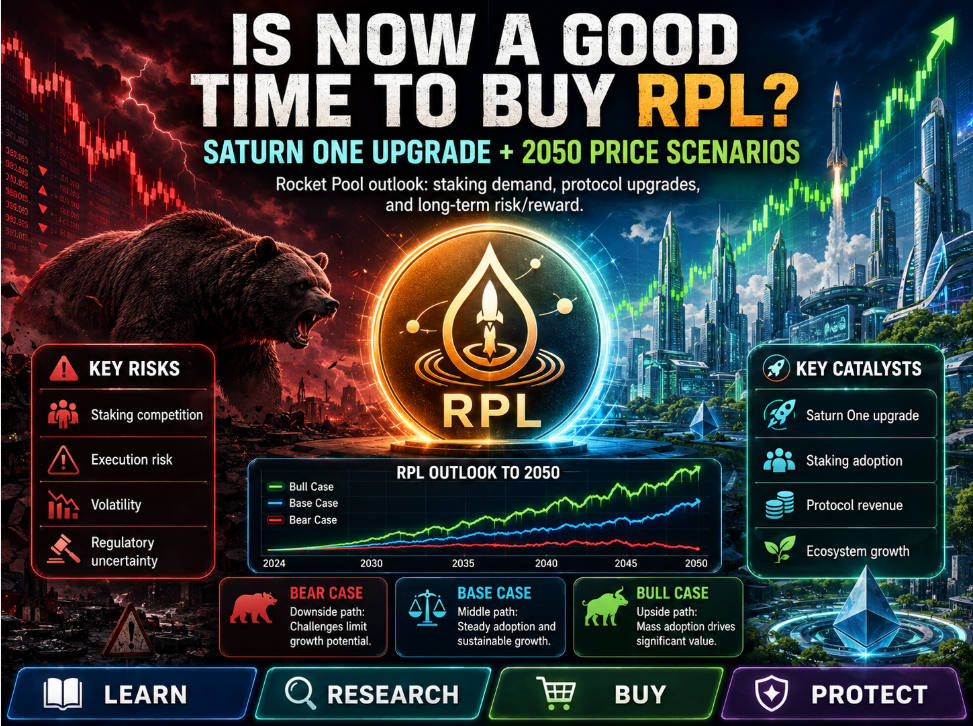
But what actually matters isn't the low price — it's where it fell from, and why it fell that far.
Rocket Pool was once one of the most closely watched decentralized protocols in the Ethereum liquid-staking sector. As Rocket Pool's native token, RPL was also given a fairly high valuation by the market during the last bull cycle. Around 2021, RPL's all-time high as recorded on mainstream market-data platforms sat near $62, with some platforms or historical data sources showing even more extreme price ranges.
Today, with RPL trading around $1.3 and a market cap of roughly $29 million, it has fallen from "core asset of the Ethereum-staking narrative" to "small-cap recovery candidate."
This isn't an ordinary pullback — it's a complete market re-rating.
Looking purely at price performance, RPL has lost roughly 98% of its value. If a project's fundamentals remain intact and its tokenomics are improving, a drawdown like this could signal long-term opportunity. But if the project keeps losing market share, token demand stays weak, and protocol revenue can't support a higher valuation, the low price might simply be the new normal after a value markdown.
So judging RPL can't rely on "how much it's dropped" alone — it requires asking whether it has a real path back to being priced by the market again.
1.1 RPL's Current Core Data: Small Cap, Low Rank, High Volatility
As of June 2026, RPL's general market position can be summarized as:
Price around $1.3
Market cap around $29 million
24-hour trading volume fluctuating quickly with market conditions, sometimes in the low single-digit millions
Market rank around #600
Circulating supply of roughly 22 million+ RPL
What does this scale actually mean?
It means RPL is no longer a mainstream DeFi token that draws default market attention — it's a small/mid-cap protocol token that needs to re-prove itself.
A small market cap has two characteristics.
First, greater upside elasticity. If data points like Rocket Pool's fee switch, MEGAPOOL adoption, and rETH growth improve noticeably, RPL's small market cap makes it easy for a strong rebound to occur.
Second, sharper downside too. Small-cap assets have thin liquidity — a single large order, an exchange trading-pair adjustment, or a wave of market panic can all cause rapid declines.
So RPL right now isn't a "low-risk cheap coin" — it's a "high-risk, high-elasticity asset that strongly needs fundamentals validation."
1.2 What Does a Nearly 98% Drawdown From the All-Time High Actually Tell Us?
Falling from $62 to around $1.3 is a drawdown of nearly 98%.
This kind of figure easily creates the illusion of "it's already so low, how much further could it possibly fall?"
But in crypto markets, falling another 50% after an already-98% drawdown isn't rare.
This is especially true for an asset like RPL, which isn't BTC and isn't ETH. BTC and ETH's declines are mostly cyclical issues, whereas RPL's decline also involves structural issues:
Lido has built a powerful network effect within the liquid-staking market.
Rocket Pool's TVL still lags Lido's by a huge margin.
RPL's inflationary incentive model was long questioned by the market.
Node-operator barriers and capital efficiency previously limited the protocol's expansion.
Small market cap leads to insufficient trading liquidity.
This means RPL's low price isn't purely the result of a bear market — it also reflects the market's reassessment of its competitiveness, token value-capture, and pace of growth.
But that doesn't mean RPL has no opportunity.
Because after the 2026 Saturn One upgrade, RPL's story has changed. The market used to question it as "a purely inflationary incentive token" — now it has a chance to become "an ETH revenue-sharing asset."
If this transformation gets validated by real data, RPL has a genuine basis for being repriced.
1.3 Technicals: $1.30 Is a Psychological Support Level — and Also a Risk Dividing Line
From a short-term technical standpoint, RPL's most critical level right now is around $1.30.
This zone carries three layers of significance:
First, it's near the current market's low-range chop zone.
Second, it's the key area investors psychologically use to judge "is it about to break down further."
Third, it affects whether short-term capital remains willing to keep buying.
If RPL repeatedly finds support around $1.30, it suggests capital is still willing to accumulate at the lows.
But if RPL decisively breaks below $1.30 and can't quickly recover, the market may retest even lower ranges — and given insufficient liquidity, any decline could get amplified.
On the upside, the key zone to watch is around $2.50.
For RPL, $2.50 isn't just a simple price resistance — it's the first clear gate for confidence repair in the market's eyes. If RPL can reclaim $2.50 in the future, accompanied by rising volume and improving Rocket Pool protocol data, that would look more like the start of genuine "right-side confirmation."
The 50-day and 200-day moving averages currently remain broadly weak, suggesting the medium-term trend hasn't fully reversed. For swing traders, it's unwise to mistake a short-term bounce for a long-term bull market before the moving-average structure strengthens.
1.4 What's the Impact of the USDC Margin Trading-Pair Adjustment on Short-Term Liquidity?
In June 2026, some trading platforms adjusted or delisted certain RPL/USDC margin trading pairs. Events like this typically aren't fundamentals-level issues for RPL, but they do affect short-term trading structure.
This can produce three outcomes:
First, reduced leverage trading convenience. Users accustomed to trading RPL with USDC margin need to switch to other pairs or other venues.
Second, reduced near-term order-book depth. If a margin pair is removed, some resting orders, arbitrage, and leveraged capital leave, potentially thinning the order book in the short run.
Third, sentiment is easily misread. A delisted trading pair doesn't mean the project has failed, but for a small-cap asset, any reduction in liquidity can be interpreted by the market as a negative signal.
So this type of event isn't the core variable determining RPL's long-term value, but it does add to short-term price volatility.
What truly determines RPL's long-term value remains Rocket Pool's protocol growth, fee-sharing, rETH demand, and the competitive landscape of the ETH staking sector.
- What Problem Does Rocket Pool Actually Solve?
To judge whether RPL is worth buying, you first need to understand what Rocket Pool actually is.
Many newcomers lump RPL, rETH, and ETH staking together, even assuming Rocket Pool and Lido do exactly the same thing. In reality, while both belong to the Ethereum liquid-staking sector, their positioning differs significantly.
Lido's strengths are scale, liquidity, ecosystem integration, and market mindshare.
Rocket Pool's core strengths are decentralization, permissionless node operation, non-custodial design, and an approach more aligned with Ethereum's decentralization ethos.
This is also the foundation of RPL's long-term value.
2.1 Why Does Ethereum Need Liquid Staking?
After Ethereum's transition to proof-of-stake, users can stake ETH to help secure the network and earn staking yield in return.
But native staking comes with several barriers:
You need 32 ETH to independently run a single validator.
You need technical capability to maintain a node.
You bear risks like downtime, slashing, and exit-period delays.
Liquidity decreases once funds are staked.
Liquid-staking protocols exist to solve exactly these problems.
Users deposit ETH into the protocol, which handles participating in Ethereum staking on their behalf. Users receive a liquid-staking token in return — Lido's stETH, for instance, or Rocket Pool's rETH. This token represents the user's share in the staking pool, and gradually appreciates or accumulates value alongside staking yield.
For ordinary users, the biggest value of liquid staking is:
You can participate in staking without needing 32 ETH.
You can earn ETH staking yield without running your own node.
The LST you receive can continue being used elsewhere in DeFi, improving capital efficiency.
Rocket Pool lets users participate in ETH staking with a much smaller amount and receive rETH in return — giving everyday ETH holders a lower barrier to entry into Ethereum's staking ecosystem.
2.2 The Essential Difference Between Rocket Pool and Lido
Lido is the largest player in the liquid-staking market.
Its advantages are clear:
Largest TVL.
Deepest stETH liquidity.
Most extensive DeFi integration.
Stronger usage habits among institutions and large holders.
But Lido's core point of controversy is also clear: its validator set is relatively more concentrated, and node operators go through a vetting process — it isn't fully permissionless.
Rocket Pool emphasizes a different path:
Anyone meeting the requirements can become a node operator.
The protocol is non-custodial.
Node operation is more distributed.
It emphasizes Ethereum's decentralization values more heavily.
This leaves Rocket Pool behind Lido in scale, but differentiated within the "decentralized staking" narrative.
For long-term investors, the question isn't whether Rocket Pool can immediately overtake Lido — it's:
Will the market increasingly value decentralized staking going forward?
If the answer is yes, Rocket Pool has a shot at a higher valuation.
If the answer is no, with the market continuing to favor the deepest, most convenient, strongest-network-effect option in Lido, then Rocket Pool's growth space gets compressed.
2.3 How Does Rocket Pool's Dual-Track Mechanism Work?
Rocket Pool's participants fall into two main categories.
The first category is ordinary ETH depositors. They deposit ETH into Rocket Pool and receive rETH in return. rETH represents their stake in Rocket Pool's staking system, and its value grows alongside validator rewards.
The second category is node operators. Node operators provide a portion of ETH and run validators, while also receiving matching funds from the protocol sourced from ordinary users' ETH deposits. Node operators can earn staking rewards, commissions, and RPL-related incentives or revenue sharing.
In earlier versions, node operators needed a higher ETH threshold, and RPL collateral was an important part of the system's security and incentive design. Later, as upgrades like Atlas, Saturn 0, and Saturn One rolled out, Rocket Pool steadily lowered the node-operator barrier and improved capital efficiency.
After Saturn One, the 4 ETH minipool/validator mechanism lets node operators support more validator capacity using less of their own ETH. This change is critical for protocol growth, because the more capital-efficient node operators become, the stronger Rocket Pool's ability to expand rETH supply.
2.4 What Does the RPL Token Itself Actually Do?
RPL's core functions can be understood across three areas.
First, node-operator collateral and protocol risk alignment. RPL has long served as collateral for node operators, helping align operators' interests with the security of the Rocket Pool network. While RPL collateral is no longer a hard requirement for all new minipools post-Saturn 0, staking RPL still relates to yield enhancement, governance, and protocol incentives.
Second, governance. Decisions on Rocket Pool's parameter adjustments, protocol upgrades, and revenue allocation are all tied to governance. RPL holders — especially node operators participating in the protocol — can influence the protocol's direction through governance.
Third, ETH revenue capture. After Saturn One, RPL's most important new role is participating in a share of the protocol's ETH revenue. In other words, RPL is no longer just "an inflationary reward token" — it's starting to approach "a protocol revenue asset."
This is the core shift in RPL's valuation logic.
2.5 What Does the TVL Gap Between Rocket Pool and Lido Tell Us?
Currently, Lido remains the absolute leader of the liquid-staking sector, with TVL far exceeding Rocket Pool's. Rocket Pool's TVL fluctuates roughly in the $800 million–$1 billion range, while Lido has long maintained tens of billions of dollars in TVL.
This gap tells us three things.
First, Lido's network effect is extremely strong. stETH's liquidity, DeFi integration, and market recognition have already formed a moat.
Second, Rocket Pool remains a "small but principled" decentralized approach. It's philosophically closer to Ethereum's decentralization ethos, but its market scale is far smaller than Lido's.
Third, RPL's valuation elasticity comes from "share recovery," not "current market dominance." If Rocket Pool's market share can recover from its low base, RPL could be repriced; if its share keeps declining, RPL's revenue-asset narrative will also be constrained.
So RPL isn't a bet that "Rocket Pool is strong right now" — it's a bet that "decentralized staking will become more important in the future."
- The Saturn One Upgrade: The Fundamental Turning Point in RPL's Valuation Logic
The key to an RPL 2050 price forecast isn't how high it once climbed in 2021, nor whether $1.3 today is cheap — it's what Saturn One actually changed.
Saturn One's core significance is:
Lowering the node-operator barrier.
Improving protocol capital efficiency.
Introducing MEGAPOOL.
Activating the RPL fee switch.
Shifting RPL from a purely inflationary incentive logic toward an ETH protocol-revenue-sharing logic.
Together, these changes form the basis for RPL's potential repricing.
3.1 MEGAPOOL: From Scattered Minipools to More Efficient Validator Management
Under the old architecture, each minipool functioned more like an independent contract structure. As node-operator scale grew, this led to higher gas costs, more complex management processes, and lower capital efficiency.
MEGAPOOL's approach lets node operators manage multiple minipools/validators within a more unified structure.
Its benefits include:
Lower operating costs.
Higher efficiency for large-scale node operation.
Simplified validator management.
Stronger scaling capacity for Rocket Pool.
For the protocol, MEGAPOOL's significance isn't just gas savings — it's giving Rocket Pool the ability to handle node operation at much larger scale.
If Rocket Pool wants to compete with Lido, centralized-exchange staking, and institutional custodial staking going forward, it has to solve the scaling problem. MEGAPOOL exists precisely to serve that purpose.
3.2 The 4 ETH Validator Design: The Core Shift in Capital Efficiency
Another core change in Saturn One is lowering the node operator's required ETH further to the 4 ETH level.
Early Ethereum required 32 ETH to run a standalone validator.
Rocket Pool's early minipools lowered the threshold to 16 ETH.
Post-Atlas brought 8 ETH minipools.
Saturn One further lowered the node operator's own-ETH requirement to 4 ETH.
What does this mean?
The same amount of node-operator capital can now support more validators.
The same amount of own-ETH can be matched against more ETH from rETH depositors.
The bottleneck on the protocol's ability to expand rETH supply is eased.
Node operators' capital return efficiency improves.
This matters a great deal for Rocket Pool.
A key reason Rocket Pool grew slowly in the past was insufficient node-operator capacity. Users wanted to deposit ETH for rETH, but the protocol needed enough node operators to absorb that ETH. If the node-operator barrier was too high, the protocol's expansion speed was capped.
The 4 ETH design improves node operators' capital efficiency, helping Rocket Pool scale up faster when demand increases.
3.3 The Fee Switch: RPL's Shift From Inflationary Token to ETH Revenue Asset
Saturn One's most important change is the RPL fee switch.
In the past, RPL's core incentive mostly came from inflationary issuance. Node operators who staked RPL could earn RPL rewards. This model was easy to attract participants during bull markets, but it carried clear long-term problems:
Rewards come from newly minted tokens.
New tokens dilute holders.
If protocol revenue doesn't grow at the same pace, the token price tends to get suppressed by inflation.
After Saturn One, RPL began receiving a share of ETH protocol revenue. This means RPL's value-capture method has shifted:
In the past, it functioned more like "token-based subsidies."
Now, it's starting to resemble "protocol revenue distribution."
To be clear, strictly speaking this isn't traditional stock dividends, nor is it equivalent to equity returns. But from a valuation-logic standpoint, RPL is genuinely moving from an inflationary governance token toward a revenue-generating protocol asset.
This is exactly why Saturn One is considered a potential catalyst for RPL's repricing.
Because the valuation the market assigns to "an inflationary token with no cash flow" versus "a protocol asset that captures ETH revenue" is fundamentally different.
3.4 Is RPL Like a "Staking ETF"?
As an analogy, RPL can be understood as a kind of "staking-infrastructure asset" built around Rocket Pool's protocol revenue.
It isn't rETH.
rETH functions more like a liquid-staking receipt users get after depositing ETH, with value derived mainly from ETH itself plus staking yield.
RPL functions more as an asset tied to Rocket Pool's governance, node incentives, and revenue capture.
If Rocket Pool's TVL grows, node count grows, and protocol revenue grows, RPL stands a better chance of being repriced higher.
This is somewhat analogous, in traditional finance, to the logic of a tokenized revenue-rights interest in an asset-management platform: the larger the platform's assets under management and the higher its revenue, the more valuable the associated rights asset becomes.
But this analogy has its limits too.
RPL is not a stock.
Holding RPL does not equate to owning equity in Rocket Pool.
Returns depend on protocol rules, governance parameters, and on-chain mechanics.
The fee-sharing ratio can be adjusted by the DAO.
So more precisely, RPL isn't a "staking ETF" — it's a "revenue-capturing token for an Ethereum decentralized-staking protocol."
3.5 Can Supply Contraction Plus the Fee Switch Form a Price Floor?
Another potential positive from Saturn One is that RPL's inflationary rewards are gradually being de-emphasized, with the protocol shifting from new issuance toward ETH revenue-sharing.
If future supply-growth pressure decreases while RPL stakers can earn ETH income, the market's approach to valuing RPL could shift.
But whether a price floor actually holds depends on three conditions:
First, whether Rocket Pool's TVL grows. Without TVL, there's no sufficient source of protocol revenue.
Second, whether RPL staking participation increases. If RPL stakers can capture income, more people may be willing to stake RPL rather than sell short-term.
Third, whether ETH price and staking yield stay healthy. Rocket Pool's revenue ultimately derives from the ETH staking system. If the ETH ecosystem weakens, expectations for RPL's revenue also decline.
So supply contraction and the fee switch are floor-improving factors — not a guarantee of price appreciation.
For RPL to climb out of its long-term lows, sustained improvement in Rocket Pool's protocol usage data needs to be visible.
- Is Now a Good Time to Buy RPL? A Reusable Decision Framework
Is now a good time to buy RPL?
A more precise answer:
If you're a short-term trader, this still isn't a strong trend-confirmation zone — wait for $1.30 support to hold, a breakout above $2.50, and rising volume.
If you're a long-term researcher, the area around $1.3 can serve as a low-zone watch area, but it isn't suited to a single large position.
If you believe in Rocket Pool's decentralized-staking approach and trust that Saturn One can deliver real ETH revenue-sharing, RPL is worth researching with a small position and tracking in stages.
But if you only want to buy RPL because it's fallen from $62 to $1.3, that's a high-risk basis for a decision.
You can evaluate whether RPL is worth buying across three dimensions.
4.1 Valuation: Is a $29 Million Market Cap an Opportunity, or a Sign the Market Has Given Up?
RPL's current market cap of roughly $29 million looks extremely low.
If Rocket Pool can regain staking market share going forward, and the RPL fee switch continues generating ETH revenue, this market cap could be significantly undervalued.
But if Rocket Pool remains long-term suppressed by Lido, rETH demand growth stays weak, node expansion underdelivers, and fee-sharing remains small, $29 million isn't necessarily cheap either.
The essence of a small market cap is:
It can give you high elasticity.
It can also indicate the market has already lowered its importance.
So RPL's valuation can't be judged on market cap alone — it needs to be combined with protocol data:
Is Rocket Pool's TVL recovering?
Is rETH supply growing?
Is the number of node operators increasing?
Is the RPL fee switch generating meaningful ETH revenue?
Is RPL's staking ratio rising?
These questions matter far more than "is the current market cap low."
4.2 Technicals: $1.30 Support and $2.50 Resistance
RPL's current technicals can be observed through two key points.
$1.30 is the short-term support zone. If RPL can stabilize in this area, it suggests the market still has buying support at the lows.
$2.50 is the next important resistance level. If price reclaims $2.50 alongside rising volume, it suggests capital is starting to reprice the impact of Saturn One.
But between $1.30 and $2.50, RPL still looks more like low-range chop than a trending bull move.
For newcomers, a staged approach is better suited:
A small first tranche as a test position.
A second tranche once support around $1.30 is confirmed.
A third tranche considered only after breaking above $2.50 and holding.
The goal here isn't catching the exact bottom — it's avoiding excessive risk before the trend has been confirmed.
4.3 Protocol Fundamentals: Has the Fee Switch Actually Generated Revenue-Sharing Yet?
The most important thing about RPL isn't its price chart — it's protocol revenue.
After Saturn One activated the fee switch, RPL's theoretical case got stronger. But theory needs to be validated by real data.
You need to monitor several metrics:
How much ETH revenue RPL stakers are actually receiving.
Whether Rocket Pool's total staked ETH is growing.
Whether rETH supply is growing.
Whether the number of node operators is increasing thanks to the 4 ETH design.
Whether MEGAPOOL is lowering operating costs and accelerating expansion.
If this data improves, RPL's "revenue asset" narrative holds up.
If fee-sharing amounts stay small or protocol growth remains stalled, the fee switch may just be a narrative upgrade — not a valuation upgrade.
4.4 Three Types of Investors, Three Different Answers
For DCA investors, RPL can be allocated in small, staged amounts, but it isn't suited to being a core holding.
RPL's risk is far higher than ETH's, and higher than most leading L1 assets too. It's better suited as a high-elasticity satellite position within the Ethereum-staking sector, rather than a primary holding.
For swing traders, waiting for right-side confirmation is the better approach.
Entering purely because the price looks low makes it easy to buy into a continuation of the downtrend. A more reliable signal is RPL holding above $1.30 and breaking upward through $2.50, with volume and protocol data improving in tandem.
For long-term value holders, what matters is not the entry price, but whether Rocket Pool can actually grow.
You need to continuously track Rocket Pool's TVL, rETH supply, node-operator count, RPL staking ratio, ETH revenue-sharing, and shifts in Lido's market share.
Holding RPL long-term is, in essence, a bet that:
The Ethereum staking market keeps expanding.
Decentralized staking becomes increasingly important.
Rocket Pool can carve out sufficient share from under Lido's shadow.
The RPL fee switch can generate revenue sustainably over the long run.
If you don't believe in these four points, you probably shouldn't hold RPL long-term.
4.5 What Signals Count as Genuine Right-Side Confirmation?
RPL's right-side confirmation isn't a single up day, nor community hype — it's several signals appearing together:
MEGAPOOL node count keeps growing.
The 4 ETH validator mechanism brings in genuinely new node operators.
Rocket Pool's share of the ETH staking market stops declining and starts recovering.
rETH supply keeps growing.
RPL stakers receive stable ETH income.
RPL price reclaims $2.50 and holds, with volume sustained.
Large ETH holders or institutions start placing more emphasis on non-custodial, decentralized staking solutions.
The more of these signals that appear, the higher the probability that RPL shifts from "cheap speculation" to "genuine fundamentals recovery."
4.6 The Downside Risk: What If Lido's Network Effect Keeps Entrenching Further?
RPL's biggest downside risk is Lido's scale advantage continuing to widen.
Lido already has deep liquidity, strong DeFi integration, institutional recognition, and a default-choice position in the market. For many users, choosing stETH is more convenient than choosing rETH, simply because stETH has more use cases and deeper liquidity.
If the market continues prioritizing scale, liquidity, and convenience over decentralization, Rocket Pool's share could keep getting squeezed.
This could trigger a chain reaction:
Insufficient growth in Rocket Pool's TVL.
Limited protocol revenue.
RPL fee-switch payouts aren't attractive enough.
Insufficient demand for staking RPL.
The market re-lowers RPL's valuation.
So RPL's risk isn't that the protocol is entirely useless — it's that it could remain stuck for a long time in a state of "good philosophy, limited market share."
- From 2030 to 2050: A Step-by-Step Milestone Forecast for RPL
2050 is an extremely distant point in time. For a small-cap protocol token like RPL, forecasting a single point price directly isn't meaningful.
A more reasonable approach breaks the timeline into three stages:
2030 — has the growth promised by Saturn One materialized?
2040 — is Rocket Pool still significant infrastructure for Ethereum staking?
2050 — can RPL stably establish itself as an ETH revenue-generating asset?
5.1 2030: The First Round of Validation for Saturn One's Effectiveness
2030 is an important validation point for RPL.
By then, the market will no longer assign expectation premiums just because "Saturn One was a major upgrade." Investors will look directly at the results:
Has Rocket Pool's TVL grown meaningfully?
Has rETH gained more DeFi integration?
Has MEGAPOOL brought node-count growth?
Has the RPL fee switch sustainably generated ETH revenue?
Has Rocket Pool reclaimed some staking market share from Lido?
If the answers to these questions lean positive, RPL has a shot at climbing out of small-cap purgatory from around $1.3.
If the answers lean negative, RPL may still just be a long-tail staking-protocol token with good philosophy but limited market share.
Forecasting models diverge significantly on RPL's 2030 price. Some conservative models suggest RPL may only sit around $3–$4, while some optimistic models suggest that if Rocket Pool's growth recovers, RPL could challenge $25 or higher.
This divergence essentially comes from two different judgments:
Conservative models believe Lido's network effect is too strong for Rocket Pool to meaningfully expand its share.
Optimistic models believe the decentralized-staking narrative will become increasingly important, and that Saturn One will change RPL's revenue structure.
For a more detailed medium-term price path, HiBT's dedicated RPL 2030 price projection is worth reading, which combines protocol growth, price structure, and market cycles leading up to 2030 for further analysis.
From a more practical standpoint, RPL in 2030 can be split into three ranges:
Weak scenario — RPL may only sit around $2–$5. This suggests Rocket Pool is still alive, but its market share hasn't improved meaningfully.
Base scenario — RPL may recover to the $8–$20 range. This means protocol growth post-Saturn One has started materializing, and the market has partially accepted RPL's revenue-asset thesis.
Optimistic scenario — RPL may challenge the $25–$60 range. This requires the overall ETH staking market to expand, Rocket Pool's share to recover, RPL's revenue-sharing to deliver consistently, and the market to once again assign a premium to decentralized staking.
5.2 2040: Is RPL Still a Viable Staking-Revenue Asset?
2040 is more critical than 2030.
By that point, Rocket Pool will have gone through multiple market cycles. The market won't care anymore about whether it was once a symbol of decentralized staking, nor about how important Saturn One seemed at the time. The market will only look at:
Does Rocket Pool still have genuine TVL?
Does rETH still have real use cases?
Are node operators still actively participating?
Can RPL still capture ETH revenue?
Can the protocol withstand regulation, competition, and technological change?
If the answers are yes, RPL would have transitioned from a "speculative governance token" into a "long-term revenue-generating infrastructure asset."
If the answers are no, RPL might still exist, but it would struggle to command a high valuation.
2040 can be split into three states:
If Rocket Pool gets marginalized, RPL may sit around $3–$9.
If Rocket Pool maintains a stable share, RPL may sit around $10–$25.
If Rocket Pool becomes mainstream decentralized-staking infrastructure, RPL has a shot at entering the $30–$50+ range.
What matters here isn't the numbers — it's the protocol's status. RPL's price in 2040 essentially reflects Rocket Pool's long-term position within the Ethereum staking market.
5.3 2050 Bear Scenario: Roughly $4–$9
In the most conservative 2050 scenario, RPL might only reach around $4–$9.
This range represents a state of "the protocol survives, but never genuinely revives."
In this scenario, Rocket Pool still exists, and rETH still has some user base, but Lido's scale effect remains powerful, while centralized-exchange staking, institutional custodial staking, and other LST protocols continue diverting market share.
Rocket Pool's decentralization narrative still carries value, but it hasn't become the first choice for mainstream users.
The RPL fee switch exists, but the protocol's revenue scale remains limited, with ETH revenue-sharing insufficient to support a high valuation.
MEGAPOOL and the 4 ETH validator design brought efficiency improvements, but failed to drive a meaningful recovery in market share.
Under these conditions, RPL wouldn't go to zero, since it still represents a long-running Ethereum staking protocol — but it would also struggle to return to its historic highs.
This is the essence of the bear scenario:
RPL survives, but never becomes a core asset again.
5.4 2050 Base Scenario: Roughly $15–$35
Under the base scenario, RPL could enter the $15–$35 range by 2050.
This range isn't a fantastical forecast — it represents a moderate recovery path.
Its core assumptions are:
The Ethereum staking market keeps expanding.
Rocket Pool maintains its position as the representative decentralized-staking option.
MEGAPOOL continues improving node-operator efficiency.
The 4 ETH mechanism attracts more node operators.
The RPL fee switch sustainably generates ETH revenue-sharing.
rETH retains a meaningful set of DeFi use cases.
Lido remains the leader, but Rocket Pool secures a stable share.
If these conditions hold, RPL's valuation logic would shift from "governance token" to "ETH revenue asset."
The $15–$35 range doesn't require the market to believe Rocket Pool will overtake Lido — it just requires acknowledging that Rocket Pool holds a stable, sustainable position within the decentralized-staking market.
For long-term investors, this scenario is the most worth taking seriously.
Because it doesn't require RPL to dominate the whole sector again, nor an extreme bull market — it only requires Rocket Pool to stably secure a portion of market share, leveraging its decentralized approach and the post-Saturn One tokenomics.
5.5 2050 Bull Scenario: Above $60
In the most optimistic scenario, RPL could return to near, or even break above, $60 by 2050.
This range would mean RPL didn't just recover — it completed a genuine long-term value re-rating.
Achieving this outcome requires at least several conditions to hold simultaneously:
Ethereum stays prosperous long-term, with total ETH staked continuing to expand.
Global institutions and large holders increasingly prioritize non-custodial, decentralized staking.
The regulatory environment increasingly favors transparent, permissionless, on-chain verifiable staking protocols.
Lido's centralization controversy persists long-term, pushing some capital toward Rocket Pool.
Rocket Pool continues improving capital efficiency through MEGAPOOL and subsequent upgrades.
rETH gains deeper liquidity and broader use cases in DeFi.
The RPL fee switch sustainably generates meaningful ETH revenue.
RPL's inflationary pressure keeps declining while staking demand rises.
If these conditions all hold simultaneously, RPL has a chance to be re-recognized by the market as "a core asset of Ethereum's decentralized-staking infrastructure."
Above $60 isn't impossible, but it isn't the base scenario — it's a strongly optimistic scenario. Because it means Rocket Pool would need not just to grow, but to maintain differentiated competitiveness over the long run against Lido, centralized exchanges, institutional custodial staking, and future new staking protocols.
5.6 Why Be Skeptical of Old RPL Predictions in the Hundreds of Dollars?
You can still find some extremely aggressive long-term RPL predictions floating around — $100, $300, or even higher. These types of predictions typically have several problems.
First, they often come from extrapolating historical bull-cycle data. During bull markets, models easily treat short-term high volatility, liquidity premiums, and narrative heat as long-term growth trends and extrapolate them directly into the future.
Second, they don't adequately account for Lido's network effect. RPL's long-term ceiling isn't determined solely by Rocket Pool itself — it also depends on whether Lido continues to hold absolute dominance.
Third, they ignore the current market-cap reality. RPL's current market cap is only around $29 million, and the market clearly isn't yet pricing it as a mainstream revenue-generating asset. Getting from this position to the hundreds of dollars would require extremely strong protocol growth and capital re-rating.
Fourth, they may not adequately account for the new post-Saturn One variables. Saturn One makes RPL's valuation logic clearer, but it also means RPL must now prove itself with ETH revenue data going forward. Models can't rely on historical candlesticks alone — they need to look at protocol cash flow.
So for ordinary investors, a more reasonable long-term framework is:
$4–$9 as the conservative survival scenario.
$15–$35 as the moderate-recovery scenario.
Above $60 as the strongly optimistic scenario.
Figures in the hundreds of dollars should be categorized purely as an extreme bull-market assumption — not suitable as a baseline for an investment plan.
- The Key Variables That Determine Which Path RPL Takes to 2050
A 2050 forecast isn't a prophecy — it's scenario modeling.
What actually matters isn't guessing a single number, but understanding which variables could push RPL down different paths.
6.1 Can the Total Size of the Ethereum Staking Market Keep Expanding?
RPL's long-term ceiling first depends on the overall size of the ETH staking market.
If Ethereum stays prosperous long-term, with ETH's overall market value rising and staking participation increasing, the revenue space for liquid-staking protocols expands too.
As an Ethereum liquid-staking protocol, Rocket Pool naturally benefits from this broader trend.
But if the ETH ecosystem's growth slows, staking yields decline, or Ethereum gets weakened by competing smart-contract ecosystems in the future, Rocket Pool's growth space gets constrained too.
So RPL's long-term value is deeply tied to ETH.
Holding RPL is, in essence, not just a bet on Rocket Pool — it's also a bet that Ethereum remains one of the most important proof-of-stake networks long-term.
6.2 Decentralization vs. Efficiency: Which Will the Market Ultimately Choose?
Rocket Pool's core differentiation is decentralization.
But the market doesn't necessarily always choose the most decentralized option.
Many users will prioritize:
The deepest liquidity.
The most DeFi integration.
The simplest path to yield.
The strongest brand recognition.
This is exactly Lido's advantage.
Rocket Pool is better suited to users who value permissionless access, non-custodial design, distributed validators, and alignment with Ethereum's values.
The real variable going forward is:
Will institutions and regulators place increasing emphasis on decentralized staking?
If regulators, DAOs, foundations, large holders, and long-term ETH holders start worrying about excessive staking concentration, Rocket Pool's value would rise.
If the market keeps favoring the largest, most liquid protocol instead, Rocket Pool's share may struggle to expand meaningfully.
It's worth comparing this to the fate of another category of protocol token. Readers can refer to HiBT's price scenarios for SNX in 2030, which helps clarify the difference in valuation logic between "infrastructure-type staking tokens" and "DeFi derivatives tokens."
Put simply:
RPL's value comes from ETH staking infrastructure, protocol revenue, and a decentralization premium.
SNX's value comes from perpetuals trading volume, protocol revenue, and a buyback flywheel.
Both require genuine revenue, but the sources of that revenue are entirely different.
6.3 Can the Fee Switch Sustainably Generate Substantive Revenue-Sharing?
RPL's most important new narrative is the fee switch.
But the fee switch isn't a magic button.
Whether it actually works depends on whether Rocket Pool has sufficient revenue.
If Rocket Pool's TVL grows, node operation stays active, and ETH staking yield remains stable, RPL stakers can earn more attractive ETH revenue-sharing.
If Rocket Pool's TVL stagnates, protocol revenue stays limited, and RPL's revenue-share is small, the market will conclude the fee switch is just a narrative without substantive value.
So going forward, it's worth closely tracking:
How much ETH RPL stakers are actually receiving.
What the annualized level of ETH revenue-sharing looks like.
Whether RPL's staking ratio is rising.
Whether the fee-allocation parameters remain stable.
Whether the DAO adjusts the revenue structure.
Only once the fee switch consistently generates genuine revenue can RPL truly shed its old label as "an inflationary governance token."
6.4 Regulatory Variables: Could Liquid Staking Be Redefined?
In 2025, the U.S. SEC's Division of Corporation Finance issued a statement regarding certain liquid-staking activities, which the market broadly interpreted as a softening of regulatory stance. But a statement like this doesn't equal a permanent legal exemption, nor does it represent globally consistent regulatory treatment.
Several types of risk could still emerge going forward:
Some regions re-examining whether liquid-staking tokens carry securities characteristics.
Protocol revenue-sharing mechanisms being brought under stricter regulatory frameworks.
Restrictions placed on staking-yield products aimed at retail users.
Institutions being limited to using only compliant custodial or whitelisted staking services.
If regulation increasingly favors transparent, non-custodial, decentralized protocols, Rocket Pool could benefit.
If regulation increasingly favors large compliant institutions and centralized custodial services, Rocket Pool could face headwinds instead.
So regulation isn't simply bullish or bearish — it will reshape where capital flows and which protocols get chosen.
6.5 Protocol Security and Slashing Risk
Rocket Pool is, at its core, an Ethereum staking protocol.
Wherever validators are involved, protocol-layer risk exists:
Node-operator downtime.
Validators getting slashed.
Smart-contract vulnerabilities.
Oracle or governance-parameter errors.
Short-term rETH depegging.
Insufficient liquidity under extreme market conditions.
While Rocket Pool's design emphasizes distributed validators, non-custodial structure, and risk buffers, no DeFi protocol can fully eliminate risk.
For RPL holders, protocol-security issues directly affect market confidence.
If a major slashing event or contract incident occurred, RPL's price could suffer a severe shock.
- How to Buy RPL on HiBT
If you've finished your research and decided to allocate a small position to RPL, you can trade it on HiBT. The process below is a reference for newcomers.
Step 1 — Register a HiBT Account
After visiting the HiBT website, you can register using an email address or phone number.
A few tips for registration:
Use a stable, long-term email or phone number.
Set a strong password.
Enable two-factor authentication.
Don't reuse passwords across other websites.
Keep your account-security information safely backed up.
Crypto account security matters a great deal — especially if you're planning to hold a small-cap asset long-term, you'll want to avoid losses caused by account-security failures.
Step 2 — Complete KYC Identity Verification
Most licensed exchanges require users to complete KYC.
KYC's purpose is to confirm user identity and prevent money laundering, fraud, account takeover, and illegal transactions.
You'll typically need:
A government ID or passport.
Facial recognition.
Phone number or email verification.
Some regions may require proof of address.
Specific requirements follow what's shown on the HiBT platform.
Step 3 — Funding: Fiat or Stablecoin Path
Before buying RPL, you'll need to fund your account first.
There are two common approaches.
The first is depositing USDT or another stablecoin, then using it to buy RPL. This is the most common approach in crypto trading and works well if you already hold stablecoins.
The second is funding through the platform's supported fiat channels. Whether fiat funding is available depends on your region, payment method, and what the platform currently supports.
Regardless of which method you use, pay attention to:
Selecting the correct deposit network.
Copying the deposit address completely and correctly.
Doing a small test deposit before sending a larger amount.
Filling in a memo or tag accurately if the deposited coin requires one.
A mistaken deposit can result in permanently unrecoverable funds — newcomers should be especially careful here.
Step 4 — Placing an Order: Market or Limit?
You can buy RPL using either a market order or a limit order.
A market order suits users who want fast execution. The advantage is simplicity; the downside is that small-cap coins may experience slippage.
A limit order suits users who want to control their entry price. For example, with RPL currently around $1.3, you could set staged limit orders at $1.30, $1.20, $1.10, or other levels, rather than buying all at once.
For newcomers, using limit orders to buy in stages is generally recommended.
This is because RPL has a small market cap, weak liquidity, and high price volatility — a single large market buy could result in considerable slippage, and is more likely to affect your mindset during short-term swings.
A more prudent approach:
A small first tranche as a test position.
A second tranche once support around $1.30 is confirmed.
A third tranche considered only after price breaks above $2.50.
The goal here isn't catching the exact bottom — it's controlling risk.
Step 5 — How to Store RPL Safely After Buying
There are two common storage approaches after buying RPL.
The first is keeping it in your exchange account. The advantage is convenience for trading, suited to short-term and swing strategies. The disadvantage is that your assets are custodied by the platform, and you bear the platform's custody risk.
The second is transferring it to a self-custody wallet. Since RPL is an Ethereum-ecosystem token, self-custody requires attention to wallet security, on-chain gas fees, contract-address verification, and avoiding phishing links.
If you're a newcomer, it's not advisable to start with large on-chain transactions right away. You can begin with small test amounts, confirm your wallet, network, and address are all correct, and then gradually learn more complex self-custody and DeFi usage.
Step 6 — Should You Use Rocket Pool to Stake ETH?
Buying RPL and using Rocket Pool to stake ETH are two different things.
If you hold ETH and want to earn ETH staking yield, you can look into Rocket Pool's rETH mechanism.
If you buy RPL, you're betting on Rocket Pool's protocol growth, the RPL fee switch, governance, and revenue-capture logic.
Put simply:
rETH leans more toward an ETH staking-yield asset.
RPL leans more toward a Rocket Pool protocol-value-capture asset.
The two carry different sources of risk and return — don't conflate them.
- Risk Disclosure
RPL is a high-risk asset and is not suitable for all investors.
1. Extremely Small Market Cap Liquidity Risk RPL's current market cap of roughly $29 million places it firmly in small-cap territory. This means a single large order could move the price, and both buying and selling can experience noticeable slippage when liquidity is thin. Under extreme market conditions, price could swing sharply over a short period.
2. Lido Competitive Risk Lido's scale advantage is structural. It has deeper liquidity, stronger DeFi integration, higher market recognition, and a larger institutional user base. Rocket Pool's decentralized approach carries genuine value, but there's no guarantee it can expand its share over the long run. If Lido maintains absolute dominance, RPL's upside potential could remain suppressed.
3. Protocol Growth Falling Short of Expectations Saturn One improved Rocket Pool's capital efficiency, but an upgrade by itself doesn't equal growth. If MEGAPOOL doesn't bring sufficient node growth, rETH demand doesn't rise, and fee-switch revenue remains limited, RPL's repricing thesis may simply fail to materialize.
4. Protocol-Layer Risk Rocket Pool involves multiple layers of risk — smart contracts, node operation, Ethereum validators, slashing, the rETH exchange rate, and DAO governance. A problem at any one of these layers could affect the protocol's credibility and RPL's price.
5. Regulatory Risk Liquid staking faces different regulatory interpretations across different countries and regions. Even if some regulators currently appear to be softening their stance, this could change in the future. If staking tokens, revenue-sharing, or protocol governance get brought under stricter regulatory frameworks, RPL's valuation logic could be rewritten.
6. Long-Term Forecast Risk A 2050 forecast carries an extremely high degree of uncertainty. Over the next 20-plus years, ETH, Ethereum staking, DeFi, regulation, on-chain infrastructure, and institutional preferences could all change dramatically. Every price range in this article is scenario analysis only and does not constitute investment advice.
Always DYOR and size positions according to your own risk tolerance.
- FAQ
Is buying RPL at $1.3 calling the bottom, or catching a falling knife? It's more accurately framed right now as a high-risk watch zone, not a confirmed bottom. If you believe in Rocket Pool's long-term decentralized-staking approach, and trust that Saturn One can sustainably drive protocol growth and ETH revenue-sharing, a small staged research position can make sense. But if you only want to buy RPL because it's fallen from $62 to $1.3, that carries significant risk. More reliable signals would be $1.30 support holding, a breakout above $2.50, Rocket Pool's TVL recovering, and RPL stakers receiving stable ETH income.
What practical benefit does the Saturn One upgrade actually bring to RPL holders? Saturn One's biggest significance is changing RPL's revenue logic. In the past, RPL relied more heavily on inflationary rewards and node-operator collateral demand. After Saturn One, RPL began sharing a portion of ETH protocol revenue, moving toward a revenue-generating asset. At the same time, the 4 ETH validator design and MEGAPOOL improved node-operator capital efficiency, helping Rocket Pool expand rETH supply and protocol scale. But these benefits need to be validated with real data — if protocol growth falls short, the market will discount the upgrade's value too.
Between RPL and Lido-related tokens, which should you pick for the long term? RPL and Lido-related assets follow different logic. Lido's advantage is scale, liquidity, and network effect. Rocket Pool's advantage is decentralization, permissionless node operation, and alignment with Ethereum's values. If you prioritize market share and liquidity, Lido is stronger. If you prioritize the decentralized-staking path and small-cap elasticity, RPL offers more imaginative upside, but also carries higher risk. For most investors, the question shouldn't be "which is cheaper" — it should be whether you're betting on scale effects or on a decentralization premium.
Can RPL really return above $60 by 2050? Possible, but it falls under the optimistic scenario, not the base case. For RPL to return above $60 by 2050 requires Rocket Pool to expand its market share over the long run, rETH to gain deeper liquidity, MEGAPOOL to keep driving node growth, the fee switch to generate stable ETH revenue, and the overall ETH staking market to keep expanding. If these conditions aren't met, RPL is more likely to stay in a lower range.
What's the minimum amount needed to buy RPL on HiBT? The exact minimum depends on what's shown on the HiBT trading page. For newcomers, it's not advisable to commit a large amount right away — start with a small amount to get familiar with registration, KYC, deposits, order placement, and account-security processes before deciding whether to increase your position. RPL is a small-cap, high-volatility asset better suited to small test positions than impulsive large bets.
Is RPL suitable for long-term DCA? RPL can be DCA'd in small amounts as a high-risk satellite position, but it isn't suited to being a core asset. If you're bullish long-term on the ETH staking sector, Rocket Pool's decentralized approach, and the revenue logic of the RPL fee switch, you can follow it with staged positions. But your core holdings should still prioritize lower-risk, higher-certainty assets such as BTC or ETH.
- Author's Note and Data Sources
This article is compiled based on public market data, protocol materials, and industry information as of June 2026. Primary references include:
RPL price, market cap, trading volume, rank, and all-time-high data from CoinGecko and CoinMarketCap.
Rocket Pool's official documentation and Saturn One upgrade notes.
DefiLlama's statistics on Rocket Pool's TVL, fees, and protocol data.
Discussions within Rocket Pool's community and governance materials regarding MEGAPOOL, the 4 ETH validator, the fee switch, and revenue-allocation mechanics.
Analysis from industry media outlets such as AMBCrypto and The Defiant covering Rocket Pool, Lido, and the liquid-staking sector.
Public HiBT materials covering account registration, trading services, and compliance disclosures.
This article will be updated following major changes in MEGAPOOL node data, Rocket Pool's TVL, rETH supply, RPL fee-switch revenue-sharing data, or the regulatory environment.
Conclusion: RPL's Core Question Isn't Whether It's Cheap — It's Whether It Can Become a Genuine ETH Revenue Asset
RPL genuinely looks cheap right now.
A price around $1.3, a market cap of roughly $29 million, and a drawdown of nearly 98% from its all-time high all make it look like a deeply undervalued candidate.
But mature investment judgment can't rely on price alone.
RPL's core question isn't "how much has it fallen" — it's:
After Saturn One, can it genuinely transform from an inflationary incentive token into an ETH revenue asset?
If Rocket Pool's TVL stays depressed, rETH growth remains slow, Lido's network effect keeps entrenching, and fee-switch payouts remain limited, then even at today's cheap price, RPL could remain undervalued for a long time.
But if MEGAPOOL drives node growth, the 4 ETH validator improves capital efficiency, rETH supply resumes expanding, RPL stakers keep earning ETH income, and the market starts placing renewed importance on decentralized staking, RPL has a real shot at being repriced out of small-cap purgatory.
So the answer to "is now a good time to buy RPL" isn't a simple yes or no.
A more precise conclusion:
For short-term traders, you need to wait for a breakout above $2.50 confirmed by volume.
For long-term researchers, the area around $1.3 can serve as a small-position watch zone.
For value investors, what actually matters isn't the all-time high — it's Rocket Pool's TVL, rETH growth, node count, and ETH revenue-sharing.
RPL's future through 2050 doesn't depend on how high it once climbed.
It depends on a more grounded question:
By 2030, 2040, and 2050, will the Ethereum staking market still need a genuinely decentralized Rocket Pool?
If the answer is yes, RPL has a real shot at qualifying to return to $15, $35, or even above $60.
If the answer is no, $1.3 might just be one stage within a long-term, persistently undervalued range.