
When most newcomers to crypto first spot a token called "CAP," it's tempting to file it away as "just another small-cap coin" or "some platform token." But dig a little deeper and you'll find the name isn't unique at all — there are several unrelated projects all using "CAP," ranging from decentralized perpetuals protocols to credit/stablecoin platforms to low-liquidity meme assets.
This article focuses specifically on Cap Finance's CAP, the native token built around a decentralized perpetual futures trading protocol. The core narrative here isn't pure speculation — it's an attempt to tie together trading fees, liquidity risk, trader demand, and token-holder rewards into one coherent system.
Before going any further, though, a critical caveat: always verify the official project name, website, contract address, and exchange announcement before buying CAP. Don't trade off the ticker symbol alone. This matters especially for beginners, because if you buy the wrong "CAP," the price logic, fundamentals, and risk profile will be completely different from what you expected.
This guide covers:
- What CAP actually is
- How Cap Finance differs from centralized derivatives exchanges
- How to read CAP's tokenomics
- Whether CAP is worth investing in
- Due diligence steps before you buy
- How to verify and trade CAP/USDT if you see it listed on HiBT
- How to manage a position after buying
- Common mistakes beginners make
This is not investment advice — it's a primer meant to build understanding, surface risk, and walk through the mechanics of trading.
1. What Is CAP, and Why Does a Trading Protocol Need Its Own Token?
Cap Finance is best understood as a decentralized derivatives protocol built for on-chain perpetual futures trading. Unlike spot trading, perpetuals let you go long or short and use leverage to amplify both gains and losses. For beginners, the simplest framing is:
- Spot trading: you buy BTC, and you only profit if the price rises.
- Perpetual futures: you can go long or short, so you can potentially profit either way the market moves.
- Leverage: you control a larger position with less margin — but losses scale just as fast as gains.
The defining feature of protocols like Cap Finance is that users trade directly through a Web3 wallet rather than depositing funds into a custodial exchange account.
How Cap Finance Differs from Centralized Derivatives Exchanges
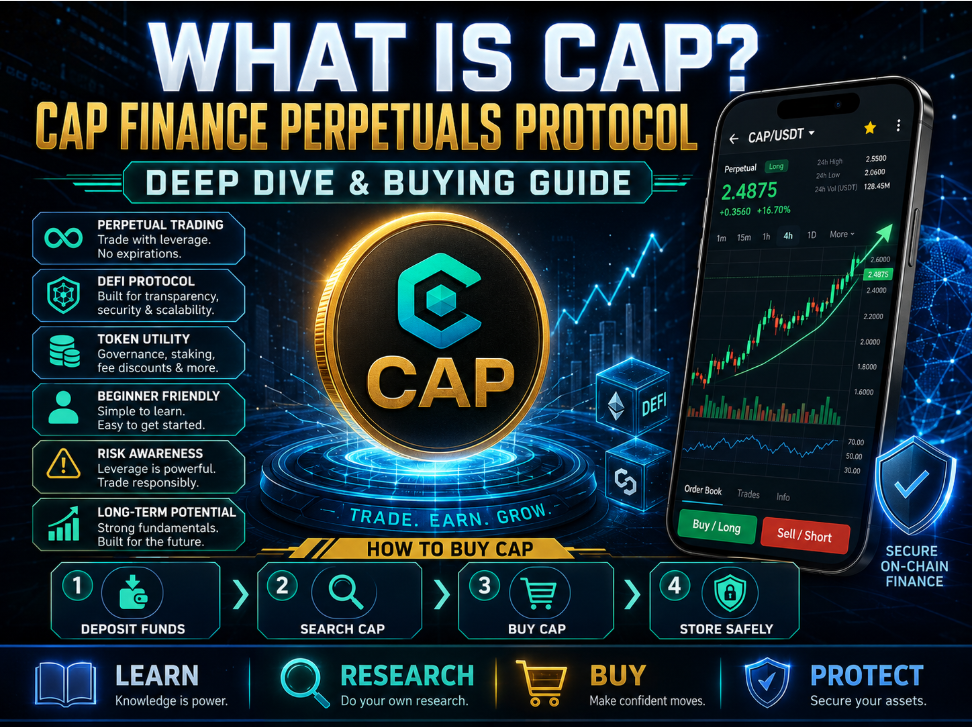
Centralized derivatives exchanges — think Binance Futures, OKX Futures, or Bybit Futures — run their own matching engine, account system, risk controls, and custody. You sign up, complete KYC, deposit USDT, and trade through the exchange's order book.
A decentralized perpetuals protocol like Cap Finance instead works more like a combination of smart contract + oracle + liquidity pool:
- You connect via a wallet rather than logging into an account
- Margin is typically denominated in mainstream assets like ETH or USDC
- Trade execution, pool accounting, and reward distribution happen on-chain
- There's no custodial account holding your funds
- Protocol safety depends on the smart contracts, oracle design, liquidity pool structure, and governance
Neither model is strictly better. Centralized exchanges offer deeper liquidity, faster matching, and a lower barrier to entry. Decentralized protocols offer more transparency and a verifiable on-chain fund trail.
That said, decentralized protocols come with a steeper learning curve. You need to understand wallets, chains, gas fees, contract approvals, slippage, oracle pricing, and liquidation mechanics. On-chain mistakes are often irreversible.
How a Decentralized Perpetuals Protocol Actually Works
A protocol like Cap Finance generally involves three participants:
Traders. They open long or short positions backed by margin. Correct calls generate profit; wrong calls erode margin and can eventually trigger liquidation.
Liquidity providers. They deposit ETH, USDC, or similar assets into a pool that takes the other side of trader positions. When traders lose money overall, the pool tends to gain; when traders win overall, the pool pays out.
Token holders/stakers. CAP can be staked to earn a share of protocol revenue. In other words, CAP isn't just a governance token — it has a direct link to trading volume, fee revenue, and staking yield.
The core mechanic: traders pay fees, the protocol earns revenue, and a portion of that revenue flows to liquidity providers and CAP stakers. So CAP's long-term value case isn't really about hype — it's about whether the protocol can sustain real trading volume.
Where Does the Fee-Sharing for CAP Holders Come From?
One of CAP's most appealing pitches is that staking it earns you a cut of protocol revenue. A common beginner misconception is assuming this yield comes from "project subsidies" or token inflation.
If a protocol funds staking rewards purely by minting new tokens, the headline APY might look great short-term, but it can cause serious long-term dilution — more tokens chasing the same value, with price erosion eventually outpacing the "high yield."
Cap Finance's design leans toward a real-revenue model instead: traders pay fees, a slice goes to CAP stakers, and rewards are paid in ETH or USDC rather than freshly minted CAP. The advantages:
- Yield doesn't depend on continuous token issuance
- Rewards track actual trading activity
- Stakers receive assets that are easier to value
- Lower inflationary pressure on the token
The trade-off: if trading volume drops, fee revenue drops, and so does staking yield. CAP staking is not a fixed-income product, and it's never a sure thing.
Why Margin in ETH/USDC Instead of the Protocol's Own Token?
This is a meaningful design choice. If a perpetuals protocol required users to post its own token as margin, it would boost token demand on paper — but it would also raise risk substantially. Native token prices tend to be volatile, so a market downturn shrinks margin value fast and can trigger cascading liquidations.
Using ETH or USDC as margin instead has real benefits:
- ETH and USDC are far more liquid
- Users have an easier time pricing their margin
- Margin volatility is more contained
- It avoids the negative feedback loop of "token drops → margin shrinks → liquidations rise → token drops further"
- It's friendlier to newer users
Stablecoins like USDC in particular let traders think in dollar terms, which makes tracking P&L much more intuitive for beginners.
2. Breaking Down CAP's Tokenomics: Supply, Circulation, Unlocks, and Distribution
Analyzing a DeFi token isn't just about price. A low price doesn't mean "cheap," and a high price doesn't mean "expensive." What actually matters is total supply, circulating supply, FDV, the unlock schedule, where staking yield comes from, and what the token is actually used for.
What's CAP's Total Supply?
Cap Finance's documentation lists a fixed total supply of 100,000 CAP, with no inflation. That's a notable departure from many DeFi tokens, which often reserve large allocations for ecosystem incentives, team vesting, market making, airdrops, or future fundraising — allocations that, if released too quickly, can create sustained sell pressure.
A fixed supply is straightforward:
- The cap on total supply is explicit
- There's no dilution risk from unlimited minting
- FDV is easy to calculate
- If rewards come from ETH/USDC rather than new CAP issuance, that's friendlier to long-term holders
That said, fixed supply doesn't guarantee the price goes up. Price still comes down to demand, real revenue, liquidity depth, and risk appetite.
How Should You Read Circulating Supply and FDV?
Real-time data for small-cap tokens like CAP can vary noticeably across platforms, so when researching, don't rely on a single third-party source. Cross-check:
- Official documentation
- Etherscan or Arbiscan contract pages
- Pricing pages on CoinGecko, CoinMarketCap, Coinbase, etc.
- On-chain tools like DEX Screener or DEXTools
- Official community announcements
The FDV formula is simple:
FDV = current price × maximum supply
With a max supply of 100,000 CAP:
- At $0.10, FDV is roughly $10,000
- At $1.00, FDV is roughly $100,000
- At $10.00, FDV is roughly $1,000,000
That's why a low-supply token with a "high" unit price isn't automatically expensive, and a high-supply token with a "low" unit price isn't automatically cheap. You have to weigh supply, circulation, volume, and liquidity depth together.
Could Team or Investor Unlocks Create Sell Pressure?
Cap Finance's early documentation emphasizes that the initial supply entered the market through public channels, without a traditional private presale. That's different from most VC-backed token models. For everyday investors, the upside is a simpler early sell-pressure structure — there's no large pool of low-cost institutional tokens waiting to unlock.
Still, caution is warranted. Even without a traditional presale, you can still run into:
- Concentrated holdings from early liquidity providers
- Whale wallets holding outsized shares
- Bridge-held balances
- Thin pool depth causing large slippage
- Liquidity drying up if project activity declines
So judging sell pressure isn't just about "are there VC unlocks" — you also need to check on-chain distribution. At minimum, look at three things:
- Top-10 wallet concentration
- DEX liquidity pool depth
- Real trading volume over the last 30 days
Even with zero team unlocks, a single whale sale can crash the price hard if daily volume is thin.
Trading, Pooling, Staking — Which Should a Beginner Choose?
Cap Finance breaks user participation into three broad paths: trading, providing liquidity, and staking CAP.
Trading means opening perpetual futures positions directly. This suits people with trading experience. Upside potential is high, but so is risk — beginners who don't understand leverage, margin ratios, liquidation price, or funding rates can lose money quickly.
Pooling means supplying ETH or USDC as liquidity. This effectively puts you on the counterparty side of trader positions. When traders lose overall, the pool tends to profit; when traders win overall, the pool can take losses. It's not simple "deposit and earn" — you're taking on counterparty risk.
Staking means locking up CAP to earn a cut of protocol revenue. This suits people who believe in the protocol's long-term growth. Returns come from a share of real revenue, so yield fluctuates with trading volume. It's generally a better fit for passive holders than direct futures trading, but it still carries token price risk, declining protocol revenue, and smart contract risk.
For beginners, a sensible order of priorities:
- Learn first — don't jump straight into leverage
- If you mainly want exposure to the project's long-term value, a small spot position beats high-leverage trading
- Before staking, confirm the staking contract, lockup terms, reward asset, and claim process
- Before pooling, make sure you understand how the pool can lose money
How Does CAP Compare to GMX and dYdX?
GMX and dYdX are both significant players in decentralized derivatives, but each emphasizes something different.
GMX leans toward a mature "trading platform + liquidity pool + token staking" model, where users can trade perpetuals or earn fees by providing liquidity, and the token combines governance, staking, and a share of protocol revenue.
dYdX leans toward professional trading infrastructure — high-performance order books, a polished trading experience, and strong mobile/API support — with its token oriented more toward chain security, staking, and governance.
Cap Finance's point of difference is a very small, fixed supply, rewards paid in ETH/USDC rather than newly minted tokens, and no inflationary incentive program. The upside is a simpler model with more transparent dilution risk; the downside is that protocol scale, liquidity, brand recognition, and trading depth likely lag behind the bigger names.
In short, CAP is probably best categorized as a high-risk, small-cap, revenue-sharing DeFi token — not a blue-chip, low-volatility asset.
3. Is CAP Worth Investing In? A Three-Part Risk/Reward Framework
Deciding whether CAP is worth buying takes more than just "it shares fee revenue." A real evaluation looks at security track record, growth drivers, and risk exposure.
Does a Clean Security History Justify Long-Term Confidence?
A protocol that's run for years without a major hack is a genuinely positive signal. In DeFi, contract bugs, oracle exploits, private key mismanagement, and front-end hijacking can all lead to losses, so surviving multiple market cycles unscathed suggests the protocol has been tested to some degree.
But beginners need to internalize one thing: no past hacks doesn't mean no future hacks. The reasons are straightforward:
- Contracts can be upgraded, introducing new bugs
- Front ends can be compromised
- Oracles can fail under extreme volatility
- Liquidity pools can be drained during sharp moves
- New features can introduce new vulnerabilities
- Attackers sometimes wait for larger TVL before striking
A clean track record is a plus, not a reason to go all-in.
What Actually Drives CAP's Price?
CAP isn't a pure meme coin — it's better analyzed through the lens of a "protocol-revenue asset." Four main drivers stand out.
Trading volume growth. Since the protocol's revenue comes from trading activity, rising volume means rising fee revenue, which can lift expected staking yield.
TVL and pool depth. TVL reflects the protocol's ability to attract capital. For a perpetuals protocol, a healthier pool supports larger positions and a smoother trading experience.
Staking ratio. Heavier staking shrinks the circulating float, which can increase price sensitivity to demand — but if yield drops, stakers may unstake and sell.
Broader DeFi sentiment. When risk appetite is high, small-cap DeFi protocols attract more capital; in risk-off periods, capital tends to rotate into BTC, ETH, stablecoins, or major exchange tokens, leaving smaller protocol tokens under more pressure.
For a framework on building long-term price expectations for similar small-cap tokens, see HiBT's LFI price prediction for 2030 — the approach there emphasizes looking past short-term price swings to break down token utility, supply/demand structure, sector potential, and risk discounting.
Three Risks Beginners Tend to Overlook
Smart contract risk. Any time funds enter an on-chain protocol, contract risk applies. Audits reduce risk but never eliminate it.
Liquidity depth risk. The biggest fear with small-cap tokens is "it's up a lot, but I can't actually sell." Thin order books mean market orders can cause severe slippage — don't use large market orders on low-liquidity assets.
Regulatory uncertainty. Perpetual futures, leverage, and revenue-sharing models can all face regulatory scrutiny in different jurisdictions. Even if the protocol itself is decentralized, its front end, the exchanges listing it, and the channels used to access it can all be affected by policy changes.
4. Due Diligence Checklist Before Buying CAP
If "fee sharing," "low market cap," and "100x potential" are the only reasons you want to buy CAP, stop and slow down first. Investing in small-cap DeFi tokens isn't a blind-box purchase — it requires real homework up front.
Check Real Trading Volume and Market Depth
At minimum, look at:
- 24-hour trading volume for CAP/USDT on the exchange
- DEX pool liquidity depth
- Bid-ask spread
- Whether volume has been consistent over the past 7 days
- Whether there are sudden pump-then-volume-disappears patterns
- How much slippage a large buy or sell order would cause
If 24-hour volume is consistently low, the token may not be suitable for moving significant size. For everyday investors, low liquidity isn't a minor detail — it directly determines whether you can actually exit a position when you want to.
Check Holder Concentration
You can check holder concentration via a block explorer. Look specifically for:
- Top-10 wallet share of total supply
- Whether any of those addresses are exchange wallets
- Whether any are bridge addresses
- Whether any are contract-locked
- Whether large holders have recently been moving funds to exchanges
If a handful of unlabeled wallets hold an outsized share — and they're not clearly tagged as contracts, pools, or exchange addresses — treat that as a red flag. A single large sale could crash the price instantly.
Assess Treasury Health
A DeFi protocol's treasury size matters less than its composition and how it's used. A healthy treasury typically:
- Isn't entirely denominated in the protocol's own token
- Holds a meaningful share of stablecoins or mainstream assets
- Has transparent spending
- Operates on a clear budget
- Doesn't make frequent transfers to unlabeled wallets
- Is trackable by the community
If a treasury is mostly its own token, its value can collapse quickly during a downturn, leaving it unable to fund ongoing operations.
How to Read Community and GitHub Signals
Community activity shouldn't be measured by follower count alone — those can be bought or inflated. More meaningful signals include:
- Genuine technical discussion on Discord or Telegram
- The team actively responding to user questions
- Ongoing commits on GitHub
- Regularly updated documentation
- A public roadmap
- Timely disclosure when issues arise
If documentation is stale, code hasn't been touched in a long time, and the community has devolved into pure price talk, that usually signals weakening fundamentals.
Marketing Phrases to Watch Out For
Beginners are most often misled by lines like:
- "Zero-risk yield"
- "Guaranteed staking returns"
- "Low cap, 100x potential"
- "About to list on a major exchange"
- "Institutions are accumulating"
- "Last chance to get in"
- "This coin can never go down"
Serious projects and credible analysts never promise guaranteed returns. Any content emphasizing certain riches should be treated as a warning sign in itself.
5. A Practical Guide to Buying CAP on HiBT — Verify First, Then Trade
This section deserves special emphasis: since multiple unrelated tokens share the "CAP" ticker, you cannot assume that CAP/USDT on HiBT automatically refers to Cap Finance.
Based on public announcement information, the CAP project HiBT listed describes itself as a "Credit platform backed by financial guarantees," with its website pointing to cap.app and a contract address on Ethereum at 0x99991c6aabba5a096f24f250b73580f5179b9999. That does not match the contract documented by Cap Finance's perpetuals protocol.
So if your goal is specifically to buy Cap Finance's CAP, first confirm whether HiBT actually supports that specific contract. If the listing page describes the cap.app project, it is not the Cap Finance token covered in this article.
The steps below assume you've already confirmed that the exchange listing, official website, and contract address all match.
Step 1: Register on HiBT and Complete KYC
After visiting HiBT's official website or app, sign up using your email or phone number. New users should immediately take three steps:
- Set a strong password
- Enable Google Authenticator or another 2FA method
- Complete identity verification (KYC)
KYC usually requires an ID document and a selfie or facial verification. Review time depends on the platform's risk controls and the clarity of submitted documents — sometimes it's instant, sometimes it takes longer.
Suggested screenshots: account registration page, identity verification page, security settings page.
Step 2: Fund Your Account
Buying CAP usually means having USDT ready first. There are two common funding methods:
Fiat-to-USDT. Best for users with no existing crypto holdings. It's straightforward, but may involve payment processing fees, exchange-rate spreads, and regional restrictions.
On-chain USDT deposit. Best for users who already hold crypto in a wallet or another exchange. It can be cheaper, but you must select the correct network. ERC-20, TRC-20, BEP-20, Arbitrum, and other networks are not interchangeable — sending on the wrong network can result in lost funds.
Beginners should stick to networks the platform explicitly supports and that they're familiar with. Test with a small amount first, confirm it arrives, then move larger amounts.
Suggested screenshots: deposit entry point, USDT network selection, deposit address copy screen.
Step 3: Search for the CAP/USDT Pair
Go to the spot trading section and search "CAP." If multiple similarly named assets appear, check each one carefully:
- Full project name
- Official website
- Contract address
- Network
- Announcement date
- Whether it's a spot pair (CAP/USDT) versus a futures or campaign listing
Beginners should generally stick to spot trading rather than jumping straight into futures — the goal here is understanding the asset itself, not short-term leveraged speculation.
Suggested screenshots: CAP search results, CAP/USDT trading pair page, project info popup.
Step 4: Market Order or Limit Order?
The two most common order types when buying CAP are market and limit orders.
Market orders fill quickly but can incur significant slippage — especially risky for large buys on a low-liquidity small-cap token.
Limit orders give you price control, but may not fill immediately. If you're not in a rush, limit orders let you scale in gradually instead of buying at a short-term spike.
A more disciplined approach:
- Start with a small test order
- Check the fill price and slippage
- Avoid large market buys when chasing a rally
- Don't buy impulsively right after a major announcement or during sharp volatility
- Buy in batches and keep reserve capital for averaging in later
Suggested screenshots: limit order input, market order input, trade history page.
Step 5: Keep on the Exchange or Withdraw to a Wallet?
After buying CAP, you have two options.
Keep it on HiBT. Convenient for active trading, but your assets are custodied by the exchange, so you're exposed to platform and account-security risk.
Withdraw to a Web3 wallet. Gives you self-custody and lets you participate in on-chain staking or governance, but you're responsible for safeguarding your seed phrase and bear the risk of on-chain operation errors.
If you're trading short-term in small size, keeping funds on the exchange is more convenient. If you plan to hold long-term and stake through Cap Finance directly, you'll need to research the official staking entry point, contract address, and supported networks — and double-check the destination chain and contract before transferring.
Suggested screenshots: assets page, withdrawal page, wallet receiving address, on-chain confirmation screen.
6. Managing a Position After You Buy: Three Holding Strategies Compared
Buying is just the start — what actually determines your outcome is how you manage the position afterward.
Short-Term Swing Trading
Short-term trading suits people experienced with candlestick patterns, volume, and order-book depth. Small-cap DeFi tokens like CAP tend to be volatile — sharp short-term rallies driven by announcements, community buzz, exchange listings, or promotions, followed by equally sharp pullbacks when liquidity thins out.
The point of a short-term strategy isn't predicting the exact top — it's risk control:
- Keep individual position sizes modest
- Don't chase consecutive big green candles
- Set stop-losses
- Take profit in batches
- Avoid high leverage
- Avoid entering or exiting size when liquidity is thin
If you have no short-term trading experience, CAP probably isn't the right vehicle to learn on.
Long-Term Holding
The case for holding CAP long-term rests on believing trading volume, fee revenue, staking yield, and overall market valuation will all improve over time.
Reasonable preconditions for long-term holding:
- You understand how the protocol works
- You can tolerate significant drawdowns
- You're willing to keep tracking protocol metrics
- You won't chase pumps or panic-sell dips
- You're not investing money you need for daily living expenses
The biggest risk to long-term holding is declining protocol activity. If trading volume shrinks, community interest fades, and code/documentation go stale, the token can sit with little buying interest indefinitely — fixed supply or not.
Staking for Fee-Sharing Yield
The advantage of staking CAP is earning a cut of protocol revenue, typically tied to trading volume. If volume grows steadily, stakers may see a more direct cash-flow-like return.
But beginners should remember staking yield isn't risk-free yield. Pay attention to:
- Current staking APR/APY
- What asset rewards are paid in
- Whether claiming is manual
- Whether there's a lockup period
- Whether unstaking has a waiting period
- Whether the staking contract is the official one
- Whether yield is enough to offset price volatility
A high headline APY can be misleading. If CAP's price drops 50%, a 10% annualized reward still leaves you net negative. Staking works best as a yield enhancement for long-term holders — not a short-term arbitrage play.
For a comparison point on infrastructure/staking-style assets, see HiBT's RPL price prediction for 2030, which applies a different valuation lens — staking and infrastructure economics — that's worth contrasting against CAP's trading-revenue model.
Setting Stop-Loss and Take-Profit Levels as a Beginner
The most common beginner mistake is having no plan at all — not knowing when to sell on the way up, refusing to cut losses on the way down, and ultimately letting emotion take over.
A more disciplined approach is to write down three things before buying:
Why am I buying? Is it conviction in the protocol's long-term revenue, or a reaction to short-term announcement hype?
What's my "I was wrong" signal? Examples: breaking below a key cost basis, volume disappearing, the project going quiet, or official information conflicting with what the exchange shows.
When will I sell? You might take partial profit at +30%, recover your principal at +100%, and let the rest ride. Or set a fixed stop-loss — say, exiting at -15% to -20% — rather than averaging down indefinitely.
Small-cap tokens like CAP are not suited to "buy more every time it drops" without limits. Averaging down should only happen if fundamentals haven't deteriorated, liquidity hasn't dried up, and your position size is still manageable.
7. FAQ
1. How do I tell Cap Finance's CAP apart from other tokens using the same name?
Check four things: official website, contract address, chain, and project description. Cap Finance's perpetuals-protocol CAP should not be confused with the cap.app credit platform's CAP, a Sui-chain meme coin called CAP, a Solana-based CAP, or any other lookalike. A shared ticker doesn't mean a shared project. If you see CAP/USDT on an exchange, always open the project detail page and verify the website and contract address — don't trade off the name alone.
2. Is the CAP on HiBT the same as Cap Finance?
Based on public announcements, the CAP project HiBT listed on June 26, 2026 points to cap.app and describes itself as a credit platform — not the Cap Finance perpetuals protocol. So if you specifically want Cap Finance's CAP, you'll need to wait for further exchange clarification, or verify and purchase through an officially documented contract on a supported chain. The key takeaway: the existence of a CAP/USDT pair doesn't guarantee it's the CAP you're actually looking for.
3. What fees apply to trading CAP on HiBT?
Generally three categories: spot trading fees, network fees for deposits/withdrawals, and slippage costs in low-liquidity conditions. Exact rates depend on your HiBT account tier, the fee schedule, and the order confirmation screen. Slippage is the cost beginners most often overlook — even with low trading fees, a large market order against a thin order book can move the fill price well away from the quoted price.
4. Do I automatically earn fee-sharing just by holding CAP?
Generally, no — simply holding CAP usually doesn't generate yield automatically. You typically need to deposit CAP into the official staking contract to earn a share of protocol revenue based on your staked amount. Whether rewards are auto-distributed or require manual claiming, and whether they're paid in ETH or USDC, depends on the official staking documentation. Never send CAP to an unfamiliar contract, and never click a "staking link" shared casually in a community chat — always go through the official documentation or official social accounts.
5. Is CAP recognized or regulated by financial authorities?
CAP is a crypto asset involving DeFi, perpetual futures, and revenue-sharing mechanics — all of which carry complex financial characteristics. Regulatory treatment varies significantly by country and region. Don't interpret an exchange listing, influencer endorsement, or community hype as "regulatory approval." Before participating, check your local laws to confirm whether trading, holding, or using the protocol is permitted where you live.
6. How much CAP should a beginner buy?
There's no universal answer, but for a high-risk, small-cap DeFi token, the general principle holds: only invest money you can afford to lose, don't borrow to buy, don't go all-in, and don't use money earmarked for living expenses. If you're just learning, start with a very small position and treat it as a case study for understanding DeFi protocols rather than a path to quick riches.
8. Risk Disclosure and Disclaimer
When researching CAP, treat your sources in tiers.
Primary sources include: official documentation, official announcements, the official contract address, block explorers like Etherscan or Arbiscan, the protocol's own front end, official GitHub repositories, and formal exchange announcements.
Secondary sources include: influencer opinions, community discussion, market-data app descriptions, third-party research articles, news coverage, and price-prediction websites.
Use primary sources to confirm facts; treat secondary sources as supplementary context only. Given how many unrelated tokens share the "CAP" name, verifying the official website and contract address should always come first.
This article is intended for educational purposes around crypto fundamentals and trading mechanics. It does not constitute investment advice, financial advice, or a recommendation to buy or sell. Cryptocurrency prices are highly volatile, and DeFi protocols carry smart contract risk, liquidity risk, oracle risk, regulatory risk, and operational risk. Past performance does not guarantee future results, and any fee-sharing, staking yield, or protocol revenue can decline or stop entirely as market conditions change.
If the platform publishing this article, its author, or any related trading platform has a partnership, promotional arrangement, holding, or other commercial relationship with the CAP project, that relationship should be clearly disclosed at the beginning or end of the article. Transparent disclosure doesn't undermine an article's credibility — it's a core part of building EEAT.
One final reminder: before buying CAP, make absolutely sure you know which CAP you're buying. For beginners, picking the wrong project is far more dangerous than paying a slightly high price for the right one.