
What Is SPCXUSD1? And Why Is SpaceX Entering the Crypto Trading Arena?
When most newcomers first see SPCXUSD1, their immediate reaction is usually: Is this a new coin? Did SpaceX officially launch a token? Does buying SPCXUSD1 mean I own SpaceX stock?
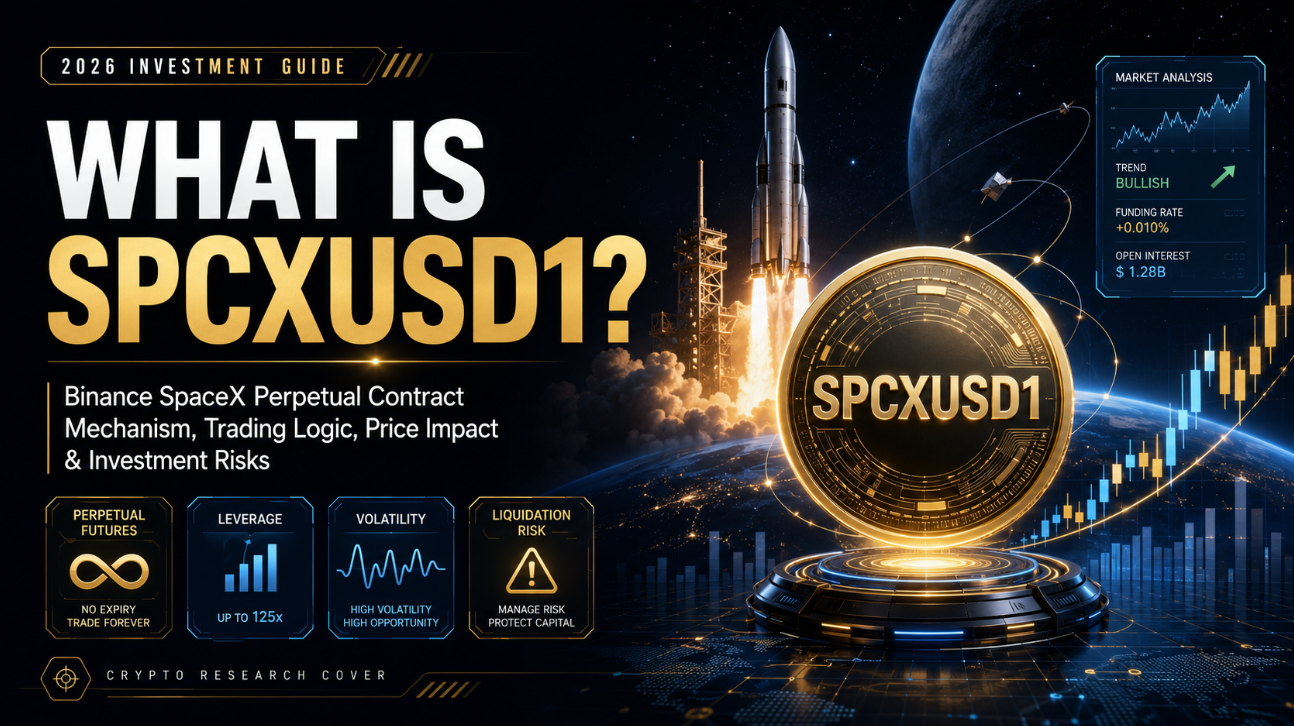
Let's clear that up right away: SPCXUSD1 is not SpaceX stock, nor is it an official SpaceX cryptocurrency. It is a perpetual contract product designed around price exposure tied to SpaceX. Its core purpose is not to grant equity in the company, but to allow traders to go long or short based on SpaceX-related price movements.
According to Binance Academy’s explanation of the SPCXUSDT product, Binance Futures previously launched a SpaceX-linked USDⓈ-margined perpetual contract, and after SpaceX went public, it transitioned from a Pre-IPO perpetual to a standard TradFi perpetual framework. A perpetual contract is, by nature, a derivative that tracks an underlying price but does not hold the actual stock.
For everyday users, the key to understanding SPCXUSD1 isn't memorizing the contract name – it's grasping the asset hierarchy:
- SPCX represents the SpaceX-related price identifier or stock ticker.
- SPCXUSD1 is the perpetual contract that lets you trade on SPCX price movements. If the platform uses USD1 as the settlement asset, your P&L will be settled in USD1.
Before trading, always refer to the contract name, margin asset, settlement asset, leverage, funding rate, and risk rules as displayed on Binance or your chosen trading platform.
SPCXUSD1 is a prime example of traditional financial assets making their way into crypto markets. In the past, stocks, IPOs, and single-stock derivatives were mostly offered by brokerages and legacy financial institutions. Today, products like RWA, Tokenized Stock, TradFi Perpetuals, and Pre-IPO Perpetuals are giving crypto users access to traditional asset price exposure. When Binance announced its Pre-IPO Perpetual product in 2026, it emphasized that these contracts allow eligible users to participate in market expectations around a company's public listing – and the very first such product was the SpaceX-linked SPCXUSDT Pre-IPO Perpetual.
So, think of SPCXUSD1 this way:
- It is not "buying SpaceX" – it's trading SpaceX price volatility.
- It is not "holding stock" – it's holding a derivative position.
- It is not a long-term equity vehicle – it's a trading tool suited for those with risk management skills.
This distinction matters. Many crypto newcomers assume that seeing an asset name on an exchange means they own the real thing. But in perpetual markets, you trade price changes, not company ownership.
What’s the Actual Relationship Between SPCX and SpaceX?
To understand SPCXUSD1, you first need to understand the link between SPCX and SpaceX.
SpaceX – Space Exploration Technologies Corp. – was founded by Elon Musk and is one of the world's most closely watched commercial space companies. Its core operations include Falcon rocket launches, Starlink satellite internet, the Starship heavy-lift system, commercial spaceflight services, and related space infrastructure. As SpaceX itself notes, Starship and Super Heavy are designed as fully reusable transport systems to carry crew and cargo to Earth orbit, the Moon, Mars, and beyond; Starlink is a low-Earth-orbit satellite constellation providing broadband internet services.
That means SpaceX's value isn't just about "building rockets." The market is excited for several long-term reasons:
- Reusable rocket technology dramatically lowers launch costs.
- Starlink could become a global satellite internet backbone.
- A mature Starship could transform deep-space transport and heavy-lift capabilities.
- Commercial space, defense contracts, satellite communications, AI infrastructure, and the broader space economy are all potential future growth stories.
SPCX is the market price identifier for SpaceX-related exposure. Binance Academy describes SpaceX as a company listed on Nasdaq under the ticker SPCX, with Binance products offering stock or derivative trading entry points tied to SPCX price performance.
But again: SPCXUSD1 is NOT SpaceX stock.
- Stock represents company ownership. Buying stock gives you shareholder status, and potentially voting rights, dividends, or other equity rights (depending on share class and platform terms).
- Perpetual contract represents price exposure. You are betting on price direction – up or down – but you do not own the underlying stock, are not a shareholder, and have no voting rights, dividends, or claim on company assets.
So, going long on SPCXUSD1 means you expect SPCX price to rise; going short means you expect it to fall. Your profit or loss comes from the contract's P&L, not from company dividends or equity appreciation.
This is critical for beginners: being bullish on SpaceX as a company does not automatically mean you should go long on SPCXUSD1. And believing in its long-term future doesn't protect you from sharp short-term contract drawdowns.
Binance SPCXUSD1 Perpetual Contract – How It Works
A perpetual contract is a futures-style derivative with no fixed expiry. Traditional futures have settlement dates; perpetuals can be held indefinitely, but exchanges use a funding rate mechanism to keep the contract price anchored to the underlying reference price.
In Binance's SPCXUSDT contract specifications, the product is described as having no expiry, with users needing to close positions to realise P&L. Open positions are subject to funding fees based on the Funding Rate mechanism. The contract's underlying is the ordinary share price of Space Exploration Technologies Corporation, with the contract quoted in USDT and settled in the settlement asset.
If you're looking at SPCXUSD1, think of it as the version that uses USD1 as margin or settlement currency. Important: USD1 is not SpaceX stock, nor is it physical US dollars – it's the settlement asset used in trading. Your contract P&L, margin, funding costs, and liquidation calculations all revolve around the platform's designated settlement asset.
SPCXUSD1 pricing can be broken down into four layers:
- Underlying reference price – The contract is anchored to SPCX price performance. If SPCX rises, long positions generally benefit; if it falls, longs lose and shorts gain.
- Exchange market price – The contract price is also influenced by buy/sell pressure on the platform. A rush of buyers can create a premium over the reference price; panic selling can create a discount.
- Funding rate – Because perpetuals never expire, the funding rate balances long and short costs. If longs are overcrowded, longs pay shorts; if shorts are overcrowded, shorts pay longs. For day traders, funding may be minor; for longer-term holders, it can significantly impact net returns.
- Liquidity and risk rules – Equity-linked perpetuals are not as mature as BTC or ETH contracts. Liquidity depth, trading hours, reference price stability, and price protection mechanisms during extreme volatility can all affect actual execution.
So, SPCXUSD1 is not a simple "up/down button." It's a complex instrument involving underlying price, leverage, margin, funding, liquidity, liquidation mechanics, and platform-specific rules.
How to Think About SPCXUSD1 Trading Logic
Many newcomers ask only one question: "Will it go up?"
But mature trading isn't about guessing direction – it's about understanding the drivers behind price moves.
Trading SPCXUSD1 is essentially trading market expectations around SpaceX-related assets. Those expectations come from company fundamentals, market sentiment, macro conditions, and crypto liquidity.
If you're bullish on SPCXUSD1, watch these factors:
- Starlink subscriber growth and revenue.
- Commercial launch cadence and backlog.
- Starship test milestones and cost-reduction progress.
- NASA, defense, and commercial satellite contracts.
- Broader tech-sector sentiment – if growth stocks are in favour, high-narrative assets like SpaceX tend to attract capital.
If you're bearish, don't ask "Is SpaceX a good company?" – ask "Is the current price already pricing in too much optimism?"
Even great companies can become overvalued. SpaceX is so high-profile that markets often price in years of future growth upfront. If Starship delays, Starlink growth slows, regulatory hurdles emerge, IPO hype fades, or macro liquidity tightens, the price can correct sharply.
That's why "good company" does not equal "good trade."
- A good company solves long-term value.
- A good trade solves price, timing, position sizing, and risk-reward.
How Does SPCX Relate to BTC and ETH?
SPCXUSD1, BTC, and ETH can all be traded in crypto environments, but their asset logic is fundamentally different.
- BTC and ETH are crypto-native assets. BTC leans toward digital gold, store of value, and decentralised consensus; ETH is smart-contract infrastructure powering DeFi, stablecoins, NFTs, Layer 2, and on-chain applications.
- SPCX is more like digital exposure to a traditional financial asset. Its price logic depends more on SpaceX itself, equity-market valuations, tech-stock risk appetite, and interest rates.
That said, in extreme risk-off environments, SPCX, BTC, and ETH can move in the same direction. When global risk appetite tanks, investors may sell tech stocks, high-growth equities, crypto, and derivatives all at once. So even though SPCXUSD1 isn't a crypto-native asset, it can still be affected by broader risk-asset cycles.
In other words, SPCXUSD1 sits at the intersection of TradFi and Crypto – it has stock-like fundamentals and crypto-like leverage and volatility.
Key Price Drivers for SPCXUSD1
Driver #1: SpaceX's own valuation
SpaceX's valuation revolves around Starlink revenue growth, launch business scale, Starship progress, government/commercial contracts, global satellite internet expansion, and the market's imagination about the space economy. If Starlink looks like a global communications backbone, SpaceX's revenue ceiling gets repriced. If Starship dramatically reduces launch costs, the business model gets revalued. If space economy, AI-satellite, and defence demand expand, SPCX gains a sentiment premium.
But valuation upgrades aren't one-way. The more attention a company gets, the higher the expectations. If growth slows, milestones slip, or profitability disappoints, the price can suffer. Binance Academy also warns that newly listed high-profile stocks may experience significant volatility in the weeks or months after an IPO – investor enthusiasm doesn't always reflect long-term fundamentals.
Driver #2: Macro environment
SPCX is a high-growth, high-narrative, high-multiple asset. Such assets are typically sensitive to interest rates. When rates are high, markets favour cash flow and earnings certainty, compressing high-multiple names. When liquidity is easy, tech stocks rally, and risk appetite improves, SPCX tends to attract attention.
Driver #3: Sentiment and news
SpaceX is closely tied to Elon Musk, so news, social media buzz, Starship test results, Starlink subscriber updates, IPO-related announcements, and institutional commentary can all move prices sharply in the short term. Perpetual markets amplify this – good news can trigger rapid spikes; bad news can cause cascading liquidations.
Driver #4: Contract market structure
SPCXUSD1 price isn't just about SpaceX – it's also about the contract market itself. Volume, open interest, funding rate, long/short ratio, liquidation data, and liquidity depth all influence short-term moves. If longs become overcrowded, even without fundamental changes, high funding costs or a long squeeze can trigger a pullback. If shorts are overcrowded, a short squeeze can send prices soaring.
SPCX Price Prediction – How to Analyse Future Moves?
Many users searching "SPCX price prediction" or "SPCX price prediction 2030" want a simple answer: "How high can it go?"
But a responsible price outlook should be layered – short-term, medium-term, and long-term.
Short-term: watch trading data
For short-term SPCXUSD1 trading, focus on volume, open interest, funding rate, long/short ratio, key support/resistance levels, market sentiment, and overall risk appetite. If price rises but volume doesn't confirm, it may be a shallow move. If price rises and funding rate spikes, longs are crowded – beware of a reversal. If price falls but shorts are extremely crowded, a bounce may be imminent.
To track SPCX live, you can use Hibt's SPCX market page for real-time price, candlesticks, and trading data. For forecast ranges, see Hibt's SPCX price prediction.
Medium-term: fundamentals and market environment
Medium-term price depends more on SpaceX business progress, any disclosed financials, Starlink growth, launch frequency, Starship milestones, tech-sector valuations, and the broader risk-asset cycle. If the market sees SpaceX's growth narrative being validated, SPCX can command a higher multiple. If expectations are already too high, price may enter a digestion phase.
Long-term: can SpaceX turn the story into cash flow?
By 2030, SPCX's long-term value shouldn't rest solely on Elon Musk's halo or space hype. It should hinge on whether SpaceX can consistently expand commercial revenue, lower launch costs, improve Starlink profitability, and maintain leadership in global satellite communications, commercial space, deep-space transport, and future space infrastructure. For a deeper long-term framework, read Hibt's 2030 SPCX price prediction.
The most important takeaway: SPCX's upside ceiling comes from SpaceX's commercial value growth, but your actual trading result depends on your entry price, leverage, funding costs, and risk management.
How Does SPCXUSD1 Compare to Other Investment Options?
Investors interested in SpaceX have several paths:
- Buy SpaceX stock directly – if your region and platform allow it, this is closer to traditional equity investing. Suitable for long-term holders focused on fundamentals, revenue growth, profitability, valuation, and competitive moats.
- Trade SPCXUSD1 – better suited for short- or medium-term traders, thanks to long/short, leverage, and flexible position management. But it comes with higher risks: liquidation, funding costs, forced closeouts, and contract price deviations.
- Indirect exposure via ETFs or baskets – if ETFs covering SpaceX or the space economy emerge, you can diversify single-stock volatility. But ETF returns tend to be less volatile (and less explosive) than single-name exposure.
- Stick with crypto-native assets – BTC, ETH, SOL, etc. Their value drivers are different (on-chain ecosystems, macro liquidity, regulation, ETF flows, DeFi development) and not directly tied to SpaceX.
So, SPCXUSD1 is not "better" than stocks and not "safer" than crypto – it's simply a higher-leverage, higher-flexibility, higher-risk way to trade SpaceX price exposure.
How to Check SPCX Market Data on Hibt
If you want to understand SPCX price action before trading contracts, start with the market page.
Hibt's SPCX market page shows real-time SPCX/USDT price, candlestick charts, market performance, and trading volume. For beginners, watching price action is more important than opening a position immediately.
When reviewing the chart, ask:
- Is the current price near short-term highs or lows?
- Is the recent rally backed by volume, or just sentiment?
- Is selling volume increasing on pullbacks?
- Is price approaching key support or resistance?
- Is the move driven by SpaceX news, tech-sector trends, or crypto market sentiment?
If you're new to SPCX, read Hibt's What is SPCX first to build a foundation, then combine it with market data and price forecasts before making any decisions.
The biggest mistake beginners make: chasing a hot narrative with high leverage, buying breakouts blindly, or panic-selling on dips. SPCXUSD1 is a derivative, not a spot asset – wrong position sizing and leverage can turn a minor directional error into a major loss.
What Are the Risks of Trading SPCXUSD1?
Risk #1: Leverage
Leverage amplifies both gains and losses. Without leverage, a 5% drop costs about 5%. With 10x leverage, a 5% adverse move could wipe out nearly half your capital – or trigger liquidation entirely. Many traders lose not because they were completely wrong on direction, but because they used too much leverage, had insufficient margin, or lacked clear stop-losses.
Risk #2: Funding rate costs
Perpetuals have no expiry, so funding fees are a real cost for longer-term positions. If you hold a long position while the funding rate remains positive, you keep paying. Even if price doesn't fall, funding can gradually eat into your returns. Conversely, if you're short in a crowded short environment, you may pay as well.
Risk #3: Equity-perpetual specific risks
SPCXUSD1 is not like BTC perpetuals. BTC trades 24/7 globally, while equity-linked contracts may be affected by traditional market hours, closures, corporate announcements, regulatory news, index pricing, and reference data sources. During off-hours, major announcements, or low liquidity, contract prices can gap or become erratic.
Risk #4: Price deviation risk
The contract price typically tracks the reference price, but during extreme conditions, order-book imbalances can cause temporary premiums or discounts. Using market orders, high leverage, or large size can expose you to slippage, unfavourable liquidation levels, or poor execution.
Risk #5: SpaceX valuation risk
SpaceX is a visionary company – but a great company isn't a great buy at any price. Markets can price in years of future growth. If growth underwhelms, valuations can contract. The biggest danger for SPCXUSD1 traders isn't ignoring whether SpaceX is good – it's ignoring how much of that "good" is already priced in.
Risk #6: Platform and product rules
Different platforms may have different contract names, margin/settlement assets, max leverage, maintenance margin, price protection, liquidation logic, and funding rate calculations. Always read the contract specifications for that specific product. Don't rely solely on articles, social media, or others' calls.
Binance's Pre-IPO Perpetual disclosures explicitly warn that these products carry high market risk and price volatility, may trigger margin calls or liquidations, do not represent underlying stock ownership, and are not sponsored or endorsed by the relevant stock issuer.
Who Is SPCXUSD1 Suitable For?
Good fit for:
- Experienced perpetual traders – those who understand stop-losses, margin, funding, liquidation prices, position sizing, and leverage risk, and can avoid emotional trading.
- Investors bullish on SpaceX's long-term value who cannot or prefer not to buy stock directly, and want to capture short- to medium-term price opportunities via derivatives – as long as they know that contracts are trading tools, not equity substitutes.
- Traders with a clear plan – e.g., low-leverage longs at key support, light shorts when sentiment overheats, or using only a small portion of capital that won't jeopardise their overall portfolio.
Not suitable for:
- Complete beginners with no prior perpetual experience. If you don't know funding rates, liquidation prices, or the difference between isolated and cross margin, stay away.
- Momentum chasers jumping in只是因为 SpaceX and Elon Musk hype. Hot assets can crash just as fast as they rally.
- Anyone with low risk tolerance – if a single losing trade could affect your lifestyle, emotions, or overall investment judgement, high-leverage SPCXUSD1 trading is not for you.
Final Takeaway: SPCXUSD1 Is Not SpaceX Stock – It's a SpaceX Price Trading Tool
SPCXUSD1 is a key concept within Binance's SpaceX perpetual contract ecosystem. It lets users trade long or short on SPCX price movements, but it does not represent direct SpaceX stock ownership, shareholder status, voting rights, or dividends.
To understand SPCXUSD1, think on three levels:
- It's a TradFi Perpetual – a bridge bringing traditional asset prices into crypto trading.
- It's a perpetual contract – with leverage, long/short, funding, margin, and liquidation mechanics.
- It moves with SpaceX price expectations – which themselves are driven by Starlink, Falcon, Starship, commercial space, tech valuations, macro conditions, and market sentiment.
For newcomers, the smartest learning path is:
- First, learn what SPCX is.
- Then, check SPCX market data.
- Next, review SPCX price prediction and the 2030 SPCX outlook.
- Only then decide whether to trade SPCXUSD1.
If you have no contract experience, the most important thing isn't predicting where SPCX will go – it's learning position sizing, understanding funding rates, setting stop-losses, and honestly assessing whether you belong in a high-volatility derivatives market.
The opportunity in SPCXUSD1 comes from SpaceX's enduring attention and market volatility; the risk comes from leverage, emotion, and price dislocation. For investors, the real edge isn't chasing the hype – it's understanding the product and risking only what you can afford to lose.
FAQ – SPCXUSD1 Common Questions
What is SPCXUSD1?
SPCXUSD1 is a perpetual contract product designed around SpaceX-related price exposure. It lets you trade on SPCX price movements. It is not direct SpaceX stock ownership, nor an official SpaceX token.
Can I buy SpaceX stock through SPCXUSD1?
No. SPCXUSD1 is a price-trading instrument, not a stock-purchase channel. Trading it gives you no shareholder rights, voting rights, dividends, or ownership in SpaceX.
What's the difference between SPCXUSD1 and SPCX?
SPCX is the price identifier or ticker representing the market's pricing of SpaceX-related equity. SPCXUSD1 is the perpetual contract that lets you trade on changes in SPCX price – the focus is on derivative trading, not holding the underlying.
Does SPCXUSD1 support leverage?
Yes, perpetuals typically support leverage, but leverage amplifies both profits and losses. Beginners should never use high leverage just because they like SpaceX – you must understand margin, liquidation prices, funding rates, and stop-loss rules first.
What factors affect SPCX price?
SPCX price can be influenced by Starlink growth, SpaceX launch activity, Starship progress, commercial space contracts, tech-stock valuations, Fed interest rates, market risk appetite, and news related to Elon Musk.
Is SPCX a good investment?
Whether SPCX is a good investment depends on SpaceX's long-term growth, current valuation, market conditions, your personal risk tolerance, and the type of instrument used. For SPCXUSD1, you must also factor in leverage, funding costs, liquidity, and liquidation risk.
Is SPCXUSD1 suitable for beginners?
If you have no prior perpetual trading experience, it's not recommended. Start by learning about SPCX fundamentals, reviewing market data, and understanding how perpetuals work – then practice with small size or paper trading.
Where can I check SPCX market data and price forecasts?
You can view SPCX real-time market data on Hibt, and refer to SPCX price prediction. For a longer-term view, read 2030 SPCX price prediction.