
What is NVDAON?
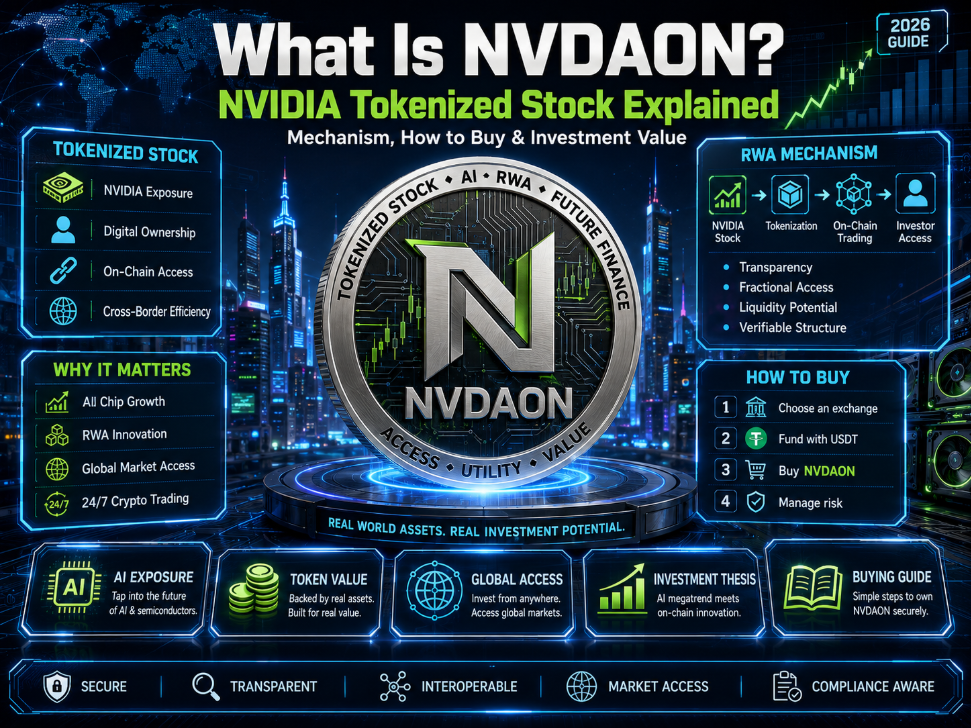
In one sentence: NVDAON is an NVIDIA tokenized stock product based on RWA (Real World Assets) that tracks the value performance of NVIDIA shares via blockchain, allowing eligible investors to gain NVIDIA exposure using crypto.
More precisely, NVDAON is neither an official NVIDIA cryptocurrency, nor an AI-themed coin, nor a meme token. It is a Tokenized Stock – a tokenized equity asset. CoinMarketCap’s listing describes NVDAon as Ondo’s tokenized version of NVIDIA, designed to give holders economic exposure similar to owning NVDA with dividends reinvested.
Quick facts about NVDAON:
- NVDAON is an NVIDIA‑related Tokenized Stock.
- NVDAON is an RWA asset.
- NVDAON is a stock‑mapped asset within the crypto ecosystem.
- NVDAON tracks the value performance of NVDA stock.
- NVDAON is not a new coin issued by NVIDIA.
- NVDAON is not an ordinary AI Token.
- NVDAON is not a Meme Token.
You can check the NVDAON real‑time price for current price, volume, market trends, and trading info.
1. What is NVDAON? Why is NVIDIA Stock Entering the Crypto Market?
This chapter answers: what exactly is NVDAON?
NVDAON is a Tokenized Stock asset linked to NVIDIA shares. Its underlying logic is not to “re‑issue an NVIDIA coin,” but to express the economic exposure of traditional stock assets through a blockchain token.
Traditional investment path:
Tokenized Stock path:
Investor
↓
Crypto platform or on‑chain wallet
↓
NVDAON
↓
NVIDIA stock value exposure
↓
RWA financial application
Ondo officially states that Ondo tokenized stocks are issued by the Ondo Stocks platform and are designed to give holders economic exposure similar to holding the underlying asset with net dividends reinvested; these tokens use the “on” suffix, e.g., TSLAon for Tesla.
Thus, NVDAON is not a “new AI coin” but an on‑chain representation of NVIDIA stock value within the crypto market.
1.1 What is the basic definition of NVDAON?
In asset classification terms, NVDAON falls into three categories.
First, it is a Tokenized Stock.
Tokenized Stocks convert traditional equity into blockchain‑tradeable tokens. Their core goal is to let users gain stock economic exposure via crypto infrastructure.
Second, it is an RWA crypto.
RWA (Real World Assets) refers to tokenizing real‑world assets – stocks, ETFs, bonds, Treasuries, gold, and real estate all fall under RWA.
Third, it is an NVIDIA‑related asset.
NVDAON’s price is highly correlated with NVIDIA stock (NVDA), but it should not be simply equated with NVDA held in a traditional brokerage account.
DefiLlama’s RWA page classifies NVDAon under Stocks & Equities, Stock Backed, and RWA assets, with Ondo as its parent platform. Therefore, NVDAON should be analysed using the RWA and Tokenized Stock framework, not a generic crypto token framework.
1.2 Why has NVIDIA become a热门 Tokenized Stock asset?
NVIDIA has become a prime Tokenized Stock asset primarily because it has emerged as one of the most critical infrastructure companies of the AI era.
In the AI industry, NVIDIA doesn’t just sell GPUs – it provides data‑centre compute, AI training, inference, networking, software ecosystems, and enterprise AI infrastructure. NVIDIA’s FY2026 annual report showed full‑year revenue of $215.9 billion, up 65% YoY, driven mainly by Compute & Networking – Data Centre compute revenue grew on Blackwell platform demand, and Data Centre networking revenue also rose significantly thanks to NVLink, Ethernet, and InfiniBand.
NVIDIA’s importance comes from four directions:
- GPU compute demand – large‑model training, inference, video generation, AI agents, robotics, and autonomous driving all require massive GPU and accelerated computing resources.
- Data centre growth – AI compute is shifting from traditional servers to AI data centres and AI factories. NVIDIA’s Q4 FY2026 revenue reached $68.1 billion (+73% YoY), with data‑centre revenue at $62.3 billion (+75% YoY).
- Cloud ecosystem – deep partnerships with AWS, Google Cloud, Microsoft Azure, Oracle Cloud Infrastructure, etc.; these cloud providers will be among the first to deploy Vera Rubin platform instances.
- AI model training & inference – as AI moves from training to inference and agentic workflows, demand for chips, networking, memory, storage, and system‑level optimisation continues – and becomes more complex.
Therefore, NVIDIA is not just a semiconductor company; it can be viewed as an AI‑era infrastructure company. This is why the crypto market is eager to bring NVIDIA stock into the Tokenized Stock and RWA ecosystem.
1.3 What are the differences between NVDAON and actual NVIDIA stock (NVDA)?
This is a core SEO question: NVDAON vs NVDA.
- NVDA is the ticker for NVIDIA in traditional securities markets. Investors buy NVDA through brokerage accounts, entering the stock market and securities regulatory framework.
- NVDAON is a tokenised asset linked to NVIDIA stock. It trades in the crypto market or on‑chain platforms, offering economic exposure to NVIDIA shares – not the stock itself in a brokerage account.
Key distinctions:
NVDA
NVDAON
Type
Traditional stock
Tokenized Stock
Purchase venue
Brokerage account
Crypto platform or supported wallet
Trading hours
Exchange hours
Potentially 24/7 on‑chain or platform trading
Rights
Defined by stock market rules
Depends on issuer, platform rules, custody, regional restrictions, and redemption mechanics
Economic exposure
Direct ownership
Total‑return tracker of underlying security
Ondo notes that its tokenized stocks are total‑return trackers of the underlying securities (reflecting price changes and reinvested dividends/interest). They are also transferable on supported chains and designed for use in DeFi protocols – e.g., as collateral for lending or in perpetual protocols.
So buying NVDAON is not simply “buying NVDA stock.” What you actually purchase is an on‑chain representation of economic performance tied to NVIDIA shares.
2. How does NVDAON work? The mechanism behind Tokenized Stocks
This chapter answers: how can a stock become a token?
Tokenized Stocks are a subset of RWA. RWA (Real World Assets) brings real‑world assets onto the blockchain – common examples include stocks, ETFs, gold, bonds, Treasuries, and real estate.
Basic logic of Tokenized Stocks:
Real stock
↓
Custody or asset‑backing structure
↓
Token issuance
↓
Blockchain
↓
Investor trading
↓
Potential DeFi integration
You can read What is TSLAX for a similar case. TSLAX is Tesla Tokenized Stock; NVDAON is NVIDIA Tokenized Stock – both tokenise US equities, but the underlying companies and investment themes differ.
2.1 How is the price of NVDAON determined?
NVDAON price is driven by four main factors:
- NVIDIA stock price – the most core factor. NVDAON aims to provide economic exposure to NVIDIA, so NVDA’s performance directly affects NVDAON.
- AI market cycles – if AI compute, data centres, cloud Capex, and enterprise AI adoption continue to grow, long‑term expectations for NVIDIA may rise, boosting NVDAON.
- Crypto market liquidity – though stock‑linked, NVDAON trades in crypto markets, so it is still influenced by USDT liquidity, platform depth, RWA sentiment, on‑chain capital flows, and overall crypto cycles.
- Token trading depth – if order books are thin, NVDAON may trade at a premium/discount or widen bid‑ask spreads even when NVDA is stable.
Thus, NVDAON price prediction cannot rely solely on NVIDIA stock – the maturity of the Tokenized Stock market itself matters.
2.2 Is NVDAON backed by real assets?
When researching NVDAON, investors must clarify four points:
- Who issues it?
- Who custodies the assets?
- Is it 1:1 backed?
- Can it be redeemed?
RWA.xyz’s asset page for NVDAon describes it as Ondo’s tokenised version of NVIDIA, offering economic exposure similar to holding NVDA with dividends reinvested. DefiLlama also lists NVDAon as a Stock Backed RWA asset under Ondo, with support across BSC, Ethereum, and Solana.
Ondo further states that its tokenized stocks benefit from low‑cost, fast minting/redemption and inherit traditional market liquidity to reduce slippage and price dislocation. Direct minting and redemption are typically available 24/5, while tokens themselves can be traded peer‑to‑peer 24/7 – though minting/redemption may be paused during corporate actions, market anomalies, or risk‑control triggers.
This confirms NVDAON is not an unsupported token; it has an RWA asset structure. However, investors must verify their actual rights based on platform terms, regional restrictions, redemption rules, and official disclosures.
2.3 How does NVDAON’s supply differ from ordinary crypto?
Many newcomers ask: why doesn’t NVDAON have a fixed supply like Bitcoin?
The answer: Tokenized Stocks do not have a fixed supply.
- Bitcoin – fixed supply and scarcity.
- Most L1 tokens – inflation, staking, network security.
- Meme tokens – fixed supply, community hype, liquidity speculation.
NVDAON, however, operates with dynamic minting and redemption. When market demand rises, the issuer may mint more tokens (backed by underlying assets); when users redeem or demand falls, supply can shrink.
So NVDAON’s long‑term value is not about “scarcity” but about:
- NVIDIA’s stock performance.
- Transparency of underlying asset backing.
- Smooth minting/redemption mechanisms.
- Sufficient market liquidity.
- Effective tracking of NVDA value.
This is one of the biggest differences between Tokenized Stocks and typical crypto tokens.
3. NVDAON Investment Thesis: Why focus on NVIDIA in the AI Era?
This chapter answers: where does NVDAON’s value come from?
NVDAON’s value base is not “AI hype” but NVIDIA’s intrinsic business strength and its position as AI infrastructure.
NVIDIA’s long‑term growth logic:
Growth in AI compute demand
↓
Growth in GPU & accelerated compute
↓
Data centre expansion
↓
Increased cloud Capex
↓
Enterprise AI adoption
↓
NVIDIA revenue & profit growth
↓
NVDA stock value change
↓
NVDAON price impact
NVIDIA’s FY2026 report showed Data Centre platform revenue of $193.7 billion (+68% YoY), with Gaming, Professional Visualization, and Automotive also growing. This highlights that NVIDIA’s investment case is heavily concentrated in AI data centres and accelerated computing, though not limited to GPU sales alone.
3.1 What are NVIDIA’s long‑term growth drivers?
Four main drivers:
- AI model scale – larger parameters, inference calls, enterprise agents, video generation, code generation, robotics – all require more compute.
- Cloud Capex – Microsoft, Amazon, Google, Oracle continue building AI infrastructure; NVIDIA GPUs, networking, and system solutions are key components. Cloud providers will be among the first to deploy Vera Rubin platform instances.
- AI chip competition – AMD, Google TPU, Amazon Trainium, custom ASICs, etc. Competition may compress margins but also expand the overall AI compute market.
- Data centre systemisation – future competition is not just single GPUs but whole‑stack systems (GPU, CPU, networking, memory, software, inference optimisation, rack‑scale). NVIDIA’s edge is that it has evolved from a chip supplier to an AI system platform.
3.2 Key variables for NVIDIA’s future growth
When analysing NVDAON, don’t just watch the token price – assess whether NVIDIA’s growth is sustainable.
- AI model & agent expansion – if AI moves from training to large‑scale inference and agents, compute demand may continue to rise.
- Cloud Capex trends – if major cloud providers keep investing in AI data centres, NVIDIA remains a beneficiary.
- Customer concentration & supply chain – heavy dependence on a few large cloud/data‑centre customers; if some customers accelerate in‑house chip development, long‑term growth expectations may be affected.
- Export controls & regional policies – AI chips are strategic; different countries’ export rules and regulations can impact NVIDIA’s revenue mix.
- Valuation – even with strong growth, high market multiples can lead to volatility. NVDAON investors should also monitor NVDA’s valuation risks.
3.3 How does NVDAON relate to the RWA trend?
The crypto market is shifting from pure digital asset trading toward on‑chain financial infrastructure.
- Past: BTC, ETH, meme tokens, DeFi tokens.
- Now: Tokenized Stocks, on‑chain Treasuries, tokenised ETFs, stablecoins, RWA lending, and composable DeFi.
NVDAON is a prime example of this trend: it brings economic exposure to a real‑world enterprise like NVIDIA into the crypto market.
If you want to understand the infrastructure relationship between AI, Web3, and RWA, read What is MUON – MUON represents Web3 infrastructure and data verification, while NVDAON represents the direction of AI enterprise assets entering on‑chain finance.
The future competition in crypto is not just which token rises fastest, but who can truly connect real‑world assets, on‑chain liquidity, and financial applications.
4. NVDAON vs Other Tokenized Stocks
This chapter answers: why are more US equities entering crypto?
Three reasons:
- Global users want US equity exposure – many crypto users are comfortable with USDT/USDC and wallets, but may not have easy access to traditional brokerages. Tokenized Stocks lower the barrier for some.
- Traditional assets seek on‑chain liquidity – stocks, ETFs, and bonds on blockchain can integrate with DeFi lending, collateralisation, and portfolio management.
- RWA is the next growth frontier – when native crypto growth stalls, on‑chain real‑world assets offer a much larger addressable market.
4.1 How do NVDAON, TSLAX, and CRCLON differ?
- NVDAON – underlying company NVIDIA; investment theme: AI chips, data centres, GPUs, accelerated computing, AI infrastructure.
- TSLAX (What is TSLAX) – underlying company Tesla; theme: EVs, robotics, Robotaxi, energy business, AI manufacturing.
- CRCLON (What is CRCLON) – underlying company Circle; theme: USDC, stablecoins, payment settlement, digital finance infrastructure.
All three are Tokenized Stocks and RWA plays, but their underlying assets are entirely different.
- NVDAON = AI compute.
- TSLAX = Tesla’s new energy & robotics.
- CRCLON = stablecoin financial infrastructure.
Investors shouldn’t just look at “they are all RWA” – first evaluate the underlying company, industry cycle, valuation, and token structure.
5. How to Buy NVDAON? A Step‑by‑Step Guide for Beginners
This chapter answers: how to buy NVDAON?
Before buying NVDAON, prepare four things:
- Crypto account – register on a platform that supports NVDAON trading, or prepare a compatible wallet.
- USDT or other supported assets – the Hibt quote page shows NVDAON real‑time price, so you can trade the NVDAON/USDT pair.
- KYC – Tokenized Stocks often involve securities‑related rules and regional restrictions; platforms may require identity verification.
- Check supported regions – some Tokenized Stock products may not be available to US persons or certain jurisdictions. Always verify with the platform.
Buying process:
- Step 1: Register on a platform that supports NVDAON trading.
- Step 2: Complete identity verification and security settings.
- Step 3: Deposit USDT or platform‑supported stablecoins.
- Step 4: Search for the NVDAON/USDT trading pair.
- Step 5: Confirm the official asset name, pair, and contract address.
- Step 6: Use limit orders or appropriate methods to buy NVDAON.
- Step 7: After purchase, monitor asset security and market liquidity.
Beginners should avoid large market‑buy orders because Tokenized Stocks may suffer from thin liquidity, wide spreads, and price deviations.
5.1 Is NVDAON safe? How to avoid fake tokens?
When searching for NVDAON, beware of NVDAON scams.
Common risks:
- Fake contract addresses.
- Imitation tokens.
- Impersonating official NVIDIA coin offerings.
- Impersonating Ondo official pages.
- DM requests to connect wallets.
- Fake airdrops and high‑yield schemes.
Remember: NVDAON is NOT an official NVIDIA coin. Any claim like “NVIDIA official token,” “NVDAON guaranteed to moon,” or “AI chip 100x coin” should raise red flags.
Five checks for trustworthiness:
- Listed on official/recognised platforms?
- Can you find it on Ondo’s or authoritative RWA data pages?
- Clear explanation of underlying asset backing?
- Real liquidity?
- No unusual high‑yield promises?
If you’re unsure about the contract address, don’t randomly click links from search engines. Instead, cross‑verify via Hibt quotes, Ondo’s asset page, CoinMarketCap, CoinGecko, or RWA data platforms.
6. NVDAON Price Prediction: Where is the upside?
This section is market analysis only – not investment advice.
NVDAON price prediction cannot be a simple target price. It is not a meme coin; it is a Tokenized Stock tied to NVIDIA. Future price depends on NVIDIA’s fundamentals, the AI industry cycle, RWA market development, and crypto liquidity.
You can check the NVDAON price prediction for market trend references, but do not treat prediction tools as guaranteed returns.
6.1 Factors affecting NVDAON price
- NVIDIA stock performance – if NVDA rises, NVDAON should theoretically follow; if NVDA falls, NVDAON is pressured.
- AI industry cycle – training, inference, agents, robotics, autonomous driving, enterprise AI – all shape long‑term expectations.
- Global compute demand – continued data‑centre expansion supports NVIDIA revenue; if cloud Capex slows, valuation may suffer.
- Crypto market environment – better liquidity attracts RWA assets; risk‑off sentiment can hurt NVDAON even if NVIDIA is stable. Check ETH price prediction to gauge crypto cycles and on‑chain sentiment.
- Tokenized Stock liquidity – thin depth can cause price deviation, slippage, and wider spreads.
6.2 Bull, Base, and Bear cases
- Bull Case: AI demand persists, cloud Capex remains strong, RWA market expands, NVDAON liquidity improves – dual benefit from NVIDIA fundamentals and Tokenized Stock adoption.
- Base Case: NVIDIA grows steadily but valuation normalises; NVDAON tracks NVDA without independent spikes – more a tool for on‑chain equity exposure than a speculative asset.
- Bear Case: AI investment cools, cloud Capex slows, competition intensifies, NVIDIA valuation corrects, or NVDAON liquidity dries up / regulatory restrictions tighten – price under pressure.
So, whether NVDAON can rise depends not on its name containing “NVIDIA” or “AI,” but on NVIDIA’s business growth, valuation, and RWA market support.
7. Risks of NVDAON: Must‑know issues before buying
This chapter answers: what are the risks of NVDAON?
- Not ordinary stock – holding NVDAON does not equal holding NVDA in a brokerage account. Confirm voting rights, dividend entitlement, redemption options, and how rights are defined by issuer/platform rules.
- AI stock valuation risk – high growth often comes with high multiples; if the market thinks AI investment is over‑heated or cloud Capex unsustainable, both NVDA and NVDAON can drop.
- Tokenized Stock liquidity risk – premiums, discounts, wide spreads, slippage. DefiLlama shows NVDAon has market caps and DeFi TVL across chains, but actual active on‑chain scale relative to total market cap requires careful monitoring.
- Regulatory risk – Tokenized Securities involve securities laws, investor qualifications, trading restrictions, and disclosure requirements across jurisdictions. Policy changes can affect NVDAON trading, redemption, or transferability.
- Platform and custody risk – NVDAON relies on issuer, custodian, trading platform, blockchain network, and smart contracts. Issues in any link can impair price tracking and asset safety.
- Fake token risk – scams are a major concern for beginners. The hotter the stock token, the more imitation contracts and phishing schemes appear.
- Crypto security risk – if you hold NVDAON on‑chain, protect your private keys, seed phrases, and contract approvals. Never connect to unknown DApps, click DM links, or transfer assets to unknown contracts.
8. Is NVDAON Worth Investing In? Who is it suitable for?
This chapter answers: is NVDAON worth investing in?
NVDAON may suit three types of investors:
- Long‑term AI believers – if you are bullish on NVIDIA’s role in AI chips, data centres, GPUs, inference, and cloud infrastructure, NVDAON offers a way to study NVIDIA exposure.
- Crypto‑native users – if you are familiar with USDT, crypto exchanges, and on‑chain assets but want to access traditional stock value, NVDAON provides a mapped equity asset in crypto markets.
- RWA investors – if you are positive on Tokenized Stocks and the broader trend of bringing traditional assets on‑chain, NVDAON is a representative case in AI chips.
But NVDAON is NOT for:
- Those seeking 100x moonshots – it is not a meme coin or micro‑cap story; it tracks NVIDIA value and RWA market structure.
- Those who don’t understand stock tokenisation – if you confuse NVDA stock, NVDAON, synthetic assets, perpetuals, and ordinary crypto tokens, don’t jump in heavily.
- Short‑term high‑frequency speculators – Tokenized Stocks may have insufficient depth and price deviations, unsuitable for those who ignore liquidity.
9. How to evaluate whether NVDAON is worth investing in?
Three layers:
Layer 1 – NVIDIA fundamentals
Focus on revenue growth, data‑centre revenue, GPU demand, cloud Capex, AI inference growth, gross margins, and competitive landscape. NVIDIA FY2026 full‑year revenue reached $215.9B (+65% YoY) and data‑centre revenue $193.7B (+68% YoY) – showing AI infrastructure demand remains the core growth driver.
Layer 2 – Token structure
Check whether NVDAON has underlying asset backing, redemption options, custody proof, regional restrictions, self‑custody possibilities, and effective tracking of NVDA.
Layer 3 – Market trends
Monitor RWA market growth, wider exchange support for Tokenized Stocks, improving crypto liquidity, and more RWA applications across Ethereum, BSC, Solana, etc.
If NVIDIA fundamentals are strong, NVDAON structure transparent, liquidity improving, and RWA trend expanding, the investment case becomes more compelling.
If NVIDIA is overvalued, AI demand slows, NVDAON liquidity is poor, or regulation worsens – caution is warranted.
FAQ: Common questions about NVDAON
Q1: What is NVDAON?
NVDAON is an NVIDIA‑related tokenized stock asset that provides economic exposure to NVIDIA stock value via blockchain. CoinMarketCap describes it as Ondo’s tokenized version of NVIDIA, aiming to offer economic exposure similar to holding NVDA with dividends reinvested.
Q2: What’s the difference between NVDAON and NVDA stock?
NVDA is the traditional NVIDIA stock in securities markets. NVDAON is a Tokenized Stock product in the crypto ecosystem. NVDA is bought through brokerage accounts; NVDAON trades on supported platforms or on‑chain. Prices are correlated, but rights, trading methods, and risks differ.
Q3: How to buy NVDAON?
Buy NVDAON using USDT on platforms that support it. Before buying, confirm the platform supports the asset, KYC requirements, regional availability, and the correct official trading pair and contract address. Start by checking the NVDAON real‑time price.
Q4: Is NVDAON safe?
Safety depends on the issuance mechanism, asset backing, custodian, trading platform, smart contracts, and your own wallet security. It is not risk‑free and does not equal directly holding NVDA stock.
Q5: Is NVDAON a scam?
NVDAON itself should be verified via public sources like Ondo, Hibt quotes, CoinMarketCap, CoinGecko, RWA.xyz, or DefiLlama. However, fake versions, imitation tokens, and phishing contracts do exist. Do not buy via unknown links or believe “official NVIDIA coin” claims.
Q6: Is NVDAON worth investing in?
That depends on a combined assessment of NVIDIA’s AI growth, NVDA valuation, Tokenized Stock adoption, NVDAON liquidity, regulatory environment, and your personal risk tolerance. NVDAON suits those interested in AI chips and RWA trends, not beginners looking to chase meme‑like pumps.
Summary: NVDAON is a key case of AI chip assets going on‑chain – but it is not ordinary cryptocurrency
NVDAON’s core value: it brings the economic exposure of NVIDIA – a global AI infrastructure giant – into the crypto market.
Strengths:
- Bridges NVIDIA stock value with crypto trading environments.
- Aligns with RWA and Tokenized Stock trends.
- Makes AI chip exposure more accessible to crypto users.
- Potential future integration with DeFi collateral, lending, and portfolio management.
Risks:
- NVDAON is not traditional NVDA stock itself.
- Holders may not have traditional shareholder rights.
- AI stock valuations can be volatile.
- Tokenized Stocks may suffer from liquidity and price‑deviation issues.
- Regulatory, custody, contract, and fake‑token risks require attention.
For beginners, the most important thing is not to mistake NVDAON for an “official NVIDIA cryptocurrency” or a generic AI‑theme coin. It is better understood as an on‑chain representation of NVIDIA’s economic exposure.
A more rational approach: first observe market performance via the NVDAON real‑time price, then build a comprehensive analytical framework by also reviewing the NVDAON price prediction, ETH price prediction, What is MUON, What is TSLAX, What is CRCLON, and Bitcoin $1M prediction analysis – covering RWA, AI chips, Tokenized Stocks, and broader crypto assets.
Whether NVDAON is worth investing in ultimately boils down to three questions: Can NVIDIA sustain its core AI infrastructure position? Is NVDAON’s token structure transparent and reliable? And can the RWA market continue to mature in compliance, custody, liquidity, and DeFi composability?