
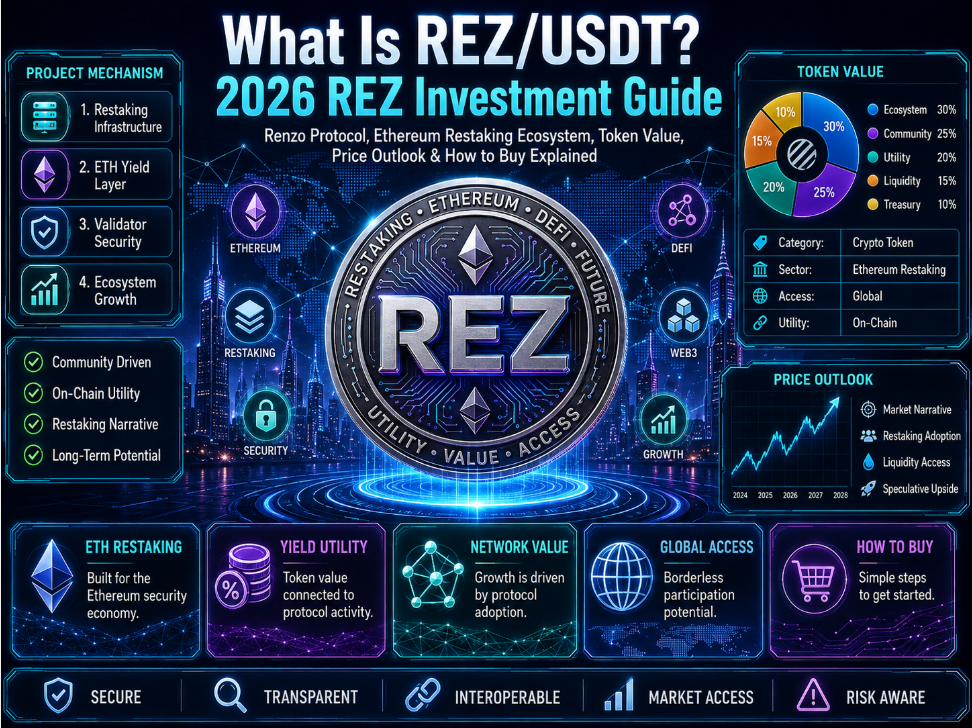
For a crypto newcomer searching for "REZ" for the first time, the most important step isn't immediately deciding whether "REZ will go up." It's understanding the project behind it: REZ is not a memecoin or a simple payment token — it's the native governance token of the Renzo Protocol ecosystem. Renzo Protocol is a Liquid Restaking protocol within the Ethereum Restaking space, designed to help users easily participate in ETH restaking while receiving liquid, tradable restaking assets.
In one sentence: REZ is the ecosystem token of Renzo Protocol, which is a Liquid Restaking protocol built on Ethereum and EigenLayer. Through assets like ezETH, Renzo lets users earn ETH restaking yields while keeping their assets liquid and usable across DeFi. According to Renzo's official docs, when users deposit ETH or LSTs into Renzo, they receive an equivalent amount of ezETH. Renzo acts as an entry point to Ethereum Restaking, routing users into EigenLayer's strategies.
So, investing in REZ isn't simply buying a "cheap coin." It's really about researching four questions:
- Does the Ethereum Restaking sector still have room to grow?
- Can Renzo maintain its market share amid Restaking competition?
- Can the REZ token truly capture the value generated by Renzo's growth?
- Has the current REZ/USDT price already priced in future expectations?
If you just want to check REZ's current market performance, visit REZ Live Price to see the REZ/USDT price, volume, and trends. If you're more focused on mid-to-long-term potential, use REZ Price Prediction for scenario modeling.
What is REZ? Why is Renzo a Standout Project in the Restaking Space?
REZ is the native governance token of the Renzo Protocol ecosystem. Its core role is not payments or pure speculation — it revolves around governance, ecosystem incentives, and future protocol decisions. Renzo's official docs define REZ as the protocol's governance token, with a total maximum supply of 10 billion tokens.
Renzo Protocol itself is a Liquid Restaking protocol. In simple terms, traditional ETH Staking means users lock ETH into Ethereum's validator set to earn base staking rewards. Restaking goes further: it extends ETH's security capabilities to additional services — such as AVSs, decentralized infrastructure, cross-chain services, and other systems that require cryptographic validation.
But directly participating in Restaking isn't easy for average users. You need to understand nodes, operators, AVSs, risk parameters, yield sources, and exit mechanisms. Renzo's value lies in productizing this complex Restaking workflow. Users can deposit ETH or LSTs via the protocol, receive ezETH, and continue using those assets in DeFi.
This is why REZ is drawing attention. Behind REZ isn't a standalone token — it's a combination play on the Ethereum Restaking sector, the EigenLayer ecosystem, LRT assets, and on-chain financial infrastructure.
For newcomers, think of it this way:
- REZ is not a memecoin.
- REZ is not an Ethereum mainnet asset.
- REZ is an Ethereum Restaking ecosystem token.
- One of Renzo's core assets is ezETH.
- REZ's long-term value depends on Renzo's protocol growth and its ability to capture token value.
So researching REZ isn't about whether the price is low — it's about whether Renzo can consistently attract ETH assets, whether ezETH maintains liquidity, whether the protocol generates revenue, and whether REZ gains real demand from governance and ecosystem incentives.
What is Ethereum Restaking? Why Does the Market Need Renzo?
To understand REZ, you must first understand Restaking.
Ethereum Staking is straightforward: users stake ETH to help secure the network and earn staking rewards. But staking has limitations — assets become illiquid, yields come mainly from Ethereum itself, and users can't easily extend the security of that same ETH to other on-chain systems.
Restaking emerged to allow ETH's security to be reused across multiple protocols. In other words, ETH can secure not only Ethereum itself but also, through Restaking infrastructure like EigenLayer, provide security for AVSs and many other decentralized services.
That's Renzo's opportunity.
As a Liquid Restaking protocol, Renzo lowers the barrier to entry. Users don't need to research each operator and AVS themselves, or manually manage complex strategies. They can access the Restaking market through Renzo. Renzo's official docs position it as one of the primary entry points to Ethereum Restaking, using smart contracts and operator nodes to help users implement risk-adjusted yield strategies.
Restaking is getting attention because it aims to solve the scalability of Ethereum's economic security. In the future, if more on-chain services require decentralized validation, Restaking could become critical infrastructure for the Ethereum ecosystem.
But investors must be aware: Restaking is not risk-free. It carries smart contract risk, AVS risk, asset de-pegging risk, cross-protocol contagion risk, and complex liquidity risk. A 2026 study also noted that Liquid Restaking introduces additional yield opportunities but also brings complex and interconnected DeFi risks.
So, REZ's investment thesis must consider both opportunity and risk — not just "Restaking is hot."
Renzo Protocol History: From ezETH to the REZ Ecosystem
Renzo first gained attention for offering a simpler entry point to ETH Restaking.
In Renzo's system, users deposit ETH or LSTs and receive ezETH. ezETH is a yield-bearing Liquid Restaking Token representing the user's Restaking position in Renzo. According to Renzo's docs, ezETH can be held in a wallet to accrue rewards, swapped on DEXs, or used across various DeFi applications.
This makes Renzo more than just a "staking platform" — it's infrastructure connecting ETH, EigenLayer, LRTs, and DeFi liquidity.
As the Restaking sector evolved, Renzo gradually expanded from a single Restaking gateway into a more complete ecosystem. The launch of the REZ token brought governance and token incentive phases. The docs show REZ is used for protocol governance, allowing holders and delegates to participate in future protocol decisions.
From an investment perspective, Renzo's development path can be broken into three steps:
- Solve the ETH Restaking accessibility problem.
- Enhance asset liquidity through ezETH.
- Use REZ to carry governance, incentives, and future protocol value.
But this doesn't guarantee REZ will rise. Product development is just the first layer. Whether REZ appreciates depends on genuine demand, lock-up mechanisms, revenue or resource allocation, and whether future unlock pressure is manageable.
What Are You Actually Investing In When You Buy REZ? A Four-Layer Value Logic
Investing in REZ is not simply betting on one project — it's betting on four layers of logic.
Layer 1: Bet on ETH staking growth. If ETH's long-term value rises, more users will want to stake, expanding the staking base. Restaking builds on top of ETH staking, so the larger the staking pool, the larger Restaking's potential market.
Layer 2: Bet on EigenLayer and Restaking ecosystem expansion. Renzo isn't the underlying Restaking infrastructure — it's a gateway and LRT protocol. Only if the EigenLayer ecosystem continues to grow, with more AVSs and clearer Restaking yield use cases, will Renzo have more room to scale.
Layer 3: Bet on Renzo's market share. The Restaking space is competitive. Users can choose Ether.fi, Puffer, Kelp DAO, and others. Whether Renzo can keep attracting TVL, expanding ezETH use cases, and improving user retention is the most critical fundamental variable.
Layer 4: Bet on REZ token value capture. This is the most important layer. Renzo's protocol growth doesn't automatically mean REZ's price goes up. You must assess whether REZ genuinely participates in governance, incentives, resource allocation, lock-ups, fee mechanisms, or ecosystem rights. If the protocol grows but REZ is just a weak governance token with no strong demand, price may not benefit long-term.
So, REZ's investment logic can be written as:
ETH growth → Restaking demand growth → Renzo TVL and ezETH adoption rise → Protocol revenue and ecosystem influence increase → Can REZ capture that value?
That final step is key — and where the risk lies.
REZ Tokenomics: Supply, Unlocks, and Value Capture
Tokenomics is a must-study for any REZ investor.
Renzo's official basics show a maximum supply of 10 billion REZ. CoinGecko data shows the circulating supply is already in the billions, with market cap changing with price and float.
Investors should focus on four key questions:
1. Is the max supply too large? 10 billion isn't inherently good or bad, but it means you can't judge value by price alone. If REZ's price looks low but its circulation and FDV are high, the real valuation may not be cheap.
2. What's the future unlock pressure? If teams, investors, ecosystem incentives, and DAO treasuries still hold large amounts yet to unlock, that could create sell pressure. Unlock schedules often impact secondary-market prices for DeFi tokens.
3. Is there real lock-up demand for REZ? If a governance token only has voting functions, value capture tends to be weak. What really matters is whether REZ will eventually tie into protocol revenue, reward boosts, staking rights, governance weight, or ecosystem resource allocation.
4. Does protocol revenue flow to token holders? DefiLlama data shows Renzo generates fees and revenue, but the "Token Holder Net Income" line is zero. This means you can't simply equate protocol revenue with REZ holder income.
So, remember this: Renzo growing does not mean REZ will rise. Only when protocol growth translates into REZ demand can token value become more secure.
Renzo Fundamentals: TVL, ezETH, Users, and Revenue
To judge whether REZ is worth investing in, don't just look at the chart — look at Renzo's fundamentals.
1. TVL (Total Value Locked) TVL represents the assets users deposit into the protocol. DefiLlama shows Renzo in the Liquid Restaking category, tracking its TVL, chain distribution (Ethereum, Linea, Arbitrum, etc.), fees, and revenue. Higher TVL means more users are willing to deposit assets. But TVL isn't a perfect metric — it can be influenced by ETH price swings, incentive campaigns, airdrop expectations, and market cycles.
2. ezETH Size ezETH represents Renzo's Liquid Restaking assets. If ezETH supply grows, liquidity deepens, and DeFi integrations increase, it signals stronger product traction.
3. Protocol Revenue DefiLlama shows fees, revenue, and cumulative revenue for Renzo. Fees come from staking, restaking, vault rewards, instant withdrawals, and Lido allocations, while revenue is the value retained by the protocol. For REZ investors, revenue matters more than TVL because it indicates real economic activity.
4. Market Share Renzo isn't the only Restaking protocol. Investors should track whether Renzo maintains a leading position in Liquid Restaking or loses ground to competitors like Ether.fi, Kelp, Puffer, and Mellow LRT.
5. User Growth If users are only here for an airdrop, they may leave after the token launch. If they stay for ezETH yields, liquidity, and DeFi composability, fundamentals are stronger.
6. REZ Market Liquidity REZ/USDT trading volume, exchange depth, bid-ask spreads, and CEX/DEX structure all affect your ability to enter and exit smoothly. For real-time data, check REZ/USDT Price.
Restaking Competitive Landscape: How Does REZ Compare to EigenLayer, Ether.fi, and Puffer?
REZ investors must understand the competitive landscape — Restaking is not Renzo's exclusive playground.
EigenLayer is the foundational Restaking infrastructure. Renzo, Ether.fi, Puffer, Kelp, and others all operate around the EigenLayer ecosystem. So REZ isn't directly equivalent to EigenLayer — it's more like an LRT gateway asset within EigenLayer's orbit.
Ether.fi is a strong competitor in Liquid Restaking, with a solid community, eETH ecosystem, and higher brand recognition. For Renzo, Ether.fi is one of the most important rivals.
Puffer leans more toward Native Restaking and validator infrastructure. Its narrative isn't identical to Renzo's, but it still competes for the same ETH Restaking users.
Kelp DAO is another major LRT player. The core competition is about who can attract more ETH assets, offer better liquidity, higher yields, and safer risk management.
Renzo's advantages:
- ezETH has built some market recognition.
- Renzo simplifies Restaking complexity for users.
- Multi-chain and multi-DeFi expansion.
- REZ provides a tokenized gateway for governance and incentives.
Renzo's risks:
- Intense LRT competition.
- Protocol growth may not translate to REZ price.
- ezETH liquidity and trust need long-term maintenance.
- REZ unlocks and sell pressure may impact price.
So, don't just claim "REZ is better than others." A more accurate conclusion: REZ is a high-beta asset within the Restaking sector. If Restaking continues to grow, REZ may benefit; but if competition intensifies, yields drop, or markets turn cold, REZ could experience greater volatility than ETH.
How Does ETH's Price Cycle Affect REZ? Is REZ an ETH Beta Asset?
REZ is closely tied to ETH, but it is not ETH and cannot replace ETH.
REZ behaves more like a high-beta asset within the ETH Restaking ecosystem. High-beta means when the ETH ecosystem strengthens, REZ may rally faster; but when ETH drops or DeFi risk appetite falls, REZ may also decline more sharply.
In a bull market:
- ETH price rises → optimism around Ethereum ecosystem assets.
- ETH staking pool expands.
- Restaking demand increases.
- Renzo TVL and ezETH adoption improve.
- REZ gains attention as an ecosystem token.
In a bear market:
- ETH price falls → LRT asset values decline.
- DeFi users reduce risk exposure.
- Restaking yields become less attractive.
- ezETH liquidity may weaken.
- REZ, as a smaller-cap DeFi token, may face heavier selling.
Therefore, REZ can be viewed as an "ETH Restaking beta asset," but not a stable substitute for ETH. ETH is the core asset of the Ethereum ecosystem; REZ is just one protocol token in the Restaking space.
To gauge REZ's medium-to-long-term environment, also track ETH Price Prediction. ETH's trend affects not only Restaking but also the broader DeFi and LRT market sentiment.
Also, gas costs on Ethereum impact DeFi user experience. If you're new to gas fees and on-chain interactions, read What is GWEI to understand Ethereum transaction cost basics.
How Could RWA and On-Chain Finance Indirectly Boost DeFi Infrastructure Value?
REZ is not an RWA asset or tokenized stock. But the growth of RWA and on-chain finance could indirectly increase the importance of DeFi infrastructure.
The logic is simple:
- Real-world assets move on-chain.
- The variety of on-chain assets increases.
- Users need lending, collateralization, yield management, and liquidity.
- Demand for DeFi infrastructure rises.
- Ethereum's security, Restaking, and LRT ecosystems gain more use cases.
If stocks, bonds, funds, energy assets, and other real-world assets become tokenized, the market won't just need trading venues — it will need stable liquidity, asset management, collateralized lending, yield strategies, and risk controls. DeFi infrastructure becomes the bridge connecting tokenized assets to financial use cases.
For example, to learn about tokenized stocks, read What is NVDAON. If you're interested in on-chain tax, asset records, and AI compliance, read What is CPA. For new on-chain trading infrastructure, read What is MANCER (note: language path may vary, but we keep domain and path).
These projects aren't the same as REZ, but they highlight a trend: crypto is moving beyond simple token trading toward a more complex on-chain financial system. As on-chain finance grows more sophisticated, demand for DeFi, Restaking, oracles, liquidity, and security infrastructure will strengthen.
REZ Price Prediction: Core Variables That Will Shape 2026 Upside
A professional REZ price prediction isn't just "it will go to X." It's about analyzing the variables that will drive future prices.
1. ETH price cycle. ETH rising usually boosts risk appetite and staking/restaking asset sizes. ETH falling weakens LRT demand and DeFi activity.
2. EigenLayer ecosystem growth. More AVSs and clearer restaking yields make gateway protocols like Renzo more valuable. Conversely, if actual restaking yields disappoint, hype may fade.
3. Renzo TVL and ezETH adoption. TVL growth, deeper ezETH liquidity, and more DeFi integrations are positive fundamental signals. DefiLlama tracks Renzo's TVL, fees, and revenue.
4. REZ token unlock pressure. If future unlock supply outpaces demand, price may face headwinds. Don't rely only on narrative — watch token float dynamics.
5. Protocol revenue and token value capture. If Renzo's revenue grows but REZ holders don't share in it, and no strong lock-up or demand mechanism exists, the bullish case weakens.
6. Overall market risk appetite. When BTC, ETH, and alts are strong, REZ (as a DeFi beta) may show higher elasticity. In risk-off phases, small-cap DeFi tokens tend to fall harder.
For scenario modeling, use REZ Price Prediction with target prices, investment amounts, and market cycle assumptions. But remember: any prediction is a research tool, not an investment promise.
How Would an ETH Bear Market Impact REZ?
Good investment analysis covers downside, not just upside.
In an ETH bull market:
- ETH rises → risk appetite increases → more ETH enters staking and restaking → Renzo TVL grows → ezETH liquidity strengthens → REZ gains attention.
In an ETH bear market:
- ETH falls → LRT asset values drop → DeFi funds exit → restaking yields become less attractive → users reduce leverage and complex strategies → REZ liquidity and price suffer.
In extreme cases, watch for three risks:
1. Smart contract vulnerabilities. Renzo, EigenLayer, and integrated DeFi protocols all involve smart contracts — any flaw could cause losses.
2. LRT de-pegging. If ezETH or other LRT assets trade at a significant discount on secondary markets, user confidence erodes.
3. Cross-protocol contagion. Liquid restaking assets are often used in DeFi, bridges, lending, and liquidity pools. Risks can transmit across protocols. A 2026 study on LRT risks also noted that while multi-chain expansion boosts adoption, it increases bridge and cross-protocol risks.
So, REZ is not a low-risk yield asset. It's more suitable for investors who understand Restaking, can tolerate high volatility, and are willing to track fundamentals over time.
How to Buy REZ/USDT? A Beginner's Trading Guide
Newbies searching "how to buy REZ" usually want to know if they can buy directly with USDT and what to watch out for.
Before buying, complete three preparations:
1. Choose a platform that supports REZ/USDT. This pair is easiest for beginners because USDT pricing is intuitive for cost and P&L.
2. Get USDT. You can purchase USDT on the platform or transfer from another wallet/exchange.
3. Check REZ live price. Visit REZ Live Price to see current price, change, volume, and trend. Don't chase a short-term pump, and don't assume a drop means it's cheap.
Typical purchase steps:
- Register and log in to a crypto exchange.
- Complete KYC (if required).
- Deposit or buy USDT.
- Search for the REZ/USDT trading pair.
- Review order book, volume, and candlesticks.
- Place a limit or market order to buy.
- Record your entry price and position size after execution.
If you buy REZ via an on-chain wallet, watch out for contract addresses, network compatibility, DEX liquidity, slippage, and approval security. Never click suspicious links from unknown communities, never share your seed phrase, and never approve unfamiliar contracts blindly.
After buying REZ, avoid overweighting a single token. REZ is a high-volatility DeFi asset — better suited as a research position rather than your entire portfolio.
What Are the Biggest Risks of Investing in REZ?
REZ's risks come from six main areas:
1. Restaking sector competition. Renzo isn't the only LRT protocol — Ether.fi, Puffer, Kelp, and others all compete for user funds. The fiercer the competition, the harder it is to maintain market share.
2. ETH cycle risk. REZ is highly dependent on the Ethereum ecosystem and Restaking market. If ETH weakens and DeFi capital shrinks, REZ may face greater downside.
3. Token unlock pressure. With a max supply of 10 billion, future unlocks from team, investors, and ecosystem incentives can create sell pressure.
4. Token value capture risk. This is the core investment risk. Renzo's growth doesn't guarantee REZ rises. If REZ is only a governance token with no revenue sharing, lock-up requirements, or mandatory use cases, its price may be mostly sentiment-driven.
5. Smart contract and LRT risks. Restaking involves multiple layers — Ethereum, EigenLayer, Renzo, ezETH, DeFi integrations, and liquidity pools. Any failure in one layer can affect user funds.
6. Liquidity risk. While REZ has trading markets, depth varies across platforms. Large trades may cause slippage, and liquidity can dry up in extreme conditions.
So, before investing, ask yourself:
- Do I understand Restaking?
- Can I accept that REZ is more volatile than ETH?
- Am I tracking token unlocks?
- Do I know that Renzo growing doesn't mean REZ will rise?
If you answer no to any, don't buy blindly.
Is REZ Worth Investing In? A Five-Dimensional Framework
Evaluate REZ using five dimensions:
1. Sector value. Restaking is a major new direction for Ethereum. If you're bullish on ETH's long-term value, EigenLayer, and DeFi infrastructure, REZ deserves a spot on your watchlist.
2. Product competitiveness. Renzo lowers the Restaking barrier via ezETH while preserving liquidity. The docs show ezETH can be held, swapped, or used in DeFi.
3. Fundamental metrics. Focus on TVL, ezETH size, protocol revenue, user growth, market share, and DeFi integrations — not just price.
4. Token value capture. Whether REZ gains real demand from governance, incentives, revenue, lock-ups, or ecosystem resources is the key to long-term value.
5. Risk/reward. REZ offers potential as a high-beta asset in the Ethereum Restaking space, but also faces high competition, volatility, unlock pressure, and smart contract risks. Weigh whether the potential upside justifies these risks.
Overall, REZ is better suited for:
- Those bullish on Ethereum's long-term ecosystem.
- Those optimistic about Restaking and LRT.
- Those comfortable with high-risk DeFi asset volatility.
REZ is NOT for:
- Short-term speculators.
- Those who don't understand DeFi and Restaking risks.
- Those seeking stable returns and unable to withstand drawdowns.
Conclusion: Is REZ Suitable for Long-Term Investors Focused on Restaking?
REZ is the ecosystem token of Renzo Protocol, tied to Ethereum Restaking and Liquid Restaking. It's not a memecoin or a simple payment token — it's an ecosystem asset linked to ETH staking, EigenLayer, ezETH, DeFi liquidity, and protocol governance.
REZ's opportunities:
- Ethereum's long-term development.
- Growing Restaking demand.
- Rising Renzo TVL and ezETH adoption.
- Renewed market attention to DeFi infrastructure.
- RWA and on-chain finance driving asset management needs.
REZ's risks:
- Intense Restaking competition.
- Protocol growth ≠ token appreciation.
- Token unlocks may create sell pressure.
- ETH bear markets amplify REZ downside.
- Complex LRT and smart contract risks.
If you're just starting research, check REZ/USDT Live Price for current market data, use REZ Price Prediction for scenario analysis, and combine with ETH Price Prediction to gauge the broader Ethereum cycle.
Ultimately, REZ is better viewed as a high-risk growth asset within the Ethereum Restaking sector, not a low-risk long-term reserve. Investors should understand Renzo's fundamentals, REZ tokenomics, and Restaking risks before deciding to participate.
REZ FAQ
What coin is REZ?
REZ is the ecosystem token of Renzo Protocol, used primarily for governance and ecosystem incentives. Renzo is a Liquid Restaking protocol in the Ethereum Restaking space, helping users participate via ezETH.
What does REZ/USDT mean?
It's the trading pair between REZ and USDT. You can buy or sell REZ using USDT, with the price quoted in USDT.
What is Renzo Protocol?
Renzo Protocol is a Liquid Restaking protocol built on Ethereum and EigenLayer. Users can deposit ETH or LSTs to receive ezETH, thus participating in Restaking while retaining DeFi liquidity.
What is ezETH?
ezETH is a Liquid Restaking Token representing a user's Restaking position in Renzo. Holders earn rewards and can use it in DEXs or DeFi apps.
What's the relationship between REZ and ETH?
REZ is an Ethereum Restaking ecosystem asset. ETH's price, staking size, EigenLayer ecosystem, and DeFi market all affect REZ's investment thesis.
Is REZ worth investing in?
It depends on your view of Ethereum Restaking, Renzo's growth, REZ's value capture, and current valuation. It's a high-risk DeFi token — not suitable for conservative investors with large allocations.
How to interpret REZ price predictions?
Focus on ETH cycles, EigenLayer growth, Renzo TVL, ezETH adoption, protocol revenue, token unlocks, and market risk appetite. Use REZ Price Prediction for scenario modeling.
How to buy REZ?
Buy via platforms that support REZ/USDT. Check REZ Live Price first for price, volume, and trends.
What is REZ's biggest risk?
Key risks include Restaking competition, token unlocks, ETH bear markets, smart contract vulnerabilities, LRT de-pegging, liquidity drops, and insufficient value capture.
Is REZ suitable for long-term holding?
If you're long-term bullish on ETH, Restaking, and DeFi infrastructure, add REZ to your watchlist. But before holding long-term, continuously track Renzo TVL, ezETH liquidity, protocol revenue, token unlocks, and the competitive landscape.
This article is for crypto project research and informational purposes only and does not constitute investment advice. Crypto assets are highly volatile; DeFi and Restaking protocols carry smart contract, market, and liquidity risks. Please conduct your own research and assess your risk tolerance before investing.