
If this is your first time searching for "METAON" as a crypto newcomer, the most common misconception is: Is METAON a new coin issued by Meta? Does buying METAON mean buying Meta stock directly? How is it different from BTC, ETH, or meme coins?
In one sentence: METAON — often written as METAon — is a tokenized stock asset tied to Meta Platforms, part of the Ondo Tokenized Stock ecosystem within the broader RWA (Real World Assets) category. Its goal is to give users blockchain-based token exposure to economic performance similar to Meta Platforms stock. CoinGecko lists it as "Meta Platforms Ondo Tokenized Stock," and Coinbase’s price page refers to it as "Meta Platforms Tokenized Stock (Ondo)."
So, METAON is not BTC, not ETH, and definitely not an official "Facebook coin" from Meta. It's closer to an on-chain expression of U.S. equity exposure — bringing the economic performance of Meta Platforms stock into crypto markets via a tokenized format.
If you just want to check current market performance, you can view METAON Live Price for the METAON/USDT price, volume, and charts. For a longer-term view, combine that with the METAON Price Prediction tool, which offers scenario analysis from multiple angles: Meta stock fundamentals, AI advertising, the RWA market, and crypto cycle dynamics.
1. What Is METAON? Is It Meta Stock or Cryptocurrency?
METAON is fundamentally a tokenized stock asset, not a traditional cryptocurrency. It corresponds to Meta Platforms Inc. — the parent company of Facebook, Instagram, WhatsApp, and Reality Labs.
From an asset-class perspective, METAON falls under RWA (Real World Assets) — the tokenization of traditional financial or real-world assets onto blockchains. Examples include stocks, ETFs, bonds, Treasuries, gold, funds, and commodities.
METAON represents economic exposure to Meta Platforms stock — not a new token issued directly by Meta. Ondo’s official materials state that its platform brings traditional publicly traded securities on-chain, with tokens freely transferable and usable in DeFi, while Ondo tokenized stocks are backed by the underlying stock or ETF.
To understand METAON, it helps to distinguish three asset types:
- Native crypto assets (e.g., BTC, ETH) — value derives from the blockchain network itself, consensus mechanisms, scarcity, usage demand, and market expectations.
- Protocol tokens (e.g., DeFi governance tokens, exchange coins, infrastructure tokens) — value typically comes from protocol usage, governance, incentives, or ecosystem demand.
- RWA tokenized assets (e.g., METAON, ORCLB, TQQQB, QQQB, SNXXB) — these don't create a new project out of thin air; they bring traditional asset price performance onto the chain.
Thus, METAON belongs to the third category. It's not "Meta issuing a coin" — it's an on-chain tokenized expression of Meta stock's economic performance.
2. Is METAON an Official Cryptocurrency Issued by Meta?
No. METAON is not an official crypto token from Meta, nor is it a "Facebook coin" or a new Meta payment currency.
This is critical. Many newcomers see "Meta Platforms Tokenized Stock" and assume Meta itself issued on-chain stock or tokens. In reality, METAON is a tokenized stock product offered by a third-party RWA financial infrastructure provider.
Ondo's official disclosures emphasize that Ondo Stocks provide economic exposure to the value of underlying assets — but the tokens are not stocks, ETFs, or ADRs themselves, and they do not grant holders the right to hold or receive the underlying assets. Additionally, these tokens are not registered under U.S. securities laws or those of other jurisdictions.
So, buying METAON is not the same as buying META stock.
- Buying META stock typically means you hold Meta Platforms shares through a traditional brokerage account, subject to securities market rules, custodian oversight, and investor protection frameworks in relevant jurisdictions.
- Buying METAON is more like gaining economic exposure to Meta stock performance via crypto markets. You care about Meta's price moves, the RWA issuance structure, token liquidity, redemption mechanisms, and platform risks.
In short:
- METAON is not an official Meta coin.
- METAON is not a Facebook payment token.
- METAON is not META stock in a traditional brokerage account.
- METAON is a tokenized stock expression of economic exposure to Meta Platforms.
This is the foundational understanding every RWA article must make clear.
3. What’s the Difference Between METAON and Meta Stock (META)?
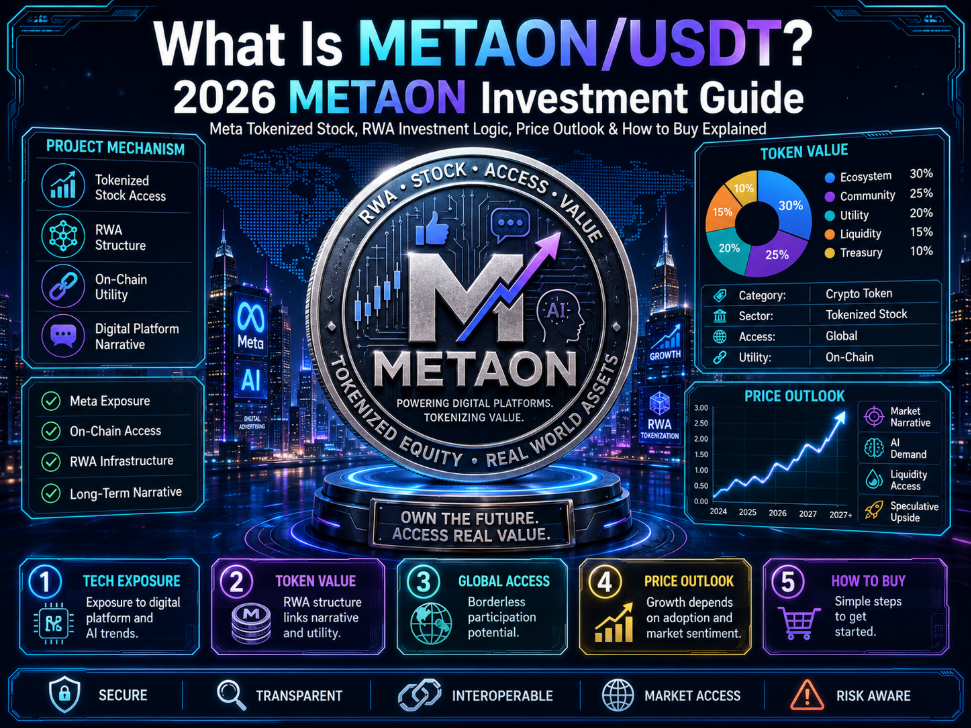
The core difference between METAON and META stock is economic exposure vs. direct equity rights.
Meta stock is a publicly traded company share in traditional securities markets. When you buy META through a broker, you typically hold traditional share records and may enjoy shareholder rights, brokerage protections, and conventional market liquidity.
METAON is an on-chain tokenized asset. Its goal is to deliver economic performance similar to Meta stock price movements, but it does not automatically grant the full legal rights of a traditional stockholder.
As Reuters has reported on tokenized stock risks, many tokenized stock products are pegged to public company shares but may not offer the same legal rights, disclosures, and investor protections as traditional stocks — and differences in rights structures and disclosures across products can pose significant risks to investors.
Thus, there are five key distinctions:
- Holding method — META stock is held via brokerage accounts; METAON is held via crypto platforms, wallets, or on-chain.
- Trading environment — META trades on traditional exchanges; METAON trades on crypto venues or decentralized environments.
- Rights structure — META stock may involve traditional shareholder rights; METAON is primarily economic exposure and should not be assumed to include voting or full shareholder rights.
- Risk sources — META stock faces business, valuation, and market risks; METAON adds issuer, custodian, regulatory, redemption, liquidity, and on-chain security risks.
- Target audience — META stock suits those familiar with brokerage accounts; METAON suits users comfortable with USDT, wallets, RWA, and crypto trading.
So, METAON is not a "simpler substitute" for Meta stock — it's a crypto-native tool for gaining Meta stock economic exposure.
4. Why Is Meta Stock Entering Crypto? The RWA Era Is Changing Investing
The reason Meta stock appears in crypto via METAON is the broader RWA trend.
In the past, crypto markets revolved around BTC, ETH, DeFi tokens, meme coins, and NFTs. By 2026, more users are asking: Can blockchains carry traditional stocks, ETFs, bonds, Treasuries, gold, and other real-world assets?
Tokenized stock is a major sub-sector of this trend.
Tokenized stock translates the economic performance of traditional equities onto blockchains via tokens, allowing users to gain asset exposure using stablecoins, wallets, or crypto trading platforms.
The appeal of RWA and tokenized stocks comes from three main angles:
- Lower global access barriers — Traditional U.S. stock investing often requires brokerage accounts, banking systems, regional eligibility, and KYC processes. Tokenized stocks are more aligned with crypto user habits — USDT, wallets, and on-chain trading.
- Greater trading flexibility — Traditional stocks have trading hours and market constraints; on-chain tokens more easily connect to 24/7 crypto markets. Ondo also notes that its platform supports on-chain transfers and DeFi use cases.
- Potential DeFi integration — If more protocols support METAON in the future, it could become part of on-chain portfolios, collateralized lending, structured yields, or risk management tools.
That's the core significance of METAON: it's not about turning Meta into a crypto project — it's about bringing Meta stock exposure into on-chain markets.
5. What Is Meta Platforms? Why Is It Still a Core Tech Stock?
To understand METAON, you can't just look at the token — you must understand the underlying Meta Platforms.
Meta Platforms is one of the world's most important internet platform companies, owning Facebook, Instagram, WhatsApp, Messenger, and Reality Labs. Meta's 2025 Form 10-K shows the company operates in two segments: Family of Apps and Reality Labs. Nearly all revenue currently comes from advertising within Family of Apps. The company also stated that key 2026 investment priorities include AI, Reels and discovery engine, wearables, product and service commercialization, teens, platform integrity, community support, and infrastructure capacity.
This means Meta's core isn't just a "metaverse concept" — it's a tech platform built on social networks, advertising systems, AI recommendations, content distribution, and future hardware computing.
The long-term investment thesis for Meta stock rests on three pillars:
- Social ecosystem advantage — Facebook, Instagram, and WhatsApp have massive global user bases, underpinning ad revenue, content distribution, business messaging, and AI assistants.
- AI-driven ad efficiency — Meta's ad business relies on recommendation algorithms, user understanding, conversion prediction, and delivery optimization. Stronger AI means better ad targeting, higher advertiser ROI, and improved monetization.
- Reality Labs and future computing — Reality Labs includes VR, AR, smart glasses, and next-gen computing platforms. Meta's 2025 10-K shows revenue from Meta Quest, AI glasses, and related software/content, but the segment remains in heavy investment mode, with substantial operating losses in 2025.
Therefore, the Meta investment thesis behind METAON includes both cash-flow strength from advertising and high-risk/high-reward spending on AI and future computing.
6. Why Does Meta’s AI Strategy Affect METAON’s Value?
METAON's price largely tracks Meta stock's economic performance, and whether Meta stock can command a higher valuation depends significantly on whether its AI strategy translates into revenue, profits, and competitive advantage.
Meta's AI investments span several areas:
- AI-powered recommendations and content distribution — Instagram Reels, Facebook Feed, short-video recommendations, content ranking, and ad matching all benefit from AI to boost user engagement and ad efficiency.
- Ad intelligence — Advertising is Meta's core revenue source. The 2025 10-K notes that ad revenue increased year-over-year, driven by higher ad impressions and average ad prices; on a constant-currency basis, ad revenue would be even stronger.
- AI assistants and personal agents — Meta is pushing AI assistants, smart glasses, and multimodal AI experiences. Reuters reported in August 2026 that CEO Mark Zuckerberg published a lengthy post on AI and "superintelligence," while markets watch whether Meta can pivot from an ad giant into a machine learning competitor to OpenAI and Anthropic.
- AI infrastructure capex — AI requires massive compute, data centers, chips, and infrastructure investment. This may boost long-term competitiveness but also raises short-term capital expenditures and margin pressure.
So, AI's impact on METAON isn't one-way bullish. If AI improves ad efficiency, user experience, and product innovation, Meta stock could rise. But if AI spending outpaces returns, or if regulatory and competitive pressures mount, valuations could suffer.
7. METAON Investment Value: Why Are Investors Paying Attention?
METAON's investment value can be broken into three layers:
Layer 1: Meta stock growth — If Meta's ad business continues growing, AI boosts monetization, Instagram/WhatsApp/Facebook retain strong user stickiness, and Reality Labs losses narrow, Meta stock may be repriced higher. METAON, as a tokenized economic exposure, would theoretically reflect that.
Layer 2: RWA market growth — If more crypto users want to access U.S. equities via USDT, tokenized stocks like METAON could gain more traction. Ondo's blog notes that its Stocks platform, available to non-U.S. investors, offers on-chain economic exposure to over 100 U.S. stocks and ETFs, with users able to mint, transfer, and redeem securities-backed tokens on Ethereum.
Layer 3: Crypto infrastructure maturity — As stablecoin scale, wallet UX, on-chain trading venues, DeFi lending, and RWA compliance infrastructure improve, tokenized stocks gain more use cases. METAON may become more than a "price tracker" — it could be part of on-chain asset management and collateralized lending in the future.
That's why METAON deserves a deep-dive RWA research report, not just a typical "new coin" intro.
8. METAON Price Prediction: Key Upside and Downside Factors
A serious METAON price prediction can't simply say "it will go to X." Instead, we analyze the core variables driving it.
Variable 1: Meta stock performance — METAON's underlying logic comes from Meta's economic performance. Earnings, ad revenue, AI ROI, Reality Labs losses, user growth, and regulatory risks all affect METAON.
Variable 2: U.S. tech sector sentiment — Meta is a major tech stock, sensitive to Nasdaq trends, interest rates, risk appetite, and AI sector valuations. A strong tech rally helps METAON; a correction hurts it.
Variable 3: AI commercialization — If AI consistently improves ad targeting, content recommendations, and new product experiences, it becomes a growth engine. If AI spending is heavy but commercialization lags, markets may revalue Meta lower.
Variable 4: RWA capital flows — If the tokenized stock market expands, METAON could see more users, volume, and liquidity. Ondo assets are already integrated with multiple wallets and trading venues — MetaMask's price page also describes METAon as an Ondo tokenized real-world asset for Meta stock.
Variable 5: ETH and on-chain environment — While METAON isn't ETH, many RWA tokens run on Ethereum or related chains. ETH ecosystem health, gas costs, DeFi activity, and stablecoin liquidity affect the RWA user experience. You can reference ETH Price Prediction to gauge the broader smart contract and on-chain asset cycle.
For scenario-based target analysis, check the METAON Price Prediction tool, which combines Meta stock, AI trends, and RWA market dynamics.
9. Three Scenarios for METAON Price Prediction: Bull, Neutral, Bear
A sound METAON price forecast should consider three scenarios:
Bull Case — Meta ad revenue continues growing; AI significantly improves conversion and recommendation efficiency; WhatsApp monetization, Reels, and AI assistants drive new revenue; Reality Labs losses gradually improve; the RWA market expands as more users access U.S. equities via USDT. In this scenario, METAON benefits from both Meta stock appreciation and rising demand for tokenized stocks.
Neutral Case — Core ad business remains stable; AI investments deliver some efficiency gains but capex also rises; RWA market grows steadily, but METAON mostly tracks Meta stock without significant independent premium.
Bear Case — Ad growth slows; AI returns disappoint; Reality Labs losses remain large; regulatory pressure intensifies; U.S. tech valuations correct; RWA regulations tighten or token liquidity dries up. METAON would face dual pressure from Meta stock declines and crypto risk-off sentiment.
Thus, METAON is not a low-risk stable asset — it's an on-chain U.S. equity exposure that combines Meta stock risk with RWA structural risk.
10. How to Invest in METAON: A Step-by-Step Guide for Beginners
Before buying METAON, first confirm what you actually want:
- If you want direct Meta stock ownership and have a brokerage account, traditional META stock is more straightforward.
- If you want to gain Meta stock economic exposure via crypto, USDT, or on-chain wallets, then METAON is worth researching.
Typical steps to buy METAON:
- Choose a platform that supports METAON trading — Look for METAON/USDT pairs, adequate volume, reasonable bid-ask spreads, and convenient deposits/withdrawals.
- Prepare USDT or USDC — For crypto newcomers, USDT pairs are intuitive for tracking cost and P&L.
- Check METAON price action — Visit the METAON Live Price to see current price, change, volume, and trends.
- Search for the METAON/USDT pair — Confirm the exact ticker to avoid buying a similarly named scam or wrong asset.
- Choose your order type — Limit orders are safer for beginners, especially since tokenized stock liquidity on some platforms may not match BTC, ETH, or traditional U.S. equities.
- Manage position size — Don't ignore tokenized-structure risks just because METAON tracks Meta stock. It's still an RWA asset in crypto markets — size accordingly.
If buying via on-chain wallets, also pay attention to contract addresses, wallet approvals, gas fees, network selection, and phishing risks.
11. Crypto METAON vs. Traditional Meta Stock – Which Is Better?
METAON and traditional META stock are not about one being absolutely better — they suit different users.
Advantages of buying METAON via crypto:
- Can use USDT or stablecoins
- Suits users who already hold crypto assets
- May support on-chain transfers and DeFi combinations
- Easier access to an RWA asset matrix
Disadvantages:
- Not equivalent to traditional shareholder rights
- Issuer, custodian, and redemption mechanism risks
- Liquidity may be thinner than traditional U.S. equities
- Regulatory and jurisdictional restrictions more complex
Advantages of buying META stock via a traditional brokerage:
- Mature, regulated market
- Deep liquidity
- Stronger securities regulatory framework
- Clearer shareholder rights structure
Disadvantages:
- Requires brokerage account
- May face regional eligibility hurdles
- Trading hours limited to traditional market sessions
- Less convenient for crypto users who prefer stablecoin on/off ramps
So, if you want a straightforward, regulated investment in Meta, traditional META is more established. If you want to access U.S. tech equities through crypto rails, METAON is a relevant RWA research candidate.
12. METAON Investment Risks: What You Must Know Before Buying
METAON carries six main risk categories:
- Tokenized stock structural risk — METAON is not traditional META stock. Ondo explicitly states that tokens provide economic exposure, not stocks, ETFs, or ADRs themselves, and do not grant rights to underlying assets.
- Meta stock market risk — If ad revenue slows, AI ROI disappoints, Reality Labs losses widen, regulatory pressure mounts, or tech stocks correct, METAON prices will be affected.
- Liquidity risk — Meta stock itself is highly liquid, but METAON as a tokenized stock may have different depth, spreads, and secondary-market liquidity. In extreme conditions, liquidity risk amplifies.
- Issuer and custodian risk — Tokenized stocks depend on the issuer, custody structure, underlying asset arrangements, and redemption mechanisms. Even if the underlying assets exist, counterparty risk remains.
- Regulatory risk — Tokenized stocks sit at the intersection of crypto and securities markets, a highly sensitive regulatory area. Different countries may restrict buying, transferring, redeeming, or retail sales.
- On-chain security risk — If trading via wallets, users face private key loss, phishing, malicious approvals, smart contract bugs, and network errors.
Therefore, METAON is not a "no-barrier U.S. stock substitute." It's a hybrid asset with traditional stock risk, RWA structural risk, and crypto market risk.
13. Comparing METAON with Other RWA Assets – How to Choose?
METAON suits investors bullish on Meta's long-term prospects, AI ad ecosystems, and social platform monetization. But the RWA market offers more than just METAON — each tokenized stock represents a different investment theme.
- METAB is also Meta-related, but you need to distinguish its issuance system, token mechanics, trading methods, and rights structure. Don't treat METAB and METAON as identical just because names are similar.
- ORCLB leans toward Oracle-related tokenized stock logic, with core themes in enterprise cloud, databases, AI infrastructure, and enterprise software.
- TQQQB represents a leveraged Nasdaq tech exposure, with higher volatility than single-name tokenized stocks like METAON.
- QQQB is more index-oriented — a basket of tech stocks, whereas METAON is a single-company exposure with higher idiosyncratic risk.
- SNXXB leans toward an RWA portfolio or index-style asset, suited for those seeking diversification and studying RWA组合化 allocation.
When choosing RWA assets, don't just chase trendy names — look at the underlying asset logic:
- METAON — social platforms, AI ads, Meta stock economic exposure
- ORCLB — cloud computing, databases, enterprise AI
- TQQQB — leveraged Nasdaq tech stocks, high volatility
- QQQB — tech sector index-style exposure
- SNXXB — RWA portfolio/combination asset
- METAB — also Meta-related, but verify issuance and rights structure
This way, you upgrade RWA investing from "chasing new coins" to "on-chain traditional asset allocation."
14. Is METAON Worth Investing In? Who Is It For?
Whether METAON is worth investing in depends on whether you simultaneously believe in three directions: Meta's long-term growth, AI ad monetization, and the RWA tokenized stock trend.
METAON suits four types of investors:
- Those bullish on Meta's long-term development
- Those who believe AI will improve ad efficiency, recommendations, and social platform monetization
- Those who want to access U.S. equities via crypto
- Those bullish on RWA and tokenized stock growth
METAON does NOT suit:
- Short-term speculators chasing 10x–100x gains on small coins
- Those who don't understand tokenized stock mechanisms
- Those unable to tolerate U.S. equity volatility, RWA regulatory risks, and token liquidity risks
Before investing in METAON, ask yourself five questions:
- Do I understand that METAON is not an official Meta-issued coin?
- Do I know that METAON is not the same as holding META stock directly?
- Am I bullish on Meta's advertising, AI, and social ecosystem?
- Can I accept issuer, custodian, regulatory, and liquidity risks?
- Am I familiar with USDT trading, wallets, and crypto platform risks?
If you can answer these clearly, METAON is worth watching as an RWA asset. If you're just buying because you see the name "Meta," you're not ready.
15. Conclusion: METAON Is Not a New Coin – It’s a Research Asset for Meta Stock Tokenization
METAON's core value isn't creating a new crypto narrative — it's bringing economic exposure to Meta Platforms stock onto on-chain markets. It represents a key direction for the RWA market in 2026: tokenized stocks.
For crypto newcomers, four key takeaways:
- METAON is not BTC, ETH, or a meme coin.
- METAON is not an official Meta-issued cryptocurrency.
- METAON is not META stock in a traditional brokerage account.
- METAON provides economic exposure related to Meta stock, while carrying RWA structural risks and crypto trading risks.
Long-term, METAON's opportunities come from Meta's core ad business, AI commercialization, social platform scale, Reality Labs' future computing bets, RWA asset growth, and on-chain demand for U.S. equities.
But on the risk side, METAON also faces Meta growth slowdown, uncertain AI ROI, Reality Labs losses, ad regulation, tokenized stock rights differences, thin liquidity, and regulatory constraints.
Therefore, METAON is better framed as a 2026 Meta Stock Tokenization Investment Research Guide than a typical "how to buy a new coin" article. When researching METAON, start by checking the METAON/USDT Price, then use the METAON Price Prediction for scenario analysis, and finally combine that with Meta's earnings, AI trends, the ETH ecosystem, and RWA market developments to make an informed judgment.
METAON FAQ
What is METAON?
METAON is a tokenized stock asset tied to Meta Platforms, part of the RWA tokenized stock sector. Its goal is to give users blockchain-based token exposure to economic performance similar to Meta stock.
Is METAON a coin issued by Meta?
No. METAON is not an official crypto token from Meta, nor is it a Facebook coin. It's a Meta stock tokenization product offered by third-party RWA financial infrastructure.
What’s the difference between METAON and META stock?
META stock is a traditional publicly traded share; METAON is an on-chain tokenized asset providing economic exposure to Meta stock, but it should not be assumed to carry full traditional shareholder rights.
How do I buy METAON?
You can buy it on platforms that support the METAON/USDT trading pair. Before buying, check the METAON Live Price to confirm price, volume, and pair details.
Is METAON safe?
METAON has underlying RWA asset backing, but it still carries issuer, custodian, redemption, regulatory, liquidity, and on-chain security risks. It is not a risk-free asset.
Will METAON go up in the future?
METAON's price is influenced by Meta stock performance, ad revenue, AI commercialization, Reality Labs spending, RWA market growth, the ETH ecosystem, and crypto risk appetite. Refer to the METAON Price Prediction for scenario analysis.
Does buying METAON mean I own Meta stock?
Not exactly. Buying METAON is more about gaining economic exposure to Meta stock price movements — it should not be simply understood as directly holding Meta Platforms common stock.
Is METAON suitable for long-term holding?
If you're structurally bullish on Meta, AI advertising, and the RWA tokenized stock trend, you can add METAON to your watchlist. But before holding long-term, you need to understand the rights differences between tokenized stocks and traditional shares, as well as liquidity and regulatory risks.
What’s the difference between METAON and METAB?
Both are Meta-related, but they may come from different issuance systems, token mechanisms, and trading structures. Before investing, verify the underlying assets, issuer, custody, redemption rules, and trading risks for each.
What is the biggest risk of METAON?
The biggest risks include Meta stock declines, disappointing AI ROI, ad market slowdown, persistent Reality Labs losses, tokenized stock rights differences, issuer risk, thin liquidity, and regulatory restrictions.
Disclaimer: This article is for research purposes only on crypto, RWA, and tokenized stocks. It does not constitute investment, legal, tax, or securities advice. Tokenized stocks carry structural, regulatory, liquidity, and market risks. Please conduct independent research and assess your personal risk tolerance before investing.