
If this is your first time searching for QQQON, you're likely a crypto newcomer with three immediate questions: Is QQQON a cryptocurrency? How does it differ from the traditional QQQ ETF? Does buying QQQON mean I'm directly buying the Nasdaq-100 ETF?
In one sentence: QQQON — often written as QQQon — is an Invesco QQQ Tokenized ETF asset within the Ondo ecosystem, designed to give investors blockchain-based token exposure that mirrors the economic profile of the Invesco QQQ ETF. According to CoinMarketCap, QQQon is the Ondo tokenized version of the Invesco QQQ ETF, providing token holders with economic exposure similar to holding QQQ and reinvesting dividends.
So, QQQON is not a native cryptocurrency like BTC or ETH, nor is it a typical meme coin. It's an RWA — Real World Asset — specifically a tokenized ETF asset within the tokenized real-world assets space. Its core logic isn't to create a brand-new crypto project, but to bring the economic performance of the traditional Nasdaq-100 ETF onto the blockchain.
If you just want to check QQQON's current market performance, you can view the QQQON live price for price, volume, and charts. If you're more focused on future potential, use the QQQON price prediction tool for scenario-based analysis.
1. What Is QQQON? Is It a Cryptocurrency or a Nasdaq ETF Token?
QQQON is fundamentally a tokenized ETF asset, not a typical crypto token. Its underlying asset is the Invesco QQQ ETF — the well-known QQQ. As Invesco's official materials explain, Invesco QQQ is a passively managed ETF that tracks the Nasdaq-100 Index, offering investors exposure to a basket of industry-leading companies.
The traditional path to investing in QQQ is:
- Open a brokerage account, buy QQQ ETF shares through your broker.
The on-chain path for QQQON is closer to:
- Use your crypto account, USDT, or wallet to purchase QQQON tokens, gaining economic exposure similar to holding the QQQ ETF.
That's why QQQON appears in the crypto market — it bridges two worlds: on one side, the Nasdaq-100 and traditional ETFs; on the other, crypto wallets, stablecoins, on-chain trading, and the RWA market.
For newcomers, think of QQQON this way:
- QQQON is not BTC.
- QQQON is not ETH.
- QQQON is not a meme coin.
- QQQON is a tokenized ETF asset.
- QQQON's price logic mainly derives from QQQ ETF performance, Nasdaq-100 trends, RWA market demand, and token liquidity.
So when you search "what is QQQON," the real question isn't "does this coin have community hype?" — it's "does it effectively provide Nasdaq-100 ETF economic exposure, and what risks come with this tokenized structure?"
2. How Is QQQON Issued? How Does the Token Map to Real Assets?
The most common concern: "Is the QQQON I buy actually backed by real assets?"
Ondo's official documentation states that Ondo tokenized stocks are fully backed by the corresponding stock or ETF — meaning Ondo's tokenized stocks and ETFs are supported by the underlying securities. Ondo also clarifies that these tokens are not registered under the U.S. Securities Act or other jurisdictions' securities laws, and that Ondo Stocks provide economic exposure to the value of the underlying assets — they are not the stocks, ETFs, or ADRs themselves, and do not grant holders the right to receive the underlying assets.
This is critical information.
It tells us that QQQON is not a "randomly issued altcoin" — it's a tokenized ETF product built around the corresponding ETF. But it also tells us that QQQON is not the same as a traditional QQQ ETF share held in a brokerage account.
Investors need to understand several core points:
First, QQQON is a tokenized asset issued by a third-party RWA financial infrastructure provider, not a traditional ETF share issued directly by Invesco.
Second, QQQON tracks the economic performance of the QQQ ETF, but it does not give you direct traditional brokerage account entitlements.
Third, QQQON may support on-chain transfers and DeFi usage, but this is subject to jurisdictional, compliance, and product-specific restrictions.
Fourth, minting and redemption mechanisms may be suspended at times. Ondo notes that direct minting and redemption on the Ondo Stocks platform are typically available 24/5, while tokens can be traded peer-to-peer 24/7; however, minting and redemption may be temporarily halted due to corporate actions, market conditions, or systematic risk controls.
So before buying QQQON, you must distinguish:
- QQQON has an RWA logic backed by underlying assets.
- But QQQON is not a traditional ETF share.
- QQQON provides economic exposure, not full securities rights.
- QQQON still carries issuer, custodian, redemption, regulatory, and liquidity risks.
This is exactly the kind of nuance that any serious RWA investment article must cover.
3. QQQON vs. QQQ ETF: What's the Difference, and Why Tokenize?
QQQ is a well-established ETF in traditional finance. Invesco's materials show that the Invesco QQQ ETF tracks the Nasdaq-100 Index, giving investors exposure to the 100 largest non-financial companies listed on Nasdaq; the fund and index are rebalanced quarterly and reconstituted annually.
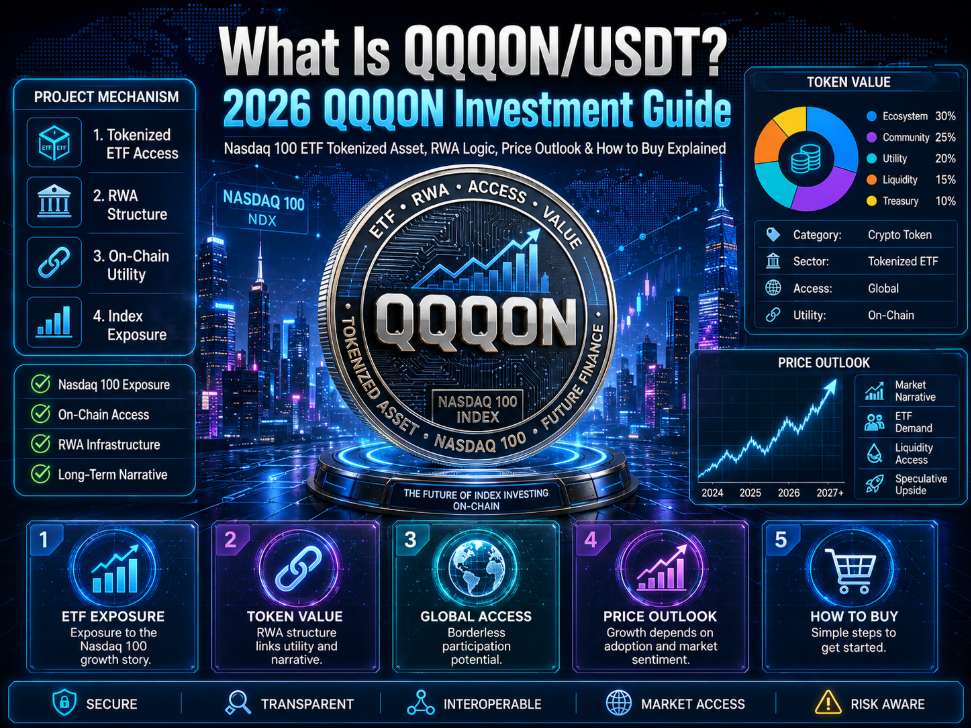
The advantages of traditional QQQ are clear: massive scale, deep liquidity, mature securities regulation, and high investor recognition. For anyone with a U.S. brokerage account, buying QQQ directly is typically simpler and more established.
So why do we need QQQON?
Because QQQON addresses a different set of users: crypto natives, global on-chain participants, those who want to gain exposure to U.S. tech assets using USDT, and those who eventually want to use ETF-like assets within DeFi portfolios.
The traditional QQQ path usually involves:
- Brokerage account, exchange, trading hours, broker systems.
The QQQON path looks more like:
- Crypto account, wallet, USDT, token trading, on-chain portfolio composition.
QQQON's edge is that its access method aligns with crypto user habits. For those already holding USDT, USDC, or on-chain assets, QQQON provides a way to gain Nasdaq-100 exposure through crypto markets.
But QQQON has downsides too:
- QQQON may not have the same liquidity as QQQ.
- QQQON is not a traditional ETF share.
- Holders should not assume they have all the rights of traditional ETF investors.
- QQQON is subject to issuer, compliance, redemption, and on-chain market risks.
So QQQON isn't a "better than QQQ" replacement — it's a Nasdaq-100 economic exposure tool built for crypto markets.
If your goal is simply low-cost, long-term Nasdaq-100 investing and you already have a solid brokerage account, QQQ is likely more suitable.
If your goal is to gain Nasdaq-100 tech exposure via USDT, crypto accounts, or on-chain methods, then QQQON is worth researching.
4. Does QQQON Equal Owning the QQQ ETF?
Not exactly.
This is worth repeating throughout this article: buying QQQON should not be simplistically understood as "directly owning the QQQ ETF."
Ondo's risk disclosure explicitly states that Ondo Stocks provide economic exposure to the value of the underlying assets (including dividends net of applicable taxes), but Ondo Stocks themselves are not stocks, ETFs, or ADRs, and do not give holders the right to receive or hold the corresponding underlying assets.
This means QQQON is best understood as an "on-chain tokenized expression of QQQ ETF economic performance."
You may gain price exposure similar to QQQ's performance, but you should not assume you have the full legal rights of a traditional ETF holder.
These differences include:
- Whether you have traditional fund share entitlements.
- Whether you enjoy traditional brokerage account protections.
- Whether you can directly redeem QQQ shares at the fund level.
- Whether you have identical tax and legal treatment as a traditional ETF.
- Whether you are covered by the same investor protection frameworks.
So QQQON's value isn't about "perfectly replicating the traditional ETF experience" — it's about letting crypto users access traditional ETF economic performance in an on-chain manner.
A more accurate framing:
- QQQ is a traditional finance ETF.
- QQQON is an RWA token representing QQQ economic exposure.
- They are related, but they are not the same holding structure.
5. Why Are Tokenized ETFs a Major Crypto Trend in 2026?
In 2026, tokenized ETFs have become a major crypto trend because RWAs are bringing traditional financial assets onto the blockchain.
RWAs can map real-world assets on-chain — including stocks, ETFs, bonds, Treasuries, gold, real estate, commodities, and funds. In the past, crypto markets mainly traded BTC, ETH, memes, and DeFi tokens. Going forward, if U.S. stocks, ETFs, and bonds can enter the chain in a compliant manner, the asset boundaries of crypto markets will expand significantly.
The value of tokenized ETFs rests on three pillars:
First, global accessibility.
Traditional ETF investing can be constrained by geography, broker availability, account opening requirements, trading hours, and eligibility. Tokenized ETFs align more with crypto market habits — users can participate via wallets, stablecoins, and on-chain tools.
Second, more flexible trading and portfolio composition.
Traditional ETF trading is bound by exchange hours. Ondo notes that direct minting and redemption on the Ondo Stocks platform are typically 24/5, while tokens can be traded peer-to-peer 24/7. This means tokenized ETFs offer a more continuous market experience that crypto users are accustomed to.
Third, DeFi composability.
Ondo's official blog mentions that Ondo tokenized stocks have entered DeFi lending markets, starting with SPYon and QQQon, and can be used as collateral in Ethereum DeFi to support lending, leverage, and capital efficiency strategies.
This is crucial. In the past, tokenized stocks and ETFs were mainly "hold or trade" assets. If they can be used in DeFi lending, collateralization, and structured products, they can evolve from "passive exposure" to "active on-chain financial assets."
That's also the long-term significance of QQQON: it's not just a token tracking QQQ — it could become part of on-chain U.S. equity ETF portfolios, lending, and yield strategies in the future.
6. Why Is the Nasdaq-100 Well-Suited for Tokenization?
The core asset behind QQQON is the QQQ ETF, which tracks the Nasdaq-100 Index.
Invesco's materials show that the Nasdaq-100 Index includes the 100 largest non-financial companies listed on Nasdaq, and QQQ provides comprehensive exposure to these companies. These firms span technology, cloud computing, semiconductors, AI, consumer internet, software services, and innovative industries.
The Nasdaq-100 is a good fit for tokenization for three main reasons:
First, global recognition.
Many crypto users may not know every U.S. stock, but they usually know Apple, Microsoft, Nvidia, Amazon, Meta, Google, and other tech giants. QQQ represents not a single company but a basket of America's most innovative firms.
Second, strong underlying liquidity.
QQQ is one of the world's most recognized ETFs. Invesco notes that QQQ's history dates back to 1999 and it is a highly liquid ETF. Strong underlying liquidity helps tokenized ETFs establish more credible price references and redemption logic.
Third, a clear AI-era narrative.
In 2026, AI remains a key driver for tech stocks. A large portion of Nasdaq-100 companies are tied to AI chips, cloud computing, enterprise software, data centers, ad algorithms, and smart devices. If the AI industry continues to grow, QQQ stands to benefit, and QQQON may be influenced through the underlying ETF's performance.
Of course, this doesn't mean QQQON will necessarily rise. The Nasdaq-100 itself faces risks including overvaluation, rising interest rates, tech sector pullbacks, AI bubbles, and macroeconomic downturns.
7. The Investment Thesis Behind QQQON: Why Are Investors Paying Attention?
QQQON's investment thesis can be broken into three layers.
Layer 1: Long-term Nasdaq-100 growth.
QQQ represents a portfolio of large-cap U.S. innovative companies — not a single name, but a composite of tech, communications, consumer, and innovation-driven businesses. Invesco states that QQQ tracks the Nasdaq-100 Index and provides exposure to many industry-leading companies in a single investment.
If AI, cloud computing, semiconductors, enterprise software, and digitization continue to drive U.S. tech earnings growth, QQQ has the potential to benefit, and QQQON may be influenced by underlying asset performance.
Layer 2: RWA market expansion.
If more crypto users want to invest in U.S. equities via USDT, tokenized ETFs could become a key gateway. QQQON represents not single-stock risk but a diversified basket of Nasdaq-100 assets, making it more intuitive for newcomers.
Layer 3: DeFi composability.
Ondo has explicitly mentioned that SPYon and QQQon have entered DeFi lending markets and can serve as collateral for lending, leverage, and capital efficiency strategies. If more protocols support QQQON in the future, it could transition from a "trading asset" to a "portfolio building block."
Thus, investors are drawn to QQQON not because it promises meme-like short-term pumps, but because it sits at the intersection of three trends:
- Long-term growth in U.S. tech stocks.
- Growth of the tokenized ETF market.
- RWA integration into DeFi.
But investors must also recognize that QQQON's upside is not independent of QQQ itself. If the Nasdaq-100 declines, QQQON will struggle to outperform on its own.
8. QQQON Price Prediction: What Factors Could Drive Future Upside?
A proper QQQON price prediction shouldn't be a simple "where will it be in 2026?" Instead, it's about analyzing the key variables that will influence its future price.
Variable 1: Nasdaq-100 performance.
QQQON's core underlying logic comes from the QQQ ETF, which tracks the Nasdaq-100. If the Nasdaq-100 rises, QQQON theoretically benefits; if it falls, QQQON typically comes under pressure.
Variable 2: AI and tech cycles.
If AI chips, cloud computing, software services, data centers, and tech giant earnings continue to grow, QQQ may find fundamental support. Conversely, if AI valuations become stretched, earnings disappoint, or tech enters a correction, QQQON will be affected.
Variable 3: Interest rate environment.
The Nasdaq-100 has a high concentration of growth-oriented tech companies, which are typically more sensitive to interest rates and valuation shifts. Rising rates or tighter liquidity could pressure tech valuations.
Variable 4: RWA capital flows.
If the tokenized stock and ETF market continues to expand, QQQON could see increased trading demand and liquidity. Ondo's materials indicate that Ondo Stocks are designed to be transferable on supported blockchains and usable in DeFi protocols that support them — e.g., as collateral for lending or in perpetual contract protocols.
Variable 5: Crypto market conditions.
When BTC, ETH, and the broader RWA sector are strong, the market is more willing to trade tokenized ETFs. When crypto risk appetite declines, even if QQQ itself is stable, QQQON's on-chain volume and liquidity may drop.
If you want to see potential performance under different market scenarios, use the QQQON price prediction tool. You can also reference the ETH price prediction, as Ethereum ecosystem health, DeFi activity, and on-chain asset affect the overall RWA token environment.
9. Three Scenarios for QQQON Price Prediction: Bull, Neutral, Bear
A more robust QQQON price forecast should consider three scenarios.
Bull Case: AI industry continues to expand, U.S. tech giants see earnings growth, the Nasdaq-100 sustains its long-term uptrend, the RWA market develops rapidly, more crypto users participate in U.S. ETF exposure via USDT, QQQON liquidity improves, and it gains adoption in more DeFi protocols. In this scenario, QQQON could benefit from both QQQ appreciation and growing demand for tokenized ETFs.
Neutral Case: Tech stocks maintain steady growth but valuations don't expand quickly; the RWA market grows steadily but without a breakout; QQQON primarily tracks QQQ's price performance with little independent premium.
Bear Case: U.S. tech valuations become overstretched, the Nasdaq-100 corrects, rising rates or macro weakness pressure risk assets, RWA regulation tightens, QQQON liquidity dries up, and the token price faces dual pressure from underlying ETF declines and falling crypto risk appetite.
Therefore, QQQON is not a "low-risk stablecoin" nor a "guaranteed-to-rise tech token." It's more like a Nasdaq-100 ETF economic exposure token brought into crypto markets, requiring analysis of both U.S. equity and crypto market dynamics.
10. How to Buy QQQON: A Step-by-Step Guide for Beginners
Before buying QQQON, newbies should first confirm why they're buying.
If your goal is simply long-term Nasdaq-100 investing and you already have a solid brokerage account, the traditional QQQ ETF is likely more straightforward.
If you want to gain Nasdaq-100 exposure via crypto methods, USDT trading, or on-chain wallets, then QQQON is worth exploring.
Buying QQQON generally falls into three approaches.
Method 1: Buy QQQON/USDT on a Crypto Exchange
This is the easiest way for crypto newcomers.
- Sign up on a platform that supports QQQON trading.
- Prepare USDT or USDC.
- Search for the QQQON/USDT trading pair.
- Check the QQQON live price to confirm current price, volume, and trends.
- Place a limit order or a small market order to buy.
- After buying, record your cost basis and keep an eye on QQQ and Nasdaq-100 movements.
Method 2: On-Chain Trading via a Crypto Wallet
This approach suits more experienced Web3 wallet users.
You'll need a wallet that supports the relevant network, stablecoins, and gas fees, then trade through a platform or protocol that supports QQQON. When using a wallet, be careful about contract addresses, networks, approvals, phishing sites, and slippage.
Method 3: Buy the QQQ ETF Through Traditional Brokerage
If you simply want to invest in the Nasdaq-100 and don't need on-chain trading, DeFi composability, or USDT involvement, the traditional QQQ ETF is more established. QQQ itself has far stronger traditional finance liquidity and securities market infrastructure.
So a truly professional investment guide shouldn't just tell you "how to buy QQQON" — it should also tell you:
- For a traditional ETF experience, choose QQQ.
- For a crypto-friendly way to gain ETF exposure, research QQQON.
- For high-risk leveraged Nasdaq exposure, look into TQQQB and similar leveraged RWA assets.
11. Risk Analysis for QQQON: What You Must Understand Before Buying
Although QQQON is backed by a mature ETF, it is still a tokenized ETF — it is not a low-risk asset.
Risk 1: Tokenized ETF structural risk.
QQQON is not a traditional QQQ ETF share. Ondo explicitly states that Ondo Stocks are not stocks, ETFs, or ADRs, and do not give holders the right to receive underlying assets. Investors must understand the difference between economic exposure and direct securities entitlements.
Risk 2: Market risk.
QQQON's price is influenced by the Nasdaq-100, tech stocks, the AI cycle, interest rates, and overall U.S. equity risk appetite. Invesco also cautions that concentration in a specific sector like technology can lead to greater volatility than more diversified investments.
Risk 3: Liquidity risk.
QQQ itself is highly liquid, but QQQON as a tokenized ETF may have different secondary market depth. Low trading volume can lead to wider bid-ask spreads and slippage on larger orders.
Risk 4: Redemption and trading mechanism risk.
Ondo notes that token minting and redemption may be temporarily suspended due to corporate actions, market conditions, or systematic risk controls. This means that in extreme conditions, the token price could temporarily deviate from underlying asset performance.
Risk 5: Regulatory risk.
Ondo discloses that these tokens are not registered under U.S. securities laws or other jurisdictions' securities laws, and U.S. users and residents of certain jurisdictions may be restricted. This means QQQON is not a universally accessible asset.
Risk 6: On-chain security risk.
If you trade QQQON via a wallet, you also face risks like private key loss, phishing sites, malicious approvals, wrong networks, and smart contract vulnerabilities.
So QQQON is suitable for those who already understand RWA mechanisms and can differentiate between an ETF and a tokenized ETF — it is not for users who treat it as a "guaranteed tech coin."
12. QQQON vs. Other RWA Assets: How to Build a Portfolio
QQQON is suitable for investors bullish on the Nasdaq-100 and large-cap U.S. tech growth. But the RWA market offers more than just QQQON; users can choose different tokenized assets based on different investment theses.
- What is TQQQB — for those researching leveraged Nasdaq-100 ETF exposure. QQQON focuses on long-term Nasdaq-100 tech growth, while TQQQB leans toward leveraged, high-beta assets with higher volatility and risk.
- What is QQQB — also related to Nasdaq assets, but users should further distinguish its token mechanism, issuance structure, and underlying exposure rather than conflating it based on name similarity.
- What is ORCLB — more focused on tokenized Oracle stock, with core themes of cloud computing, enterprise software, and enterprise AI.
- What is MUUB — more focused on Micron and the memory chip cycle, suitable for investors tracking AI storage, HBM, DRAM, and NAND cycles.
- What is SNXXB — more geared toward RWA portfolios or index-type assets, for those seeking broader diversified RWA exposure.
When choosing RWA assets, don't just chase the hottest name — look at the underlying investment logic:
- QQQON: Nasdaq-100, tech stocks, AI growth, ETF economic exposure.
- TQQQB: Leveraged Nasdaq, high volatility, high risk.
- ORCLB: Enterprise software, cloud computing, AI applications.
- MUUB: Memory chip cycles, AI data center demand.
- SNXXB: RWA portfolio/composite assets.
This way, you elevate RWA investing from "chasing new coins" to "on-chain traditional asset allocation."
13. QQQON vs. Traditional QQQ ETF: Which Is Better for You?
If you already have a solid brokerage account and your primary goal is long-term Nasdaq-100 holding, the traditional QQQ ETF is generally more established. It has a longer track record, deeper liquidity, a more complete securities market framework, and a clear ETF structure.
If you're a crypto user already holding USDT or USDC and want on-chain exposure to Nasdaq-100 assets, QQQON is more worth researching.
If you intend to use your assets for DeFi collateral, lending, or on-chain composability in the future, QQQON may be more suitable for crypto scenarios than traditional QQQ. Ondo has already confirmed that QQQon is entering DeFi lending markets and supporting collateralized lending and capital efficiency strategies.
But if you don't understand the tokenized ETF structure, aren't clear on the difference between economic exposure and direct ETF shares, or aren't familiar with wallet safety and platform risks, then blindly buying QQQON is not advisable.
A simple decision framework:
- Want traditional ETF rights and brokerage account protections? Choose QQQ.
- Want a crypto-native way to gain Nasdaq-100 economic exposure? Research QQQON.
- Want higher-risk leveraged Nasdaq exposure? Then research TQQQB.
- Want single-stock RWA exposure? Research ORCLB, MUUB, and similar assets.
14. Is QQQON Worth Investing In? Who Is It For?
Whether QQQON is worth investing in depends on whether you are simultaneously bullish on three trends: the Nasdaq-100, RWA tokenized ETFs, and the convergence of crypto and traditional finance.
QQQON suits three types of investors:
- Those bullish on AI and long-term U.S. tech sector growth.
- Those who want to gain Nasdaq-100 exposure through crypto channels.
- Those who believe in the future of RWA and are willing to study tokenized ETF structures.
QQQON does not suit three other types:
- Those chasing short-term 10x–100x meme-style returns.
- Those who don't understand the difference between an ETF and a token mechanism.
- Those with low risk tolerance who cannot accept liquidity, regulatory, and on-chain risks.
Before investing in QQQON, ask yourself five questions:
- Do I understand that QQQON is not a traditional QQQ ETF share?
- Can I accept the issuer and regulatory risks of a tokenized ETF?
- Am I bullish on the Nasdaq-100's long-term performance?
- Can I handle tech stock valuation volatility?
- Do I know how to safely use crypto platforms or wallets?
If your answers are clear, QQQON can be a candidate for your RWA watchlist. If you still treat QQQON as just another new altcoin, it's not suitable for direct purchase.
15. Conclusion: QQQON Is Not a New Coin — It's a Tokenized Nasdaq ETF Research Asset
QQQON's core value is not "a new crypto project" — it's bringing the economic exposure of the Invesco QQQ ETF to the on-chain market. It represents a key direction in the 2026 RWA landscape: tokenized ETFs.
For crypto newcomers, understanding QQQON comes down to four points:
- QQQON is not BTC, ETH, or a meme coin.
- QQQON is not a traditional QQQ ETF share held in a brokerage account.
- QQQON provides economic exposure tied to the QQQ ETF.
- QQQON carries U.S. tech equity risk, tokenization structural risk, regulatory risk, and on-chain market risk.
Over the long term, QQQON's opportunity comes from Nasdaq-100 tech growth, AI industry expansion, RWA asset proliferation, and improved DeFi composability.
On the risk side, QQQON is also vulnerable to tech pullbacks, rising rates, RWA regulation, insufficient liquidity, and redemption mechanism limitations.
Therefore, QQQON is better positioned as a core asset in a 2026 Tokenized Nasdaq ETF Investment Research Guide rather than a typical "new coin hype piece." If you're researching QQQON, start by checking the QQQON/USDT live price, then use the QQQON price prediction tool for scenario analysis, and finally make your own judgment by combining QQQ, Nasdaq-100, ETH, and broader RWA market trends.
QQQON FAQ
What is QQQON?
QQQON — often written as QQQon — is an Invesco QQQ Tokenized ETF asset. It falls under the RWA tokenized ETF umbrella, aiming to give users blockchain-based exposure similar to the economic performance of the QQQ ETF.
Is QQQON the same as the QQQ ETF?
No. QQQON is not a traditional QQQ ETF share held in a brokerage account. It is a tokenized expression of QQQ's economic exposure. Investors should not equate QQQON with directly owning the QQQ ETF.
Is QQQON a cryptocurrency?
QQQON trades in crypto markets, but it is not a native cryptocurrency like BTC or ETH. It is a tokenized ETF asset, with its underlying logic derived from QQQ and the Nasdaq-100.
What's the difference between QQQON and QQQ?
QQQ is a traditional ETF traded through brokerage accounts. QQQON is an on-chain tokenized asset that provides similar economic exposure via crypto platforms, wallets, or USDT trading. They are related but not the same holding structure.
How do I buy QQQON?
You can buy QQQON on platforms that support the QQQON/USDT trading pair. Before buying, check the QQQON live price to confirm price, volume, and trading pair details.
Will QQQON go up in the future?
QQQON's price is primarily influenced by Nasdaq-100 performance, QQQ trends, the AI/tech cycle, interest rates, RWA market development, and crypto risk appetite. You can use the QQQON price prediction tool for scenario analysis.
Why would someone choose QQQON instead of buying QQQ directly?
QQQ is better for those with traditional brokerage accounts seeking a mature ETF experience. QQQON is more suitable for crypto users, USDT holders, and those who want on-chain exposure to Nasdaq-100 assets.
Is QQQON safe?
QQQON has an RWA structure backed by underlying assets, but it still carries tokenization structural risk, issuer risk, custodian risk, redemption risk, regulatory risk, liquidity risk, and on-chain security risk. It should not be viewed as risk-free.
Is QQQON suitable for long-term holding?
If you are long-term bullish on the Nasdaq-100, AI tech, and the RWA sector, you can add QQQON to your watchlist. But before holding long-term, you need to understand its differences from traditional QQQ ETF entitlements, as well as the liquidity and regulatory risks of tokenized ETFs.
What's the difference between QQQON and TQQQB?
QQQON focuses on Nasdaq-100 ETF economic exposure, suited for studying long-term tech growth. TQQQB leans toward leveraged Nasdaq exposure, with typically higher volatility and risk.
This article is for research purposes only and does not constitute investment, legal, tax, or securities advice. Tokenized ETFs carry structural, regulatory, liquidity, and market risks. Please conduct your own independent research and assess your personal risk tolerance before investing.