
For crypto newcomers searching for EWYON for the first time, the most common questions are: Is EWYON a South Korean stock? Is it a new cryptocurrency? Does buying EWYON mean directly buying a Korean ETF?
One sentence to understand it: EWYON, often written as EWYon, is the Ondo Tokenized version of the iShares MSCI South Korea ETF. Its goal is to give crypto users token-based economic exposure similar to holding the EWY ETF with dividends reinvested. BYDFi’s listing announcement also describes EWYon as the Ondo Tokenized version of the iShares MSCI South Korea ETF, stating that it provides token holders with economic exposure comparable to holding EWY and reinvesting dividends.
So, EWYON is not BTC, not ETH, and definitely not a new coin issued by the Korean government, Korean exchanges, or Korean listed companies. Its more accurate positioning is: an RWA tokenized asset that provides economic exposure to the South Korean equity market via an ETF wrapper.
If you just want to check EWYON’s current market performance, you can visit EWYON Real-Time Quote to view the EWYON/USDT price, trading volume, and charts. If you’re more focused on future potential, you can combine that with the EWYON Price Prediction for scenario analysis from multiple angles: Korean stock market, semiconductor cycles, AI supply chain, exchange rates, and RWA market dynamics.
1. What Is EWYON? A One-Minute Guide to Korean Market Tokenized Assets
EWYON is a tokenized ETF asset – in other words, a tokenized fund. Its underlying logic comes from the iShares MSCI South Korea ETF, a common U.S.-listed ETF that tracks the South Korean stock market, trading under the ticker EWY.
The BlackRock website shows that the iShares MSCI South Korea ETF seeks to track an index composed of South Korean equities, helping investors express a view on the single-country Korean market and gain targeted exposure to Korean companies. BlackRock’s page also indicates that the ETF’s benchmark is the MSCI Korea 25/50 Index, and as of August 7, 2026, the fund holds 78 securities.
This means EWYON is not a standalone crypto project, but rather an on-chain economic exposure tool built around a South Korean equity ETF.
The traditional path to investing in a Korean ETF typically involves:
Investors opening a brokerage account and buying EWY or other Korea-focused ETFs through their broker.
EWYON’s on-chain path is closer to:
Investors using USDT, a crypto exchange account, or a web3 wallet to purchase EWYON tokens, thereby gaining economic exposure tied to the South Korean stock market ETF.
Therefore, EWYON’s core identity can be summarized as:
- EWYON is not a native cryptocurrency.
- EWYON is not a coin issued by the Korea Exchange.
- EWYON is not a South Korean government digital currency.
- EWYON is a RWA tokenized expression of Korean ETF economic exposure.
- EWYON’s price dynamics are mainly driven by South Korean stock market performance, EWY ETF trends, token liquidity, RWA capital flows, and crypto risk appetite.
2. What Underlying Asset Does EWYON Track? A Look at the Base ETF and Investment Holdings
To research EWYON, you must first understand what it actually tracks.
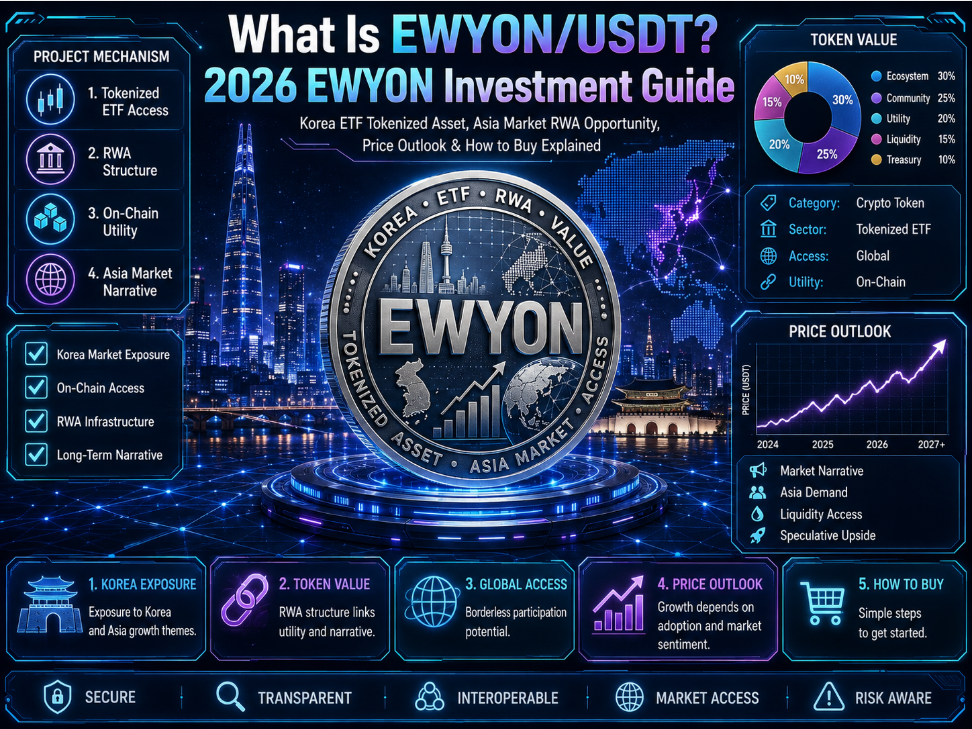
EWYON corresponds to the tokenized version of the iShares MSCI South Korea ETF, and EWY itself is a BlackRock iShares ETF that tracks South Korean equity indices. BlackRock’s site lists EWY’s asset class as Equity, exchange as NYSE Arca, and benchmark as the MSCI Korea 25/50 Index.
From a sector perspective, BlackRock shows that as of August 7, 2026, EWY’s Information Technology weighting is 46.00%, Industrials 20.72%, Financials 12.09%, and Consumer Discretionary 6.63%. This indicates EWY is not a simple “broad Korean market average” but a single-country ETF with significant exposure to Korean tech, semiconductors, and industrial sectors.
South Korean media outlet Seoul Economic Daily reported that Ondo Finance launched EWYon in February 2026, with its underlying asset being the BlackRock-managed iShares MSCI South Korea ETF, and noted that the ETF includes major Korean companies such as Samsung Electronics, SK hynix, and Hyundai Motor.
Thus, EWYON’s underlying logic is not “buying a Korean coin,” but rather:
Korean stock market → EWY ETF → Ondo Tokenized ETF → EWYON Token → Crypto users gain South Korean market exposure via USDT
Before buying EWYON, investors must verify its issuance mechanism, custody arrangements, underlying asset support, redemption rules, and geographic restrictions. Because a tokenized asset provides economic exposure, it should not be simply equated with ETF shares held in a traditional brokerage account.
3. Is EWYON a Korean Stock? How Should Token Rights Be Understood?
EWYON is not a Korean stock, nor is it an ETF share directly issued by the Korea Exchange.
It is better understood as an “on-chain tokenized expression of the economic performance of a Korean ETF.” This is crucial because many newcomers assume that buying EWYON means directly owning shares of Korean listed companies or directly becoming an ETF holder.
Ondo’s official documentation on Ondo Stocks states that Ondo tokenized stocks are supported by the underlying stocks or ETFs and are transferable on supported blockchains; however, these tokens are not registered under the U.S. Securities Act or the securities laws of other jurisdictions. The disclaimer on Ondo’s asset pages also clarifies that Ondo Stocks provide holders with economic exposure to the value of the underlying assets, including the impact of dividend values after applicable withholding taxes, but these tokens are not stocks, ETFs, or ADRs themselves.
This means buying EWYON and buying a traditional Korean ETF are not the same thing.
- Buying EWY ETF typically means you hold ETF shares through a traditional brokerage account, governed by securities market and fund rules.
- Buying EWYON means gaining economic exposure related to the EWY ETF through the crypto market. You hold a token, not an ETF share in a traditional securities account.
Therefore, purchasing EWYON does not automatically grant you:
- All the rights of a traditional ETF holder.
- Shareholder rights of Korean listed companies.
- Full legal rights at the fund level.
- Unrestricted rights to redeem the underlying assets.
A more accurate statement is: EWYON allows crypto users to obtain on-chain economic exposure related to the price performance of a Korean ETF, but they still bear issuer, custody, redemption, regulatory, and liquidity risks.
4. What Are the Differences Between EWYON and a Traditional Korean ETF?
The differences between EWYON and a traditional Korean ETF lie mainly in investment method, holding structure, rights arrangements, and sources of risk.
Traditional Korean ETFs or EWY are more suitable for investors familiar with brokerage accounts. Their advantages include a mature securities market, clear ETF structures, stable trading rules, better liquidity, and a more established regulatory framework. Their drawbacks may include account opening hurdles, geographic restrictions, trading hour limitations, and complex cross-border investment processes.
EWYON is better suited for those already comfortable with crypto accounts, USDT, wallets, and RWA assets. Its advantages are that it aligns more closely with crypto user habits, allows exposure to the Korean market via tokens, and can potentially be integrated into on-chain portfolios and DeFi use cases.
However, EWYON’s drawbacks are also clear:
- It is not a traditional ETF share.
- It does not automatically carry full ETF rights.
- It has token-structural risks.
- It may suffer from insufficient liquidity.
- It is subject to issuer, custody, and redemption mechanics.
- It may face regulatory restrictions in different jurisdictions.
So, EWYON is not a “safer” alternative to a Korean ETF. It is more like an economic exposure tool for crypto users who want access to the Korean market via digital assets.
If you already have a well-established brokerage account and want a traditional ETF experience, EWY or other Korean market ETFs may be more straightforward.
If you prefer to invest in the Korean market using USDT or crypto rails, then EWYON is worth researching.
5. Why Are Korean Assets Entering Crypto? Analyzing the Global RWA Trend
Korean assets entering the crypto market is part of the broader RWA globalization trend.
RWA stands for Real World Assets – traditional assets moving into blockchain-based finance. This can include equities, ETFs, Treasuries, gold, real estate, commodities, and fund shares. In the past, the crypto market mainly traded BTC, ETH, memecoins, and DeFi tokens; but post-2026, more and more traditional assets are entering the crypto ecosystem via tokenized stocks, tokenized ETFs, and on-chain Treasuries.
EWYON represents a specific sub-sector of RWA: Asian market ETF tokenization.
Seoul Economic Daily noted that EWYon is based on an ETF that invests in the Korean stock market, and highlighted that tokenization enables freer transfer on blockchain, reduces time and geographic constraints, and allows simultaneous settlement. The report also mentioned that EWYon settles in USDC and can be traded from anywhere in the world.
This shows EWYON is not just “another tradable token” – it gives crypto users a way to access Asian equity market assets through on-chain rails.
The value of RWA globalization can be seen in three main areas:
First, lowering cross-border investment barriers. Many users do not have Korean brokerage accounts and are unfamiliar with local Korean broker processes, but they may already hold USDT or have crypto exchange accounts.
Second, increasing asset accessibility and flexibility. Tokenized ETFs allow traditional financial assets to be more easily integrated into user wallets, trading platforms, and on-chain portfolios in a way that fits the crypto ecosystem.
Third, expanding the boundaries of crypto assets. If the crypto market only trades native tokens, the asset universe is limited. But if stocks, ETFs, bonds, and global market assets move on-chain, the crypto financial system becomes closer to a global multi-asset market.
This is why EWYON deserves a place in HIBT’s RWA content matrix.
6. Why Is the Korean Tech Market Becoming a Key Investment Theme in the AI Era?
EWYON is worth researching not just because it’s a Korean ETF token, but because the Korean market is deeply tied to AI, semiconductors, and the tech supply chain.
South Korea is a major Asian capital market, with representative industries including semiconductors, memory chips, consumer electronics, automobiles, batteries, and industrial manufacturing. In particular, Samsung Electronics, SK hynix, and others hold critical positions in the global semiconductor and AI storage supply chain. Seoul Economic Daily’s EWYon report specifically mentioned that EWY includes Samsung Electronics, SK hynix, and Hyundai Motor.
From an AI industry chain perspective, Korea’s core appeal lies in:
- Semiconductors
- Memory chips
- AI data center supply chain
- Consumer electronics
- Automotive and smart manufacturing
In the AI era, model training, inference, data centers, and cloud computing all require massive compute and storage resources. Korean companies play a major role in memory chips, HBM, semiconductor manufacturing, displays, and electronics supply chains, making the Korean market a natural fit for AI infrastructure investment themes.
However, investors should also note that the Korean market is not a risk-free growth story. It is affected by global semiconductor cycles, export demand, the KRW/USD exchange rate, foreign capital flows, geopolitics, and local policies. As an economic exposure to the Korean ETF, EWYON is also subject to these factors.
7. South Korea’s Semiconductor Industry, AI Supply Chain, and the EWYON Investment Thesis
EWYON’s investment thesis can be broken down into three layers.
Layer 1: South Korean stock market growth. If the Korean equity market rises overall, EWY’s net asset value increases, and EWYON as a tokenized economic exposure should theoretically benefit.
Layer 2: Growth in Korean semiconductors and the AI supply chain. BlackRock’s data shows EWY has a high Information Technology weighting – 46.00% as of August 7, 2026. That means EWYON is significantly influenced by the performance of Korean tech and semiconductor stocks.
If AI data centers continue to expand, demand for memory chips, HBM, servers, consumer electronics, and advanced manufacturing rises, Korean tech assets may benefit, and EWYON could indirectly gain as well.
Layer 3: RWA market growth. If more crypto users want to participate in traditional ETFs and global stock markets using USDT, tokenized ETFs like EWYON will attract more attention. It is not a single-company token but an ETF exposure to the Korean market, offering more diversification than a single stock token.
You can place EWYON into an AI Semiconductor RWA Cluster:
- What Is INTCON? – represents Intel and U.S. semiconductor assets.
- What Is WDCB? – represents Western Digital-related AI storage assets.
- EWYON represents Korean semiconductor, tech, and Asian market ETF assets.
Together, these three form an AI infrastructure RWA matrix: compute, storage, and the Asian supply chain.
8. EWYON Price Prediction: Five Key Factors Influencing Future Performance
A price prediction for EWYON should not be a simple “target price.” A more professional approach is to analyze the core variables that will shape its future price.
Factor 1: South Korean stock market performance. Since EWYON provides economic exposure to a Korean ETF, the movement of Korean indices, corporate earnings, foreign inflows, policy environment, and market valuations all affect EWYON.
Factor 2: Semiconductor cycles. The Korean market has high exposure to semiconductors and tech. AI capital expenditures, memory pricing, chip demand, data center construction, and global electronics cycles all influence Korean tech asset performance.
Factor 3: Exchange rates. Korean assets are impacted by the KRW/USD exchange rate. For crypto users pricing EWYON in USDT or USD, a stronger or weaker won can affect underlying ETF returns and investment outcomes.
Factor 4: RWA market capital flows. If the tokenized ETF market continues to expand, EWYON may see more trading demand; if RWA regulation tightens or crypto risk appetite falls, EWYON’s liquidity may suffer.
Factor 5: The broader crypto market environment. EWYON is not BTC or ETH, but it trades in the crypto market. BTC and ETH trends influence risk appetite, stablecoin liquidity, and RWA trading activity. You can refer to the ETH Price Prediction to understand the on-chain financial ecosystem, and the BTC Price Prediction to gauge overall crypto risk sentiment.
For different scenario-based target price analyses, check the EWYON Price Prediction , which simulates outcomes based on Korean markets, semiconductor cycles, exchange rates, and RWA flows.
9. Three Scenarios for EWYON Price Prediction: Bull, Neutral, Bear
A more reasonable EWYON price forecast should be broken into three scenarios.
Bull Case: Korean tech stocks continue to rally; Samsung, SK hynix, and other semiconductor/AI supply chain companies benefit from global AI capex; the Korean market attracts foreign inflows; the KRW is stable or strengthens; the RWA market keeps expanding; and more crypto users participate in Asian ETF exposure via USDT. In this case, EWYON could benefit from both the rising Korean ETF and growing demand for tokenized ETFs.
Neutral Case: The Korean market remains stable; semiconductor cycles recover moderately; EWY tracks fundamentals with moderate growth; the RWA market continues to develop but without a breakout; EWYON mainly tracks EWY with no significant independent premium.
Bear Case: The Korean economy weakens; semiconductor prices drop; AI capex slows; the KRW fluctuates; foreign capital exits; the Korean stock market corrects; RWA regulations tighten; or EWYON faces liquidity shortages. In this scenario, EWYON could face pressure from both the Korean market and the crypto market.
Therefore, EWYON is not a “must-rise Korean market token.” It is an RWA asset that combines Korean equity risk, ETF risk, currency risk, and tokenized-structure risk.
10. How to Invest in EWYON? Comparing Crypto vs. Traditional ETF Approaches
Before buying EWYON, newcomers should first decide which investment path they prefer.
If you already have a brokerage account and want to invest directly in a Korean market ETF, EWY is more straightforward.
If you prefer a crypto-native approach – using USDT or an on-chain wallet to gain Korean market exposure – then EWYON is worth researching.
Buying EWYON typically follows this process:
Step 1: Choose a platform that supports EWYON trading. Look for EWYON/USDT pairs, sufficient volume, reasonable bid-ask spreads, and convenient deposits/withdrawals. BYDFi announced it listed the EWYONUSDT spot pair in April 2026.
Step 2: Prepare USDT or USDC. For crypto users, a USDT pair is intuitive for calculating cost basis and P&L.
Step 3: Check EWYON’s price action. Before trading, visit the EWYON Real-Time Quote to see current price, change, volume, and candlestick charts.
Step 4: Search for the EWYON/USDT pair. Confirm the asset name, pair, and platform details to avoid buying a similarly named copycat or wrong token.
Step 5: Choose your order type. Limit orders are recommended for beginners; avoid large market orders. Tokenized ETFs may have lower liquidity than BTC, ETH, or traditional ETF markets on some platforms.
Step 6: Manage position sizing after purchase. Although EWYON tracks a Korean ETF, it is still an RWA asset in the crypto market. Do not overlook token-structure, liquidity, and regulatory risks just because it is ETF-linked.
If purchasing EWYON through an on-chain wallet, pay extra attention to contract addresses, networks, wallet approvals, gas fees, routing, and phishing websites.
11. EWYON vs. Korean ETF Investing: Which Is Right for You?
EWYON and traditional Korean ETFs are not about one being absolutely better – they suit different users.
Traditional Korean ETFs or EWY are for those who already have brokerage accounts and want a more mature financial market experience. Advantages: established regulation, clear ETF structures, usually better trading depth. Disadvantages: account opening, geographic restrictions, trading hours, and cross-border fund transfers can be more complex.
EWYON is for those already familiar with crypto trading and who want to gain Korean market exposure using USDT or on-chain wallets. Advantages: aligns with crypto user habits and fits into RWA portfolios. Disadvantages: an extra layer of tokenized-structure risk, including issuer, custody, redemption, liquidity, and regulatory limitations.
Simple rule of thumb:
- If you want traditional ETF rights and a brokerage account framework, research EWY or other Korean ETFs.
- If you want to gain economic exposure to the Korean market via crypto, research EWYON.
- If you want U.S. tech index exposure, research QQQON.
- If you want single U.S. tech stock exposure, research METAON, INTCON, PLTRON, etc.
12. EWYON vs. EWYB vs. QQQON: Comparing Global Tokenized ETF Assets
EWYON is suitable for those bullish on the Korean market, Asian tech industries, and semiconductor cycles. But the RWA market offers more than just EWYON.
What Is EWYB? – also related to the Korean market, but you need to distinguish its issuance structure, token mechanics, trading channels, and rights arrangements. Do not treat EWYB and EWYON as identical just because their names are similar.
What Is QQQON? – represents the Nasdaq-100 ETF tokenized asset, with a core focus on U.S. large-cap tech, AI, cloud computing, and software platforms. Compared to QQQON, EWYON leans more toward the Korean market and Asian supply chain.
What Is METAON? – represents a tokenized Meta stock, with logic tied to AI advertising, social platforms, and consumer internet applications; EWYON is a Korean market ETF exposure, not a single-company asset.
Think of the global tech RWA assets as:
- EWYON: Korean market, semiconductors, Asian tech supply chain.
- QQQON: U.S. tech index, Nasdaq-100, AI platform companies.
- METAON: Meta single-company exposure, AI ads, social ecosystem.
- INTCON: Intel single-company exposure, AI chips, semiconductor manufacturing.
- WDCB: Western Digital-related assets, AI storage infrastructure.
These assets are not substitutes; they correspond to different regions, industries, and risk profiles.
13. EWYON vs. INTCON vs. WDCB: An AI Infrastructure Investment Map
If you place EWYON within the AI infrastructure RWA matrix, its position becomes very clear.
- What Is INTCON? – represents an Intel tokenized stock, focusing on U.S. semiconductors, AI PCs, data center chips, and foundry turnaround logic.
- What Is WDCB? – represents Western Digital-related assets, focusing on AI data storage, cloud data centers, and storage infrastructure.
- EWYON – represents Korean market ETF exposure, focusing on Samsung, SK hynix, and the Korean tech/semiconductor supply chain.
In other words:
- INTCON → AI compute
- WDCB → AI storage
- EWYON → Korean semiconductor ecosystem
- QQQON → U.S. tech index
- METAON → AI applications and ad platforms
This framework can help users move from researching a single token to understanding the broader AI-industry-chain RWA investment map.
14. EWYON Investment Risks: Market, Currency, Industry Cycles, and Token Risks
EWYON has six main risk categories.
1. South Korean stock market risk. EWYON tracks Korean ETF exposure, so it is affected by Korean equity volatility, corporate earnings, foreign inflows/outflows, policy changes, and global risk appetite.
2. Sector concentration risk. EWY has a high Information Technology weighting – 46.00% as of August 7, 2026. If Korean tech and semiconductor sectors correct, EWYON may come under pressure.
3. Semiconductor cycle risk. Semiconductors and memory are cyclical – periods of high demand can be followed by inventory pressure, price declines, and margin compression. EWYON is not just a “Korean growth token”; it is also exposed to global chip cycles.
4. Currency risk. Korean assets are affected by the KRW/USD exchange rate. For crypto users using USDT as their base currency, exchange rate movements can impact underlying ETF performance and actual returns.
5. Tokenized asset structural risk. EWYON is not a traditional EWY ETF share. Ondo’s disclosures emphasize that Ondo Stocks provide economic exposure but are not stocks, ETFs, or ADRs themselves.
6. Liquidity and regulatory risk. Tokenized ETFs sit at the intersection of crypto and securities markets, making them highly sensitive to regulation. Different countries may restrict purchases, transfers, or redemptions. If secondary market depth is shallow, EWYON may experience wide bid-ask spreads and slippage on large trades.
Therefore, EWYON should not be treated as a “low-risk Korean ETF substitute.” It is an RWA asset carrying market risk, industry cycle risk, currency risk, and token-structure risk.
15. Is EWYON Suitable for Long-Term Investment?
Whether EWYON is suitable for long-term investment depends on whether you are simultaneously bullish on three directions: Korean tech industries, Asian equity markets, and the RWA tokenized ETF trend.
EWYON suits four types of investors:
- Those bullish on Asian tech industries.
- Those bullish on Korean semiconductor and AI supply chain trends.
- Those who want to invest in traditional ETF assets via crypto rails.
- Those who believe in the long-term development of RWA and tokenized ETFs.
EWYON does NOT suit three types:
- Those who only want to invest in BTC or ETH.
- Those chasing short-term explosive gains.
- Those who do not understand tokenized assets, ETF structures, or currency risks.
Before investing in EWYON, ask yourself these five questions:
- Do I understand that EWYON is not a coin issued by the Korean government or the Korea Exchange?
- Do I know that EWYON is not the same as directly holding EWY ETF shares?
- Am I bullish on Korean tech and semiconductor industries?
- Can I accept KRW exchange rate volatility and Korean market fluctuations?
- Am I familiar with tokenized ETF issuers, liquidity, and regulatory risks?
If you can answer all these clearly, EWYON can be an RWA asset to watch in the Asian market. If you are tempted to buy simply because you see “Korean asset tokenization,” then direct participation may not be suitable.
16. Summary: EWYON Is an RWA Asset Bringing a Korean ETF into the Crypto Market
EWYON’s core value is not creating a new crypto narrative, but bringing the economic exposure of a South Korean equity ETF onto the on-chain market. It represents an important direction in the 2026 RWA landscape: Asian market ETF tokenization.
For crypto newcomers, understanding EWYON comes down to four key points:
- EWYON is not BTC, ETH, or a memecoin.
- EWYON is not a cryptocurrency issued by the Korea Exchange or the Korean government.
- EWYON is not an EWY ETF share held in a traditional brokerage account.
- EWYON provides economic exposure related to a Korean ETF, while also carrying RWA structural risks and crypto trading risks.
In the long run, EWYON’s opportunities come from Korean tech industries, semiconductor cycles, the AI supply chain, Asian market allocation demand, RWA asset growth, and on-chain ETF trading demand.
But from a risk perspective, EWYON also faces Korean market volatility, tech sector concentration, exchange rate fluctuations, semiconductor down cycles, tokenized ETF rights differences, liquidity shortages, and regulatory constraints.
Therefore, EWYON is better framed as a 2026 Guide to Korean ETF Tokenization: How Asian Tech Assets Enter Crypto via RWA, rather than a simple “how to buy EWYON” coin-purchase article. When researching EWYON, users should first check the EWYON/USDT Quote , then use the EWYON Price Prediction for scenario analysis, and finally combine insights from the Korean market, semiconductor cycles, the ETH/BTC market environment, and RWA development trends to form a judgment.
EWYON FAQ
What is EWYON?
EWYON is the Ondo Tokenized version of the iShares MSCI South Korea ETF, falling under the RWA tokenized ETF category. Its goal is to provide users with blockchain-token-based economic exposure to a South Korean equity ETF.
Is EWYON a Korean stock?
No. EWYON is not a single Korean stock; it is a tokenized asset linked to a Korean ETF. It is better described as on-chain economic exposure to the Korean stock market ETF.
What ETF does EWYON correspond to?
EWYON’s underlying logic comes from the iShares MSCI South Korea ETF. BlackRock’s website states that the ETF seeks to track an index of South Korean equities and provides targeted exposure to Korean companies.
What is the difference between EWYON and EWYB?
Both are related to the Korean market, but they may come from different token mechanisms, issuance systems, and trading channels. Before investing, check each one’s underlying assets, issuer, custody, redemption rules, and trading risks separately.
What is the difference between EWYON and a Korean ETF?
A traditional Korean ETF or EWY is held through a brokerage account; EWYON is held via a crypto platform, USDT pair, or on-chain wallet. EWYON provides economic exposure and should not be assumed to carry the full rights of a traditional ETF.
How do I buy EWYON?
Users can buy EWYON on platforms that support the EWYON/USDT trading pair. Before buying, check the EWYON Real-Time Quote to confirm price, volume, and pair details.
Will EWYON go up in the future?
EWYON’s price is primarily influenced by Korean stock market performance, semiconductor cycles, AI supply chain demand, the KRW/USD exchange rate, RWA market development, the ETH/BTC market environment, and crypto risk appetite. Refer to the EWYON Price Prediction for scenario analysis.
Is EWYON safe?
EWYON has underlying RWA asset logic, but it still carries issuer, custody, redemption, regulatory, liquidity, and on-chain security risks. It is not a risk-free asset.
Is EWYON suitable for long-term holding?
If you are long-term bullish on Korean tech industries, semiconductor supply chains, and the RWA tokenized ETF trend, you can add EWYON to your watchlist. But before holding long-term, you need to understand Korean market risk, currency risk, and tokenized ETF structural risk.
What is the difference between EWYON and QQQON?
EWYON focuses on Korean market ETF exposure; QQQON focuses on the U.S. Nasdaq-100 tech index exposure. EWYON is more concentrated on Korean tech and semiconductor cycles, while QQQON leans toward a basket of major U.S. tech companies.
Disclaimer: This article is for educational and research purposes only regarding crypto, RWA, and tokenized ETFs. It does not constitute investment, legal, tax, or securities advice. Tokenized ETFs carry structural, regulatory, liquidity, and market risks. EWYON is also subject to Korean market conditions, exchange rate fluctuations, and semiconductor cycles. Please conduct your own independent research and assess your personal risk tolerance before investing.