
What is MSTRON? For crypto newcomers searching for "MSTRON USDT," the most common questions are: Is MSTRON a cryptocurrency issued by MicroStrategy? Does buying MSTRON equal buying MSTR stock? And why is it tied to Bitcoin?
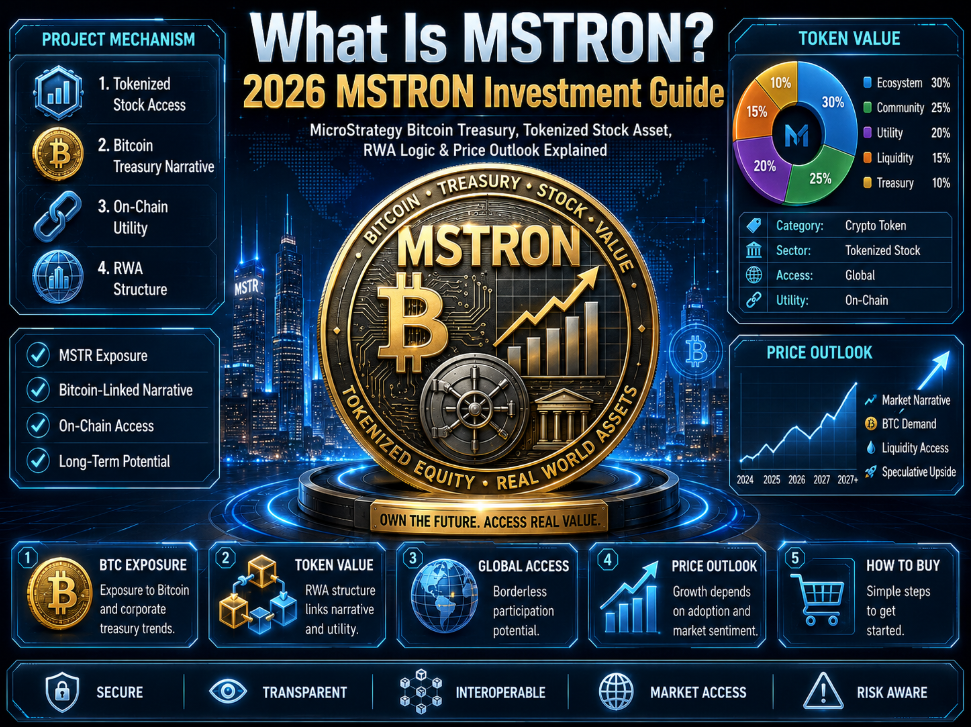
In a nutshell: MSTRON (often written as MSTRon) is a tokenized stock asset linked to MicroStrategy—now known as Strategy Inc.—and falls under Ondo’s tokenized stock ecosystem as an RWA (real-world asset) token. Its goal is to give users blockchain-based exposure to the economic performance of MSTR stock. CoinGecko describes MSTRON as a digital token that provides on-chain economic exposure to MicroStrategy shares; DefiLlama similarly notes that MSTRon is a structured token issued by Ondo Global Markets, designed to track the performance of the corresponding public stock or ETF.
So, MSTRON is not BTC, not ETH, and certainly not a memecoin. More accurately, it is a tokenized RWA expression of economic exposure to MicroStrategy / Strategy stock. But MSTRON differs from ordinary stock tokens because Strategy is one of the world’s most prominent Bitcoin Treasury companies—MSTR’s share price is heavily influenced by Bitcoin’s price, the company’s BTC holdings, its financing strategies, and overall market risk appetite.
If you just want to check MSTRON’s current market performance, go to MSTRON Live Price to view the MSTRON/USDT price, volume, and charts. For a forward-looking perspective, combine that with MSTRON Price Prediction for scenario analysis based on Bitcoin cycles, MSTR stock performance, RWA market trends, and crypto risk sentiment.
1. What is MSTRON USDT? Is it Bitcoin or a MicroStrategy Stock Token?
MSTRON is neither Bitcoin nor a conventional cryptocurrency—it’s a tokenized stock asset. Its underlying investment thesis comes from MicroStrategy, now Strategy Inc., trading under the ticker MSTR on NASDAQ.
The traditional way to invest in MSTR stock:
Open a brokerage account and buy MSTR shares through a broker and the NASDAQ market.
The on-chain path via MSTRON:
Use USDT, a crypto exchange account, or a wallet to purchase MSTRON tokens, gaining economic exposure to MSTR’s price performance.
That’s why MSTRON exists in crypto markets—it bridges three distinct markets:
First, the stock market.
MSTRON’s underlying logic derives from MSTR stock performance.
Second, the Bitcoin market.
Strategy’s core strategy is a long-term Bitcoin Treasury, so MSTR is widely viewed as a high-beta, Bitcoin-correlated equity.
Third, the crypto and RWA market.
MSTRON brings MSTR’s economic exposure on-chain, allowing crypto users to participate via tokenized stocks.
For newcomers, think of MSTRON this way:
- MSTRON is not Bitcoin.
- MSTRON is not an official coin issued by MicroStrategy.
- MSTRON is not the same as holding MSTR stock in a traditional brokerage account.
- MSTRON is a tokenized representation of economic exposure to MSTR stock.
- Its price is influenced by MSTR stock, BTC price, RWA liquidity, and crypto market sentiment.
Therefore, analyzing MSTRON isn’t just about “will this token go up?”—you must also understand MicroStrategy’s Bitcoin Treasury strategy, MSTR valuation dynamics, and the structural risks of tokenized stocks.
2. Is MSTRON a Cryptocurrency Issued by MicroStrategy?
No. MSTRON is not an official crypto token from MicroStrategy (Strategy Inc.), nor is it a “Bitcoin stock coin” launched by the company.
Ondo’s official documentation states that Ondo tokenized stocks are backed by the corresponding stocks or ETFs, and holders receive economic exposure similar to owning the underlying stock with dividends reinvested. However, these tokens are not stocks, ETFs, or ADRs themselves, nor do they entitle holders to receive the underlying assets.
That means MSTRON and MSTR stock are not interchangeable.
- Buying MSTR stock means you hold shares of a publicly traded company through a traditional brokerage, subject to securities regulations, broker oversight, and investor protections in the relevant jurisdictions.
- Buying MSTRON means you gain on-chain economic exposure to MSTR’s price performance via the crypto market. You hold a token, not a traditional security.
Key differences:

So, MSTRON is not “MicroStrategy’s coin”—it’s a third-party RWA financial infrastructure product that tokenizes MSTR stock.
3. What is MicroStrategy / Strategy, and Why Does Crypto Care?
MicroStrategy was originally a U.S. public company focused on enterprise analytics software, but the crypto world pays attention because it made Bitcoin a core part of its corporate balance sheet strategy. The company later rebranded to Strategy Inc., positioning itself as a Bitcoin Treasury Company.
In its 2025 annual report, Strategy stated that as of February 13, 2026, it held approximately 717,131 Bitcoins, all unencumbered, with a fair value of about $49.3 billion based on Coinbase market prices that day. In its Q4 2026 earnings release (as of February 1, 2026), the company reported holding 713,502 BTC and called itself the largest corporate Bitcoin holder and the world’s first Bitcoin Treasury Company.
This makes MSTR stock fundamentally different from an ordinary software company. Buying MSTR isn’t just investing in software—it’s gaining exposure to a publicly traded company that is highly correlated with Bitcoin.
Strategy’s business logic can be summarized as:
- Software operations provide baseline cash flow.
- Capital market fundraising provides dry powder.
- Bitcoin serves as the core reserve asset.
- MSTR becomes one of the most closely watched Bitcoin-related equities in traditional markets.
That’s also why MSTRON stands out among other tokenized stocks. For example, PLTRON tracks Palantir (AI/data analytics), INTCON tracks Intel (semiconductors), while MSTRON’s core label is:
Stock × Bitcoin Treasury × RWA Tokenized Stock
For more on other RWA tokenized stock cases, read What is PLTRON and What is INTCON.
4. How Do MSTRON, MSTR Stock, and Bitcoin Differ?
MSTRON, MSTR stock, and BTC are often discussed together, but they are not the same asset.
BTC is a native crypto asset. It has no corporate entity, no board, no earnings reports, and doesn’t depend on any company’s capital structure. BTC price is driven by supply/demand, macro liquidity, miner behavior, ETF flows, regulation, market sentiment, and long-term scarcity expectations.
MSTR stock is a traditional public equity. It represents equity exposure to Strategy Inc., and its price is affected by Bitcoin’s price, the company’s BTC holdings, financing structure, dilution, preferred shares, debt, software business performance, valuation multiples, and overall market confidence.
MSTRON is a tokenized asset representing economic exposure to MSTR stock. It is not directly BTC, nor is it directly MSTR in a brokerage account—it tracks MSTR’s performance through an RWA token structure.
So, the relationship:
- BTC = core crypto asset.
- MSTR = traditional stock of a Bitcoin Treasury company.
- MSTRON = on-chain economic exposure token for MSTR stock.
- Investing in BTC = direct bet on Bitcoin itself.
- Investing in MSTR = betting on a public company’s Bitcoin Treasury strategy and capital structure.
- Investing in MSTRON = gaining MSTR economic exposure via crypto, while bearing token-structure risks.
These three have completely different risk profiles. BTC has no corporate financing or dilution risk; MSTR has corporate capital structure and valuation premium risk; MSTRON adds issuer, custody, redemption, liquidity, and regulatory risks on top.
Therefore, MSTRON is neither a substitute for BTC nor a perfect substitute for MSTR stock—it’s an RWA tool suited for crypto users exploring this asset class.
5. How Does MSTRON Work? Understanding the Asset-Backing Mechanism
MSTRON’s value derives primarily from MSTR stock performance, but it trades within the crypto and tokenized-stock ecosystem.
Ondo’s Stocks page explains that Ondo tokenized stocks are backed by the corresponding stocks or ETFs, giving holders economic exposure similar to owning the underlying with dividends reinvested. DefiLlama similarly describes MSTRon as a structured note designed to track the performance of a publicly traded stock or ETF, including dividend reinvestment where applicable.
Generally, MSTRON-type tokenized stocks involve four key mechanisms:
1. Underlying asset backing
MSTRON’s value is anchored to MSTR’s economic performance. When MSTR rises, MSTRON theoretically benefits; when MSTR falls, MSTRON typically faces pressure.
2. Price tracking mechanism
The issuer, market makers, on-chain trading, redemption mechanisms, and arbitrage opportunities work to keep the token price closely aligned with the underlying stock’s economic value.
3. Minting and redemption
If the token price deviates from the underlying asset’s value, eligible participants may arbitrage through minting or redemption—though these mechanisms may be limited by market hours, platform rules, jurisdictional restrictions, and risk controls.
4. On-chain transfer and crypto trading
MSTRON can be traded on crypto venues, held in wallets, and potentially used in DeFi, but this also introduces on-chain security and liquidity risks.
So, when evaluating MSTRON, don’t just ask “is it backed by MSTR?”—ask:
- Who issues it?
- Who custodies the assets?
- Is there a redemption mechanism?
- Is there sufficient trading depth?
- Are there regional restrictions?
- What specific rights do holders actually have?
These questions define the real differences between MSTRON and traditional MSTR shares.
6. Why is MicroStrategy Stock a Natural Fit for Crypto? The Bitcoin Treasury + RWA Logic
MicroStrategy (now Strategy) is uniquely suited for tokenization because it’s a bridge between equity markets and Bitcoin markets.
Most public companies keep cash in bank deposits, T-bills, money market funds, or operating capital. Strategy, however, has long used Bitcoin as its core reserve asset, expanding its BTC exposure through equity, debt, preferred shares, and other capital market tools. In a May 2026 press release, Strategy reported holding 843,738 Bitcoins as of May 25, 2026, alongside a capital structure that includes convertible bonds, preferred shares, and USD reserves.
This gives MSTRON a three-market connection:
Stock market – MSTRON tracks MSTR’s economic performance.
Bitcoin market – MSTR’s valuation is highly correlated with BTC price, the value of BTC holdings, per-share BTC metrics, and market confidence in the company’s Bitcoin strategy.
RWA market – MSTRON enters the crypto trading environment via a tokenized stock structure, letting users gain this equity exposure with USDT or on-chain methods.
Thus, MSTRON is not an ordinary RWA stock token. Its defining features:
- If BTC rallies, MSTR may benefit, and MSTRON may follow.
- If BTC drops, MSTR may see amplified effects, and MSTRON may also suffer.
- If the RWA market expands, MSTRON may attract more crypto users.
- If Strategy’s capital structure faces strain, MSTRON will reflect those risks.
That’s the unique “Bitcoin Treasury + Tokenized Stock” logic behind MSTRON.
7. Why Are Investors Watching MSTRON? Core Investment Thesis
MSTRON draws attention for three layers of value:
Layer 1: MSTR stock growth
If Strategy’s Bitcoin Treasury strategy continues to gain market validation, MSTR may remain highly followed. Key metrics include BTC holdings, per-share BTC, mNAV valuation, fundraising capacity, preferred share and debt costs, and balance sheet resilience through cycles.
Layer 2: Bitcoin bull cycles
As a quintessential Bitcoin Treasury company, a rising BTC price typically boosts its net asset value, market sentiment, and stock attention. Conversely, a falling BTC price directly undermines confidence in MSTR’s valuation.
Layer 3: RWA adoption
If more crypto users want to invest in traditional equities via USDT, MSTRON-type tokenized stocks could see increased demand. MSTR itself is already a highly discussed stock in crypto circles, so tokenizing it makes it a natural fit for RWA content and on-chain portfolio discussions.
That’s why MSTRON fits well within HIBT’s RWA content matrix, alongside What is PLTRON, What is INTCON, What is QQQON, and What is METAON to form a thematic cluster:
- PLTRON = AI/data analytics stock tokenization
- INTCON = semiconductor/AI infrastructure stock tokenization
- QQQON = NASDAQ-100 index tokenization
- METAON = social media/AI advertising stock tokenization
- MSTRON = Bitcoin Treasury stock tokenization
Together, these show that crypto is evolving beyond native tokens into on-chain economic exposure for stocks, ETFs, and more real-world assets.
8. MSTRON Price Prediction: Key Factors Driving Future Moves
A credible MSTRON price forecast can’t just be “it will go to X.” Instead, analyze the core variables:
1. Bitcoin price trajectory
This is among the most critical variables. Strategy’s market cap and MSTR’s share price depend heavily on the market’s valuation of its BTC holdings. If BTC rises, MSTR likely benefits; if BTC falls persistently, MSTR may face valuation discounts, financing pressure, and fading confidence.
2. MSTR stock performance
MSTRON tracks MSTR economic exposure, not BTC directly. MSTR is influenced not only by BTC but also by the company’s financing strategy, share dilution, preferred stock structure, USD reserve management, debt costs, and equity market risk appetite.
3. Strategy’s capital structure
By 2026, Strategy had built a complex capital structure including common stock, preferred shares, convertible notes, USD reserves, and Bitcoin holdings. In a July 2026 SEC 8-K filing, the company disclosed that it sold BTC between June 29 and July 5, using proceeds to pay preferred distributions and replenish USD reserves. This shows that investors cannot simply assume “the company buys BTC forever.”
4. RWA market liquidity
If the tokenized stock market grows, MSTRON may see more trading demand; if RWA regulation tightens or crypto risk appetite declines, MSTRON liquidity could shrink.
5. ETH and on-chain financial environment
While MSTRON is not an ETH asset, RWA tokens typically rely on chain infrastructure, stablecoins, wallets, and DeFi ecosystems. The health of the Ethereum ecosystem and on-chain finance affects the overall usability of RWA assets. For context, check ETH Price Prediction to gauge smart contract and RWA market conditions.
For detailed scenario analysis at different price targets, see MSTRON Price Prediction and combine with BTC cycles, MSTR stock action, and RWA market heat.
9. Three Scenarios for MSTRON Price Prediction: Bull, Neutral, Bear
A more disciplined MSTRON forecast should consider three scenarios:
Bull Case: Bitcoin enters a sustained uptrend, Strategy’s BTC holdings appreciate, the market re-rates MSTR at a higher valuation premium, financing conditions improve, RWA market expands, and more crypto users participate via USDT. In this case, MSTRON could benefit from BTC upside, MSTR stock gains, and growing tokenized stock demand.
Neutral Case: BTC trades in a range, Strategy continues managing its BTC reserves and capital structure, MSTR stock fluctuates mainly around BTC net asset value and market premiums, and MSTRON largely tracks MSTR without a significant independent premium.
Bear Case: Bitcoin enters a prolonged downturn, Strategy’s net asset value declines, mNAV compresses, preferred and debt pressures rise, concerns mount over BTC sales, dilution, or funding capacity, and RWA liquidity weakens. MSTRON would then face triple pressure from BTC, MSTR, and crypto risk sentiment.
This is what makes MSTRON different from ordinary RWA stock tokens: it’s not just about one company’s operating income—it’s heavily dependent on Bitcoin prices and capital market confidence.
10. How to Invest in MSTRON: A Beginner’s Guide
Before buying MSTRON, clarify what exposure you want:
- If you want direct Bitcoin exposure, BTC itself is more straightforward.
- If you want to invest in Strategy through traditional markets, research MSTR stock.
- Only if you want crypto-based, USDT or on-chain exposure to MSTR’s economic performance should you consider MSTRON.
Typical steps to buy MSTRON:
Step 1: Choose a platform that supports MSTRON trading. Check for MSTRON/USDT pairs, sufficient volume, reasonable spreads, and convenient deposits/withdrawals.
Step 2: Prepare USDT or USDC. For crypto newcomers, USDT pairs are intuitive for cost and P&L tracking.
Step 3: Check MSTRON market data. Go to MSTRON Live Price to see current price, changes, volume, and candlestick patterns.
Step 4: Search for the MSTRON/USDT pair. Confirm the asset name and trading pair to avoid copycats or wrong tokens.
Step 5: Choose your order type. Limit orders are safer for beginners; avoid large market orders, as tokenized stock liquidity may be thinner than BTC, ETH, or the actual US equity market.
Step 6: Manage your position after purchase. Even though MSTRON tracks MSTR, it’s still an RWA token. Don’t ignore token structure, liquidity, and regulatory risks just because of its Bitcoin connection.
If buying via an on-chain wallet, pay extra attention to contract addresses, networks, wallet approvals, gas fees, routing, and phishing risks.
11. BTC, MSTR Stock, or MSTRON – Which Should You Choose?
Before investing in MSTRON, compare the three:
Buy BTC directly – Best for pure Bitcoin exposure. Pros: simple, no corporate capital structure, dilution, or equity valuation premiums. Cons: you don’t get the high-beta leverage that MSTR’s equity financing can provide.
Buy MSTR stock – Suitable for those with brokerage accounts who understand equities and Strategy’s capital structure. Pros: more mature liquidity in traditional markets, clearer equity rights. Cons: you bear BTC volatility, corporate financing decisions, dilution, preferred shares, and valuation premium/discount risks.
Buy MSTRON – Best for crypto-native users who want to gain MSTR economic exposure via USDT or on-chain methods. Pros: aligns with crypto user habits. Cons: adds tokenized stock structure risks—issuer, custody, redemption, liquidity, and regulatory constraints.
Simple rule of thumb:
- Want to bet directly on Bitcoin? Research BTC.
- Want to bet on a Bitcoin Treasury via equities? Research MSTR.
- Want on-chain exposure to MSTR economics? Research MSTRON.
To judge Bitcoin’s long-term trend, refer to BTC Price Prediction and combine it with MSTRON’s own market data for a holistic view.
12. Comparing MSTRON with Other RWA Assets – Building a Portfolio
MSTRON suits those bullish on the Bitcoin Treasury strategy and MSTR’s high-beta nature. But the RWA market offers many tokenized stocks, each representing different investment themes.
What is MSTRB also relates to MicroStrategy, but you must distinguish its issuance structure, trading mechanics, token mechanism, and rights—don’t assume MSTRB and MSTRON are identical just because names look similar.
What is QQQON leans toward the NASDAQ-100 index, representing a basket of U.S. tech stocks. Compared to MSTRON, QQQON is more diversified, while MSTRON is concentrated on Strategy and Bitcoin Treasury logic.
What is METAON represents Meta’s tokenized stock, focusing on AI advertising, social platforms, and consumer internet—MSTRON focuses on Bitcoin balance sheet strategy.
What is PLTRON tracks Palantir, centered on AI data analytics and enterprise AI platforms; MSTRON is centered on Bitcoin Treasury and capital markets strategy.
What is INTCON tracks Intel, focused on semiconductors, AI PCs, and Foundry turnaround; MSTRON is highly dependent on BTC price and MSTR valuation.
When choosing RWA assets, don’t just follow the hottest name—look at the underlying logic:
- MSTRON: Bitcoin Treasury, MSTR stock, high BTC correlation.
- QQQON: NASDAQ-100, tech index, diversified exposure.
- METAON: AI advertising, social media, Meta stock.
- PLTRON: AI data analytics, enterprise AI, Palantir stock.
- INTCON: Semiconductors, AI PCs, Intel stock.
This way, you upgrade your RWA investing from “chasing new coins” to “on-chain traditional asset allocation.”
13. Risk Analysis: What to Know Before Buying MSTRON
MSTRON carries six main risk categories:
1. Bitcoin price risk
One of the largest risks. MSTR stock is heavily influenced by BTC; if BTC drops sharply, Strategy’s BTC holdings lose value, market confidence wanes, MSTR valuation suffers, and MSTRON feels the impact.
2. Strategy capital structure risk
Strategy doesn’t just hold Bitcoin—it also has common stock, preferred shares, debt, USD reserves, and BTC sale/financing strategies. The July 2026 8-K filing showed the company sold BTC for preferred distributions and reserve replenishment. MSTRON investors must monitor capital structure, not just BTC price.
3. mNAV compression risk
MSTR has often traded at a premium to its BTC net asset value. If the market no longer awards that premium, or if enterprise value falls below BTC holdings, MSTR shares could face significant pressure. Reuters reported in June 2026 that Strategy’s enterprise value briefly dipped below its Bitcoin holdings, raising questions about the sustainability of its aggressive Bitcoin strategy.
4. Single-stock concentration risk
MSTRON is not an ETF—it’s a single-company tokenized stock. Compared to index-based assets like QQQON, MSTRON is more vulnerable to company-specific strategy, financing, and sentiment shifts.
5. Tokenized asset structural risk
MSTRON is not traditional MSTR stock. Ondo’s documentation clarifies that the token provides economic exposure, not the stock, ETF, or ADR itself, and does not grant rights to receive underlying assets.
6. Liquidity and regulatory risk
Tokenized stocks bridge crypto and securities markets—a highly regulated area. MSTRON may also face thin secondary trading, wide bid-ask spreads, redemption restrictions, and purchasing limits in certain countries.
In short, MSTRON is not a “low-risk Bitcoin stock version.” It’s a high-beta, high-volatility, structurally complex RWA asset.
14. Is MSTRON Worth Investing In? Who Is It For?
Whether MSTRON is worth it depends on whether you’re bullish on three trends simultaneously: Bitcoin’s long-term value, Strategy’s Bitcoin Treasury model, and the RWA tokenized stock market.
MSTRON suits three types of investors:
1. Those bullish on Bitcoin’s long-term value – If you believe BTC has further upside, MSTRON can be a tool for MSTR economic exposure.
2. Crypto investors bullish on RWA development – If you believe stocks, ETFs, bonds, and more traditional assets will move on-chain, MSTRON is a unique Bitcoin Treasury case in the RWA matrix.
3. Those who want to invest in U.S. equities via crypto – If you already hold USDT or use crypto platforms, MSTRON fits your crypto habits better than a traditional brokerage.
MSTRON is NOT for three types:
1. Those who only want traditional stocks and don’t want token-structure risk.
2. Those who cannot accept extreme BTC volatility.
3. Those chasing short-term, high-leverage gains without understanding RWA mechanics.
Before investing, ask yourself five questions:
- Do I understand that MSTRON is not an official MicroStrategy coin?
- Do I know MSTRON is not the same as holding MSTR stock directly?
- Can I accept large Bitcoin price swings?
- Do I understand Strategy’s financing, preferred shares, and USD reserve structure?
- Am I familiar with issuer, liquidity, and regulatory risks of tokenized stocks?
If you can answer these clearly, MSTRON can be an RWA asset to watch. If you’re buying just because it’s tied to Bitcoin, you’re not ready to participate.
15. Summary: MSTRON – A Bitcoin Treasury Stock Tokenized for the Crypto RWA Market
MSTRON’s core value isn’t creating a new Bitcoin-themed coin—it’s bringing economic exposure to Strategy / MicroStrategy stock onto the chain. It represents a unique 2026 RWA asset class: Bitcoin Treasury stock tokenization.
For crypto newcomers, grasp four key points:
- MSTRON is not BTC or ETH.
- MSTRON is not an official cryptocurrency from MicroStrategy.
- MSTRON is not MSTR stock in a traditional brokerage account.
- MSTRON provides economic exposure to MSTR stock while bearing BTC volatility, equity valuation, corporate capital structure, and tokenized asset risks.
Long-term opportunities come from Bitcoin’s secular growth, Strategy’s capital markets capabilities, RWA expansion, and on-chain U.S. equity demand.
But risks include BTC bear markets, MSTR valuation compression, financing/preferred share pressures, single-stock concentration, tokenized stock rights differences, illiquidity, and regulatory constraints.
Thus, MSTRON is best framed as “The 2026 MicroStrategy Stock Tokenization Investment Guide: How Bitcoin Treasury Enters Crypto via RWA” —not a simple “how to buy MSTRON” coin article. When researching MSTRON, start with MSTRON/USDT Price, then use MSTRON Price Prediction for scenario analysis, and finally combine with BTC trends, MSTR stock performance, Strategy’s capital structure, and RWA market developments.
MSTRON FAQ
What is MSTRON?
MSTRON is a tokenized asset for MicroStrategy / Strategy stock, part of the RWA tokenized stock sector, designed to give users on-chain economic exposure similar to MSTR stock performance.
Is MSTRON a coin issued by MicroStrategy?
No. MSTRON is not an official crypto token from MicroStrategy or Strategy—it’s a third-party RWA financial infrastructure product that tokenizes MSTR stock.
What’s the difference between MSTRON and MSTR stock?
MSTR stock is a traditional publicly traded equity; MSTRON is an on-chain tokenized asset providing economic exposure to MSTR, but without assuming full shareholder rights.
Why is MSTRON linked to Bitcoin?
Strategy holds a large Bitcoin position and uses Bitcoin as its corporate reserve core. Thus, MSTR stock is widely seen as a high-beta Bitcoin-correlated equity, and MSTRON is indirectly influenced by BTC price.
How do I buy MSTRON?
You can buy MSTRON on platforms that support the MSTRON/USDT pair. Check MSTRON Live Price first to confirm price, volume, and pair details.
Will MSTRON go up in the future?
MSTRON price is influenced by Bitcoin trends, MSTR stock performance, Strategy’s capital structure, RWA market growth, the ETH ecosystem, and crypto risk appetite. See MSTRON Price Prediction for scenario analysis.
Is buying MSTRON the same as buying Bitcoin?
No. Buying MSTRON gives you economic exposure to MSTR stock, which is influenced by Bitcoin price—it is not direct BTC ownership.
What’s the difference between MSTRON and a BTC ETF?
A BTC ETF tracks Bitcoin itself; MSTRON tracks MSTR stock performance, which is further affected by corporate financing, dilution, preferred shares, debt, and valuation premiums.
Is MSTRON suitable for long-term holding?
If you are long-term bullish on Bitcoin, Strategy’s Bitcoin Treasury model, and RWA tokenized stock trends, MSTRON can be on your watchlist. But long-term holding requires understanding BTC volatility, MSTR valuation risks, and tokenized stock structural risks.
What is the biggest risk with MSTRON?
Major risks include a sharp Bitcoin decline, MSTR valuation compression, Strategy capital structure stress, tokenized stock rights differences, issuer risk, illiquidity, and regulatory restrictions.
This article is for educational and research purposes only—it does not constitute investment, legal, tax, or securities advice. Tokenized stocks carry structural, regulatory, liquidity, and market risks. MSTRON is also subject to Bitcoin price movements and Strategy’s capital structure. Please conduct your own research and assess your risk tolerance before investing.