
1. What Is SILV? It’s Not a “Silver-Price Concept Coin”—It’s Physical Silver RWA
First-time searches for what is SILV or what does SILV USDT mean often lead users to mistake it for a typical new token, a silver‑price gimmick, or even a Meme Coin. But based on Dominion’s official disclosures, SILV is better understood as a tokenized silver asset—on‑chain silver RWA.
In one sentence:
SILV is a Solana‑native tokenized silver asset issued by Dominion, with the official design that 1 SILV equals 1 troy ounce of physical silver.
Its theoretical value does not come from:
- community consensus,
- meme hype, or
- the project’s storytelling.
It comes from:
Physical Silver → Custody → Tokenization → SILV
Dominion’s website describes SILV as a silver token on Solana, emphasizing that each token is 1:1 backed by one troy ounce of physical silver held in insured vaults. The official page also notes that SILV can be purchased with USDC, USDT, or SOL, priced at the spot silver price plus a minting fee.
So SILV is not a typical “low‑cap micro‑coin,” nor should it be analyzed using Meme Coin logic. It is closer to a Commodity RWA + Tokenized Silver + Solana DeFi asset.
2. What Does SILV USDT Mean?
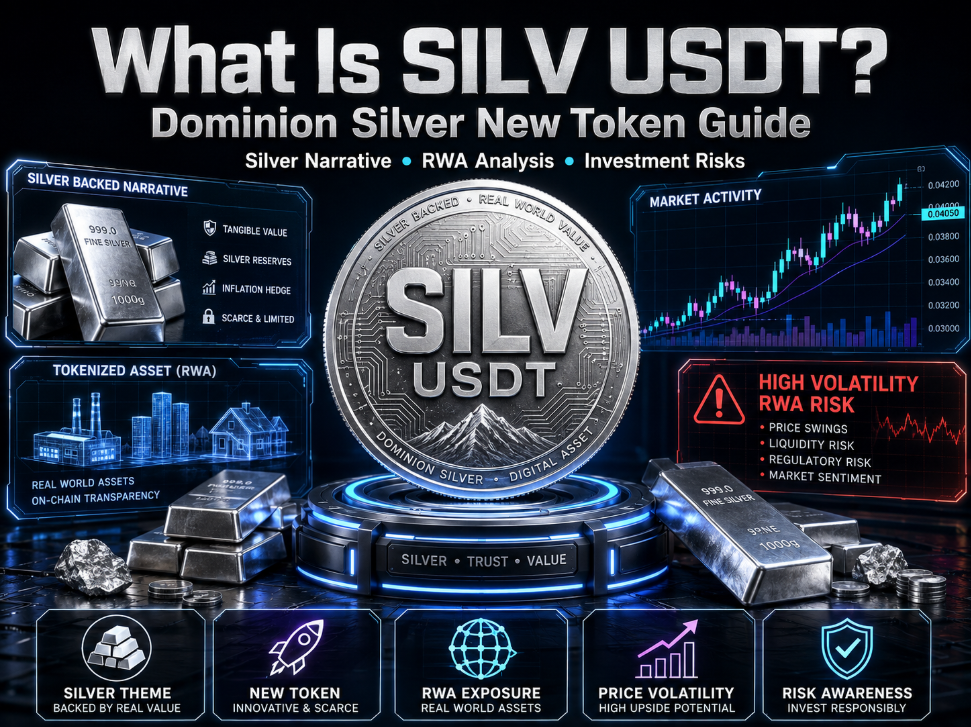
SILV/USDT is a trading pair—meaning SILV is quoted and traded against USDT.
It’s important to distinguish two concepts:
- SILV is the asset itself—the on‑chain silver token issued by Dominion.
- USDT is the quote currency used to price SILV.
So when you see SILV/USDT rising, in theory it means SILV is appreciating relative to USDT. But that does not mean SILV can expand indefinitely like a typical altcoin driven by market sentiment—because if SILV is consistently pegged to one ounce of silver, its price must ultimately revert to the physical silver spot price.
This is the most critical premise for analyzing SILV:
Start with Silver Spot, not the candlestick chart.
3. Which Crypto Sector Does SILV Belong To?
SILV fits into four main categories.
First, RWA (Real World Assets). SILV attempts to bring physical off‑chain silver onto the blockchain.
Second, Tokenized Commodities. It is not tokenized equity or a stablecoin—it is a precious‑metals commodity token.
Third, Precious Metals. It sits in a similar—but not identical—investment framework as gold RWA, silver ETFs, and physical silver bars.
Fourth, Solana DeFi. By choosing Solana, SILV is positioned for wallet transfers, DEX trading, on‑chain liquidity, and DeFi collateral use cases.
Therefore, for newcomers, SILV should not be casually labeled as a “new coin.” Instead, think of it as:
On‑chain silver.
4. What Is Dominion, and Why Is It Bringing Silver to Solana?
The issuer behind SILV is Dominion. Dominion positions itself as a tokenized‑silver project, aiming to give physical silver on‑chain liquidity, transparent reserves, and DeFi composability. Its website explicitly states that SILV offers 1:1 vaulted silver exposure, 24/7 Solana liquidity, transparent reserves, and DeFi utility.
Traditional silver investing has many pain points.
If you buy physical bars or coins, you have to deal with storage, insurance, transport, authentication, bid‑ask spreads, and limited trading hours. For smaller amounts, the costs can be even more prohibitive.
Dominion attempts to transform this process into:
Vaulted Silver → Blockchain Token → 24/7 Transfer
That is, the silver stays in an off‑chain vault, but ownership—or exposure—is expressed and transferred via an on‑chain token.
This is not simply issuing a “silver‑price concept token.” Dominion’s core narrative is:
Each SILV should be backed by actual physical silver.
So analyzing SILV requires more than asking “Is the project hot?”—you must ask harder questions:
- Where is the silver?
- Who custodies it?
- Who audits it?
- Does the token supply equal the silver reserve?
- Can users redeem physical silver?
These questions determine whether SILV is a credible tokenized silver asset or simply a high‑risk token dressed in RWA clothing.
5. Does 1 SILV Really Equal 1 Ounce of Silver?
This is the most important question in the entire article.
Dominion currently states:
1 SILV = 1 troy ounce physical silver.
One troy ounce equals approximately 31.1035 grams. So, by design, holding 1 SILV theoretically gives you exposure to one troy ounce of physical silver.
Dominion’s website also notes that the silver backing SILV is stored in secure vaults in the United States and Canada, using fully allocated vault custody with no rehypothecation.
Two key terms need explanation.
Allocated custody typically means that specific metal bars are assigned to specific clients or assets, rather than the custodian merely owing you a quantity of silver on its books.
No Rehypothecation means the same pool of assets is not re‑pledged, lent, or used for other financial arrangements. If the same silver were reused multiple times, it would create layers of claims and complex bankruptcy risks.
Dominion emphasizes “no rehypothecation, no commingling, fully allocated custody” as a core selling point. But investors should not rely solely on marketing copy—they must continuously verify independent audits, Proof of Reserve, custody agreements, and redemption terms.
6. How Can You Prove SILV Is Actually Backed by Silver? Proof of Reserve Matters More Than a Whitepaper
The core trust issue for any RWA asset is:
Does the on‑chain token truly correspond 1:1 to the off‑chain asset?
The blockchain can prove how many SILV tokens have been minted, but the blockchain cannot automatically prove that an equivalent amount of silver actually exists in the vault.
A complete silver RWA verification chain should look something like this:
Vault Silver → Custodian Records → Independent Verification → Proof of Reserve → On‑chain SILV Supply
Investors need to check not just “the project says it’s 1:1 backed,” but also:
- Who is the vault custodian?
- Are there bar lists or inventory records?
- Is there an independent auditing firm?
- How frequent are audits—daily, monthly, or ad hoc?
- What is the total on‑chain token supply?
- Is the mint address public?
- Is the Proof of Reserve continuously updated?
Chainlink’s industry commentary on tokenized silver emphasizes that for tokenized silver to gain institutional trust, the link between digital tokens and physical vaults must be rigorously verified; Chainlink oracles can connect to vault APIs or audit reports to verify the quantity of silver in custody.
So the real “EEAT” test for SILV is not a polished website, but:
Can independent, continuous, and verifiable data prove that 1 SILV is indeed backed by 1 ounce of silver?
7. How Is SILV Minted, and Why Should Its Price Theoretically Track International Silver Prices?
SILV is not a typical fixed‑supply crypto.
Most tokens specify:
Max Supply = 1 Billion
and then price themselves around scarcity, unlocks, and market cap.
SILV’s logical framework is different:
- New silver enters custody.
- The issuer or authorized mechanism confirms the silver reserve.
- New SILV is minted on‑chain.
- Users hold, trade, or redeem.
This means SILV’s supply should not rise based on a “scarcity narrative,” but rather follow the volume of silver entering custody.
Dominion’s website states that SILV is priced at the spot silver price plus a single 1.5% minting fee.
Thus, SILV’s fair value formula is closer to:
SILV Fair Value ≈ Silver Spot Price ± Premium / Discount
If SILV trades significantly above spot silver, it has a premium. If it trades below, it has a discount.
These premiums or discounts can arise from:
- insufficient liquidity,
- weekend closures in traditional silver markets,
- sudden on‑chain buying pressure,
- incomplete redemption mechanisms,
- thin market‑making depth,
- or shifting trust in the issuer.
This is a key point for RWA investors:
A tokenized asset does not automatically maintain a perfect 1:1 peg forever.
8. Can SILV Really Be Redeemed for Physical Silver?
Whether redemption is possible is a critical test of SILV’s quality.
Dominion’s website currently states that SILV is redeemable for physical metal, but the physical redemption feature will be enabled 3 to 6 months after launch.
This wording must be read carefully.
Do not write it as:
All users can immediately redeem physical silver right now.
The accurate phrasing is:
Dominion currently lists physical redemption as a planned feature, and investors must verify the specific redemption terms after the function is officially live.
Once redemption is actually open, users should also check:
- Minimum redemption quantity.
- Redemption fees.
- KYC requirements.
- Which countries or regions are eligible.
- Whether small amounts are supported.
- Who bears shipping costs.
- How insurance is calculated.
- Delivery timeframes.
- Tax implications.
For RWA assets, “theoretically redeemable” and “practically smooth redemption” are two different things. This distinction must be made clear before investing in SILV.
9. Why Did Dominion Choose Solana? What’s the Relationship Between SILV and SOL?
For RWA assets to work on‑chain, the underlying network needs low‑cost transfers, high throughput, fast settlement, wallet interoperability, DEX liquidity, and DeFi composability.
Solana positions itself as a high‑performance network for internet‑scale capital markets, payments, and crypto applications, and its RWA solutions page mentions that real‑world assets on Solana include tokenized Treasuries, public market funds, ETFs, commodities, and equities—all of which can move through wallets, DeFi, and institutional infrastructure.
This explains why Dominion likely chose Solana:
- Low transaction costs.
- Fast confirmation times.
- Suitability for on‑chain asset trading.
- Strong DEX and wallet ecosystem.
- Good fit for building RWA liquidity.
However, it’s important to note that SOL’s price does not directly determine SILV’s silver value.
SILV is pegged to silver, not SOL.
That said, SOL does affect:
- Solana network activity.
- DeFi liquidity.
- SILV trading volume.
- RWA user growth.
- Risk appetite for on‑chain assets.
Therefore, when analyzing SILV, you can reference SOL Real‑Time Price & Chart and SOL Price Prediction, but do not equate a SOL rally with an increase in SILV’s silver value.
10. Why Is the Market Paying Attention to Silver Again in 2026?
SILV has narrative room not only because RWA is hot, but also because silver itself is back in focus in 2026.
Silver is not a pure safe‑haven asset—it has a dual nature:
- Precious Metal.
- Industrial Commodity.
Gold is viewed more as a monetary asset and safe haven, while silver is also influenced by industrial demand. Silver is used in electronics, electric vehicles, solar power, data centers, semiconductors, and industrial equipment.
The Silver Institute, in its February 2026 outlook, stated that the silver market is expected to remain in a supply deficit for the sixth consecutive year in 2026; meanwhile, global silver demand is projected to stay broadly stable, with growth in retail investment offsetting declines in jewelry, silverware, and some industrial segments.
In another report on technology demand, the Silver Institute also noted that solar energy, automotive electrification, data centers, and AI will continue to drive silver demand in key technology sectors through 2030.
Thus, silver’s investment logic is not identical to gold’s.
Gold leans more toward:
Monetary / Safe Haven.
Silver leans more toward:
Monetary + Industrial Demand.
So silver prices often exhibit more cyclicality than gold, and may experience larger swings when industrial demand, investment demand, and supply tightness converge.
11. Why Could Tokenized Silver Become a New RWA Subsector?
In the first phase of RWA, the market primarily tokenized dollars, U.S. Treasuries, money‑market funds, gold, equities, and ETFs.
In the next phase, commodity RWA could become more significant.
The goal of tokenized commodities is to turn traditional off‑chain assets into composable on‑chain assets. Silver, gold, oil, agricultural products, and industrial metals are all potential candidates.
Potential advantages of Tokenized Silver include:
- 24/7 trading.
- Fractional ownership.
- Global transfers.
- On‑chain settlement.
- DeFi composability.
- No need to personally store physical bars.
Chainlink’s explanation of tokenized metals also notes that tokenized metals combine the stability of hard assets with the speed, liquidity, and transparency of Web3 ecosystems, allowing investors to trade commodities 24/7, gain fractional ownership, and use metal‑backed value in DeFi protocols; moreover, because silver has a lower price‑to‑weight ratio than gold, tokenization is especially helpful in reducing friction from physical transport and storage.
That is the vision for assets like SILV:
Not turning silver into a Meme Coin, but making silver an RWA asset that can be transferred, collateralized, traded, and combined on‑chain.
12. What’s the Difference Between SILV and Buying Physical Silver?
The biggest advantage of buying physical silver is direct possession.
You own silver bars, coins, or other physical forms. You don’t need to worry about smart contracts, lost tokens, on‑chain hacks, or issuer bankruptcy. As long as you store it safely, physical silver is physical silver.
But physical silver also has drawbacks:
- It requires storage.
- It needs insurance.
- Bid‑ask spreads can be wide.
- Transport and authentication are costly.
- Small transactions are inconvenient.
- Cross‑border movement is more complicated.
SILV attempts to solve these issues:
- It can be traded on‑chain, 24/7.
- You don’t need to store silver yourself.
- It may eventually participate in DeFi applications.
But SILV also introduces a whole new set of risks:
- Issuer Risk.
- Custodian Risk.
- Proof‑of‑Reserve Risk.
- Smart Contract Risk.
- Redemption Risk.
- Wallet Security Risk.
The core conclusion:
SILV solves some usability problems of physical silver but simultaneously adds financial intermediary layers and crypto‑technological risks.
So if your top priority is “physical metal in hand,” physical silver is more direct. If you need on‑chain liquidity, wallet transfers, DeFi composability, and fractional transactions, then SILV becomes worth discussing.
13. What’s the Difference Between SILV and a Silver ETF?
Many users ask:
If I want to invest in silver, why not just buy SLV ETF?
Silver ETFs are primarily traded through traditional brokerage accounts. For example, iShares Silver Trust’s official page states that SLV seeks to track the price performance of silver bullion, offering investors exposure to the silver market without directly purchasing physical silver.
SILV, in contrast, is an on‑chain tokenized physical silver asset.
The difference is not about which is “better”—it’s about entirely different use cases.
A silver ETF suits traditional brokerage users, with mature trading hours, regulatory frameworks, custodian arrangements, and tax treatment.
SILV is designed for on‑chain users, emphasizing wallet holding, 24/7 transfers, Solana liquidity, DeFi composability, and potential physical redemption.
But SILV also depends more heavily on the issuer, custodian, on‑chain contracts, and redemption mechanisms.
So, if you simply want silver price exposure, an ETF may be simpler. If you want to turn silver into an on‑chain asset, SILV is the more RWA‑aligned choice.
14. Can SILV’s Price Deviate from Real Silver?
Yes.
Any tokenized asset can trade at a premium or discount.
Under normal conditions, arbitrage mechanisms should help SILV revert toward the spot silver price.
- If SILV trades above spot, arbitrageurs can theoretically mint SILV and sell it, compressing the premium.
- If SILV trades below spot, arbitrageurs can theoretically buy SILV and redeem physical silver, narrowing the discount.
But this arbitrage mechanism has a prerequisite:
The mint and redemption channels must be smooth.
If redemption is not yet live, or if the thresholds, fees, geographic restrictions, or settlement times are too high, the arbitrage loop is incomplete. In that case, SILV’s premium or discount could widen.
This is a particularly relevant risk today, because Dominion’s official description states that physical redemption is still a planned feature 3 to 6 months after launch—not something every user can immediately complete right now.
Therefore, when investing in SILV, don’t just look at the slogan “1 SILV = 1 oz silver”—watch whether the actual market price consistently tracks spot silver over time.
15. What Actually Drives SILV’s Price? Breaking Down 6 Core Factors
The first and primary driver of SILV’s price is the international silver spot price. If silver enters a bull market, SILV’s theoretical value rises accordingly.
The second factor is SILV’s premium or discount to spot. If on‑chain demand spikes, SILV may trade above spot; if trust in custody or redemption falters, it may trade below.
The third factor is on‑chain liquidity. Deeper liquidity stabilizes the price; thinner liquidity makes it more prone to deviations.
The fourth factor is mint and redemption efficiency. Smoother mint/redeem processes make arbitrage more effective, keeping the price closer to silver.
The fifth factor is Solana RWA adoption. If Solana’s RWA user base grows, SILV may attract more trading, collateral, and liquidity demand.
The sixth factor is overall crypto liquidity. A BTC or ETH rally does not directly increase SILV’s underlying silver value, but improved risk appetite in crypto markets can boost SILV’s trading activity and on‑chain premium.
So when analyzing SILV, you can also watch BTC Price Prediction and ETH Price Prediction, but keep in mind:
BTC and ETH affect the crypto liquidity environment; silver spot affects SILV’s fundamental value.
16. SILV Price Prediction: Don’t Use Standard Altcoin Models for Silver RWA
Many token articles like to write:
- Price target for 2026.
- Price target for 2027.
- Price target for 2030.
But that approach does not fit SILV.
Because if SILV truly represents one troy ounce of physical silver over the long term, then a SILV price prediction should first forecast silver—not apply generic altcoin valuation models.
A more reasonable formula is:
SILV Price ≈ Silver Price Per Troy Ounce ± Premium / Discount
Bull Case
A bullish scenario for SILV requires several conditions to align:
- Silver enters a bull run.
- Both industrial and investment demand strengthen.
- Precious metals markets remain robust.
- SILV liquidity improves.
- Proof of Reserve remains consistently reliable.
- The redemption mechanism launches smoothly and gains market trust.
- The Solana RWA ecosystem expands.
In that case, SILV could benefit from both rising silver prices and some on‑chain premium.
Base Case
A neutral scenario:
- Silver trades in a range.
- SILV gradually gains users, but adoption is moderate.
- On‑chain liquidity grows slowly.
- Redemption functionality improves over time.
- The price mostly tracks spot silver.
In this case, SILV behaves more like an on‑chain silver exposure than a high‑beta altcoin.
Bear Case
A pessimistic scenario includes:
- Silver prices decline.
- RWA demand falters.
- SILV trading depth shrinks.
- Concerns arise over custody or reserves.
- Redemption mechanisms are not smooth.
- SILV trades at a persistent discount.
In this situation, even if silver itself does not collapse, SILV could underperform due to structural RWA risks.
17. Can SILV 10x? A Question That Easily Misleads Newcomers
For a typical low‑cap token, a 10x usually means market‑cap expansion.
But for SILV, the logic is completely different.
If 1 SILV consistently represents 1 ounce of silver, then a 10x price increase would generally require silver itself to appreciate by a similar magnitude—unless SILV develops an exceptionally large on‑chain premium.
This is entirely unlike a Meme Coin.
A Meme Coin can 10x in a short time due to attention, community, and speculative capital.
But SILV, if it is a strict 1:1 silver RWA, is fundamentally anchored to the silver price, not to “projected market cap imagination.”
So the more relevant question is not:
Can SILV 10x?
But rather:
- Does silver have a long‑term bull case?
- Can SILV consistently track spot silver?
- Are the reserve, custody, and redemption mechanisms reliable?
- Is the on‑chain premium reasonable and sustainable?
That is the correct analytical framework for silver RWA.
18. The 9 Biggest Risks of Investing in SILV
First, Silver Price Risk. Silver itself can fall. If SILV is pegged to silver, it will also be affected by silver’s decline.
Second, Custody Risk. The silver is held in vaults and custody structures. Custodian identity, insurance, legal ownership, and bankruptcy remoteness are all critical.
Third, Proof‑of‑Reserve Risk. Reserve information may be delayed, incomplete, or insufficiently verified. An RWA project cannot rely solely on on‑chain token supply to prove off‑chain asset existence.
Fourth, Redemption Risk. Theoretical redeemability does not guarantee smooth redemption at any time. Minimum quantities, geographic limits, fees, KYC, and logistics all affect the actual redemption experience.
Fifth, Depeg Risk. SILV may deviate from spot silver in the short term, especially during low liquidity or redemption bottlenecks.
Sixth, Liquidity Risk. When on‑chain trading depth is thin, large orders can cause significant slippage.
Seventh, Smart Contract Risk. The Solana token, trading pools, front‑end interfaces, wallet interactions, and related contracts all carry technical risks.
Eighth, Issuer Risk. Dominion itself is a key centralized node. If the issuer faces operational, compliance, or disclosure issues, SILV’s trust foundation erodes.
Ninth, Regulatory Risk. Tokenization of physical commodities involves different jurisdictions’ rules on commodities, securities, custody, KYC, taxation, and cross‑border delivery.
These risks illustrate that SILV is not a “safer” alternative to physical silver—it is a new asset structure formed by placing physical silver into the on‑chain financial system.
19. Is SILV Worth Investing In? Answer These 7 Questions First
Whether SILV is worth investing in should not be answered with a simple “yes” or “no.”
You should first ask seven questions.
First: Can SILV’s silver reserves be independently verified?
Second: Is the custodian trustworthy, and is the silver held in allocated custody?
Third: Does the token supply match the silver reserve in real time?
Fourth: Is physical redemption actually live, rather than still a planned feature?
Fifth: What is SILV’s premium or discount to Silver Spot?
Sixth: Is on‑chain liquidity sufficient for your trading size?
Seventh: Compared to ETFs and physical silver, do you genuinely need on‑chain composability?
If your need is simply “buy a bit of silver and hold it long‑term,” physical silver or a silver ETF may be simpler.
If your need is “hold, transfer, trade, or combine silver assets on Solana,” then SILV offers a clearer differentiator.
20. How to Buy SILV/USDT: Verify the Token Identity Before You Trade
If you are preparing to buy SILV/USDT, the first step is not placing an order—it’s verifying the token’s identity.
Step 1: Confirm Dominion’s Official Mint Address
A ticker is not proof of token identity. The name “SILV” may be used by other projects or same‑name assets. Before trading, cross‑check with Dominion’s official channels, Solana block explorers, and major trading venues.
Step 2: Confirm the Solana Network
SILV is a Solana‑native silver token issued by Dominion. Do not mistakenly buy a same‑name SILV on another chain.
Step 3: Prepare USDT, USDC, or SOL
Dominion’s website currently shows support for users to acquire SILV using USDC, USDT, or SOL.
Step 4: Compare Price with Silver Spot
Do not just look at the token price itself—compare it against the international silver spot price. If SILV is significantly above or below spot, understand why.
Step 5: Check Slippage and Liquidity
Especially in early stages, liquidity may be shallow. Check the price impact of both small and large orders before buying.
Step 6: Keep Transaction and Token Records
Save trade records, mint address, purchase price, wallet address, and relevant screenshots for future transfers, redemptions, and tax records.
21. Beyond SILV: Which Other RWA Assets Are Worth Researching in 2026?
SILV represents Commodity RWA—tokenization of physical commodities. Beyond silver, several other RWA directions in crypto deserve attention in 2026.
If you are interested in AI data centers, storage hardware, and tokenized traditional equities, read What is WDCON USDT?. Extending from silver’s industrial demand, WDCON offers a complementary angle on AI storage and hardware RWA.
If you follow AI optical communications, data‑center infrastructure, and tokenized stocks, continue with What is LITEON USDT?. It leans more toward AI infrastructure and on‑chain equities.
To understand Bitcoin Treasury and equity tokenization, refer to What is MSTRON?. Its logic is not commodity RWA, but BTC reserve assets and tokenized stock narratives.
If you want to expand from commodity RWA to ETF tokenization, read What is EWYON USDT? to understand how Korean ETFs and regional market assets enter the on‑chain trading ecosystem.
This internal linking flow is natural:
- SILV = Commodity RWA.
- WDCON and LITEON = Equity RWA.
- MSTRON = Bitcoin Treasury RWA.
- EWYON = ETF RWA.
All these assets fall under the broader RWA umbrella, but their underlying assets, risk structures, and price drivers are entirely different.
22. SILV FAQ
What coin is SILV?
SILV is a Solana‑native tokenized silver asset issued by Dominion, officially designed so that 1 SILV represents 1 troy ounce of physical silver.
Is SILV an RWA?
Yes. SILV’s core logic is to tokenize off‑chain physical silver, making it a Real World Asset and Tokenized Commodity.
Which chain is SILV on?
Dominion describes SILV as a Solana‑native tokenized silver asset. Solana provides low‑cost, fast‑settlement, and DeFi‑friendly infrastructure.
How much silver does 1 SILV represent?
Dominion states that 1 SILV represents 1 troy ounce of physical silver.
Is SILV really backed by physical silver?
Dominion claims that SILV is 1:1 backed by physical silver held in insured vaults. However, investors should continuously verify independent audits, Proof of Reserve, custody details, and redemption terms.
Where is SILV’s silver stored?
Dominion’s website states that the silver is stored in secure vaults in the United States and Canada, using fully allocated custody.
Can SILV be redeemed for physical silver?
Dominion states that SILV is redeemable for physical metal, but the redemption feature is planned to open 3 to 6 months after launch. Therefore, it cannot be assumed that all users can redeem immediately today.
What’s the difference between SILV and a silver ETF?
A silver ETF is traded through brokerage accounts and suits traditional finance users. SILV is an on‑chain tokenized physical silver asset, emphasizing wallet holding, 24/7 transfers, Solana liquidity, and DeFi composability.
What’s the difference between SILV and PAXG?
PAXG is primarily a gold‑tokenized asset; SILV is silver‑tokenized. Gold leans more toward monetary and safe‑haven attributes, while silver has both precious‑metal and industrial‑commodity characteristics, so their price drivers differ.
Why did SILV choose Solana?
Solana offers low fees, fast settlement, and an active DeFi ecosystem, making it suitable for on‑chain asset trading. Solana also lists RWA—including tokenized Treasuries, funds, ETFs, commodities, and equities—as one of its solution areas.
Why might SILV’s price deviate from spot silver?
Reasons include low liquidity, incomplete redemption channels, market sentiment, on‑chain premiums, thin market‑making, and shifts in issuer trust.
Is SILV worth holding long‑term?
If you are bullish on silver and need on‑chain holding and transfer functionality, SILV is worth researching. If you simply want straightforward silver exposure, physical silver or a silver ETF may be more direct.
Can SILV 10x?
You cannot apply the typical Meme Coin or altcoin 10x framework to SILV. If SILV strictly represents 1 ounce of silver, its long‑term price depends primarily on silver spot, not pure market‑cap speculation.
What are the risks of SILV?
Major risks include silver price declines, custody risk, Proof‑of‑Reserve risk, redemption risk, depeg risk, liquidity risk, smart contract risk, issuer risk, and regulatory risk.
23. Conclusion: Investing in SILV Is Essentially a Bet on Both “Silver” and “Tokenization”
SILV’s most important investment thesis can be broken into two layers.
Layer one is the Underlying Asset—silver itself.
This determines SILV’s long‑term fundamental value. You need to monitor international silver prices, industrial demand, precious‑metals cycles, interest rates, the U.S. dollar, supply‑demand gaps, and investment demand.
Layer two is the Tokenization Infrastructure—Dominion + Solana.
This determines whether SILV can reliably transfer silver’s value on‑chain. You need to examine custody, Proof of Reserve, redemption, liquidity, premium/discount, and smart‑contract risks.
So the most important investment question for SILV is not:
Will this new coin moon?
But rather:
Can every single SILV, over the long term, verifiably and redeemably represent one troy ounce of real silver?
If this 1:1 chain is reliable, SILV is closer to a true on‑chain silver asset.
If any critical link—reserve, custody, audit, redemption, or contract—fails, SILV will expose RWA risks that do not exist in traditional silver investing.
Therefore, SILV is not an ordinary crypto, nor a mere substitute for a silver ETF. It is a hybrid asset that combines precious‑metals investment logic, RWA trust structures, and Solana on‑chain liquidity.
For newcomers, the safest way to understand it is:
Study silver first, then study Dominion, and only then study the SILV/USDT price.